Unpacking TikTok Shop Account Manager Duties
At the heart of it, an account manager's job is about building strong client relationships, steering strategic growth, and making sure campaigns knock it out of the park. But for TikTok Shop and DTC brands, this role is so much more than just client service. It's about being the performance engine that directly fuels revenue through creator partnerships and smart, data-backed moves.
The New Playbook for Account Managers in Social Commerce
In the past, the term "account manager" might have made you think of someone who just reacts to client requests and focuses on keeping them happy. That image is completely outdated in the fast-paced world of TikTok Shop and direct-to-consumer (DTC) brands. Today's account manager is a proactive, strategic partner—a crucial cog in a brand's growth machine.
Their role has completely shifted from just managing relationships to actively engineering success. They are now deeply embedded in the entire social commerce lifecycle. This means everything from spotting and recruiting top-tier creators to running data-driven campaigns and squeezing every last drop of ROI out of the budget.
From Relationship Manager to Revenue Driver
This evolution isn't happening in a vacuum; it reflects a major change across all of digital marketing. Success isn't just about keeping clients anymore. It's measured by hard numbers and tangible performance. A great account manager in this space needs to be fluent in both creative strategy and cold, hard analytics.
This dual focus makes their job more dynamic than ever. They have to:
- Lead Creator Strategy: Find, vet, and build real, lasting partnerships with affiliates and influencers who genuinely fit the brand and can drive authentic engagement.
- Execute Flawless Campaigns: Take a client's big-picture business goals and turn them into killer TikTok campaigns that grab attention, build a community, and turn viewers into loyal customers.
- Analyze Performance Data: Keep a constant eye on key performance indicators (KPIs) to tweak strategies on the fly, making sure every single dollar spent is working its hardest.
The job has fundamentally changed. An account manager isn't just a point of contact anymore. They are the central hub connecting a client's goals with creative talent and measurable results, making them absolutely essential for any brand serious about growing on platforms like TikTok.
Adapting to a Tech-Enabled Future
This demanding new role is getting a major boost from a new generation of tools. Automation and AI aren't here to replace account managers; they're here to empower them, freeing them up to focus on high-impact work. Instead of spending days on manual outreach, for instance, they can use automated systems to connect with thousands of potential affiliates in a fraction of the time. You can even see how an AI-powered affiliate writing assistant helps streamline communication at https://forms.hivehq.ai/ai-affiliate-writing/.
This tech-driven shift is also changing the job market. As automation takes over the routine stuff, the demand is skyrocketing for managers who excel at virtual client engagement and data-driven relationship building. In fact, this trend is projected to create approximately 23,800 new account manager jobs in the US over the next decade, proving there's a huge need for pros who can blend human connection with tech efficiency. Discover more insights about account manager job trends on Zippia.com.
In the rest of this guide, we’ll dig into the specific duties that define this modern, performance-focused role.
What an Account Manager Actually Does Day-to-Day
A great TikTok Shop account manager is like the conductor of an orchestra. They aren't playing every instrument, but they’re responsible for making sure every section works together to create something amazing. Their job isn’t just about checking boxes; it’s about strategically guiding a brand's growth and profitability on the platform.
The role really boils down to three core responsibilities that all feed into each other: managing creators, running campaigns, and obsessing over performance. Getting these three right is the difference between a brand that just exists on TikTok and one that thrives.
Let's pull back the curtain and look at what each of these key duties involves.
Creator and Affiliate Management
At the heart of any killer TikTok Shop strategy, you'll find the creators. An account manager's first job is to be the architect and manager of this powerful network. This is so much more than just shipping out free products; it’s about building a genuine, performance-driven community that loves and sells the brand.
It all starts with finding the right people. The goal isn't just to snag creators with massive follower counts. It’s about strategically identifying affiliates whose audience is a perfect match for the brand’s target customer. They use data to find creators who don't just get views, but actually convert those views into sales.
Once a list of potential partners is ready, the account manager steps in to manage the entire relationship:
- Outreach and Onboarding: This means writing personalized messages that actually get a creator’s attention and clearly explain why a partnership makes sense. They handle everything from negotiating terms and sending samples to writing crystal-clear creative briefs.
- Relationship Nurturing: This is where the real magic happens. Building authentic, long-term relationships is crucial. It means offering consistent support, creating performance incentives, and making creators feel like true partners, not just hired guns.
- Performance Tracking: They constantly keep an eye on which creators are bringing in the most GMV (Gross Merchandise Value) and figure out why. This lets them invest more in top performers and offer helpful coaching to those who are lagging.
Manually managing all this can be a huge time sink. This is where a tool like HiveHQ's Affiliate Bot becomes a lifesaver, automating outreach so managers can connect with thousands of vetted creators without the manual grind. At the same time, the Creator Tracker puts all the performance data in one place, making it simple to spot your star players instantly.
Campaign Setup and Execution
With a solid roster of creators on board, the next big job is turning a client’s goals into TikTok campaigns that people actually want to watch—and buy from. The account manager is the critical link between the brand’s big-picture vision and the creative execution that feels native to the platform.
This is far more strategic than just telling creators to "make a video about this product." It requires a deep understanding of the brand, its products, and the ever-changing TikTok landscape. The manager must first define clear goals for the campaign. Is the objective to blow out sales for a specific product? Is it about building general brand awareness? Or is it about driving traffic to a new launch?
A great account manager doesn't just manage campaigns—they design them for success from the very beginning. They're responsible for making sure every video aligns with the brand’s goals while still feeling authentic to the creator and the TikTok audience.
Once the strategy is set, the execution phase is all about meticulous project management. This means coordinating product seeding to make sure samples arrive on time, setting clear deadlines for content, and reviewing every video before it goes live to check for brand alignment. They are the central point of contact, keeping communication flowing smoothly between the brand and dozens (or even hundreds) of creators at once.
Performance Monitoring and Optimization
This final pillar is arguably the most important for proving an account manager's value: constantly monitoring performance and making smart adjustments. In the fast-paced world of social commerce, "set it and forget it" is a recipe for disaster. A top-tier account manager acts like a data detective, always digging into the numbers to see what's working, what's not, and why.
They practically live in the data, tracking key metrics in real-time, including:
- Sales and Revenue: Keeping a close watch on GMV, conversion rates, and return on ad spend (ROAS).
- Creator Performance: Analyzing which affiliates are driving the most revenue and engagement.
- Campaign Effectiveness: Figuring out which video formats, product angles, or calls-to-action are hitting home with viewers.
With a tool like HiveHQ's Profit Dashboard, an account manager can get an instant, clear view of profitability at both the shop and product level, factoring in everything from ad spend to affiliate payouts. This data-first approach empowers them to make quick, intelligent decisions. If one style of video is crushing it, they can immediately ask other creators to try a similar approach. If a campaign is falling flat, they can pivot the strategy on the fly to protect the client's budget and drive better results.
Mapping the Account Manager's Daily, Weekly, and Monthly Rhythm
To get a real feel for what an account manager does, you have to look at how their work unfolds over time. A great account manager doesn't just randomly tackle tasks as they come up; they operate on a specific rhythm, a cadence that balances putting out today's fires with building tomorrow's success.
This structured approach is what turns small, daily efforts into significant weekly wins, which then feed into the bigger monthly and quarterly goals. It’s a system designed to build momentum and deliver consistent results.
Let's break down what this rhythm actually looks like in practice.
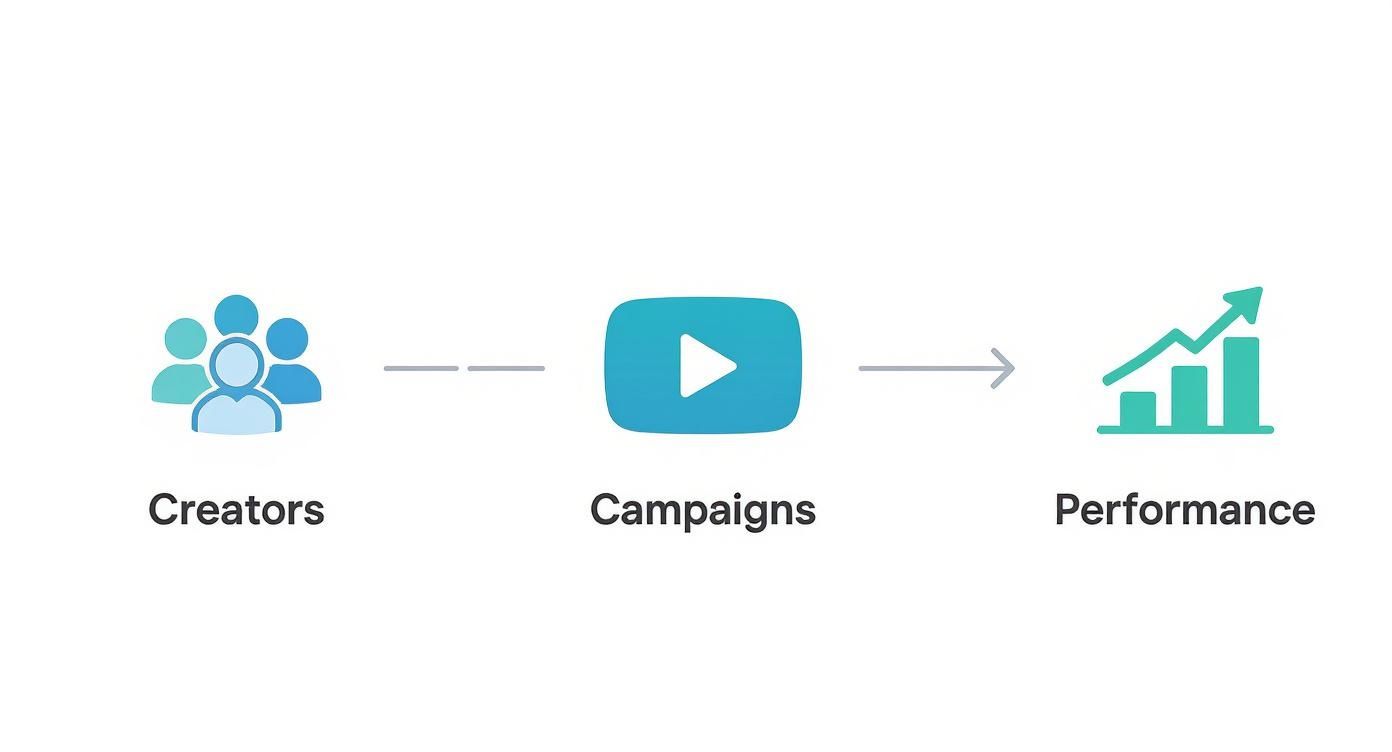
This simple flow—Creators to Campaigns to Performance—is the core loop. Each stage feeds the next, creating a cycle of strategy, action, and refinement that keeps the engine running.
The Daily Grind
Daily tasks are all about being proactive and staying connected. This is where the account manager has their finger on the pulse of every live campaign, making sure things are running smoothly and catching small issues before they blow up. It’s a fast-paced, high-attention part of the job.
Here’s what’s on the daily to-do list:
- Performance Dashboard Checks: The first thing an account manager does is dive into the numbers. They're checking sales, GMV, and creator performance from the last 24 hours, looking for any weird spikes or dips that need investigating.
- Creator Communication: This is constant. They’re answering DMs from creators, giving feedback on draft videos, and double-checking that scheduled posts actually went live. Strong relationships are built here.
- Active Campaign Monitoring: It's not just about the data. They're also watching live TikToks to make sure they follow brand guidelines and, crucially, that all the links and discount codes actually work.
The Weekly Pulse
Once a week, the focus zooms out a bit. Weekly tasks are about reporting, getting people paid, and syncing up with the client. It's the time to summarize what happened, make sure creators are compensated accurately, and tweak the strategy based on what the data from the past 7 days is telling you.
An account manager's week is built on accountability. They have to translate the daily flood of data into clear, actionable insights for both their clients and their creator network, ensuring everyone is aligned and motivated for the week ahead.
Key weekly responsibilities include:
- Client Reporting and Check-ins: This involves putting together and sending out weekly performance reports that spell out the wins, the challenges, and what to do next. Usually, a quick call follows to talk through the results and plan for the upcoming week.
- Affiliate Payouts: Calculating and processing commissions for every creator and affiliate. Getting this right is non-negotiable for keeping partners happy and trust high.
- Content and Strategy Review: They'll analyze which videos popped off during the week, identify trends, and use those insights to shape the next round of creative briefs.
The Monthly and Quarterly Outlook
When you get to the monthly and quarterly tasks, it's all about strategy. This is where the account manager steps back from the day-to-day grind to look at the big picture. They analyze broader trends, plan major initiatives, and hold high-level business reviews with clients.
Monthly Tasks Focus On:
- Performance Trend Analysis: Looking for overarching patterns in sales, which types of creators are most effective, and overall campaign ROI.
- Creator Pipeline Review: Sizing up the current roster of affiliates, flagging top performers for potential retainer deals, and planning outreach to fresh talent.
- Strategic Planning: Setting the big goals and mapping out the campaign calendar for the next month.
Quarterly Tasks Involve:
- Quarterly Business Reviews (QBRs): These are in-depth presentations for clients. They review the past quarter's performance against the original goals and set ambitious new targets for the next one.
- Long-Term Growth Strategy: This is the fun stuff—brainstorming huge campaigns, mapping out new product launches, and finding creative ways to grow the brand's footprint on TikTok Shop.
Jumping between the tiny details and the 30,000-foot view requires a lot of mental energy. To avoid burnout, it's critical to understand how your own energy levels affect your work. Learning more about the connection between your energy levels and your capacity for effective decision-making can be a huge advantage for anyone in this demanding role.
The following table breaks down this rhythm, showing how these tasks fit together and how a platform like HiveHQ can help manage the load.
Account Manager Task Cadence for TikTok Shop
| Cadence | Key Duties | HiveHQ Tool for Automation/Streamlining |
|---|---|---|
| Daily | Check performance dashboards (sales, GMV). Monitor live campaigns. Communicate with creators about content & scheduling. | Profit Dashboard for real-time performance tracking. Creator Tracker for monitoring live content. |
| Weekly | Prepare and send client performance reports. Process affiliate/creator payouts. Review top-performing content. | Automated Reporting features to generate client-ready summaries. Affiliate Bot to manage and automate commission calculations. |
| Monthly | Analyze long-term performance trends. Review creator pipeline for new talent. Plan next month's campaign calendar and goals. | Profit Dashboard with historical data filters. Creator Tracker to identify and manage top-performing affiliates. |
| Quarterly | Conduct Quarterly Business Reviews (QBRs). Develop long-term growth strategies. Set high-level targets and budgets. | Custom report generation for QBR presentations. Use trend data from the Profit Dashboard to inform strategic planning. |
Having a clear cadence turns a potentially chaotic job into a well-oiled machine, ensuring nothing falls through the cracks and every action contributes to the client's long-term success.
The Skills That Separate Good from Great
Knowing the daily, weekly, and monthly tasks of an account manager is a great start. But the real magic—the thing that turns a good manager into a brand's most valuable partner—lies in the skills they bring to the table.
Think of it like being a top chef. You need the technical knife skills, but you also need a creative palate to bring it all together. For an account manager in the fast-paced world of TikTok Shop and DTC, it's the exact same story. You have to nail the technical side while also mastering the human element of the job. It's this blend that allows you to not just manage an account, but to truly drive its growth.
Mastering the Hard Skills
Let's start with the hard skills. These are the teachable, technical abilities that form the bedrock of the role. For anyone managing social commerce, this comes down to data, platforms, and processes. These are your tools.
Here are the non-negotiables:
- Data Analysis and Interpretation: You have to be comfortable swimming in analytics, tracking key metrics like GMV, ROAS, and creator conversion rates. But more than that, you need to pull a clear story out of the raw numbers—a story that tells you exactly what to do next.
- Platform Proficiency: This is about knowing TikTok Shop inside and out. You need to be a pro at navigating its affiliate center, tweaking campaign settings, and understanding its reporting dashboards. This also means getting a handle on third-party creator management tools that make your life easier.
- Financial Acumen: A great account manager gets the money side of things. That means accurately calculating commission payouts, keeping a close eye on budgets, and using tools like HiveHQ’s Profit Dashboard to ensure every single campaign is actually making money, not just noise.
A top-tier account manager doesn't just look at data—they speak its language. They see numbers not as abstract figures, but as direct feedback from the market, guiding them on where to double down and when to pivot.
These technical skills are always evolving. A huge trend right now is the rise of AI and automation. Routine work like sorting data or reconciling numbers in real-time is increasingly being handled by smart systems. This frees you up to focus on big-picture strategy, but it also means you have to be fluent with these new tools. The competition for this kind of tech-savvy talent is fierce, with unemployment for related roles like accountants hovering near 1.3%. You can discover more insights about these in-demand finance roles at Robert Half.
Cultivating Essential Soft Skills
If hard skills are the "what," then soft skills are the "how." These are the interpersonal skills that really define your success. They're what help you navigate tricky client relationships, get creators excited to work with you, and solve problems when the pressure is on.
Here's what truly makes a difference:
- Proactive and Persuasive Communication: This isn't just about sending updates. It’s about getting ahead of your client's needs, clearly explaining your vision, and building a foundation of trust. It covers everything from writing outreach messages that creators actually want to open, to confidently walking a client through a quarterly business review.
- Strategic Thinking: Anyone can get bogged down in daily tasks. A strategic thinker connects those tasks to the brand's long-term goals. They spot market trends before they're obvious and are always hunting for new ways to deliver value.
- Problem-Solving and Adaptability: Let’s be real: things go wrong in social commerce. A campaign flops. A star creator pulls out. The TikTok algorithm changes overnight. A great account manager doesn't panic. They stay calm, think on their feet, and find a creative way to keep the train on the tracks.
At the end of the day, these communication skills are all about connection and influence. Even the little things, like non-verbal cues on a video call, can make a huge impact when you're building rapport with clients or negotiating with creators. Understanding how your body language can affect your mood and project confidence is a subtle but seriously powerful tool.
When you bring these hard and soft skills together, you get a well-rounded pro who can handle anything modern account management throws at them.
What the Role Looks Like in the Real World

It’s one thing to talk about duties and skills in theory, but it’s another to see how they actually show up in a real job listing. To make this concrete, let's break down two different TikTok Shop account manager roles: one junior and one senior.
Seeing them side-by-side gives you a clear roadmap of what career growth looks like. You can see how the job shifts from executing daily tasks to owning high-level strategy. This helps both aspiring managers and hiring teams understand what it takes to succeed at each stage.
Junior Account Manager: The Ground Floor
A junior role is all about execution and support. You’re there to learn the ropes, build solid relationships, and make sure the day-to-day work of creator campaigns runs like a well-oiled machine. The duties are hands-on and form the foundation of your career.
What You'll Be Doing:
- Helping find and onboard new creators and affiliates.
- Organizing product seeding and making sure partners get their samples.
- Keeping an eye on active campaigns every day to ensure content gets posted on time.
- Pulling the weekly performance numbers and helping put together reports for clients.
Think of this as your training ground. It’s where you master the core skills you'll need for the rest of your career in account management.
Senior Account Manager: The Strategist
A senior role, on the other hand, is defined by strategy, ownership, and making a real, measurable impact on the business. You’re not just executing anymore—you’re expected to lead, innovate, and drive serious revenue growth for your clients. You become a strategic partner, not just a campaign coordinator.
How the Role Evolves:
- You'll develop and own the entire creator and affiliate strategy for your key accounts.
- You'll be negotiating bigger, long-term partnerships and retainers with top-tier creators.
- You'll lead all client communication, running Quarterly Business Reviews (QBRs) and setting ambitious growth targets.
- You'll dig into complex performance data to forecast revenue and find ways to make your clients more profitable, using tools like the Profit Dashboard in HiveHQ to get the insights you need.
The leap from junior to senior is really a shift from doing the work to directing the work. You stop managing tasks and start managing outcomes, and your success is measured by the client's bottom line.
How Pay Changes with Responsibility
It’s no surprise that this jump in responsibility comes with a different kind of pay package. Junior roles usually have a solid base salary with some smaller performance bonuses. Senior roles, however, often have more complex compensation designed to heavily reward high performance.
This typically means a higher base salary, a more aggressive commission tied to Gross Merchandise Value (GMV), and annual bonuses based on client retention and growth. As you prove you can deliver tangible results, your earning potential grows right alongside it.
The numbers back this up. As of late 2025, the average salary for a Global Account Manager in the United States is around $79,499 a year. While top earners can break $120,000, the pay band for many is relatively tight. This tells us that to really boost your salary, you need to climb into those senior, strategic roles. Mastering advanced account manager duties is the key to unlocking that higher earning potential. Discover more detailed salary insights for account managers on ZipRecruiter.com.
Looking at these real-world roles, you can see a clear path forward. A career in account management offers a structured way to grow, rewarding those who can make the leap from being skilled doers to becoming indispensable strategic leaders.
Common Questions About Account Manager Duties
Even with a solid grasp of the tasks and skills, you’ll always run into questions about how the job really works day-to-day. The world of social commerce moves at light speed, especially on a platform like TikTok, and it’s completely rewriting the old rules for account managers.
This section tackles those tough, practical questions that every account manager, new or experienced, eventually asks. We'll give you straight, actionable answers to help you handle the most critical parts of the job—from juggling tricky relationships to proving you’re an indispensable part of the team.
What Is the Biggest Challenge in Managing Creator Relationships?
Hands down, the single biggest challenge is maintaining authenticity at scale.
It’s one thing to build a genuine, personal connection with a handful of creators. But what happens when you’re managing dozens, or even hundreds, of affiliates? Suddenly, your program is at risk of feeling cold, transactional, and impersonal.
And that’s a huge problem, because authenticity is the only currency that matters on TikTok. Audiences can sniff out a forced, awkward brand deal from a mile away, and it’s an instant killer for engagement and sales. The second a creator feels like they’re just another name on a spreadsheet, the magic is gone. Their content loses its spark, and your brand’s message falls completely flat. The real challenge, then, is to build a system for managing relationships without killing the human touch.
So, how do you pull it off?
- Segment Your Creators: Stop treating everyone the same. Group your creators into different tiers based on their performance, engagement, or how long you've worked with them. Your top-tier partners deserve more one-on-one time and strategic calls, while you can use more streamlined, automated communication for newer folks.
- Automate Logistics, Not Relationships: Use technology to take the tedious, impersonal tasks off your plate. For example, a tool like HiveHQ's Affiliate Bot can handle the initial outreach, send reminders about sample deliveries, and follow up on content. This frees you up to spend your time on what actually builds relationships: giving creative feedback, celebrating their wins, and building real rapport.
- Create a Community: Build a space where your creators feel like they belong. This could be a private Discord or a group chat where they can swap tips, ask questions, and even team up. When creators feel like they’re part of a community, their loyalty and motivation go through the roof.
By letting automation handle the logistics, you save your most important resource—your time—for nurturing the genuine partnerships that actually drive results.
How Can an Account Manager Prove Their ROI?
In a job driven by performance, numbers talk. An account manager has to be able to clearly and consistently show the value—and the return on investment (ROI)—they’re bringing to the table. This is about more than just saying, "we had a good month." You need to use data to tell a convincing story.
Proving your worth boils down to tracking the right numbers and presenting them in a way that connects your work directly to the client's bottom line. The goal is to show that your management isn't just a cost; it's a profit center.
These are the key metrics that prove your value:
- Gross Merchandise Value (GMV): This is the clearest measure of sales your creator program is driving. Track it daily, weekly, and monthly, and make sure you’re highlighting growth over time.
- Return on Ad Spend (ROAS) and Commission Costs: Show exactly how much revenue comes in for every dollar spent on creator commissions or related ads. A high ROAS is solid proof of an efficient, well-oiled program.
- Creator Contribution Analysis: Break down the total GMV by individual creator. This shows you know who your stars are and that you’re smartly investing more in the partnerships that deliver the biggest bang for the buck.
Your job isn't just to report numbers; it's to provide insight. A great report doesn't just say what happened—it explains why it happened and what you're going to do next to build on that success.
To make your data hit home, you need a tool that gives you the full financial picture. Using HiveHQ's Profit Dashboard, you can present a crystal-clear report of your shop's performance, factoring in every cost from commissions to the cost of goods sold. This lets you walk into a meeting and confidently say, "My management of this program generated $X in net profit this quarter." That’s the most powerful statement of value you can make.
How Is AI Changing an Account Manager's Daily Tasks?
Artificial intelligence isn't here to replace account managers—it's here to give them an upgrade. AI is completely changing the day-to-day account manager duties by automating all the repetitive, low-impact tasks that used to eat up most of their time. This shift is turning managers from reactive coordinators into proactive strategists.
Instead of spending hours manually digging for creators or firing off endless follow-up emails, managers can now use AI-powered tools to do that work at a massive scale. For instance, an Affiliate Bot can send out thousands of personalized outreach messages, spot promising new creators based on performance data, and even automatically send out a content brief the moment a product sample is delivered.
This automation changes the daily workflow in a few key ways:
- From Manual Outreach to Strategic Curation: Instead of searching for a needle in a haystack, your job becomes curating a shortlist of top-tier creators that an AI has already found and warmed up for you.
- From Data Entry to Data Analysis: Forget spending hours plugging numbers into spreadsheets for weekly reports. Now, you can focus on analyzing the trends and insights that automated dashboards serve up, helping you make smarter decisions, faster.
- From Reactive Problem-Solving to Proactive Optimization: With AI handling reminders and tracking content, you can spend less time chasing down late posts and more time brainstorming exciting new campaign ideas with your best creators.
Ultimately, AI handles the "what" and "when," which frees you up to focus on the "why" and "how." It transforms the role into one that’s all about strategic thinking, creative direction, and high-level relationship management—the very skills that AI can't replicate.
Ready to upgrade your account management with powerful automation and real-time profit insights? HiveHQ provides the all-in-one suite to help you scale your TikTok Shop effortlessly. See how our Affiliate Bot, Profit Dashboard, and Creator Tracker can transform your workflow at https://hivehq.ai.