Mastering affiliate marketing home depot: A Practical Guide
Thinking about joining The Home Depot affiliate program? It’s a huge opportunity, giving you a chance to earn by promoting one of the most recognized brands in home improvement. But before you jump in, it’s crucial to get a real sense of how it works. Making money here isn't just about sending traffic—it's about smart, strategic promotion.
Let's break down the core components you need to understand to build a profitable strategy from the ground up.
Breaking Down the Commission Structure
The first thing to know is that Home Depot's commission rates are all over the place. They are not one-size-fits-all, and this is probably the most important detail that will shape your content strategy.
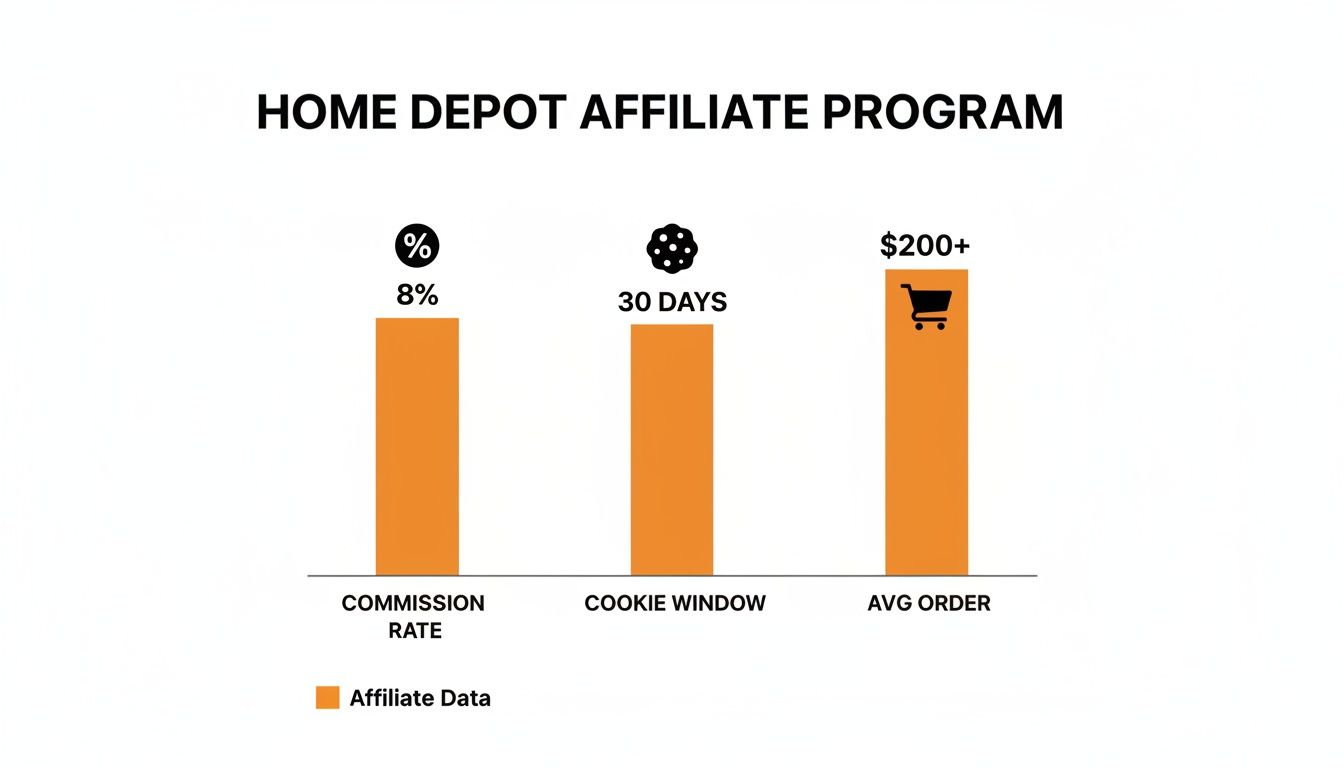
- Top Tier Commissions: Some categories, like home décor and specific online-only items, can net you up to 8%. These are often your best bet for maximizing earnings on smaller, more frequent purchases.
- The Middle Ground: A huge chunk of the product catalog, think tools and garden supplies, falls into a more standard, lower commission tier.
- The Low End: This is where it gets tricky. Big-ticket items like major appliances or high-end power tools often come with the lowest rates, sometimes as low as 1%. If you were dreaming of a massive payday from a single refrigerator sale, you need to adjust your expectations.
What does this mean in practice? A creator focused on a complete patio makeover—promoting furniture, planters, and outdoor lighting—will likely earn far more per sale than someone just reviewing a single high-ticket appliance. Your niche directly impacts your bottom line.
The 24-Hour Cookie Window Explained
Here’s the real challenge: the 24-hour cookie window.
When someone clicks your affiliate link, a small tracking file (a "cookie") is saved to their browser. For you to get credit for a sale, that person must complete their purchase within 24 hours of that click. If they wait longer, you get nothing.
This has massive implications, especially for big-ticket items. Someone might click your link while researching a $2,000 riding mower, but if they take a couple of days to think it over or talk to their spouse before buying, that commission is gone.
My Takeaway: Your content needs to target buyers who are ready to pull the trigger. The goal isn't to be the first resource they find during their research; it's to be the last click they make right before heading to checkout.
Low Rates vs. High Order Value: The Balancing Act
So, if some commissions are tiny and the cookie window is tight, how does anyone actually make money? The secret is Home Depot’s massive average order value (AOV).
Shoppers rarely go to Home Depot for just one thing. They're usually gearing up for a whole project—they need paint, but also brushes, painter's tape, drop cloths, and maybe a new ladder. That basket size adds up fast.
To give you a clearer picture, I've put together a table that breaks down the essential details of the program.
Home Depot Affiliate Program at a Glance
This table summarizes the key financial and structural details to help you quickly assess if the program is a good fit for you.
| Metric | Details | What This Means for You |
|---|---|---|
| Commission Rate | Varies from 1% to 8% by product category | You need a niche strategy. Focus on higher-commission categories like home décor to maximize earnings. |
| Cookie Duration | 24 hours | Your content must create urgency and target buyers at the end of their decision-making process. |
| Average Order Value | Often over $200-$300 | Even with low commission rates on some items, large basket sizes can lead to solid earnings on a single transaction. |
| Payment Threshold | Varies by network (e.g., $50 on Impact) | You'll need to hit this minimum commission amount before you can cash out your earnings. |
While the average commission percentage hovers around 2.14%, the brand’s impressive average basket size (often over $300) is what makes the math work. A small percentage of a large cart is still a respectable payout.
For a deeper dive into the numbers and what other affiliates are saying, the team at geniuslink.com put together a great analysis.
Ultimately, success with The Home Depot hinges on understanding this balance. You're playing a game of volume and high AOV to counteract the short cookie window and variable rates.
How to Get Approved for the Program
Getting into the Home Depot affiliate program isn't as simple as just signing up. It’s more like an audition. Since the program is managed through the Impact network, a real person will be reviewing your application to see if you’re a good fit for their brand. This is your one shot to make a great first impression.
The single biggest factor they look at? Your existing online presence.
Build a Strong Foundation First
Before you even head over to the application page, take a hard look at what you’ve already built. Whether you run a blog, a YouTube channel, or have a killer social media following, you need an established platform. A brand-new website with just a handful of posts is an almost certain "no."
The review team is looking for a solid history of high-quality content that makes sense for Home Depot. Your niche should feel like a natural fit—think home improvement, DIY projects, gardening, or home décor.
- Your Content: Is it original, genuinely helpful, and well-produced? They'll pass on sites that just spin product descriptions or have thin, uninspired articles.
- Your Audience: Are people actually engaging with what you create? Likes, comments, and shares are proof that you have influence, which is exactly what a brand like Home Depot wants to see.
- Your Website's Look & Feel: A clean, professional-looking site that's easy to get around is crucial. Broken links and a clutter of ads everywhere send the wrong message.
The most common mistake I see is people applying way too soon. Spend a few months building out your content library and growing your audience first. This shows the review team you're serious and gives them something substantial to actually evaluate.
Nailing Your Application Details
When it's time to fill out the form on Impact, be specific and professional. Pay close attention to the section that asks about your promotional methods—this is where you can really shine. "I'll use my blog" isn't going to cut it.
Give them a clear, detailed plan. For instance, you could say you'll create in-depth DIY tutorials with project-specific shopping lists, write comparison reviews of different cordless tool brands, and produce TikTok videos showing off seasonal décor hauls. That level of detail proves you’ve actually thought this through and have a real strategy.
Common Reasons for Rejection to Avoid
Knowing why others get turned down is your best defense against it happening to you. The review team has a sharp eye for red flags, so make sure you don't raise any.
| Rejection Reason | How to Avoid It |
|---|---|
| Irrelevant Niche | Make sure your content is obviously connected to home, garden, or DIY. A travel or fashion blog just isn't a logical fit. |
| Low-Quality Website | Your site is your resume. Proofread everything, fix any broken links, and make sure it has a clean, mobile-friendly design. |
| Not Enough Content | Don't even think about applying until you have at least 15-20 high-quality, relevant posts or videos published. |
| Policy Violations | If your site is full of coupon-scraping pages or uses shady SEO tactics, you're out. They want transparent, fully compliant partners. |
If you can get ahead of these common pitfalls, your chances of getting accepted go way up. You want to position yourself as a strategic partner who can actually drive sales, not just another affiliate looking for a quick commission.
Smart Promotional Strategies That Actually Work

Getting approved is the first hurdle. Now comes the real work. Just dropping links all over the internet isn't going to cut it; earning consistent commissions requires a much savvier approach.
To succeed with a brand like Home Depot, you have to meet your audience right where they are. That might be on their phone looking for quick project inspiration or on their laptop deep in research mode for a major renovation.
So, let's skip the generic advice. Here are the specific strategies that actually resonate with the DIY and home improvement crowd and turn their project dreams into your affiliate income.
Capitalize on Short-Form Video
The quick-hitting, visual format of TikTok and Instagram Reels is a natural fit for the home improvement world. People are scrolling, actively looking for project ideas, tool demos, and clever hacks. This is your prime opportunity to show, not just tell.
A perfect example is a 30-second time-lapse of a simple weekend project, like building a raised garden bed. You can overlay text pointing out the key tools and materials—a specific Ryobi drill, a certain brand of wood stain. Then, your link-in-bio can funnel followers to a dedicated page with all those products neatly listed with your affiliate links.
Another angle that works incredibly well is the "tool comparison" video. Pit two popular cordless drills against each other in a quick, head-to-head test. Show which one handles a specific task better. This kind of authentic, hands-on content builds serious trust with your audience.
Build an SEO Content Engine for Long-Term Growth
While social media delivers those great, immediate traffic spikes, an SEO-focused blog is your key to building a sustainable, passive income stream. This is how you catch people with high purchase intent, right when they're searching on Google.
You need to think bigger than just a basic product review. Instead of only reviewing a single DeWalt miter saw, write a comprehensive guide like "The Best Miter Saws for Beginner Woodworkers." In that post, you can compare three different models from Home Depot, breaking down the pros and cons for someone just starting out. This instantly positions you as a helpful expert, not just a salesperson.
Here are a few high-converting content ideas to get you started:
- Detailed Project Guides: A step-by-step tutorial on "How to Install Vinyl Plank Flooring" can naturally embed dozens of affiliate links for everything from the flooring itself to the underlayment and installation tools.
- "Best Of" Listicles: Articles like "Best Cordless Leaf Blowers Under $200" or "Top 5 Smart Thermostats for Energy Savings" are magnets for buyers who have already decided they need something and are just narrowing down their options.
- Seasonal Content: Get ahead of the calendar with timely guides like "How to Winterize Your Lawn" in the fall or "Best Patio Furniture for Small Balconies" in the spring.
Remember, the key to successful SEO in affiliate marketing home depot is targeting long-tail keywords. Forget "drills." Focus on a super-specific query like "best budget cordless drill for drywall." That searcher is much, much closer to making a purchase.
Leverage Paid Ads on Visual Platforms
Paid ads can be a fantastic way to accelerate your growth, but you have to play by the rules. The Home Depot affiliate program strictly forbids bidding on their branded keywords. That means you absolutely cannot run a Google Ad targeting terms like "Home Depot deals." Try it, and you'll get kicked out of the program fast.
But here’s the smart workaround: platforms like Pinterest are a goldmine. Pinterest acts more like a visual search engine where users are actively planning projects and building wishlists. It's the perfect environment.
The strategy here is to run ads promoting your own content, not Home Depot’s site directly. For example, you could create a beautiful Pin featuring a "Modern Farmhouse Kitchen Mood Board." Your ad would drive traffic back to your blog post, which then breaks down the entire look and includes affiliate links to the specific faucets, light fixtures, and backsplash tiles from Home Depot.
This method keeps you 100% compliant while still targeting users with massive commercial intent. You’re simply paying to get more eyes on your valuable content, and the affiliate commissions follow. It's a clever, indirect approach that respects the program's rules while scaling your reach.
Creating Content That Converts Clicks into Commissions

Getting traffic to The Home Depot is half the battle. The real magic—and the money—is in turning those clicks into actual sales. A winning content strategy doesn't just display products; it solves problems and inspires projects, making a purchase feel like the most natural next step for your audience. It’s about moving beyond generic product pages and becoming a go-to resource.
Authenticity is everything. Your audience can smell a repurposed product description from a mile away. They want to see you actually use the products. Show them the unboxing, get some sawdust on that new circular saw, and reveal the real-world results of that gallon of paint. This hands-on, genuine approach builds a level of trust that a simple affiliate link could never accomplish on its own.
The Anatomy of a High-Converting Review
A top-tier product review isn't just a list of features; it's a story. It answers the questions your potential buyer is already asking in their head. The key is to frame your reviews around their real-world problems and show the product as the solution.
- Show, Don’t Just Tell: Instead of saying a drill has a lot of torque, show a video of it effortlessly sinking a 3-inch screw into a pressure-treated 4x4. Visual proof is king.
- Define the Ideal User: Be specific. Is this pressure washer a beast built for stripping old paint, or is it the perfect tool for a homeowner who just wants to clean their patio furniture? Helping people see themselves in the product builds buying confidence.
- Embrace the Flaws: Nothing is perfect. Pointing out a minor drawback, like a short power cord or a heavy battery, actually makes your review more credible. It proves you're giving an honest assessment, not a sales pitch.
When you do this, you’re no longer just an affiliate. You become a trusted advisor, which is exactly what people are looking for when they’re about to spend their hard-earned money.
Building Project-Based Content with Shopping Lists
One of the most powerful tactics for affiliate marketing home depot is to create step-by-step DIY tutorials. This approach is brilliant because it lets you naturally bundle multiple affiliate links into one cohesive piece of content, which can seriously boost your commission from a single visitor.
Think about it. If you create a guide on "How to Build a Backyard Fire Pit," you won't just link to a single type of paver. Your tutorial and shopping list would naturally include everything needed for the job:
- The specific paver stones you used.
- The construction adhesive that holds up to the elements.
- The shovel and level needed for proper site prep.
- The metal fire pit ring that sits in the center.
At the end of your tutorial, provide a clean, simple "Project Shopping List" with direct links to each item at Home Depot. You've not only inspired them but also eliminated all the guesswork. You’re selling the successful completion of a project, not just the individual parts.
Tapping into the Untapped Pro and B2B Market
While the DIY homeowner is the obvious target, there's a huge, often-overlooked audience: professional contractors and B2B customers. These buyers operate on a different level. They buy in bulk, prioritize extreme durability, and need to constantly restock their tools and supplies. If you can create content that speaks their language, you can unlock a seriously lucrative niche.
This isn't about reviewing a new hammer for a homeowner. It's about creating content that helps a pro make a business decision. Think articles like "Jobsite Table Saw Shootout: Which Brand Holds Up?" or "The Best Bulk Pricing on Drywall Screws." This targets a high-value customer with massive purchasing power.
The sheer scale of Home Depot is your biggest advantage here. The company's full-year net sales hover around $159.5 billion, and their online catalog features over 500,000 products. This includes an incredible array of contractor-grade equipment that most DIY-focused affiliates completely ignore. For more on this, check out the reporting on Home Depot's massive B2B sales growth on digitalcommerce360.com.
By building your strategy around these three pillars—authentic reviews, project-based tutorials, and pro-level content—you're set up for success. If you're looking for more ideas, see how you can generate compelling affiliate content with AI tools. This framework ensures you’re building a valuable resource that drives real results and sustainable commissions.
Tracking and Optimizing Your Affiliate Performance
If you want to generate serious, sustainable income, you have to treat your affiliate marketing efforts like a real business. That means moving beyond just posting links and really digging into the data to see what's actually working. Your Impact Radius dashboard is your command center for this. It’s packed with reports that tell you exactly what’s hitting the mark and what’s falling flat.
Success in affiliate marketing home depot isn’t about guesswork; it’s about making data-driven decisions. By regularly checking your performance, you can stop wasting time on strategies that don’t convert and double down on the ones that do.
Mastering Your Impact Radius Dashboard
Your first stop should always be the performance reports inside Impact. This is where you can break down your traffic, clicks, and sales to find your most valuable content. Don't just glance at the total commission number; the real opportunities are hidden in the details.
Start by figuring out which pieces of content are your top performers. Is it a specific blog post, a YouTube video, or a particular series of TikToks? Look for what's driving the most clicks and, more importantly, the most sales. That data is pure gold. For example, if your in-depth review of a Milwaukee tool set is crushing it, that’s a huge signal from your audience to create more content around that brand or that specific category of tools.
Go a step further and see which products are earning you the most. You might be surprised to find that a lower-priced, high-volume item like a specific brand of painter's tape is a steady, consistent earner. This insight helps you build future content that subtly features these proven sellers.
Key Metrics That Actually Matter
To optimize your work, you need to know which numbers really define success. Moving past simple click counts is how you start gauging the true profitability of your efforts.
Here are the essential metrics to keep a close eye on:
- Conversion Rate (CR): This is the percentage of clicks that actually turn into a sale. A low CR might mean there's a disconnect between your content and the product page, or maybe your traffic isn't quite ready to buy.
- Earnings Per Click (EPC): This metric shows your average earnings for every single click you send to Home Depot. It’s an incredibly powerful way to measure the financial performance of different articles, videos, or traffic sources.
- Average Order Value (AOV): While you can't control what people buy, you can see which of your links lead to bigger shopping carts. Promoting entire projects (e.g., "Everything You Need for a Deck Refresh") instead of single items often drives a much higher AOV.
By focusing on improving your EPC, you shift your mindset from just driving traffic to driving profitable traffic. It’s a small change in focus with a massive impact on your bottom line.
The Realistic Math of Scaling Your Income
The big question is always how to scale your efforts to hit significant income goals. Let’s do some real-world math. Hitting a target like $10,000 a month is ambitious, but it's absolutely possible if you understand the numbers behind it.
Looking at public discussions from other creators, the arithmetic becomes clear. Assuming an average commission payout somewhere around $3–$6 per order, an affiliate aiming for $10,000 a month would need to generate between 1,667 and 3,333 sales. Every single month. Creators have estimated that to get thousands of orders, you often need to drive hundreds of thousands of targeted visitors, especially with Home Depot’s tight 24-hour cookie window. You can dive deeper into these creator insights and the numbers behind scaling affiliate income on YouTube.
This isn't meant to discourage you—it’s about giving you a realistic roadmap. Hitting those numbers requires a relentless focus on optimization. You have to constantly test new headlines, tweak your calls-to-action, and experiment with different content formats to see what moves the needle on your conversion rate.
Ultimately, scaling successfully means treating your affiliate work as a system of continuous improvement. Analyze the data, find your winners, and figure out how to replicate that success. That's how you go from earning a few bucks to building a substantial income stream.
Common Questions About Home Depot Affiliate Marketing
When you're getting started with a program as big as Home Depot's, a lot of questions come up. It's totally normal. To help you get your footing and start earning faster, I've rounded up some of the most common questions I hear from affiliates.
Getting these details sorted out from the beginning is the key to building a solid, profitable partnership. Let’s dive into what you really need to know.
Why Do Applications Get Rejected?
It's a huge bummer to get that rejection email, but it's almost always for a few specific—and preventable—reasons. The review team is looking for established partners who can send them quality traffic, and they have a sharp eye for red flags.
The biggest deal-breaker is a new or low-traffic website. Home Depot wants to see that you’ve already built an audience that trusts you. If your site only has a handful of posts and gets minimal traffic, it sends a clear signal that you’re not quite ready to drive sales for them.
Another common pitfall is a content mismatch. If your blog is all about cryptocurrency or fashion, trying to pivot to power tools just won't fly. The link between what your audience cares about and what Home Depot sells needs to be crystal clear.
Finally, you have to get the basics right. Your site needs to look and feel professional.
- Poor Site Quality: A clunky design, broken links, or an amateurish look just won’t cut it. It tells them you can't represent their brand well.
- Thin or Scraped Content: Your articles have to be original and genuinely helpful. Simply rewriting product descriptions from their site is a surefire way to get denied.
- Policy Violations: Aggressive pop-ups, shady marketing tactics, or other ethical no-nos will get your application tossed immediately.
My Advice: Before you even think about hitting that apply button, build out your site. Aim for at least 15-20 high-quality, relevant articles that show you know your stuff. Prove you’re a valuable partner first.
Can I Use Paid Ads to Promote Links?
Yes, but you have to walk a very fine line here. The Home Depot affiliate program has incredibly strict rules about paid advertising because they don't want you bidding against their own marketing team. Mess this up, and you'll get kicked out of the program—no questions asked.
The absolute golden rule is this: you cannot bid on their branded keywords. This includes "Home Depot," "Home Depot coupon," any variations, or even common misspellings. This is non-negotiable and a standard policy for most major retail affiliate programs.
But that doesn't mean paid ads are off-limits. The smart way to approach it is by targeting non-branded, long-tail keywords. Think about what a potential buyer would search for. For instance, you could run ads for terms like "best cordless drill for concrete" or "waterproof vinyl plank flooring reviews."
Here’s the critical part: you must send that traffic to your own website—a blog post, a review, or a comparison guide—not directly to HomeDepot.com. Your content acts as the bridge. From your page, a user can then click your affiliate link to head over and buy. Always, always double-check the latest terms of service on paid search before you spend a dime.
How the Cookie Window Affects Big-Ticket Items
This is where things get tricky. The Home Depot affiliate program has a 24-hour cookie window, which can be a real challenge when you’re promoting expensive products. You only get credit for the sale if your referral buys within 24 hours of clicking your link.
Think about it. Someone might click your link to research a $2,500 refrigerator, but they aren't likely to buy it on the spot. They need time to measure their kitchen, compare models, and talk it over with their spouse. If they come back to the Home Depot site three days later to make the purchase, you get absolutely nothing for that sale. Your cookie has expired.
This short window means you have to be strategic. It heavily favors content that targets buyers who are at the very end of their decision-making process. Your goal is to be the final touchpoint that pushes them to buy now.
This is why content centered around "deal of the day" promotions, urgent holiday sales, or even lower-priced impulse buys tends to convert so much better. You have to create urgency and be the last click before the purchase.
Ready to scale your creator partnerships and automate your outreach? HiveHQ provides the tools you need to discover, recruit, and measure the ROI of your affiliate program. Stop guessing and start growing with our all-in-one suite. Find out more at the HiveHQ website.