A Guide to B2B Affiliate Marketing That Drives Real Growth
At its core, B2B affiliate marketing is a performance-based partnership. It's about rewarding industry experts, consultants, and content creators for sending you qualified leads and actual sales. Think of it as a supercharged referral engine, but instead of relying on casual word-of-mouth, it's driven by the trusted voices your target audience already listens to.
Redefining B2B Growth with Performance Partnerships

Let's get past the textbook definition. B2B affiliate marketing isn’t about just slapping banner ads on a few websites. It's about building strategic alliances with partners—think industry bloggers, software reviewers, or integration specialists—who promote your products or services to their own established, niche audiences.
In a world where every marketing dollar is under a microscope, this model is a game-changer because you only pay for real results, not just impressions or clicks. It's a fundamental shift from paying for eyeballs to paying for outcomes.
The Core Mechanics of B2B Affiliate Marketing
The process itself is surprisingly straightforward. Your business gives partners unique, trackable links. When a potential customer clicks that link and completes a valuable action—like signing up for a demo, starting a free trial, or making a purchase—the partner earns a commission. It’s a true win-win: partners get paid for their influence, and your business gets high-intent customers in a cost-effective way.
This performance-based model brings some serious advantages to the table for B2B companies:
- Cost-Effective Acquisition: You only pay a commission after a sale or lead comes through. This drives down customer acquisition costs and seriously improves your marketing ROI.
- Access to Niche Audiences: Good partners give you a direct line to highly targeted and engaged audiences that would be incredibly difficult or expensive to reach with traditional ads.
- Enhanced Brand Trust: A recommendation from a respected industry figure is powerful social proof. It builds credibility and trust for your brand much faster than any ad campaign ever could.
B2B affiliate marketing transforms your growth strategy from a monologue into a conversation. Instead of just talking about your brand, you empower trusted industry voices to advocate for you, creating authentic connections with your ideal customers.
Why It Matters Now More Than Ever
For years, affiliate marketing was dominated by B2C industries like fashion and gadgets. But that's changed. It’s now a core strategy for B2B companies in software, finance, and consulting, all driven by the need for more efficient and measurable ways to grow.
The global affiliate market is projected to hit USD 71.74 billion by 2034, and the B2B space is a huge part of that growth. With over 80% of brands now using affiliates for sales and awareness, the trend is clear. You can dig into more affiliate marketing statistics to see just how fast this channel is expanding.
This growth highlights a simple truth: if your competitors are building powerful affiliate programs and you’re sitting on the sidelines, you're going to lose visibility and market share. Thankfully, platforms like HiveHQ make the entire process easier, offering automation for finding partners and clear dashboards to track performance. This makes it more manageable than ever to launch and scale a profitable B2B affiliate marketing program.
How B2B and B2C Affiliate Marketing Differ
Trying to run a B2B affiliate program with a B2C playbook is one of the most common—and costly—mistakes you can make. While they both run on the same core idea of performance-based partnerships, the way they work in the real world couldn't be more different. Think of it like this: buying a candy bar at the checkout is an impulse, but buying a new family minivan involves weeks of research, test drives, and family discussions.
That's the fundamental difference. The tactics that work for a quick consumer sale, like a flash discount from a popular influencer, just don't translate to the B2B space. A company isn't going to sign a $10,000 software contract because of a 24-hour deal. B2B affiliate marketing is a different game altogether—one built on trust, deep expertise, and demonstrating long-term value.
To really get a handle on how these two worlds diverge, it helps to look at them side-by-side.
Key Differences Between B2B and B2C Affiliate Marketing
| Attribute | B2B Affiliate Marketing | B2C Affiliate Marketing |
|---|---|---|
| Sales Cycle | Long, complex (weeks to months) | Short, simple (minutes to days) |
| Purchase Driver | Trust, expertise, ROI, problem-solving | Emotion, impulse, discounts, trends |
| Audience | Niche, professional, multiple decision-makers | Broad, mass-market, individual consumers |
| Partner Profile | Industry experts, consultants, content creators | Influencers, coupon sites, mass-appeal bloggers |
| Commission Model | High-value, recurring, or lead-based | Low-value, one-time, percentage of sale |
| Key Goal | Generating qualified leads and trusted referrals | Driving high-volume, immediate sales |
| Attribution | Multi-touch, long cookie life | Last-click, short cookie life |
As you can see, almost every strategic element is a mirror image of the other. Let's break down exactly what that means in practice.
Sales Cycle and Customer Journey
The single biggest gap between B2B and B2C is the sales cycle. B2C affiliate marketing is all about speed and volume. Someone sees a product on a blog, clicks a link, and buys it within a few minutes. The whole thing is usually trackable with a simple last-click attribution model because the path to purchase is so direct.
On the other hand, the B2B sales cycle can stretch on for months. It often involves a whole committee of people—from the person doing the initial research to the department head and the CFO who has to sign off on the budget. An affiliate referral might be the very first touchpoint, but the journey from there involves demos, team evaluations, security reviews, and contract negotiations. This demands more sophisticated tracking with longer cookie windows to properly credit the partner who started the conversation.
A B2C affiliate sells a product. A B2B affiliate sells a solution. Their role isn't just to promote, but to act as a trusted advisor who helps a business make a complex, high-stakes decision over time.
Commission Structures and Payouts
It's no surprise that the commission models reflect these different realities. B2C programs typically offer smaller, one-time commissions on single products. An affiliate might make a few bucks on a t-shirt or a kitchen gadget, so they have to push a ton of volume to make real money.
B2B affiliate marketing is a high-value, low-volume game. Because B2B products are often recurring subscriptions with a high lifetime value (LTV), the commissions can be massive. It’s pretty standard for B2B programs to offer things like:
- Hefty one-time payouts for each new customer, sometimes running into the hundreds or even thousands of dollars.
- Recurring commissions, where the partner gets a cut of the subscription fee for as long as that customer sticks around.
- Lead-based commissions that reward partners for bringing in qualified leads (like MQLs or SQLs), even before they become a paying customer.
The Ideal Affiliate Partner Profile
The person you want as a B2B partner looks nothing like a typical B2C influencer. While B2C success often hinges on influencers with massive, broad followings, B2B partners are valuable because of their niche authority and credibility within a very specific industry.
Instead of hunting for lifestyle bloggers or TikTok stars, your best B2B affiliates are almost always:
- Industry consultants who already recommend tools and solutions to their clients.
- Specialized content creators who run highly-respected blogs, podcasts, or YouTube channels for a professional audience.
- Integration partners whose products or services work alongside yours.
- Professional associations or training companies that are central to your target industry.
These partners aren’t just blasting out links. They are educating their audience, building trust, and validating your solution’s worth. A single, thoughtful recommendation from a respected expert is worth more than a hundred scattered links from generalists. That's the foundation you need to build your program on for it to succeed.
Building Your B2B Affiliate Program Framework
Alright, let's move from theory to action. Building a B2B affiliate program that actually works means creating a solid framework first. This isn't just about finding people to promote you; it's about building a whole ecosystem where the rules are clear, the rewards are compelling, and the entire structure is designed for long-term growth.
If you skip this step, even the most aggressive recruitment efforts will eventually fall flat.
Choosing the Right Commission Model
The first big decision is how you're going to pay your partners. Your commission structure is the clearest signal you can send about what you value, and it directly ties your partners' incentives to your own business goals. B2C is often a simple percentage of a sale, but B2B gives you a lot more flexibility to reward different kinds of valuable actions.
The right model really depends on your sales cycle, how you price your product, and what you’re trying to achieve.
Here are the most common structures you'll see in B2B:
- Cost Per Lead (CPL): With this model, you pay a set fee for every qualified lead a partner sends your way—think demo requests or trial signups. This is a fantastic fit for businesses with longer sales cycles because it rewards partners for starting important conversations, even if the deal takes months to close.
- Cost Per Acquisition (CPA): This is a clean, simple, one-time flat fee you pay when a referral becomes a paying customer. It works beautifully for products with a straightforward entry price. Just make sure the payout is beefy enough to get partners excited.
- Revenue Share: This is where things get interesting. Partners earn a percentage of the revenue from the customers they bring in. It could be a one-time cut of the initial contract, but the real power lies in offering a recurring percentage of a subscription. A recurring commission is the holy grail for top-tier partners because it creates a passive income stream for them.
The most sophisticated B2B affiliate programs often blend these models. For instance, you could offer a modest CPL for a qualified demo request and then a much larger, recurring revenue share if that lead converts. This rewards partners at multiple points in the funnel.
For most B2B companies, especially in SaaS, a recurring revenue share model is the gold standard. It gives partners a massive incentive to refer high-quality customers who will stick around, perfectly aligning their success with yours. If you want to dive deeper into this, check out our guide on building an affiliate program for software to see these models in the wild.
Defining Your Terms of Service
Once your commission structure is locked in, the next critical piece is your Terms of Service (TOS). Think of this as the official rulebook for your program. It protects your brand, protects your partners, and sets crystal-clear expectations from day one. A vague TOS is just asking for disputes down the road.
Your terms should be explicit and cover these key areas:
- What is a "Qualified" Referral? You need to be surgically precise here. What counts as a valid lead or sale? Does a free trial signup count? What happens if the customer uses a discount code from another source? Define the exact criteria a referral must meet to trigger a commission.
- Promotion Guidelines: Lay out the do's and don'ts. This is where you set rules about bidding on your brand name in paid search ads, prohibit spammy email tactics, and provide guidelines for how partners can use your logos and brand assets.
- Cookie Duration: This is the "cookie life"—the window of time after someone clicks a partner's link during which that partner gets credit for a sale. B2B decision-making takes time, so a longer window of 60-90 days is standard and shows you understand the customer journey.
- Reversal Conditions: Be upfront about the situations where a commission might be clawed back. This usually includes things like customer fraud, refunds issued within a certain period, or a partner breaking your rules.
Establishing Reliable Payout Schedules
Finally, let's talk about getting paid. Nothing builds trust faster than reliable, on-time payments. Your affiliates are running their own businesses, and they count on that income. A flaky payout process is the quickest way to lose good partners.
Set a clear and consistent payment schedule, whether that’s net-30, net-60, or whatever fits your accounting cycle. Be transparent about any minimum payout thresholds, too (for example, partners need to earn at least $100 before a payment is sent).
Using a dedicated affiliate management platform automates all of this, making sure commissions are tracked perfectly and paid out on schedule, every single time. That kind of operational excellence is what builds the trust you need to scale a truly successful B2B affiliate program.
How to Find and Recruit Ideal Affiliate Partners
Your B2B affiliate program is only as strong as the partners you bring on board. This isn't a numbers game where more is always better. Success hinges on finding a select group of partners who have genuine authority and influence with your exact customers. A handful of perfectly aligned affiliates will always, always outperform a hundred irrelevant ones.
The key is to stop thinking about mass outreach and start thinking like a strategic talent scout. You're not just looking for people with an audience; you're looking for respected voices who can authentically vouch for your solution. This takes a methodical approach to identifying, vetting, and recruiting partners who are a natural fit.
Identifying Key Partner Archetypes
In the B2B world, the most valuable affiliates often aren't the ones with the biggest follower counts. Instead, they’re professionals whose recommendations carry serious weight within a specific industry. Your recruitment efforts should zero in on a few key archetypes.
These ideal partners usually fall into a few distinct categories:
- Industry Content Creators: These are the bloggers, podcasters, and YouTubers who create deep, valuable content for your niche. They’ve already done the hard work of building the trust and audience you want to reach.
- Consultants and Coaches: Professionals who advise clients on business strategy or technology are prime affiliate material. Their recommendations are part of their core service, making your product a natural, value-add extension of their work.
- Integration Partners: Think of companies whose software or services complement yours. A joint marketing effort benefits both sides, and an affiliate relationship formalizes that "we work better together" story.
- Educators and Course Creators: Experts who teach skills related to your product's function can introduce your solution to a highly motivated and engaged audience that's actively looking to learn.
This framework shows what it takes to build a program that these high-value partners will actually want to join.
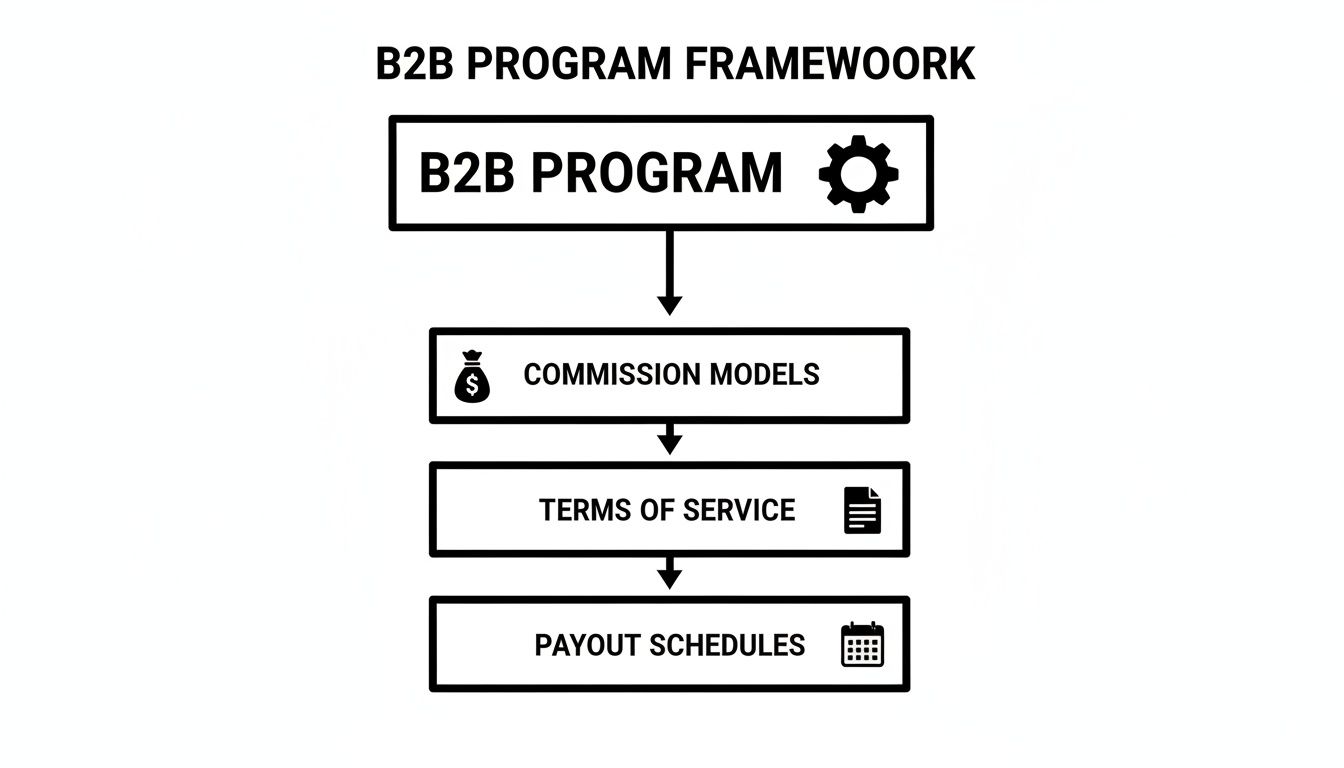
As you can see, a compelling commission model, clear terms, and reliable payouts are the foundation. Get those right, and you're already ahead of the game.
Vetting and Qualifying Potential Partners
Once you've identified some potential candidates, the real work begins: rigorous vetting. Just because someone looks good on paper doesn't mean they're the right partner. You need to dig deeper to ensure their brand aligns with yours and that their audience is a dead-on match for your ideal customer.
Before you even think about reaching out, assess each potential partner against a clear set of criteria.
- Audience Alignment: Do their followers actually match your target customer persona? Sift through the comments on their blog, check out their LinkedIn connections, or look at the questions asked on their webinars. This gives you a real feel for their audience's professional level and interests.
- Content Quality and Authority: Is their content well-researched, insightful, and professionally presented? High-quality content is a massive signal that a partner values their reputation and will represent your brand well. Steer clear of anyone relying on clickbait or low-effort posts.
- Engagement Levels: A massive following means very little without real engagement. Look for active discussions, shares, and meaningful comments. A micro-influencer with a super-engaged niche audience is often far more valuable than a major publisher with a passive readership.
The whole point of vetting is to find partners who do more than just drop a link. You want advocates—people who can educate, persuade, and build genuine trust with potential customers on your behalf.
Crafting an Effective Outreach Strategy
Generic, mass-emailed invitations are a fast track to the trash folder when recruiting top-tier B2B affiliates. Your outreach has to be personalized, professional, and completely value-driven. You aren't just offering a link; you're proposing a mutually beneficial business partnership.
Your approach has to be smart. North America is a major hub, expected to command 40-45% of global affiliate marketing revenue in 2025. This isn't surprising, given affiliate marketing already drives a staggering 16% of all U.S. ecommerce sales. It’s a proven channel for B2B lead generation in a market poised to blow past USD 17 billion this year. You can dig into more stats about the power of affiliate marketing to see just how big the opportunity is.
To break through all that noise, your outreach needs to stand out by focusing entirely on what's in it for them. Show you've done your homework. Reference a specific piece of their content and explain exactly why you believe your product would be a perfect fit for their audience.
This is where platforms like HiveHQ can be a game-changer. Using its Affiliate Bot, you can automate outreach at scale without sacrificing that critical personalization. It lets you connect with thousands of potential partners from a vetted pool, using advanced filters to find the exact creators and experts who align with your brand. This makes your recruitment efforts both incredibly efficient and far more effective.
The Technology That Powers Modern Affiliate Programs

Let's be blunt: trying to run a B2B affiliate program without the right tech is like trying to manage a global supply chain with a paper ledger. It’s not just inefficient; it's a recipe for failure. The sheer complexity of tracking long sales cycles, attributing conversions that involve multiple touchpoints, and managing dozens (or hundreds) of partner relationships demands a solid tech stack.
Modern affiliate management platforms are the central nervous system of your program. They handle all the tedious, error-prone tasks that would otherwise bury your team in spreadsheets, freeing you up to focus on what actually matters—strategy and building relationships.
Core Functions of Affiliate Management Platforms
At the very least, any serious affiliate platform needs to nail a few non-negotiable tasks. These are the pillars that make a performance-based partnership model actually work. Think of them as the engine, transmission, and dashboard of your program; without any one of them, you're not going anywhere.
A good platform automates the entire journey, from the first click to the final payout:
- Link Tracking and Attribution: This is the absolute bedrock. The software generates unique, trackable links for each partner, giving you a crystal-clear picture of who sent you a lead or sale. The best systems can handle the long cookie windows (60-90 days) common in B2B, making sure partners get credit even when a deal takes months to close.
- Commission Calculation: The platform automatically figures out what you owe based on your rules—whether it's a flat fee per qualified lead, a one-time payout per sale, or a complex recurring revenue share. This puts an end to manual errors and the disputes that come with them.
- Automated Partner Payments: Paying your partners accurately and on time is non-negotiable for building trust. These systems process payouts on a set schedule, handling different currencies and payment methods without your finance team having to lift a finger.
- Performance Dashboards: You and your partners both get access to clean, intuitive dashboards. You can keep an eye on the program's overall health, while partners can track their clicks, conversions, and earnings in real time. This kind of transparency is a huge motivator.
A dedicated affiliate platform turns what could be a high-maintenance channel into a scalable growth engine. It delivers the data transparency and operational efficiency you need to build trust with partners and prove ROI to your leadership.
Solving B2B-Specific Challenges with Technology
B2B affiliate marketing has its own unique hurdles that generic, B2C-focused platforms often trip over. The right technology is built to solve these specific problems, which in turn makes your program far more effective and attractive to top-tier partners. For instance, a key challenge is simply arming partners with the right promotional assets. You can find some great resources on using AI to generate high-converting affiliate copy to empower them with messaging that works.
The best platforms tackle these B2B headaches head-on:
- Handling Long Sales Cycles: By supporting extended cookie durations and multi-touch attribution, the tech ensures the partner who started the conversation gets the credit, even if the customer interacts with your blog, social media, and sales team before finally signing on.
- Managing Multiple Decision-Makers: A B2B purchase journey often involves a whole committee of stakeholders. Sophisticated tracking can connect these different touchpoints back to the original affiliate referral, giving you a much fuller picture of your partner's true influence.
- Streamlining Partner Onboarding: Good software makes it incredibly easy for new partners to sign up, grab their unique links, and access a full library of creative assets like banners, email templates, and detailed product guides. A smooth start is a good start.
Empowering Growth with Automation and Insight
Ultimately, the right technology does more than just manage your program—it helps you grow it. Platforms like HiveHQ, for example, bring powerful automation into the picture. Its Affiliate Bot can automate outreach to thousands of potential partners, using advanced filters to find the perfect fit for your brand and your audience.
This is how you scale recruitment without hiring an army of partner managers. At the same time, a centralized dashboard provides a single source of truth for both your team and your partners. It's this real-time visibility into performance data that builds the trust and confidence needed to create a successful, long-term B2B affiliate program.
How to Measure and Optimize Program Performance
There’s an old saying in business: what gets measured gets managed. Launching a B2B affiliate marketing program is really just step one. The real magic happens when you start running it with a data-first mindset, looking past surface-level stats like clicks to see the actual business impact your partners are making.
This means you need to get laser-focused on the key performance indicators (KPIs) that truly matter. These are the numbers that tie affiliate activity directly to your company’s revenue and tell you if your program is actually healthy.
Identifying Your Core Program KPIs
Every business is unique, but a solid B2B affiliate program should always keep an eye on a core set of metrics. Think of these KPIs as an unfiltered look into what’s working and what’s not, giving you the clarity to make smart adjustments.
Here are the key numbers to have on your dashboard:
- Lead-to-Customer Conversion Rate: This is the ultimate proof of lead quality. A high conversion rate means your partners are sending over genuinely interested prospects that your sales team can actually close.
- Customer Lifetime Value (LTV) from Affiliate Channels: Are the customers coming from your partners sticking around? Tracking LTV answers this critical question and shows if your partners are bringing in loyal, high-value clients.
- Average Revenue Per Account (ARPA): This metric gives you a snapshot of the initial deal size. A strong ARPA is a great sign that partners are driving significant business right out of the gate.
- Partner Engagement Levels: You need to know how active your partners actually are. Tracking the percentage of partners generating clicks or conversions each month tells you if your program is inspiring action or just collecting dust.
The goal here is to get away from vanity metrics. A single partner who brings in five high-LTV customers is worth infinitely more than a hundred partners driving thousands of clicks that go nowhere.
Turning Data into Actionable Optimization
Once this data starts rolling in, you can begin the real work: optimizing your program for better profit and stronger partner relationships. Your performance dashboard isn’t just a report card; it’s a roadmap telling you where to go next.
For instance, platforms like HiveHQ offer profit dashboards that pull these critical metrics into a clear, intuitive view. This kind of visibility lets you spot your top-performing partners in seconds and figure out what makes them so successful. With that insight, you can roll out targeted incentives—think tiered commissions or performance bonuses—to reward them and motivate even better results.
On the flip side, the data will also show you which partners are struggling. Don’t just cut them loose. This is your chance to step in and provide targeted support. Maybe they need some co-marketing materials, a one-on-one strategy call, or different creative assets that speak to their audience. This proactive help not only strengthens the relationship but can turn an underperformer into a star.
This cycle of measure, analyze, and act is what turns a stagnant affiliate program into a powerful growth engine. It’s a continuous process of refining your approach to make sure everyone—you and your partners—is winning.
B2B Affiliate Marketing FAQs
Getting into B2B affiliate marketing always stirs up a few practical questions. Let's tackle some of the most common ones so you can move forward with a clear game plan.
How Quickly Will I See Results?
This is where B2B and B2C really differ. While a B2C program can start generating sales almost overnight, B2B is a much longer game.
Because of the longer sales cycles involved, you're looking at 3-6 months to get a steady stream of good leads. It’ll likely take a few more months for those leads to actually become paying customers. The key here is patience; you're building high-value relationships that pay off over time, not chasing quick wins.
What’s a Good B2B Commission Rate?
There isn't a magic number, but B2B programs have to offer more substantial payouts to attract serious partners. The commission needs to be worth their time and influence.
Here are a few models that work well:
- Recurring Revenue Share: Giving partners 20-30% of the subscription fee for the life of the customer is incredibly attractive. It shows you're in it for the long haul together.
- One-Time Payouts: This is a flat fee for each new customer, which can be anywhere from $100 to over $1,000. It all depends on your product's price point and how much a customer is worth to you over time.
- Cost Per Lead (CPL): A smaller, fixed payment (think $25-$100) for every qualified lead who signs up for a demo or a trial. This is great for getting your foot in the door with new partners.
The best programs tie their commissions directly to customer LTV. A high recurring commission tells a partner you see them as a true partner in growth, not just a lead-gen machine.
What's the Startup Cost for a B2B Affiliate Program?
Your main expenses will be your affiliate management platform and the commissions themselves. Software fees can run anywhere from $50 to $500+ a month, depending on what you need.
It's also smart to set aside a budget for recruiting partners and creating high-quality marketing assets for them to use. If you want to dive deeper into the fundamentals, check out these excellent free affiliate marketing classes that walk you through setting everything up from scratch.
Ready to grow your affiliate program with smart automation and data you can actually use? HiveHQ brings together an Affiliate Bot, Creator Tracker, and Profit Dashboard to help you find the right partners, manage your relationships, and boost your ROI—without the guesswork. See how HiveHQ can change your growth strategy.