How to Create My Own Brand for TikTok Shop

Building a brand is so much more than just coming up with a cool logo. It really starts with a deep, almost obsessive, understanding of who you're serving and what makes you different. This means getting crystal clear on your target audience, nailing your unique selling proposition (USP), and making sure people actually want what you're selling before you spend a single dollar.
Building Your Brand’s Strategic Foundation
Before you even dream about product listings or viral TikToks, you've got to pour a solid foundation. A great idea is just that—an idea—until the market tells you it's a great idea. For a TikTok Shop brand, this is all about diving deep into the platform's unique world of communities, trends, and what makes people buy.
We're not talking about broad demographics like "women aged 18-34" anymore. We need to go deeper. What are they watching? Who do they follow? What problems are they genuinely trying to solve in their day-to-day lives?
A successful brand doesn't try to be everything to everyone. It becomes the only real choice for a very specific group of people. That clarity is your secret weapon in a seriously crowded marketplace.
Identify Your Niche Audience on TikTok
First things first: forget casting a wide net. Your goal is to find a dedicated, fired-up sub-community that already exists on TikTok. A great way to start is by just exploring hashtags, sounds, and creator accounts that are even remotely related to your product idea.
Let's imagine you want to launch a line of eco-friendly cleaning products. Instead of targeting anyone with a messy home, you could zero in on:
#CleanTok Fanatics: These are the people who get a real thrill from watching satisfying cleaning videos. They’re always on the hunt for the next viral product that will give them that perfect shine.
Eco-Conscious Millennials: This group actively seeks out sustainable swaps for their home and follows creators who champion a low-waste lifestyle. They care about ingredients and packaging.
Pet Owners: A massive community desperately looking for pet-safe, non-toxic cleaning solutions to tackle very specific messes like muddy paws and endless fur.
Each of these is a totally different world with its own language, values, and pain points. Your job is to pick one and become an expert on them. What are their biggest complaints about the products out there now? What kind of video makes them stop their endless scroll?
Craft a Unique Selling Proposition
Once you know who you’re talking to, you need to figure out what to say. Your Unique Selling Proposition (USP) is the one big reason someone should buy from you and not the ten other options they just saw on their For You Page. It’s the core promise you make to your niche.
A powerful USP isn't just about a feature; it's about a benefit that solves a real problem. It has to answer the customer's unspoken question: "What's in it for me?"
Pro Tip: Your USP has to be more than just "high-quality" or "great service." Those are table stakes. It needs to be a specific, compelling reason for your audience to choose you. For instance, instead of "high-quality skincare," a much stronger USP would be "the first vegan retinol serum specifically formulated for sensitive, acne-prone skin."
A great way to uncover your USP is to do some detective work on your competitors. Dig through their TikTok Shop reviews and the comments on their videos. What are people complaining about? Maybe their shipping takes forever, their packaging is wasteful, or their product just doesn't work for a certain skin type. These gaps are your golden opportunities. As you start laying this groundwork, it's also a great time to explore how to build a social media brand that stands out from the noise.
Validate Product-Market Fit
Finally, you need some proof that people will actually open their wallets for your solution. This is all about validating product-market fit. It's the moment your research and ideas either become a viable business or get sent back to the drawing board.
Here are a few simple, low-cost ways to test your concept before you order a mountain of inventory:
Run Polls on TikTok: Create some simple videos around the problem your product solves. Use the poll sticker to ask your target audience directly about their preferences, frustrations, and what they'd want in a perfect solution.
Analyze Search Data: Just use TikTok's search bar like a real user. Start typing in keywords related to your product. The autocomplete suggestions will show you exactly what people are actively looking for, revealing their biggest needs.
Launch a "Coming Soon" Page: You don't need a full website. A simple landing page that explains the product and collects email addresses for a launch notification is all you need. A healthy number of sign-ups is a fantastic sign that you're onto something.
This foundational work might not be the most glamorous part of building a brand, but I promise you, it's the most important. Getting this right ensures you're building a business on a solid base of real customer demand, setting you up for a killer launch on TikTok Shop.
Before moving on, let's put these core ideas into a simple checklist. Answering these questions now will save you a ton of headaches down the road.
Brand Foundation Checklist
| Pillar | Key Question to Answer | Example (Skincare Brand) |
|---|---|---|
| Niche Audience | Who is my hyper-specific customer on TikTok? | Gen Z and young millennials (18-28) with sensitive, acne-prone skin who follow "skin-positive" creators. |
| Customer Pain Point | What is the #1 problem my product solves for them? | They're terrified of trying powerful ingredients like retinol because they fear irritation and breakouts. |
| Unique Selling Prop. | Why are we the only solution for this specific problem? | Our product is the first 0.5% encapsulated retinol serum with cica and hyaluronic acid, making it effective yet gentle enough for sensitive skin. |
| Validation Signal | How do I know people will actually buy this? | A TikTok poll showed 78% of our target audience avoids retinol due to irritation. 1,200+ email sign-ups on our "coming soon" page. |
Nailing these four pillars gives you a clear roadmap for everything that comes next, from your product development to your very first TikTok video.
Mapping Out Product Sourcing and Profitability
Having a killer brand idea and knowing your audience inside and out is a fantastic start, but it's only half the story. If the math doesn't work, your brilliant concept won't survive its first quarter. This is where we get down to brass tacks, shifting from the creative vision to the financial engine that will actually power your business.
Your entire brand-building journey hinges on making smart financial moves right from the get-go. You need a rock-solid plan for getting a product in your hands and selling it at a price that doesn't just keep the lights on but actively fuels your growth. It’s time to build the financial framework that will make your vision a reality.
Finding the Right Sourcing Partners
TikTok moves at the speed of light, and your sourcing strategy has to keep up. You can't afford to be stuck in a contract with massive order minimums and suppliers who take months to deliver. You need a partner who gets the frantic pace of social commerce, where a single viral video can create an avalanche of demand overnight.
Here are a few sourcing models that work especially well for a new brand on the scene:
Print-on-Demand (POD): Absolutely perfect for testing the waters with apparel, accessories, or home goods. You handle the creative designs, and a third-party partner prints and ships the product only after a customer buys it. The best part? Zero upfront inventory cost. It's the lowest-risk way to see what resonates with your audience.
Dropshipping: This model is a close cousin to POD. You never touch the inventory yourself. You simply list a supplier's product on your TikTok Shop, and when a sale comes through, they ship it directly to the customer. The challenge here is finding a truly reliable supplier—great products and fast shipping are non-negotiable if you want to avoid a flood of bad reviews.
Small-Batch Manufacturing: This is for when you have a truly custom product in mind. You'll work directly with a manufacturer to produce a limited run. While it requires more upfront capital, it gives you total control over the quality and branding of your product. The key is to find manufacturers with low minimum order quantities (MOQs) to keep that initial investment from becoming overwhelming.
As you can see, the groundwork you laid—defining your audience and your unique selling proposition—directly feeds into these critical sourcing decisions.
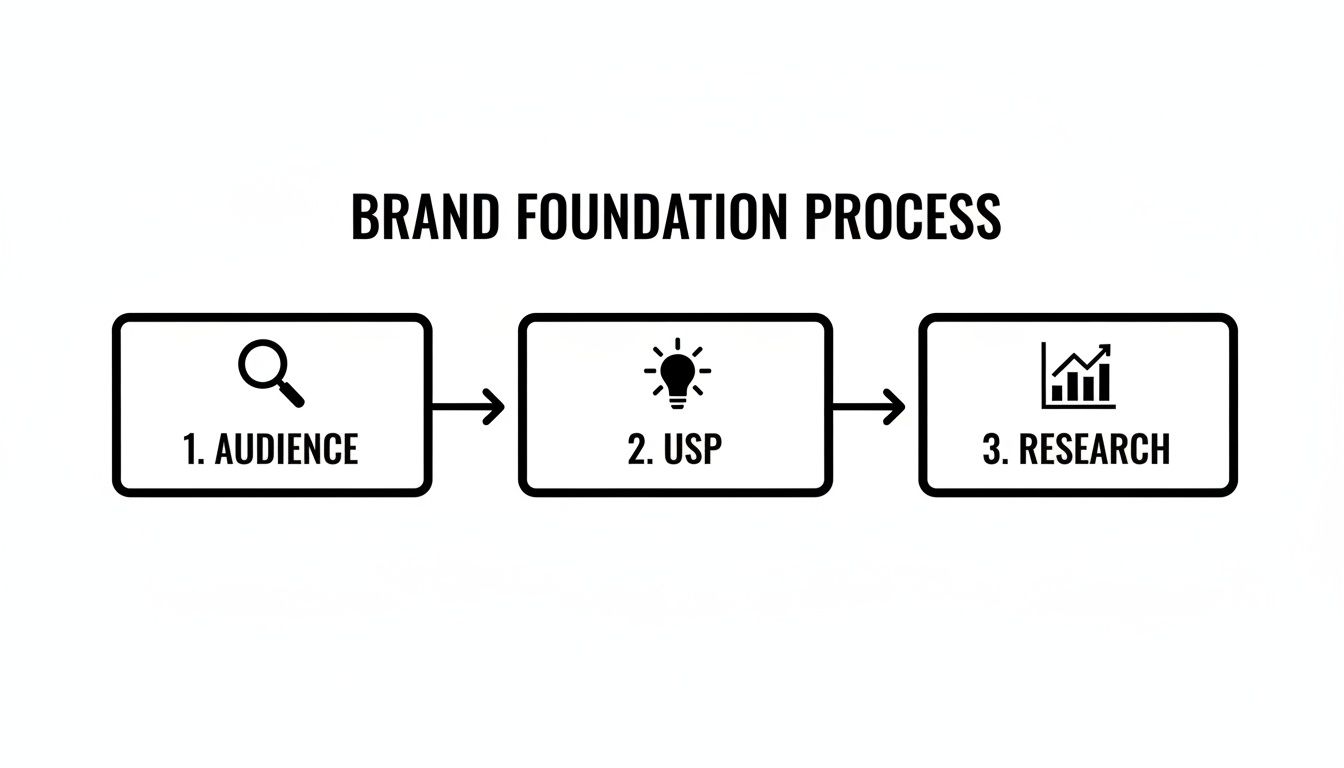
This process shows why that initial brand foundation is so essential. Without it, you're just guessing when it comes to costs and pricing.
Nailing Your Pricing and Profitability
Let’s be clear: pricing isn’t just about slapping a 3x markup on your product cost. On TikTok Shop, that’s a rookie mistake. Your price has to cover a whole host of platform-specific fees and costs if you want to actually make money on each sale.
Your retail price doesn't just cover the product cost. It funds your brand’s future. It has to pay for the item itself, creator commissions, platform fees, and marketing, all while leaving enough profit to reinvest and grow.
You absolutely have to factor these variables into your pricing strategy:
Cost of Goods Sold (COGS): The most basic number. This is what you pay for the product itself, including any shipping costs to get it to you.
TikTok Shop Fees: The platform takes a slice of every sale. This fee can change, so you always need to stay updated on the current seller terms.
Creator Commissions: Creators are your sales force on TikTok. You have to budget for their commission, which can easily be anywhere from 10% to 20% (or even more for top-tier talent).
Marketing & Ad Spend: This bucket holds your budget for running TikTok ads, seeding free products to creators, and any other promotional pushes.
Overhead: This is the catch-all for everything else it takes to run your business—software like your HiveHQ dashboard, packaging materials, customer service tools, you name it.
Let's walk through a quick, real-world scenario. Say your product costs you $8 (your COGS). A simple 3x markup prices it at $24. Sounds good, right?
But wait. A 5% platform fee immediately takes $1.20. A 15% creator commission takes another $3.60. Suddenly, that $24 is down to $19.20 in your pocket, and from that, you still have to cover shipping, ads, and all your other overhead. Your actual profit margin just got a lot thinner.
Before you even think about placing an order, run your numbers through a profitability calculator. Plug in every single estimated cost against your target retail price. If the final profit margin makes you wince, you have two choices: find a way to lower your costs or build a stronger brand that justifies a higher price. This pre-launch financial check is the most important step you'll take.
Nailing Your Brand Identity and Getting Official
Alright, this is where the fun really begins.Alright, this is where the fun really begins. Your brand is about to leap off the spreadsheet and become something real. We're shifting gears from pure strategy to the creative and administrative work that brings it all to life. It's time to build an identity that not only looks incredible but actually connects with your audience—all while setting up a solid legal foundation.

This part of the process covers everything from brainstorming a name that sticks to choosing a business structure that protects you down the line. Each piece is absolutely vital for building a brand that's not just profitable, but built to last.
Choosing a Memorable Brand Name
Your brand name is your first handshake with the world. It has to be catchy, easy to remember, and—this is critical—actually available. On TikTok, that means you need to be just as diligent about checking for the username (@YourBrandName) as you are for the domain (YourBrandName.com). A mismatch creates a frustrating gap for customers trying to find you.
Get a brainstorming session going with words tied to your product, your audience, and the vibe you want to create. Here are a few angles to try:
Invent a word: Think about names like "Olaplex" or "Tatcha." They're totally unique and instantly ownable.
Use a metaphor: A name like "Sunday Riley" evokes a feeling and an experience, not just a product.
Mash two words together: "Pinterest" (pin + interest) is a perfect example of this. It's new, but instantly makes sense.
Once you’ve got a shortlist, do a quick and dirty trademark search on the USPTO website. This isn't a substitute for real legal advice, of course, but it can help you spot obvious red flags early. The last thing you want is to invest time and money into a name you can't legally own.
Building Your Visual Identity
On a visual-first platform like TikTok, your brand’s look is everything. Your identity needs to be strong enough to pop in a chaotic, fast-scrolling feed and be instantly recognizable, even as a tiny profile icon. This goes way beyond just having a pretty logo; it’s about creating a consistent visual language.
Your visual identity is your brand's uniform. It ensures that no matter where a customer sees you—on their For You Page, your shop, or your packaging—they know it's you instantly. Consistency builds trust.
Focus on locking down these core elements:
A Scalable Logo: Your logo has to work hard. It needs to look sharp as a tiny avatar and on your product packaging. Simple, clean wordmarks or abstract icons usually win here. Stay away from complex designs that turn into an unreadable smudge when you shrink them down.
A Purposeful Color Palette: Colors trigger emotions. If you’re a wellness brand, you might lean into calming blues and greens. Launching a high-energy snack? Vibrant yellows and reds will do the heavy lifting. Try to stick to two main colors and a few accent shades to keep things looking tight.
Cohesive Typography: Pick two fonts you love—one for headings, one for body text. This simple choice makes your website, social graphics, and product descriptions all feel like they belong to the same family.
Defining Your Brand Voice
If visuals are how your brand looks, your brand voice is how it sounds. How do you actually talk to your customers in captions, comments, and DMs? Your tone should be a direct reflection of the audience you defined earlier. Are they into witty, meme-heavy humor, or do they respond better to inspiring, educational content?
Think of your brand as a person. Is it the helpful expert? The funny best friend? The cool older sibling? Nailing this personality down ensures that every single piece of copy, from a TikTok caption to a customer service email, sounds authentically you.
Setting Up Your Legal Structure
I know, this is the least glamorous part, but it's arguably the most important step in making your brand official. Choosing the right legal structure protects your personal assets and prepares you for growth. For most new e-commerce founders, it really boils down to two options.
| Business Structure | Key Features & Considerations | Best For... |
|---|---|---|
| Sole Proprietorship | - The easiest and cheapest way to get started. | |
| - No legal separation between you and the business. | ||
| - Your personal assets (home, car) are at risk. | Individuals just testing an idea with very low risk and minimal initial investment. | |
| LLC (Limited Liability Co.) | - Creates a separate legal entity. | |
| - Protects your personal assets from business debts. | ||
| - Offers more credibility and tax flexibility. | Serious entrepreneurs ready to invest in their brand and wanting long-term legal protection. |
While the simplicity of a sole proprietorship is tempting, forming an LLC is one of the smartest early investments you can make. It establishes a professional foundation from day one and gives you critical protection as you start making money and scaling your operations. This legal groundwork is the final piece of the puzzle, turning your brand into something truly built to last.
Developing Your Content and Creator Playbook
On TikTok, your brand isn't what you say it is; it's what your content and creators show it to be. A slick logo and a clever tagline just don't carry the same weight here. Your brand is built one video, one collaboration at a time. This is your playbook for turning content into your most powerful asset.
This requires a fundamental shift in thinking. Forget traditional advertising and embrace authentic storytelling. The goal is to create a non-stop flow of content that doesn't just sell, but educates, entertains, and builds a real community around what you offer.
Building Your Core Content Strategy
Before you even think about hitting record, you need a plan. Just throwing videos at the wall and hoping one goes viral is a surefire way to burn out. A smart content strategy for TikTok Shop is built on three core pillars, each designed to connect with your audience wherever they are in their buying journey.
Your content mix should be a thoughtful blend of:
Educational Content: Think how-to guides, quick tutorials, and "hack" videos that show your product solving a genuine problem. For a skincare brand, this might be a video on "The Right Way to Apply Retinol for Beginners."
Entertaining Content: This is your chance to jump on trends, use popular sounds, and let your brand's personality shine. It’s less about a hard sell and more about forging a connection so you become a memorable part of their feed.
Sales-Driving Content: Here's where you convert interest. We're talking authentic product demos, user-generated content (UGC) showing off real results, and clear calls-to-action that send people straight to your TikTok Shop.
And remember that brand voice you worked on? It needs to be the common thread tying every single video together. Consistency is what turns casual scrollers into loyal fans and, ultimately, customers.
The Power of Creator Partnerships
While your own content is the foundation, the real engine of growth on TikTok Shop is a well-oiled creator partnership program. Creators are the platform's trusted insiders. When they endorse a product, their audience pays attention. For anyone asking how to create my own brand that can scale fast, mastering creator marketing is completely non-negotiable.
The numbers speak for themselves. Influencer marketing spend is on track to hit $2.35 billion by 2025 for a reason. Branded creator collaborations generate 27% higher ad recall than old-school ads, and view-through rates can jump by as much as 193% when you team up with TikTok creators. The fact that nearly 45% of consumers shop based on paid influencer recommendations shows just how crucial this channel is. You can dig deeper into these TikTok shopping statistics to see the full picture.
The best creator partnerships feel less like an ad and more like a genuine recommendation from a friend. Your goal is to find creators whose audiences trust them implicitly and align perfectly with your brand's values.
Finding and Recruiting the Right Creators
Sourcing the right partners can feel like a huge task, but a strategic approach makes it manageable. The secret is to look past vanity metrics like follower counts and zero in on what really matters: engagement and audience alignment.
A creator with 10,000 highly engaged followers in your niche is infinitely more valuable than one with 500,000 generic followers who couldn't care less about your product category.
Here’s a practical way to find and vet your partners:
Define Your Ideal Creator Profile: Based on your target audience, who are they already following? Are they micro-influencers known for brutally honest reviews, or larger trendsetters?
Use Smart Search Tactics: Dive into relevant hashtags like #skincarehacks, #cleantok, or #ecofriendlyhome. See who's making the content that’s already performing well.
Lean on Automation: Manually searching is a grind. Platforms like HiveHQ give you access to a huge database of active affiliates. You can filter by niche, engagement rates, and audience demographics to find perfect-fit creators at scale, turning what could be a week-long search into just a few hours of work.
Crafting Your Outreach and Seeding Products
Once you have a shortlist of creators, your outreach has to cut through the noise. These people get dozens of pitches every day, so a generic copy-paste message is going straight to the trash.
Your first message should be:
Personalized: Mention a specific video of theirs you liked. Show you've actually done your homework.
Value-Oriented: Be upfront about what's in it for them (commission, free product, a long-term partnership).
Simple: Keep it short and get straight to the point. Respect their time.
Once you've made contact, a great next step is product seeding—sending your product for free, with no strings attached. It's a low-pressure way to get your product into their hands. If they genuinely fall in love with it, the authentic user-generated content they create will be far more powerful than any scripted ad you could pay for. This constant stream of real UGC is the lifeblood of your TikTok Shop, driving sales and building unstoppable social proof.
Executing a High-Impact Launch and Scaling Plan
Launch day isn't the finish line; it's the starting pistol. All the strategic work you’ve put in—nailing down your audience, crafting your brand identity, and building your content playbook—has all been leading up to this moment. Now, it's time to execute a launch that makes a real splash on TikTok Shop and then use the data from that splash to build a truly scalable business.

The pivot from pre-launch planning to post-launch analysis is where so many new brands stumble. A successful launch is about creating a coordinated burst of energy, while scaling is about methodically turning that energy into sustainable momentum.
Engineering a Powerful Launch Day
A high-impact launch doesn't happen by accident. It’s a carefully orchestrated event designed to maximize visibility and sales from the very first minute your shop goes live. The real goal here is to create a "surround sound" effect where your target audience sees your brand from multiple trusted sources in a very short period.
To pull this off, you need to coordinate your first wave of creator content to go live almost simultaneously. Imagine a potential customer scrolling their For You Page and seeing three different creators they follow all hyping your product on the same day. That’s not just marketing; that's powerful social proof in action, signaling that your brand is the next big thing.
Here's what your launch day checklist should look like:
Final Pre-Launch Buzz: In the 24-48 hours before you go live, hit your own channels with "coming soon" teasers and countdowns. This primes your early followers and builds anticipation.
Creator Coordination: Make sure your launch-day creators have their content ready to post within a specific 1-2 hour window. This concentrated effort is what creates that crucial initial sales velocity.
Shop Optimization: Your TikTok Shop needs to be flawless. That means high-quality product images, crystal-clear descriptions, and a checkout process so smooth it’s frictionless. A surge of traffic means nothing if the user experience is clunky.
Shifting From Launch to Growth Analysis
Once the initial launch excitement settles, your mission shifts from execution to optimization. This is where you put on your data detective hat and figure out exactly what worked and why. Forget vanity metrics like views or likes; you need to focus on the numbers that directly impact your bottom line.
After the launch, your most valuable asset is data. It tells you which creators are actually moving the needle, which products are resonating, and where you should invest your next dollar. Guesswork is the enemy of scale.
The key performance indicators (KPIs) that truly matter are the ones that paint a full picture of your shop's financial health. You need to know more than just how much you sold; you need to know how profitable each sale was after all expenses are accounted for.
Tracking the Metrics That Matter
To scale effectively, you have to track performance at a granular level. The goal is to move beyond top-line revenue and get a real handle on your profitability. Building your own brand on TikTok Shop means tapping into its insane platform growth, where U.S. Gross Merchandise Value (GMV) is projected to skyrocket from $15.1 million in July 2023 to $1.1 billion by July 2025. With the number of shops surging over 5,000% in that same period, timing and data are everything. This is where a good dashboard becomes your mission control, surfacing real-time GMV, COGS, ad spend, and commissions so you can make decisions based on facts, not feelings. You can find more insights on TikTok Shop's explosive growth at Marketing LTB.
Here’s what you should be monitoring obsessively:
| Metric | Why It's Important | How to Use It |
|---|---|---|
| Gross Merchandise Value (GMV) | The total value of all products sold. It's your top-line revenue and a key indicator of overall sales velocity. | Track GMV daily and weekly to spot trends. A sudden spike might be tied to a specific viral video you can put more ad spend behind. |
| Conversion Rate | The percentage of shop visitors who make a purchase. This tells you how effective your product listings and creator content are. | If your traffic is high but conversion is low, it’s time to optimize your product pages or analyze which creator traffic isn’t converting. |
| Creator Attribution | Identifies which specific creators are driving the most sales (GMV). This is your most powerful lever for growth. | Use a creator tracker to see your top performers. Double down on these successful partnerships and cut ties with those not delivering ROI. |
By meticulously tracking these KPIs, you can move from a one-off launch success to building a reliable, scalable growth engine. You'll know exactly which creator partnerships to nurture and which ad campaigns to fund, allocating your budget with the confidence that every dollar is working hard to build your brand.
Your Top Questions About Building a TikTok Shop Brand, Answered
Jumping into TikTok Shop feels like stepping onto a new stage. Even with a solid game plan, you're bound to have questions. Let's walk through some of the biggest ones I hear from founders who are figuring out how to build their brand on the platform.
How Much Cash Do I Really Need to Start?
This is always the first question, and the answer is—it depends. The great thing about building a brand on TikTok is that you can get off the ground for less than you'd think. It all comes down to your business model.
Print-on-Demand or Dropshipping: You can genuinely get started for under $500. This covers getting your first samples, maybe a basic Canva subscription for designs, and a small budget to send free products to a handful of micro-creators. You carry zero inventory risk.
Small-Batch Manufacturing: If you're creating a custom product from scratch, you'll need more skin in the game. I'd budget between $3,000 to $7,000 to be safe. This gives you enough for a small first run of inventory, branded packaging, setting up your LLC, and a real budget for creator partnerships.
The trick is to be smart and scrappy. Don't go all-in on a massive inventory order before you have a single sale. Validate the idea first.
What are the Biggest Mistakes to Avoid in Year One?
Your first year is all about survival and learning. The most common tripwire I see is impatient scaling. A founder gets a couple of viral videos, the sales start rolling in, and they immediately place a massive inventory order. Then the hype cools off, and suddenly their cash is trapped in boxes sitting in a warehouse.
The second biggest killer is ignoring your numbers. It’s easy to get excited about the big revenue number (GMV), but many new owners forget to track their actual profitability. They aren’t factoring in creator commissions, TikTok's fees, and shipping costs, and they end up losing a little bit of money on every single order.
Another classic mistake is inconsistent content. The TikTok algorithm is a machine that needs to be fed constantly. If you post five videos one week and then go silent for ten days, you’re killing your own momentum. You need a sustainable content rhythm, both from your own account and from your creator partners.
I Have One Winning Product. How Do I Scale?
Scaling is all about listening. Your first 100 customers are your most valuable focus group. Dive into your comments and DMs. What are they asking for? What other problems do they have that your brand could solve?
For any brand serious about TikTok, having solid strategies to grow TikTok followers is non-negotiable. A dedicated community will literally tell you what they want to buy from you next.
Once you have that hero product selling day in and day out, here are a few ways to expand:
Product Variations: This is the easiest win. Offer your hit product in new colors, different sizes, or new scents. It’s a low-risk way to broaden your appeal.
Complementary Products: Selling a viral vitamin C serum? The obvious next move is a moisturizer or a face wash that works perfectly with it. Think about the customer’s routine.
Community-Led Bundles: Notice customers are always buying two specific products together? Package them as an official bundle. This boosts your average order value and makes your loyal fans feel seen.
Ready to stop guessing and start scaling with data-driven precision? HiveHQ gives you the tools to automate creator outreach, track every dollar of profit, and optimize your partnerships for maximum ROI. See how HiveHQ can transform your TikTok Shop.