how to find influencers for your brand: quick guide
how to find influencersinfluencer marketingbrand partnershipsinfluencer discovery
Finding the right influencers for your brand is a journey that starts with some introspection. You need to get crystal clear on your goals and who you're trying to reach. Once you have that locked in, it's time to roll up your sleeves and combine smart manual searches with the right tools to find creators who truly vibe with your brand's mission.
Let's be real—it's tempting to get dazzled by huge follower counts. But the real magic happens when you prioritize genuine engagement and audience relevance. That’s the foundation of a partnership that feels authentic and actually works.
Why the Right Influencer Changes Everything
Before we get into the nitty-gritty of search tactics and outreach templates, let's pause for a second. It's so important to grasp why this process is a game-changer. A great influencer partnership isn't just another box to check on your marketing to-do list; it’s a strategic investment that can completely shift how people see your brand and drive real, measurable growth.
Think of it this way: you can stand on a street corner and shout your message with a megaphone, or you can have a trusted friend rave about your product to their inner circle. An influencer who genuinely connects with what you do doesn't just rent out their audience for a post—they transfer trust. That's the heart of modern marketing.
The Power of Authentic Connection
People are tired of ads. We're all bombarded with them, and our skepticism is at an all-time high. What we crave is authenticity and proof from people we actually trust. This is exactly where the right influencer steps in.
When a creator a person follows and trusts seamlessly weaves your product into their content, it stops feeling like a sales pitch. It feels like a genuine, helpful recommendation.
I've seen it happen time and again. A small skincare startup sells out its new serum after one heartfelt review from a micro-influencer whose followers hang on their every word. Or a B2B tech company suddenly gains massive credibility when a respected industry voice features their software in a real-world case study.
The right partnership builds a bridge of trust directly to your ideal customer. It’s not just about reaching people; it's about connecting with them on a level that traditional ads simply can't achieve.
Driving Real Business Outcomes
At the end of the day, finding the perfect influencer is about getting results you can actually measure. You don't have to look far to see how effective this channel is. The global influencer marketing market is expected to hit a staggering $32.55 billion by 2025—a huge jump from just $1.4 billion back in 2014. If you want to dive deeper into these numbers, you can find more growth insights on influencermarketinghub.com. This explosive growth tells one clear story: brands are putting their money here because it works.
A well-chosen influencer can help you hit a wide range of business goals:
- Boost Brand Awareness: Get your brand in front of thousands of potential new customers in a highly specific niche.
- Increase Engagement: Kickstart meaningful conversations and build a real community around your products.
- Drive Sales: Turn followers into loyal customers with authentic endorsements, affiliate links, and special discount codes.
When you stop seeing your search as a simple task and start treating it as a core investment in your brand’s future, you unlock all of these incredible benefits.
Define Your Goals Before You Start Searching
Jumping into influencer platforms without a clear plan is a surefire way to burn through your marketing budget. Before you even think about searching for creators, you need to lay the groundwork for your campaign. This upfront strategy makes sure every move you make is deliberate and pushes you closer to what you actually want to achieve.
Without a target, you're just shooting in the dark. Vague goals like "increase brand awareness" are impossible to track and won't help you find the right partners. You need sharp, measurable objectives tied directly to real business results.
Set Specific and Measurable Campaign Goals
Your goals will shape everything—the type of influencer you need, the platform you focus on, and the content you'll ask for. Are you trying to drive sales right now, or is this all about building an email list? Each goal demands a completely different strategy.
Here are a few examples of what solid, measurable goals look like in the real world:
- Generate 150 qualified leads in Q3 through an influencer-driven webinar.
- Boost email sign-ups from Instagram by 20% by having creators promote a new guide.
- Drive $10,000 in sales using unique affiliate codes shared by TikTok creators.
- Source 50 new video assets from influencers to use in our next ad campaign.
See the difference? Each one is specific, has a deadline, and gives you a clear benchmark for success. This clarity becomes your North Star when you start digging for the perfect influencers.
Create a Detailed Influencer Persona
Once you know what you want to achieve, you need to figure out who can help you get there. This goes way beyond just looking at follower counts. An influencer persona is a detailed profile of the perfect creator for your campaign, helping you find someone whose personal brand truly clicks with yours.
A great influencer doesn't just have the right audience; they have the right voice, values, and visual style. This alignment is what makes a partnership feel authentic and trustworthy to their followers.
Your persona should get into the nitty-gritty details:
- Content Style: Are you looking for polished, professional videos or something more raw and behind-the-scenes?
- Tone of Voice: Do you need someone funny and relatable, or is your brand better suited to an aspirational, educational tone?
- Audience Values: What does their community genuinely care about? Do those values overlap with what your brand stands for?
- Platform Expertise: Are they a master of short-form video on TikTok or an expert at building community on Instagram?
Establish a Realistic Budget
Finally, let's talk money. Influencer marketing isn't free, and a smart budget covers more than just the creator's fee. You need to think about the whole picture.
A comprehensive budget should include:
- Influencer Fees: The direct payment for their content and promotion.
- Product Costs: The retail value and shipping for any products you send out.
- Management Time: The hours your team will spend on outreach, negotiation, and keeping the campaign on track.
Having a clear budget from day one is a huge time-saver. It keeps you from chasing after influencers who are way out of your price range and makes your entire search more focused and efficient right from the start.
Mastering Influencer Discovery Tools and Tactics
With your strategy mapped out, it's time for the fun part: finding the right people to bring your brand to life. The hunt for influencers can start with some clever, manual tactics that cost you nothing but a bit of time. These grassroots methods are fantastic for uncovering authentic creators who aren't yet on the radar of bigger brands.
Start by digging into the social platforms where your audience hangs out. Think of advanced hashtag searches on Instagram and TikTok as your best friends. Don't just search for a broad term like #fitness; get specific with community-focused tags like #localgymlife or #veganmealpreprecipes. You'll find much more relevant content this way.
Another great trick is to check out your competitors' tagged posts. This is a goldmine for finding influencers who are already active and trusted in your niche. See who’s tagging them, what kind of content they're making, and how their audience is reacting. You might just stumble upon some hidden gems ready for a new collaboration.
Speeding Things Up with Discovery Platforms
While manual searching is a great starting point, it can quickly eat up your schedule. This is where dedicated influencer discovery platforms really shine, saving you countless hours while delivering deep analytical insights. These tools are built to sift through millions of creator profiles to find your perfect match.
Think of them as super-powered search engines for influencer marketing. You can filter by criteria that would be nearly impossible to find on your own, such as:
- Audience Location: Pinpoint influencers whose followers are concentrated in specific cities or countries.
- Engagement Rates: Go beyond vanity metrics and find creators with genuinely active and responsive communities.
- Brand Affinity: Discover influencers who have already talked about your brand or your competitors organically.
This whole process hinges on having a solid understanding of your goals, target persona, and budget. Those foundational pieces guide every search you run.
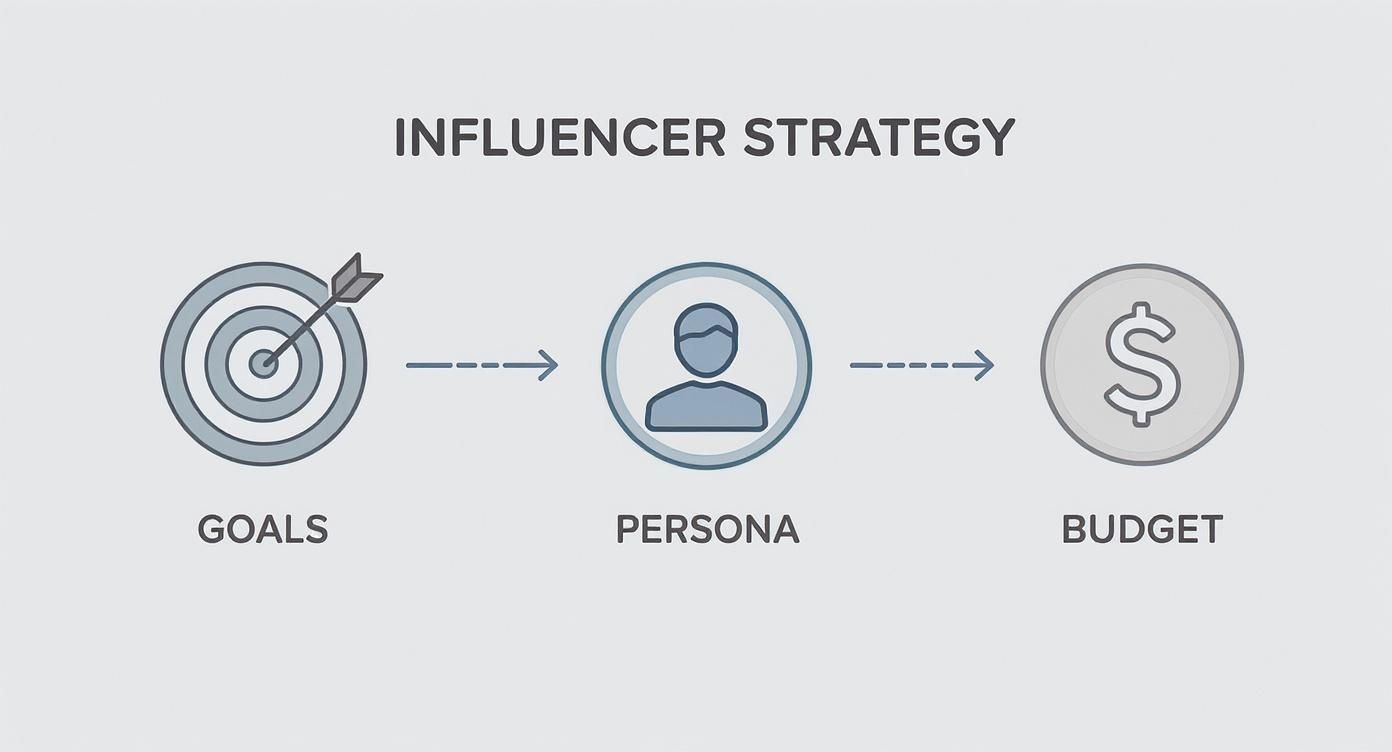
This workflow ensures that any influencer you even consider is already pre-vetted against your most important campaign criteria, making your job a lot easier down the line.
Before you commit to one method, it helps to see how they stack up.
Comparing Influencer Discovery Methods
| Method | Cost | Time Investment | Scalability | Best For |
|---|---|---|---|---|
| Manual Search | Free (except your time) | High | Low | Brands on a tight budget or those seeking hyper-niche, authentic micro-influencers. |
| Discovery Platforms | $$ - $$$ (Subscription) | Low | High | Brands looking to scale their efforts efficiently with data-backed decisions. |
| Agency Partnerships | $$$$ (Retainer/Commission) | Very Low | Varies | Companies that need full-service management and access to exclusive talent rosters. |
Each approach has its place. The right choice really depends on your budget, timeline, and how hands-on you want to be.
Putting Filters to Work: A Real-World Example
Let's make this practical. Imagine you run a sustainable activewear brand based in Austin, Texas. You're targeting women aged 25-35 who love yoga and getting outdoors.
Using a platform like HiveHQ, you could plug in the following filters:
- Category: Fitness & Wellness
- Keywords: Yoga, hiking, sustainable living
- Audience Location: Austin, TX
- Audience Age: 25-34
- Engagement Rate: Above 3%
In seconds, you'd get a curated list of local fitness influencers whose audience is a dead ringer for your ideal customer. This turns what could be a week-long search into a quick, repeatable task.
Instagram, in particular, continues to be a powerhouse for these campaigns. It boasts a staggering 2.11 billion monthly active users, and 68% of marketers see it as essential. What's really interesting is that 76% of its influencers are nano-influencers (1k-10k followers), who command the highest engagement rates at an average of 2.19%. This makes them incredibly powerful partners for brands that crave real connection over raw reach. You can dive deeper into the numbers by checking out the full 2025 influencer marketing report.
Key Takeaway: Combining manual sleuthing with the powerful filtering of discovery platforms gives you the best of both worlds. You get the thrill of finding overlooked talent and the data-driven efficiency to scale your program. This balanced approach is the secret to successfully finding influencers for your brand.
How to Vet Influencers and Spot Red Flags
Finding a potential influencer who seems like a good fit is just the beginning. The real work—the part that protects your brand and your budget—starts now. Before you even draft an outreach email, you need to put on your detective hat.
It's tempting to get excited by a massive follower count, but honestly, that's often just a vanity metric. Real influence isn't about the size of an audience; it's about the quality of the connection, the authenticity of the content, and the trust they've built. Your job is to make sure their community is real, engaged, and genuinely a good match for your brand.
Digging Deeper Than Follower Counts
First thing's first: look past the big number at the top of their profile and zoom in on their engagement rate. A creator with 20,000 followers who consistently gets 1,000 likes per post (a 5% engagement rate) is almost always more valuable than someone with 200,000 followers and only 2,000 likes (a 1% engagement rate).
High engagement is a clear sign of a loyal, active community that actually listens to what the creator has to say.
Next, it's time to scroll through the comments. Are they just a sea of "Great post!" and fire emojis, or are people having real conversations? You want to see:
- Real questions: Followers asking for more details about a product or a trip.
- Shared stories: People connecting the content to their own experiences.
- Actual conversations: The influencer actively replying to and chatting with their audience.
A healthy comment section feels alive. If the comments look robotic or are always from the same handful of accounts, you might be looking at an engagement pod or purchased interactions—both are major red flags.
Auditing Past Collaborations and Content
The way an influencer has worked with other brands is a preview of what you can expect from a partnership. Hunt down their past sponsored posts (usually tagged with #ad or #sponsored). Does the product feel like a natural part of their content, or does it stick out like a sore thumb?
Look for professionalism. A creator who puts real thought and effort into their sponsored content will likely do the same for you. On the flip side, if their feed is a chaotic mess of random brand deals, it could mean they'll promote anything for a paycheck. That kind of partnership can dilute their credibility and your brand's message right along with it.
This is where you protect your investment. Influencer marketing can be an incredibly profitable channel—on average, brands earn $5.78 for every $1 spent, and some see returns as high as $20 per dollar. Choosing partners who prioritize authenticity is the key to unlocking that potential. You can learn more about the profitability of influencer marketing on thunderbit.com.
Spotting Common Red Flags
As you go through this process, keep an eye out for warning signs. Catching them early can save you from a partnership that might hurt your brand's reputation.
A few tell-tale signs that something is off:
- Suspicious Follower Growth: A sudden, massive jump in followers after a long period of slow growth is a classic sign of buying followers.
- Wildly Inconsistent Content: If their posts swing from polished, professional videos one day to blurry, low-effort photos the next, it shows a lack of consistency.
- Poor Brand Alignment: Scroll back through their content from the last six months. Do their values, tone, and overall message actually mesh with yours?
Ultimately, this isn't just about finding a billboard. You're looking for a genuine brand advocate who can connect with their audience in a way that feels real.
Crafting Outreach That Actually Gets a Reply
https://www.youtube.com/embed/LiZxKzMQoRs
You've done the digging, vetted your list, and found a creator who feels like a perfect match. Now for the hard part: making contact. This is where so many brands drop the ball. A generic, copy-pasted message is the fastest way to get your pitch ignored, especially when you realize popular creators are fielding dozens of these every single day.
To cut through that noise, your outreach needs to be personal, professional, and genuinely respectful of their time. You're not just sending a request; you're starting a conversation. A solid first impression can be the difference between a dream partnership and getting left on read.
The Anatomy of a Winning First Message
Your first message, whether it’s a DM or an email, needs to feel like it was written just for them. Remember, influencers are entrepreneurs who have painstakingly built their audience and brand. Show them you see that and have actually paid attention to their work.
Here’s what every great first message should include:
- A Personal Hook: Always start with their name and mention something specific and recent that you genuinely liked about their content. "I loved your recent video on sustainable kitchen swaps" is worlds better than "I like your page." It proves you're not just blasting out a template.
- A Clear Intro: Briefly introduce your brand and, more importantly, explain why you think a collaboration makes sense for their audience. Draw a clear line connecting your brand’s mission to their personal values.
- The Value Prop: This is the make-or-break element. What's in it for them? State the compensation clearly, whether it's a flat fee, gifted product, an affiliate commission, or a mix. Be upfront and transparent about the value you're offering right from the start.
Pro Tip: Never, ever ask an influencer for their rates in the first message. Lead with your offer. It shows you've done your homework, have a real budget, and respect their work enough to put a concrete proposal on the table. This one move immediately elevates the conversation to a professional level.
Good vs. Bad Outreach Examples
Let’s look at this in the real world. The difference between a thoughtful pitch and a lazy one is night and day.
Bad Outreach Email:
"Hey,
We’re a cool brand and we want to collab. We like your page and think you'd be a great fit. Let us know if you’re interested in working together!"
This kind of message is just lazy. It's impersonal, offers zero value, and forces the creator to do all the work just to figure out what you want. Instant delete.
Good Outreach Email:
"Hi [Influencer Name],
My name is [Your Name] from [Your Brand]. I've been following your series on [specific topic] for a while, and your tips on [specific tip] were absolutely brilliant!
We create [your product type] designed to help people [solve a problem], and I immediately thought of you. Your focus on [their value, e.g., 'conscious living'] aligns so perfectly with our entire mission.
We'd love to partner with you for a dedicated Instagram Reel. Our budget for this is [$$$], and of course, we'd be happy to send over our full product line for you to try.
Let me know if this sounds like something you’d be interested in exploring!"
See the difference? This email shows genuine interest, clearly explains the brand fit, and presents a professional offer with a clear call to action. It’s a pitch that respects their time and is far more likely to get the positive reply you're looking for. This is how you find influencers who are genuinely excited to work with your brand.
Common Questions About Finding Influencers
Even with a great plan, you're bound to run into a few tricky questions when you start looking for influencers. Things like figuring out payments, what the different "tiers" of creators really mean, and what to do when you get total radio silence are all part of the process. Let's tackle some of the most common ones so you can feel confident moving forward.
How Much Should I Expect to Pay an Influencer?
This is the million-dollar question, isn't it? The most honest answer is: it depends. Wildly. There's no industry-wide rate card, so a creator's fee hinges on everything from their follower count and engagement rate to the type of content you want—a polished Reel will always cost more than a quick Story.
As a rough guide, nano-influencers (1k-10k followers) might be happy with gifted products or a smaller fee, maybe in the $50 to $250 range per post. Once you get into the micro-influencer space (10k-100k followers), you're typically looking at $250 to over $1,000. Beyond that, macro and mega-influencers can command fees that easily climb into the tens of thousands.
My best advice? Never go into a negotiation asking, "What are your rates?" Instead, do your homework and lead with a fair, well-researched offer. It shows you're a serious partner who respects their time and value.
What Is the Difference Between Nano and Macro Influencers?
Knowing the difference between influencer tiers is crucial for matching your search to what you actually want to achieve. It's about so much more than just follower numbers; each type of creator offers something unique.
Here’s a quick rundown of who you might target and why:
- Nano-Influencers (1,000 - 10,000 followers): These creators are the unsung heroes of engagement. Because their communities are small and hyper-focused, their recommendations feel like advice from a trusted friend. They're perfect for brands that need to build genuine trust with a niche audience.
- Micro-Influencers (10,000 - 100,000 followers): This is the sweet spot for a lot of brands. You get a great balance of decent reach and a genuinely engaged community. They’re often seen as credible experts in their niche and can effectively drive both awareness and sales.
- Macro-Influencers (100,000 - 1 Million followers): Think of these as established social media personalities. They are fantastic for getting your brand name in front of a massive audience quickly, making them a go-to for top-of-funnel awareness campaigns.
What Should I Do If an Influencer Does Not Respond?
First off, don't take it personally. It happens all the time. The inboxes of great creators are a battlefield, and it's easy for even the best pitch to get lost in the shuffle. A lack of response doesn't automatically mean "no."
If you’ve sent a solid, personalized email and heard nothing back, it’s perfectly fine to send a single, polite follow-up after about a week.
Keep it short and friendly. Something as simple as, "Just wanted to gently bump this in your inbox in case it got buried!" works wonders. If there’s still silence after that? It’s time to respectfully move on. Pestering a creator is a bad look for your brand. There are thousands of other amazing partners out there waiting to be discovered.
Ready to stop searching and start scaling? The HiveHQ Affiliate Bot automates your outreach to a pool of 500,000+ active creators, so you can discover and recruit the perfect partners effortlessly. Learn more and book a demo with HiveHQ.