How to Use AI to Make Money A Practical Guide for Entrepreneurs

When people talk about making money with AI, it really comes down to three main game plans: cranking out content at scale, putting your sales on autopilot, and building new AI-driven products. Whether you're a one-person show or a team on the rise, these aren't just abstract ideas—they're real, tangible ways to turn technology into revenue right now.
The New Frontier of AI Monetization
Let's cut through the hype. Artificial intelligence isn't some far-off sci-fi concept anymore; it's a practical tool that smart entrepreneurs are using to make money today. The conversation has shifted from if you can profit from AI to how you can put it to work for your business. For anyone selling on platforms like Shopify or TikTok Shop, this is a massive opportunity to get ahead.
What’s great about the AI tools available now is that you don't need a Ph.D. in machine learning to use them. You can tap into existing platforms to handle tasks that used to drain your time and budget. This frees you up to think about the big picture and focus on growth, letting the AI handle the grunt work.
Actionable Paths to Profit
Making money with AI isn't a one-size-fits-all deal. Think of it as a set of different paths you can take, each suited to different business models and skills. Once you understand the core approaches, you can pick the one that fits your goals.
- The Content and Commerce Engine: This is all about using AI to generate a ton of quality content. We’re talking SEO-friendly product descriptions, blog posts that pull in traffic, and social media content that actually engages people. The end game? Build an audience that buys.
- Intelligent Sales Automation: Here, AI becomes your secret weapon for streamlining the entire sales process. You can use chatbots to capture leads around the clock, automate personalized email campaigns, and even analyze customer data to figure out who's ready to buy. It’s all about boosting conversions.
- AI-Powered Product Development: This is the most advanced play. It involves building and selling your own AI tools. This could be anything from a specialized chatbot for a niche market to a full-blown data analysis platform sold as a subscription service.
The real magic of AI isn't just what it can do, but how you apply it. It’s about solving real-world business problems—finding customers, closing deals, and creating value—faster and more effectively than ever before.
To make this crystal clear, I've broken down these strategies into a simple table. This should give you a good sense of the effort involved and what you can expect in return.
Core AI Monetization Strategies at a Glance
This table sums up the primary ways you can use AI to generate revenue, giving you a quick overview of the approach, the skill level required, and the potential financial upside.
| Strategy | Primary Use Case | Effort Level | Potential ROI |
|---|---|---|---|
| Content Creation | SEO, affiliate marketing, social media | Low | Medium |
| Sales Automation | Lead generation, customer support, email | Medium | High |
| Product Development | SaaS, custom tools, AI services | High | Very High |
Ultimately, the right strategy for you hinges on your current resources and where you want to take your business. Each of these paths offers a legitimate way to use AI to boost your bottom line, turning smarter operations into real, measurable cash.
Building Your AI Content and Commerce Engine
This is where the rubber meets the road. It's time to build a system that turns your creative ideas directly into sales—what I call an AI content and commerce engine.
Forget spending hours manually crafting every product description or TikTok script. We're talking about building an automated workflow that handles everything for you. The goal is to create a machine that works in the background, attracting new customers and converting them on autopilot.
By weaving AI into every step, from initial product research to the final ad copy, you can build a powerful and incredibly cost-effective revenue stream that just keeps delivering.
The basic loop is simple but powerful: AI-driven content gets you sales, and those sales tell you which products to focus on next.
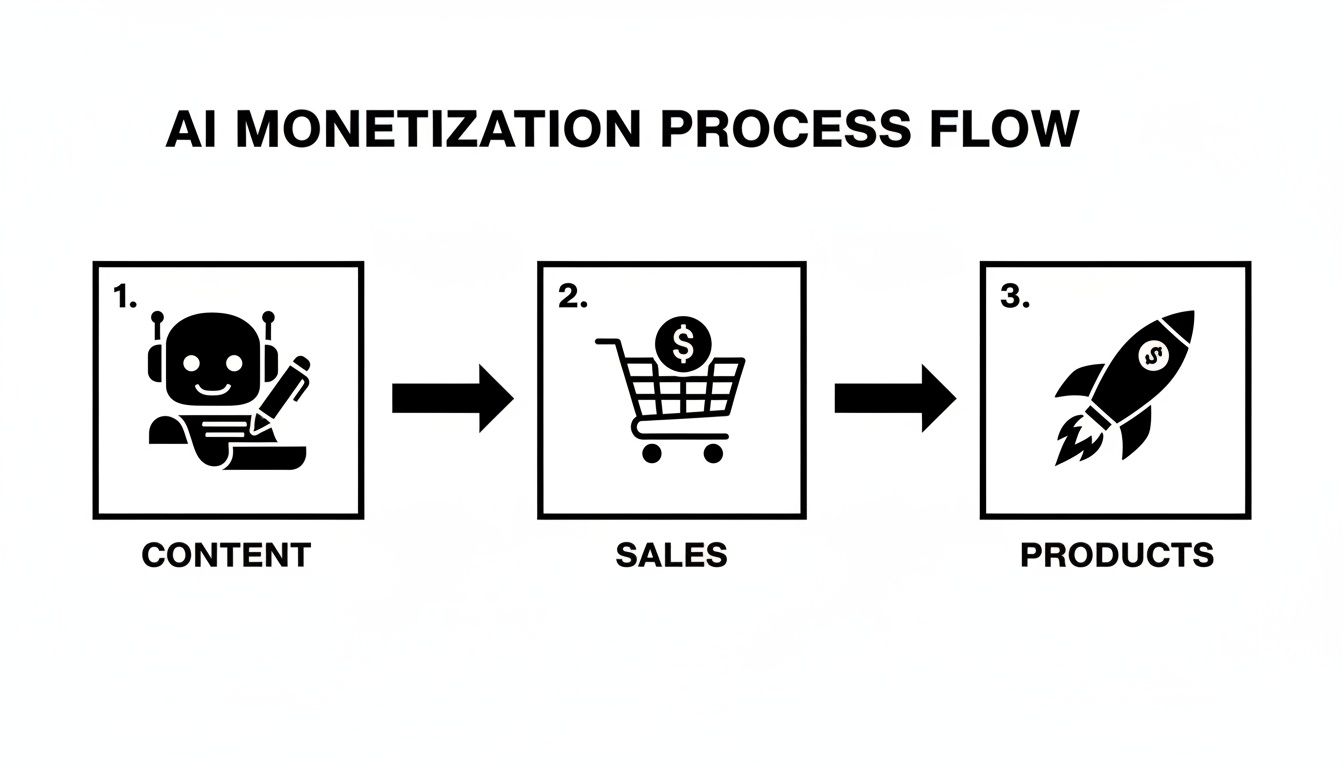
This visual really captures the essence of the strategy. It's a continuous, self-improving cycle.
Ideation and Product Research with AI
Before you write a single word, you have to know what people actually want to buy. This is where AI research tools come in, analyzing social media trends, search data, and what your competitors are up to. You can stop guessing and start making decisions based on real data.
Let's say you're a TikTok Shop owner selling skincare. You could use an AI tool to scan everything under the #skintok hashtag. The AI would instantly spot recurring themes, hot ingredients like niacinamide, and the specific problems people complain about in the comments. That’s gold. This insight tells you exactly which products to stock and what benefits to highlight in your content.
The real game-changer here is speed. You can compress weeks of painstaking market analysis into a few hours. In a fast-moving space like TikTok Shop, that speed is a serious competitive advantage.
Crafting High-Converting Copy at Scale
Once you know what to sell, you need the words to sell it. This is where AI is a complete powerhouse, letting you produce a massive amount of high-quality copy without sounding like a robot.
The secret? A well-defined brand voice guide that you feed to the AI.
Here's a practical way to do it:
- Create a Master Brand Prompt: Write a detailed prompt that defines your brand's personality (e.g., witty, professional, minimalist), your ideal customer, key talking points, and even words you want to avoid.
- Generate Product Descriptions: Give your master prompt and some product specs to an AI writer. Ask it for a few different versions so you can A/B test which one gets more sales.
- Write Ad and Social Copy: Use that same brand prompt to spit out catchy ad headlines, Instagram captions, and scroll-stopping hooks for your videos.
This system ensures every piece of content feels like it came from you, keeping your brand strong and consistent as you grow.
Automating Your Content Workflow
Using AI to make money isn't about one-off tasks; it's about building an automated system that runs itself. This isn't just a fleeting trend—by 2025, an estimated 67% of small businesses will be relying on AI for these exact tasks. The efficiency is undeniable, with some companies reporting they’ve cut content production costs by as much as 55%.
Here’s what a streamlined workflow looks like in action:
- AI Research: Your AI tool flags a trending product or topic in your niche.
- Blog & SEO Content: You use that intel to generate a keyword-rich blog post that starts pulling in organic traffic. Our guide on how to use AI for affiliate writing digs into more advanced strategies for this.
- Social Media Repurposing: Next, you feed that blog post into an AI and ask it to create a full week of social media content—think tweets, LinkedIn updates, and Instagram captions.
- Video Script Generation: Finally, you have the AI pull the most important points from the article and turn them into a snappy, engaging script for a TikTok or Instagram Reel.
By linking these steps, you’ve just turned one single idea into a whole arsenal of marketing assets. That’s how you build a reliable content engine that drives consistent sales and positions your brand as a leader in your space.
Put Your Sales on Autopilot with AI
If creating great content is how you build an audience, then sales automation is how you turn that attention into actual dollars. Bringing AI into your sales process is one of the most direct ways to make money with this tech, and it completely changes how you find, nurture, and close deals. It's all about working smarter, not harder, by letting the machines handle the grunt work so your team can focus on what they do best: building relationships.
This isn't just about saving time; it's a serious strategy for growing your revenue. I've seen businesses that were early to adopt AI in their sales process boost their win rates by more than 30%. That kind of jump can fundamentally change your growth trajectory without having to hire a single new salesperson. The AI takes over tedious tasks like scoring leads, drafting personalized emails, and even flagging deals that might be at risk.

This kind of automation just makes your entire sales operation faster, smarter, and way more profitable.
Find Your Best Leads with AI Scoring
Let's be real: not all leads are created equal. Wasting precious time chasing prospects who aren't ready to buy is one of the biggest drains on any sales team. AI-powered lead scoring is the perfect solution. It digs through your customer data to predict who's most likely to become a customer.
Think about how this works for a Shopify store. The AI is constantly watching for dozens of signals in real-time:
- Engagement History: How many times has someone looked at your pricing page?
- Behavioral Data: Did they almost check out with a high-value item, only to abandon their cart?
- Demographic Info: Does this person fit the profile of your best customers?
- Source: Did they click through from a high-intent ad or just stumble in from a blog post?
Based on all this, the AI gives each lead a simple score. Your sales team can then just sort their list and focus on the hot leads, making sure every conversation they have is with someone who's already halfway to saying "yes." It's a targeted approach that makes a huge difference in conversion rates.
AI lead scoring is like giving your sales team a crystal ball. It stops them from chasing cold leads and points them directly toward the people who are ready to have a serious conversation about buying.
Use AI Chatbots to Capture Leads 24/7
Your website is your digital storefront, and it needs to be working for you around the clock. An AI chatbot is your best, most tireless salesperson—always there to greet visitors, answer questions, and grab leads, even in the middle of the night.
And these aren't the clunky, robotic chatbots you might remember. Today's AI bots can hold surprisingly natural conversations, figure out what a visitor actually wants, and guide them through the first few steps of the sales process. If you're curious about the tech behind it all, we've got a great breakdown on how chatbots work.
Here's how this plays out for a TikTok Shop seller: a potential customer sees one of your viral videos and lands on your product page at 2 AM. They've got a quick question about shipping times. Instead of clicking away, they ask your AI chatbot. The bot gives them an instant answer and, sensing their interest, offers a 10% discount code if they drop their email.
Boom. Lead captured. Customer happy. The next morning, that lead is already in your system, scored by your AI, and queued up for a follow-up email. You simply can't scale that kind of instant, personal interaction with a human team.
Automate Personalized Email Follow-Ups
Once you've got the lead, you need to nurture it. Generic email blasts just get ignored. People expect communication that's actually relevant to them, and AI is what makes it possible to deliver that personal touch at scale.
AI can look at a customer's browsing habits, past purchases, and other interactions to build incredibly specific email sequences.
- For an abandoned cart: The AI can send an email featuring the exact product they left behind, maybe tossing in some great customer reviews to seal the deal.
- For a new subscriber: It can kick off a welcome series that introduces your brand and points them toward products similar to what they were looking at.
- For a loyal customer: It can even predict when they're about to run out of a product they bought before and send a friendly reorder reminder.
This level of smart automation ensures every single person gets the right message at the perfect moment, guiding them from casual browser to happy customer. It’s a core part of turning passive interest into active sales and building the kind of loyalty that keeps people coming back.
Developing and Investing in AI Solutions
While using AI to supercharge your content or automate sales is a great way to earn, the truly massive opportunities often come from creating the tools themselves. Making the leap from an AI user to an AI creator or investor might sound intimidating, but it's more achievable now than ever before. It all starts with finding a specific, painful problem in a niche market and building a laser-focused AI tool to solve it.
This isn't about trying to build the next ChatGPT. Forget competing with the giants. The real money is in finding an underserved audience and creating something that makes their day-to-day work dramatically easier. You don't need to be a coding prodigy, either. Thanks to the explosion of no-code and low-code platforms, you can build a fully functional AI application—what we call a Minimum Viable Product (MVP)—using simple visual tools.
The strategy is to start small with a tool that delivers immediate, tangible value. From there, you listen to your first users, iterate on their feedback, and slowly scale your simple tool into a full-blown Software as a Service (SaaS) business with that beautiful, recurring subscription revenue.
Finding Your Niche and Building an MVP
The golden rule is to find a problem worth solving before you even think about the solution. Immerse yourself in a specific community—hang out where TikTok Shop sellers, freelance writers, or digital marketers congregate online. Pay close attention to their recurring complaints and the manual, time-sucking tasks they despise.
Once you’ve pinpointed a real headache, you can jump into a no-code platform to build your MVP. These platforms are game-changers, letting you create powerful web apps with drag-and-drop interfaces that connect to advanced AI models, all without writing a single line of code.
Here's a simple breakdown of how to approach this:
- Identify a Repetitive Task: Look for something people in your niche do over and over. A great example is a TikTok Shop owner who spends hours each week manually checking what their competitors are charging.
- Define a Simple Solution: Your MVP needs to do one thing perfectly. For our TikTok Shop owner, the tool could simply take a product link and spit out a clean report on competitor prices. That’s it.
- Choose a No-Code Platform: Tools like Bubble.io, Softr, or Webflow are perfect for this. They have built-in integrations that make connecting to AI APIs, like those from OpenAI, surprisingly straightforward.
- Build and Test: Get a basic version of your tool into the hands of a few potential users as quickly as possible. Their raw, honest feedback is gold—it tells you exactly what to build next.
For instance, this screenshot shows the editor inside Bubble.io. It's a visual canvas where you build your application's logic and design, no code required.
This is what makes it possible for non-technical founders to bring their AI-powered ideas to market fast.
Exploring the Investment Landscape
If building a tool from scratch still feels like too heavy a lift, there's another path: investing in promising AI startups. The market is absolutely booming, and if you can spot a winner early, the returns can be incredible.
Whether you're building or investing, you're tapping into some serious market momentum. The numbers are almost hard to believe. PwC, for example, projects that AI will contribute a staggering $15.7 trillion to the global economy by 2030. In 2024 alone, private AI investment in the US soared to $109.1 billion. You can dive deeper into these figures by checking out the full research on AI market statistics.
When you're looking at a potential AI investment, you have to see past the buzzwords. The best bets are on startups solving a real, specific business problem with a clear plan to make money—not just those with flashy tech.
A smart investment strategy means zeroing in on companies with a solid founding team, a deep understanding of their target customer, and a product that already has some early traction. Platforms like AngelList or Republic have opened the doors for everyday investors to get in on the ground floor. By backing the right teams, you can own a piece of the future of AI without having to build it yourself.
Measuring Your AI ROI and Navigating Ethics
Bringing AI into your business is more than just a tech upgrade; it's a financial investment. And like any investment, you need to know if it's paying off. To really understand how to make money with AI, you have to get serious about measuring its impact on your bottom line.

Quantifying your Return on Investment (ROI) isn't as complicated as it sounds. You just need to track what goes in and what comes out. On one side, you have your costs—things like software subscriptions and the time your team spends getting up to speed. On the other, you have the benefits, and that’s where the real magic happens.
Calculating Your AI-Driven Profitability
To get a true sense of AI's financial impact, you need to watch a few key metrics. These Key Performance Indicators (KPIs) show you exactly where AI is saving you cash or generating new revenue. It's all about connecting an automated task to a real-world financial outcome.
Here’s what I always recommend tracking:
- Cost Per Acquisition (CPA) Reduction: Are your AI-powered ads actually cheaper? Monitor this like a hawk. A 15-20% decrease in CPA is a fantastic sign that your AI is working hard for you.
- Increased Conversion Rates: Pit your new AI-generated product descriptions against the old ones in an A/B test. Every uptick in conversions is pure profit driven by smarter content.
- Time Savings Translated to Dollars: This one is huge. Figure out how many hours your team gets back from AI handling tasks like creator outreach or content scheduling. Multiply those hours by their hourly rate, and you’ve got your direct cost savings.
- Revenue Lift from Personalization: If you're using AI for personalized email campaigns or product recommendations, make sure you can attribute the sales from those specific campaigns back to your AI strategy.
Here’s a simple way to think about it: Let's say your AI tools cost $300 a month. But they save your team 20 hours of manual work, and you pay your team members $25/hour. That's a $500 savings right there. You're already up $200 before you even count a single extra sale.
If you want to go deeper on the financial side, building a solid dashboard in a spreadsheet is a great move. We've got a guide that walks you through using https://blog.hivehq.ai/excel-financial-functions/ to track this stuff like a pro.
Upholding Ethical Standards in AI
As you start using these powerful tools, remember you're not just a business owner—you're a custodian of your customers' trust. Using AI ethically isn't optional; it's essential for any brand that wants to stick around. A breach of trust can tear down your reputation faster than any AI tool can build it.
Building a trustworthy, AI-powered business means being upfront and responsible. This isn’t just about dodging legal bullets; it’s about creating a brand that people feel good buying from.
Here’s a quick checklist for using AI the right way:
- Be Transparent with Customers: If a customer is talking to a chatbot, they should know it. A simple "Hi, I'm an AI assistant" builds honesty and sets the right expectations from the start.
- Protect Customer Data: Use customer data only to make their experience better, not for anything that feels invasive. Make sure any AI tool you use is compliant with privacy laws like GDPR and CCPA.
- Audit for Algorithmic Bias: AI models are only as good as the data they learn from. If that data is biased, your AI will be too. Regularly check your AI's outputs—whether it's ad targeting or product recommendations—to ensure you're not accidentally discriminating against certain groups of people.
At the end of the day, making money with AI is a balancing act. You need sharp financial tracking to prove its worth and a solid ethical foundation to keep your customers loyal. Nail both, and you'll have a profitable, future-proof business on your hands.
Got Questions About Making Money with AI? We've Got Answers.
Jumping into any new business idea brings up questions. When that idea involves something as fast-moving as AI, it's smart to want a few things cleared up first. This is where we tackle the common hang-ups we hear from entrepreneurs who are ready to get started but want to make sure they’re on the right track.
Let's cut through the noise and get straight to the practical answers, from what this will cost you upfront to what skills you actually need. Think of this as your final briefing before you dive in.
How Much Money Do I Need to Start?
This is always the first question, and the answer is better than you think: you can get started for less than the cost of a daily coffee. Seriously. Many of the most powerful AI tools out there run on a "freemium" model, which means you get a ton of value without paying a dime.
For instance, you can start cranking out product descriptions or social media posts using the free versions of popular AI writers. The real investment at the beginning isn't cash—it's your time. Time to learn how to write good prompts and figure out a workflow that makes sense for you. Once you start bringing in revenue, you can funnel a tiny piece of that back into paid plans for more features and fewer limits.
The barrier to entry here is incredibly low. Your biggest asset isn't a fat wallet; it's your willingness to play around with the powerful, low-cost tools that are already at your fingertips.
What's the Easiest Way for a Beginner to Start?
If you're just dipping your toes in, the most direct path is using AI for content creation and affiliate marketing. The learning curve is gentle, and it builds on skills you probably already have. No need to understand fancy algorithms or write a single line of code.
Here’s what that looks like in the real world:
- Pick a Niche: Start with something you actually know and like, whether it’s sustainable fashion or home fitness equipment.
- Find Affiliate Partners: Sign up for affiliate programs with brands in that space. Amazon Associates is a classic place to start, but most brands have their own programs.
- Let AI Do the Heavy Lifting: Use an AI writer to help you draft blog posts, product reviews, or social media captions. You can then weave your affiliate links into that content naturally. The AI handles the initial research and gets the words on the page.
- Publish and Promote: Get your content out there on a simple blog or your social channels to start getting eyeballs on it.
This approach gives you a clear line of sight between the content you create and the money you earn. It’s a fantastic, motivating way to get your first win with AI.
What Skills Actually Matter for Success?
Good news: you don't need a technical background. But a few core skills will absolutely separate you from the pack and speed up your success. These aren't about coding; they're about thinking strategically.
- Prompt Engineering: This is the big one. It's the skill of telling the AI exactly what you need. Learning to write clear, detailed prompts with plenty of context is the difference between getting bland, generic mush and creating high-quality, on-brand content.
- Critical Thinking & Editing: An AI is an assistant, not the boss. You have to be the one to review what it spits out, check the facts, and then layer in your own voice and perspective. This human touch is what makes your content trustworthy.
- Niche Expertise: This is your secret weapon. An AI has no lived experience or genuine passion. Your deep knowledge of a topic is what allows you to guide the AI to create something that truly connects with your audience.
Nail these three things and you’ll have a solid foundation. You'll be able to direct AI tools with precision, making sure they help you build a profitable, authentic business that doesn't just blend in with all the noise.
Ready to stop guessing and start scaling your TikTok Shop? HiveHQ gives you the Affiliate Bot, Profit Dashboard, and Creator Tracker you need to automate growth and make data-driven decisions. See exactly how our tools can boost your sales by visiting us at https://hivehq.ai.