The 4 Stages of the Product Life Cycle on TikTok
product life cycletiktok shop strategyecommerce marketingsocial commerceproduct management
The 4 stages of the product life cycle are Introduction, Growth, Maturity, and Decline. This simple yet powerful framework is like a strategic map, showing you the journey your product will take from its first day on the market to its eventual retirement. Knowing where you are on this map is crucial for making smart marketing and business decisions.
Unpacking the Product Life Cycle
Think of your product's journey like a hit song. First, there's the exciting debut (Introduction), where you're just trying to get heard. Then, it starts climbing the charts as people catch on (Growth). For a while, it's a well-known classic that everyone has on their playlist (Maturity), before it eventually fades from the radio to make way for new hits (Decline).
This isn't just theory; it's a practical tool for any brand, especially on a fast-moving platform like TikTok Shop. It helps you see what's coming, decide where to put your money, and change your strategy before you get left behind. The industry gets it, too. The global market for product lifecycle management (PLM) solutions hit USD 28.02 billion in 2022 and is projected to nearly double by 2030, which you can read more about on Grand View Research.
A Visual Guide to the Four Stages
To really see how this plays out, this timeline shows the distinct phases a product goes through, from its high-energy launch to its strategic wind-down.
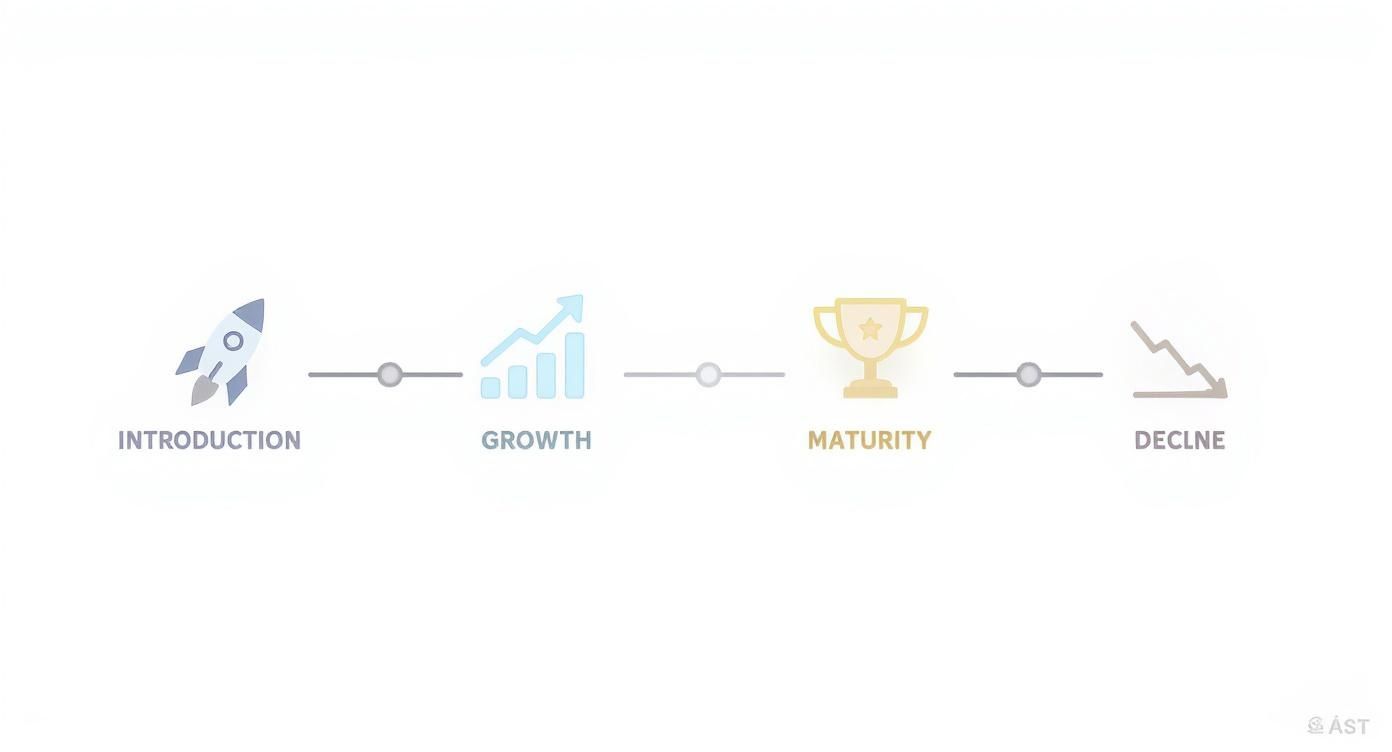
This graphic clearly shows the progression from the uncertainty of the Introduction phase, through the peak performance in Maturity, and into the final Decline.
To help you quickly reference the goals and tactics for each phase, here's a simple breakdown.
Product Life Cycle Stages at a Glance
| Stage | Characteristics | Primary Goal | Marketing Focus |
|---|---|---|---|
| Introduction | Low sales, high costs, minimal competition, low consumer awareness. | Build awareness and generate initial trials. | Educate the market, build brand identity, secure early adopters. |
| Growth | Rapidly rising sales, increasing profits, emerging competition. | Maximize market share and build brand preference. | Penetrate the market, scale creator campaigns, focus on features. |
| Maturity | Peak sales, high profits but slowing growth, intense competition. | Defend market share and maximize profit. | Differentiate from competitors, foster brand loyalty, optimize pricing. |
| Decline | Falling sales, declining profits, shrinking market. | Reduce costs and milk the brand. | Target a niche audience, minimize marketing spend, plan exit. |
Understanding these distinctions is the key to creating a TikTok Shop strategy that works for your product right now.
Key Characteristics of Each Stage
Each phase brings its own set of challenges and opportunities. Knowing the tell-tale signs of each stage lets you tailor your TikTok Shop strategy for the biggest impact.
Introduction: At this point, nobody knows you exist. Sales are just trickling in, and your main goal is to get your name out there. Expect to spend a lot on marketing and creator collaborations just to make a dent.
Growth: Things are taking off! Sales are accelerating as your product catches fire. But you're not alone anymore—competitors are starting to pop up. The focus shifts to grabbing as much market share as you can, as fast as you can.
Maturity: Sales growth is slowing down and hitting a plateau. The market is crowded, and your primary objective is to protect your turf from competitors while squeezing out as much profit as possible.
Decline: Sales and profits are heading south. Now, the game is about managing the end of the line. Do you phase out the product, sell it off, or maybe find a new way to reinvent it for a completely different audience?
The Introduction Stage: Your Product's Big Debut
This is it—the grand opening. Your product has officially launched on TikTok Shop. The introduction stage is a whirlwind of excitement, but it's also defined by high costs and, almost always, low initial sales. Think of it like planting a seed; you have to put in a lot of work and resources upfront before you see any real growth. Right now, profit isn't the primary goal. Your mission is to build awareness and generate those first, crucial sales.
At this point, you probably don't have much competition, which is great. The flip side is that customer awareness is practically zero. This means all your marketing muscle goes into educating the market, carving out your brand identity, and convincing those first brave souls—the early adopters—to give you a shot. Every single sale feels like a hard-won victory because it is. Each one validates that your product has a place here.
Don't be discouraged if things feel slow. This phase is notoriously tough. Research shows that the average product spends about 18 to 24 months in the introduction stage. In fact, only 20% of new products manage to get a solid foothold in the market within their first year. As you can read in this product launch research from the University of Illinois, most products take two to three years just to make it to the growth phase.
Key Metrics to Track in the Introduction Stage
In this uncertain period, data is your compass. Focusing on the right numbers tells you if your launch strategy is working or if you need to pivot—fast. Guesswork is an expensive luxury you can't afford.
Here's what you absolutely need to keep an eye on:
- Gross Merchandise Volume (GMV): This is your total sales revenue. It'll be low to start, but what you're looking for is a steady, even if small, upward trend.
- Cost of Goods Sold (COGS): Keep a tight grip on your production costs. This ensures your pricing strategy makes sense for the long haul.
- Ad Spend: Track every dollar you put into TikTok Spark Ads and other promotions. The goal is to figure out which creative angles and audiences are giving you the best bang for your buck early on.
- Creator-Driven GMV: This is the golden metric. It shows you exactly how much revenue is coming directly from your affiliate creators, telling you which partnerships are actually moving the needle.
Actionable TikTok Shop Strategies for Launch
A successful TikTok Shop debut isn't about blanketing the platform with ads. Spreading your budget too thin is a classic mistake. The real key is to concentrate your efforts and create a small but powerful wave of buzz.
1. Recruit Seed Creators: Forget trying to sign up hundreds of affiliates. Instead, hand-pick a small, trusted group of 5-10 "seed creators" who genuinely vibe with your brand. These are your foundational partners. They’ll provide that first wave of authentic reviews and user-generated content (UGC) that builds the social proof you desperately need to convince new customers.
2. Test Creatives with Spark Ads: Never assume you know what message will connect with your audience. Use TikTok Spark Ads to experiment with multiple creative angles, hooks, and calls-to-action. Run small-budget campaigns to see which videos get the most engagement and clicks. This data-first approach lets you find a winning formula before you pour more money into ads.
Key Takeaway: The introduction stage is all about learning. Every ad you run and every creator you work with is an experiment. Your goal is to gather data, find what works, and build a repeatable model you can scale up in the growth stage.
How HiveHQ Supports Your Product Launch
Trying to manage a launch manually is a recipe for chaos, missed opportunities, and wasted cash. This is where tools like HiveHQ come in, giving you the clarity and control you need during this make-or-break phase.
The HiveHQ Profit Dashboard brings all your most important launch metrics into one place, so you're not juggling a dozen spreadsheets. You can instantly see how your creator-driven GMV stacks up against your ad spend, helping you make sure your launch stays on a path to profitability from day one.
Plus, with the Creator Tracker, you can monitor the performance of your seed creators in real-time. You'll know exactly who is driving sales and who isn't. This lets you double down on the partnerships that work and refine your affiliate strategy as you prepare for the next of the 4 stages of the product life cycle. By automating the data grunt work, you can focus on what really matters: making a powerful first impression.
The Growth Stage: Scaling and Dominating Your Niche

This is the moment every founder dreams of. After all the hard work of the introduction stage, your product enters the most exciting of the 4 stages of the product life cycle: Growth.
Suddenly, things start to click. Sales take off, brand awareness spreads like wildfire, and your product begins carving out a real identity in its niche. Think of it like a song that’s just cracked the top 40—the early buzz has officially turned into real, tangible momentum.
The market has given you the green light, so the game changes. You’re no longer just trying to get noticed; you’re fighting for market share. But this kind of success rarely goes unnoticed. That steep sales curve is a magnet for competitors who want a slice of your pie.
This stage is a thrilling but delicate balancing act. You have to pour fuel on the fire to keep growing, but at the same time, you need to build a moat around your brand to fend off rivals. It’s time to shift from cautious experimentation to bold, confident execution.
Key Metrics to Track in the Growth Stage
As your business scales, your relationship with data has to mature. Vanity metrics won't cut it anymore; the focus has to be on sustainable, profitable growth. If you aren't watching the right numbers, you might find that your rapid expansion is just an expensive illusion.
Here’s what you should be obsessing over:
- Gross Merchandise Volume (GMV) vs. Commissions: Sure, total sales are climbing, but at what cost? If the commissions you're paying creators are growing faster than your GMV, you have a profitability problem brewing.
- Creator-Driven GMV: This metric is still your north star. It’s the clearest indicator of your affiliate program’s direct impact on revenue and helps you double down on the creators who are true growth partners.
- Cost of Goods Sold (COGS): With higher order volumes, you should be able to negotiate better rates with suppliers. Keep a close eye on your COGS to make sure your margins are actually improving as you scale.
- Return on Ad Spend (ROAS): If you're running ads, this is non-negotiable. With bigger budgets comes bigger responsibility. Every single dollar you spend needs to be pulling its weight and delivering a positive return.
Actionable TikTok Shop Strategies for Scaling
During the growth phase, your TikTok Shop strategy needs to be aggressive yet methodical. The goal is to flood the "For You" page, making your product feel inescapable to your target audience.
1. Go Big on Your Affiliate Program: That small, curated group of creators from the launch phase was just the opening act. Now, you need to build an army. We’re talking about recruiting dozens, maybe even hundreds, of high-quality affiliates to amplify your brand. This creates a powerful network effect where potential buyers see your product recommended by multiple people they trust.
2. Poach Your Competitors' Top Creators: One of the smartest and fastest ways to grow is to find out who is already crushing it for your competitors. These creators have a proven ability to sell similar products to an audience that's already warmed up. Reaching out and winning them over is a double victory: you boost your sales and weaken a rival's position.
3. Automate Your Creator Outreach: As you scale, trying to manually message, follow up with, and track dozens of creators is a recipe for burnout. Automating the grunt work—like initial outreach, content reminders, and follow-ups—frees you up to focus on strategy. This is often the key difference between brands that scale smoothly and those that crumble under the pressure.
Pro Tip: In the growth stage, speed is your ultimate weapon. The quicker you can recruit creators and saturate the market, the harder it is for competitors to get a foothold. You want to establish your product as the choice in the niche before it gets too crowded.
How HiveHQ Fuels Your Growth Engine
Taking an affiliate program from 10 partners to 100+ creates a ton of operational headaches. This is where a platform like HiveHQ goes from a nice-to-have to an absolute necessity for keeping your momentum going.
The system is built to handle the chaos of the growth stage. For example, the Affiliate Bot lets you put creator discovery and recruitment on autopilot. You can set it to find creators who are already promoting your competitors, then automatically send personalized outreach to bring them over to your side.
By analyzing competitor data, you can build a highly targeted list of proven sellers, which makes your recruitment efforts incredibly efficient.
As your program balloons, features like the Creator Tracker and Profit Dashboard become your command center. You can see at a glance which of your new affiliates are driving the most creator-driven GMV and weigh it against their commission costs.
This data-first approach ensures that as you scale your reach, you're also scaling your profits—building a rock-solid foundation for the next stage of your product's journey.
The Maturity Stage: Defending and Maximizing Profit
After the wild ride of the growth stage, your product hits its peak—the Maturity stage. This is the third of the 4 stages of the product life cycle. The rocket-ship growth starts to level off, and sales eventually plateau. Congratulations, you’ve saturated the market. But the game has just changed entirely. The space is now crowded, and every competitor wants a slice of the territory you fought so hard to win.
This phase isn't about breakneck expansion anymore. It’s all about playing smart defense and squeezing every drop of profit out of your success. Your goals pivot from acquiring new customers at any cost to keeping the ones you have, fine-tuning your operations, and holding onto this profitable peak for as long as possible. Think of it like a champion defending their title—it's all about strategic execution, efficiency, and outlasting the newcomers.
For most successful products, this is the longest part of the journey. Research shows the median duration for a product in this stage is between 12 and 16 quarters (that's 3 to 4 years) before a real sales decline kicks in. That same study found that a product’s sales typically peak within the first two to three years post-launch, which really highlights how crucial it is to master this stage. You can dive deeper into these product sales trends in the full research paper.
Key Metrics to Track in the Maturity Stage
During the maturity stage, your metrics need to be razor-sharp. It's a game of profitability and efficiency. Every dollar you put into marketing and operations has to be justified to protect your margins.
Your dashboard should be zeroed in on these KPIs:
- Return on Ad Spend (ROAS): With everyone fighting for attention, ad costs inevitably climb. You have to track ROAS like a hawk to make sure your campaigns are still making money and be ruthless about cutting the ones that aren't.
- Cost of Goods Sold (COGS): Never stop looking for ways to streamline your supply chain. Even shaving a few cents off your COGS can make a massive difference to your bottom line when you’re dealing with peak sales volume.
- Customer Lifetime Value (CLV): Since you're shifting from acquisition to retention, you need to know exactly what a customer is worth over their entire relationship with your brand. This metric justifies spending on loyalty programs and retention marketing.
- Creator-Driven GMV vs. Commissions: Take a hard look at your affiliate program. Are the creators you're paying top-tier commissions still delivering the sales to justify it? It's time to analyze who is truly providing a strong return.
Actionable TikTok Shop Strategies for Maturity
Your TikTok Shop strategy has to evolve. Forget the broad, aggressive campaigns of the growth stage; now it's about precise, targeted tactics to defend your market share.
1. Create Tiered Commission Structures
Not all creators are created equal. Pinpoint your top 5-10%—the true powerhouses who consistently drive the most sales. Reward their loyalty and killer performance with an exclusive, higher commission tier. This not only keeps them motivated but also makes it much harder for competitors to lure them away.
2. Introduce Product Variations and Bundles
Keep your offerings fresh without starting from scratch. Introduce new colors, different sizes, or limited-edition versions of your hero product. You can also create exclusive product bundles just for TikTok Shop. This offers a higher perceived value, encourages larger cart sizes, and can reignite interest from both new and existing customers.
Key Takeaway: The maturity stage is a game of inches. Success comes from surgically optimizing every aspect of your business—from affiliate commissions to product offerings—to protect your profit margins and extend your product’s reign at the top.
How HiveHQ Helps You Maximize Profitability
In a market this crowded, gut feelings won't cut it. Data-led decisions are the only way to stay ahead. A platform like HiveHQ becomes your command center, giving you the detailed insights you need to defend your position.
The Creator Tracker, for instance, is perfect for identifying your most valuable partners. You can easily see who your top performers are based on long-term creator-driven GMV. This lets you confidently build and manage tiered commission structures that actually reward your best affiliates, not just the loudest ones.
This screenshot shows how HiveHQ lets you track and compare individual creator performance, highlighting their total GMV and sales generated.
This level of detail means you can see exactly which partnerships are delivering the highest ROI, making it simple to optimize your affiliate program for maximum profitability.
On top of that, the Profit Dashboard gives you a precise, real-time look at your financial health. You can track your COGS and ad spend right alongside your GMV. This visibility helps you spot shrinking margins early, giving you time to adjust your pricing, tweak ad budgets, or renegotiate with suppliers before profits start to slip away. It’s all about making sure you get the most out of this critical stage.
The Decline Stage: Making Smart, Strategic Exits

Sooner or later, every product’s journey comes to an end. The decline stage, the last of the 4 stages of the product life cycle, is marked by a persistent drop in sales and profits. It’s not a sign of failure—it’s just the natural order of things. Markets get saturated, customer tastes shift, or a new competitor comes along with a game-changing alternative.
The real test isn't avoiding this stage, but navigating it with intention. Ignoring the warning signs is a recipe for disaster, leading to wasted marketing dollars and warehouses full of unsold inventory. Instead of just letting a product fade into obscurity, the goal is to manage its exit gracefully. This is your chance to make a sharp, data-driven decision that protects your brand and your bottom line.
When a product enters this phase, you're faced with a big question. Do you pull the plug, squeeze out every last drop of profit, or go for a bold reinvention? Each path requires a completely different playbook.
Navigating Your Three Strategic Options
Once sales start heading south for good, you’ve arrived at a crossroads with three clear paths forward. The right choice isn’t a gut feeling; it’s a calculated move based on your sales data, creator performance history, and a realistic assessment of the market.
Here’s a look at your options:
Harvest the Product: Think of this as milking the cow dry. The objective is to maximize short-term cash flow by slashing all non-essential costs. You’ll cut marketing budgets to the bone, scale back production, and streamline operations. You're not investing in the future; you're extracting every last bit of value from its past success.
Divest the Product: This is the clean break. You get rid of the product line entirely, either by selling it to another company that sees untapped potential or by simply discontinuing it and liquidating your remaining stock. This move frees up cash, time, and attention to pour into your next big winner.
Rejuvenate the Product: The riskiest—and potentially most rewarding—option. This is a full-blown comeback attempt. You might rebrand the product, add new features, or find a completely new audience for it on a platform like TikTok. Essentially, you're trying to send the product right back to the Introduction stage for a second life.
Key Takeaway: The decline stage is not a passive waiting game. It demands an active, strategic decision informed by hard data. Your historical performance metrics are the most reliable guide for choosing whether to harvest, divest, or attempt a bold rejuvenation.
To make this decision-making process a bit clearer, let's lay out these strategies side-by-side.
Strategic Options in the Decline Stage
The table below breaks down the three primary strategies for managing a product in decline, highlighting the end goal and the actions required for each path.
| Strategy | Primary Goal | Key Actions |
|---|---|---|
| Harvest | Maximize remaining profit with minimal investment. | Cut ad spend, reduce marketing support, and sell remaining stock. |
| Divest | Free up company resources for other products. | Discontinue the product, liquidate inventory, or sell the product line. |
| Rejuvenate | Find a new market or use for the product. | Rebrand, add features, or target a new demographic on TikTok. |
Each option has its place, and the right one for you depends entirely on the story your data tells.
Using Data to Guide Your Exit Strategy
This is where all the data you’ve collected becomes your most valuable asset. With a platform like HiveHQ, you can zoom out and look at the entire history of your product to see which creators consistently delivered the highest ROI.
Let’s say you decide to harvest. That historical data is gold. You could trim your entire affiliate program down to only your top 1-2% of all-time performers. This lets you maintain a small but highly profitable trickle of sales with almost zero ongoing marketing spend.
The HiveHQ Profit Dashboard lets you analyze long-term Gross Merchandise Volume (GMV) against your ad spend and commissions. This historical view can show you if a product still has a dedicated niche worth serving (a perfect harvest candidate) or if its profit margins have completely vanished (time to divest).
And if you’re considering rejuvenation? You can dive into your data to identify creator archetypes you’ve never partnered with, potentially unlocking brand-new audiences and giving your product a second act on TikTok Shop.
Frequently Asked Questions
Knowing the theory behind the 4 stages of the product life cycle is a great start, but how does it actually play out on a platform as wild as TikTok Shop? Let's tackle some of the most common questions brands have when trying to put this framework into practice.
Can a Product Go Backward in the Life Cycle?
Absolutely. The product life cycle isn't a one-way street. With the right strategy, a product that’s hit a plateau or even started to fade can be pushed right back into the growth stage. Think of it as a strategic refresh.
A great example would be a skincare product that’s been around for a while. If it gets reformulated with a new, trending ingredient and is relaunched to a younger audience on TikTok, it essentially gets a second life. This "re-launch" kicks it back into an earlier phase, ready to grow all over again.
How Can a Small Brand on TikTok Shop Use This Model?
For small brands, this model is a lifesaver. It’s all about focusing your limited time and money where it will have the biggest impact. Instead of trying to do everything at once, you get a clear roadmap for what matters most right now.
- Introduction Stage: Forget about a massive, expensive ad campaign. Your goal is validation. Find 5-10 seed creators who genuinely fit your brand to generate authentic UGC and build that crucial social proof.
- Growth Stage: Now that you know your product is a winner, it's time to pour fuel on the fire. Concentrate your spending on scaling what's already working—that means recruiting more creators who look like your top performers and putting more budget behind the ads that drove the best results.
By matching your tactics to your stage, even a tiny brand can make some serious noise.
What Is the Most Important Metric in the Growth Stage?
While seeing your overall GMV climb is thrilling, the one metric you absolutely cannot ignore during the growth stage is your creator-driven GMV versus your commission payouts. This ratio is your reality check—it tells you whether your affiliate program is actually making you money.
It's surprisingly easy for incredible sales growth to hide an unprofitable creator strategy. If you're paying out more in commissions than you're earning from those creator sales, you're not scaling a business; you're scaling a liability. Watch this ratio like a hawk. If commissions are outpacing creator sales, it’s time to rethink your approach before you scale yourself into a corner.
How Long Does Each Stage Last?
There’s no magic number here. The timeline for each stage depends entirely on your product, your market, and how much competition you have. Some viral TikTok sensations might blast through the introduction and growth phases in just a few weeks. On the other hand, a classic product in a stable niche could comfortably remain in the maturity stage for years.
A product's speed through the life cycle is often dictated by market trends. A buzzy new gadget might have a total cycle of 12 months, while a timeless fashion piece could stay in the maturity stage for over a decade. Stop watching the calendar and start watching your data.
Your own metrics—sales velocity, customer acquisition cost, and profit margins—are the real indicators of which of the 4 stages of the product life cycle you’re in.
Ready to stop guessing and start making data-backed decisions at every stage? HiveHQ gives you the clarity you need to find winning creators, track your affiliate profitability in real-time, and scale your TikTok Shop with confidence. See how it works by visiting https://hivehq.ai.