A Modern TikTok Shop Account Management Strategy
account management strategyTikTok Shopcreator managementaffiliate marketingecommerce growth
An effective account management strategy is all about nurturing relationships to drive long-term value. On TikTok Shop, this concept gets a serious makeover. We're not talking about your classic B2B playbook; we're talking about building a system to manage hundreds, or even thousands, of creator affiliates at scale. This isn't about a few high-touch clients—it's about systematically engaging a massive volume of partners to drive sales.
Why Your Account Strategy Is Failing on TikTok Shop
If your current account management playbook feels broken on TikTok Shop, you're not alone. The platform’s creator-driven ecosystem demands a complete shift in how we think about partnerships. Success isn't found in nurturing a few big accounts; it comes from systematically managing a high volume of affiliate creators who are the lifeblood of your sales.
Think about traditional account management. It's built on deep, one-on-one relationships with a handful of clients. It's a "farmer" mentality, where you spend months cultivating a few high-value plots of land. On TikTok Shop, you're not just a farmer—you're managing an entire ecosystem.
The Shift from B2B Tactics to Creator-Centric Systems
The real problem comes down to a mismatch of scale and speed. A B2B account manager might juggle 10-20 key accounts, spending quarters building out strategic plans. A TikTok Shop manager, on the other hand, needs to oversee hundreds of creators at once, in a world where performance can skyrocket literally overnight.
This new reality requires a completely different approach. The skills of a traditional account manager—like strategic planning and building genuine connections—are still incredibly valuable, but you have to apply them in a new way.
The best TikTok Shop operators I've seen blend the "farmer" mentality of nurturing top talent with the "hunter" efficiency of constantly finding and activating new creators. It’s about building a system, not just managing a few relationships.
This creator-centric account management strategy is built on several key pillars that you can't ignore:
- Scalable Onboarding: You can't personally walk 50 new creators through your program each week. The process has to be smooth, automated, and self-serve.
- Data-Driven Segmentation: Instead of treating every creator the same, you have to group them into tiers based on real performance (like GMV and conversion rates). This lets you focus your high-touch efforts where they'll have the biggest impact.
- Lifecycle Automation: You need workflows that automatically activate, nurture, and re-engage creators at different stages of their journey, all without you having to lift a finger for every single one.
- Performance Optimization: You need real-time data to see what’s working. Which creators are driving real ROI? Where should you double down?
So, forget what you know about conventional account management. This guide is designed to move past generic advice and give you a scalable framework built for the breakneck speed of social commerce. We'll show you how to turn the chaos of creator outreach into a predictable revenue engine—one built for a world where your next top partner could be a creator with just 10,000 followers. It's time to build a system that actually works.
Defining Your Goals and Setting Smart KPIs
Before you even think about inviting a single creator into your program, you need to know what winning looks like. A solid account management strategy starts with a clear roadmap, not just a random spreadsheet of contacts. This means getting specific and moving past vague goals like "get more sales" to establish Key Performance Indicators (KPIs) that actually matter on TikTok Shop.
Without this clarity, you're just spinning your wheels, wasting time and money on activities that don't move the needle. Every single thing you do—from sending out a product sample to hashing out a commission rate—should tie directly back to a measurable goal. Are you trying to drive raw Gross Merchandise Value (GMV)? Or maybe you're focused on generating a steady flow of authentic user-generated content (UGC)? Perhaps you just need to get your brand noticed in a new niche. Each of these goals requires a completely different way of measuring success.
Knowing the Difference Between Goals and Metrics
Your main goal is the "what"—the big-picture business outcome you're chasing. Your KPIs are the "how"—the hard numbers that tell you whether you're actually getting closer to that goal.
For instance, if your primary objective is to maximize revenue, then your number one KPI is obviously GMV. But you can't stop there. You need to keep an eye on secondary KPIs to really understand the health and efficiency of your program. These other metrics give you the full story.
Here are a few essential KPIs for any revenue-focused TikTok Shop program:
- GMV per Creator: This one is huge. It shows you exactly who your rockstar affiliates are, so you know who deserves more of your time and resources.
- Commission-to-Revenue Ratio: This is all about efficiency. It measures how cost-effective your program is, ensuring you're driving profitable sales, not just revenue at any cost.
- Sample Conversion Rate: How many creators who get a free product actually end up posting a video? This metric helps you fine-tune your sampling strategy and stop wasting inventory on creators who don't convert.
When you define your KPIs upfront, you turn your creator program from a guessing game into a predictable revenue engine. It's the difference between hoping something works and knowing what drives real growth.
This laser-focused approach is a lot like what you see in the world of Account-Based Marketing (ABM), where highly targeted efforts deliver massive returns. It's a strategy that has exploded in popularity, with 70% of marketers now running active ABM programs. These companies aren't just dabbling, either—they're dedicating an average of 29% of their marketing budgets to ABM and seeing an 87% higher ROI on average. You can learn more about these compelling ABM statistics and see for yourself how a targeted approach pays off.
To make this crystal clear, let's map out how your business objectives connect directly to the KPIs you should be tracking.
Mapping TikTok Shop Objectives to Measurable KPIs
The table below breaks down common business goals for a creator program and connects them to specific, trackable KPIs. It also points you to the tools within the HiveHQ platform that make tracking this data straightforward.
| Business Objective | Primary KPI | Secondary KPIs | Tracking Tool |
|---|---|---|---|
| Maximize Revenue & Sales | Gross Merchandise Value (GMV) | GMV per Creator, Commission-to-Revenue Ratio, Average Order Value (AOV) | Profit Dashboard |
| Increase Brand Visibility | Total Video Views | Reach, Impressions, Mentions | Creator Tracker |
| Boost Engagement | Total Engagement (Likes, Comments, Shares) | Engagement Rate per Video, Comments per Video | Creator Tracker |
| Drive Creator Activation | Number of Activated Creators | Sample Conversion Rate, Time to First Sale | HiveHQ Affiliate Bot |
| Optimize Program ROI | Return on Investment (ROI) | Cost per Acquisition (CPA), Creator Lifetime Value (CLV) | Profit Dashboard |
Using a framework like this ensures that every activity is purposeful and directly contributes to your overarching strategy. It takes the guesswork out of measuring performance.
Setting Realistic and Actionable Targets
Okay, so you've defined your KPIs. Now what? The next step is to set targets that are actually achievable. These numbers will depend on where your business is at, what your budget looks like, and what's considered normal in your industry. A brand that's brand-new to TikTok Shop might set a pretty modest GMV goal for its first quarter. On the other hand, an established brand might be more focused on fine-tuning its commission-to-revenue ratio.
Let’s look at a couple of real-world scenarios:
- For a New Brand: Your initial goal might be to activate 20 new creators in your first month and generate $5,000 in affiliate GMV. The whole point here is to build some early momentum and start collecting performance data you can learn from.
- For a Growing Brand: Your objective could be to increase your average GMV per creator by 15% over the next quarter. You'd achieve this by giving better creative briefs and more hands-on support to your mid-tier affiliates to help them level up.
This whole process—setting clear goals and diligently tracking your KPIs—is the absolute core of a successful account management strategy. It gives you the hard data you need to make smart decisions, optimize your outreach, and ultimately prove the value of your creator program to the rest of your company. Without it, you're just flying blind.
How to Segment and Prioritize Your Creators
Trying to give every creator the same level of attention is a classic rookie mistake. It’s a fast track to burning out your team and wasting your budget. On a platform as dynamic as TikTok Shop, where hundreds of affiliates can be driving sales at any given moment, a one-size-fits-all approach just doesn't cut it. The real secret to scaling is smart segmentation—figuring out who your real players are and focusing your efforts there.
This isn’t just about making a tidy list. It’s a fundamental part of your entire account management strategy. By grouping creators into different tiers, you can customize your communication, support, and even your commission structures. This means your most valuable partners get the white-glove treatment they’ve earned, while up-and-comers are nurtured in a way that doesn’t drain all your resources. It’s the difference between constantly putting out fires and strategically building a powerhouse affiliate army.
A Simple, Practical Tiering System for TikTok Shop
The best way to get started is with a simple, data-driven tiering system. Forget vanity metrics like follower counts for a second and focus on what actually moves the needle: performance.
Here’s a three-tier structure I’ve seen work wonders for countless shops:
- Tier 1: Your All-Stars. These are the creators who are absolutely crushing it. They consistently bring in serious Gross Merchandise Value (GMV) and have a proven knack for turning their audience into your customers. This elite group is usually the top 5-10% of your active creators, but don’t be surprised if they’re driving 50-80% of your total affiliate revenue.
- Tier 2: The Steady Earners. This is your reliable core. They might not be hitting viral home runs every week, but they generate consistent, predictable sales. These creators are the bedrock of your program’s stability and often have the potential to jump to Tier 1 with a bit of guidance.
- Tier 3: The New and Promising. This bucket holds all your newly onboarded creators and those who are just starting to find their footing. They might have few or no sales yet, but you see the potential—maybe they have great engagement or their niche is a perfect match for your brand. This is your talent pipeline.
And remember, this isn’t about how many followers someone has. A micro-influencer with a super-engaged, niche audience who’s driving consistent sales is absolutely a Tier 1 priority. On the flip side, a macro-influencer with a huge following but poor conversion rates might be better placed in Tier 2, where you can work on optimizing their content without over-investing your time and money.
Using Real Data to Segment (Not Just a Vibe Check)
For this system to actually work, you have to base your decisions on cold, hard data. Gut feelings have their place, but this isn't it. Your creator management platform should make it easy to pull these numbers.
Here’s the data that matters most:
- Past GMV: This is your north star metric. What have they actually sold for you in the last 30, 60, or 90 days? This tells you their real-world impact.
- Engagement Rates: High engagement (likes, comments, shares) is a fantastic leading indicator. It shows a creator has an active, loyal audience that trusts them, which often translates to sales down the line.
- Niche Relevance: How well does their audience match your ideal customer? A creator with a perfectly aligned niche is infinitely more valuable than one with a broad, generic following.
- Content Quality & Consistency: Take a look at their feed. Is the content high-quality and authentic? Does it fit your brand’s vibe? Are they posting regularly? A committed partner shows up consistently.
Key takeaway: This system has to be fluid. A Tier 3 creator could have a video go viral overnight and pull in $10,000 in GMV. They need to be moved to Tier 1 immediately. Make a habit of reviewing and re-tiering your creators at least once a month.
Tailoring Your Management Style to Each Tier
Okay, so you’ve segmented your creators. Now what? Now you apply a different management style to each tier. This is where you get strategic about how you spend your most valuable asset—your time.
| Tier Level | Management Approach | Communication Cadence | Key Actions |
|---|---|---|---|
| Tier 1 All-Stars | High-Touch & Personal | Weekly 1-on-1 Check-ins | Offer exclusive commission rates, co-create content, send new products before anyone else, set up performance bonuses. |
| Tier 2 Steady Earners | Scalable & Nurturing | Bi-weekly Group Updates | Share best practices in a group chat, run competitions, provide targeted feedback, offer incentives for hitting new milestones. |
| Tier 3 New & Promising | Automated & Educational | Automated Sequences | Send onboarding guides, content templates, and product info. Use automated check-ins to nudge them to make their first post. |
This tiered approach is the key to a program that can actually scale. It lets you build deep, meaningful relationships with the handful of creators driving the bulk of your revenue. At the same time, you can use efficient, automated workflows to manage and develop everyone else, making sure no potential star falls through the cracks. This is how you stop just managing affiliates and start building a predictable sales engine on TikTok Shop.
Building Your Creator Lifecycle Workflows
Once you've sorted your creators into tiers, it's time to guide them on a journey that unlocks their true potential. This is where your account management strategy gets real. You need to build repeatable, almost second-nature workflows for each phase of the creator lifecycle, making sure no one falls through the cracks and every creator has a clear path to making money.
This isn't just about firing off a generic welcome email and crossing your fingers. It’s about creating a deliberate sequence of touchpoints that nurtures creators from their very first interaction all the way to becoming your top-performing advocates. The four key stages are Onboarding, Activation, Nurturing, and Reactivation.
Designing a High-Impact Onboarding Sequence
Your onboarding process sets the entire tone for the relationship. A clunky, confusing start is the fastest way to lose a creator's interest before they've even posted their first video. The goal? Make it dead simple for them to get started and feel confident repping your brand.
A solid onboarding flow isn't just one message. It's a multi-step sequence that delivers exactly what they need, right when they need it.
- The Welcome: As soon as a creator joins, hit them with a message confirming they're in. This is where you give them the essentials: their unique affiliate link and commission rate.
- The Product Deep Dive: A day or two later, follow up with the good stuff. Don't just send a boring spec sheet. Share your top-selling points, real customer testimonials, and video ideas that have already crushed it for other creators.
- The Content Playbook: Finally, give them simple, clear content guidelines. Cover any must-have talking points, hashtags to use, and any brand do's and don'ts. Make it easy for them to make content that feels authentic and drives sales.
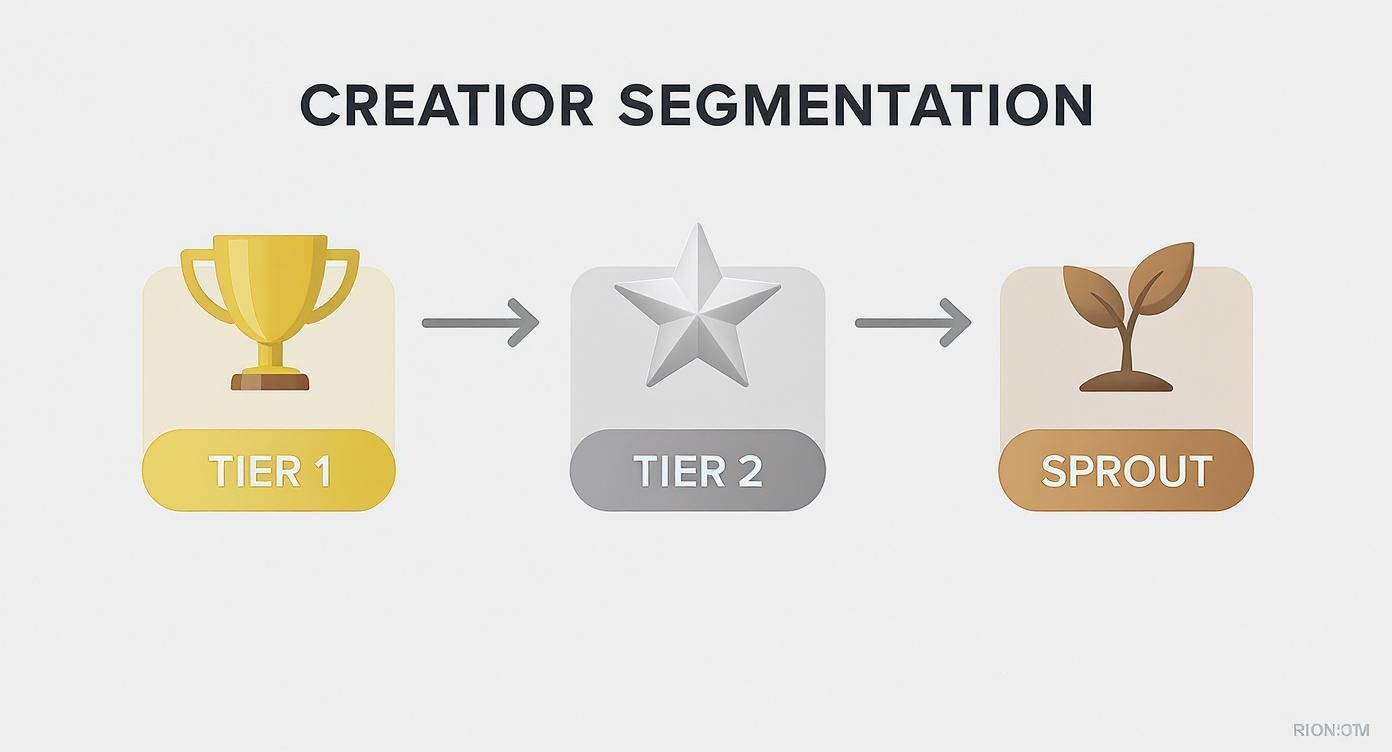
Thinking about your creators in these groups—like All-Stars, Steady Earners, and New & Promising—is a constant reminder that each tier needs a slightly different touch within your workflows.
Driving Activation and That All-Important First Post
Onboarding gets them in the door, but activation gets them on the board. The single most important goal here is to get that creator to post their first video with your product. Momentum is everything on TikTok Shop. The sooner they see that first commission roll in, the more fired up they'll be to create again.
Here are a few proven tactics I’ve seen work wonders:
- Send Free Samples with Purpose: Don’t just blindly ship products. Use a smart, automated workflow to send samples to your most promising new creators and track the delivery. The moment that package lands, trigger a follow-up message with a few killer content ideas.
- Offer a First-Post Bonus: A little incentive, like a $10 or $20 bonus for their first video that meets your guidelines, can be incredibly powerful. It lowers the barrier to entry and shows you're invested in their success from day one.
The activation phase is your first major test. Creators who receive a sample and post within the first 14 days are significantly more likely to become long-term, consistent performers. Your workflow should be designed to make this happen.
Nurturing for Long-Term Growth
Once a creator is active, the game changes. Your focus shifts to keeping your brand top-of-mind and actually helping them get better. This is the nurturing phase, where you build genuine loyalty and turn good creators into great ones. It's all about consistent, valuable communication.
This stage of your account management strategy is all about being proactive. You can share performance stats, celebrate their wins, and run exclusive competitions to keep things exciting. This kind of long-term thinking is becoming the new standard. The evolution of account management has seen a big shift from static plans to more dynamic approaches. As DemandJump notes, AI is now used to gather intelligence and track industry patterns, turning account plans into living, breathing documents.
Re-engaging Dormant Creators
It’s just a fact: some creators will go quiet. Maybe they got busy, or their first few videos didn't pop off like they hoped. A reactivation workflow gives you a system to bring them back into the fold without having to manually chase every single one.
Just set up an automated trigger that flags creators who haven't posted in, say, 30 or 45 days. From there, send a friendly check-in. Ask if they need any support or want to try a new product. Sometimes, that simple nudge is all it takes to get the conversation—and the content—flowing again.
Scaling Your Outreach with Automation Tools
This is where all that groundwork on your lifecycle workflows really pays off. A well-thought-out account management strategy is useless if you can't execute it consistently. Let’s be real—trying to manually manage hundreds of creators is a direct path to burnout. The answer isn't to hire an army; it's to work smarter with automation.
Think of automation tools as the engine that brings your strategy to life at scale. They take over the repetitive, time-sucking tasks, which frees you up to focus on what actually moves the needle—like building real relationships with your Tier 1 All-Stars. This isn't about replacing the human touch; it's about amplifying it where it matters most.
And the industry is catching on. The global market for account planning tools is already projected to reach USD 1.4 billion and is expected to climb to USD 2.2 billion by 2035. This boom is driven by AI and real-time analytics becoming non-negotiable for modern account management. You can dig deeper into the future of account planning tools and see how they’re evolving.
Putting Automation into Practice
So, what does this look like day-to-day?
Imagine setting up a message sequence that automatically onboards every new affiliate. No more copy-pasting welcome messages or manually sending product info. Instead, every single creator gets a polished, professional introduction to your brand the second they sign up.
Or picture this: a trigger that automatically sends a personalized congratulations message when a rising star hits their first $100 in commission. It's a small, automated gesture, but it makes a creator feel valued and motivated. It strengthens their bond with your brand without adding a single thing to your to-do list.
Automation ensures every creator gets a consistent, positive experience, regardless of their tier. It systemizes the little things that build big relationships, ensuring no one feels ignored or left behind as you scale.
You can also get proactive. Set up a workflow that sends a friendly reminder to creators who received a product sample but haven't posted within 10-14 days. It's a simple, non-pushy follow-up that can make a huge difference in your sample conversion rate.
Executing Workflows with HiveHQ Affiliate Bot
This is exactly what tools like the HiveHQ Affiliate Bot were built for. They let you design and execute custom message sequences based on specific creator actions or timelines.
Here are a few practical workflow ideas you can build right away:
- Onboarding Flow: A three-part message sequence sent over five days to new affiliates, covering welcome info, product highlights, and content guidelines.
- Activation Nudge: An automated message that goes out seven days after a sample is delivered, checking in and offering some quick content ideas.
- Performance Milestone Celebration: A trigger that sends a "Congrats!" message and maybe a small bonus code when a creator crosses $500 in GMV.
- Re-engagement Campaign: A workflow that reaches out to creators who've been inactive for 45 days, offering a new product or an increased commission rate to get them excited again.
When you start implementing these, your account management strategy shifts from a list of manual chores to a self-sustaining system. It guides every creator through their journey, helps them reach their potential, and drives predictable growth for your TikTok Shop—all without overwhelming you or your team.
How to Track Performance and Optimize Your Strategy
https://www.youtube.com/embed/Q0abFq3lJWY
An account management strategy without measurement is just a bunch of good intentions. If you want to turn your efforts into a reliable growth engine, you have to close the loop by tracking what’s working and what isn't. This is where guesswork ends and real, data-driven optimization begins.
The whole point is to turn raw data into insights you can actually use to sharpen your strategy over time. Using a tool like a dedicated Profit Dashboard is a great starting point. It gives you that 30,000-foot view of the big KPIs you set earlier, like overall GMV and program ROI, so you always know how you're tracking financially.
From Raw Data to Actionable Insights
But solid performance tracking goes deeper than just sales numbers. You need to dig into the specifics to understand why certain creators or campaigns are popping off. This is where a specialized Creator Tracker becomes your best friend, pulling all that individual performance data into one place.
Imagine you're looking through your creator data and notice affiliates in the "skincare" niche have a 30% higher conversion rate than your "fashion" creators. That one insight is gold. It’s a clear signal to shift your recruitment focus and double down on finding more skincare creators to get a better return on your investment.
If you weren't tracking at this granular level, you'd be flying blind, probably still spending time and money on partners who just aren't as effective for your brand.
The goal of performance tracking isn’t just to report on what happened; it’s to inform what you do next. Every data point should answer the question, "How can we do this better?"
Establishing a Simple Reporting Rhythm
To keep from getting buried in data, you need a simple and sustainable reporting cadence. This makes sure you're looking at the right metrics at the right time without living in spreadsheets.
Here’s a practical rhythm that works well:
- Daily Checks (5-10 minutes): Keep this quick. You're just scanning for immediate opportunities or red flags. See a new video with your product going viral? Jump on it. Engage with the creator and see how you can support or boost the content.
- Weekly Reviews (30 minutes): This is your time to analyze trends. How are your different creator tiers performing? Are your Tier 1 creators still crushing it? Do you have any Tier 2 creators who are showing potential and might be ready for a promotion?
- Monthly Analysis (1-2 hours): Time to zoom out and look at the big picture. This is when you'll calculate your overall program ROI, check your commission-to-revenue ratio, and really evaluate the success of any specific campaigns you ran that month.
Following a structured process like this is how you continuously refine your account management strategy, making sure you’re building sustainable, long-term growth for your TikTok Shop.
Got Questions? We've Got Answers
Stepping into TikTok Shop creator partnerships often brings up a ton of questions. As you get your account management strategy rolling, it's totally normal to hit a few bumps or wonder about the best way to handle certain situations. Let's tackle some of the most common ones sellers run into.
So, How Many Creators Can I Realistically Manage?
There's no magic number here that fits every single brand. A great place to start is with a solid, manageable group of about 20-30 creators. This gives you enough volume to see what's working without getting completely swamped while you're still ironing out your onboarding process and communication style.
Once you have those workflows humming and some automation in place, you can absolutely scale up to handle hundreds of affiliates. The real trick isn't the total count; it's how you segment them. Focus your hands-on, high-touch effort on that top 10-20% of creators who are actually driving the sales. This frees you up to manage a much larger pool of talent effectively.
What's the Best Way to Deal with Creators Who Ghost Me?
It's a classic headache: you ship out a product sample, and then… radio silence. Instead of chasing each one down individually, the best approach is to build a system for it. An automated message sequence is your best friend here.
A simple, friendly reminder about 7-10 days after the product delivery confirmation usually gets things moving. If that doesn't work, a second, slightly more direct message a week later can often prompt a response. If they're still silent after that? It's time to cut your losses.
Don't burn your energy chasing ghosts. Just move them to a 'dormant' list in your system and pour that time and effort back into the partners who are actually posting and getting results.
Should I Be Paying Creators a Flat Fee on Top of Commission?
For the vast majority of affiliates in your TikTok Shop program, a commission-only model is the industry standard—and for good reason. It’s the most sustainable way to operate, directly linking what you pay to the sales they generate. This keeps your program profitable as it scales.
That said, there are times when it pays to be strategic. For your absolute rockstar creators or for a really important campaign—like a major new product launch—offering a flat fee or a "seeding bonus" can be a game-changer. It can lock in high-quality, dedicated content and really strengthen those crucial relationships. Just reserve this tactic for proven, high-impact partners where you know the upfront investment will pay off.
Ready to stop guessing and start scaling? With HiveHQ, you can automate your creator workflows, track performance with precision, and build a predictable revenue engine on TikTok Shop. Get started with our all-in-one platform at https://hivehq.ai.