Affiliate Keyword Research for TikTok Shop

affiliate keyword researchTikTok Shopkeyword researchaffiliate marketingTikTok SEO
Affiliate keyword research is all about getting inside your customer's head and figuring out the exact phrases they type into the search bar when they're looking to buy. This isn't a game of just driving traffic; it's about finding those golden, commercially valuable keywords that attract people who are ready to pull out their wallets. Get this right, and you'll see a direct impact on your commission earnings.
Why Traditional Keyword Research Fails on TikTok
Let's get one thing straight: old-school SEO tactics are dead on arrival on a platform that moves at the speed of a viral trend. Trying to apply a rigid, Google-first mindset to TikTok is like trying to fit a square peg in a round hole. It just doesn't work because it completely misses the point of social commerce, which is all about discovery and impulse.
This is a huge stumbling block for so many affiliate marketers. They get fixated on high search volume numbers from tools built for Google, totally ignoring the chaotic, visual, and trend-driven nature of TikTok. A keyword with 50,000 monthly searches on Google might be a complete dud on TikTok if it doesn’t align with a popular video format, a trending sound, or a conversation happening right now in the comments.
Shifting Your Focus from Volume to Intent
The real secret is to pivot your entire affiliate keyword strategy. Stop hunting for massive volume and start trying to deeply understand user intent. On TikTok, you can see intent everywhere—in the hashtags, the trending audio clips, and the specific language people use in video comments. Someone searching for "best wireless earbuds review" on Google is in a completely different headspace than someone scrolling through videos tagged with #techdupes or #tiktokmademebuyit.
To win here, you need a modern framework built from the ground up for social commerce. This means finding keywords based on their potential to spark immediate interest and drive a quick sale, not just rack up passive views. Your research should be a constant cycle of discovery, mapping, and analysis.
This process is what a modern, effective affiliate keyword research strategy for TikTok looks like.
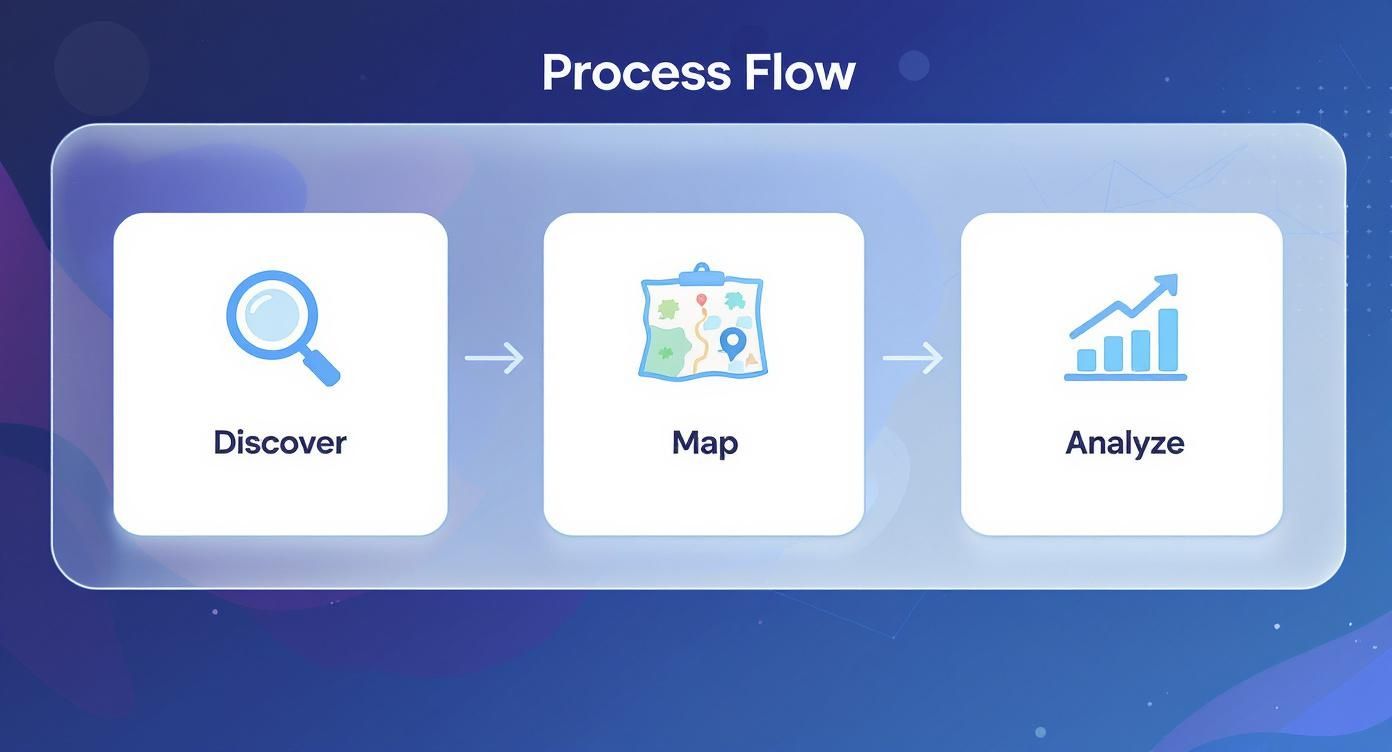
As you can see, it all starts with finding terms that feel native to the platform. From there, you map their intent and analyze their real commercial potential, creating a feedback loop that keeps your strategy sharp.
The Power of Socially-Driven SEO
This approach isn't just a hunch; it lines up perfectly with where the industry is heading. Affiliate marketing is now deeply intertwined with SEO-driven insights. In fact, current data shows that around 70% of all affiliate traffic is generated from organic search. What's more, 78% of marketers confirm that SEO is their key to generating more organic traffic, which is absolutely crucial for conversions. You can dive deeper into the full research on affiliate marketing statistics to see the full picture.
The biggest mistake is treating TikTok search like Google search. On TikTok, the 'search engine' is the 'For You' page. Your goal is to find keywords that help the algorithm understand who needs to see your video, not just who is actively searching for it.
At the end of the day, a winning strategy for TikTok Shop affiliates comes down to a few core things: discovering those untapped social keywords, mapping them directly to the unique buyer's journey on the platform, and using the right tools to stay one step ahead of the next viral trend. This is the foundation we’re about to build on.
Finding Untapped Keywords on TikTok and Beyond
While the usual keyword research tools give you a good foundation, the real magic for TikTok affiliates happens where most marketers aren't even looking. If you want to find genuinely untapped opportunities, you have to get your hands dirty, dive deep into the platform's culture, and start thinking like a user.
Forget search volume and CPC for a minute. Your mission is to uncover the raw, unfiltered language your audience uses every single day. We're looking for keywords that are just starting to bubble up, not the ones that are already oversaturated.
Mine TikTok Directly for Keyword Gold
Your best source of intel is TikTok itself. Seriously, the platform is a massive, living focus group if you know where to dig. Before you open any complex software, start right here with these simple but incredibly effective methods.
- Look at Viral Hashtags and Sounds: Go deeper than the obvious ones like
#TikTokMadeMeBuyIt. You need to spot the niche-specific hashtags that are gaining traction in your corner of the internet. A trending sound that’s constantly paired with a certain type of product is a huge keyword signal. For example, if a specific audio clip is always in gadget unboxing videos, that sound is the keyword. - Get Lost in the Comment Sections: The comments on any popular product review video are an absolute goldmine. This is where you'll find the exact questions, frustrations, and comparison terms people are using. Phrases like “is this better than the [competitor] one?” or “does it actually work for oily skin?” are perfect long-tail keywords just waiting to be turned into content.
- Reverse-Engineer Your Competitors: Don't just mindlessly scroll through what successful creators are posting—dissect their work. What phrases are they putting in their on-screen text? What about their captions and video titles? They’ve already done a lot of the A/B testing for you, showing what the algorithm and their audience respond to.
This is a perfect example from TikTok's own Discover page, showing the hashtags, sounds, and effects that are grabbing everyone's attention right now.
Keeping an eye on these real-time trends lets you spot new product categories and user interests before they blow up, giving you a serious first-mover advantage.
The most powerful affiliate keywords on TikTok rarely look like traditional keywords. They're conversational phrases, inside jokes, niche slang, or even the name of a viral challenge. Your job is to translate these cultural moments into a smart content strategy.
Look Beyond the Platform for Deeper Insights
While TikTok is your main playground, stepping off-platform can reveal a completely different layer of what your audience is thinking. People flock to forums and other social sites to ask the detailed questions they can't get answered in a 60-second clip.
Think of it this way: TikTok is for discovery, but forums are for validation. This is where you’ll find the super-specific, problem-focused keywords that signal someone is ready to buy.
Uncovering Audience Pain Points on Reddit and Quora
Sites like Reddit and Quora are fantastic for understanding the why behind a search. People aren't trying to perform for an audience; they're looking for real solutions to real problems.
Here’s a simple, methodical way to mine these sites:
- Find the Right Communities: First, identify the subreddits or spaces where your audience hangs out. If you're promoting home coffee gear, you should be living in places like
r/espressoorr/Coffee. - Search for Problem-Oriented Language: Once you're in, look for posts using words like “help,” “question,” “recommendation,” or “what’s the best.” The titles of these threads are often fully-formed, high-intent keywords. A post titled “Recommendation for a quiet coffee grinder for apartments” is a perfect example—a ready-made keyword with clear commercial intent.
- Analyze the Language They Use: Pay close attention to how people describe their issues and what features matter most to them. You should mirror this exact language in your TikTok content to build instant trust and relatability. If everyone in a subreddit is complaining about a specific product's flaw, you've just found a golden opportunity for a video about "alternatives to [flawed product]."
By blending on-platform trend spotting with off-platform problem-solving, you build a powerful affiliate keyword list that no single tool could ever give you. This two-pronged approach ensures your content is not only timely enough for the TikTok algorithm but also deeply connected to what your potential customers actually need. This is how you stop chasing views and start driving real, predictable sales.
How To Turn A Messy Keyword List Into A Money-Making Plan

So, you've got a massive, disorganized list of keywords. Congratulations, you've completed the first step. But right now, it's just noise. The real magic in affiliate keyword research isn't finding terms; it's knowing how to sift through that mountain of data to pinpoint the gems that will actually make you money.
This is where we move from raw data to a smart, actionable content strategy. It's about building a system to turn that spreadsheet of hundreds (or thousands) of phrases into a focused plan, balancing all the factors to spot the real opportunities.
What Metrics Actually Matter?
Before you can prioritize, you need to know what you're looking at. There are dozens of metrics you could track, but in my experience, only a few are truly critical for making smart affiliate marketing decisions.
- Search Volume: This is the most obvious one—the estimated number of times a keyword is searched per month. It's a great starting point for gauging traffic potential, but it should never be your only guide. A high-volume keyword with zero buying intent is a total waste of time.
- Keyword Difficulty (KD): Presented as a score (usually from 1-100), this estimates how hard it will be to crack the first page of Google. If you're a new affiliate or have a smaller site, targeting keywords with a lower KD is your ticket to gaining early traction.
- Cost Per Click (CPC): Even if you aren't running paid ads, CPC is a goldmine of information. It's a powerful signal of commercial intent. If advertisers are willing to pay top dollar for a click, you can bet that keyword converts to sales.
These numbers give you the what, but the real skill is in how you weave them together to understand the why behind a keyword's potential.
My Go-To Framework for Prioritization
The best way I’ve found to make sense of a huge keyword list is to sort every term into one of two buckets: Quick Wins and Authority Builders. This simple mental model helps me balance my immediate need for commission checks with my long-term plans for growth.
Target The Quick Wins First
These are your low-hanging fruit—the keywords you should go after right away. They are a new affiliate’s best friend.
A "Quick Win" keyword usually has:
- Lower search volume (think 50-500 searches/month).
- Low keyword difficulty (I look for KD < 20).
- High commercial intent (look for modifiers like "review," "vs," "best for," or "alternative").
These terms won't bring a tsunami of traffic, but the people who do show up are ready to buy. Stringing together a series of these wins builds that crucial initial revenue and proves your strategy is working.
Build Your Foundation With Authority Builders
These are your long-term plays. They take more time and effort, but the payoff can be huge.
An "Authority Builder" keyword typically has:
- Higher search volume (often 1,000+ searches/month).
- Higher keyword difficulty (KD > 30).
- Broader, more informational intent (phrases like "how to use," "what is," or "getting started with").
Ranking for these is a grind. But landing a top spot for an authority-building term can turn into a pillar for your site, driving consistent traffic and establishing your credibility in the niche for years.
Don't fall into the classic trap of only chasing huge-volume keywords from day one. A well-curated portfolio of low-competition, high-intent "quick win" keywords will almost always generate more commission income in the first six months than a single high-competition term you're barely ranking for.
Putting It All Together with a Prioritization Matrix
To take the guesswork out of this, I use a simple prioritization matrix in a spreadsheet. This helps me score and rank my keywords objectively, giving me a clear, data-driven roadmap for my content calendar.
Making these strategic choices is what separates successful affiliates from the rest. It’s no surprise that affiliate marketing spending in the US hit a staggering $8.2 billion in 2023, a 10.8% jump from the year before. That growth is fueled by marketers who understand that targeted research delivers a better ROI, which is why 62% of them are planning to increase their affiliate budgets. You can dig deeper into these affiliate marketing trends to see where the industry is heading.
To get started, you can build a simple scoring system like the one below.
The Affiliate Keyword Prioritization Matrix
I've found this framework invaluable for scoring keywords based on a mix of traffic potential, buying intent, and how hard they are to rank for. It instantly shows you where to focus your energy.
| Keyword | Monthly Volume | Competition Score (1-100) | Commercial Intent (Low/Med/High) | Priority Score |
|---|---|---|---|---|
| best wireless mic for TikTok | 800 | 25 | High | 8 |
| how to get clear audio | 2,500 | 45 | Low | 4 |
| Shure MV7 vs Rode PodMic | 350 | 18 | High | 9 |
| cheap lavalier mic review | 200 | 12 | High | 10 |
By creating a simple "Priority Score" based on these factors, you get a clear plan of attack. This ensures you're always working on the piece of content that has the highest potential to impact your bottom line right now.
From Keyword to Ka-Ching: Creating TikToks That Actually Sell
Finding the right keyword is only half the battle. You can target the perfect phrase, but if the video you make is a dud, all that research goes right out the window. This is where you turn your data into dollars by creating content that doesn't just get views, but actually convinces someone to tap that little orange shopping cart.
Remember, TikTok isn't Google. People are there to be entertained, not to sift through search results. Your content has to feel like a native part of their "For You Page," grabbing their attention instantly and offering value—whether it's a laugh, a life hack, or a jaw-dropping product demo. You have three seconds to stop the scroll. Make them count.
Match the Content Format to the Searcher's Vibe
Different keywords signal different needs, and your video format should reflect that. Think about what the person typing in that phrase is really looking for.
For instance, someone searching "best wireless mic for TikTok" is in full-on shopping mode. They have their wallet out and they're looking for a clear recommendation. This is your cue to create a direct comparison video or a "Top 3 Mics Under $50" listicle. They want you to help them make a decision, fast.
But what about a broader keyword like "how to get clear audio for videos"? This person has a problem, but they might not even know a product is the solution yet. A tutorial is the perfect fit here. Show a quick "before and after" clip demonstrating how a specific mic solves their exact problem. You're not just selling a product; you're solving their frustration.
Here are a few formats that consistently crush it for TikTok Shop affiliates:
- Real-Deal Product Reviews: This is your bread and butter. Don't just list the specs. Show yourself using the product in a real-life situation. What specific problem does it solve for you? Being honest, even about minor downsides, builds massive trust.
- Problem/Solution Hooks: Start the video by showing a super-relatable frustration. Then, BAM—introduce the product as the hero. This format works so well because it connects with the viewer's pain point immediately.
- "Top 5" Listicles: These are addictive and highly shareable. Use quick cuts, bold text on the screen, and a countdown structure. Always save your top recommendation for last to keep people watching.
- Comparison & "Dupe" Videos: Putting two popular products head-to-head (like "Anker Power Bank vs. INIU") or showing a cheaper "dupe" for a viral high-end product is a recipe for engagement and clicks.
The whole game is about matching your video style to the user intent you already figured out during your keyword research.
Weaving Keywords into Your Video's DNA
Just tossing your keyword in the caption is rookie stuff. To truly signal your video's relevance to the TikTok algorithm, you need to embed it everywhere.
Think of it as a layered approach. You want the algorithm to see, hear, and read the keyword.
- Say It Out Loud: Mention your target keyword within the first few seconds. For example: "If you're on the hunt for the best wireless mic for TikTok, stop scrolling."
- Plaster It On-Screen: Use text overlays with your keyword. This is a non-negotiable, since a huge chunk of users watch with the sound off.
- Drop It in Your Caption & Hashtags: This is the obvious one, but it’s still crucial. Make your primary keyword one of your very first hashtags.
The most powerful TikToks are aligned on every level. The algorithm hears the spoken words, reads the on-screen text, and crawls the caption. When all three are singing the same tune, TikTok knows exactly who to show your video to.
Your Secret Weapon: The Simple Content Brief
To stay organized and make sure every video has a purpose, a content brief is your best friend. It doesn't have to be some fancy, complicated document. It's just a quick blueprint to ensure every video is strategically built around a keyword and its intent.
Here’s a dead-simple brief you can copy and paste for your next video.
| Element | Details |
|---|---|
| Primary Keyword | best portable charger for travel |
| User Intent | Commercial. They're looking for a product to buy for an upcoming trip. |
| The Hook (First 3 Sec) | "Stop letting your phone die when you travel. This is the only portable charger you need." |
| Video Format | Quick, punchy product demo and review. |
| Key Talking Points | 1. Show its compact size. 2. Demo how many charges it gives. 3. Highlight a cool feature (like built-in cables). |
| Call to Action (CTA) | "I linked the exact one I use in my TikTok Shop. Grab it before your next trip!" |
| Keyword Placements | Spoken in the hook, shown in on-screen text, and used in the caption/hashtags. |
This took less than five minutes to fill out, but now I have a clear roadmap. It guarantees the content nails the searcher's intent, hooks them immediately, and gives them a clear path to purchase. When you systematize your process like this, you stop guessing and start building a real, sales-generating content machine.
Automating Outreach and Tracking Your Success

All the sharpest keyword research in the world won't matter if you can't turn it into partnerships and sales. You’ve done the hard work—you have a prioritized keyword list and a stack of content briefs. That's your battle plan. Now it's time to actually execute it at a scale that moves the needle for your TikTok Shop.
Let’s be honest, manually finding, messaging, and tracking hundreds of creators is a direct path to burnout. This is where smart automation comes in, turning your research from a time-consuming chore into a scalable, revenue-driving machine.
Bridging Research and Recruitment
Your keyword research has already pointed you to the exact phrases your target audience is searching for. The next move is simple: find the creators who are already ranking for those terms. These are the people who have proven they can make content that your ideal customer loves.
Instead of starting your search from scratch, you can use a tool like the Affiliate Bot from HiveHQ to build a hyper-targeted outreach list. This completely flips the script on creator discovery. You're not just looking for creators in your niche; you're pinpointing those who have already captured the very audience you want to reach.
Here’s what that workflow looks like in practice:
- Feed the Bot Your Keywords: Take your high-priority, commercial-intent keywords and plug them straight into the system.
- Filter for the Best: Sift through the results using filters like follower count, engagement rate, and recent activity to find creators who fit your brand perfectly.
- Automate Your First Touch: Set up personalized message sequences to kick off conversations with dozens of qualified creators at once.
Suddenly, your keyword list transforms from a static spreadsheet into a dynamic lead-gen tool for building powerful affiliate partnerships.
Your keyword research shouldn't just guide your content; it should be the foundation of your entire creator recruitment strategy. Finding a creator who already ranks for "best portable charger for travel" is infinitely more valuable than finding a generic travel influencer.
From Outreach to Onboarding
Once you've connected with potential partners, the real work of managing those relationships begins. This is another area where manual methods fall apart fast, especially as you scale up. Trying to juggle spreadsheets, email chains, and DMs is a recipe for missed follow-ups and lost opportunities.
A centralized platform is the only way to keep everything on track. This is where a creator tracker becomes absolutely essential.
Using a dedicated system allows you to automate critical follow-ups. Imagine setting up a smart trigger that automatically sends a content brief the moment a creator's sample product ships. This ensures every partner gets the right information at exactly the right time, massively boosting the chances they'll create high-converting content that nails your target keywords.
Measuring What Matters Most: GMV
At the end of the day, the success of your affiliate keyword strategy is measured in one thing: Gross Merchandise Value (GMV). Clicks and views are nice, but what you really care about is revenue.
This is the final, crucial piece of the puzzle. You need a way to draw a straight line from a specific keyword to a specific creator to the exact amount of revenue they generated. A profit dashboard is built for exactly this, letting you track performance with surgical precision.
By integrating directly with your TikTok Shop, a profit dashboard can show you the metrics that count:
- GMV per Creator: See exactly which partners are your top performers.
- Commission Costs: Know precisely how much you're spending on each affiliate.
- Return on Ad Spend (ROAS): If you're boosting posts, measure the direct return.
- Cost of Goods Sold (COGS): Get a true picture of your profitability after all costs are factored in.
This level of data creates a powerful feedback loop. You can instantly see which keywords and content styles are driving the highest ROI, allowing you to double down on what works. It proves the value of your initial research and gives you the confidence to invest more in the strategies delivering real, measurable results.
Answering Your Top Affiliate Keyword Research Questions
https://www.youtube.com/embed/1x2W_a5EFb8
Alright, let's tackle some of the common questions that pop up once you start digging into affiliate keyword research for TikTok. Getting your hands dirty is where the real learning happens, and these are the hurdles most affiliates run into.
Think of this as a quick-reference guide to sharpen your strategy. Getting these details right often separates a campaign that falls flat from one that drives consistent commissions.
How Often Should I Be Doing Keyword Research?
On a platform like TikTok, keyword research is definitely not a one-and-done task. Trends and user behavior move incredibly fast, and a keyword list that worked last month could be totally irrelevant today.
I've found a two-pronged approach works best. Plan to do a major, deep-dive review of your niche and core keywords quarterly. This is your chance to zoom out, see what competitors are doing, and reassess your foundational strategy. But you also need to be in the trenches weekly, or at least bi-weekly, looking for those breakout trends, new viral products, and trending sounds that you can jump on right away.
On TikTok, a keyword's relevance can spike and die in a matter of days. Constant monitoring isn't just a best practice; it's a necessity for staying competitive and capturing fleeting opportunities before they become oversaturated.
This rhythm keeps you aligned with what people are actually searching for right now, not what they were searching for a month ago.
What Are the Best Free Tools for TikTok Keyword Research?
You don't need a huge budget to get started. While premium tools have their place, you can build an incredibly effective keyword strategy using resources that won't cost you a dime. You just have to be a bit scrappy.
Here are the free tools I always come back to:
- TikTok's Search Bar: Honestly, this is your best friend. Start typing a keyword and watch the autocomplete suggestions. Those aren't guesses; they're real-time insights into what actual users are looking for. It's the purest data you can get.
- AnswerThePublic: This tool is a goldmine for finding long-tail keywords framed as questions. It visualizes all the "who, what, why, where, how" questions people are asking about your topic, giving you a ton of content angles.
- Google Trends: While it's not TikTok-specific, Google Trends is fantastic for gauging the broader, long-term interest in a product or niche. This helps you figure out if a TikTok trend is just a flash in the pan or if it has real staying power.
Should New Affiliates Go After High-Competition Keywords?
It's so tempting to aim for those huge, high-volume keywords from day one, but it’s a classic beginner’s mistake. Targeting a hyper-competitive term when you're just starting is like trying to get on the main stage at a music festival when you've never played a gig. You have to earn your way there.
Instead, pour your energy into low-competition, long-tail keywords. These are much more specific phrases that attract a smaller but way more motivated audience. For instance, instead of going after "skincare," you’d have much better luck with something like "best vitamin c serum for oily skin."
This approach helps you get some early wins, make your first sales, and build authority in a very specific niche. Once your account starts to grow and you've built some credibility, you can start strategically targeting those bigger, more competitive terms.
How Do I Know if a Keyword Has Commercial Intent?
This is probably the single most important skill you can develop. You have to learn to tell the difference between people who are just browsing and people who have their wallets out. The good news is, users leave clues all over the place.
Look for specific "buyer" words and modifiers in their search terms. Phrases that include words like "review," "vs," "dupe," "discount," "code," or "best" are massive signals of high commercial intent.
Another pro tip is to dive into the comment sections of videos that are already ranking for that keyword. If you see comments like, "Where can I buy this?!" or "Do you have a link?"—you’ve struck gold. That's undeniable proof that the keyword drives purchase intent.
Ready to turn your keyword research into a scalable sales machine? With HiveHQ, you can automate creator outreach, track partnership performance, and measure the exact GMV your campaigns generate. Stop guessing and start growing with a platform built for TikTok Shop success. Explore HiveHQ and book your demo today!