Affiliate Marketing Keyword Research That Converts
affiliate marketing keyword researchaffiliate SEOprofitable keywordsaffiliate marketingkeyword strategy
When it comes to affiliate marketing, keyword research isn't just another box to tick on your SEO checklist. It's the strategic foundation that separates the affiliates who make a real income from those who just spin their wheels. The secret? Stop chasing high search volume and start focusing on high user intent.
This means digging for the exact phrases people use when they’re close to making a purchase, even if the search numbers look small at first glance.
Thinking Beyond Search Volume for Affiliate Success
Let’s be real for a second. Most of the keyword advice out there is all about chasing big, flashy numbers. You see a keyword with 50,000 monthly searches and the traffic potential seems huge. But for an affiliate marketer, that’s usually a trap. Not only are those high-volume keywords insanely competitive, but they’re also way too broad.
Success in this game is about getting into the head of the searcher. Someone typing "best camera" is just starting their journey. They’re browsing, comparing, and probably weeks away from actually buying anything. Sure, you might get some traffic, but your conversion rate will be abysmal.
The Power of High-Intent Keywords
Now, picture a different searcher. This one types in "Sony a7iii vs Fujifilm xt4 for travel video." See the difference? This isn't a casual browse. This is someone who has done their homework, narrowed down their choices, and is looking for that final nudge to make a decision.
This is the golden rule of affiliate marketing: A keyword with 300 monthly searches from users ready to buy will always be more profitable than a keyword with 30,000 searches from casual browsers.
Getting this right is the most important mindset shift you can make in affiliate marketing keyword research. Your job isn't to get the most traffic; it's to get the right traffic.
When you zero in on these high-intent, long-tail keywords, you start seeing real results. Here's why:
- You Attract Qualified Buyers: You’re speaking directly to people who are ready to pull out their credit cards, which naturally boosts your conversion rates.
- You Sidestep the Competition: Instead of fighting tooth and nail for generic terms, you carve out a space where your content can actually be seen and ranked.
- You Build Real Authority: By creating detailed content that answers very specific questions, you become the go-to expert people trust for advice.
Finding Your Golden Ticket Keywords
Alright, this is where the magic happens—the hunt for keywords that practically scream "I'm ready to buy." Great affiliate keyword research isn't just about random brainstorming; it's a deliberate process. You'll start with a "seed" keyword from your niche, which is really just your launchpad for discovering a whole universe of profitable terms.
Let's say your site is all about coffee. Your seed keyword might be something broad like "home espresso machine." That’s a decent start, but the real affiliate gold is found in the more specific phrases that spiral out from that initial idea.
Once you plug that seed keyword into a tool like Ahrefs or Semrush, you'll see what I mean. You'll quickly uncover gems like "breville barista express review" or "best espresso machine under 500." See the difference? These phrases show a much stronger intent to actually make a purchase.
Focusing on High-Intent Keyword Categories
As you start pulling these keywords, you'll begin to notice some clear patterns. Certain types of phrases are just naturally better at attracting people who are close to pulling out their credit cards. Knowing these categories is fundamental to building a content plan that actually drives commissions.
I've found that the most profitable affiliate keywords almost always fall into a few key buckets. These are the terms that signal a searcher has moved past casual browsing and is now actively evaluating their options.
High-Intent Affiliate Keyword Types
| Keyword Category | Buyer Intent Signal | Example Keyword |
|---|---|---|
| Reviews & Ratings | User wants a final opinion before buying. | "Nespresso Vertuo review" |
| Direct Comparisons | User is weighing two specific products. | "Breville vs De'Longhi espresso" |
| "Best Of" Listicles | User wants curated recommendations. | "best drip coffee makers 2024" |
| Problem/Solution | User has a specific need or pain point. | "quietest coffee grinder" |
| Price-Based | User is shopping with a specific budget. | "espresso machine under $200" |
| Brand-Specific | User is loyal to a brand but needs help choosing. | "which Jura coffee machine is best" |
These keyword types are your bread and butter because they target people at the most critical points in their buying journey.
This infographic breaks down how different types of keywords align with the buyer's journey, from initial awareness right through to the decision to buy.
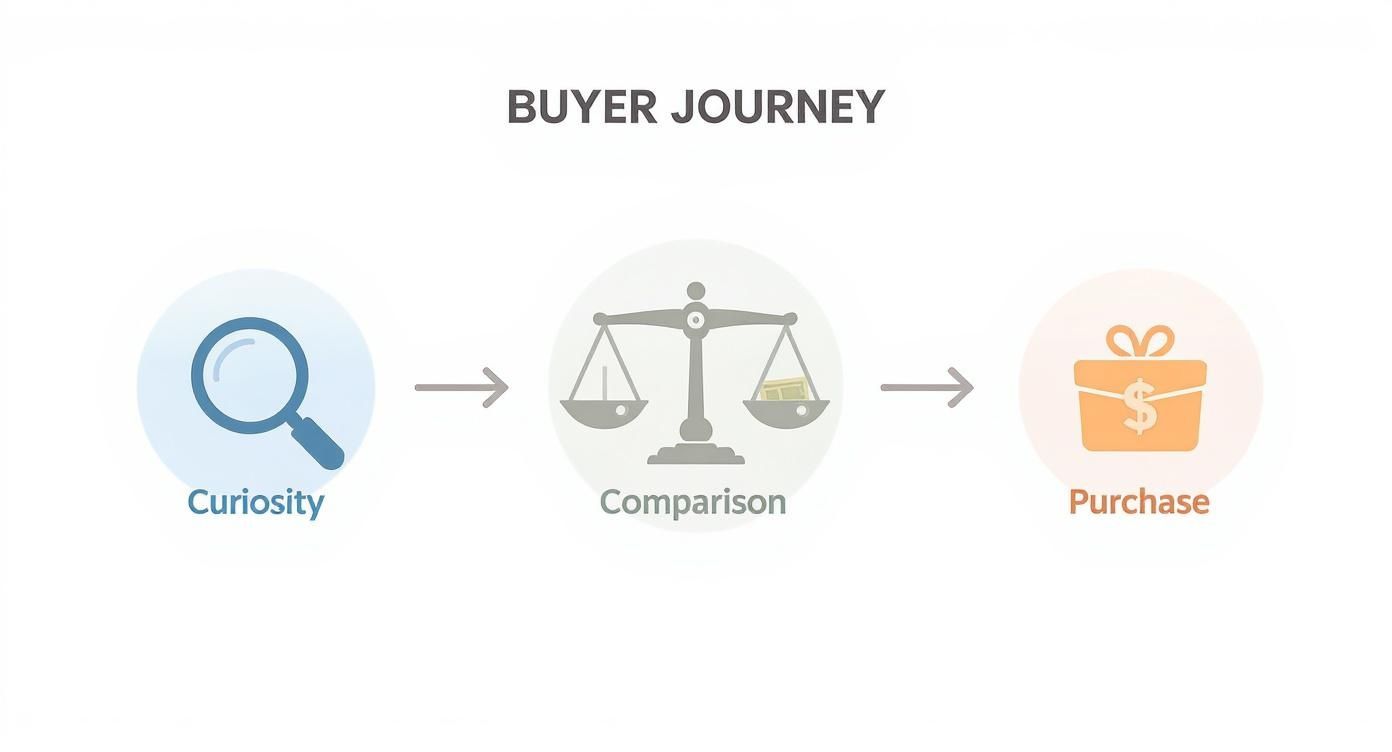
As you can see, the real action for affiliates is in the "Comparison" and "Purchase" stages. This is the domain of long-tail keywords, and they are your absolute sweet spot.
Long-tail keywords are known to convert about 2.5 times higher than shorter, more general keywords precisely because they tap into a very specific user need.
Think about it: an incredible 91.8% of all search queries are considered long-tail. Ignoring them means you're missing out on the bulk of search traffic that’s actually ready to convert. If you want to dive deeper into why this is so effective, there's some great research on MGID's blog that really breaks it down.
Decoding Keyword Metrics That Actually Matter
Alright, so you've got a list of potential keywords. Now the real fun begins. It's so easy to get fixated on huge search volumes, but chasing those big numbers is a classic rookie mistake in affiliate marketing. The real money is hidden in the story behind the data.
This is the exact spot where a lot of affiliates trip up. They see a keyword with 3,000 monthly searches and think it's a goldmine compared to one with just 300. More often than not, the opposite is true. You have to look at a few key metrics together to see a keyword's true potential.
Finding the Sweet Spot: Buyer Intent and Competition
For any affiliate marketer, the two numbers that should jump off the page are Cost-Per-Click (CPC) and Keyword Difficulty (KD). A high CPC is like a giant, flashing green light. It tells you that companies are shelling out good money for every click, which is a dead giveaway that the traffic converts into sales. If advertisers are paying, there's profit to be made.
On the flip side, Keyword Difficulty tells you how brutal the fight will be to get on Google's first page. Tools like Ahrefs calculate this score by looking at the backlink profiles of the pages already ranking. If you have a newer site, trying to rank for a keyword with a KD of 50 is just setting yourself up for failure. But a KD of 5? That’s an opportunity you should jump on.
Let's look at a real-world example for a drone review site. You're trying to choose between two keywords:
- "best beginner drone": Search Volume: 3,000 | KD: 45 | CPC: $2.50
- "dji mini 2 se review": Search Volume: 300 | KD: 8 | CPC: $4.00
That first keyword's volume is tempting, I get it. But with a KD of 45, you'll be wrestling with authority sites for years. The second keyword is the smarter, more strategic play.
The much lower competition (KD 8) gives you a legitimate shot at ranking, while the higher CPC ($4.00) screams "buying intent." Sure, you'll get less traffic, but the people who do show up are much closer to making a purchase.
This is what smart keyword selection is all about. You're not just looking for traffic; you're looking for traffic that puts money in your pocket. By balancing these metrics, you can confidently pick the keywords that will actually drive commissions.
Reading the SERP to Find Your Opening

Keyword tools are great for giving you data, but they don't paint the full picture. The real source of truth is the SERP (Search Engine Results Page) itself. It shows you exactly what Google thinks searchers want for any given keyword. Before I even think about writing an article, I always do a manual SERP analysis. It's non-negotiable.
Honestly, this hands-on check is the single most important step you can take. It keeps you from wasting months creating content that was dead on arrival. This is where you confirm that the opportunity your tools pointed to is real and figure out how you can actually win.
Analyzing the Competition
First thing’s first: you need to size up who you’re up against. Go ahead and search for your target keyword. Now, look closely at the top 10 results. Who are they?
Are you seeing massive authority sites like Forbes, The New York Times, or Wirecutter? Or are you seeing smaller, niche-specific blogs that look a lot like yours?
If the first page is a wall of household names, breaking in will be a serious uphill battle, especially if your site is new. But if you spot other affiliate blogs, forums like Reddit and Quora, or other user-generated content, that's a fantastic sign. It’s Google telling you it's willing to rank content from smaller players.
My personal rule of thumb is simple: If I can spot two or three other independent affiliate sites on the first page, I know I have a fighting chance. It tells me the competition is tough, but not impossible.
Understanding Content Format and Intent
Next, you need to dissect the type of content that’s ranking. This is your roadmap. Google is literally showing you what kind of content searchers want to find. This isn't just about scanning page titles; it’s about understanding the structure and goal of each ranking page.
Look for the dominant patterns. Is the SERP filled with:
- "Best of" listicles? (e.g., "7 Best Air Purifiers")
- In-depth single product reviews? (e.g., "Coway Airmega 200M Review")
- Head-to-head comparisons? (e.g., "Coway vs. Levoit Air Purifiers")
- Informational guides? (e.g., "How Do Air Purifiers Work?")
- YouTube videos?
If the top five results are all "best of" listicles, your brilliant single-product review probably isn't going to get much traction. It just doesn't match what users are looking for. Your goal isn't to reinvent the wheel here. It’s to create a better, more helpful version of what Google already knows works.
This part of your affiliate marketing keyword research tells you not just if you can rank, but what you need to create to get there.
Weaving Keywords into Content That Converts

Okay, you've done the hard work of finding those golden affiliate keywords. But solid research is just one side of the coin. Now, it's time to transform that list of phrases into a piece of content that actually earns you commissions.
This isn’t about just sprinkling your keywords into a generic article and hoping for the best. The real goal is to create something genuinely helpful—a resource that guides someone toward a confident decision. Get this right, and you'll satisfy both Google's algorithm and your reader's needs.
Structuring for Conversions
Every great piece of affiliate content starts with a strategic outline, and your primary keyword is the cornerstone. You need to place it in a few key spots right away to signal to search engines what your article is all about.
For high-impact affiliate articles—think "best of" roundups or head-to-head product comparisons—a proven structure makes all the difference. It helps you place keywords naturally while leading your reader down a path that ends with a click.
Here’s a quick on-page checklist I always follow:
- H1 Title: Your main keyword has to be here. For example, "Best Air Purifier for Pet Dander."
- Introduction: Weave your primary keyword into the first 100 words to set the stage immediately.
- URL Slug: Keep it short and sweet, and include the primary keyword. Something like
/best-air-purifier-pet-danderworks perfectly. - H2/H3 Subheadings: This is where you bring in your secondary keywords. Use them to organize your content and make it easy for people to scan.
- Image Alt Text: Don't forget your images! Describe them accurately and use relevant keywords where it makes sense.
Following this structure helps build authority and trust. You’re not just writing for a search engine bot; you're creating a genuinely useful guide that answers the questions your audience is asking. That's how you earn the click.
The growing popularity of voice search really drives this point home. We have to start optimizing for more conversational, question-based searches. In fact, titles that include a question word often see a huge jump in engagement.
This isn’t just a hunch; the data backs it up. A surprising 8% of all searches are typed in as questions. Better yet, articles with question-based titles can get up to 14.1% more clicks. You can find more details in these fascinating SEO statistics on Keyword.com.
When you focus on truly answering your audience's questions, you naturally build content that ranks and converts.
Answering Your Top Keyword Research Questions
Even with a solid plan, you're bound to run into a few questions when you're deep in the keyword research trenches. It happens to everyone. Let's walk through some of the most common ones I hear, so you can get clear answers and keep your momentum going.
How Many Keywords Should I Target in One Article?
This is a classic question. The simple answer is to focus on one primary keyword per article. Think of this as your article's main theme—the core idea you want to rank for. It should be front and center in your title, URL, and the first few sentences to signal your topic to both people and search engines.
Once you have your primary target, you can sprinkle in 3 to 5 related long-tail keywords naturally throughout the content. This isn't about stuffing; it's about adding depth and context. Doing this helps Google see the full picture of what your article covers, allowing you to rank for a whole cluster of related searches with a single, high-quality piece.
What Is a Good Keyword Difficulty Score to Target?
There’s no magic number here—it all comes down to your website's authority. If you're just starting out with a brand-new site, you need to be realistic. I always recommend sticking to keywords with a Keyword Difficulty (KD) score under 10, using a tool like Ahrefs as your benchmark. This gives you a fighting chance to get some early wins.
For a more established site that has been around a while and has a decent number of backlinks, you can start aiming for keywords in the 20-40 range. Don't even think about going after those super competitive terms until your site is a recognized player in its niche.
The real secret is to focus on relevance and purchase intent first. It's always better to rank for a lower-volume keyword that converts than to chase a high-volume term you have no chance of ranking for.
Can I Do Affiliate Keyword Research for Free?
You absolutely can, but you'll be trading money for time. Free tools are fantastic for getting your initial ideas flowing and figuring out what questions your audience is actually asking.
A solid free toolkit would include a mix of these:
- Google Keyword Planner: Great for getting ballpark search volume figures.
- AnswerThePublic: A goldmine for unearthing the question-based phrases people are typing into Google.
- Google's Own SERP: Don't overlook the "People Also Ask" boxes and autocomplete suggestions. They're direct lines into the searcher's mind.
While you can get pretty far with these, serious affiliate marketers eventually invest in a paid tool. Something like Ahrefs or SEMrush gives you the accurate difficulty scores and competitor insights that are just too hard to piece together on your own.
Ready to scale your TikTok Shop with powerful automation and data-driven insights? HiveHQ combines an Affiliate Bot, Profit Dashboard, and Creator Tracker to help you discover top-tier creators, automate your outreach, and maximize your ROI. Stop guessing and start growing by visiting https://hivehq.ai to see how our all-in-one suite can transform your affiliate strategy.