A Guide to Affiliate Program Management

affiliate program managementaffiliate marketingpartner marketingaffiliate recruitmentperformance marketing
Managing an affiliate program is far more than just setting up a system and hoping for the best. It's about actively steering your affiliate channel, from mapping out clear goals and designing smart commission plans to recruiting the right partners and meticulously tracking what works. At its heart, the goal is to build a reliable, growing revenue stream by giving your affiliates everything they need to win.
Building a Strong Foundation for Your Affiliate Program
A great affiliate program is built, not stumbled upon. I’ve seen it time and time again: businesses get excited and jump straight into recruiting partners without laying any groundwork. This almost always leads to wasted time, frustration, and disappointing results. Real, effective affiliate program management starts with defining success for your business, creating an incentive structure that actually motivates, and picking the right tech to keep track of it all.
Nailing these fundamentals from the get-go helps you sidestep the most common headaches, like ending up with low-quality affiliates, paying out unsustainable commissions, or being completely unable to prove your ROI. Think of it like building the engine of a car before you hit the road. You won't get very far without a powerful, well-built engine.
Defining Your Program's Core Objectives
First things first, you need clear, meaningful goals. "Increase revenue" is a start, but it's not a real objective—it's too vague. The best goals are specific and connect directly to your bigger business metrics. Let’s move beyond just top-line sales and think about profitability and smart growth.
Try focusing on more strategic objectives like these:
- Improve Customer Acquisition Cost (CAC): Can you acquire new customers through affiliates at a lower cost than, say, your paid ad campaigns? That's a solid goal.
- Increase Customer Lifetime Value (LTV): The idea here is to recruit affiliates whose audiences are a perfect match for your brand, bringing in customers who stick around longer.
- Boost Average Order Value (AOV): You can encourage partners to promote your higher-value products or special bundles to increase the size of each sale they generate.
- Expand into New Markets: Need a foothold in a new country or demographic? Partnering with influential affiliates in that space is an incredibly efficient way to do it.
Taking a strategic approach is critical, especially when you consider how fast this industry is growing. The global affiliate marketing space is expected to hit $31.7 billion by 2031, and more than 80% of advertisers already rely on it. This kind of growth means you need a tightly managed program that delivers real, measurable value. You can dig deeper into these affiliate marketing trends and see how they're shaping e-commerce.
Designing a Compelling Commission Structure
Your commission structure is your single most powerful tool for motivating partners. It has to be attractive enough to bring in high-quality affiliates but also sustainable for your own bottom line. There’s no magic formula here; the right model is all about your business goals.
Comparing Affiliate Commission Models
Choosing the right commission model is a crucial decision. Each structure incentivizes different behaviors and works best for different types of businesses. This table breaks down the most common models to help you figure out what makes sense for your program.
| Commission Model | How It Works | Best For | Potential Drawback |
|---|---|---|---|
| Flat-Rate (PPS) | A fixed percentage or dollar amount for every sale. | Simplicity, high-volume sales, predictable costs. | May not motivate top performers to push harder. |
| Tiered Commission | Commission rate increases as affiliates hit sales targets. | Motivating high-performers, encouraging growth. | Can be more complex to manage and track. |
| Pay-Per-Lead (PPL) | Affiliates earn a fixed amount for each qualified lead. | Service-based businesses, high-value B2B products. | Leads may be lower quality if not properly vetted. |
| Pay-Per-Click (PPC) | Affiliates earn a small amount for every click sent. | Building brand awareness and driving top-of-funnel traffic. | High risk of fraud; not directly tied to revenue. |
Ultimately, the best structure is one that aligns perfectly with what you're trying to achieve—whether that's raw sales volume, lead generation, or rewarding your most loyal partners.
Here's a simple way to think about it:
A flat-rate commission (like 10% on every sale) is beautifully simple. It's easy for everyone to understand and works great if your main goal is just driving as many sales as possible across your entire product line.
On the other hand, a tiered commission structure is designed to reward your superstars. For example, an affiliate might earn 10% on their first 20 sales, 15% on the next 30, and a top rate of 20% on every sale after that. This is a fantastic way to keep your best partners engaged and pushing for that next level.
This visual really clarifies the decision-making process:
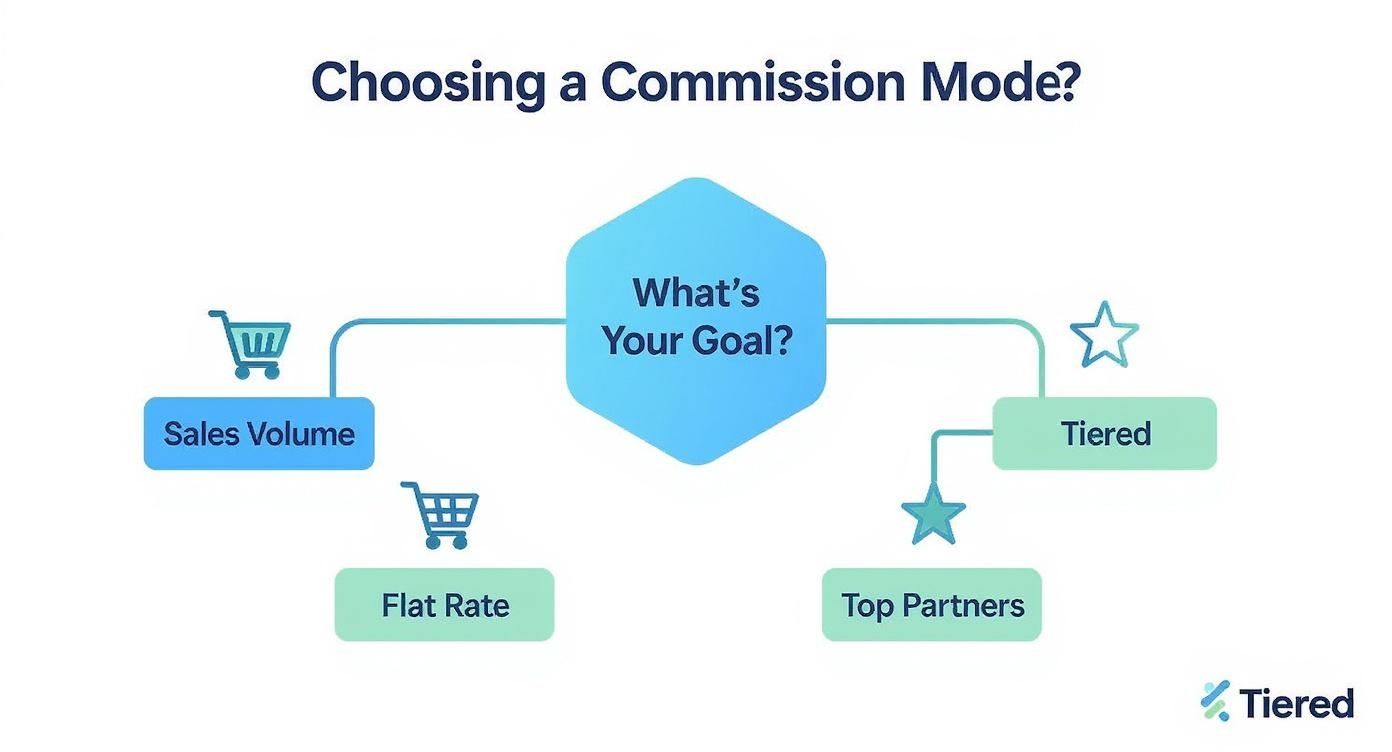
As you can see, if maximizing sales volume is the name of the game, a simple flat rate is usually your best bet. But if you want to nurture and motivate your top-tier partners, a tiered system is the way to go.
Key Takeaway: Your commission structure should be a direct reflection of your program's goals. Don't just copy what a competitor is doing. Build a model that supports your specific business outcomes and protects your profit margins.
Selecting the Right Tracking Platform
Finally, technology is the backbone of any modern affiliate program. Without a solid tracking platform, you're essentially flying blind. This software is the central nervous system that handles everything: tracking clicks and attributing sales, managing payouts, and delivering performance data.
When you're shopping for a platform, keep an eye out for these must-have features:
- Reliable Tracking: The platform must have rock-solid attribution, whether through cookies or newer cookieless methods. Accuracy is everything.
- Clear Dashboards: You and your affiliates need clean, intuitive dashboards to see performance at a glance. No one wants to dig through confusing reports.
- Automated Payouts: Look for a system that can automate commission payments. This saves a massive amount of admin work and ensures your partners are paid on time, every time.
- Robust Reporting: Non-negotiable. You need access to detailed analytics to see what’s working, what isn’t, and where you can optimize.
Recruiting and Onboarding High-Value Partners
An affiliate program is only as good as its partners. Let’s be honest—it’s not about how many affiliates you have, but about recruiting the right ones who will become true champions for your brand. Casting a wide, generic net is a surefire way to build a list of dormant accounts. The real magic happens when you pinpoint creators whose audience is a mirror image of your ideal customer.
This targeted approach is a game-changer. It means you stop chasing vanity metrics and start building a powerhouse network of partners who drive real sales. It's a strategic shift from quantity to quality, ensuring your hard work results in profitable, long-term relationships instead of just a bloated list of sign-ups.
Identifying Your Ideal Affiliate Partners
Before you even think about sending that first email, you need a crystal-clear picture of who you're looking for. A high-value partner isn't just someone with a massive following; they're an expert whose content and community align perfectly with what you offer. The first step is to build a detailed profile of this ideal partner.
Get specific about their niche, content style, and audience demographics. Selling high-end skincare? You should be looking for beauty bloggers who focus on luxury products and have an engaged audience of women aged 30-50. Launching a new SaaS tool? Your prime targets are tech reviewers on YouTube and B2B bloggers who publish in-depth tutorials.
Pro Tip: Your own customer base is a goldmine of information. What blogs do they read? Which YouTubers do they watch? Who are they following on Instagram and TikTok? Your best future affiliates are often the same people your best customers already trust.
Crafting a Personalized Recruitment Pitch
Once you have a solid list of potential partners, your outreach has to cut through the noise. Generic, copy-pasted templates are the fastest way to get your email deleted. A pitch that actually works shows you’ve done your homework and genuinely see the value in a potential partnership.
Your message should be built on mutual benefit. Don't just lead with, "Join our program and earn 15% commission." Instead, frame it as a true partnership. Mention a specific blog post or video of theirs that you genuinely enjoyed, and then explain why your product would be a natural fit for their audience.
A pitch that gets replies always includes these key elements:
- Personalization: Use their name and reference their specific work. It shows you’re not just spamming a list.
- Value Proposition: Clearly explain how your product solves a problem for their audience, not just yours.
- Clear Next Steps: Make it ridiculously easy for them to learn more or sign up. No one wants to hunt for a link.
- Social Proof: If you have well-known creators or brands in your program, mention them. It builds instant credibility.
For example, you could say, "I saw your recent TikTok on scaling e-commerce stores and thought it was brilliant. Our tool helps TikTok Shop sellers automate their creator outreach, and I think your audience would get a ton of value from it." This approach respects their work and positions your offer as a helpful solution, not just another sales pitch. For those looking to scale this process, exploring tools like an affiliate bot can help automate initial outreach without losing that personal feel.
Creating a Seamless Onboarding Experience
Getting an affiliate to sign up is just the beginning. The first 30 days are absolutely critical. A smooth, welcoming onboarding process is the key to motivating new partners to start promoting immediately and setting them up for long-term success.
A disorganized or confusing start can cause a partner to go cold before they even generate their first click. Your goal here is to eliminate any and all friction, making them feel confident and excited to talk about your brand.
The Essential Welcome Kit
The centerpiece of your onboarding should be a comprehensive welcome kit. This is more than just a "welcome" email with a link. Think of it as a curated package of resources designed to give your new partner everything they could possibly need to get started on the right foot.
Your affiliate welcome kit should include:
| Resource Type | Description |
|---|---|
| Brand Assets | High-resolution logos, product images, and lifestyle photos. |
| Program Guide | A clear, concise document covering commission rates, cookie duration, and payment schedules. |
| Promotional Content | Pre-written email swipes, social media captions, and banner ads they can easily adapt. |
| Product Information | A one-pager detailing key features, benefits, and the target audience. |
| Contact Information | The direct email of their dedicated affiliate manager for any questions. |
This kit becomes their go-to resource, answering most questions upfront and empowering them to create on-brand content from day one.
The Power of the Personal Touch
Finally, while automation is a lifesaver, nothing beats a genuine human connection. A quick, personalized welcome email from you, the affiliate manager, can make a world of difference. To really stand out, offer a brief 15-minute onboarding call to answer questions and brainstorm a few campaign ideas together.
This small, upfront investment in the relationship builds incredible loyalty and proves that you see them as a true partner, not just another number in your dashboard. This early engagement is often the deciding factor between an affiliate who becomes a top performer and one who fizzles out.
Keeping Your Affiliates Active and Engaged
https://www.youtube.com/embed/5BaxErQKq_g
Getting a new affiliate to sign up is exciting, but let's be honest—that's the easy part. The real work starts the moment they’re on board. A huge list of partners doesn't mean much if half of them have gone silent. The core challenge is turning those initial sign-ups into consistent, high-performing advocates for your brand.
This is about building a genuine partnership, not just sending out monthly commission checks. Keeping affiliates in the game requires a steady rhythm of communication, fresh creative, and compelling reasons for them to keep promoting you. If you don't actively manage the relationship, even your most promising partners will lose steam and fade away.
Build a Dynamic Promotional Calendar
One of the biggest reasons affiliates go quiet is that they simply don't know what to promote. They’re busy, and your brand can easily fall off their radar unless you give them a solid reason to talk about it. This is where a dynamic promotional calendar becomes your most valuable tool.
And I don't just mean circling the big holidays. Your calendar should be packed with events that actually resonate with your audience.
- Product Launches: Give your partners a heads-up 2-4 weeks before a new product drops. Arm them with sneak peeks, exclusive assets, and all the info they need to build hype.
- Seasonal Campaigns: Think "Back to School" or "Summer Getaway." Create entire campaign kits with themed banners, email copy, and social media posts.
- Company Milestones: Are you celebrating your company's anniversary? Turn it into a promotion with a special, limited-time commission bump.
- Industry Events: Align your promotions with major trade shows or conferences in your niche. It gives your affiliates a timely, relevant angle for their content.
When you're this proactive, you stop being just a program manager and become a strategic partner. You're not just waiting for sales to happen; you're actively creating opportunities for your affiliates to win.
Master the Psychology of Motivation
Consistent communication and resources are the foundation, but if you really want to light a fire under your affiliates, you need to think about incentives. Motivation isn't a one-size-fits-all deal. By layering different types of incentives, you can turn your average performers into top-tier revenue drivers.
A well-designed bonus structure can work wonders. For instance, you could offer a $500 bonus to any affiliate who generates over $10,000 in sales in a single quarter. This gives your top partners a concrete goal to shoot for beyond their standard commission.
Expert Insight: I've found that running friendly, short-term contests is a fantastic way to spike engagement. A simple leaderboard showing the top 5 affiliates for the month, with a nice prize for the winner, can create a real surge of activity and competitive spirit.
Another tactic that works incredibly well is a performance-based tiered system. When affiliates consistently hit higher sales thresholds, they unlock a permanently higher commission rate. This doesn't just reward their past performance—it creates a powerful, lasting reason for them to keep pushing your brand. For brands running campaigns on TikTok Shop, keeping tabs on which creators are driving the most sales is a breeze with a dedicated creator tracking tool.
Foster a True Partnership with Communication
Your communication strategy is the glue that holds everything together. If your affiliates feel like they're just another number in your system, their loyalty will be paper-thin. The goal is to make them feel heard, valued, and like they’re truly part of the team. That means getting beyond the generic, automated emails.
A high-value affiliate newsletter is a great place to start. Don't just announce the next sale. Fill it with content that's genuinely useful for them.
| Content Type | Example |
|---|---|
| Success Stories | Spotlight a top-performing affiliate and break down the specific tactic they used to get great results. |
| Industry Insights | Share a quick summary of a new trend in your niche and offer ideas on how they can capitalize on it. |
| Content Previews | Give them an exclusive first look at an upcoming blog post or video they can be the first to share. |
| Q&A with the Team | Feature a short interview with your product manager or head of marketing to give them a behind-the-scenes look. |
This kind of thoughtful communication builds a real community around your brand. It shows you're invested in their growth, not just your own, and that’s a critical part of successful affiliate program management.
The affiliate marketing world is exploding, with U.S. spending projected to soar from $9.56 billion in 2023 to nearly $16 billion by 2028. This incredible growth underscores the massive opportunity for businesses that actively nurture their partnerships. You can check out more insights on these affiliate marketing statistics on wix.com.
Using Data and Technology to Fine-Tune Your Performance
You can only get so far with gut feelings and guesswork in affiliate marketing. The real, sustainable growth kicks in when you start digging into the data to see what’s actually moving the needle, what’s falling flat, and where your hidden gems are. Your tracking platform is the key that unlocks all of this.
It's about shifting your mindset from just counting sales to truly understanding the entire affiliate journey. This approach lets you sharpen every part of your program, from pinpointing your most valuable partners to tweaking campaigns for the best possible return.
The diagram below breaks down the fundamental flow of how affiliate marketing data is tracked and attributed. This is the bedrock of all performance analysis.

As you can see, the tracking system is the crucial link connecting an affiliate's promotion to a customer's purchase. It’s the source of every piece of data you'll use.
The Metrics That Truly Matter for Success
Your affiliate dashboard is probably packed with numbers, but let's be honest—not all of them are created equal. To avoid getting lost in a sea of data, you need to focus on a handful of key performance indicators (KPIs) that give you the most actionable insights.
Here are the essential metrics I always keep a close eye on:
- Conversion Rate (CR): The percentage of clicks that turn into a sale. If this number is low, it could point to a problem with the affiliate's traffic, their promotional angle, or even your landing page.
- Earnings Per Click (EPC): This is a quick way to gauge profitability. Just divide total commissions by the number of clicks. It's a fantastic metric for comparing the performance of different affiliates side-by-side.
- Average Order Value (AOV): How much is the average customer spending when they buy through an affiliate link? A high AOV is a great sign that your partners are driving high-value sales.
- Click-Through Rate (CTR): This shows how many people click an affiliate's link after seeing their content. While it’s not as critical as conversion metrics, a strong CTR tells you an affiliate’s promotions are engaging and effective.
- Your Top Performers: Always, always know who your top 10 affiliates are by revenue. Figure out who they are and what makes them so successful—it's the best playbook you'll ever find for activating your other partners.
Keeping a regular pulse on these numbers helps you spot trends early, reward your star performers, and offer targeted help to those who need a little boost. To get a holistic view of how these KPIs affect your bottom line, a specialized tool can be a game-changer. You can see how to visualize these metrics in an affiliate profit dashboard for your shop.
Putting Technology and AI to Work for You
The next big step in affiliate management is bringing artificial intelligence into the mix. AI isn't some far-off concept anymore; it's a practical tool that can automate grunt work and find optimization opportunities you’d likely miss on your own.
My Takeaway: AI-powered tools are quickly becoming non-negotiable for staying competitive. They handle things like fraud detection, real-time campaign adjustments, and personalized affiliate outreach, freeing you up to focus on high-level strategy instead of manual data crunching.
For example, AI algorithms can sift through thousands of data points to spot fraudulent activity like click spamming or cookie stuffing with way more accuracy than a human ever could. This protects your budget and makes sure you're only paying for legitimate sales.
AI is also a master of optimization. It's predicted that by 2025, 73% of affiliate networks will be using AI for both fraud detection and campaign improvements. We’re already seeing what this can do—AI-driven strategies have been shown to boost conversion rates by an average of 28%. One case study even reported a 34% lift in EPC just by using AI to change product recommendations based on user behavior.
Ultimately, technology gives you the power to run a smarter, more efficient program. When you embrace data and automation, you can transform your affiliate channel from a simple sales generator into a finely tuned engine for growth.
Navigating Compliance and Partner Relationships
A great affiliate program runs on trust and transparency. While finding and exciting new partners gets all the attention, it’s the less glamorous work of managing compliance and relationships that truly determines your long-term success.
Ignoring the fine print is a rookie mistake, and it can open the door to fraud, brand damage, and a ton of legal headaches.
Effective management is all about setting clear expectations right from the start. This isn’t about being a drill sergeant; it's about creating a predictable, safe playing field where your best partners can really shine. When everyone knows the rules, you minimize risk and attract affiliates who value integrity as much as you do.
Crafting a Bulletproof Affiliate Agreement
Think of your affiliate agreement as your program's constitution. It's the go-to document that clearly lays out the dos and don'ts, protecting both you and your partners. A vague or incomplete agreement is basically an open invitation for trouble.
This document needs to be thorough, but it should be written in plain English—not dense legalese that no one can understand.
Here are the non-negotiable elements your agreement has to cover:
- FTC Disclosure Requirements: Be crystal clear that all partners must disclose their affiliate relationship. They need to follow current FTC guidelines, which often means using hashtags like #ad or #sponsored in a place people can't miss.
- Brand Bidding Policies: Explicitly forbid bidding on your branded keywords in paid search campaigns. This includes any variations or common misspellings. This is crucial because it stops partners from driving up your own ad costs and competing directly against you.
- Approved Promotional Methods: Spell out what's okay and what's not. Can they use email marketing? What about social media? Get specific about which channels are allowed and which are off-limits, like spammy tactics or making misleading claims about your product.
- Coupon and Discount Code Usage: If you use coupon codes, define the rules. Specify if they can only use official codes provided by you and forbid them from submitting to coupon aggregator sites without explicit permission.
- Termination Clauses: Outline the conditions for ending the partnership. This should include clear grounds for immediate termination, like fraud, as well as notice periods for other situations.
Proactive Monitoring to Protect Your Brand
Once you’ve set the rules, you can't just set it and forget it. You have to actively monitor what’s happening. This is all about catching potential issues before they snowball into major problems that could harm your brand's reputation or drain your budget.
Make it a habit to regularly audit partner activity. I recommend setting aside time each month to spot-check your top affiliates. A quick Google search for your brand name can reveal if anyone is bidding where they shouldn't be. You can also use specialized tools that automatically monitor for these kinds of violations.
My Experience: I once found a new affiliate running Google Ads that looked exactly like our official brand ads, sending traffic to their own landing page first. Because we were doing routine checks, we caught it within days. We terminated the partnership immediately, before it could cause serious brand confusion or siphon off our paid traffic.
Managing Relationships and Handling Disputes
Even with a rock-solid agreement, disagreements will pop up. How you handle these moments is what really defines the health of your program. The goal should always be to find a constructive solution and, if possible, preserve the relationship.
When a conflict arises—maybe over a disputed commission or a promotional tactic you don't like—start with a direct, calm conversation. Don't open with accusations. Just present the facts as you see them and ask for their side of the story. More often than not, it's just a simple misunderstanding.
Delivering feedback is another delicate art. If an affiliate's content is a little off-brand, don't just tell them it's wrong. Offer constructive advice and point to examples of what works well. Frame it as a way to help them improve their conversion rates—a classic win-win.
Of course, not every partnership is built to last. If you have to end a relationship due to consistent rule-breaking or poor performance, handle it professionally. Send a clear email that references the specific clause in your agreement that was violated and state a definitive end date. Keep it factual and unemotional. This approach protects your program's reputation and makes a tough situation as smooth as possible.
Questions That Always Come Up in Affiliate Management
Even with the best-laid plans, you're going to have questions pop up as you run your affiliate program day-to-day. Getting a handle on these common hurdles is what separates a good manager from a great one. Let's dig into a few of the questions I hear all the time.
What's a Fair Commission Rate for Affiliates?
I wish there was a magic number, but the truth is, it completely depends. Your commission has to make sense for your industry, your profit margins, and most importantly, what your competitors are willing to pay.
For most e-commerce brands, a commission between 5-15% is a pretty standard starting point. If you're in the SaaS world with recurring subscriptions, you’ll see much higher rates, often from 20% all the way up to 70% for the first payment.
Before you set anything in stone, do your homework. A quick search for affiliate programs in your niche will tell you what the going rate is. You need an offer that’s attractive enough to catch the eye of top-tier partners without tanking your own profitability.
Here's a little pro-level advice: Don't just set one flat rate. Create a tiered commission structure. This is a fantastic way to motivate your best affiliates by rewarding them with higher percentages once they hit certain sales goals. It gives them a real reason to push your products over someone else's.
Should I Join an Affiliate Network or Go In-House?
This is a classic fork in the road for any new affiliate program. Do you join a big network like ShareASale or CJ Affiliate, or do you run everything yourself with in-house software?
Think of a network as a ready-made marketplace. It instantly connects you with thousands of potential affiliates and handles all the messy stuff like tracking and payments. The downside? They take a cut.
Running your own program with software like PartnerStack or Everflow puts you in the driver's seat. You get total control and avoid those network fees, but the trade-off is huge: you have to recruit every single affiliate from scratch.
- Affiliate Networks: The perfect choice if you want to get up and running fast and need access to a large pool of publishers right away.
- In-House Software: A better fit for brands that already have some traction and want to maximize their control and long-term profitability.
How Can I Protect My Program From Fraud?
Fraud prevention starts long before you see a suspicious click. The first line of defense is a rock-solid affiliate agreement. Make sure your terms of service explicitly outlaw shady tactics like cookie stuffing, bidding on your branded keywords in paid search, or using any promotional methods you haven't approved.
Next, make sure your management software has your back. Good platforms have fraud detection tools built right in. They can automatically flag weird click patterns or conversion rates that look too good to be true, giving you a heads-up before a small problem becomes a big one.
Honestly, though, the best tool against fraud is a real relationship. It’s amazing how rarely you see problems from affiliates you actually talk to. When your partners feel like they're part of your team, they're far more invested in doing things the right way.
Ready to automate your affiliate outreach and track performance with precision? The HiveHQ Affiliate Bot helps you discover and recruit the right creators at scale, while our Profit Dashboard and Creator Tracker give you the data you need to optimize every partnership. Learn more about how HiveHQ can grow your TikTok Shop.