Choosing Your Affiliate Program Management Software

affiliate program management softwareaffiliate marketing toolspartner managementperformance marketing
Think of affiliate program management software as the central nervous system for your entire partner marketing strategy. It's the dedicated platform that automates and organizes every moving part, from tracking partner links and calculating commissions to sending out payments. It effectively transforms what could be a chaotic, spreadsheet-fueled headache into a powerful, scalable revenue channel.
What Exactly Is Affiliate Management Software?
Imagine you're trying to conduct an orchestra. Each musician is an affiliate partner, and the music they play is the content they create. Without a conductor and a shared sheet of music, you'd just have a lot of noise. Chaos.
Affiliate program management software is your conductor's podium. It brings order to the chaos.
Instead of manually trying to figure out which affiliate sent which sale using a clunky spreadsheet, the software automatically tracks every click, every conversion, and every commission earned. It ensures every partner is credited accurately for their work, eliminating the human error that so often leads to payment disputes and broken trust.
Solving Critical Business Pains
Trying to run an affiliate program without a proper system is an administrative nightmare waiting to happen. It's a common story: a business gets bogged down by recurring problems that kill growth and frustrate their best partners.
The right software tackles these pain points head-on by:
- Eliminating Manual Tracking Errors: Spreadsheets are notoriously prone to mistakes. A slip of the finger can mean an affiliate gets underpaid or overpaid. Automated tracking builds confidence and ensures everyone is treated fairly.
- Automating Commission Calculations: Do you have different commission tiers? Or maybe recurring payouts for subscriptions? These complex structures are a nightmare to manage by hand. The software does the math instantly and perfectly.
- Simplifying Payouts: Paying dozens, or even hundreds, of affiliates one by one is a huge time-sink. Most platforms connect with payment systems to handle mass payouts in just a few clicks.
- Enabling Scalability: Managing 10 affiliates manually is tough. Managing 100 is nearly impossible. Software gives you the foundation to grow your program without drowning your team in admin work.
A good way to understand the core capabilities is to see them laid out.
Core Functions of Affiliate Management Software at a Glance
| Function | Description | Key Benefit |
|---|---|---|
| Affiliate Tracking | Monitors clicks, conversions, and sales generated by each affiliate's unique link in real-time. | Ensures accurate attribution so every partner is credited correctly for the sales they drive. |
| Commission Management | Automates the calculation of commissions based on predefined rules (e.g., flat fees, percentages, tiers). | Eliminates manual errors and handles complex payment structures with ease. |
| Payout Processing | Integrates with payment gateways to facilitate mass, on-time payments to all affiliates. | Saves countless hours of administrative work and keeps partners happy. |
| Performance Dashboard | Provides a centralized hub for you and your affiliates to view real-time performance data and analytics. | Builds trust through transparency and empowers partners to optimize their strategies. |
| Asset Management | A central library where affiliates can easily access approved marketing materials, banners, and links. | Ensures brand consistency and equips partners with the tools they need to succeed. |
This clear, organized system is what sets a thriving program apart from a stagnant one.
By taking the tedious, repetitive tasks off your plate, this software frees you up to focus on what really matters: recruiting great partners, building strong relationships, and fine-tuning your overall strategy.
Ultimately, this software becomes the single source of truth for both you and your affiliates. Partners get a professional dashboard to grab marketing assets, track their performance, and see exactly what they've earned. That transparency is the bedrock of any strong, long-term partnership.
For sellers on platforms like TikTok Shop, specialized tools can take things even further by automating the entire recruitment process. You can learn more about how an affiliate bot helps scale creator outreach on our blog. This level of automation and organization is what turns an affiliate program from a side project into a primary engine for business growth.
The Must-Have Features of Top Affiliate Software
Let's be clear: not all affiliate software is created equal. While most platforms can handle the basics, the really good ones give you a powerful set of tools that can turn a simple referral program into a serious growth engine. Knowing what to look for is the key to making a smart investment.
Think of it like this: a basic tool gives you a paper map. A great one gives you a full-blown GPS with live traffic updates, route optimization, and a detailed dashboard. It doesn’t just show you where you are; it helps you get where you’re going faster and with fewer headaches.
Robust and Reliable Tracking
The absolute foundation of any affiliate program is tracking. If you can't reliably trace a sale back to the right partner, trust disappears, and the whole system falls apart. The best software uses multiple tracking methods to make sure nothing slips through the cracks.
The old standby is cookie-based tracking, which drops a small file on a user's browser when they click an affiliate link. But with all the new privacy rules and browser updates, relying on cookies alone is a risky game.
That’s why top-tier platforms offer more reliable alternatives:
- Server-to-Server (S2S) Tracking: This is the gold standard. Instead of relying on the user's browser, your server talks directly to the software's server. It’s immune to cookie blockers and far more accurate.
- Coupon Code Tracking: This one's a game-changer for social media influencers. You can assign a unique discount code to each affiliate. When a customer uses that code, the sale is automatically credited to the right person. Simple and effective.
Flexible Commission Structures
Your business isn't a cookie-cutter operation, so why should your commission plan be? Powerful affiliate program management software lets you design payment models that actually match your business goals and motivate your partners to perform.
This kind of flexibility lets you get creative and move beyond a simple flat percentage for every sale.
The ability to customize commissions is what separates a static program from a dynamic one. It empowers you to incentivize the specific actions that drive the most value for your business, whether that's attracting new customers or retaining existing ones.
Here are a few common structures you should be able to set up:
- Tiered Commissions: Reward your best affiliates by bumping up their commission rate as they hit certain sales targets (e.g., 15% for 1-10 sales, but 20% for 11-50 sales).
- Recurring Commissions: This is a must-have for any subscription business. It pays affiliates a percentage for as long as their referred customer stays subscribed.
- Performance-Based Bonuses: Fire up your partners by offering one-time bonuses for hitting specific goals, like driving 100 sign-ups in a single month.
Automation and Centralized Management
The whole point of using software is to do less manual work, right? Two features are non-negotiable here: automated payouts and a centralized partner portal. The best platforms link up with payment systems like PayPal or Stripe, letting you pay all your affiliates with just a few clicks.
A partner portal is a self-service hub where your affiliates can log in to grab marketing materials, create their tracking links, and see their performance stats in real-time. This transparency builds a ton of trust and drastically cuts down on the number of support emails you have to answer. A well-run portal is a huge time-saver, and for anyone managing a lot of creators, figuring out how to centralize their performance is crucial. A dedicated creator tracker can provide valuable insights into getting the most from these relationships.
Finally, look for features that protect your bottom line. Built-in fraud detection is vital for spotting sketchy clicks or fake sales, saving you from paying out commissions you don't actually owe. When you pair that with deep analytics dashboards, you get the hard data you need to fine-tune your strategy, find your star performers, and really maximize your return on investment.
Why Automating Your Affiliate Program Drives Growth

Investing in affiliate program management software isn't just about organizing your partnerships. It’s about completely changing the way you approach growth. When you finally ditch the spreadsheets and endless email chains, you unlock three powerful advantages that are almost impossible to get when you're doing everything by hand.
Think of it this way: a manual affiliate program is like a small local shop. You know every customer by name, which is great for a while, but you can only serve a handful of people at a time. Automating your program is like turning that shop into a major retail chain with a sophisticated logistics network. Suddenly, you can serve thousands without dropping the ball.
This shift lets you move from just running a program to strategically scaling a major revenue channel. The payoff comes down to massive time savings, rock-solid partner trust, and, most importantly, true scalability.
Reclaim Your Most Valuable Asset: Time
Time is the one resource you can never get back. A manual affiliate program is a notorious time thief, sucking up countless hours on tasks that don’t really move the needle. Your team gets stuck in administrative quicksand, constantly reacting to problems instead of proactively building for the future.
Automation completely flips that script. All the repetitive, low-impact work gets handed off to the software, freeing up your team for the high-value activities that actually drive growth.
- Automated Reporting: Instead of spending hours pulling data and wrestling with spreadsheets, your team gets instant, real-time insights. This means they can spend their time analyzing what’s working and fine-tuning campaigns.
- Effortless Payouts: Calculating and processing dozens, or even hundreds, of individual commission payments is a logistical nightmare. Software automates this entire process, ensuring partners get paid accurately and on time with just a few clicks.
- Streamlined Onboarding: New affiliates can sign up, grab their unique links, and access marketing materials through a self-service portal. This cuts out all the back-and-forth communication that slows everyone down.
By taking these tasks off their plate, you empower your team to focus on what matters: recruiting top-tier partners, nurturing relationships, and developing creative campaigns that expand your reach.
Build Unbreakable Trust Through Accuracy
In affiliate marketing, trust is everything. Your partners are extensions of your brand, and they need to have absolute confidence that their hard work will be tracked and rewarded fairly. Manual tracking is just asking for human error, and those mistakes can quickly destroy that trust.
A single missed sale or an incorrect payout can permanently damage a relationship with a high-performing affiliate. Affiliate program management software eliminates this risk by providing a single, undisputed source of truth for tracking and attribution.
When affiliates trust your tracking system, they become more motivated. They see a direct, reliable connection between their effort and their earnings, encouraging them to invest more of their time and resources into promoting your brand.
This accuracy turns affiliates from simple promoters into genuine brand advocates who feel secure in their partnership with you. When performance data is transparent and easy to access, it creates a powerful feedback loop. You can also get a clearer picture of your program’s health by using tools that help you monitor your TikTok Shop Profit Dashboard to see exactly how affiliate efforts contribute to your bottom line.
Unlock True Scalability
This is where automation delivers its biggest return. A manual program has a hard ceiling on growth—you can only manage as many partners as your team can personally handle. Every new affiliate adds a proportional amount of administrative work, making it impossible to scale in any meaningful way.
Automation shatters that ceiling. The right software provides the infrastructure to manage hundreds or even thousands of partners with the same team that once struggled with just a few dozen. This ability to grow without linearly increasing your workload is a massive competitive advantage.
The market itself tells the story. Projections show the affiliate marketing software market, valued at USD 12.76 billion in 2024, is expected to surge to USD 27.83 billion by 2033. This growth underscores how businesses are relying on technology to manage increasingly complex and global partner networks. You can dive deeper by exploring the full report on the affiliate software market.
For a growing e-commerce store, this means you can build an army of brand advocates and compete with industry giants. You're no longer limited by your team's bandwidth, but by your ability to recruit and inspire great partners.
How to Choose the Right Affiliate Management Software
Picking the right affiliate management software isn't about finding the single "best" platform out there. It’s about finding the right one for your business. Think of it like buying a car. A two-seater sports car is a blast, but it’s a terrible choice for a family of six heading out on a camping trip.
In the same way, a massive, enterprise-level software might have every feature imaginable, but it's often overkill and overpriced for a small but growing brand. The goal is to land on a solution that fits your budget, team, and immediate needs while still giving you room to scale. Get this choice wrong, and you're looking at wasted money, frustrated partners, and a program that never gets off the ground.
Start With Your Business Model
Before you even start looking at software demos, you need to look inward. The perfect platform for a SaaS company built on recurring subscriptions is going to be very different from what a high-volume TikTok Shop needs. Your business model is the compass that guides your entire search.
Ask yourself these questions first:
- How do you make money? Are you selling one-time products, subscriptions, or a mix? This directly impacts the kind of commission structures you'll need, like lifetime recurring payouts for a subscription service.
- Who are your ideal partners? Are you recruiting professional content creators, rewarding loyal customers, or partnering with major media publishers? This will shape how simple or sophisticated your affiliate portal needs to be.
- What's your team's tech-savviness? Do you have developers on hand for a complex integration, or do you need a plug-and-play tool that just works?
Answering these questions first keeps you from being distracted by shiny features you’ll never actually use. It grounds your search in what will actually make a difference for your business.
A great way to narrow down the options is to match your business type to the features that matter most.
Software Feature Comparison for Different Business Models
This table helps you see which features are non-negotiable for your specific business model, making the evaluation process a whole lot easier.
| Business Model | Must-Have Features | Ideal Pricing Structure |
|---|---|---|
| TikTok Shop / Ecommerce | Direct integration with ecommerce platform (e.g., Shopify), product-level tracking, coupon code tracking, simple affiliate dashboard. | Flat-rate SaaS subscription with predictable monthly costs. Avoid models with high transaction fees. |
| SaaS / Subscription | Recurring and lifetime commission tracking, customizable commission tiers, deep integration with payment processors (e.g., Stripe). | Tiered SaaS pricing based on revenue or number of affiliates, which scales with your growth. |
| Lead Generation | Cost-Per-Lead (CPL) commission structures, robust form tracking, fraud detection to ensure lead quality. | A model that charges based on the number of affiliates or clicks, rather than a percentage of revenue. |
| Large Enterprise | Advanced reporting and analytics, multi-level marketing (MLM) capabilities, API access for custom development, dedicated support. | Custom enterprise-level pricing, which may include a base fee plus performance-based costs. |
By using your business model as a filter, you can quickly disqualify platforms that aren't a good fit and focus your energy on the ones that are truly built for what you do.
Evaluate Critical Integration Capabilities
Your affiliate software can't operate on an island. It has to connect seamlessly with the other tools you rely on every day, especially your ecommerce platform and payment processor. A clunky or broken integration is an absolute deal-breaker—it leads to tracking errors, payment nightmares, and a huge administrative headache.
Make sure any platform you're considering has solid, well-documented integrations with your core systems. For most online businesses, this means you need to check for compatibility with:
- Ecommerce Platforms: Shopify, WooCommerce, BigCommerce.
- Payment Processors: Stripe, PayPal.
- Marketing Tools: Your email marketing service (like Klaviyo or Mailchimp) and your CRM.
A strong integration isn't just a feature on a checklist; it's the bridge that lets data flow accurately between your store and your affiliate program. Without it, you can't trust your numbers. And if you can't trust your numbers, your partners won't either.
Don't just take the sales page at its word. Ask for case studies or look for reviews from other businesses using the same tech stack as you. That real-world proof is gold.
This simple decision tree can help you see which type of solution might be the best starting point for you.
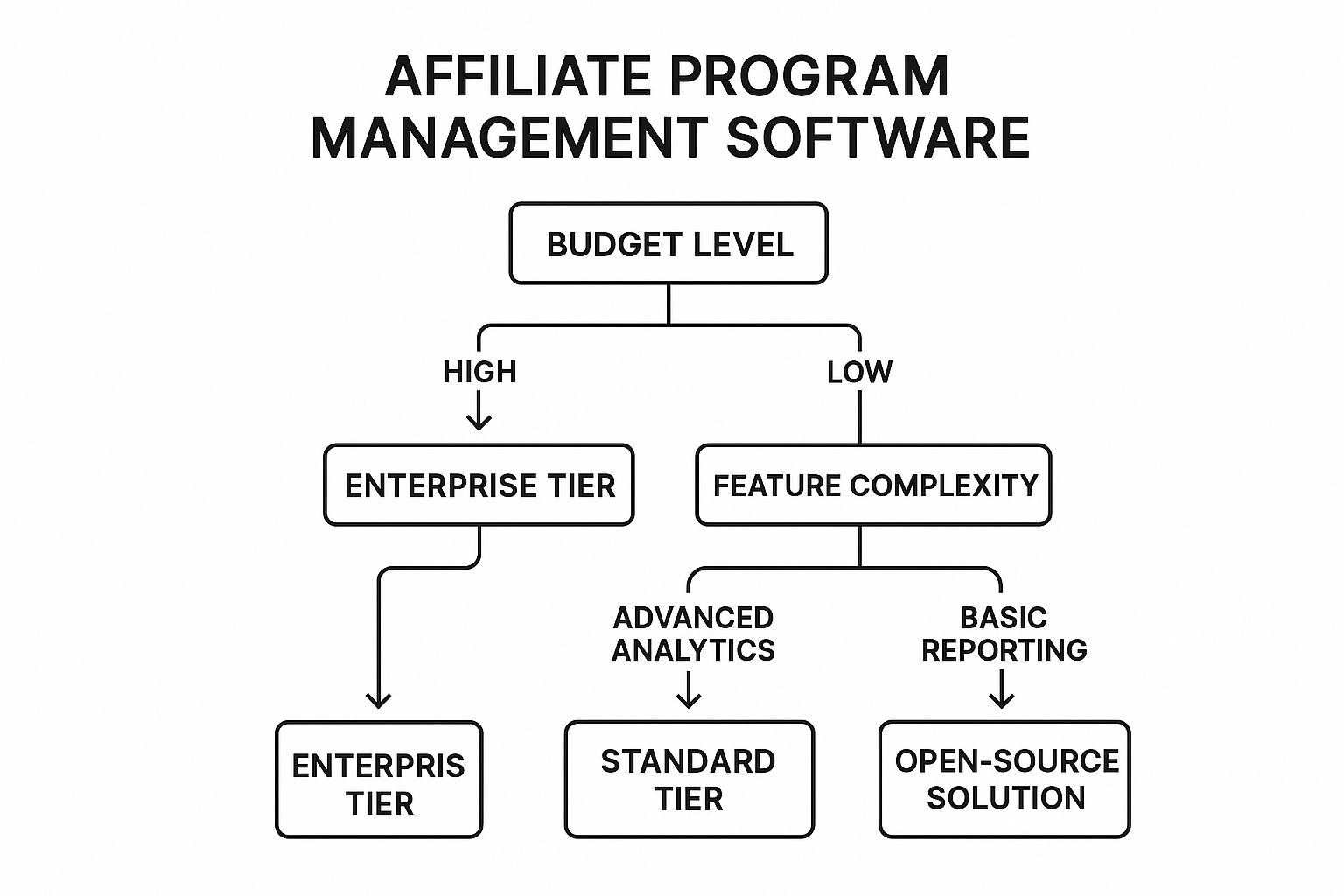
As the visual shows, businesses with smaller budgets often start with standard SaaS solutions, while those with more complex needs and deeper pockets might look toward enterprise-tier platforms.
Analyze Pricing Models and Total Cost of Ownership
Software pricing can be tricky. A low monthly fee can easily hide other costs, like transaction fees, one-time setup charges, or expensive support packages. You need to dig deeper to understand the total cost of ownership (TCO), not just the sticker price.
You'll generally run into two main pricing models:
- SaaS (Software-as-a-Service): This is the most popular model, where you pay a predictable monthly or annual subscription. It includes hosting, security, and updates. Just watch out—some SaaS platforms also tack on a small percentage of your affiliate commissions, which can really add up as your program grows.
- Self-Hosted (On-Premise): Here, you buy the software license upfront and run it on your own servers. This gives you maximum control and customization, but it also means you're on the hook for setup, maintenance, and security, which requires serious technical resources.
For most ecommerce brands, the SaaS model strikes the right balance between power and simplicity. In fact, the affiliate marketing software market is projected to hit $9.8 billion by 2035, and that growth is fueled almost entirely by the rise of accessible and scalable SaaS tools. This trend shows a clear shift toward performance-based marketing that requires reliable, easy-to-use software. You can read more about these market growth trends at Future Market Insights.
When you're comparing options, don't just look at today's price. Map out the total costs for each platform based on your current sales and where you project you'll be in one year. This simple exercise will quickly reveal which option is the most cost-effective for the long haul.
Successfully Implementing Your New Software

Choosing the right affiliate software is a massive step, but the real test is how you put it into action. It’s like buying a high-performance engine for a race car. The potential is huge, but it means nothing until it's installed, calibrated, and running smoothly on the track.
A solid implementation plan is your roadmap to a clean launch. It makes sure your partners feel supported from day one and helps you sidestep the common mistakes that can sink your investment before it even gets going.
Nailing the Technical Setup
Let's be blunt: if your affiliates don't trust your tracking, your program is dead on arrival. The technical setup is where you earn that trust.
This part is all about being meticulous. Don't rush it. The goal is to ensure every single click, sale, and commission is tracked with 100% accuracy from the moment you flip the switch.
Here’s your non-negotiable checklist for getting the tech right:
- Install Tracking Scripts: The first step is to place the software’s tracking pixel or script on your website’s order confirmation page (the "thank you" page). This little piece of code is what tells the platform a sale has happened.
- Run Test Conversions: Before you even think about inviting affiliates, you need to play customer. Make several test purchases using different browsers and devices to make absolutely sure each sale shows up correctly in your dashboard.
- Validate Commission Calculations: Double-check the math. During your tests, confirm that the commission amounts recorded match the rules you set. Whether it’s a simple percentage or a complex tiered system, it has to be perfect.
Getting the technical details right isn't just a best practice; it's the bedrock of affiliate trust. An accurate, reliable system shows partners you are a serious and professional business worth their time and effort.
Managing a Smooth Affiliate Migration
If you're not starting from scratch, moving your existing affiliates over to a new platform is a delicate operation. Your aim is to make the switch feel effortless for them, minimizing any headaches and clearly showing them why the new system is better.
Clear communication is your best friend here. Keep your partners in the loop at every stage, and frame the move as an upgrade that benefits everyone.
A smart migration plan includes:
- Clear and Early Communication: Give your affiliates plenty of notice. Send an email explaining why you're switching and highlight the awesome new features they'll get, like better reporting or faster payouts.
- Provide Simple Instructions: Nobody wants to read a manual. Create a super-simple guide or a short video showing them exactly how to sign up on the new platform and grab their new tracking links.
- Offer Direct Support: Set up a dedicated email address or support channel just for migration questions. A fast, helpful answer can turn a frustrated affiliate into a happy one.
Launching Your First Campaigns
With the tech locked in and your affiliates on board, it's time to arm them for success. A strong campaign launch gives your partners everything they need to start promoting your products effectively. This is where you shift from setup to actual growth.
Think of it as stocking the shelves of a store. You want to provide top-notch materials and clear instructions that make it easy for affiliates to represent your brand well and drive sales.
Here are the key things you need for a killer campaign launch:
- Compelling Offers: Don’t just tell them to "promote your store." Give them specific, attractive offers to push, like a unique discount code, a special product bundle, or early access to a new release.
- High-Quality Marketing Assets: Build a library of creative assets they can grab and use. This includes professional banners, high-res product photos, and even pre-written social media copy.
- Clear Program Terms: Create a straightforward terms of service document. It should clearly spell out commission rates, when they get paid, and any rules about how they can promote your products. This prevents headaches down the road.
The affiliate marketing industry is on a massive growth trajectory, expected to jump from $18.5 billion in 2025 to $31.7 billion by 2031. With roughly 80% of advertisers now running affiliate programs, getting your affiliate program management software implemented correctly puts you in a prime position to get a piece of that pie. You can dive deeper into affiliate industry trends at Hostinger.
Common Questions About Affiliate Software
https://www.youtube.com/embed/-4ofHwy6ik4
Even after getting a good look at the features and benefits of affiliate program management software, a few practical questions usually pop up. Feeling confident in your decision means getting straight answers to those common sticking points.
Let's tackle those lingering questions head-on to make sure you have the complete picture.
What Is the Difference Between an Affiliate Network and Affiliate Management Software?
This is a big one. People often use these terms interchangeably, but they represent two completely different ways to run a partner program. Getting this right is critical to picking the best path for your brand.
Think of an affiliate network like a giant, pre-built marketplace. Companies like ShareASale or CJ Affiliate are perfect examples. You join their network and immediately get access to a massive, existing pool of affiliates. They handle the tracking and payments, but in return, they take a big cut of your commissions and often charge hefty network fees. You're basically renting access to their audience and their platform.
On the other hand, affiliate program management software is your own private, branded tool. It’s like building your own storefront instead of just setting up a stall in a crowded market. You recruit your own partners, keep total control over your brand’s look and feel, set your own commission rules, and talk directly with your affiliates.
The core difference really boils down to control versus convenience. A network gives you a ready-made pool of partners but costs more and gives you less brand control. Software empowers you to build a direct, more profitable program from the ground up.
For most growing brands, especially in e-commerce, building a direct program with your own software is almost always more cost-effective and scalable over the long haul.
Can I Use This Software for My TikTok Shop or Social Commerce?
Absolutely, and this is where modern affiliate software truly shines. The best platforms are built to be channel-agnostic, which is just a fancy way of saying they can track referrals from pretty much anywhere—including the fast-moving world of social commerce.
The real magic is in the tracking itself. The software generates unique tracking links or, even better for social media, custom coupon codes for each of your creators. An influencer can then drop that code into a TikTok video, an Instagram Story, or a YouTube description.
When a customer uses that specific code at checkout on your TikTok Shop or website, the software instantly credits the sale to the right creator. The trick is to ensure the platform you choose integrates smoothly with your e-commerce backend (like Shopify) to make that connection seamless. This is exactly how top brands are managing and scaling their creator partnerships on social media today.
How Much Does Affiliate Program Management Software Typically Cost?
Pricing for these platforms can be all over the map, but it generally falls into a few predictable tiers based on your program's size, traffic, and feature needs. Knowing these tiers will help you set a realistic budget.
- Entry-Level Plans: Designed for small businesses and startups just getting their feet wet. These plans usually start around $50 to $150 per month and cover the essentials like tracking, basic reporting, and support for a limited number of affiliates.
- Mid-Tier Solutions: For growing businesses that need more muscle. Prices here typically range from $200 to $600 monthly. You'll get more advanced features like deeper analytics, better automation, and fraud detection.
- Enterprise Platforms: This is for the big players. Large-scale operations with thousands of partners and huge traffic can expect to pay thousands of dollars per month for custom-built solutions, dedicated account managers, and full API access.
One thing to watch out for is a hybrid pricing model. Some platforms will charge a base monthly fee plus a small percentage of the commissions you pay out. Always read the fine print to get a clear picture of the total cost as your program gets bigger.
Ready to stop guessing and start growing your TikTok Shop affiliate program? HiveHQ provides the all-in-one suite of tools you need to automate creator outreach, track profits accurately, and scale your partnerships with confidence. Explore how HiveHQ can transform your affiliate marketing today.