A Modern Guide to AI Affiliate Writing for TikTok Shop
ai affiliate writingtiktok shopaffiliate marketingai content creationcontent strategy
So, what exactly is AI affiliate writing? At its core, it's about using artificial intelligence to help create, fine-tune, and massively scale the content for your affiliate marketing programs. Think of it as moving from a manual, one-by-one process of creating reviews, scripts, and promotional copy to a fast, data-informed operation built for high-volume platforms like TikTok Shop. This shift lets brands pump out on-brand content at a speed that was unthinkable just a few years ago.
The New Reality of Affiliate Content Creation

We're in a completely new era for affiliate marketing. The old, slow grind of content creation is quickly being replaced by a much smarter, faster workflow driven by AI. For any brand playing on a fast-moving platform like TikTok Shop, this isn't some futuristic idea—it's a critical operational change you need to make just to keep up.
Let's be real: the traditional way of doing things just doesn't cut it anymore. Briefing creators, waiting around for first drafts, then getting stuck in endless revision cycles is a surefire way to miss the boat. AI affiliate writing completely changes the game by letting brands generate solid content frameworks, video scripts, and product descriptions in minutes, not weeks.
This isn't about replacing the human touch. It's about supercharging it. By letting AI handle the grunt work—the repetitive and time-sucking parts of drafting content—your team and your affiliate partners are freed up. They can focus on what truly moves the needle: authentic delivery, sharp strategic insights, and building a real connection with their audience.
A Modern Workflow for Scalable Growth
Today’s affiliate workflow is less about churning out content by hand and more about being the architect of a smart, scalable system. You're moving from a content factory model to one where you provide the strategic direction.
With this new model, brands can finally:
- Lock Down Brand Consistency: When you feed an AI your style guides and product info, it can produce perfectly on-brand messaging. This consistency holds true whether you're working with ten affiliates or a thousand.
- Jump on Trends Instantly: A new TikTok trend is blowing up? You can use AI to immediately spit out relevant video ideas and script outlines for your creators, letting you ride the viral wave before it crashes.
- Personalize Content at Scale: AI makes it possible to tweak content for different creator niches and audience segments. This makes your promotional material feel natural and tailored, not like a generic, copy-pasted ad read.
The results speak for themselves. We've seen that AI-driven affiliate campaigns can boost affiliate sales by up to 30%. Not only that, but the highly targeted strategies this approach unlocks have been shown to increase click-through rates by as much as 40%. You can find more data on AI in performance marketing from the team at Partnero.
The real win here is speed to market without sacrificing quality. It gives your brand the agility to move at the speed of culture, and on a platform like TikTok, that's everything.
Building AI into your affiliate writing process isn't just an upgrade; it's like installing a new engine for growth. It takes what has always been a resource-heavy part of marketing and turns it into an efficient, agile, and incredibly effective operation that gives you a serious advantage.
To truly understand the shift, it helps to see the old and new methods side-by-side.
How AI Transforms Affiliate Content Workflows
Here’s a look at how AI completely overhauls the traditional, manual process of creating affiliate content, stage by stage. The difference is stark, with AI introducing major gains in efficiency, scale, and performance.
| Workflow Stage | Traditional Method | AI-Enhanced Method |
|---|---|---|
| Initial Briefing | Manual briefs for each creator; often generic and time-consuming. | AI generates personalized, data-driven briefs for different creator segments. |
| Content Creation | Creators write scripts from scratch; long lead times and inconsistent quality. | AI provides initial drafts, script hooks, and talking points in minutes. |
| Optimization | Relies on guesswork or past performance; slow to adapt. | AI analyzes top-performing content to suggest optimal keywords, CTAs, and angles. |
| Brand Alignment | Manual review for brand voice and messaging; prone to human error. | AI automatically checks content against brand guidelines for consistency. |
| Scaling | Limited by team capacity; onboarding new affiliates is a slow process. | Generate hundreds of content variations instantly to support a large creator network. |
| Performance Review | Manual analysis of metrics; insights are often delayed. | AI provides real-time performance insights and suggests data-backed iterations. |
As you can see, integrating AI isn't just about speeding things up. It introduces a layer of intelligence and scalability that was previously impossible to achieve, allowing brands to be more strategic and effective across their entire affiliate program.
Crafting Prompts That Actually Convert

The real gap between generic, flat AI content and copy that actually makes you money comes down to one thing: the quality of your prompts.
Simply asking an AI to "write a TikTok video script" is a surefire way to get something you can't use. To make AI affiliate writing work, you have to think like a prompt engineer, carefully layering your instructions to guide the model toward a specific, high-converting result.
This whole process starts way before you type a single prompt into a chat window. It begins with creating a centralized "Brand Voice Bible." This isn't just a list of dos and don'ts; it's the core brain you'll feed the AI. Think of it as pre-loading the AI with your brand's unique DNA so every piece of content feels like it came straight from your team.
Your Brand Voice Bible needs to be a living document that gives the AI everything it needs to know to speak for you. Getting this foundational step right is what separates the amateurs from the pros running scalable, money-making operations.
Building Your Brand Voice Bible
You can't expect consistent results from the AI if you don't give it consistent instructions. Your Brand Voice Bible is that single source of truth for your brand's personality, rules, and style.
Here’s what you absolutely need to include:
- Tone & Personality Profile: Don't just say "friendly." Get specific. Use descriptive pairs like "Witty but not sarcastic," "Authoritative but not arrogant," or "Enthusiastic but not cheesy." Give concrete examples of what this looks and sounds like.
- Key Messaging & USPs: This is your cheat sheet. List your product's core unique selling propositions (USPs), value statements, and any taglines. This ensures the AI always hits on what makes your product a no-brainer.
- Audience Persona: Paint a picture of your ideal TikTok Shop customer. What keeps them up at night? What kind of humor do they get? What slang or cultural references will actually land with them?
- Mandatory Disclosures: This one is non-negotiable. State the exact wording you need for FTC compliance, like #ad, #commissionearned, or
Affiliate Link. Command the AI to include these every single time. - Forbidden Words & Phrases: Keep your messaging clean. List out any cringey corporate-speak, industry jargon, or competitor names you want the AI to stay away from.
When you build a detailed Brand Voice Bible, you're not just giving the AI instructions for a single task. You're training it on your entire brand, which massively improves the quality and consistency of everything it produces down the line.
Putting in this work upfront pays off instantly. Instead of repeating the same background info in every prompt, you can just reference your bible. It saves a ton of time and guarantees every post is perfectly on-brand.
The Art of the High-Converting Prompt
With your Brand Voice Bible ready to go, you can now focus on engineering prompts for specific TikTok Shop content. A great prompt is layered, specific, and tells the AI what to do. It doesn't just explain what to create, but how and for whom.
Let's walk through a real-world example. Say you're promoting a new energy-boosting hydration powder on TikTok. A lazy prompt would be: "Write a video script about our new hydration powder." You'll get something bland and useless.
Here’s how you build a prompt that actually works.
The Layered Prompt Template: Product Review Video
- Give it a Role & Goal: "Act as a top-tier TikTok content strategist. Your mission is to create a 30-second script for a user-generated-style review video. The primary goal is to drive clicks to the TikTok Shop link for [Product Name]."
- Provide Context & Audience: "Your target audience is burnt-out college students studying for finals. Per our Brand Voice Bible, the tone should be relatable, high-energy, and a little funny."
- Feed it Product Details: "The product is 'FocusFuel,' a hydration powder with natural caffeine and nootropics. The key benefits are no jitters, zero sugar, and three amazing flavors: Electric Lemon, Berry Blast, and Tropical Punch."
- Define the Structure & Flow: "Structure the script with a killer hook, a quick demo, a highlight of 2-3 key benefits, and a crystal-clear call-to-action.
- Hook: Open with a relatable pain point, like hitting that '3 PM slump' during a brutal study session.
- Demo: Show how ridiculously easy it is to mix the powder in a water bottle.
- Benefits: Focus on the 'clean energy without the crash' and 'it actually tastes good.'
- CTA: Be direct. End with something like: 'Stop scrolling and grab yours before it sells out! The link is right here.'"
- Set Constraints & Mandates: "The script absolutely must be under 150 words. You must include the hashtags #ad and #TikTokShopFinds. Do not mention any competitors by name."
This layered approach turns a vague wish into a precise blueprint. It guides the AI to produce content that's strategic, compliant, and far more likely to get that click. Once you master this method, your AI affiliate writing stops being a game of chance and becomes a predictable engine for growth.
Building a Bulletproof Quality Control System
Let's be real: using AI to pump out content is a game-changer for speed. But if you're just hitting "generate" and publishing without a second glance, you're setting yourself up for failure. A solid quality control (QC) system isn't just a nice-to-have; it's the absolute foundation of any serious ai affiliate writing strategy.
Without a human editor in the loop, you risk publishing content that's factually wrong, tonally deaf to your brand, or even legally non-compliant. The point of QC isn't to slow you down. It's to build a crucial safety net that protects your reputation while you scale. This is about making sure every TikTok script and creator brief is polished, accurate, and trustworthy before it ever goes live.
Think of your QC process as the final line of defense against the weird mistakes and "hallucinations" AI is known for. It’s what preserves the trust you’ve worked so hard to build.
The Human-in-the-Loop Workflow
A great QC system isn’t about rewriting everything from scratch. It’s about having a structured, repeatable review process that’s built for both efficiency and accuracy. Your team needs a clear checklist so nothing slips through the cracks.
Here’s what that looks like in practice:
- Fact-Checking Product Claims: The AI might confidently state your product is "made with 100% organic materials" when it's really 95%. A human reviewer has to verify every single product spec, ingredient list, and performance claim against official documentation. No exceptions.
- Verifying Technical Accuracy: Does that AI-generated script actually explain how to use the product correctly? Even small mistakes can lead to frustrated customers and bad reviews. Your reviewer should put themselves in a new user's shoes and walk through the steps.
- Tone of Voice Alignment: Does the script actually sound like you? AI can easily default to generic, corporate-speak. That human touch is what injects the personality, humor, and specific nuances that make up your brand's voice.
- Compliance and Disclosure Check: This one is huge. Reviewers absolutely must confirm that all necessary affiliate disclosures (like #ad or #commissionearned) are there and formatted correctly for FTC guidelines and TikTok's rules.
The best QC systems I've seen all rely on standardized checklists. It removes the guesswork and ensures everyone, whether they're in-house or a freelancer, is holding the content to the exact same high standard.
This process isn't just about protecting your brand; it protects your bottom line. With global affiliate marketing spend projected to hit $37.3 billion in 2025, the stakes are high. At the same time, affiliate fraud cost marketers an estimated $84 billion in 2023. A rigorous, human-led QC process is your first and best defense. You can dig into more data on this from the experts at TrafficGuard.
Creating Your Standardized QA Checklist
To make this whole system work at scale, you need a document that anyone on your team can pick up and use instantly. This checklist becomes the single source of truth for what "good" looks like.
Break your checklist down into clear, actionable categories.
| Category | Key Checkpoints |
|---|---|
| Accuracy | Are all product names, specs, and prices 100% correct? Have all factual claims been verified against a primary source? |
| Brand Voice | Does the tone match our brand personality? Are we avoiding forbidden words or cringey phrases? |
| Compliance | Is the affiliate relationship clearly and correctly disclosed? Does it meet all FTC and TikTok requirements? |
| Clarity & Flow | Is the call-to-action (CTA) crystal clear? Is the script easy for a casual viewer to understand and follow? |
| Formatting | Are hashtags used correctly? Is the script timed properly for the video format? Is the text on-screen legible? |
By putting a structured review like this in place, you turn quality control from a subjective chore into an objective, repeatable process. This is the secret to scaling your ai affiliate writing efforts responsibly, making sure that speed never comes at the expense of your brand’s credibility.
Getting Your Content Into the Right Hands
Okay, so you've used AI to whip up some brilliant, on-brand content. That's a huge win. But here's the reality check: that content is useless if it just sits on your hard drive. The real muscle behind a killer affiliate program is getting that content to the right creators and making sure it actually sees the light of day on TikTok.
This is where your AI writing strategy meets the pavement.
Trying to manually email hundreds of creators, keep track of who got what sample, and chase down posts that are two weeks late? That's a one-way ticket to burnout. To really grow, you need a system. This is where a platform like HiveHQ can be a game-changer, turning what feels like organized chaos into a smooth-running machine.
The goal is to stop talking one-to-one and start communicating one-to-many, but without losing that personal touch. Let's dig into how you make that happen.
Ditch the Generic Outreach—Use AI to Personalize at Scale
The biggest hurdle in recruiting affiliates is simply getting noticed. Creators are drowning in generic, copy-paste "collab?" DMs and emails. They're instantly deleted. But you have an ace up your sleeve: the AI-generated content you’ve already created.
You can use snippets of it to make your outreach feel like you've already invested in them.
Instead of a bland pitch, imagine sending something like this:
- Lead with actual value: Don't just say you like their work. Mention a specific video, then immediately give them something useful.
- Offer a compelling teaser: Attach a killer video hook or a short script excerpt your AI came up with. Frame it as, "Hey, we were brainstorming ideas for your audience and came up with this—what do you think?"
- Show you get their vibe: The AI angles you created should match their style, whether they do unboxing reviews, funny skits, or straight-up tutorials. Mentioning this shows you've done your homework.
This is what it looks like inside HiveHQ, where you can manage these campaigns without drowning in spreadsheets.
Having a clear dashboard view of your entire creator pipeline—from the first "hello" to a live video—is absolutely critical when you're managing more than a handful of people.
The secret to scaling outreach isn't about blasting more emails. It's about sending smarter ones. Your AI-generated content is the hook that turns a cold pitch into a warm invitation.
With a tool that has an Affiliate Bot, you can load up these personalized templates and deploy them to thousands of potential partners. You can build campaigns targeting creators based on follower count, niche, or engagement rate, and then let the system handle that first point of contact.
Set Up Smart Follow-Ups That Actually Work
That first message is just the start. The money is in the follow-up, and honestly, this is where most brands drop the ball. A "Smart Follow-Up" sequence is just a series of automated messages that trigger based on specific events.
This isn't about annoying creators. It’s about giving them timely, helpful nudges that keep the collaboration on track.
Here's a simple, effective sequence you can set up in a platform like HiveHQ:
- "Sample Shipped" Trigger: The second you mark a product as shipped, an email automatically goes out. "Good news! Your [Product Name] is on the way. While you wait, check out these talking points and a sample script we put together to get your ideas flowing."
- "Package Delivered" Trigger: Once the tracking number shows it's arrived, another message fires off. "Looks like your package is there! We're excited to see what you come up with. Let us know if you have any questions."
- "Content Due" Reminder: A couple of days before the post is supposed to go live, a gentle reminder helps everyone stay on schedule. "Hey! Just a friendly heads-up that your TikTok Shop post for [Product Name] is due on [Date]. Can't wait to see it!"
This kind of automated nurturing keeps your brand top-of-mind and makes you look incredibly organized and professional. Creators appreciate a smooth process.
Your Command Center: The Creator Tracker
As your program picks up steam, so does the complexity. A Creator Tracker becomes your central hub for everything. It's where you see what's working, who's delivering, and who your real stars are.
From a single dashboard, you should be able to see:
- Content Status: Who has their sample? Who has posted? Who's late? Get the answers in seconds.
- Performance Metrics: Track the GMV (Gross Merchandise Value) each creator is actually driving. This is how you find the hidden gems who might not have the biggest following but have an incredibly engaged audience that buys.
- Communication History: See every message exchanged in one place. This is a lifesaver when you have a team and anyone needs to jump in and understand the status of a partnership.
When you pair AI-powered content with a solid automation platform, you build an affiliate program that can actually scale. This system frees you from the soul-crushing admin work and lets you focus on what really matters: strategy and building real, profitable relationships with your best creators.
Using Data to Refine Your AI Strategy
https://www.youtube.com/embed/vUnG7hsPe5E
Your AI affiliate writing strategy can't be a "set it and forget it" play. Think of it as a living process that gets smarter over time, but only if you’re feeding it the right data. Your first batch of AI-generated content is really just an educated guess. The real truth is in your performance metrics. This is how you close the feedback loop, turning raw numbers into actionable insights that sharpen your entire approach.
This data-driven cycle is what separates brands just using AI from those building a truly intelligent content engine. Without tracking, you’re just throwing content at the wall and hoping something sticks. With the right analytics, every campaign becomes a lesson that makes the next one more profitable and efficient.
Translating Metrics into Action
You need to move past vanity metrics like views and likes and get to what really impacts your bottom line. This is where a tool like the HiveHQ Profit Dashboard comes in handy, cutting through the noise to show you exactly what's working with your AI affiliate writing efforts.
Here are the key numbers I always keep an eye on and what they're telling me:
- Gross Merchandise Value (GMV) per Creator: This is your north star. It shows precisely how much revenue each creator's content is generating. A high GMV tells you you've found a winning combination of creator influence and effective content.
- Commission Rate vs. ROI: Are you actually getting a good return from your highest-paid affiliates? Compare their commissions to the GMV they bring in. This will instantly show you who’s over-performing and who might be getting paid too much for the results they deliver.
- Content Angle Performance: I always tag AI-generated content by its angle—things like "problem-solution," "unboxing," or "dupe alert." This simple step lets you see which narratives are truly connecting with your TikTok Shop audience and driving them to buy.
By consistently digging into these numbers, your AI prompts evolve from creative guesswork into data-backed formulas. You might discover that a "problem-solution" angle with Creator A drives 3x the GMV of a simple unboxing video. With that insight, you immediately know how to adjust your future content briefs.
This is the kind of automated outreach that gets the ball rolling. It's the first step to getting your content into creators' hands so you can start gathering this crucial performance data.
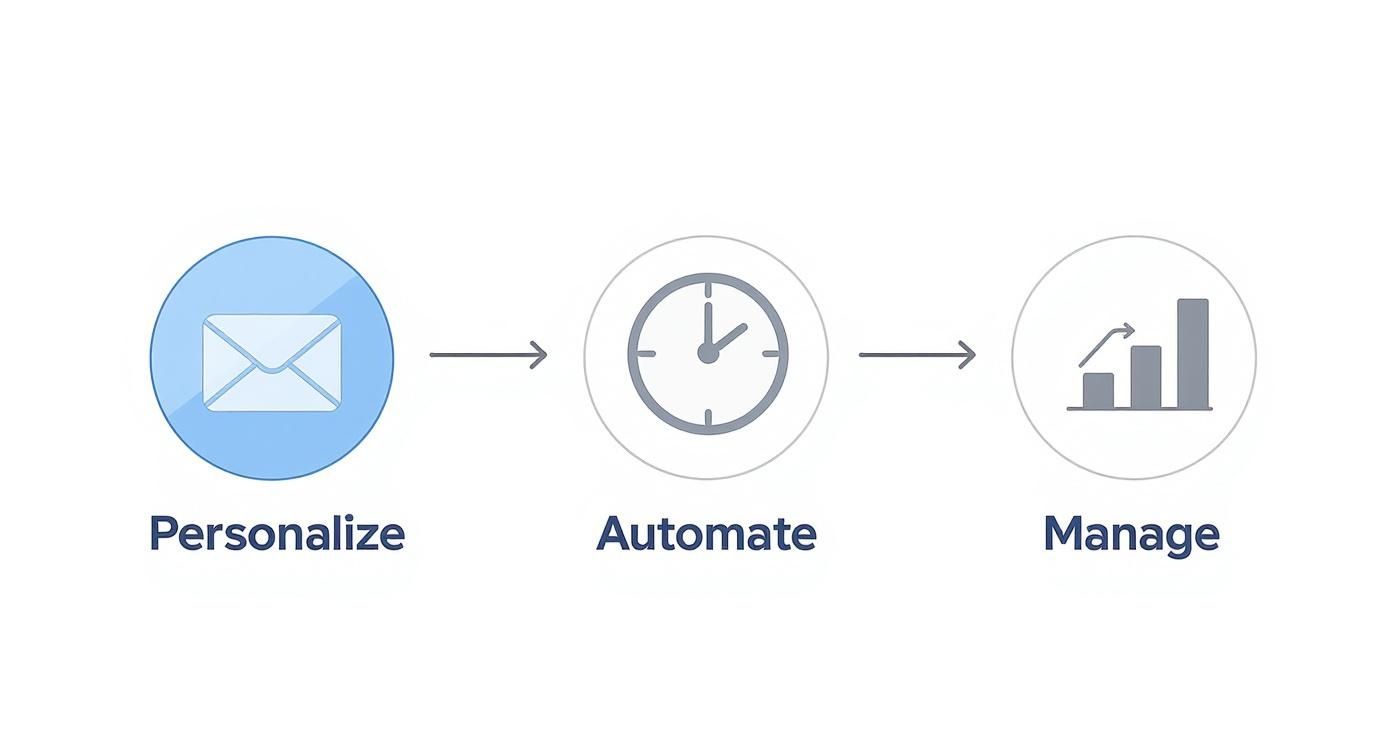
A streamlined process for connecting with creators is what ensures your AI-generated content can start producing the data you need to analyze and improve.
Iterating and Optimizing Your Prompts
Once you’ve identified your winning content, it’s time to figure out why it worked. Deconstruct those top-performing scripts and briefs and feed those learnings right back into your AI.
Look for the common threads. Was it a specific hook? A certain type of call-to-action? Did you focus on a particular product benefit?
This analysis is pure gold for refining your prompt templates. For instance, maybe you find that AI scripts starting with a question have a 20% higher click-through rate to your TikTok Shop. Great. You can now update your master prompt to instruct the AI to always frame hooks as a relatable question. That’s how you build a real cycle of continuous improvement.
This kind of optimization has a huge impact. In 2025, with nearly 80% of affiliate marketers using AI, the real competitive edge will come from who applies it most intelligently. We already know that AI-driven video content can produce a 49% higher conversion rate. You can read more about these kinds of affiliate marketing statistics on Hostinger to see the bigger picture.
A data-first approach to AI affiliate writing ensures you're not just creating content faster—you're creating content that predictably converts.
Common Questions About AI Affiliate Writing
Whenever you're jumping into a new strategy, you're going to have questions. AI affiliate writing is no different. We see the potential for incredible speed and scale, but practical concerns about authenticity, effectiveness, and the tools themselves pop up all the time. It’s smart to get these sorted out before you go all-in.
The best way to build a solid, sustainable plan for your TikTok Shop is to tackle these common hurdles head-on. Let's break down some of the most frequent questions we hear from brands stepping into this space.
Can AI-Generated Content Truly Be Authentic?
This is probably the biggest and most valid concern. The short answer is yes, but it comes with a huge caveat: AI should be your assistant, not your author. Authentic content has to come from a real human perspective—that’s completely non-negotiable.
Think of AI as a brilliant starting point. It's fantastic for churning out structured drafts, brainstorming a dozen different hooks, or outlining talking points based on your prompts. But that output is just the raw material.
- Humanizing the Draft: The real magic happens when a human—either an editor or the creator themselves—gets their hands on the AI's script. This is where they inject personal stories, genuine reactions, and the unique quirks that make their content feel real and relatable.
- Finding the Right Angle: Use AI to explore a bunch of different content angles, but always let the creator pick the one that feels most genuine to them and their audience. Authenticity isn't about who wrote the first draft; it's about the honesty of the final delivery.
The goal isn't to have a robot talk to your audience. It's to use a robot to handle 80% of the foundational work, freeing up your creators to focus on the final 20%—the part that actually builds connection and trust.
When you reframe AI's role from creator to co-pilot, you get massive efficiency gains without sacrificing authenticity. The final product should always have a clear human touch.
What Is the Best AI Tool for Affiliate Writing?
There’s no single "best" tool, especially since the landscape is changing so fast. Instead of getting hung up on one platform, it’s much more effective to think in terms of capabilities. Your ideal toolset should support your entire workflow, from coming up with ideas to the final quality check.
In our experience, most successful brands use a combination of tools, not just one.
| Tool Category | Primary Function | Example Scenario |
|---|---|---|
| Generative Models | Drafting scripts, hooks, and descriptions. | Using a large language model to create five different video script variations for a new product launch. |
| SEO & Research Tools | Identifying trending topics and keywords. | Finding breakout search terms on TikTok that you can build content around for your affiliates. |
| Editing & Grammar | Polishing final copy for clarity and correctness. | Running a final script through an editor to catch awkward phrasing or typos before sending it to a creator. |
The key is to pick tools that slide right into your existing process. A powerful, flexible generative model is a great place to start for the core writing. As your program grows, you can layer in more specialized tools for optimization. Ultimately, the most important skill is mastering prompt engineering to get high-quality output, no matter which specific tool you choose.
How Do I Measure the ROI of My AI Content Efforts?
Measuring the return on your AI affiliate writing strategy is critical. If you're not tracking clear metrics, you're just creating content in a vacuum. The process itself is pretty straightforward: you have to connect the content you're creating directly to the sales it generates.
This is where having a dedicated platform becomes a game-changer. A tool with a solid profit dashboard lets you track performance with real precision.
You should be keeping a close eye on:
- GMV per Creator: See exactly which affiliates are driving the most sales with the content you've helped them create.
- Performance by Content Angle: Tag your AI-generated scripts by their theme (like "how-to," "unboxing," or "problem-solution"). This will quickly show you which narratives resonate most and actually lead to conversions.
- Cost vs. Revenue: Put your affiliate commissions and any tool costs up against the revenue they brought in. This gives you a crystal-clear picture of your profitability.
By consistently tracking these numbers, you can easily spot your top-performing content and creators. That data then becomes a feedback loop, helping you refine your AI prompts and double down on what’s working. It’s how you make sure your efforts aren't just efficient, but also wildly profitable.
Ready to stop the guesswork and start scaling your TikTok Shop with data-driven precision? HiveHQ combines a powerful Affiliate Bot, Creator Tracker, and Profit Dashboard to automate your outreach and maximize your ROI. Discover how HiveHQ can transform your affiliate program today!