ai business solutions for TikTok Shop and DTC growth
ai business solutionsdtc growthtiktok shopai marketingcreator economy
So, what are AI business solutions? Forget the sci-fi jargon. In simple terms, they're smart tools that automate tedious tasks, make sense of complex data, and even predict what's coming next, helping your business grow smarter, not just harder.
For brands killing it on TikTok Shop or running their own DTC site, this means swapping guesswork for genuine intelligence. It’s about using AI to pinpoint the perfect creator partners, create personalized shopping experiences, and make sharp, data-backed decisions that actually drive sales.
How AI Is Rewriting the Rules of Modern Commerce
Let's get practical. When we talk about AI business solutions, we're not talking about some far-off concept. We're talking about a real-world engine for growth.
Think about it this way: old-school marketing was like yelling into a packed stadium, hoping your perfect customer just happened to be in the crowd. AI, on the other hand, is like a personal shopper for every single person, guiding them to exactly what they're looking for, right when they need it.
This move from broadcasting a single message to creating hyper-personal connections is completely changing the game. For DTC and TikTok Shop brands, the pressure is on. The competition is insane, ad costs are through the roof, and holding a customer's attention is harder than ever. AI offers a real edge here, delivering results you can actually see.
From Manual Grind to Automated Smarts
At its heart, AI takes over the complex, mind-numbing tasks that used to eat up your team's day. Instead of manually digging through thousands of creator profiles, an AI tool can instantly flag the partners who will perform best for your brand based on cold, hard data. Instead of guessing which products will be a hit, predictive analytics can forecast demand with scary accuracy.
This automation frees up your people to do what they do best: think strategically, get creative, and build real relationships with customers and partners.
But it’s not just about saving a few hours. It’s about unlocking the ability to scale your efforts in ways that were impossible before. With AI, brands can:
- Dig through huge datasets to spot hidden trends in customer behavior and creator performance.
- Automate outreach and follow-ups to thousands of potential affiliates at once, without losing that personal touch.
- Tailor the shopping experience for every visitor, which directly boosts conversion rates and builds loyalty.
- Fine-tune operations across the board, from keeping the right products in stock to handling customer service.
Why AI Is No Longer Optional in Business
This isn't just a trend; the market numbers prove it. The global AI market is on track to hit around $254.50 billion in 2025 and is projected to explode to an eye-watering $1.68 trillion by 2031.
This massive growth shows just how vital these tools are becoming. For e-commerce brands, the biggest wins are happening in core functions like customer service (which accounts for 38% of AI's business value) and marketing (20%). You can dive deeper into the data behind AI's business impact to see the full picture.
The real magic of AI isn't just that it can process a ton of data. It's that it can turn that data into profitable decisions—like telling you which creator will drive the most sales next month or which ad creative will actually connect with your target audience.
The bottom line is that AI business solutions aren't just for mega-corporations anymore. They are accessible, practical tools that are essential for any DTC or TikTok Shop brand serious about winning in the creator economy.
Real-World AI Wins for DTC Brands
It's one thing to talk about AI in theory, but it’s a whole different ballgame when you see it solve the real, nagging problems you face every day. For anyone running a Direct-to-Consumer (DTC) or TikTok Shop brand, the daily grind is a mix of finding creators, managing inventory, and a million other tasks. This is where AI business solutions stop being buzzwords and start becoming your most valuable players.
Let's break down how AI is tackling some of the biggest growth hurdles, swapping out those tedious manual tasks for smart, automated systems that just work.
Find Your Next Rockstar Creators—Fast
Let's be honest: finding the right creator partners often feels like searching for a needle in a haystack. You scroll endlessly, make educated guesses, and cross your fingers. Big follower counts can be fool's gold; a creator with a million followers might not move a single product. AI flips this whole process on its head.
Instead of you doing the digging, AI platforms sift through millions of creator profiles in the blink of an eye. They ignore the vanity metrics and zero in on what actually drives sales for DTC brands:
- True Audience Match: The AI figures out if a creator's audience is actually your ideal customer by looking at their demographics, interests, and even buying habits.
- Proven Sales Power: It digs into past performance data to spotlight creators who have a history of driving real sales, not just empty likes and comments.
- Brand Safety Net: AI systems can scan a creator’s entire content history for red flags, making sure their vibe and values align with yours. This saves you from partnering with someone who could damage your brand's reputation.
Imagine finding 50 high-converting micro-influencers in your niche in the time it once took you to vet a single one. That's the kind of efficiency we're talking about.
Put Your Affiliate Campaigns on Autopilot
So you've found your creators. Great. Now comes the real slog: tracking every link, managing all the back-and-forth, and making sure everyone gets paid correctly. For brands running affiliate or performance-based campaigns, especially on a fast-moving platform like TikTok Shop, this admin work can quickly become a full-time job.
AI can automate this entire workflow from start to finish.
Think of it as your own tireless campaign manager—one that works 24/7 without ever needing a coffee break. The system automatically tracks every sale from every creator, calculates commissions with 100% accuracy, and handles payouts on schedule, every single time.
This frees up your team from being buried in spreadsheets and manual calculations. Now, they can focus on what really matters: building stronger relationships with your top performers and thinking up the next big campaign strategy. For instance, an AI tool can automatically ping a creator when their product arrives or send a friendly reminder when a post is due, so nothing ever slips through the cracks.
Craft Shopping Experiences That Feel Personal
The days of one-size-fits-all marketing are over. Your customers expect you to get them—to understand what they like and what they're looking for. AI is what makes it possible to deliver that kind of hyper-personalization at scale, something that’s flat-out impossible to do by hand.
Here’s how AI can create those tailored moments:
- Smarter Product Recommendations: An AI can analyze a shopper's clicks, purchase history, and even what they've left in their cart to show them other products they're almost certain to love.
- Content That Clicks: The system can change what people see on your site or in your emails. A loyal customer might get a "welcome back" message with new arrivals in their favorite category, while a first-time visitor sees your all-time bestsellers.
This isn’t just a nice-to-have; it directly impacts your revenue. Brands that nail personalization generate 40% more revenue from it than their competitors. It's how you build real loyalty and turn browsers into buyers.
End the Guesswork in Your Inventory Planning
Nothing hurts a DTC brand more than bad inventory management. You either run out of your hottest product right when it goes viral (goodbye, sales) or get stuck with a warehouse full of stuff that won't sell (goodbye, cash). AI-powered forecasting tools replace that risky guesswork with solid, data-backed predictions.
By crunching historical sales numbers, social media trends, and even upcoming holidays, AI can predict demand with stunning accuracy. This helps you:
- Eliminate Stockouts: Keep your bestsellers on the shelf so you never miss a sale.
- Cut Down on Overstock: Avoid tying up your money in products that are gathering dust, which frees up capital and prevents heavy discounting.
At the end of the day, these AI business solutions aren't about chasing the latest tech trend. They're practical, powerful tools built to solve the real-world operational headaches that hold DTC brands back, letting you work smarter, not harder, and scale faster than ever before.
Building Your AI Implementation Roadmap
Jumping into the world of AI business solutions can feel overwhelming, but it really doesn't have to be. Getting started with AI isn’t about a massive, overnight overhaul of your entire business. It's about taking a measured, step-by-step approach that focuses on clear goals and tangible wins.
Think of it like building a house. You’d never start swinging a hammer without a solid blueprint. This roadmap is that blueprint, broken down into four essential pillars to guide you from a simple idea to scalable success—without blowing up your budget or burning out your team.
Prepare Your Data Foundation
Before any AI tool can start working its magic, it needs the right ingredients. For any TikTok Shop or DTC brand, that primary ingredient is data. The goal here isn't just to collect data, but to get it organized so an AI can actually understand and act on it.
Start by focusing on the core numbers that directly impact your growth. You don't need to capture every single data point in the universe. Instead, prioritize clean, accessible information that tells a clear story about what’s working and what isn’t.
Key data sources to wrangle first include:
- Sales Data: Things like Gross Merchandise Volume (GMV), average order value, and which products are flying off the shelves.
- Creator Metrics: This means tracking affiliate-driven sales, how much you're paying in commissions, and creator engagement rates.
- Customer Behavior: Look at purchase history, how people navigate your site, and how often they come back to buy again.
Getting this information organized in one central spot, whether that's your Shopify dashboard or a well-structured spreadsheet, creates the solid foundation your AI will be built on.
This simple visual shows a straightforward, three-step process for putting AI into action: Discover, Automate, and Personalize.
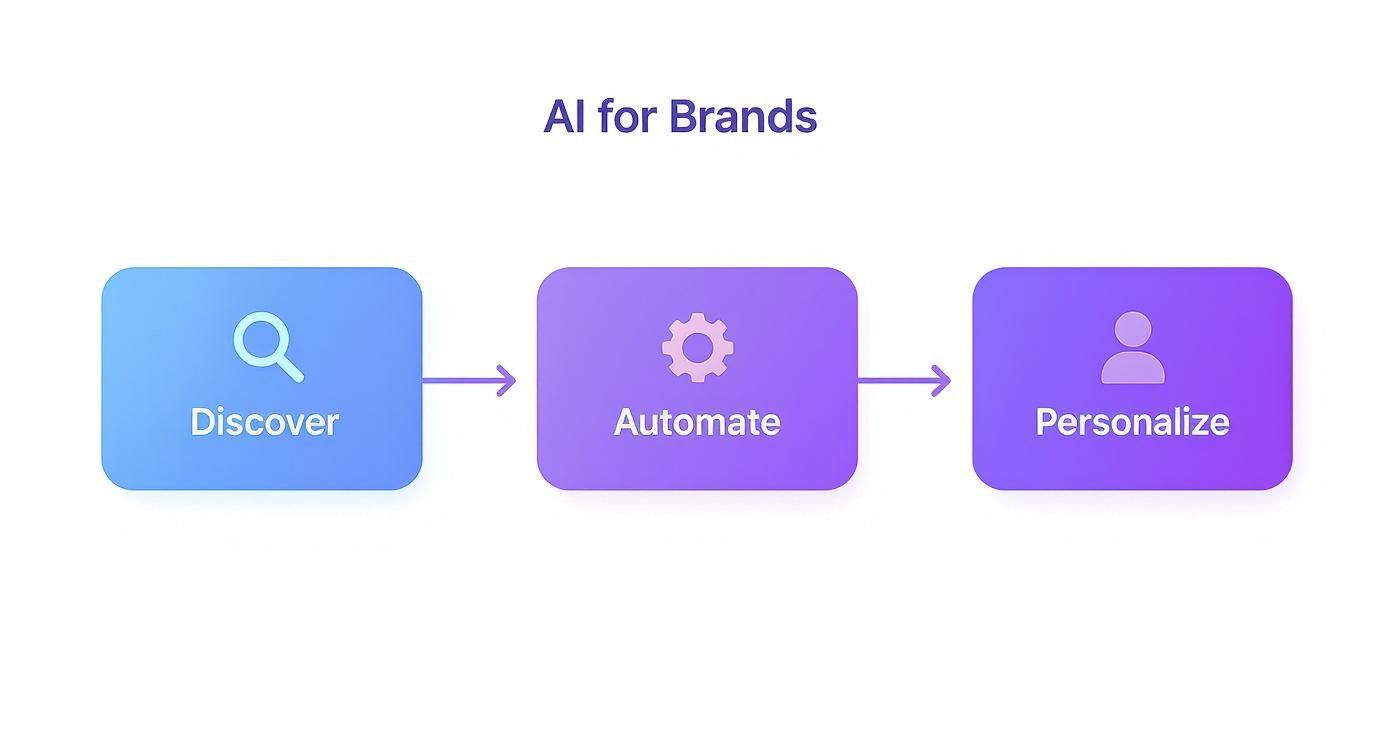
The process really is that simple. It all starts with discovering opportunities hidden in your data, which then allows you to automate key tasks and deliver the kind of personalized experiences that truly drive growth.
Choose Your Technology Wisely
Let’s be clear: integrating AI doesn't mean you have to rip out all the systems you already depend on. The best AI business solutions are built to plug directly into your existing tech stack, especially platforms like Shopify and TikTok Shop. The trick is to find tools that make your life easier, not more complicated.
Look for solutions with seamless, native integrations. If an AI platform requires a ton of custom code or a team of engineers just to get it up and running, it’s probably not the right choice for a fast-moving DTC brand. Your priority should be finding user-friendly tools that your marketing team can actually use and manage on their own.
Your tech stack should feel like a set of interconnected LEGOs, not a tangled mess of wires. The right AI solution will snap neatly into place, immediately start pulling data, and deliver insights without disrupting your day-to-day operations.
Structure a Team for Action
One of the biggest myths about adopting AI is that you need to go out and hire a room full of data scientists. For most DTC brands, that couldn’t be further from the truth. You don’t need to hire specialized AI experts; you need to empower your existing team with better tools.
Your marketing managers, affiliate coordinators, and e-commerce strategists are the ones who will turn AI insights into real-world action. They already know your customers, your brand, and your market inside and out. An AI tool just gives them superpowers, letting them make smarter decisions, faster. The goal is to find platforms that present insights clearly, making it easy for non-technical team members to see the "why" behind the numbers and confidently take the next step.
Experiment and Scale Intelligently
Finally, resist the urge to launch a massive, company-wide AI initiative right out of the gate. A much smarter approach is to start small, test a specific idea, and scale what actually works. This "crawl, walk, run" method minimizes risk and builds momentum.
Here’s a simple framework for smart experimentation:
- Start with a Pilot Project: Pick one specific problem you want to solve, like automating your creator outreach or improving product recommendations on your site.
- Define a Clear Hypothesis: State exactly what you expect to happen. For example, "Using an AI affiliate bot will increase our new creator partnerships by 25% in the first month."
- Measure and Learn: Track the results against the KPIs you set. Did you hit your goal? Why or why not?
- Scale What Works: Once you have a proven win, expand that strategy to other parts of the business.
This iterative approach ensures every move you make is backed by real data. The AI market's explosive growth, projected to hit USD 1.77 trillion by 2032, is being fueled by companies using these kinds of smart, scalable strategies. With 42% of large enterprises having already put AI to work, it's clear where the industry is heading. You can dig deeper into the trends driving the AI market's growth if you're curious. By following this roadmap, you can confidently bring AI into your operations and unlock a whole new level of growth.
Measuring the Real Impact of Your AI Strategy
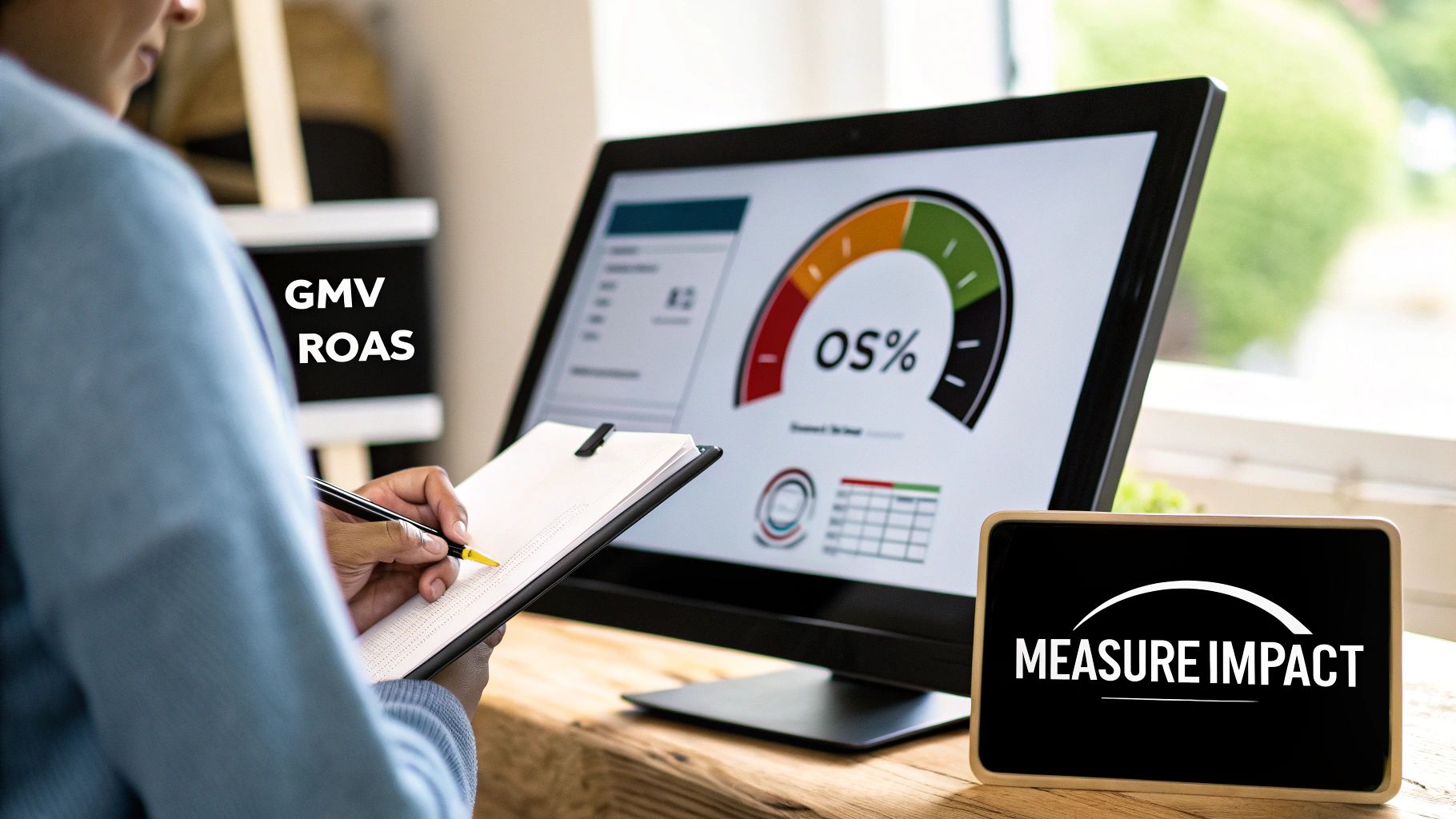
Bringing new AI business solutions into your workflow is exciting, but the real test is whether they actually make a difference to your bottom line. You have to prove this investment isn't just a shiny new tech toy, but a genuine engine for growth. That means cutting through the noise and focusing on the Key Performance Indicators (KPIs) that truly matter to the health of your brand.
When you track the right metrics, your AI strategy stops being a vague "nice-to-have" and becomes a concrete, measurable asset. You get the hard data you need to justify the budget, double down on what’s working, and make smarter decisions as you scale. This is how you prove to yourself, your team, and any other stakeholders that an AI-powered approach is actually paying off.
Defining Your Core Growth Metrics
Before you can measure success, you have to define what it looks like for your business. For most TikTok Shop and DTC brands, a handful of core metrics tell the most important stories about performance. These are the numbers that connect straight to your bank account.
Gross Merchandise Volume (GMV): Think of this as the total price tag of everything you sold over a certain time. By tracking the GMV generated from your AI-driven creator campaigns, you can draw a straight line from your automation efforts to your top-line revenue.
Return on Ad Spend (ROAS): A non-negotiable metric for any paid marketing. ROAS tells you how much money you made for every dollar you spent on ads or, in this case, on creator commissions. AI helps you find partners who naturally deliver a higher ROAS, so every dollar works harder.
Customer Acquisition Cost (CAC): This is simply what it costs you to win a new customer. When you use AI to pinpoint creators with super-engaged, relevant audiences, your CAC can drop dramatically because you’re reaching the right people from the get-go.
Customer Lifetime Value (LTV): LTV is a prediction of the total profit a single customer will bring to your brand over their entire relationship with you. AI-powered personalization and better creator matching lead to happier customers, which means more loyalty and a higher LTV.
These four KPIs are the bedrock of a data-driven AI strategy. They give you a clear view of exactly where and how your tech is creating real value.
A Clear Framework for Tracking AI Performance
Knowing which metrics matter is step one; actually tracking them is step two. You need a reliable system to monitor how your AI initiatives are influencing each KPI. This is what allows you to spot trends, celebrate wins, and pivot quickly when something isn't hitting the mark.
A tool like the Profit Dashboard from HiveHQ, for instance, surfaces these numbers in real-time. It automatically connects data from your shop and creator campaigns, calculating your margins and performance without you ever having to touch a spreadsheet.
The goal is to move beyond vanity metrics like likes and views and focus relentlessly on the numbers that directly impact profitability. This is what separates brands that are just playing with AI from those who are truly winning with it.
To help you get started, here’s a breakdown of how to track the ROI from your AI tools. This table provides a clear view of the essential KPIs, what they measure, and why they’re so critical for gauging the success of your AI-driven commerce strategy.
Key Performance Indicators for AI-Driven Commerce
| KPI | What It Measures | How to Calculate It | Why It Matters for AI |
|---|---|---|---|
| GMV Contribution | Total revenue generated by specific AI-powered campaigns or creators. | (Total Sales from Creator A) + (Total Sales from Creator B) | Directly proves the revenue-generating power of your AI-driven affiliate program. |
| ROAS | The efficiency of your spending on creator partnerships. | (Revenue from Campaign) / (Total Commissions Paid) | AI identifies high-performing creators, maximizing your return on every dollar spent. |
| CAC Reduction | The decrease in cost to acquire a new customer. | (Old CAC) - (New CAC with AI) | Shows that AI-powered creator discovery is more effective at converting new customers. |
| LTV Growth | The increase in the long-term value of your customers. | (New LTV) / (Old LTV) - 1 | AI-driven personalization creates happier, more loyal customers who spend more over time. |
By consistently keeping an eye on these KPIs, you create a powerful feedback loop. You’ll see which AI business solutions are giving you the best results, allowing you to invest your time and money with confidence and build a more resilient, profitable brand.
How to Choose the Right AI Partner
Picking the right AI partner is a big deal. Let’s be honest, it’s a high-stakes decision. You’re not just buying another piece of software; you’re betting on a core part of your growth strategy. The market is absolutely flooded with vendors promising the moon, but the right choice for your brand is the one that actually solves your problems without creating a bunch of new ones.
This guide is designed to help you cut through that noise. It's a straightforward checklist of the tough questions you need to be asking any potential AI vendor. Getting clear answers here will help you find a partner that genuinely empowers your team, slots into your operations without a fuss, and delivers a return you can actually see.
Does It Fit Your Existing Workflow?
The most advanced AI tool on the planet is worthless if it doesn't play nicely with the systems you already use every single day. If a solution forces you to completely rip out and replace your current workflow, it’s just going to create friction and slow you down. The first thing you absolutely have to confirm is seamless compatibility with your e-commerce backbone.
Ask potential vendors these direct questions:
- How deep is your integration with Shopify and TikTok Shop? You’re looking for native, one-click integrations that sync data automatically. Anything that requires manual uploads or custom code is a red flag.
- Can your platform pull data from our other key tools? Think about your email software, ad platforms, or inventory management systems. The more data the AI can access, the smarter its insights will be.
- What does the setup actually look like? Insist on a live demo, not a polished, pre-recorded video. You need to see exactly how the platform connects to your stores and how long it really takes to get up and running.
A true partner solution should feel like a natural extension of your tech stack, not some clunky add-on that makes everyone's job harder.
Can Your Team Actually Use It?
So many AI platforms are built by engineers, for engineers. They might be packed with features, but their interfaces are often a confusing mess for a marketing or operations team. The best AI business solutions for DTC brands are designed for the people who will be in the driver's seat every day.
Usability isn’t a "nice-to-have" feature; it’s a core requirement for adoption. If your team finds the tool too complex, they simply won't use it, and your investment will go down the drain.
Probe for real answers on usability and support:
- Who is your typical user? Is the platform built for a data scientist or for an affiliate marketing manager? Their answer will tell you a lot about the tool’s entire design philosophy.
- What kind of training and onboarding do you provide? Look for dedicated support, live training sessions, and a deep knowledge base your team can turn to whenever they need it.
- Can we run a pilot program or trial? There’s no substitute for getting your hands on the keyboard. It's the only way to know for sure if the platform is a good fit for your team’s skills and daily routines.
Will It Scale With Your Brand?
Your business is built to grow, and your AI partner has to be able to keep up. A solution that works great when you have ten creator partnerships might completely fall apart when you’re trying to manage a thousand. Scalability isn't just about handling more data—it's about growing with you without performance dropping off a cliff or the price suddenly skyrocketing.
The global artificial intelligence market was estimated at USD 638.23 billion in 2025 and is projected to climb to around USD 3.68 trillion by 2034. This explosion is largely thanks to AI-as-a-Service (AIaaS) platforms offering scalable, cloud-based tools, making powerful AI accessible to everyone. To get a better sense of the landscape, you can learn more about the trends shaping the global AI market. The partner you choose should be part of this scalable future.
Before you sign any contracts, get clarity on what growth looks like:
- What are your pricing tiers, and how do they scale? You need to understand the cost implications as your GMV, creator count, or data usage grows. Steer clear of partners with unpredictable pricing models.
- How does the platform handle large-scale automation? For a tool like HiveHQ’s Affiliate Bot, this means asking if it can manage outreach to tens of thousands of creators without breaking a sweat.
- What’s on your product roadmap? A forward-thinking partner is always improving their product. You want to see that they’re building features that will support your needs six months or a year from now.
Choosing an AI partner is a strategic move. By asking these pointed questions about integration, usability, and scalability, you can confidently pick a solution that will become a true catalyst for your brand’s growth.
Your Top Questions About AI Business Solutions, Answered
Jumping into any new technology brings up a lot of questions. That’s a good thing—it means you’re thinking critically about what’s right for your brand. When it comes to AI business solutions, we see the same worries pop up: Is this going to be too complex? Too expensive? Will we lose the human touch that makes our brand, our brand?
Let's clear the air on these common concerns so you can make your next move with confidence.
A huge myth is that you need a Ph.D. in data science just to get started. Honestly, that couldn't be further from the truth. Modern AI tools are built for the people actually running the business—marketers and operators, not a room full of engineers. The best platforms are designed to be intuitive, turning a sea of data into clear, actionable insights your team can use right away.
What’s a Realistic Budget and Timeline to See a Return?
Okay, let's talk money and results. How much does this cost, and when do you actually start seeing a payback?
The budget for AI tools can be all over the map, but many of the best solutions are surprisingly affordable, especially those offered as AI-as-a-Service (AIaaS). They typically run on a subscription model, which means you get access to incredibly powerful tech without a scary upfront investment.
As for your ROI timeline, it really depends on where you're starting from and what you want to achieve. That said, most brands start seeing real results a lot faster than they think.
- Short-Term Wins (1-3 Months): This is all about efficiency. Think about automating creator outreach—that simple change can instantly free up hours of manual work every single week. Your team can stop digging through inboxes and start focusing on strategy.
- Mid-Term Gains (3-6 Months): Now you’ll start seeing the impact on your bottom line. As the AI helps you find and manage better creator partnerships, you’ll see measurable bumps in Gross Merchandise Volume (GMV) and a stronger Return on Ad Spend (ROAS).
The whole point isn’t a one-off campaign spike; it’s about creating a sustainable engine for growth. Those early efficiency wins build momentum, which then translates into real revenue as the AI learns from your data and gets even smarter.
Does AI Kill Human Creativity?
This is probably the biggest and most important question: Will AI replace the creativity, intuition, and relationship-building that’s the heart and soul of creator marketing?
It’s a valid concern, but it comes from a misunderstanding of what AI is built to do. AI doesn’t replace human connection; it gives you the bandwidth to create more of it.
Think of AI as your team's ultimate assistant. It handles the mind-numbing, data-intensive work—analyzing performance metrics, automating follow-ups, and flagging the best opportunities. This frees your people from drowning in spreadsheets and administrative busywork. It gives them back the time to do what humans do best: build genuine relationships with creators, dream up amazing campaign concepts, and think big about where the brand is headed.
Simply put, AI handles the science so your team can focus on the art.
Ready to see how HiveHQ can put your TikTok Shop growth on autopilot, without the guesswork? Our all-in-one suite, featuring the Affiliate Bot and Profit Dashboard, is built for operators who need to move fast and see real results. Explore our features and get started today at hivehq.ai.