artificial intelligence affiliate marketing: Quick Guide
artificial intelligence affiliate marketingai in marketingaffiliate marketingcreator economytiktok shop
Think about the last time you tried to find the perfect creator for a campaign. It probably involved endless scrolling, a dozen open tabs, and a whole lot of guesswork. It feels a bit like searching for a needle in a digital haystack, right?
Now, imagine you had a GPS that didn't just find that needle but told you its exact location, how sharp it is, and the best way to pick it up. That's essentially what artificial intelligence brings to affiliate marketing. It’s a shift away from gut feelings and surface-level metrics, moving us toward a smarter, data-driven approach.
AI doesn't just look at follower counts. It dives much deeper, analyzing an audience's demographics, their engagement patterns, and even past conversion data. This helps you find creators who have the right audience for your products, not just a big one.
This isn't some far-off future concept; it's happening now. The affiliate marketing industry, valued at $19.2 billion in 2021, is on track to hit $36.9 billion by 2030. A huge chunk of that growth is fueled by AI and smarter analytics, which you can read more about in this market growth forecast on Tapfiliate.com. It's clear that AI is already a practical tool delivering real results.
A Smarter Engine for Affiliate Growth
At its core, AI acts as a super-powered assistant. It takes on the repetitive, time-sucking tasks that bog down affiliate managers, freeing you and your team to focus on the things that matter most: strategy, creative thinking, and building real relationships with your best partners.
This fundamental shift from manual to AI-powered operations introduces a much smarter way of working. The table below breaks down just how different the two approaches are.
Traditional vs. AI-Powered Affiliate Marketing
| Task | Traditional Approach (Manual) | AI-Powered Approach (Automated & Optimized) |
|---|---|---|
| Creator Discovery | Time-consuming manual searches, relying on keywords and follower counts. Often subjective. | Data-driven discovery based on performance history, audience alignment, and predictive analytics. Finds hidden gems. |
| Outreach | Generic, one-size-fits-all email templates sent in batches. Low response rates. | Personalized outreach at scale, with messaging tailored to each creator. Higher engagement and success rates. |
| Campaign Briefing | Manual creation and distribution of briefs. Inconsistent follow-ups. | Automated brief generation and delivery. Systematic, automated follow-ups to ensure deadlines are met. |
| Commission Setting | Standard, fixed commission rates for all affiliates, regardless of performance or influence. | Dynamic commission models that adjust based on real-time performance, sales data, and creator value. |
| Performance Tracking | Basic tracking of clicks and sales. Attribution can be difficult and often relies on last-click models. | Advanced attribution models that track the full customer journey. Predictive analytics forecast future performance. |
| Optimization | Reactive adjustments based on past performance reports. Slow and often too late. | Proactive, real-time optimization. AI suggests adjustments to campaigns and partnerships to maximize ROI. |
As you can see, AI introduces a level of precision and efficiency that just isn't possible with manual methods. It transforms affiliate marketing from a numbers game into a highly optimized performance channel.
By taking care of the heavy lifting, AI gives marketing teams the speed and insight they need to make better decisions.
The goal isn't just to automate tasks; it's to augment human expertise. AI handles the data crunching so you can focus on building the strategic partnerships that drive real, sustainable growth.
Ultimately, using AI in your affiliate program gives you a framework to scale intelligently. It’s about making smarter, faster, and more profitable decisions at every turn—from finding the right people to making sure they’re motivated to deliver their best work.
How AI Transforms Affiliate Marketing Workflows

When we talk about AI in affiliate marketing, it's easy to think of it as just a tool for automating the tedious stuff. But that’s not the whole story. Real AI integration goes deeper, completely reshaping how programs are built and run. We're moving from a reactive, task-based approach to a proactive, intelligent strategy.
Think of it this way: a calculator can speed up your math, but it can't tell you where to invest your money. A financial modeling computer, on the other hand, can forecast outcomes and spot hidden opportunities. That's the leap AI offers. It turns the core parts of your affiliate workflow into a smart, data-driven engine for growth.
And the results are tangible. Campaigns driven by AI have been shown to boost click-through rates by up to 40% by delivering recommendations that actually resonate with people. This level of smart targeting can lift affiliate sales by as much as 30%, making a real dent in the bottom line. You can dive deeper into the future of performance marketing on Partnero.com.
Predictive Creator Discovery
The old way of finding affiliates was a bit of a guessing game. You'd look at follower counts or search for basic keywords, but those surface-level metrics don't tell you if a creator can actually sell your product. A huge audience means nothing if they're not the right audience.
AI flips this entire process on its head with predictive creator discovery.
Instead of just looking at vanity metrics, AI algorithms sift through millions of data points to find creators who are a genuinely good fit for your brand. It’s a much smarter way to build your roster.
- Audience Affinity Analysis: The AI figures out if a creator's audience truly matches your ideal customer profile—their demographics, interests, and even what they tend to buy.
- Performance Forecasting: By crunching the numbers on a creator's past content and engagement, AI can predict how well they're likely to convert for your specific products before you even send that first email.
- Authenticity Scoring: Some advanced systems can even sniff out fake followers and manufactured engagement, ensuring you're partnering with creators who have a real, dedicated community.
This data-first approach takes the guesswork out of recruitment. You start building partnerships based on a high probability of success, which saves an incredible amount of time and boosts your campaign ROI right from the get-go.
Automated Outreach At Scale
So, you've got your list of high-potential creators. Now what? The old-school approach of manually sending hundreds of personalized emails is a soul-crushing task, and it's easy to fall back on generic templates that just don't work.
AI-powered outreach is the answer. It handles the volume without killing the personalization.
An AI system can draft and send thousands of unique messages, each one tailored to the creator it's talking to. It pulls in details like their recent videos, their niche, and audience interests to make the outreach feel like it came from a real person who did their homework.
By handling the initial contact and systematic follow-ups, AI frees affiliate managers from tedious administrative work. This allows them to focus their energy on building strong, lasting relationships with top-performing partners who have already shown interest.
This isn't just a fancy email blaster; it's a full-on communication pipeline. AI can track who opened your message, schedule follow-ups automatically, and alert you the moment a creator replies. No more promising partners falling through the cracks.
Hyper-Personalized Offers
Traditionally, personalization in affiliate marketing stopped with the creator. You’d give them a custom link, and that was about it. With AI, you can take that personalization all the way to the end customer.
Imagine a user clicks a link from a fitness creator's TikTok about your new running shoes. Instead of a generic homepage, AI can direct them to a landing page that specifically features those shoes. It might even suggest complementary products, like performance socks or a running belt.
This creates a seamless, incredibly relevant journey for the shopper, which naturally makes them more likely to convert. You’re no longer serving up a one-size-fits-all experience. Instead, you're tailoring the journey to what brought them there in the first place.
Performance Prediction and Optimization
Finally, AI changes how we manage performance. Instead of waiting until the end of the month to pore over reports and figure out what worked, AI models can forecast campaign outcomes and flag optimization opportunities as they happen.
These systems analyze data in real-time to predict a campaign's final ROI. They can spot an underperforming affiliate early or suggest bumping up the commission for a partner who is crushing it. The AI might even recommend sending new creative assets to a creator who seems to be struggling. This allows you to be agile and make smart, data-backed decisions that continuously improve your results.
AI-Driven Strategies for TikTok Shop Brands
If you’re running a brand on TikTok Shop, you know that speed is everything. Trends explode and then vanish in days. Trying to keep up with traditional, manual affiliate marketing is like showing up to a race in a horse-drawn buggy. It’s just too slow.
This is where AI gives you a serious edge. It transforms the chaotic, high-speed world of TikTok into a system you can actually manage and profit from.
Think of it this way: instead of desperately trying to catch a trend after it’s already peaked, AI helps you see where the next big wave is going to form. For TikTok Shop brands, that means running campaigns with a level of speed and precision that felt impossible before.
Here are four practical ways to use AI that are built for the unique hustle of TikTok Shop.
Mass Creator Recruitment at Scale
Let’s be honest, the old way of finding creators—mindlessly scrolling the "For You" page—is a recipe for burnout. With millions of potential partners out there, it’s like trying to find one specific grain of sand on a massive beach. You might get lucky, but it’s not a strategy.
AI flips the script with mass creator recruitment. An AI-powered system can scan the entire platform, sifting through thousands of profiles a minute to spot creators in your niche before they blow up. It goes way beyond just looking at follower counts.
- Real Audience Engagement: The AI dives into comment sentiment, how quickly a video is shared, and average watch time to find creators with genuinely passionate communities, not just passive followers.
- Sales Potential: By looking at how similar products have performed in the past, the system can actually predict which creators are most likely to drive sales for your brand.
- True Niche Relevance: It scores creators on how well their content and audience match your product, ensuring you’re partnering with people who are a natural fit.
This approach helps you find those hidden gems—the high-potential creators your competitors are completely missing—and build a powerful affiliate army at scale.
Automated Creative Briefs and Follow-Ups
So you’ve found hundreds of creators. Great! Now comes the logistical nightmare of managing them all. Writing and sending individual creative briefs is a massive bottleneck. One small delay can throw your entire launch schedule off course.
AI gets rid of this friction by generating and sending out customized briefs on its own. You create one master template, and the system can spin up hundreds of personalized versions, each with the creator’s name, unique tracking link, and specific product info already plugged in.
This screenshot from a platform like HiveHQ shows what this looks like in practice—a central dashboard that tames the chaos of managing dozens or even hundreds of creators.
You can see at a glance who’s on track and who needs a nudge, letting you focus your energy where it matters most.
And the follow-up? That’s automated, too. The system can send a reminder when a product is delivered, ping a creator when a deadline is near, or flag anyone who’s falling behind. Your campaign stays on track without you having to chase everyone down.
Dynamic Commission Optimization
A one-size-fits-all commission just doesn't make sense. Some of your affiliates will drive way more sales than others, but a flat-rate model pays them all the same. This means you’re probably overpaying for mediocre results while failing to properly reward your top performers.
Dynamic commission optimization is a much smarter way to handle payouts. The AI watches your sales data in real-time, sees which creators are moving the needle, and automatically adjusts their commission rates to match their impact.
Think of your commissions not as a fixed cost, but as a flexible investment. By giving higher rates to your best partners, you’re directly encouraging the behavior that drives more revenue. It’s about maximizing the return on every dollar you spend.
For example, the AI might spot a creator whose videos consistently bring in a high average order value and bump them up to a premium commission tier. At the same time, it can flag partners with poor conversion rates, giving you the chance to either help them improve or shift that budget to someone who’s getting better results.
Enhanced Attribution and Payouts
On TikTok, a single viral video can spark thousands of sales from countless other user-generated clips and shares. Figuring out who gets credit for what is a huge attribution headache. If you can't track it accurately, you risk underpaying your best people, which is a surefire way to kill a good partnership.
AI-powered attribution cuts through the confusion. It analyzes multiple data points to trace sales back to the original source—connecting a specific purchase to a specific video and creator, no matter how complicated the customer's journey was. This ensures every creator gets paid fairly for the value they bring, building the trust you need for a strong, long-term relationship.
Building Your AI Affiliate Marketing Roadmap
Bringing AI into your affiliate marketing might sound like a huge undertaking, but it’s much more manageable when you have a clear plan. Think of this roadmap as a flexible blueprint, not a rigid set of instructions. It’s designed to guide you from gathering your initial data all the way to running a fully scaled, compliant operation.
By breaking the process down into phases, you can build a powerful AI engine one step at a time. This approach helps you sidestep common mistakes, like investing in the wrong tools or failing to measure what really matters, and creates a solid foundation for smarter, more efficient affiliate growth.
Phase 1: Data Aggregation and Preparation
Before any AI can start working its magic, it needs high-quality fuel. For us, that fuel is data. The very first and most critical step is to pull together all the relevant information scattered across your different systems. This ensures your AI has a clean, complete dataset to learn from.
You'll need to connect the dots between multiple sources to get a full picture of your affiliate activities.
- E-commerce Platform Data: This is your ground truth—sales records, average order value (AOV), customer lifetime value (CLV), and product performance metrics from platforms like Shopify or BigCommerce.
- CRM and Affiliate Platform Data: Dig into your creator communication history, past campaign performance, commission payouts, and engagement rates.
- Website Analytics: Information from tools like Google Analytics reveals crucial insights into traffic sources, user journeys, and conversion paths.
The goal here is to demolish data silos and create a single source of truth. Without clean, centralized data, any AI model you build will be trying to solve a puzzle with half the pieces missing, which only leads to bad predictions and flawed recommendations.
Phase 2: Defining Your Key Performance Indicators
With your data organized, it's time to decide what success actually looks like. Vague goals like "improve our program" just won't cut it. You need specific, measurable Key Performance Indicators (KPIs) that will act as the scorecard for your AI’s performance.
Your KPIs should be directly tied to the problems you're trying to solve with artificial intelligence affiliate marketing.
Instead of just tracking conversions, AI lets you set much smarter goals. You can start measuring things like the reduction in time-to-first-sale for new affiliates or the predictive accuracy of your creator recruitment model.
For instance, you might set goals like these:
- Increase the creator activation rate by 25% within the first quarter.
- Cut down on manual outreach by 15 hours per week through automation.
- Improve the predictive accuracy of affiliate sales forecasts to 90%.
Setting clear targets right from the start gives you a precise way to measure ROI and justify the investment in AI technology.
Phase 3: Choosing the Right Tools and Platforms
Not all AI tools are created equal. When you're looking at different platforms, aim for an integrated solution that covers your entire workflow, not just a patchwork of separate tools. An all-in-one platform like HiveHQ can centralize everything from creator discovery to payment processing, making sure data flows seamlessly between every function.
Focus on core capabilities that match your KPIs, such as predictive analytics for finding the right creators and powerful automation for outreach and campaign management. Remember, the right platform should feel like a superpower for your team, not a replacement for them.
Phase 4: Piloting and Testing Your Strategy
Don't go all-in at once. Start with a small, controlled pilot program. Pick a specific segment of your affiliate program—maybe a new product launch or a group of your mid-tier creators—to test out your new AI-powered workflows. This approach minimizes risk and lets you gather valuable data in a low-stakes environment.
During this phase, run A/B tests to compare your AI-driven strategies against your old methods. For example, you could pit an AI-generated outreach sequence against your go-to manual template. This constant testing and tweaking will help you fine-tune your models and prove they work before you roll them out to everyone.
Phase 5: Scaling and Ensuring Compliance
Once your pilot program is a proven success and you’ve refined your approach, you’re ready to scale. This means gradually rolling out your AI-powered workflows to the rest of your affiliate program. As you grow, keep a close eye on your KPIs to make sure your performance stays strong.
This infographic shows a typical AI-powered workflow for TikTok, from finding creators to sending briefs and processing payouts.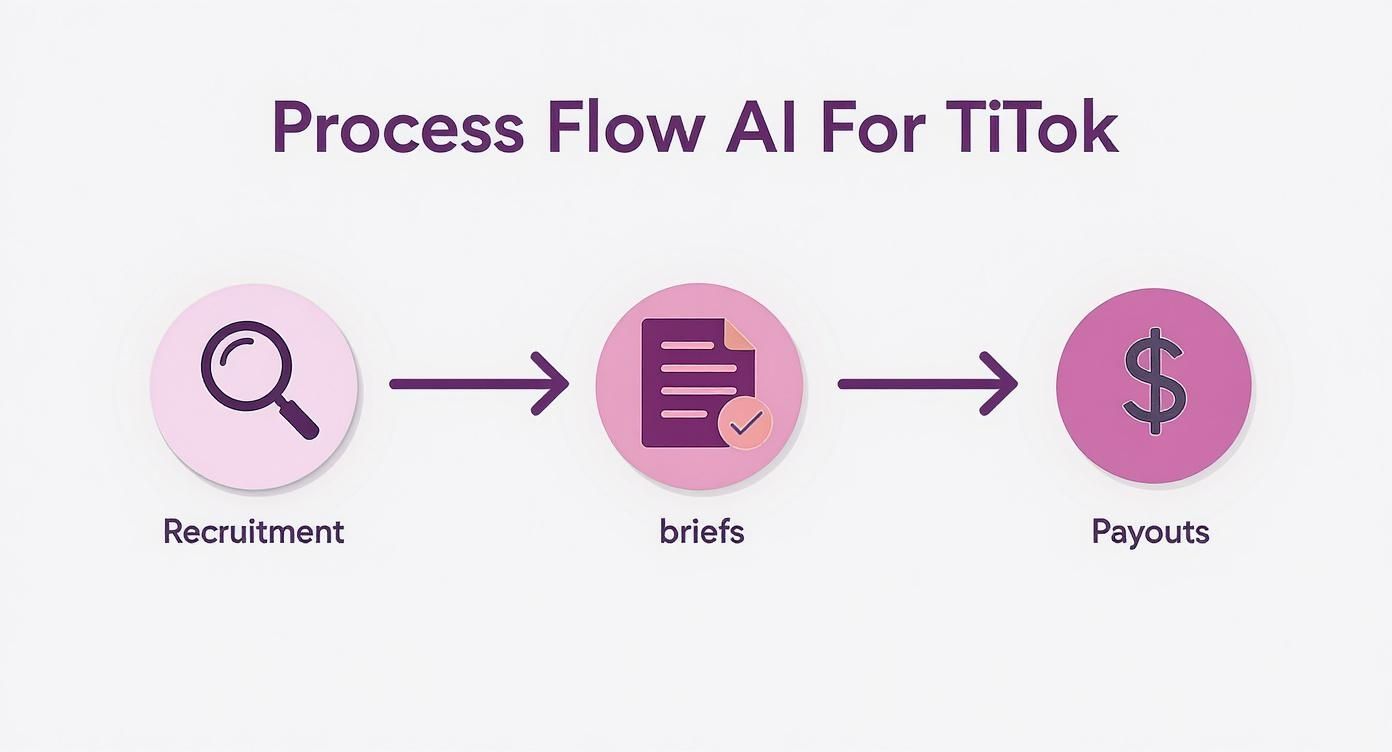
The process shows how automation can tie each step together, creating a far more efficient system for managing campaigns at scale.
Finally, as you start handling more data, compliance becomes non-negotiable. Make sure your data collection and processing practices follow privacy regulations like GDPR in Europe and CCPA in California. Being transparent with both your customers and your affiliate partners about how you use their data is absolutely essential for building and keeping their trust.
Measuring Success with AI-Powered Metrics
If you're going to invest in an AI-driven strategy, you need to upgrade how you measure success. Forget just tracking simple clicks and last-touch conversions; that’s an old-school approach. AI in affiliate marketing opens the door to a whole new world of predictive and diagnostic KPIs that give you a much richer picture of your program's health and future potential.
Think of these advanced metrics like a high-resolution camera. They reveal the fine details you’d otherwise miss. Instead of just seeing that a sale happened, you can now forecast a creator's future value, understand the true impact of every touchpoint, and even grade your creative before it ever goes live. This is the key difference: moving from reactive reporting to proactive forecasting. It’s what gives AI-powered programs their edge.
And this isn't some niche trend anymore—it's fast becoming the industry standard. By 2025, an estimated 79.3% of affiliate marketers are expected to be using AI tools to get more out of their campaigns, with North America alone driving over 40% of the market revenue. You can dig into more stats on the widespread adoption of AI in affiliate marketing via Hostinger.com. This rapid adoption means your metrics have to keep up with the technology.
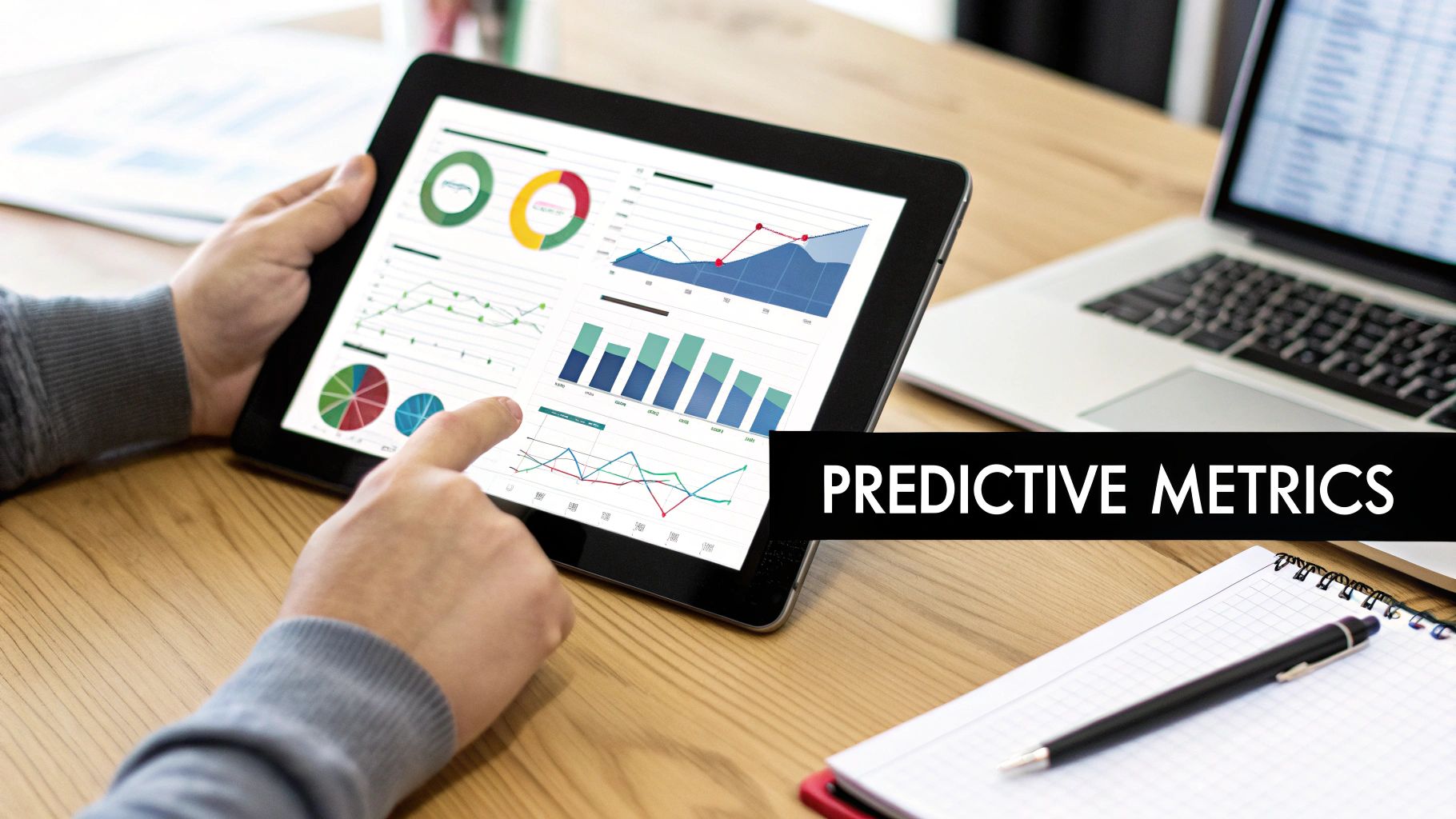
Predictive Performance Metrics
One of the coolest things AI brings to the table is its ability to look forward, not just backward. Predictive metrics use your historical data to forecast what's likely to happen next, helping you make smarter investments and tweak campaigns before you blow your budget. It’s the closest thing we have to a financial crystal ball for affiliate marketing.
These forecasts give you the confidence to put your resources where they’ll count, rewarding high-potential partners and stepping in early with those who are underperforming.
- Creator Lifetime Value (CLV): This isn't just about last month's sales. CLV forecasts the total revenue you can expect a creator to generate over your entire partnership. It helps you spot the difference between a one-hit wonder and a genuine long-term partner.
- Predictive ROAS (Return on Ad Spend): Imagine knowing your potential ROAS before a campaign launches. AI can analyze a creator's profile, the planned content, and audience data to estimate the financial return, letting you approve or adjust plans with real data to back you up.
Diagnostic and Optimization Metrics
Beyond just predicting the future, AI also gives you metrics that act like a health check for your affiliate program. These KPIs help you find the weak spots in your process, from attribution blind spots to content that just isn't landing. They give you clear signals on what needs fixing.
By keeping an eye on these scores, you ensure your entire operation is running smoothly and that every part of your strategy is actually moving you toward your goals.
An AI-powered affiliate program doesn't just measure results; it measures the quality of its own decision-making process. Metrics like the Attribution Accuracy Score provide crucial feedback on how well your technology is understanding the customer journey, leading to continuous improvement.
- Attribution Accuracy Score: This is essentially a confidence score (usually a percentage) from your AI model. It tells you how sure it is about assigning credit correctly across multiple touchpoints. A high score means your attribution is solid; a low score is a red flag that it’s time to retrain your model.
- Content Performance Index (CPI): This is an AI-generated grade for your creative assets—a TikTok video, an Instagram Reel, you name it. It analyzes everything from the visuals to the caption sentiment to predict engagement and conversion potential. It's a quick way to know which creative to double down on.
The table below breaks down how these new metrics stack up against traditional ones, giving you a clearer view of the strategic shift they represent.
Key AI-Driven Affiliate Marketing Metrics
| AI Metric | What It Measures | Strategic Advantage |
|---|---|---|
| Creator Lifetime Value (CLV) | Forecasts the total net revenue a creator will generate over the entire partnership. | Moves focus from short-term wins to building sustainable, high-value relationships. |
| Predictive ROAS | Estimates the return on ad spend for a campaign before it launches. | Enables data-driven budget allocation and risk mitigation. |
| Attribution Accuracy Score | Rates the confidence of the AI model in its multi-touch attribution assignments. | Provides transparency into your data's reliability and signals when to refine models. |
| Content Performance Index (CPI) | Scores creative assets on their potential to drive engagement and conversions. | Helps prioritize and scale top-performing content, improving overall campaign quality. |
By weaving these AI-powered metrics into your regular reporting, you’re not just tracking what happened—you're building a strategic asset that actively guides future growth.
Common Questions About AI in Affiliate Marketing
Whenever a new technology shows up, it’s smart to be skeptical. And when it comes to AI in affiliate marketing, the questions are completely valid. Will I lose control? Can we even afford it? Does a machine really understand the human side of partnerships?
Let's cut through the noise. Here are some of the most common concerns we hear from brands, along with some straight-up, practical answers.
Does Using AI Mean I Lose Control Over My Affiliate Program?
This is probably the biggest worry we see, and the short answer is a hard no. A much better way to think about AI is as an expert co-pilot, not the one flying the plane. You’re still very much in the driver's seat.
A well-built AI platform is designed to execute your strategy, not create it. You set the budget caps, you approve the creative direction, and you define what "brand safe" actually means. The AI simply works within those guardrails to handle the repetitive, data-heavy tasks that would take a human team forever.
For instance, the AI might sift through thousands of creator profiles to surface the top 50 who are a perfect fit for your brand. But you—or your team—always have the final say on who gets that first outreach email. It's about automating the grunt work so you have more time to focus on the big picture, like building genuine relationships and planning your next big campaign.
Is AI Affiliate Marketing Only for Large Enterprises?
Not anymore. It used to be that only the big players with massive budgets could afford this kind of tech, but that's changed dramatically. Today, many modern platforms are built for growing brands, with flexible pricing that makes sense for businesses scaling on places like TikTok Shop.
Instead of just looking at the sticker price, think about the return on investment (ROI). A good AI tool should pay for itself, and then some.
Here’s a practical way to look at the value:
- More Efficiency: Think about the hours your team spends hunting for creators or sending follow-up emails. If AI saves them 20 hours a week, that's real money back in your pocket and more time for work that actually moves the needle.
- Better Performance: The right AI can pinpoint creators who will actually drive sales. A 15% lift in affiliate revenue is a very realistic outcome, and it can easily cover the cost of the platform.
- Hidden Gems: AI is fantastic at uncovering high-potential creators you would’ve never found on your own. Landing just one new superstar affiliate can change the entire trajectory of your program.
For most brands today, the cost of not using AI—in missed sales and getting outpaced by competitors—is actually far greater than the cost of the tool itself.
How Does AI Handle the Creative and Human Side of Affiliate Relationships?
Let’s be clear: AI is great at data and logic, but it's terrible at building genuine human connection. And that's exactly why it's so useful. Its job is to handle the logistical stuff so you have more time for the creative, relationship-driven parts of the job.
The machine manages the tasks; you manage the people.
By automating the mundane, you free up your team to do what they do best—talk to creators, brainstorm campaign ideas, and build real partnerships.
AI can find the perfect creator, but a human has to build the rapport. AI can send the creative brief, but a human comes up with the brilliant campaign idea. The tech is there to serve the strategy, never to replace it.
Think of it like this:
- AI Finds: The system flags 30 up-and-coming creators whose audiences are a dead ringer for your ideal customer.
- AI Sends: It automatically sends out personalized outreach and schedules follow-ups so no one falls through the cracks.
- You Connect: The moment a creator replies, you step in. Now you can have a real conversation, hash out creative concepts, and build a relationship that lasts.
This tag-team approach lets you scale your program without turning into a robot. The AI handles the science, leaving you to master the art of partnerships.
Ready to see how an integrated AI platform can transform your TikTok Shop affiliate program? HiveHQ combines a powerful Affiliate Bot, Profit Dashboard, and Creator Tracker to automate recruitment, provide crystal-clear performance data, and help you scale your partnerships with confidence. Explore HiveHQ and book a demo today to start building a smarter affiliate strategy.