bots for shopping: Boost Sales with AI Chatbots
bots for shoppingecommerce chatbotsAI shopping assistantconversational commerceTikTok shop automation
Ever wonder how some online stores seem to have someone ready to help you, anytime, day or night? That’s the magic of shopping bots. In simple terms, these are automated programs that act as your digital sales assistant, running 24/7. They’re designed to answer customer questions, suggest products, and even help people check out, making the whole shopping experience smoother and more personal.
Think of it as having an incredibly efficient, always-on personal shopper for every single person who visits your store.
What Are Shopping Bots and How Do They Work

At its heart, a shopping bot is an application that’s really good at two things: chatting like a human and handling simple, repetitive tasks. Picture your best salesperson—the one who knows your products backward and forward, intuits what a customer is looking for, and is never too busy to help. A shopping bot essentially clones that person, making that level of service available to everyone at once.
These bots are plugged directly into your ecommerce platform or social channels, like TikTok, ready to jump in and start a conversation the second a customer arrives. They work off a combination of pre-set rules and, for the more sophisticated ones, a dose of artificial intelligence.
The Brains Behind the Bot: Natural Language Processing
So, how does a bot actually understand what a customer is typing? The secret sauce is something called Natural Language Processing (NLP). It’s a fascinating branch of AI that gives computers the ability to read and make sense of human language, slang and all.
Think of NLP as the bot's universal translator. When a shopper asks, "Got this in blue?", the NLP engine gets to work. It breaks the sentence down to understand the core intent: the customer wants to know about product availability ("got this") for a specific color ("in blue"). The bot then instantly checks your inventory database, finds the answer, and serves it up in a friendly, conversational reply.
This is what allows a bot to handle all sorts of common questions without you lifting a finger, like:
- Answering FAQs about your shipping or return policies.
- Giving a customer an update on their order status.
- Suggesting a similar item if a product is sold out.
Guiding the Customer Journey
Good shopping bots do more than just answer questions; they actively guide the customer. They’re programmed to create a clear, simple path that takes a shopper from just browsing to confidently clicking "buy."
For instance, the moment someone lands on a product page, a bot might pop up and offer to help them find the right size or show them accessories that would go perfectly with it. It feels less like a hard sell and more like a helpful friend in a store, which makes customers feel understood and taken care of.
A well-designed shopping bot doesn't just automate tasks; it creates a conversational experience that builds trust. It turns a transactional visit into a relational one, guiding customers with helpful suggestions instead of leaving them to navigate alone.
This guided approach is a game-changer. By anticipating what a customer might need and giving them answers on the spot, bots can stop people from getting frustrated and leaving their carts behind. They make sure every visitor has an easy, intuitive way to find what they're looking for, which naturally leads to more completed sales.
Why Bots Are Dominating E-commerce
The move toward shopping bots isn't just some passing fad—it's a direct answer to a massive shift in how people shop. Today's online customers crave instant gratification. They want their questions answered now, not tomorrow. They expect recommendations that feel like they were picked just for them, and a checkout that’s over in a click. Let's be honest, nobody wants to wait for an email reply or sit on hold anymore.
This need for speed has put a ton of pressure on e-commerce sellers. Even the most dedicated human team can't be online 24/7, fielding questions from every corner of the globe. That's exactly where bots come in. They fill that gap, offering instant, scalable support that perfectly matches what modern shoppers demand. Think of them as the engine that lets your business run at the speed of the internet.
The Soaring Demand for Automation
The market data tells a crystal-clear story. The global chatbot market, which is largely fueled by e-commerce, is absolutely exploding. After being valued at around $2.47 billion in 2021, it's on track to hit an incredible $15.57 billion by 2025.
But it doesn't stop there. Forecasts predict the market will reach a staggering $46.64 billion by 2029, growing at an annual rate of about 24.5%. Businesses are jumping on board to make their customer service more efficient and cut down on operational costs. We're talking about potential savings of up to $11 billion and nearly 2.5 billion work hours worldwide. If you want to dive deeper, you can explore more chatbot market statistics on Exploding Topics to see the full picture.
This isn't just about saving money, though. The rapid adoption proves that bots deliver a serious return on investment. They're not just a tool for putting out fires; they're a proactive engine for growth.
By automating all the routine, back-and-forth conversations, businesses free up their human experts to tackle the complex, high-value problems that actually push the company forward. This two-for-one benefit—a better customer experience and smarter operations—is precisely why bots are becoming non-negotiable.
Simply put, they handle the repetitive stuff so your team can focus on big-picture strategy, building real customer relationships, and innovating.
A Look at the Projected Market Growth
The financial momentum behind shopping bots is impossible to ignore. A quick look at the numbers shows this technology has gone from a "nice-to-have" novelty to a core piece of any serious e-commerce strategy.
Here's a quick look at the projected growth and what's driving it.
Chatbot Market Growth Projections
| Year | Projected Market Value | Key Driver |
|---|---|---|
| 2021 | $2.47 Billion | Initial adoption for basic customer service automation. |
| 2025 | $15.57 Billion | Widespread integration into sales and marketing funnels. |
| 2029 | $46.64 Billion | Advanced AI capabilities driving hyper-personalization at scale. |
As you can see, the evolution is clear. This isn't just about managing more chats; it's about making every single conversation smarter, more personal, and ultimately, more profitable.
Beyond Cost Savings: A Competitive Advantage
While the cost savings are a huge plus, the real magic of shopping bots is the competitive edge they give you. In a marketplace where everyone is shouting for attention, the customer's experience is often what makes or breaks a sale.
Bots help you create that standout experience in a few key ways:
- 24/7 Availability: They provide instant answers anytime, anywhere. This builds trust and keeps shoppers from getting frustrated and clicking away.
- Personalized Recommendations: By tapping into data, bots can suggest products a customer will genuinely love, which naturally boosts the average order value.
- Seamless Support: They guide users smoothly from the moment they land on your shop to any post-purchase questions, removing all the usual friction points.
At the end of the day, bots are taking over e-commerce because they solve the industry's biggest headaches: how to scale your service, meet the need for speed, and turn simple conversations into sales.
What Can Shopping Bots Actually Do for Your Store?

It’s one thing to understand the mechanics of bots for shopping, but it's another to see how they can genuinely move the needle for your business. These aren't just fancy chat widgets; they’re designed to create a better shopping experience that leads directly to more sales and less operational chaos.
When you break it down, the advantages really fall into three buckets that every online seller obsesses over.
First, they completely change the customer journey for the better, making every visit a helpful, guided one. Second, they're absolute workhorses for your sales efforts, actively pushing for conversions and bigger cart sizes. And finally, they introduce some serious efficiency into your daily grind, giving you back your most precious asset—time.
Make the Customer Journey Effortless
Picture this: It's 11 PM, and a potential customer, let's call her Sarah, is browsing your TikTok Shop. She's eyeing a new skincare product but has a crucial question: is it okay for her sensitive skin? Without a bot, she'd likely close the tab and you'd lose the sale.
But with a shopping bot, the story plays out very differently.
The bot pops up instantly, greeting her and offering help. Sarah asks her question, and the bot immediately pulls up a pre-approved answer, highlighting the gentle ingredients and even linking to reviews from other customers with sensitive skin. That quick, confident response builds trust and keeps her on the page.
The real magic of a shopping bot is its ability to be there for your customers 24/7. It meets them right where they are, whenever they’re ready to buy, turning what could be a moment of friction into a genuinely positive interaction with your brand.
This always-on support is what modern shoppers expect. They feel seen and supported, which not only nudges them to buy but also builds the kind of loyalty that creates repeat customers.
Actively Drive Sales and Conversions
Great service is fantastic, but at the end of the day, we're here to make sales. This is where bots really shine, turning simple chats into completed checkouts.
Let's get back to Sarah. After the bot answered her question, it didn't just sign off. It acted like a smart salesperson. It might say something like, "Glad I could help! Customers who bought this serum also fell in love with our hydrating facial mist. Want to add it and get 15% off your order?"
Just like that, a simple query becomes an upsell. Sarah adds the mist to her cart, and the average order value goes up, all without a human lifting a finger.
Shopping bots are built to boost your bottom line by:
- Cutting Down on Abandoned Carts: By instantly answering those last-second questions about shipping times, return policies, or sizing, bots clear away the final doubts that cause people to leave.
- Making Smart Product Recommendations: A good bot can look at a user's browsing behavior and suggest other products they'll genuinely love, making discovery feel personal and exciting.
- Prompting Action: Bots can be programmed to share limited-time offers or mention when stock is running low, giving shoppers a little nudge to buy now.
This isn't about being pushy; it's about being helpful at precisely the right moments. The bot becomes an active part of your sales team, not just a passive helper.
Get Your Operations in Order
Beyond the flashy, customer-facing wins, shopping bots are a game-changer for your backend operations. Think about it: every minute your team spends answering "Where's my order?" is a minute they aren't spending on marketing, product sourcing, or big-picture strategy.
A bot can juggle an endless number of those repetitive questions at once. It can check an order status, explain your return process, or calculate shipping costs in a split second. This automation frees up your actual team to handle the tricky situations that need a human touch, like a complex customer issue or building relationships with key affiliates.
This kind of operational efficiency means you can grow your store without your support costs spiraling out of control. It leads to lower overhead, a happier team, and a business that runs like a well-oiled machine, even when you're hit with a massive influx of orders.
How Bots Directly Impact Your Revenue
Of course, making your operations run smoother is a huge win. But let’s be honest, the real reason to get excited about shopping bots is their direct, measurable impact on your sales. We're not just talking about fancy support tools here; these are powerful sales channels built to turn conversations into cash. Forget the abstract ideas—let's look at the hard numbers and see the real return these automated assistants can deliver.
Today’s shoppers have zero patience. When they have a question, they want an answer now, not in a day or two via email. This shift has opened up a massive opportunity for sellers who can deliver instant, on-demand help.
Meeting the Demand for Instant Gratification
In the world of online shopping, speed and convenience are king. The moment a customer is ready to buy, any hesitation or roadblock can send them clicking over to a competitor. Bots step in to get rid of that waiting game.
Think about it: research shows that a staggering 62% of shoppers would rather talk to a chatbot than wait for a human agent. That’s a huge tell. It shows that instant assistance isn't just a nice perk anymore; it's the baseline expectation.
By offering 24/7 support, bots catch sales that would otherwise disappear overnight or when your team is swamped. They give customers the quick answers they need to feel confident and hit that "buy" button, no matter what time it is.
Shopping bots essentially turn your store from a static product catalog into a live, interactive sales floor. They connect with customers right when their interest is highest, giving them the perfect piece of information to turn browsing into buying.
This immediate connection doesn't just save sales you might have lost—it actively creates new ones. A bot can pop up to offer help, point a shopper toward products they'll love, and answer questions before they even become a problem.
Quantifying the Financial Impact
The money tells the real story. By 2025, e-commerce sales handled by chatbots are expected to hit an incredible $142 billion globally. This explosion is fueled by the 5 billion people using messaging apps every month, creating a ready-made audience.
Right now, about 19% of online businesses are already using chatbots. And they’re loving the results—74% report major improvements in both speed and customer engagement. You can see even more chatbot statistics from SlickText to get the full picture.
This isn't some far-off prediction. It's happening now. The market is already rewarding businesses that embrace automation.
Turning Support into a Profit Center
For years, we've thought of customer support as a cost center—a necessary expense to keep people happy. Shopping bots completely flip that script. They transform your support function into a proactive machine for generating revenue.
Here’s a quick look at how they pull it off:
- Intelligent Upsells and Cross-Sells: A bot sees what’s in a customer’s cart and what they’ve been looking at. It can then offer perfectly timed recommendations for related products, bumping up the average order value.
- Lead Qualification: Selling higher-priced items? Bots can ask a few smart questions to pre-qualify leads, making sure your human sales team only spends time on shoppers who are serious about buying.
- Proactive Promotions: Based on a user's behavior, a bot can offer a personalized discount code or let them know about a flash sale. This creates a little urgency and nudges them to make a purchase right away.
By weaving these sales-focused tactics into every customer chat, bots make sure no interaction is wasted. Every single question becomes a chance to build a stronger connection and drive another sale. They're not just a tool; they're an engine for growth.
Driving Conversions with AI-Powered Bots
Let's be honest, not all bots for shopping are created equal. We've all run into those basic, rule-based bots that feel like a slightly more advanced phone tree. They can answer a handful of simple questions, but the moment you ask something unexpected, they hit a wall. It’s functional for a narrow set of tasks but frustrating when you need real help.
Intelligent, AI-powered bots are in a completely different league. Think of them less as a rigid script and more as your sharpest, most intuitive sales associate—one who never sleeps. They don't just follow a set of commands; they learn, adapt, and actually understand the nuances of a real conversation.
The Power of Understanding Intent
The real magic behind AI is its ability to grasp user intent. A simple, rule-based bot will get stuck if a customer types, "Can I get this in London?" instead of the exact phrase it was programmed to recognize, like "Do you offer UK shipping?" It's just looking for keywords.
An AI bot, on the other hand, understands the goal behind the question. It immediately recognizes that both questions are about shipping to the UK and provides the right answer. This knack for interpreting context is what creates a natural, human-like dialogue that builds trust instead of causing a dead end.
By understanding what a customer truly wants—not just the exact words they type—AI bots can deliver incredibly accurate recommendations and guidance. This turns a simple question into a guided shopping experience that feels like it was made just for them.
This deeper level of understanding is what separates a clunky, automated exchange from a genuinely helpful one that leads straight to a sale.
How AI Creates a Superior Shopping Experience
AI-powered bots do more than just answer questions; they actively improve the entire customer journey. They manage this through a few powerful capabilities that have a direct impact on your bottom line.
- Hyper-Personalized Recommendations: AI can look at a shopper's browsing history, past purchases, and even what they're looking at right now to suggest other items they'll actually want. It's like having a personal stylist on call 24/7.
- Natural Conversation Flow: Instead of robotic, one-and-done answers, AI bots can hold a real conversation. They handle follow-up questions, switch topics smoothly, and remember what you were talking about earlier.
- Proactive Engagement: A smart bot doesn't just sit around and wait. It can jump in to offer help, share a timely discount code, or let a shopper know when a hot item is almost out of stock. This creates a little urgency and makes the customer feel looked after.
When these features work together, they remove friction from the buying process and gently guide shoppers toward the checkout. The result? A noticeable increase in sales and much happier customers.
The Proof Is in the Numbers
The difference that intelligent automation makes isn't just a feeling; it's backed by some pretty convincing data. Research shows that shoppers who get help from AI chatbots complete their purchases 47% faster. Why? Because getting instant answers and smart suggestions removes all that guesswork and hesitation.
Now, let's look at how this impacts your conversion rates. The numbers show that shoppers who engage with an AI chatbot have a much higher likelihood of making a purchase compared to those who don't.
Impact of AI Chatbots on E-commerce Metrics
| Metric | With AI Chatbot Interaction | Without AI Chatbot Interaction |
|---|---|---|
| Conversion Rate | 12.3% | 3.1% |
| Average Spend Increase | +25% (for returning customers) | Baseline |
| Purchase Time | 47% faster | Baseline |
As you can see, the data tells a clear story. Shoppers who interact with a bot are not only more likely to buy, but they also spend more when they come back. This proves that smarter bots don't just secure the first sale—they build loyalty and increase customer lifetime value. You can dive into the full findings on AI's future in e-commerce to see the data for yourself.
Investing in AI-driven bots for shopping is more than just a tech upgrade for your customer service. It’s a strategic move to build a more effective, efficient, and profitable sales channel that delivers a clear and significant return.
Implementing Your First Shopping Bot
Jumping into the world of bots for shopping might sound like a massive technical project, but it’s a lot more straightforward than most people think. You don't need to be a developer to get started. It’s really about smart strategy, not complex code.
Think of it this way: you wouldn't hire a new employee without a clear job description, right? You'd define their role, what success looks like, and how they should talk to customers. The exact same thinking applies to your first bot. A bot that works is one with a crystal-clear purpose.
Define Your Bot's Core Mission
Before you start clicking any buttons, ask yourself one critical question: What's the single biggest headache I want this bot to fix? A common mistake is trying to make a bot a jack-of-all-trades from day one. That usually ends with a confusing and frustrating experience for everyone. Instead, zoom in on one specific, high-value goal.
Are sales dropping off when your team logs off for the day? Are you constantly swamped with "Where is my order?" tickets? Maybe shoppers are getting cold feet at checkout over shipping costs. Find your biggest pain point and make that your bot's reason for being.
A few great starting points could be:
- Slash cart abandonment by instantly answering questions about shipping times or return policies.
- Automate order status updates and give your support team their time back.
- Bump up the average order value by suggesting products people will actually want.
Picking one clear objective acts as your North Star. It guides every decision you make and ensures your bot is actually solving a real problem for your business.
Craft a Personality That Fits Your Brand
Your bot is a direct extension of your brand, so its personality needs to match. If you sell high-end fashion, your bot should sound very different from one designed for a quirky gift shop. This is a golden opportunity to strengthen your brand identity with every single chat.
Think about the vibe you're going for. Do you want your bot to be:
- Friendly and casual? Think emojis and a light, conversational tone.
- Professional and direct? All about getting straight to the point with concise answers.
- Witty and fun? Using a bit of humor to make customers smile.
The key is consistency. A well-defined personality makes the bot feel less like a piece of software and more like a helpful member of your team. That connection builds trust and makes the entire experience more engaging.
Once you’ve landed on a personality, stick to it. It’s a great idea to write out a few sample answers to common questions to lock in the voice. This simple step makes sure the automated conversations feel just as authentic as the ones your customers have with your human team.
Map Out the Conversation Flow
With your goal and personality locked in, it’s time to sketch out the conversation. You're basically creating a simple roadmap of the journey a customer will take. Don't overcomplicate it. For an order-tracking bot, the flow is pretty simple:
- The Greeting: The bot says hello and asks what it can help with.
- The Ask: It requests the customer's order number or email.
- The Answer: The bot pulls the order status and gives a clear, simple update.
- The Next Step: It then asks if the customer needs anything else, like help with a return.
And always, always include an escape hatch. If the bot doesn’t have the answer or the customer’s problem is too complex, make sure there's a smooth handoff to a human agent. This "human-in-the-loop" safety net prevents frustration and shows customers you're ready to help, no matter what.
The infographic below shows just how much this kind of careful setup can move the needle on key metrics.
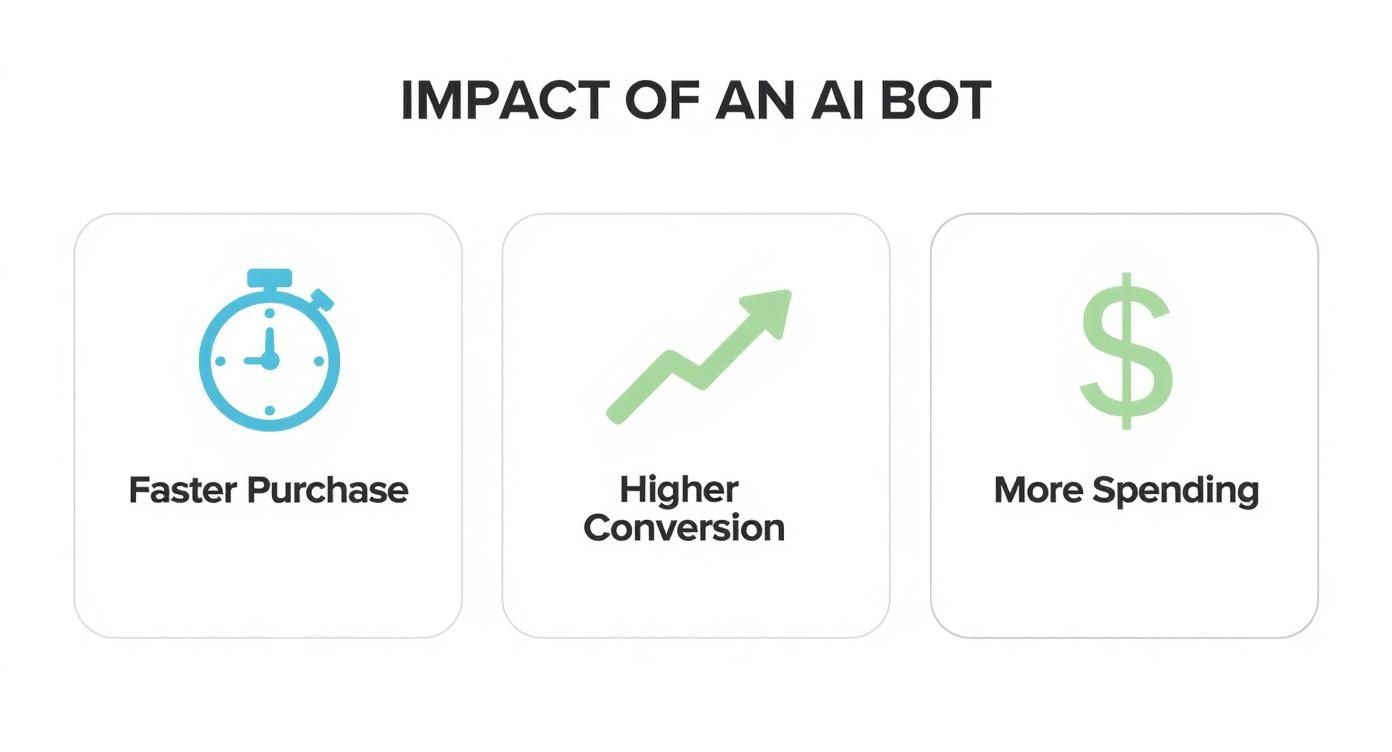
As you can see, a well-planned bot doesn't just answer questions—it directly speeds up the buying process, leading to more sales and higher spending.
Got Questions About Shopping Bots?
Even with all the upside, it's smart to have questions. Bringing any new tool into your workflow is a big deal, and you want to be sure it's the right call for your business. Let's walk through some of the most common things sellers ask about using bots for shopping.
Getting these concerns out in the open helps demystify the tech and shows just how practical it is for shops of all sizes.
Aren't Shopping Bots Too Complicated for a Small Business?
Not anymore. It’s true that a few years ago, you might have needed a developer on speed dial to get a bot up and running. But today's platforms have completely flipped the script. Many offer simple, no-code builders with ready-to-go templates made specifically for e-commerce.
You can genuinely launch a helpful bot in a couple of hours without touching a single line of code. The best way to start is to keep it simple. Automate the answers to your top three to five most asked questions—think "Where's my package?"—and build from there as you get the hang of it.
Will a Bot Make My Brand Feel Robotic?
This is probably the biggest fear sellers have, but a well-built bot can actually make your brand feel more personal, not less. The secret is to give it a personality that matches your own—whether you're witty, buttoned-up professional, or fun and friendly.
A bot isn’t here to replace human connection. It’s here to amplify it. By handling the repetitive questions 24/7, it frees up your team to give incredible, high-touch support for the complex problems where a real conversation makes all the difference.
Plus, smart bots can use customer history, like past purchases, to offer genuinely helpful recommendations. That kind of personalized touch makes shoppers feel seen and understood.
How Do I Know if a Shopping Bot Is Actually Worth It?
Figuring out the ROI on a bot is more straightforward than you might think. It really comes down to tracking a few key numbers that tie directly to your sales and how efficiently your business runs.
Here are the main metrics you’ll want to keep an eye on:
- Conversion Rate: Are people who chat with the bot buying more often than those who don't? If you see a lift here, that's a huge win.
- Support Ticket Volume: Watch for a drop in the number of basic support tickets. Every ticket the bot handles is time saved for your team.
- Average Order Value (AOV): Is the bot successfully upselling or cross-selling? An increase in AOV from bot conversations is pure profit.
Most bot platforms have built-in dashboards that make it easy to see these numbers at a glance, giving you a crystal-clear picture of how it's impacting your bottom line.
Ready to stop guessing and start growing? HiveHQ provides the ultimate suite of tools to automate your TikTok Shop growth, from recruiting top-tier affiliates to tracking every dollar of profit. See how our Affiliate Bot, Profit Dashboard, and Creator Tracker can transform your business.