How Much Can Affiliate Marketing Make Realistically?

how much can affiliate marketing makeaffiliate marketing incomeaffiliate earningspassive incomeonline income
Alright, let's get right to the question on everyone's mind: how much can you actually make with affiliate marketing? The truth is, there's no single answer. Earnings can range from a little extra coffee money each month to a full-blown, six-figure income. It's not a salaried job; what you make is a direct result of your effort, your strategy, and the audience you build.
What Affiliate Marketing Income Really Looks Like
Think of affiliate income as a massive spectrum. On one end, you have hobbyists and beginners who might make a few bucks here and there. On the far other end, you have "super affiliates" running multi-million dollar digital empires. Where you land on that spectrum depends entirely on how well you play the game.
This isn't a get-rich-quick scheme. It's a real business model that works by creating value. You help people solve a problem or make a decision by recommending great products, and when they buy through your link, you earn a piece of the sale. The more trust you build and the better your marketing skills become, the more your income potential grows.
Affiliate Marketing Earning Potential by Experience Level
To give you a clearer picture of what's possible, let's look at the typical earning brackets. This isn't a guarantee, but it's a solid roadmap of what you can expect as you move from just starting out to becoming a seasoned pro.
Here's a breakdown of what you might earn as you gain more experience and refine your skills.
Table: Affiliate Marketing Earning Potential by Experience Level
| Experience Level | Typical Monthly Earnings (USD) | Primary Focus |
|---|---|---|
| Beginner | $0 - $1,000 | Building a website, learning SEO, creating initial content. |
| Intermediate | $1,000 - $10,000 | Optimizing conversions, diversifying traffic sources, growing an email list. |
| Advanced | $10,000 - $100,000 | Scaling with paid ads, building a team, creating systems. |
| Super Affiliate | $100,000+ | Developing proprietary products, large-scale media buying, brand building. |
As you can see, the journey starts with laying a solid foundation and gradually scales up as you master more complex strategies.
The opportunity here is massive and only getting bigger. The global affiliate marketing industry is already valued at $18.5 billion as of 2025 and is on track to hit a staggering $31.7 billion by 2031.
This isn't just a niche industry; it's a major economic driver.
This growth translates into real money for marketers. For instance, affiliates in the software space pull in an average of $5,967 per month, highlighting just how lucrative a high-ticket niche can be. It’s a win for brands, too, who see an average return of $15 for every $1 spent on their affiliate programs. You can dig deeper into these affiliate marketing industry statistics to see the full scope.
Your Earning Journey from Beginner to Super Affiliate
So, how much can you really make with affiliate marketing? The honest answer isn't a single number—it's a spectrum. Your income grows as you do. Think of it less like a lottery ticket and more like leveling up in a game. Each new level brings more sophisticated strategies, bigger challenges, and, of course, a higher earning potential.
This progression is surprisingly predictable. Everyone starts at square one and moves through distinct stages, each with its own focus and financial milestones. Figuring out where you are on this path is key, because it tells you exactly what you need to do to climb to the next rung.
This infographic lays out the typical career path of an affiliate marketer, from those first tentative steps to becoming an industry powerhouse.
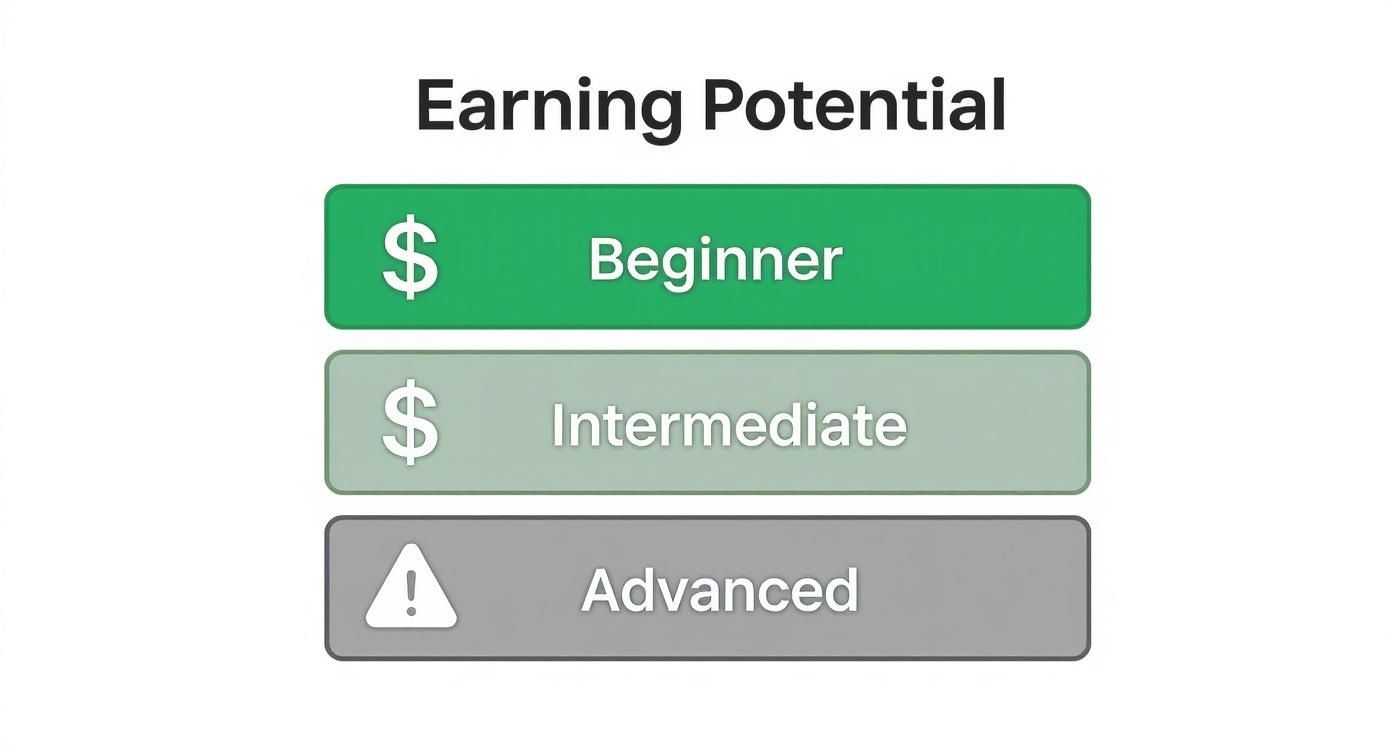
As you can see, the income jumps between levels aren't just incremental; they're exponential. That growth reflects a true mastery of the craft.
The Beginner Affiliate ($0 – $1,000 per month)
Every single affiliate starts right here. This is the foundation-building stage, where the only goal that matters is learning the ropes and earning that very first commission. The focus is laser-sharp: one platform, one traffic source.
Most beginners will:
- Pick a niche: This is usually something they're passionate about, like home espresso machines or solo backpacking gear.
- Build a simple website: A basic blog is the classic starting point for creating helpful content where you can place your affiliate links.
- Focus on SEO: The game plan is to write articles that people are searching for on Google, attracting "free" organic traffic over time.
Income here is patchy at best. That first dollar feels like a million bucks, but it can easily take a solid 6-12 months of consistent work to see any kind of regular earnings. Patience isn't just a virtue here; it's a requirement.
The Intermediate Affiliate ($1,000 – $10,000 per month)
Once traffic is flowing and commissions are coming in steadily, you've graduated to the intermediate phase. You’ve proven the concept works. Now, the name of the game is optimization and expansion. You stop being just a content creator and start thinking like a real marketer.
An intermediate affiliate's strategy gets more layered:
- Conversion Rate Optimization (CRO): You're now obsessed with testing everything—call-to-action buttons, landing page layouts, and where you place your links—to squeeze more sales out of the traffic you already have.
- Building an email list: This is a game-changer. You're creating a direct line to your audience, letting you promote offers whenever you want without being at the mercy of search engine algorithms.
- Adding new traffic channels: You might start a YouTube channel to complement your blog, build a following on Pinterest, or create an engaged Facebook group.
This is the point where affiliate marketing can transform from a side hustle into a legitimate, full-time career.
The Advanced Affiliate ($10,000 – $100,000 per month)
At the advanced level, you're running a business, plain and simple. Your mindset shifts from doing everything yourself to building systems that can scale. Earning $10,000+ a month consistently almost always means moving beyond purely organic strategies and using paid advertising to pour fuel on the fire.
Advanced affiliates are defined by their skillset:
- Mastery of paid ads: They run complex ad campaigns on platforms like Google Ads, Facebook, or TikTok, driving highly targeted traffic on demand.
- Building a team: It's no longer a one-person show. You're hiring writers, a virtual assistant, or a dedicated media buyer to run your ad campaigns.
- Creating sophisticated funnels: These aren't just links on a page. They are multi-step marketing systems designed to nurture leads through email sequences, webinars, and retargeting ads, maximizing the value of every visitor.
At this stage, you're not just playing in the market—you're a major player, shaping it with strategic media buys and powerful brand partnerships.
The Super Affiliate ($100,000+ per month)
Welcome to the top. Super affiliates represent the top 1-3% of the entire industry. They operate more like a full-blown media company than a solo marketer. Their income doesn't just come from promoting other people's products; it comes from building and controlling entire brand ecosystems.
They reach this stratosphere by:
- Building an undeniable brand: Their name or website becomes the go-to authority in their niche. People seek them out directly.
- Launching their own products: They create their own courses, software, or physical products, leveraging their audience to generate far higher profit margins than standard affiliate commissions.
- Negotiating exclusive deals: Companies come to them. They command premium commission rates and forge custom partnerships that are completely off-limits to smaller affiliates.
While this level of success is rare, it’s the ultimate proof of what's possible when you combine deep expertise with sharp business acumen. This is the final destination on the affiliate marketing journey.
The Core Factors That Control Your Affiliate Earnings
Ever wondered why some affiliates pull in five-figure months while others are stuck just covering their hosting fees? It's not about luck. It's about understanding and manipulating the handful of variables that directly dictate your income. Getting a handle on these is the difference between affiliate marketing as a side-hustle and running it as a real, profitable business.
Think of these factors like the faders on a mixing board. Each one controls a different part of the final output—your earnings. If one is off, the whole thing sounds wrong. Let's break down the four most critical levers you need to get right.

Niche Selection: Your Financial Foundation
The niche you choose is, without a doubt, the most important decision you'll make. It’s like picking a location for a physical store. You could have the best coffee in the world, but if you open your shop in the middle of nowhere, you’re going to struggle. Set up in a busy downtown area, and your chances of success skyrocket.
It’s the same online. Some markets are just naturally more profitable. They have higher-priced products, audiences ready to buy, and generous commission structures. Passion for a topic is great, but you can't ignore the numbers. A niche full of low-cost items with tiny commissions means you'll need an enormous audience to make real money. In contrast, a high-ticket niche can be incredibly lucrative with far less traffic.
Choosing the right niche multiplies the effectiveness of everything else you do.
Choosing a profitable niche is like planting a fruit tree instead of a flower. Both require care and effort, but only one can produce a sustainable harvest year after year.
Take the Software as a Service (SaaS) space, for example. It's a high-demand niche where commissions can run anywhere from 20% to 70%. This is exactly how some veteran affiliates with a decade of experience are able to earn upwards of $44,000 per month—they've become masters of profitable niches in growing markets. You can discover more insights about affiliate marketing statistics to see just how powerful these trends are.
Commission Models and Product Choice
Let's be clear: not all commissions are created equal. The way you get paid has a massive impact on your income potential and how you grow your business. If you don't understand the different models, you're flying blind.
Here are the most common structures you'll run into:
- Pay-Per-Sale (PPS): This is the classic model. You earn a percentage or a flat fee for every single sale you drive through your link. Simple and effective.
- Recurring Commissions: This is the holy grail for many. It's common with subscription products like software or memberships. You get paid every single month that your referred customer stays signed up, creating a predictable, compounding income stream.
- Pay-Per-Lead (PPL): With this model, you get paid for sending a qualified lead—like someone filling out a form or signing up for a free trial—even if they don't buy anything right away.
The smartest affiliates don't just pick one. They build a portfolio. High-ticket, one-time commissions give you big cash injections, while recurring commissions build a stable, reliable monthly baseline.
Traffic Quality and Source Diversity
Traffic is the lifeblood of any online business, but here's a crucial distinction: not all traffic is equal. One hundred visitors actively searching for a product review are infinitely more valuable than ten thousand people who accidentally land on your site from a random link.
Your job is to attract a targeted audience that is ready to act. People typically get this traffic from a few key places:
- Search Engine Optimization (SEO): This is about getting free, organic traffic from places like Google. It’s a long-term game, but the visitors it brings are usually highly qualified and ready to buy.
- Paid Advertising (PPC): Using platforms like Google Ads or Facebook Ads lets you drive targeted traffic almost instantly. It costs money and requires careful testing, but it's the fastest way to scale.
- Social Media Marketing: This involves building a loyal community on platforms like Instagram, TikTok, or YouTube and promoting products to an audience that already trusts you.
- Email Marketing: Building an email list is like having a direct line to your audience. You can promote offers whenever you want, without worrying about an algorithm getting in your way.
Here’s a rookie mistake to avoid: relying on a single traffic source. A Google update or a change in a social media algorithm can wipe out your income overnight. The pros build a diverse set of traffic streams to create a business that can weather any storm.
Conversion Rate Optimization
Okay, you've got traffic. That's only half the battle. Conversion optimization is the process of turning those visitors into actual customers. It’s where the magic really happens. A tiny bump in your conversion rate—say, from 1% to 2%—literally doubles your revenue without needing a single extra visitor.
This means you’re constantly tweaking and testing things like:
- The layout and user experience of your website.
- How persuasive your writing and calls-to-action (CTAs) are.
- Where you place your affiliate links to get the most clicks.
- Building trust with authentic, helpful reviews and social proof.
Mastering conversion is about getting inside your audience's head and making it as easy and compelling as possible for them to click "buy." It's the final, critical lever that turns website traffic into actual income.
Finding Profitable Niches and Commission Models

Your choice of niche is easily the most critical decision you'll make when you start asking, how much can affiliate marketing make? Think of it like real estate: some plots of land are fertile and ready for a skyscraper, while others are rocky and will barely support a shed.
The most profitable niches aren't just about what you're passionate about; they're where your passion meets a market with money to spend. These areas typically solve a real problem for an audience that's actively looking for a solution, and just as importantly, they offer commission models that actually make your effort worthwhile.
Identifying High-Potential Niches
So, where's the money? Some industries just consistently outperform others. This usually comes down to high-ticket items or, even better, recurring revenue models. These allow you to earn more from a single sale and build an income stream that doesn't reset to zero every month.
You’ll find that three niches pop up again and again as top earners:
- Software (SaaS): This is a powerhouse. SaaS companies often pay out high recurring commissions, sometimes 20-50% of the monthly subscription fee, for as long as your referral remains a customer.
- Personal Finance: Think credit cards, loans, and investment apps. The commissions here are often high, one-time payments because a single customer can be incredibly valuable to these companies.
- E-learning and Online Courses: The boom in digital education isn't slowing down. Promoting high-value courses can net you a hefty percentage on products that often cost hundreds or even thousands of dollars.
These niches are often called "evergreen" because demand never really dries up. People always need tools to run their business, help managing their finances, and skills to get ahead in their careers.
Your choice of niche directly influences your income ceiling. A high-volume, low-commission niche requires massive traffic to earn a significant income, whereas a low-volume, high-commission niche can be profitable with a much smaller, targeted audience.
Comparing Commission Structures
Just looking at a niche isn't enough; you have to dig into how you actually get paid. A $150 one-off commission for a web hosting sign-up feels fantastic in the moment. But a $30 recurring monthly payment from a software tool can quickly eclipse that one-time win, becoming far more valuable in the long run.
To give you a clearer picture, let's compare some of the most popular affiliate marketing spaces side-by-side.
Comparison of Profitable Affiliate Niches
The table below breaks down what you can realistically expect from some of the top niches, highlighting the vast differences in how they reward affiliates.
| Niche | Average Commission Rate | Commission Type | Example Programs |
|---|---|---|---|
| Software (SaaS) | 20% - 50% | Recurring Monthly | HiveHQ, HubSpot |
| Personal Finance | $50 - $300 per lead/sale | Pay-Per-Lead / Flat Fee | Credit Karma, SoFi |
| Web Hosting | $60 - $150+ per sale | Flat Fee | WP Engine, Kinsta |
| E-commerce (General) | 1% - 10% | Pay-Per-Sale (PPS) | Amazon Associates |
This table really spells out the trade-offs. While promoting general e-commerce products through a program like Amazon Associates might feel like the easiest entry point, the tiny commission rates mean you need a staggering amount of traffic and sales to make a living.
On the other hand, just a few sign-ups for a premium web host or a specialized SaaS product could generate the same revenue with a fraction of the traffic. It's a much smarter, more efficient path to hitting those higher income goals.
Understanding the Global Affiliate Marketing Economy
Before we dive into your personal earning potential, it’s helpful to zoom out and look at the bigger picture. Affiliate marketing isn't just a side hustle—it's a massive global industry where serious money changes hands every single day. Brands aren't just dipping their toes in the water; they're investing billions of dollars into this channel year after year.
This level of spending shows just how legitimate and stable affiliate marketing has become. When you become an affiliate, you're not trying to convince companies to try something new. You're plugging into a well-oiled machine where businesses are actively searching for partners to help them grow.
The Scale of Brand Investment
The amount of money flowing into affiliate programs is staggering, especially in established e-commerce markets. This isn't just experimental budget dust for the world's biggest brands; it's a core part of their marketing strategy. From retail giants to niche software companies, they all rely on affiliates to connect them with new customers.
For an individual marketer, this means the opportunities are practically limitless. The bigger the overall pie, the more chances you have to carve out your own profitable slice, no matter what niche you're in.
This trend is only getting stronger. In the United States, which is a great bellwether for the industry, spending reached a whopping $9.56 billion in 2023. Projections show it climbing to nearly $12 billion by 2025.
Considering the U.S. market accounts for over 40% of global affiliate revenue, its growth is a fantastic sign for marketers everywhere. You can dig into these affiliate spending trends on Statista to see the data for yourself.
At the end of the day, this consistent, large-scale investment is the ultimate proof that affiliate marketing is a stable and profitable game to be in. It should give you confidence that as you build your skills and audience, you’re stepping into an industry with a proven track record and a very bright financial future.
Burning Questions About Affiliate Marketing Income
Alright, even with a solid plan in place, you probably still have a few questions rattling around in your head about what it really takes to make money as an affiliate. Let's dive into the stuff people are often hesitant to ask so you can move forward with your eyes wide open.
These are the nitty-gritty, practical questions that come up the second you try to put theory into practice. Getting straight answers is the key to setting goals you can actually hit and not getting discouraged right out of the gate.
How Long Does It Really Take to Start Making Money?
I wish there was a magic number, but the honest answer is: it depends entirely on your strategy.
If you’re playing the long game with organic traffic—think SEO and blogging—you're looking at a 6 to 12-month runway before you start seeing a steady, reliable income. This is a marathon, not a sprint. You're building a real asset that pays off down the road, so patience is non-negotiable.
On the flip side, if you jump into paid advertising, you could theoretically see your first sale within days or even hours. But this path requires cash upfront and comes with a real risk—if your ads don't convert, that money is gone. For most beginners sticking to organic methods, pocketing your first commission within 3-6 months is a totally achievable milestone.
Can I Do Affiliate Marketing Without a Website?
Yes, you 100% can. A website is fantastic because it's your piece of digital real estate, but plenty of affiliates are crushing it without one. Social media has completely changed the game, with platforms like YouTube, TikTok, and Instagram becoming massive drivers of affiliate sales.
Here are a few ways people are making it work without a traditional blog:
- Video Reviews: Think about it. Creating deep-dive product reviews, how-to tutorials, or "Top 5" list videos on YouTube is a killer way to build trust and guide viewers to a purchase.
- Building a Community: Starting a dedicated Facebook Group or growing an Instagram following around your niche lets you share affiliate links with people who are already listening to you. They trust your recommendations.
- The Power of Email: An email list is a direct line to your audience. No algorithms, no gatekeepers. You can promote offers straight to their inbox.
That said, there's a reason a website is so highly recommended. It’s the foundation you own and control, immune to sudden algorithm changes or platform bans.
Think of a website as your home base that you own outright. Social media is like renting a storefront in a popular mall; the landlord can raise the rent or change the rules on a whim, and your whole business could be at risk.
What Are the Biggest Beginner Mistakes to Avoid?
New affiliates often trip over the same handful of mistakes. Knowing what they are is half the battle.
One of the classic blunders is chasing a "profitable" niche you couldn't care less about. If you're not genuinely interested, your content will feel flat, and you'll burn out trying to fake enthusiasm. You have to actually enjoy what you're talking about to stick with it.
Another common error is trying to promote everything under the sun. It's confusing for your audience and makes you look like a walking billboard, not a trusted expert. Start by focusing on just a few killer products you truly stand behind.
But the number one reason people fail? They just quit too soon. This isn't a get-rich-quick deal. It takes consistent work, a ton of patience, and treating it like a real business. The affiliates who push through that initial grind are the ones who end up with the life-changing income.
Ready to scale your TikTok Shop with powerful automation and data-driven insights? HiveHQ is the all-in-one platform designed to help you discover top-performing affiliates, track your profitability, and automate your outreach. Stop guessing and start growing by visiting https://hivehq.ai to see how our tools can transform your business.