How to Sell on TikTok Shop A Guide for Sellers

how to sell on tiktok shoptiktok shop guidesocial commerceecommerce tipstiktok marketing
Selling on TikTok isn't just about listing products; it's about creating scroll-stopping content that turns viewers into customers, often without them ever leaving the app. The secret sauce is making your products a natural part of the entertainment.
Your Blueprint for TikTok Shop Success
Welcome to the new frontier of social commerce. TikTok has evolved from a hub for viral dances into a serious e-commerce powerhouse, creating a unique space where entertainment and shopping collide. This guide is your complete roadmap to mastering how to sell on TikTok Shop and turning your brand presence into a profitable sales channel.
We’ll walk you through the entire process, step-by-step, from getting your account approved to fulfilling your first order. Forget the theory—this is a practical launchpad designed to give you the confidence to navigate the platform and start selling.
The Rise of Discovery Commerce
On platforms like Amazon, people search for what they already want. On TikTok, they discover it. This is the heart of "discovery commerce"—users stumble upon items in their feeds through fun, engaging videos and make impulse buys on the spot. It’s a massive shift in consumer behavior.
The numbers don't lie. TikTok is a global giant with over 1.6 billion monthly active users. The platform's Gross Merchandise Value (GMV) exploded, hitting $26.2 billion in just the first half of 2025—a huge leap from $20 billion for all of 2023. The U.S. market alone drove $5.8 billion in GMV during that same period, marking a staggering 91% year-over-year growth. You can dive deeper into these powerful TikTok statistics to see just how big this opportunity is.
Think of your TikTok content as the modern-day storefront window. It’s not about pushing a hard sale but about creating an experience so engaging that the purchase becomes a natural next step.
This visual roadmap breaks down the seller journey into three core phases you'll move through.
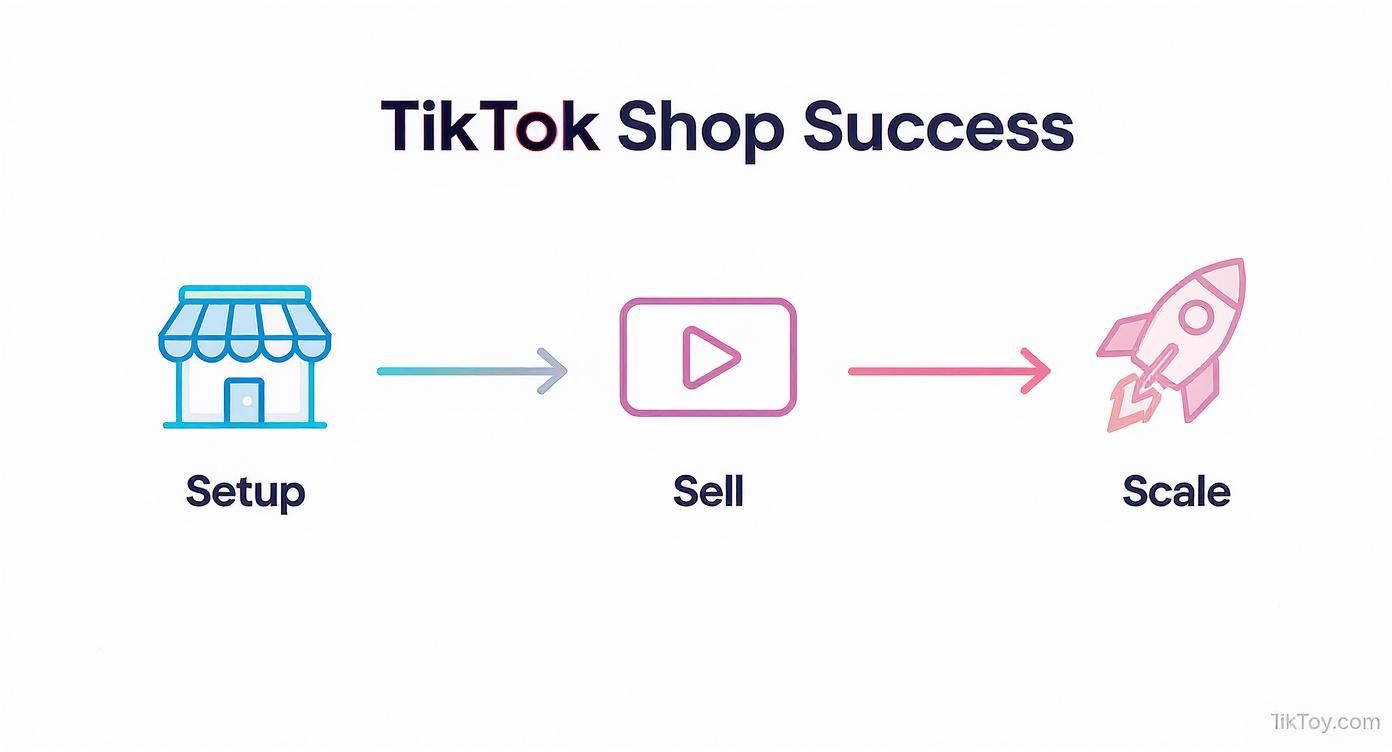
As you can see, success starts with a solid setup, moves into active selling through video content, and then focuses on scaling your operations for long-term growth.
To give you a bird's-eye view of what's ahead, here’s a quick summary of the journey we’ll be taking together.
The TikTok Shop Seller Journey at a Glance
| Stage | Key Action | Primary Goal |
|---|---|---|
| 1. Foundation | Register and verify your business. | Get your store approved and ready for business. |
| 2. Product & Listing | Select products and create optimized listings. | Attract your target audience and drive conversions. |
| 3. Launch & Promote | Go live, post videos, and run ads. | Generate your first sales and build initial momentum. |
| 4. Scale with Affiliates | Recruit and manage creator partnerships. | Amplify reach and create a consistent sales engine. |
| 5. Optimize & Automate | Track performance and use tools to streamline. | Maximize profitability and ensure sustainable growth. |
Each stage builds on the last, creating a powerful flywheel for your business.
Your High-Level Success Checklist
Think of this as your executive summary—a quick look at the critical stages we'll be diving into throughout this guide. Getting these right is non-negotiable.
- Foundation First: We’ll cover navigating eligibility, completing the registration, and getting your store approved without the common, frustrating delays.
- Product & Presentation: This is all about sourcing items that actually resonate with the TikTok audience and creating listings that turn casual viewers into buyers.
- Launch & Promotion: Time to make some noise. We’ll look at driving your first sales with a smart mix of organic video, LIVE shopping events, and targeted ads.
- Scaling with People: You can't do it all alone. Here, we'll focus on building and managing an army of creator affiliates to amplify your reach and drive sales while you sleep.
- Data-Driven Growth: Finally, we’ll get into tracking what works, analyzing your profitability, and using smart tools like HiveHQ to automate and optimize your entire operation.
Getting Your Shop Live and Finding Products That Pop
Alright, let's get down to business. The first real hurdle is getting your TikTok Shop up and running. It's a pretty straightforward process, but knowing the potential snags ahead of time can save you a world of headaches. We’ll walk through getting your store approved, and then get to the fun part: figuring out what to sell.
TikTok has made setting up a shop surprisingly fast. If you have all your documents in order, you can honestly be live in less than an hour. They want you on the platform and selling, so they’ve cut out a lot of the red tape you might see elsewhere.
Your journey starts at the TikTok Shop Seller Center. You’ll have to decide whether you're signing up as an individual seller or a registered business, which just changes the paperwork you'll need.
- For Individuals: A clear photo of a government-issued ID is usually all you need. Think driver's license or passport.
- For Businesses: You’ll need your official business registration documents. For sellers in the US, this is typically your EIN.
Get these scanned and ready to go. Seriously, one of the most common delays is a blurry photo or missing information. Double-check everything before hitting submit.
Nailing the Eligibility and Registration
First things first, make sure you're in a country where TikTok Shop is actually available. The list is growing, but it's currently focused on key markets like the US and UK.
Once you’ve confirmed you’re good to go, you'll connect or create your TikTok for Business account. This is non-negotiable, as it’s your key to all the advertising and analytics tools you’ll need to grow.
After you submit your application, approval usually comes through in one to two business days. If you're left hanging for longer, pop back into the seller center to see if they've requested more info. A classic mistake is having a slight mismatch between your legal business name and the name on your bank account—this is an instant red flag for their system.
My Two Cents: Make sure the bank account you link for payouts has the exact same legal name as your business registration. Even a small difference can get you stuck in verification limbo. Consistency is your best friend here.
Once you get that "approved" notification, the real work begins. You've got an empty digital storefront, and its success is all about what you put on the shelves.
The Art of Finding and Sourcing Products for TikTok
Here’s a hard truth: not every product is cut out for TikTok. The platform runs on impulse buys, things that look incredible on video, and clever gadgets that solve a problem you didn't even know you had. Just dumping your entire Shopify catalog onto TikTok is a surefire way to hear crickets.
You have to think like a user scrolling their For You Page. What makes them stop? It’s almost always something surprising, deeply satisfying to watch, or an "aha!" moment that solves a nagging issue.
Focus your search on products that fit these molds:
- Problem-Solvers: Think of items with a clear "before and after." A powerful stain remover, a kitchen gadget that shaves minutes off prep time, or a skincare product with immediate, visible effects are all gold.
- Visually Striking: If it looks cool on camera, it has a chance. We're talking about things like color-changing lipstick, mesmerizing kinetic sand, or unique home decor that just begs to be filmed.
- Trend-Driven: This is about riding the wave. If a specific Stanley cup dupe or a walking pad is blowing up, finding a unique accessory or a similar product can lead to some quick wins.
Knowing what kind of product to look for is half the battle. The other half is figuring out how to get it. You've basically got three main options, each with its own set of trade-offs.
| Sourcing Method | Best For | Pros | Cons |
|---|---|---|---|
| Dropshipping | Testing a ton of ideas with zero risk. | No inventory costs; pivot on a dime. | Slim margins; no control over shipping. |
| Private Label | Building a real, lasting brand. | Great margins; you control the brand. | Requires cash upfront for inventory. |
| Reselling/Wholesale | Selling brands people already know and trust. | Built-in demand and brand recognition. | Super competitive; thinner margins. |
For anyone just starting out, dropshipping is a fantastic way to dip your toes in. It lets you test a dozen different product ideas without buying a single unit of inventory. You can run videos, see what gets views and clicks, and then go all-in on the winners. Once you’ve proven there's a market, you can always transition to a private label model for better margins and brand control. It's the perfect strategy for minimizing risk while you hunt for that viral hit.
Crafting Product Listings That Convert
You've got a great product and a solid supplier. That's a huge win, but it's only half the battle. The other, arguably more important half, is how you present it. On a platform as visual and fast-paced as TikTok, your product listing is everything. It's your digital storefront, your 24/7 salesperson, and your brand's first impression, all in one. Let’s get into how to create listings that actually stop the scroll and get people to click "buy now."
Think of your TikTok Shop as a complete ecosystem. A potential customer sees a creator's video, gets intrigued, taps the little orange shopping cart icon, and lands on your product page. This is your moment. If that page is confusing, boring, or missing key info, they're gone. That potential sale vanishes in a puff of smoke.

This isn't just about listing features. It's about quickly telling a story and showing someone you have the solution to their problem.
Writing Titles and Descriptions That Sell
Your product title is the first thing anyone reads. It has to be crystal clear, descriptive, and sprinkled with the right keywords—without sounding like a robot wrote it. Put yourself in the shoes of someone searching in the Shop tab. What simple, direct words would they use?
A good title finds the sweet spot between clarity and appeal. For instance, "Face Cream" is a terrible title. Something like "Hydrating Glow Serum with Hyaluronic Acid - 50ml" is miles better. It tells you the benefit ("hydrating"), a key ingredient ("hyaluronic acid"), what it is ("glow serum"), and the size ("50ml").
The description is where you seal the deal. Forget long paragraphs. People on TikTok scan. Use short sentences and bullet points to make your key selling points pop. I’ve found that structuring descriptions to anticipate questions works best.
- What it is: A quick, one-sentence summary.
- What it does: Focus purely on the benefits and results.
- How to use it: Super simple, numbered steps.
- Key ingredients/materials: Be transparent. This builds major trust.
This format makes information easy to digest, which is exactly what you need for the platform's "get to the point" audience.
Creating Scroll-Stopping Visuals
It’s TikTok. Video is king, queen, and the entire royal court. Your main product listing must have a high-quality video showing the product in action. And please, this isn't the place for a stuffy corporate ad. People want to see real, authentic, and relatable content.
A killer product video shows the item from different angles, demonstrates its main purpose, and highlights its coolest feature. Selling a portable blender? Show it demolishing ice and frozen fruit into a perfect smoothie. A new necklace? Get a shot of how it sparkles and catches the light as someone moves. The data doesn't lie: TikTok says users are 1.5x more likely to immediately buy something they find on the platform. Your visuals are what spark that impulse.
Pro Tip: Keep your main product video short and punchy, ideally between 15-30 seconds. The formula is simple: show the problem, introduce your product as the hero, and end with a satisfying shot of the final result. Don't forget trending audio and text overlays to grab attention immediately.
But don't sleep on your images! They're essential for shoppers who want to zoom in and inspect the details.
A well-rounded image gallery should have:
- Studio Shots: Crisp, clean photos on a white background.
- Lifestyle Images: Your product being used in a natural, real-world setting.
- Detail Shots: Close-ups of textures, materials, or unique features.
- Scale Reference: A photo that gives a clear idea of the product's actual size.
Together, these visuals tell a complete story and leave no questions in the buyer's mind.
Smart Pricing and Promotions
Pricing on TikTok Shop is a bit of a tightrope walk. You have to be competitive enough to catch those impulse buys, but you also need to protect your profit margins. First, do your homework. See what similar products are selling for, but don't just race to the bottom.
Your price tag should reflect your product's quality and your brand's value. When I'm pricing a new product, I always factor in these four things:
- Cost of Goods Sold (COGS): What it costs you to get the product in hand.
- TikTok Fees: The commission TikTok takes from every sale.
- Shipping Costs: Are you offering free shipping or is the customer paying?
- Marketing Spend: Budgeting for ads and creator commissions.
Once you’ve set a solid base price, you can start layering in promotions to create excitement. Flash sales, exclusive coupons, and product bundles are pure gold on TikTok Shop. They create a sense of urgency and make the buyer feel like they're getting a special deal.
For example, try bundling a best-selling face serum with a matching moisturizer for a slight discount. You’ll likely see your average order value jump, and you’ve just introduced a happy customer to another one of your products. It’s a win-win.
Alright, your shop is live and your listings look fantastic. Now for the exciting part: getting your products in front of actual buyers and turning those views into sales.
On TikTok, this really boils down to two things: creating great organic content and running smart paid ads. If you can get a handle on both, you'll build the kind of momentum that leads to a truly successful shop.
Think of it like this: your organic videos build a community and earn you trust. Ads, on the other hand, are the gas you pour on the fire to reach specific people, fast. The best brands don't pick one or the other—they blend them together into a powerful selling machine.
This dual approach means you're not just crossing your fingers and hoping the algorithm notices you. You’re actively making your own luck.
Mastering Organic Content That Sells
The number one rule on TikTok? Think like a creator, not a brand.
Slick, corporate-style commercials just don't work here. They stick out like a sore thumb. People are scrolling their For You Page for authentic, entertaining, and relatable content. Your job is to show them what your product can do, not just tell them.
The most effective videos weave your product into a story or a demonstration so naturally that it doesn't feel like an ad at all. Forget the hard sell.
Here are a few video formats I’ve seen work time and time again:
- Problem/Solution Demos: Find a common, frustrating problem and position your product as the obvious solution. A video showing a powerful stain remover instantly erasing a red wine spill will always outperform a static product shot.
- Behind-the-Scenes: People are curious. They love seeing how things are made or what happens behind the curtain. Film yourself packing an order with care, sketching a new design, or unboxing fresh inventory. It builds a real human connection.
- Unboxing & First Impressions: Capture that "ASMR" experience of someone opening your product for the very first time. Focus on the satisfying sounds, the textures, and the thoughtful details of your packaging.
- Educational Tutorials: Don't just show your product—teach people how to use it in cool and unexpected ways. If you sell art supplies, create a quick tutorial for a DIY project. This makes you the expert and showcases your product's true value.
Creating Urgency with TikTok LIVE Shopping
While short videos are your daily bread and butter, TikTok LIVE is the main event. LIVE shopping is an absolute game-changer for driving a flood of sales in a short period. It gives you a direct line to your audience, allowing you to answer their questions in real-time and create a sense of FOMO that’s impossible to replicate in a pre-recorded video.
The beauty brand P.Louise, for example, famously generated over $2 million in a single 12-hour LIVE session. That wasn't an accident. It was the result of building massive hype and offering exclusive, time-sensitive deals to an audience that was completely tuned in.
A successful LIVE is all about good energy and a solid plan. You don't need a fancy studio, but you do need decent lighting, clear audio, and a rough script. Think of it as having a beginning (what's coming up), a middle (product demos, special offers), and an end (a final call to action).
Make sure you're using the tools TikTok gives you:
- Pin Products: Keep your star products pinned to the screen so viewers can tap and buy without leaving the stream.
- Flash Deals: Announce surprise discounts that are only valid during the LIVE. This is your secret weapon for encouraging impulse buys.
- Answer Questions: Engage with the comment section. When people see you answering questions live, it builds a massive amount of trust.
Demystifying TikTok Ads for Beginners
Ready to really accelerate things? TikTok Ads let you bypass the algorithm and put your products directly in front of a hyper-targeted audience. The Ads Manager might look a little complex at first, but launching your first campaign is surprisingly straightforward.
For most e-commerce sellers, the go-to ad format is the In-Feed Ad. These are the shoppable videos that show up natively as users scroll their For You Page. When you set up your campaign, you'll just need to focus on a few key decisions.
1. Choose Your Objective
First, tell TikTok what you want to accomplish. For a TikTok Shop, your goal is almost always going to be Product Sales. This signals the algorithm to hunt for users who are most likely to actually pull out their credit card.
2. Define Your Audience
This is where the magic really happens. You can zero in on users based on all sorts of data:
- Demographics: Age, gender, location, and language.
- Interests: People who have recently engaged with content related to topics like "skincare" or "home decor."
- Behaviors: Users who have interacted with specific types of videos, creators, or even hashtags.
My advice? Start with a fairly broad audience based on who you think your ideal customer is, and then let TikTok's powerful algorithm do the heavy lifting to find the converters.
3. Set Your Budget and Bidding
You can choose either a daily budget or a lifetime budget for your campaign. A great starting point is around $20-$50 per day. That’s enough to get meaningful data on what’s working without risking too much upfront. For your bidding strategy, start with Lowest Cost and let TikTok automatically find the cheapest conversions for you.
Once your ads are live, keep a close eye on your Return on Ad Spend (ROAS). A good rule of thumb is to aim for a 2x ROAS or higher. This means for every $1 you put into ads, you're getting at least $2 back in revenue. This is the single most important metric to tell you if your ad campaigns are actually profitable.
Scaling Your Business with Creator Partnerships
Organic content and paid ads will get you your first few sales, but if you're serious about scaling on TikTok Shop, you need to plug into its most powerful asset: creators. This is where affiliate partnerships come in, acting as the engine for sustainable, explosive growth. We're not just talking about sending out free products; this is about building an army of authentic advocates who sell for you.
Think about the last time you bought something you saw on TikTok. Was it from a brand's own video? Probably not. It was likely a creator you follow and trust, showing you exactly how a product solved a problem or fit perfectly into their life. That’s the magic of creator-led commerce, and it's how you go from making a few sales to building an empire.

When you get this right, your marketing shifts from a manual, day-to-day task into a self-sufficient growth machine, freeing you up to focus on the bigger picture.
Finding Creators Who Genuinely Drive Sales
The single biggest mistake I see brands make is chasing big follower counts. A creator with one million followers and a lukewarm, disengaged audience is far less valuable than a micro-creator with 10,000 die-hard fans who hang on their every word. Your goal isn't just reach; it's resonance.
You need to find creators whose audience is a mirror image of your ideal customer. A great creator is a natural storyteller who can weave your product into their content so seamlessly that it doesn't even feel like an ad.
When you're vetting potential partners, dig into these areas:
- Engagement Rate: Look past the likes. Are people firing off comments, asking genuine questions, and saving the videos? A high comment-to-like ratio is a gold-star indicator.
- Previous Brand Partnerships: Have they worked with brands like yours before? Go watch that content. Did it feel authentic, or was it a stiff, generic product placement?
- Audience Trust: This is the secret sauce. Read the comments on their non-sponsored posts. Does their audience truly respect their opinion? Do they ask for recommendations?
While TikTok's Creator Marketplace is a decent starting point, the real gems are often found by just scrolling the app and seeing who is already making incredible content in your niche.
A creator's true value isn't in their follower count but in the trust they've built with their community. Find partners whose audience sees them as a trusted friend, not just an entertainer, and you'll unlock a powerful sales channel.
Once you’ve got a shortlist, it’s time to reach out.
Mastering Affiliate Outreach and Management
Effective outreach is personal and packed with value. A generic, copy-pasted message is a one-way ticket to being ignored. Your first message needs to prove you've actually watched their content and understand what they're about.
Your outreach should clearly cover:
- Who you are and a specific reason you love their content.
- What your product is and why it's a no-brainer for their audience.
- What's in it for them—usually a free sample and a clear commission percentage.
Speaking of which, the standard commission on TikTok Shop hovers between 10% and 20%. If you're launching a new product or have a higher-priced item, dangling a more competitive rate is a great way to attract top-tier talent.
This is where automation becomes a lifesaver. Manually finding, messaging, and keeping track of hundreds of creators is a recipe for burnout. A tool like HiveHQ's Affiliate Bot can automate this entire workflow. You can set filters to surface ideal creators from a massive pool, send personalized outreach messages at scale, and even handle the follow-ups automatically.
Setting Up Your Affiliate Program for Success
TikTok Shop’s native affiliate program makes managing these partnerships surprisingly straightforward. The key is to use their different commission "plans" strategically to incentivize creators.
- Shop Plan: This is your baseline—a default commission rate that applies to all products in your shop. It's open to any creator who wants to promote you.
- Open Plan: Use this to set a higher, more attractive commission rate for specific products you really want to push. Creators can apply to join this plan.
- Targeted Plan: This is your VIP room. You can invite your top-performing creators to a private plan with an exclusive, high commission rate as a reward for their hard work.
The range of products on the platform creates affiliate opportunities across almost any niche you can imagine. According to recent data, food and beverages lead the pack at $759.84 million in sales, with health close behind at $600.42 million, and Muslim fashion at $506.00 million. This incredible variety means you can find creators in almost any vertical. You can explore more data on popular TikTok Shop categories to see where your brand fits in.
Now, let's look at the different ways you can structure these partnerships.
Creator Partnership Models
Deciding how to work with creators isn't a one-size-fits-all situation. Your choice will depend on your budget, goals, and the creator's own preferences. Here’s a quick breakdown of the common models you’ll encounter on TikTok.
| Model | Best For | Typical Commission | Pros & Cons |
|---|---|---|---|
| Pure Affiliate | Brands on a tight budget; testing new creators. | 10-25% of sales | Pro: Pay-for-performance. Con: Harder to attract top-tier creators. |
| Free Product Gifting | New product launches; building initial buzz. | Free product + affiliate commission. | Pro: Low-cost way to get content. Con: No guarantee of posting or quality. |
| Flat Fee + Affiliate | Working with established creators; major campaigns. | Upfront fee + 5-15% commission. | Pro: Guarantees high-quality content. Con: Requires a larger upfront budget. |
| Long-Term Ambassadorship | Building deep brand trust and loyalty. | Monthly retainer + commission. | Pro: Creates authentic, ongoing advocacy. Con: Highest investment; requires a proven partner. |
Ultimately, a hybrid approach often works best. Start smaller creators on a gifting or pure affiliate model, and as they prove their value, move them to a more structured plan like a flat fee or ambassadorship. This lets you scale your program without taking on unnecessary risk.
Fine-Tuning Your Shop for Long-Term Growth
Getting your shop live is a huge first step, but it’s really just the beginning. The real work—and the real success—comes from what you do next. Staying on top of your performance and keeping your operations running like a well-oiled machine is what separates the shops that thrive from those that fade away after the initial buzz.
From here on out, your job is to get obsessed with your data and your logistics. This is all about making smart, informed decisions that drive up your profits while making sure every single customer walks away happy.
Let Your Data Be Your Guide
The single most important tool you have is the TikTok Shop Seller Center. Don't just give your sales a quick look and move on. You need to get in there and really dig into the analytics to see the story your numbers are telling. Think of it as your mission control for spotting what's working, what isn't, and catching small problems before they become big ones.
Make a habit of checking these key metrics:
- Gross Merchandise Value (GMV): This is your total sales revenue before any costs are taken out. It’s the quickest way to gauge your overall sales momentum.
- Conversion Rate: What percentage of people who land on your product page actually buy something? If this number is low, it could be a red flag for your pricing, your product photos, or even your description.
- Average Order Value (AOV): On average, how much does a customer spend in a single purchase? Finding ways to bump this up with product bundles or smart recommendations can make a huge impact.
- Traffic Sources: Where are your sales coming from? Are they from your own videos, your creator partners, or people browsing the main Shop tab? This tells you exactly where you should be investing more of your time and energy.
Tracking these isn't just a numbers game. It's about asking why. Why did that one video bring in 10x more sales than the others? Which creator is giving you the best bang for your buck? The answers to these questions are your playbook for scaling your business.
A tool like HiveHQ’s Profit Dashboard simplifies this process immensely. It automatically pulls in all your data and layers on critical costs like your Cost of Goods Sold (COGS), ad spend, and affiliate commissions. Suddenly, you have a crystal-clear, real-time view of how profitable each product is, taking all the guesswork out of your strategy.
Mastering Your Inventory and Fulfillment
As you start making more sales, things get more complicated behind the scenes. And let me tell you, nothing will kill your momentum faster than running out of stock on a product that just went viral or getting a flood of bad reviews because of shipping delays.
Good inventory management is all about looking ahead. Keep a close eye on how fast your products are selling and get your reorders in well before you're at risk of running out. If a video unexpectedly blows up, you have to be ready to act fast to meet the demand without getting stuck with a mountain of inventory later.
For fulfillment, you've got two main paths. You can handle it all yourself (Seller-fulfilled) or you can use Fulfilled by TikTok (FBT). For many sellers, FBT is a lifesaver. TikTok takes care of the storage, packing, and shipping, which frees you up to focus on what you do best: marketing and growing your brand.
Finally, never underestimate the power of great customer service. Answer questions and respond to reviews quickly and professionally. Every positive chat is a chance to build a loyal following and turn a first-time buyer into a fan. On TikTok, your reputation is everything.
Got Questions About Selling on TikTok Shop? We've Got Answers.
Jumping into a new platform like TikTok Shop always brings up a few questions. It's totally normal. When you're getting the hang of selling on TikTok, it's the practical, day-to-day stuff that you really need to nail down. Let's clear up some of the most common things sellers ask.
How (and When) Do I Actually Get Paid?
Let's get right to it—the money. It's probably the first thing on your mind, and for good reason. TikTok Shop uses what's called a settlement period, which is there to make sure both you and your customers are protected.
Here’s the flow: once an order is marked as delivered, a short confirmation window for the customer begins. After that passes, usually just a few days, the funds are released to your account. You can then pull that money straight into your linked bank account. The whole system is built to be simple and reliable, so you know exactly when to expect your earnings.
What’s the Deal with Seller Fees?
Like any marketplace, TikTok Shop takes a small commission from each sale. Think of it as their cut for giving you access to millions of potential buyers.
This fee is just a percentage of the total order value. While the exact rate can change a bit depending on where you are and what you're selling, it’s right in line with what other major e-commerce platforms charge. The key is to build this commission right into your pricing from the start. That way, you know your profit margins are solid on every single sale.
Remember, this fee isn't just for listing products. It covers all the payment processing and gives you access to the entire suite of selling tools on the platform. It’s a predictable part of your overhead.
How Do I Handle Returns and Refunds?
Returns are just part of the e-commerce game, and TikTok Shop has a pretty straightforward system to manage them. If a customer gets a damaged item, the wrong product, or something just isn't what they expected, they can start a return right from the app.
You'll get a notification in your Seller Center, and you can chat with the buyer directly to sort things out. While you can set your own return policy details, staying aligned with TikTok's overall guidelines is crucial. It keeps your customers happy and your account in good standing.
Ready to stop guessing and start scaling? HiveHQ provides the ultimate toolkit for TikTok Shop success. Use our Affiliate Bot to recruit top creators, our Profit Dashboard to track every penny, and our Creator Tracker to manage your partnerships—all in one place. Start your journey with HiveHQ today.