How to Set Up Affiliate Links: A Simple, High-Converting Guide

how to set up affiliate linksaffiliate link guideaffiliate marketinglink trackingmonetize content
Before you can even think about earning commissions, you've got to get the basics right. Setting up an affiliate link isn't just a copy-paste job; it's about making sure your efforts actually get tracked and paid.
The whole process boils down to three main actions: joining an affiliate program that makes sense for your audience, grabbing your unique tracking link from the program's dashboard, and placing that link where your audience will actually see and click it. Nail these fundamentals, and you're officially in the game.
Building the Foundation for Profitable Affiliate Links
Let’s be real: the difference between a link that sits there collecting digital dust and one that brings in a steady stream of revenue is all in the prep work. Before you share a single URL, you need a strategy. This isn't just about finding any product—it's about finding the right product for the people who trust you.
Choose Partners That Align With Your Audience
Your first move is your most critical one: picking the right affiliate programs. If your recommendations don't resonate with your audience, you're dead in the water. For example, if you've built a community around sustainable living, promoting a fast-fashion brand is a surefire way to lose credibility and get zero clicks.
Instead, look for partners whose products genuinely help your followers. Think about what problems they face and find solutions. Your options are pretty varied:
- Massive Marketplaces: Starting with a giant like Amazon Associates is a popular move. Everyone knows and trusts Amazon, and their product catalog is endless.
- Niche SaaS Partners: If your audience is in tech or business, promoting software tools can be incredibly lucrative. Think high-ticket items and, even better, recurring commissions every month.
- Direct Brand Partnerships: Don't overlook brands that run their own in-house affiliate programs. Going direct often means better communication, closer relationships, and sometimes, better commission rates.
Understand the Anatomy of Your Link
An affiliate link isn't just a regular web address. It’s a special URL embedded with tracking parameters that tell the merchant, "Hey, this customer came from me!" When you first grab a link from a partner dashboard, it might look long and messy, but that's because it's packed with data that ensures you get paid.
The core principle is simple: your unique affiliate ID tells the merchant that you sent the customer. Without it, you won't get paid. This is the non-negotiable component of every link you create.
Taking the time to understand this groundwork sets you up for a sustainable income stream, not just a quick win. If you're looking to speed up the learning curve, exploring some of the top free affiliate marketing classes is a great way to build a solid knowledge base.
This isn't a small-time game, either. U.S. affiliate marketing spending is on track to hit nearly $12 billion in 2025. This kind of growth is exactly why so many creators are jumping in. And with a platform like Amazon Associates controlling a staggering 46.62% of the global affiliate market share, you can see why it's often the first stop for newcomers.
To get started quickly, here's a simple breakdown of the essential steps.
Quick Guide to Setting Up Your First Affiliate Link
This table summarizes the core actions needed to get your first affiliate link live and ready to earn.
| Step | Action | Key Consideration |
|---|---|---|
| 1. Find a Partner | Research and join an affiliate program. | Does this brand's product genuinely serve my audience's needs? |
| 2. Generate Link | Navigate to the partner's dashboard to create your unique URL. | Copy the link exactly as provided to ensure tracking works. |
| 3. Place the Link | Embed the link naturally within your content (e.g., blog post, video description). | Is the link placed where it's most helpful and likely to be clicked? |
| 4. Add Disclosure | Include a clear FTC disclosure statement near the link. | Transparency builds trust and is a legal requirement. |
| 5. Test Your Link | Click the link yourself (in an incognito window) to ensure it works correctly. | A broken link means zero commissions. |
Following these fundamental steps removes the guesswork and ensures you've built your affiliate efforts on a solid, reliable foundation from day one.
A Practical Guide to Crafting and Customizing Your Links
Alright, let's move from theory to action and get into the nitty-gritty of creating affiliate links that actually perform. Your journey starts inside your partner's dashboard, where you’ll grab your base affiliate link. This raw URL has your unique affiliate ID, which is the bare minimum for getting credit. But honestly, if you stop there, you're leaving a lot of money on the table.
The real magic happens when you customize that link. A standard link tells you that a sale happened. A customized one tells you exactly how and where that sale came from, which is pure gold for your strategy. This is where tracking parameters, especially Sub-IDs, become one of the most powerful tools in your affiliate toolkit.
Adding Sub-IDs for Smarter Tracking
Think of Sub-IDs as little labels you stick on your links to see where your traffic is coming from. Let's say you're promoting a new camera in a blog post, a YouTube video, and an email newsletter. Without Sub-IDs, every click and sale looks identical in your affiliate dashboard. You're flying blind.
But by adding a simple, unique identifier to each link, you can pinpoint which channels are your heavy hitters.
yourlink.com/?affid=123&subid=blogpostyourlink.com/?affid=123&subid=youtubedescyourlink.com/?affid=123&subid=emailnov22
This tiny addition completely changes the game. Suddenly, your analytics report shows that your YouTube description is converting at twice the rate of your blog post. That’s actionable data right there. It tells you to double down on your video content and gives you a blueprint for how to set up future affiliate links for the best results. You can even take those insights and use AI-powered tools to refine your content. For more on that, check out our guide on how to use AI for affiliate writing.
This diagram breaks down the core process of setting up your affiliate links from start to finish.
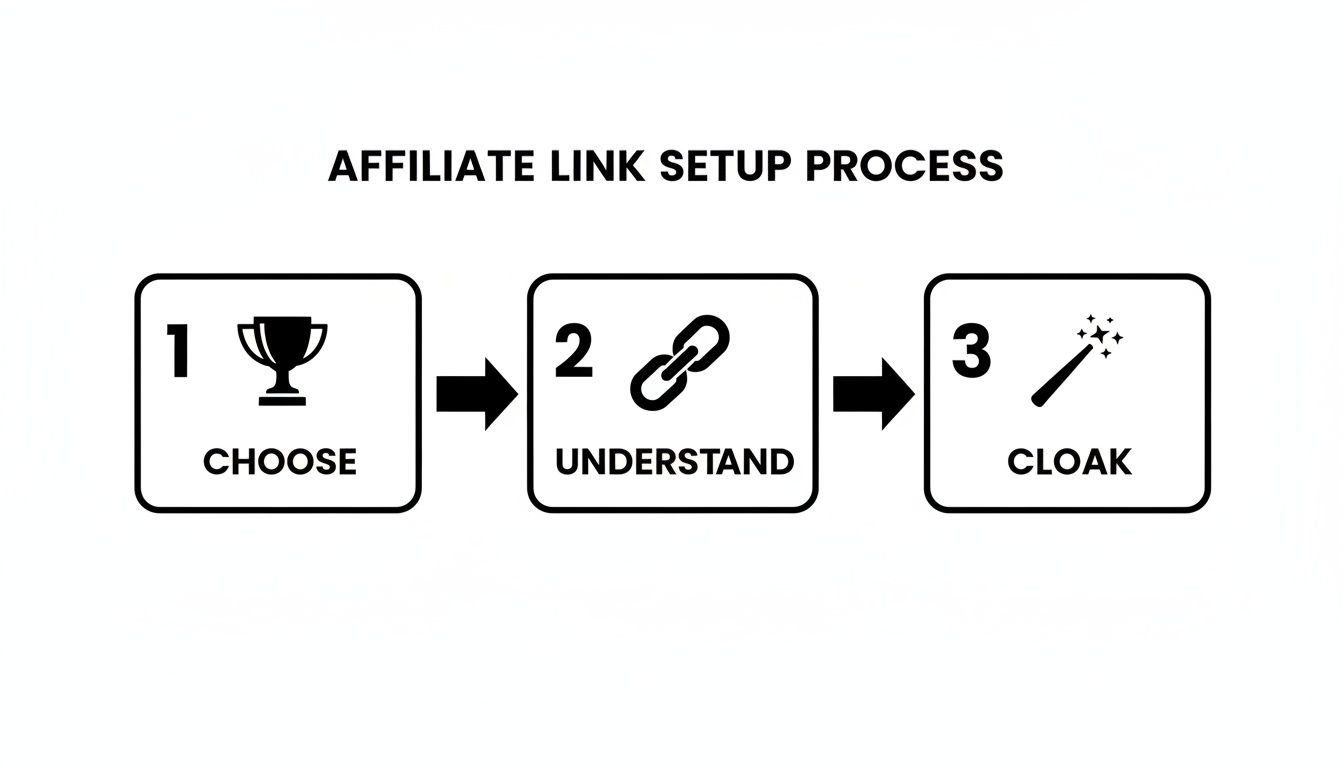
It really simplifies the journey into three distinct phases, showing that good link setup is a strategic process, not just a quick copy-and-paste job.
Why You Should Cloak Your Affiliate Links
Once you have your perfectly tracked link, the next job is to make it look good. Let’s be real—raw affiliate links are often long, ugly, and full of random characters. That can make potential buyers hesitate before clicking because, frankly, the URL just doesn't look trustworthy.
This is exactly where link cloaking saves the day. Link cloaking is simply the practice of turning that long, messy affiliate URL into a shorter, cleaner, and more memorable one that uses your own domain.
A cloaked link like
yourwebsite.com/recommends/productinspires far more confidence than a jumbled mess likeproduct.com/offer?id=123&aff=xyz&utm=456. It looks professional and keeps your branding front and center.
If you’re on WordPress, this is incredibly easy to do with plugins like Pretty Links. The free version is great for getting started with the basics, and the pro plans offer some seriously powerful automation. The benefit is clear: cleaning up those messy URLs into branded ones makes people more likely to click. It’s a simple change that can have a big impact.
How to Place Affiliate Links on Different Platforms

A perfectly crafted affiliate link won't earn a dime if no one clicks it. The real art is knowing where and how to place it. What works in a long-form blog post will fall completely flat on a fast-moving platform like TikTok.
To get this right, you have to think like your audience. Their mindset changes dramatically from channel to channel. A blog reader is in research mode, ready to dig into the details. An Instagram scroller? They want quick, visual, and immediate value. Your link placement strategy has to respect that context to have any chance of success.
For Your Blog or Website
Your own website is your home turf. It’s where you can build the most trust and offer the most depth. Affiliate links here shouldn't feel like advertisements; they should feel like organic, helpful recommendations woven directly into your content.
Here are a few proven methods:
- In-Content Text Links: This is the gold standard. When you’re writing about a specific camera, link the model name directly to the product page. It’s natural, non-intrusive, and highly effective.
- Resource Pages: Creating a dedicated "My Gear" or "Favorite Tools" page is a fantastic long-term play. It becomes a central hub for your most trusted recommendations that your audience can bookmark and return to again and again.
- Comparison Tables: When you’re reviewing several products at once, nothing beats a clear comparison table. Lay out the features, pros, and cons, and cap it off with a "Check Price" button that uses your affiliate link.
The beauty of a blog is that you have the space to build a compelling case for a product before you ever ask for the click.
On Social Media Platforms
Social media is a different beast entirely. Attention spans are incredibly short, so you need to be much more direct. Your link must be easy to find and the reason to click it has to be immediately obvious.
On platforms like Instagram and TikTok, the "link in bio" is your most valuable piece of digital real estate. Use a service like Linktree or build a simple landing page on your own site to host multiple affiliate links. Then, in your videos or posts, your call to action is simply telling people, "Check the link in my bio for all the details!"
On Instagram Stories, the link sticker is a game-changer. A beauty influencer reviewing a new serum can pop a direct affiliate link sticker on the screen with a "Tap to Shop" call-to-action. It creates a completely seamless path from seeing the product to buying it.
In Videos and Emails
With video and email, you have a captive audience, which opens up some powerful opportunities for link placement.
For a YouTube video, the description box is prime territory. Don't bury your links! List all the products you mentioned right at the top of the description so viewers don’t even have to click "Show more" to find them. It's also a great practice to mention verbally that "all the products are linked in the description below."
Your email newsletter is where you'll often see the highest engagement. You're talking directly to people who have opted-in to hear from you. Here, you can embed your affiliate links in text, on product images, or inside bold call-to-action buttons. Since that trust is already established, the conversion potential is massive.
To make this crystal clear, the table below breaks down the best approach for each channel.
Affiliate Link Placement Strategy Comparison
Choosing the right placement method for each platform is crucial for turning your recommendations into revenue. This table compares the most effective strategies for the main digital channels.
| Platform | Best Placement Method | Key Advantage |
|---|---|---|
| Blog | Natural in-content text links and resource pages. | High trust and authority, allowing for detailed persuasion. |
| Instagram/TikTok | "Link in bio" and Story link stickers. | Direct, visual calls-to-action capture impulse clicks. |
| YouTube | At the top of the video description. | Engaged viewers are primed to explore recommended products. |
| Buttons and contextual links within the newsletter. | Highest engagement and conversion from a loyal audience. |
Ultimately, the goal is always the same: make it as easy and logical as possible for your audience to act on your recommendation, no matter where they're consuming your content.
Mastering Performance Tracking and Analysis

Creating your affiliate link is really just step one. The real work—and where the money is made—begins after the click. If you're not diving into your performance data, you're essentially flying blind, and that's a surefire way to leave cash on the table.
Stepping into an affiliate dashboard can feel like a data firehose at first. But you don't need to track everything. The secret is focusing on the numbers that actually give you something to act on, turning all that raw data into smarter decisions that boost your bottom line.
Key Metrics That Actually Matter
Getting a ton of clicks might feel good, but it's just a vanity metric if those clicks aren't turning into sales. To get a real sense of how you're doing, you need to look a little deeper.
These are the metrics the pros obsess over:
- Conversion Rate (CR): This is the golden number. It’s the percentage of clicks that actually lead to a sale. A high CR tells you that your audience trusts what you're saying and the product is a great fit for them.
- Earnings Per Click (EPC): Put simply, this shows you how much you make, on average, every single time someone clicks your link. It's a fantastic way to quickly gauge a link's profitability.
- Average Order Value (AOV): Knowing the average spend per customer from your links helps you figure out which partners attract bigger spenders. More of that, please.
Keeping a close eye on these three metrics will quickly show you which campaigns are your cash cows and which ones are just taking up space.
Leveraging Sub-IDs for Granular Insights
Remember those Sub-IDs we talked about? This is where they become your secret weapon. Without them, you just see a lump sum of sales. But with Sub-IDs, you can pinpoint the exact piece of content, link placement, or campaign that drove each and every conversion.
Let’s say you’re promoting a new software tool in three places: a detailed blog post, a YouTube tutorial, and an email newsletter.
By tagging each link with
subid=blog,subid=video, andsubid=email, you might find that your email link boasts a 5% conversion rate, while the blog post is only pulling a 1% CR. That isn't just an interesting fact; it's a clear signal to double down on your email promotion for that offer.
This kind of detail is what separates guessing from strategy. It allows you to make adjustments backed by real-world data. As your affiliate program grows, this becomes absolutely essential. To get a better handle on your data capabilities, you can explore concepts like the analytics maturity model which can guide how you scale your efforts.
Turning Analysis Into Action
The final piece of the puzzle is taking what you've learned and putting it into practice. Your data tells a story about what your audience wants and what they respond to. All you have to do is listen.
If a specific product consistently delivers a high EPC and AOV, you know what to do: feature it more prominently. If you find that in-depth case studies drive way more sales than quick-hitter reviews, it's time to write more case studies.
This constant feedback loop—track, analyze, optimize, repeat—is how you systematically grow your affiliate income month after month. It's the process that separates the hobbyists from the pros.
Staying Compliant and Building Audience Trust
In affiliate marketing, your audience’s trust is the only currency that really matters. It takes ages to build but can be shattered in an instant with a single shady recommendation. That's why getting disclosure right isn't just about ticking a legal box—it’s the bedrock of a long-term, sustainable business.
The Federal Trade Commission (FTC) has pretty straightforward guidelines to protect consumers. The big idea is this: if you have a financial relationship with a brand you're talking about, you must disclose it clearly and conspicuously. Your audience shouldn't need a magnifying glass to find it.
What “Clear and Conspicuous” Actually Looks Like
"Clear and conspicuous" isn't just vague legal-speak. It's a practical standard. Your disclosure has to be easy to spot and simple enough for the average person to understand immediately. Burying it in your website footer or at the bottom of a long list of hashtags just won't fly.
Placement is everything. The disclosure needs to show up before someone has a chance to click your affiliate link.
- Blog Posts: Put it right at the top of the article, before you even get into the meat of the content.
- Social Media: Use obvious hashtags like #ad or #affiliate at the very beginning of your caption. Don't hide them in a sea of other tags.
- Videos: Say it out loud near the beginning of your video. Also, add a written disclosure in the description box above the "show more" fold so it's immediately visible.
A simple, honest statement works best. Something like, "This post contains affiliate links, which means I may earn a small commission if you make a purchase—at no extra cost to you," is perfect. It's transparent and shows you respect your audience.
Simple Disclosure Templates You Can Use
You don't need to be a lawyer to write a good disclosure. The goal is to be direct and human.
Here are a few real-world examples you can adapt:
- Short & Sweet (for social media):
(AD) Totally obsessed with this new gadget! It's made my workflow so much smoother. - Friendly & Informative (for blogs):
Heads up: Some of the links on this page are affiliate links. If you click one and make a purchase, I might earn a commission. Rest assured, I only recommend stuff I genuinely use and love! - Official Tone (for in-depth reviews):
Disclosure: We may receive a commission if you purchase through our links. This does not, however, impact our reviews and comparisons.
At the end of the day, compliance is about more than just avoiding fines. It's about honesty. When you're upfront about how you set up affiliate links and earn an income, you turn a simple transaction into a relationship built on trust. That's how you build a loyal community.
Common Questions About Setting Up Affiliate Links
As you get started with affiliate marketing, a few questions always seem to come up. It's totally normal to feel a bit unsure when you're learning the ropes, and getting some clear answers upfront can save you a lot of time and headaches.
Let's tackle some of the most common questions I hear from people just starting out. Think of this as your go-to guide for those tricky "what if" moments.
How Many Affiliate Programs Should I Join?
It’s really tempting to sign up for every affiliate program that looks even remotely interesting when you're new. My advice? Don't do it.
A much smarter strategy is to start small and focus on just one to three affiliate programs that are a perfect fit for your audience. This way, you can actually learn the products inside and out and understand each program's rules without feeling completely swamped. You'll create much better, more authentic content for a few partners instead of mediocre content for a dozen. Once you’ve mastered those and figured out what works, then you can think about expanding.
Quality over quantity is the name of the game here, especially at the start. It’s far better to prove your worth to a couple of programs than to generate zero sales across ten of them.
Affiliate Link vs. Referral Link: What's the Difference?
This is a common point of confusion, but the distinction is pretty simple once you break it down.
An affiliate link is almost always tied to a formal program where you earn a cash commission for every sale you drive. It's a structured business arrangement designed for marketing. A referral link, on the other hand, is usually more casual. Typically, both you and the person you refer get some kind of perk—like a discount, store credit, or a free month of a service. The goal is more about shared benefit than direct income.
Can I Put Affiliate Links on Any Social Media Platform?
For the most part, yes. Most social platforms are fine with affiliate links, but you have to follow their specific rules. Every platform, from Instagram to Pinterest, has its own terms of service for commercial content, and so will every affiliate program you join. If you ignore them, you risk getting your account restricted or being removed from a partner’s program.
Even more critical is the FTC's requirement for clear disclosure. Every single post with an affiliate link needs to be identified as such. Using hashtags like #ad, #sponsored, or #affiliate right at the beginning of your caption is an absolute must. This keeps you compliant and, just as importantly, helps you maintain trust with your audience. Always check the rules for both the platform and the program before you post.
What if My Links Aren't Getting Any Clicks?
If you're posting links and hearing crickets, it’s time to play detective. Don't worry—this is a common problem, and it's usually fixable.
Start by digging into these potential issues:
- Is the link placement awkward? If you just jam a link into a piece of content where it doesn't belong, it will feel spammy. It should feel like a natural, helpful recommendation.
- Is your call-to-action (CTA) strong enough? Are you actually giving people a compelling reason to click? "Check out this tool" is pretty weak. Something like, "Here’s the exact tool I use to save 5 hours a week" is far more persuasive.
- Is it the right product for your audience? Take a step back and honestly assess if the offer is a genuine solution for the people you're trying to reach. A mismatch here is a common reason for low clicks.
Start testing different link placements, writing stronger CTAs, and maybe even trying a different offer to see what your audience really wants.
Ready to stop guessing and start scaling on TikTok Shop? HiveHQ automates your affiliate outreach, tracks creator performance, and gives you a crystal-clear profit dashboard. Discover and recruit winning creators effortlessly. See how HiveHQ can grow your brand.