Keyword Research for Affiliate Marketing Mastery
affiliate marketingkeyword researchaffiliate seoprofitable keywordscontent strategy
When it comes to keyword research for affiliate marketing, the goal is simple: find the exact search terms people type into Google right before they pull out their wallets. This isn't about chasing huge search volumes; it's about getting laser-focused on user intent to drive real conversions and, more importantly, earn commissions.
The Bedrock of Affiliate Marketing Success

The first person might get a trickle of traffic, but those visitors are all over the place. They could be looking for pictures, cleaning tips, or just browsing. The second marketer, however, is attracting people who have already decided they need a new pan and are actively looking for the right one to buy. That’s a night-and-day difference in traffic quality, leading to way better engagement, more clicks on affiliate links, and actual revenue.
From Vanity Metrics to Buyer Intent
The biggest mindset shift for successful affiliate marketers is moving away from vanity metrics like raw traffic numbers and focusing squarely on buyer intent. A keyword with 100,000 monthly searches is worthless if none of those people are ready to buy. Your success hinges on finding keywords with strong commercial or transactional intent.
These are the golden phrases that signal someone is deep in the buying cycle:
- Comparison Keywords: "Caraway vs. Our Place pans"
- Review Keywords: "HexClad 10 inch pan review"
- "Best Of" Keywords: "best ceramic cookware set 2024"
- Problem-Solving Keywords: "safest cookware for high heat"
This focus is everything. With the global affiliate market projected to rocket from over $18 billion to $31.7 billion by 2031, the space is only getting more crowded. If you don't nail your keyword strategy, your content will get buried. Shockingly, only about 10% of search results on Google actually lead to a conversion, which means a staggering 90% of traffic is left on the table.
To help visualize this, let's break down how intent changes the game.
High-Intent vs. Low-Intent Affiliate Keywords
| Keyword Intent Type | Example | Typical Searcher Goal | Conversion Potential |
|---|---|---|---|
| High Intent (Commercial) | "breville smart oven air fryer pro review" | Actively comparing models, looking for validation before buying. | Very High |
| High Intent (Transactional) | "buy anker power bank" | Ready to purchase right now, looking for a direct sales page. | Highest |
| Medium Intent (Informational) | "how to choose a power bank" | Learning about the topic, not yet decided on a product. | Medium |
| Low Intent (Navigational) | "anker website" | Trying to find a specific brand's homepage. | Low |
Focusing your content efforts on the "High Intent" rows is how you build a profitable affiliate site from the ground up.
Pro Tip: Don't just glance at a keyword's search volume and difficulty score. Go incognito and actually Google it. The Search Engine Results Page (SERP) is a goldmine of information. Are the top results other affiliate roundups, e-commerce product pages, or informational blog posts? The SERP tells you exactly what kind of content Google believes satisfies that searcher's intent.
Mastering this process means you stop throwing content at the wall and hoping it sticks. You start making calculated, data-backed decisions that directly fuel your affiliate income. And for those operating on platforms like TikTok Shop, using an automated affiliate bot to manage and recruit partners can give you a massive edge in a fast-moving environment.
How to Brainstorm Your Initial Seed Keywords
Every solid keyword strategy starts with a handful of core ideas. We call these seed keywords, and they’re the foundation for everything that comes next. But this isn't about guessing what might work. It's about getting inside your customer's head and speaking their language.
Before you even think about opening a keyword tool, you need to know who you’re talking to. Let's say you're in the home coffee niche. Your ideal customer isn't just "someone who likes coffee." It’s "Sarah," a remote worker who desperately needs a quiet coffee grinder that won't wake up her family during those 6 AM video calls. Just by creating that simple picture, you've already found a clear direction for your research.
Mine Real User Conversations
The absolute best keywords aren't hiding in a spreadsheet; they're in real-life conversations. I always start by digging into forums like Reddit and Q&A sites like Quora. These places are treasure troves of unfiltered customer language. People are there asking for advice, complaining about products, and sharing what they truly love.
Take a quick scroll through Reddit's r/Coffee, for example. You’ll immediately see countless threads where people are discussing very specific needs.

The screenshot above is a perfect illustration. People are literally asking for the "Best espresso machine under $500" and debating specific features. These aren't just questions; they're high-intent seed keywords handed to you on a silver platter.
Uncover Keywords in Product Reviews
Another goldmine? Product reviews on sites like Amazon. Don't just look at the 5-star raves. The real magic is in the 2-star and 3-star reviews. This is where you find out what a product lacked or what problems people ran into.
A review complaining that "the grinder is way too loud for my small apartment" instantly gives you a killer keyword idea: "quiet coffee grinder for apartments." It’s that simple.
By analyzing real user feedback, you're not just finding keywords; you're uncovering pain points. Your content can then be framed as the solution, building trust and driving conversions far more effectively than generic articles.
Once you’ve gathered these raw, customer-driven phrases, you'll have a powerful seed list. This list is the starting point for all the other steps in your research. It ensures your entire affiliate strategy is grounded in what real people actually want.
And once you have that list, you can check out detailed guides on the top products to promote to make sure your content aligns with profitable opportunities from the get-go.
Using Keyword Tools to Find Those Hidden Gems
Alright, you’ve got your seed keywords. Now it’s time to turn that handful of ideas into a goldmine of real opportunities. This is where a good keyword research tool comes into play. Think of it as a powerful magnifying glass for your initial brainstorming, showing you thousands of related searches you’d never think of on your own.
You can definitely start with free tools like Google Keyword Planner to get a basic feel for what's out there. Just plug in your terms and see what comes back. But if you're serious about making money with affiliate marketing, upgrading to a paid tool like Ahrefs or Semrush is a must. These platforms give you the data you really need to make smart decisions.
They unlock two metrics that are everything for an affiliate marketer:
- Search Volume: A good estimate of how many people search for a keyword each month.
- Keyword Difficulty (KD): A score, usually from 0 to 100, that tells you how tough it will be to crack the first page of Google for that term.
Your goal is to find that perfect balance: keywords with enough search volume to be worthwhile, but a low enough KD that you actually stand a chance of ranking.
Putting Keyword Analysis into Practice
Let's stick with our example: "quiet coffee grinder." When you pop this into a tool like Ahrefs' Keyword Generator, it does way more than just analyze that one phrase. It spits out a long list of long-tail variations that actual people are typing into Google.

Look at that. You instantly find fantastic, low-competition keywords with high buyer intent, like "best quiet coffee grinder for french press" (KD 3) or "quiet manual coffee grinder" (KD 0). These are the bread and butter of a profitable affiliate site.
Specificity is your secret weapon. Affiliate marketing is a huge driver of e-commerce, accounting for about 16% of all online sales, but success isn't about chasing the big, flashy keywords. The hard truth is that only around 5% of affiliate pages ever make it into the top 10 search results, usually because they’re fighting an uphill battle for terms they can't win.
A long-tail keyword like "organic shampoo for sensitive scalp under $20" might only get 500 searches a month, but the people searching for it know exactly what they want. Its conversion rate could easily be ten times higher than a generic term like "shampoo."
Pro Tip: Don't have the budget for a paid tool right now? No problem. Use the "Alphabet Soup" trick in Google. Type your seed keyword into the search bar, add a space, and then type "a." See what Google suggests. Then delete the "a" and try "b," then "c," and so on. It’s a simple but effective way to find dozens of long-tail ideas straight from the source.
As your site gains traction, you can even branch out and learn how to create high-traffic videos to support your articles and reach a whole new audience. The main thing is to keep digging into the data to find and focus on the keywords that will give you the best bang for your buck.
Finding Hidden Gems by Spying on Your Competitors
Some of your best keyword ideas are hiding in plain sight—right on your competitors' websites. One of the smartest shortcuts in this game is simply reverse-engineering what’s already working for them. It completely takes the guesswork out of the equation and shines a spotlight on topics already proven to pull in traffic.
First things first, though. You need to identify your real competitors. I'm not talking about giants like Amazon or Best Buy. Your true rivals are the other affiliate blogs and niche content sites battling for the exact same eyeballs you are.
Once you have a list of a few solid competitors, you can pop their domains into a tool like Ahrefs or Semrush and run a content gap analysis. This shows you exactly what they rank for that you don’t, instantly handing you a list of potential opportunities.
Digging into a Competitor’s Top Pages
Let's say you run a blog focused on smart home gadgets. You’ve found a competitor who seems to be crushing it in the search results. Your first move is to plug their domain into your SEO tool and head straight for the "Top Pages" report.
This report is pure gold. It lays out which of their articles get the most organic traffic and, more importantly, the main keywords driving that traffic.
You might find their most successful post is a big roundup titled "Best Smart Plugs for Google Home." Just from that title, you’ve learned a ton:
- People are definitely searching for this topic.
- "Best of" articles signal strong commercial intent—people are looking to buy.
- The target audience is locked into a specific ecosystem (Google Home).
That’s not just a keyword; it’s a proven content blueprint. You now have a clear target to aim for.
Uncovering Those Juicy Keyword Gaps
The real magic happens when you start looking for keyword gaps. These are valuable terms your competition ranks for that you haven’t even touched yet. Most good SEO tools have a "Content Gap" or "Keyword Gap" feature built specifically for this purpose.
It’s simple: you enter your domain and your competitor's. The tool then spits out a list of keywords they rank for (usually in the top 10) where you’re nowhere to be found. Scrolling through this list can reveal some incredible long-tail keywords you’d never stumble upon just by brainstorming.
For instance, you might see them ranking for "energy monitoring smart plug" or "outdoor smart plug for holiday lights." These are hyper-specific, high-intent keywords from people who are pretty darn close to making a purchase.
Your job now is to look at those keywords and the content your competitor built around them. Then, ask the most important question: Can I do better? Can you write a more comprehensive guide, add a helpful comparison video, or offer more current product details? If you can confidently say yes, then you’ve just struck affiliate marketing gold.
How to Qualify Keywords for Maximum Profit
Alright, you’ve done the brainstorming and spied on your competitors. Now you’re staring at a massive spreadsheet of potential keywords. This next part is where the real money is made in affiliate marketing: turning that raw data into a smart, strategic content plan. This is how you separate the profitable gems from the duds that will waste your time.
You can't just chase every keyword that looks good. To make smart decisions, you need a repeatable process. I run every single potential keyword through a four-part filter: relevance, commercial intent, search volume, and competition. Only the keywords that pass all four tests make it onto my priority list.
This decision tree is a great visual for how I think through this process quickly.
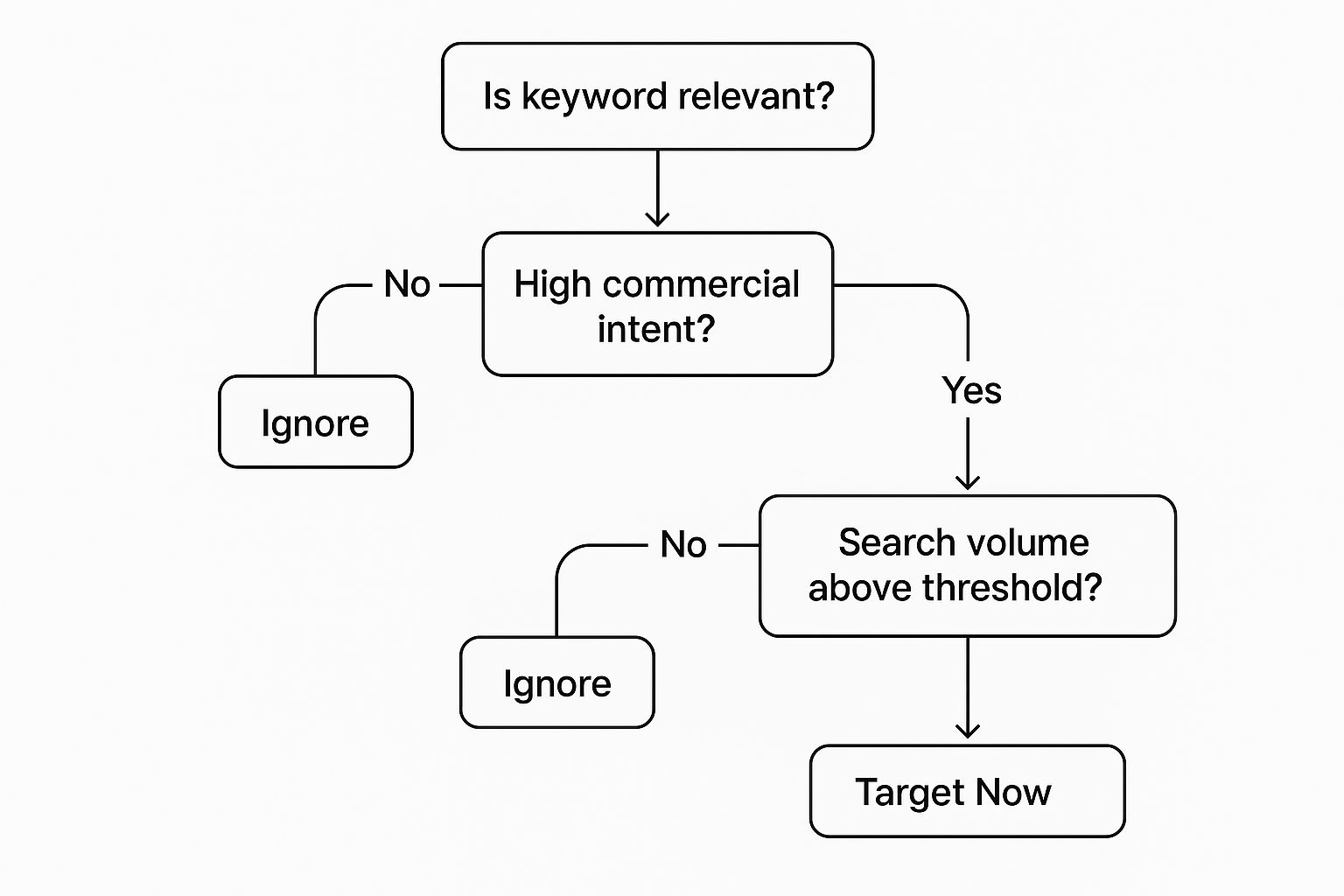
Following this simple flow forces you to put your resources behind keywords with the highest probability of driving affiliate sales, instead of just chasing empty traffic numbers.
Decoding Commercial Intent
Out of the four filters, commercial intent is the most critical. Honestly, this is what separates affiliates who actually make a living from those who just get traffic. You have to get inside the searcher's head and figure out where they are in their buying journey.
I like to break keywords down into three main groups:
- "Buy Now" Keywords: These are pure gold and should always be your top priority. They’re packed with transactional modifiers like "review," "vs," "best," and "buy." Someone searching for "Sony WH-1000XM5 vs Bose QC Ultra" is literally moments away from making a purchase.
- Product Keywords: These searchers are one step back in the process. They're exploring their options and comparing features. Think "noise cancelling headphone alternatives" or "Bose QuietComfort features." They have strong interest but need a bit more info to pull the trigger.
- Informational Keywords: These are at the very top of the funnel. Queries like "how do noise cancelling headphones work" or "what is spatial audio" won't convert on the spot. But they are absolutely essential for building topical authority and getting new people into your ecosystem who you can eventually guide toward a purchase.
Balancing Volume and Competition
Finally, it’s time to weigh search volume against the competition. A keyword with 10,000 monthly searches is completely useless if the entire first page of Google is dominated by huge brands you’ll never outrank. The goal is to find that sweet spot: a healthy search volume paired with a manageable Keyword Difficulty (KD) score.
The game is always changing. Searches for high-intent affiliate terms using "best" or "review" have jumped by over 30% since 2020. That makes these keywords more valuable than ever. At the same time, brands are catching on, with 6 in 10 now spending more on affiliate commissions. The rewards are bigger, but you have to pick your battles carefully. For more on this, you can discover more about affiliate marketing statistics and see where the industry is heading.
This handy checklist breaks down exactly what I look for when I’m sizing up a keyword.
| Keyword Qualification Checklist for Affiliates |
| :--- | :--- | :--- | :--- |
| Evaluation Criteria | What to Look For | High-Potential Signal | Red Flag |
| Relevance | Does it align with my niche and products? | Direct match to products you promote. | Vague or unrelated to your affiliate offers. |
| Commercial Intent | What's the searcher's goal? | Transactional words like "best," "review," "vs," "buy." | Purely informational terms like "what is" or "history of." |
| Search Volume | Is there enough demand? | A realistic monthly search volume for your site's authority. | 0-10 searches/month (unless it's a new, high-ticket item). |
| Competition | Can I realistically rank for this? | Low Domain Authority sites, forums, or Quora on page 1. | The top 10 results are all household-name brands. |
Using this checklist helps you stay objective and avoid falling for keywords that look good on the surface but have no real profit potential.
By systematically running every keyword through this framework, you transform a messy spreadsheet into a powerful, prioritized content calendar. You'll know exactly what to write next, confident that every article is targeting a keyword with real profit potential. This is the difference between guessing and growing.
Still Have Questions About Affiliate Keywords? Let's Clear Them Up
Even after you get a process down, affiliate keyword research can throw some curveballs. It’s totally normal. Here are some of the most common questions I get asked, along with some straight-to-the-point answers to help you get unstuck.
How Many Keywords Should I Really Aim for in One Article?
I've always found that the sweet spot is one primary keyword and about three to five secondary keywords. The idea isn’t to cram as many phrases in as possible. Instead, you're building a tight, focused piece of content around a single core idea. When you do that, you're signaling to Google that you’re the go-to expert on that specific topic.
Let's say your main target is "best coffee grinder for french press." Your secondary, supporting keywords would naturally flow from that:
- coarse ground coffee grinder
- blade vs burr grinder for french press
- manual coffee grinder reviews
This strategy lets you rank for a whole cluster of related searches, bringing in a wider—but still super relevant—audience.
What's a Realistic Keyword Difficulty Score to Target?
Honestly, the "right" Keyword Difficulty (KD) score depends entirely on your site's authority. If you’re just starting out and have a low Domain Authority (DA) or Domain Rating (DR)—say, under 10—then you should be laser-focused on keywords with a difficulty score of 10 or less. These are your low-hanging fruit.
Once you start publishing consistently and earning some backlinks, your site’s authority will climb. That’s when you can start going after the bigger fish with higher search volume and more competition.
My Advice: Never, ever ignore a keyword just because its KD is '0'. If it shows commercial intent and has even a little search volume, it's pure gold. These low-competition terms are often the fastest way to get your first trickle of traffic and sales.
Should I Focus on Informational or Commercial Keywords First?
The smart money is on a mix of both. Your commercial keywords—the ones with terms like "best," "review," or "vs"—are your bread and butter. They're what people type in when they've got their wallets out.
But don't neglect informational keywords ("how to," "what is," "guide"). These are your secret weapon for building topical authority. They attract organic backlinks and get you in front of potential buyers way earlier in their journey. A killer affiliate site weaves these two together, often linking a bunch of helpful informational posts back to a central, money-making "hub" article.
How Often Do I Need to Refresh My Keyword Research?
Keyword research isn’t a one-time thing; it's a living part of your strategy. I recommend doing a full-blown review of your keyword plan at least once a year to keep up with what's new and what's changed.
On a more regular basis, you should check your keyword rankings monthly. Jump into Google Search Console and look for keywords where you're stuck on the second page (positions 11-20). These are your biggest opportunities. Often, a simple content refresh—like adding new info, swapping out old products, or tightening up the on-page SEO—is all it takes to push that article onto page one for a huge traffic boost.
Ready to scale your affiliate program on TikTok Shop without the manual grind? The HiveHQ Affiliate Bot automates creator outreach and recruitment, while our Profit Dashboard provides the data-driven insights you need to grow smarter. Discover how HiveHQ can transform your affiliate marketing today.