Social Media Marketing Automation Done Right
social media marketing automationmarketing automationsocial media toolscontent schedulingdigital marketing
Think of social media marketing automation less as a robot taking over your job and more as a super-efficient assistant. It’s all about using smart software to handle the tedious, repetitive tasks that eat up your day—things like scheduling posts, pulling performance reports, and keeping an eye on brand mentions.
This isn't about removing the human touch. It's about freeing you up to focus on what humans do best: strategy, creativity, and building real connections with your audience.
What Is Social Media Marketing Automation
Let's break down what social media marketing automation really means. It's not some far-off, futuristic concept; it's a practical tool that helps you manage your social media presence more effectively. At its core, it's about using software to automate the predictable parts of your social media workflow.
This technology works tirelessly in the background, ensuring your brand stays active and responsive even when you’re not at your desk. It’s designed to support your team, not replace it, allowing you to move from just doing social media to thinking strategically about it.
The Core Functions of Automation
So, what does this software actually do? Instead of you manually logging into five different platforms to post the same update or spending hours digging through data for a report, the automation tool takes care of it. This consistency is key to keeping your audience engaged without burning out your team.
Here are a few of the main jobs automation can handle:
- Content Scheduling: Plan out your content calendar and let the software publish posts at the perfect time for each platform, whether it's during your workday or in the middle of the night.
- Social Listening and Monitoring: The software can act as your eyes and ears, automatically tracking mentions of your brand, your competitors, or important keywords. This helps you jump on opportunities and manage your reputation.
- Performance Analytics: Forget messy spreadsheets. Automation tools can instantly gather data on engagement, follower growth, and clicks, then turn it all into easy-to-read reports that show you what’s working.
- Audience Interaction: Handle initial interactions with ease, like automatically routing a customer service question to the right person or sending a quick reply to common inquiries.
To get a clearer picture, let's look at how these tasks differ when done by hand versus with an automation tool.
Manual vs Automated Social Media Tasks at a Glance
| Task | Manual Approach | Automated Approach |
|---|---|---|
| Content Publishing | Log in to each platform individually to post in real-time. | Schedule all posts in advance from a single dashboard for multiple platforms. |
| Community Engagement | Manually search for brand mentions and reply one by one. | Receive instant alerts for mentions and keywords; use templates for common replies. |
| Reporting & Analytics | Manually collect data from each platform's analytics and compile it into a spreadsheet. | Generate comprehensive, multi-platform reports with a single click. |
| Lead Generation | Monitor comments and messages for potential leads and manually forward them to sales. | Automatically identify and tag potential leads based on keywords and route them to the CRM. |
As you can see, automation doesn't change what you do, but it dramatically changes how you do it, saving an incredible amount of time and effort.
Why Automation Is No Longer Optional
Trying to manage social media manually for a growing business is like trying to empty the ocean with a bucket. The numbers alone are staggering. By 2025, there will be an estimated 5.45 billion people on social media, which is roughly 67.1% of the entire global population.
People spend an average of 2 hours and 24 minutes every single day scrolling through about seven different platforms. Reaching this massive, always-on audience with timely content and meaningful interactions is simply impossible at scale without a little help from technology. You can find more eye-opening social media statistics over at Sonary.com.
The goal of social media marketing automation is not to "set it and forget it." Instead, it’s about creating a highly efficient foundation that empowers you to spend more time on what truly matters—building authentic relationships and crafting compelling stories for your audience.
Why Automation Is a Game-Changer for Growth

When we talk about social media automation, it's easy to think it's just about saving time. And while getting hours back in your day is a huge plus, the real magic is how it becomes a direct engine for business growth. It's what allows your team to stop just doing social media and start thinking strategically.
Think of your social media presence like a physical storefront. Without automation, you can only open the doors when someone is there to run the shop. With automation, your business is open 24/7. It's constantly welcoming new people, sharing valuable info, and building a presence, even when your team is logged off for the night.
This always-on approach creates a reliable stream of content that builds trust and keeps your brand top of mind. It’s the difference between a reactive strategy—posting whenever you have a free moment—and a proactive one that nurtures an audience around the clock.
Moving from Reactive Tasks to Proactive Strategy
It’s a familiar story for most social media managers: they get trapped in a never-ending cycle of manual tasks. Posting, responding, pulling reports... it’s a grind that leaves almost no time for the high-value work that actually moves the needle.
By letting technology handle the repetitive stuff, you free your team to become true strategists. Instead of asking, "What should we post today?" they can start asking, "How can we improve our customer journey based on last month's data?"
That shift is where real growth begins. Your team suddenly has the bandwidth to focus on:
- Deeper Audience Analysis: Really digging into who your followers are, what they care about, and how to create content that genuinely connects.
- Creative Campaign Development: Brainstorming and building those big, memorable campaigns that drive serious engagement and sales.
- Competitor and Market Research: Keeping an eye on what others are doing, spotting new trends, and finding openings to get ahead.
The data backs this up. A huge 47% of marketers are already automating social media tasks, making it the second most common channel for automation right after email. For the average marketer, this frees up about six hours every week. That's over 300 hours a year to put back into smart planning. You can see more on the rise of marketing automation from inbeat.agency.
Enhancing Customer Experience and Lead Generation
Automation also has a massive, direct impact on how you interact with customers and potential leads. We live in a world of instant gratification, and automated systems can be your first line of defense, ensuring no question or comment goes unanswered.
For instance, you can set up automated replies for common DMs or instantly route comments about support issues to your customer service team. This doesn't just cut down response times; it ensures the most important conversations get to the right person, fast.
Automation ensures every lead is captured and every customer feels heard, even outside of business hours. This consistent attention transforms your social profiles from simple broadcast channels into powerful engines for customer service and sales.
This improved responsiveness feeds directly into lead quality. Automated workflows can spot and tag potential leads based on keywords or actions they take, sending them straight into your sales pipeline. Your sales team gets warmer, more qualified leads without having to manually sift through all the noise.
Making Smarter Decisions with Data
Finally, let's talk about one of the most powerful growth drivers of all: data. Pulling reports manually is slow, painful, and often full of mistakes. Social media automation tools get rid of that bottleneck completely.
With automated analytics, you get clear, simple reports on your key performance indicators (KPIs) in real time. You can see at a glance which content formats are killing it, what posting times get the most eyeballs, and how your audience is growing across every platform.
Having instant access to reliable data allows you to make smart, evidence-based decisions. You can quickly double down on what’s working, tweak campaigns that aren't hitting the mark, and constantly optimize your strategy for the best possible ROI. At the end of the day, automation isn't just an efficiency hack; it's a core piece of any modern, data-driven growth plan.
Putting Automation to Work for You
Knowing what social media automation is feels good, but putting it to work to get real results? That’s where the fun begins. It's time to shift from theory to practice and turn your social channels from simple broadcasting tools into assets that work for you 24/7.
Let's dive into the most powerful and practical ways you can start using automation today. These aren’t just abstract ideas; they're concrete strategies designed to save you time, boost your engagement, and deliver a clear return on your effort.
Build a Dynamic Content Calendar with Smart Scheduling
Consistency is the bedrock of any solid social media strategy, and automation is how you achieve it without burning out. Smart scheduling is by far the most popular use of these tools—in fact, 85% of all platform usage is dedicated to it. Instead of having to post everything live, you can build out a rich content library and schedule your updates weeks or even months ahead of time.
But this is so much more than just a simple content queue. The best tools get to know your audience, analyzing their activity to pinpoint the absolute best times to post on each platform. This ensures your message arrives exactly when people are most likely to see it and, more importantly, act on it.
- Evergreen Content Loops: Got some timeless, high-value content? Load it into an "evergreen" library that automatically re-shares those posts at set intervals. Your feed stays active and helpful with zero extra effort.
- Campaign-Specific Queues: Planning a product launch or a holiday sale? Set up a dedicated queue just for that campaign. The system will publish all your promotional content right on schedule.
- Time Zone Optimization: If you have customers around the world, you can’t be awake 24/7. Automation can. It schedules posts to go live during peak hours in every major time zone, a feat that's simply impossible to manage by hand.
This graphic really drives home how businesses are benefiting from these platforms.
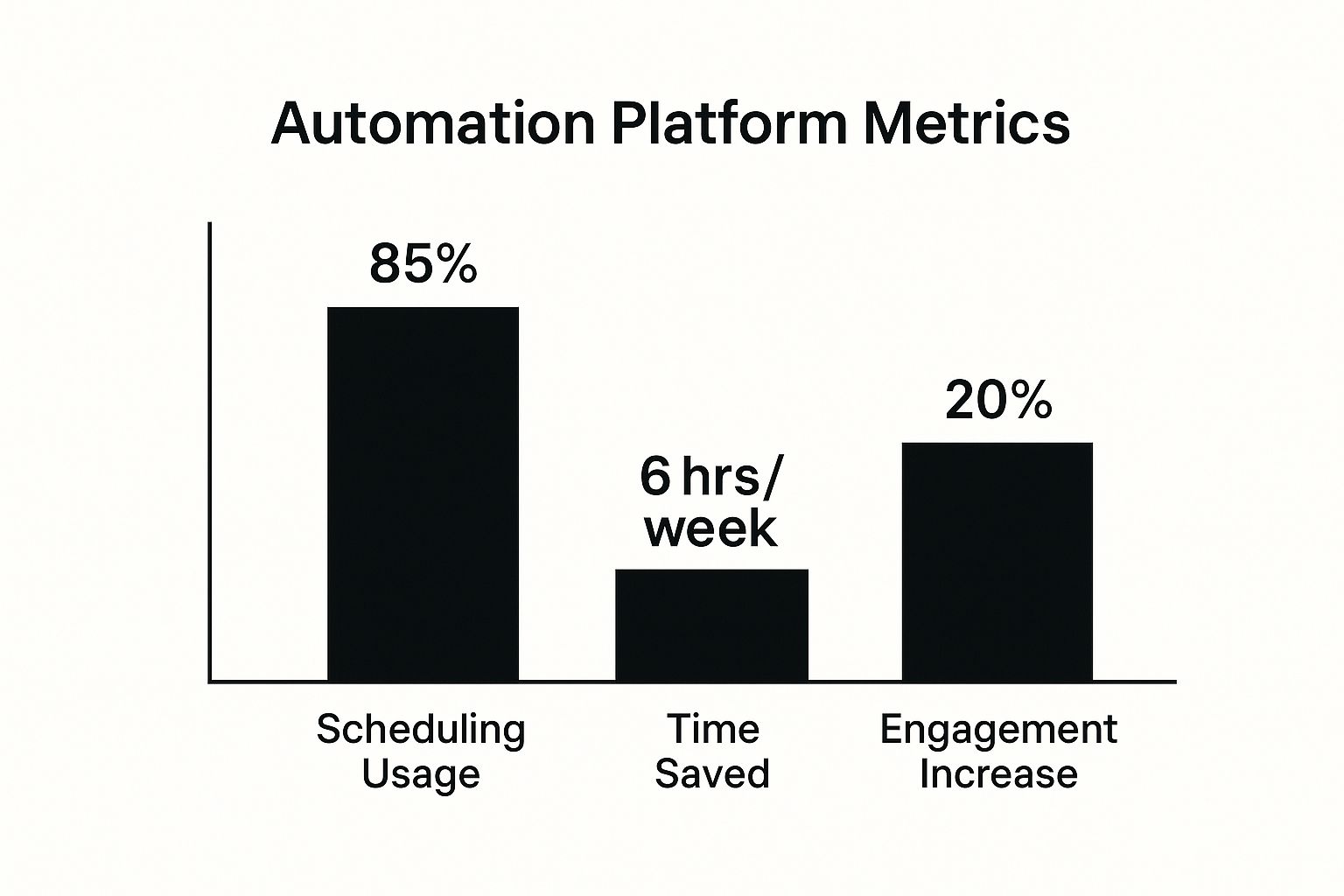
As you can see, while scheduling is the main event, the ripple effects—massive time savings and a real bump in audience engagement—are impossible to ignore.
Activate Real-Time Social Listening
What are people saying about your brand when you're not looking? Think of social listening automation as your digital ears, constantly scanning platforms for mentions of your company, products, competitors, or key industry phrases. It gives you a live, unfiltered pulse on your brand's reputation and what’s happening in your market.
You can set up alerts that notify you the moment specific keywords pop up. This allows you to jump on a customer service issue before it snowballs, thank someone for a glowing review, or contribute to an important industry conversation as it’s unfolding. It’s the difference between reacting to yesterday’s news and shaping today’s conversations.
Streamline Initial Engagement and Support
On social media, speed is everything. A quick response to a customer's question can be the difference between a sale and a lost opportunity. While a bot can't replace a thoughtful human conversation, it can absolutely handle the first point of contact and drastically cut down your response times.
Automation can be your frontline support, ensuring no customer query is missed. You can set up workflows to automatically respond to common questions with pre-written answers or route more complex support tickets to the right team member.
For example, a comment that includes "price" or "how much" could instantly trigger an automated DM with a link to your pricing page. This frees up your human team members to focus on the nuanced, high-value interactions that truly build relationships. If you need some inspiration, check out our guide on the top hooks and CTAs to drive engagement.
Generate Automated Performance Reports
Let’s be honest: manually pulling data from five different social platforms into a single spreadsheet is a soul-crushing task. It's tedious, time-consuming, and an open invitation for errors. With automation, you can kiss those messy spreadsheets goodbye for good.
You can set up automated reports that land in your inbox daily, weekly, or monthly. These dashboards consolidate all your key metrics—engagement rate, follower growth, click-throughs, reach—into one clean, easy-to-read view. This gives you a consistent, up-to-the-minute look at your ROI, helping you see what’s working and what isn’t without ever having to copy and paste a single data point yourself.
Choosing the Right Automation Tools
Stepping into the world of social media automation tools can feel like walking into a massive, noisy warehouse. Everywhere you look, platforms are shouting about their features, promising to solve all your problems. So, how do you cut through the noise and find the right fit?
Think of it this way: you wouldn't buy a massive delivery truck if all you need to do is zip around the city for personal errands. A scooter would do just fine. The same logic applies here. The best tool isn't the one with the longest feature list; it's the one that perfectly matches your goals, your team's size, and your budget. Before you even think about demos and free trials, the real work starts with a bit of self-reflection.
Start With a Clear Needs Assessment
It’s tempting to jump straight into testing out shiny new platforms, but that's a recipe for decision fatigue. A much smarter approach is to first figure out what you actually need. A feature that’s a game-changer for a global e-commerce brand might be completely useless to a local B2B consultant.
Get your team together and ask some honest questions:
- Where does our audience live? If your customers are all on Instagram and TikTok, a tool that's heavily focused on LinkedIn just won't cut it. Pinpoint your non-negotiable platforms first.
- What's our biggest time-waster? Are you drowning in manual report creation? Is scheduling content across channels eating up your entire Monday? Find your biggest pain point, and you'll find your must-have feature.
- Who will be using this? A solo founder needs something simple and intuitive. A growing marketing department, on the other hand, needs collaboration tools like content approval workflows and shared media libraries to keep everyone on the same page.
- What's our real budget? Be realistic. Tool pricing can swing wildly from $20/month for a basic scheduler to thousands for a full-blown enterprise suite. Know your number before you start shopping.
Answering these questions first will give you a clear filter, helping you narrow down the endless options to a manageable shortlist of real contenders.
Comparing Different Types of Tools
Once you know what you're looking for, you'll start to see that most tools fall into a few distinct categories. Understanding these buckets is key to avoiding the classic mistakes: overpaying for features you'll never touch or, worse, picking a tool you'll outgrow in six months.
See which of these descriptions sounds most like your business:
All-in-One Platforms: Think of tools like Hootsuite or Sprout Social as the Swiss Army knives of social media. They do a bit of everything—scheduling, analytics, social listening, team management—across almost every network imaginable. They're incredibly powerful but can come with a steep learning curve and a hefty price tag, making them a better fit for larger organizations.
Scheduling-Focused Tools: Platforms like Buffer or Later are masters of one craft: getting your content planned and published. They pride themselves on clean interfaces and user-friendliness. If your main goal is simply to maintain a consistent posting calendar without breaking the bank, these are your best bet.
Niche-Specific Solutions: Some tools are built with a laser focus on solving one very specific problem. For instance, a TikTok Shop owner's needs go way beyond scheduling. They have to manage creator collaborations and track affiliate sales. That's where a specialized creator tracker like HiveHQ comes in, offering depth that the all-in-one platforms just can't match for that use case.
The right tool isn't always the one with the most features. It's the one with the right features for your specific business goals, whether that's broad-based brand awareness or targeted affiliate sales on a single platform.
Look to the Future of Automation
When you choose a tool, you're not just buying a piece of software; you're investing in a partner for your future growth. This space is expanding fast—the marketing automation market is on track to hit $13.97 billion by 2030.
With nearly 50% of marketers already using these tools and over 70% preferring cloud-based options for their flexibility, it’s clear this is no passing trend. As you make your choice, look for a platform that has a vision for the future and a product roadmap that excites you. You can read more about these marketing automation trends on Emailvendorselection.com.
Your Step-By-Step Automation Strategy Plan
Jumping into social media automation without a solid plan is a recipe for chaos. It’s like trying to build a piece of IKEA furniture without the instructions—you’ll end up with a wobbly, confusing mess that doesn't serve its purpose. A clear strategy is what turns automation from a simple tool into a powerful engine for growth.
This guide will walk you through setting up your strategy, one manageable step at a time. Let's build a system that works for you, not against you.
Define Your Automation Goals
First things first: what are you actually trying to accomplish? Vague goals like “saving time” or “boosting engagement” are nice, but they aren't actionable. You need to get specific. We're talking SMART goals—Specific, Measurable, Achievable, Relevant, and Time-bound.
What does a win look like for your brand? Maybe you want to cut your customer service response time by 50% in the next quarter. Or perhaps the goal is to drive 20% more leads from your social channels this month.
Getting crystal clear on your objectives is essential. These goals will be your compass, guiding every decision you make, from the software you choose to the workflows you create.
Map Out Your Key Workflows
With your goals set, it’s time to get tactical. Think about the common, repetitive tasks that eat up your team's day and map them out visually. Start with the low-hanging fruit—the simple, high-volume jobs that are begging to be automated.
A few great places to start include:
- The Content Approval Process: How does a post go from a draft to live? Who needs to sign off on it? Chart out every step to find the bottlenecks.
- Comment Moderation: What’s your game plan for incoming comments? How do you separate spam from legitimate questions or praise from criticism?
- Customer Inquiry Routing: When a DM slides in, where does it go? Who needs to see it, and how quickly do they need to respond?
Sketching these processes out on a whiteboard or using a digital flowcharting tool is incredibly powerful. It brings clarity to your operations and instantly shows you where automation can make the biggest impact.
Build and Organize Your Content Library
Great automation needs great content. Think of your content library as the fuel for your social media machine—without it, you’re not going anywhere. A little organization here goes a long way.
Start by creating dedicated folders for different types of content. For instance, you could set up categories like:
- Evergreen Content: This is your timeless stuff—blog posts, industry tips, and company stories that stay relevant and can be shared again and again.
- Promotional Content: Here’s where you’ll store assets for specific campaigns, product launches, flash sales, or upcoming events.
- User-Generated Content (UGC): Create a curated collection of customer photos, reviews, and shout-outs that you have permission to share. It's social proof gold.
By organizing your content this way, you make it easy to build a varied and engaging schedule. Your feed will feel fresh and balanced, not like a non-stop sales pitch.
Monitor Performance and Optimize Relentlessly
Finally, remember that automation is never a "set it and forget it" deal. It’s a dynamic process that needs regular check-ins to stay effective. Carve out time each week to dive into your analytics and see what’s really happening.
Pay close attention to your key metrics. Are certain types of posts killing it? Do specific times of day get more traction? Use these insights to tweak your schedule, refresh your content, and fine-tune your automated workflows. To see the real business impact, you need to connect your social efforts to your finances. You can track key financial metrics with a comprehensive profit dashboard to see exactly how your strategy is affecting the bottom line.
Common Automation Mistakes and How to Avoid Them

While social media marketing automation is a massive time-saver, it can go wrong in a hurry. The biggest danger isn't a technical bug; it's that you slowly lose the human touch that makes social media so powerful to begin with. If you fall into a few common traps, your brand can come across as robotic, clueless, or just plain fake.
The good news? Just knowing what these pitfalls are is half the battle. By sidestepping a few key mistakes, you can make sure your automation tools amplify your brand’s personality, not muffle it.
The Dangers of Over-Automating
By far, the most frequent mistake is trying to automate everything. It’s tempting, I get it. Setting up automatic DMs for new followers or canned replies for every mention seems efficient. But in reality, it often does more harm than good. People can sniff out a generic, scripted response a mile away, and it instantly devalues the entire interaction.
Instead of aiming for 100% automation, think about automating the tedious, non-conversational stuff. Use tech for scheduling posts and pulling reports, but keep the one-on-one engagement human.
The goal isn't to replace human interaction but to create more time for it. Automation should handle the logistics so you can focus on building genuine relationships.
This balanced approach lets you be efficient without sacrificing your brand’s authenticity. At the end of the day, people follow brands on social media because they want to connect with the humans behind the logo, not chat with a bot.
Forgetting to Monitor and Adapt
Another huge pitfall is the "set it and forget it" mentality. Sure, scheduling your content a month out feels great, but if you're not keeping an eye on the real-time conversation, you're walking into a minefield. A cheerful, pre-scheduled post can look incredibly tone-deaf if it publishes right in the middle of a public crisis or somber news event.
Great automation requires constant vigilance. Someone on your team needs to have a finger on the pulse of what's happening on your channels and in the world at large.
To avoid this classic blunder, build a solid monitoring routine:
- Daily Check-ins: Carve out at least 15-30 minutes every day to scan comments, mentions, and DMs. You need to stay in the loop.
- Pause and Pivot: Have an emergency plan to immediately pause all scheduled content when a sensitive situation blows up. This buys your team time to craft a thoughtful, appropriate response.
- Performance Review: Don't just stick to the plan because it's there. Regularly check your analytics to see what's actually working and adjust your upcoming content based on that data.
Using One-Size-Fits-All Content
Finally, blasting the exact same message across every social media platform is a rookie move. That witty, 280-character post that killed it on X (formerly Twitter) is going to completely bomb as an Instagram caption without a great visual. Each network has its own audience, its own culture, and its own rules of engagement.
When you don't bother to customize your content, you just look lazy. It signals to your audience that you don't really understand the platform they love. So, take the extra five minutes to tweak your message for each channel, even when you're using one tool to schedule everything. It shows you respect the platform and the people on it.
Common Questions About Social Media Automation
Jumping into social media automation can feel like a big step, and it's natural to have questions. It’s smart to get the lay of the land before you commit. Let's walk through some of the most common things people ask when they're getting started.
Is Automation Going to Kill My Engagement?
This is probably the biggest fear people have, and it's a fair one. The short answer? Not if you do it right.
The danger isn't the tool itself—it's how you use it. If you start pumping out generic, soulless replies or schedule content months in advance and never check in, then yes, your engagement is going to tank. People can spot a robot from a mile away.
But when you use automation smartly, it actually boosts your ability to engage. Think of it as your behind-the-scenes crew. It handles the tedious stuff like scheduling posts at the perfect time and pulling performance reports. This frees you up to do what really matters: having real, human conversations with your followers. The goal is to automate the machine, not the human connection.
What’s This Going to Cost Me?
The price tag on automation tools can be all over the map, which is actually good news—it means there’s something for just about every budget. Most platforms base their pricing on how many social accounts you're managing, how many people are on your team, and how powerful the features are.
Here's a rough idea of what you can expect to spend:
- For the Solo Creator or Small Shop: If you just need the basics like post scheduling, you can find great tools starting around $20 to $50 per month.
- For Growing Teams: When you need more collaboration tools and deeper analytics, plans typically run between $100 and $250 per month.
- For Large Companies & Agencies: Enterprise-level platforms with all the bells and whistles—like advanced social listening, competitor analysis, and VIP support—can start at $500 per month and go up from there.
Don't forget, many services offer a free plan with limited features. It's the perfect way to try before you buy and see what works for you.
What Should I Absolutely Never Automate?
Automation is a workhorse, but some things just need a human touch. These are the moments where authenticity isn't just a buzzword—it's everything. Trying to automate them can do more harm than good.
You should never automate the things that make your brand human. Genuine conversations, delicate customer issues, and crisis communications require empathy, and software just isn't there yet.
Here are a few tasks that should always stay on your plate:
- Handling Negative Feedback: Sending an automated reply to an angry customer is like pouring gasoline on a fire. These situations need a real person who can listen, empathize, and make things right.
- Managing a Crisis: When things go wrong or a sensitive topic is trending, the first thing you should do is pause all scheduled posts. Your response needs to be crafted in real-time, with careful thought and a human voice.
- Engaging with VIPs: When an industry leader, a super-fan, or a potential partner interacts with your brand, that's a golden opportunity. A personal, thoughtful reply is how you build a real relationship.
Ready to unlock your TikTok Shop's full potential? HiveHQ provides the specialized automation and analytics tools you need to find top creators, track profitability, and scale your sales with confidence. Explore HiveHQ today and see how our all-in-one suite can transform your growth.
Article created using Outrank