10 Social Selling Strategies to Dominate TikTok Shop in 2025
social selling strategiesTikTok ShopeCommerce growthcreator partnershipsHiveHQ
The TikTok Shop gold rush is in full swing, but relying on sporadic viral hits is a recipe for inconsistent growth. The brands that are truly winning are those that implement deliberate, scalable social selling strategies. This isn't about chasing trends; it's about building a predictable revenue engine by combining authentic community engagement with powerful automation and data-driven insights. Many sellers get stuck in a cycle of posting content and hoping for the best, missing the structured approach needed for sustained success.
In this guide, we break down 10 high-impact social selling strategies tailored specifically for the dynamic environment of TikTok Shop. We move beyond generic advice to give you actionable blueprints you can implement immediately. You will learn precisely how to forge powerful creator partnerships, automate your affiliate outreach programs, and use critical data to transform your TikTok presence from a gamble into a well-oiled sales machine.
Whether you are just starting your shop or are looking to scale your existing operations, these strategies will provide the framework you need to dominate the platform. The goal is to move from reactive content creation to proactive, strategic selling that generates consistent results.
1. Strategy 1: Build a Hyper-Engaged Community with Value-First Content
Instead of focusing solely on product-centric videos, build a loyal community by creating content that educates, entertains, and solves your audience's problems. This approach transforms your TikTok profile from a digital storefront into a go-to resource, fostering trust that converts followers into customers. By consistently providing value, you create an environment where sales feel like a natural extension of the relationship, not a forced pitch. This strategy is about playing the long game to build brand equity and a dedicated customer base that advocates for you.
How to Implement a Value-First Content Strategy
This approach prioritizes audience needs over direct sales messages. The goal is to become an indispensable resource, making your brand the first one that comes to mind when a need arises. This is one of the most sustainable social selling strategies because it builds a defensive moat of brand loyalty around your business.
For example, a skincare brand could create tutorials on identifying skin types, videos debunking common beauty myths, or a series on building a beginner-friendly routine. This content provides immense value without directly pushing a product in every video. The sales then come naturally when viewers, who now trust the brand's expertise, see a product tagged that solves the exact problem discussed.
Actionable Steps for Implementation:
- Identify Audience Pain Points: Use comment sections, competitor analysis, and tools like AnswerThePublic to discover what questions your target audience is asking.
- Create Content Pillars: Develop 3-5 core themes that align with your brand and audience needs. For a kitchenware brand, this could be "30-Minute Recipes," "Kitchen Organization Hacks," and "Cooking for Beginners."
- Engage Authentically: Respond to every comment and DM. Go live to host Q&A sessions where you answer questions without a hard sales agenda. This two-way dialogue is crucial for community building.
2. Employee Advocacy Programs
Employee Advocacy Programs turn your team into a powerful marketing force by empowering them to share brand content and industry insights on their personal social media channels. This strategy dramatically amplifies your brand's reach and credibility, as content shared by individuals is often perceived as more authentic and trustworthy than posts from official brand accounts. By leveraging the collective social networks of your employees, you can tap into new audiences and build genuine connections that drive sales.
How to Implement an Employee Advocacy Program
This approach formalizes and encourages employees to act as brand ambassadors. The core principle is that a recommendation from a trusted individual is far more potent than a corporate advertisement. It's one of the most cost-effective social selling strategies because it leverages an existing, high-trust resource: your people.
For instance, companies like Cisco have demonstrated immense success with this model, generating millions in social-driven sales. They provide employees with curated, interesting content and the training needed to share it effectively. This turns their team into a distributed network of credible micro-influencers who can speak to the brand's value from a genuine, first-hand perspective, boosting both brand awareness and sales pipeline.
Actionable Steps for Implementation:
- Start with Volunteers: Identify employees who are already active and enthusiastic on social media. Build a pilot program around this core group before a company-wide rollout.
- Provide Shareable Content: Use a platform like GaggleAMP or Hootsuite Amplify to create a central hub of pre-approved articles, videos, and posts. Crucially, encourage employees to add their own personal commentary to maintain authenticity.
- Offer Training and Guidelines: Host regular sessions on social media best practices and establish clear, easy-to-understand social media policies. This ensures brand consistency while empowering employees to post confidently.
- Recognize and Reward Participation: Publicly acknowledge top advocates and use gamification with leaderboards or small incentives to keep participants engaged and motivated.
3. Content-First Social Selling
This strategy prioritizes creating and sharing valuable, educational content that addresses prospect pain points before initiating any sales conversation. It positions sellers as trusted advisors and thought leaders by consistently delivering insights, industry trends, and actionable tips. The approach attracts prospects organically, warms them up through content consumption, and creates natural entry points for sales conversations when they engage. This is one of the most effective social selling strategies for building long-term authority.

How to Implement a Content-First Social Selling Strategy
The core idea is to lead with generosity, offering expertise without an immediate expectation of return. By becoming the go-to source for information in your niche, you build an audience that trusts you before you ever ask for the sale. This trust is the foundation of high-conversion social selling.
For example, real estate mogul Ryan Serhant built a multi-billion dollar business by consistently creating content that educates buyers and sellers. Similarly, solo-entrepreneur Justin Welsh generated millions by sharing his business-building frameworks on LinkedIn and Twitter. They didn't lead with "buy from me"; they led with "here's how you can succeed," and the sales followed.
Actionable Steps for Implementation:
- Follow the 4-1-1 Rule: For every self-promotional post, share one relevant post from another source and four pieces of original, value-driven educational or entertaining content.
- Repurpose Content: Turn a single idea into multiple assets. A deep-dive blog post can become a LinkedIn article, a Twitter thread, and a short-form video script.
- Engage to Amplify: Treat the comment section as a second stage for your content. Respond to every comment to spark conversation, extend the post's reach, and build community. Explore additional insights and find other Content-First Social Selling resources to refine your approach.
4. Social Listening and Trigger-Based Outreach
This strategy involves actively monitoring social media for conversations, keywords, and competitor mentions to identify sales opportunities in real time. Instead of cold outreach, you engage with prospects based on specific "triggers," such as a user expressing frustration with a competitor's product or asking for recommendations. This makes your outreach highly contextual, timely, and helpful rather than intrusive. It’s one of the most proactive social selling strategies for getting ahead of customer needs.
How to Implement a Social Listening and Trigger-Based Strategy
By tuning into the digital chatter surrounding your industry, you can pinpoint prospects who are actively seeking solutions or are dissatisfied with their current options. The goal is to enter the conversation at the perfect moment with a valuable insight or a helpful resource, positioning your brand as the ideal problem-solver. This method transforms your sales approach from broadcasting to precise, needs-based engagement.
For instance, a brand selling ergonomic office chairs could monitor keywords like "back pain WFH" or "uncomfortable desk chair." When a user posts about their struggles, the brand can respond with a helpful tip about posture or a link to an article on choosing the right chair, subtly introducing their solution. This value-first interaction builds credibility and opens the door for a natural sales conversation.
Actionable Steps for Implementation:
- Set Up Keyword Monitoring: Use tools like Hootsuite or Brandwatch to track competitor names, industry pain points (e.g., "slow shipping"), and solution-related keywords.
- Identify Sales Triggers: Create a list of key events to watch for, such as competitor complaints, questions about your product category, or positive mentions of complementary brands.
- Respond with Value: Lead every interaction by offering help, not a hard pitch. Share a relevant resource, answer a question, or offer a unique insight. Personalize each message to the specific context of the user's post.
5. Video Social Selling
Video Social Selling leverages short-form and long-form video content to build relationships, demonstrate expertise, and directly engage prospects. This strategy humanizes the seller, builds trust faster than text, and generates significantly higher engagement rates. By capitalizing on social media algorithms that favor video, brands can cut through the noise with personalized messages, product demonstrations, and educational content that resonates deeply with modern buyers. This approach transforms a passive scroll into an active conversation, accelerating the sales cycle.
How to Implement Video Social Selling
This method moves beyond static images and text to create a more dynamic and personal connection. The goal is to use video to show, not just tell, by demonstrating value, answering questions visually, and putting a face to the brand. This is one of the most effective social selling strategies because it taps into the audience's preference for video, which often leads to higher response and conversion rates.
For example, a sales professional at a software company could send a personalized Loom video to a prospect, walking them through a specific feature relevant to their business challenges. Similarly, a real estate agent like Ryan Serhant uses dynamic property tours and market updates on social media to build authority and attract high-value clients, making video a cornerstone of their success.
Actionable Steps for Implementation:
- Start Simple and Stay Consistent: Use your smartphone to record authentic, unscripted videos. Consistency and the value you provide matter more than high production quality, especially in the beginning.
- Optimize for Silent Viewing: Add captions to all videos, as a majority of social content is watched without sound. Use the first three seconds to grab attention with a compelling hook.
- Use the Right Tools: Leverage platforms like Vidyard or Loom to record and send personalized video messages for outreach. Post videos natively to platforms like LinkedIn for better algorithmic reach.
- Include a Clear Call-to-Action: End every video by telling the viewer exactly what to do next, whether it's booking a demo, asking a question in the comments, or visiting a link.
6. Account-Based Social Selling (ABSS)
Account-Based Social Selling (ABSS) applies the laser-focused principles of account-based marketing to your social media efforts. Instead of casting a wide net, this strategy targets specific high-value accounts with coordinated, personalized engagement across multiple decision-makers. It involves deeply researching target companies, identifying the entire buying committee, and orchestrating a multi-threaded social engagement campaign. This transforms social selling from a volume game into a strategic, high-impact play.
How to Implement an ABSS Strategy
This advanced approach treats each target account as a market of one. The goal is to build relationships and establish credibility with every key stakeholder simultaneously, creating internal consensus that accelerates the sales cycle. This is one of the most effective social selling strategies for B2B or high-ticket B2C sales where multiple people influence the purchasing decision.
For example, a software company targeting an enterprise account would identify the CIO, Head of Engineering, and a project manager on LinkedIn. The sales team would then engage with each person's content, share insights relevant to their specific role, and coordinate with marketing to serve them account-specific content. This unified approach ensures the brand is top-of-mind across the entire buying committee.
The following diagram breaks down the core hierarchical components of a successful ABSS program.
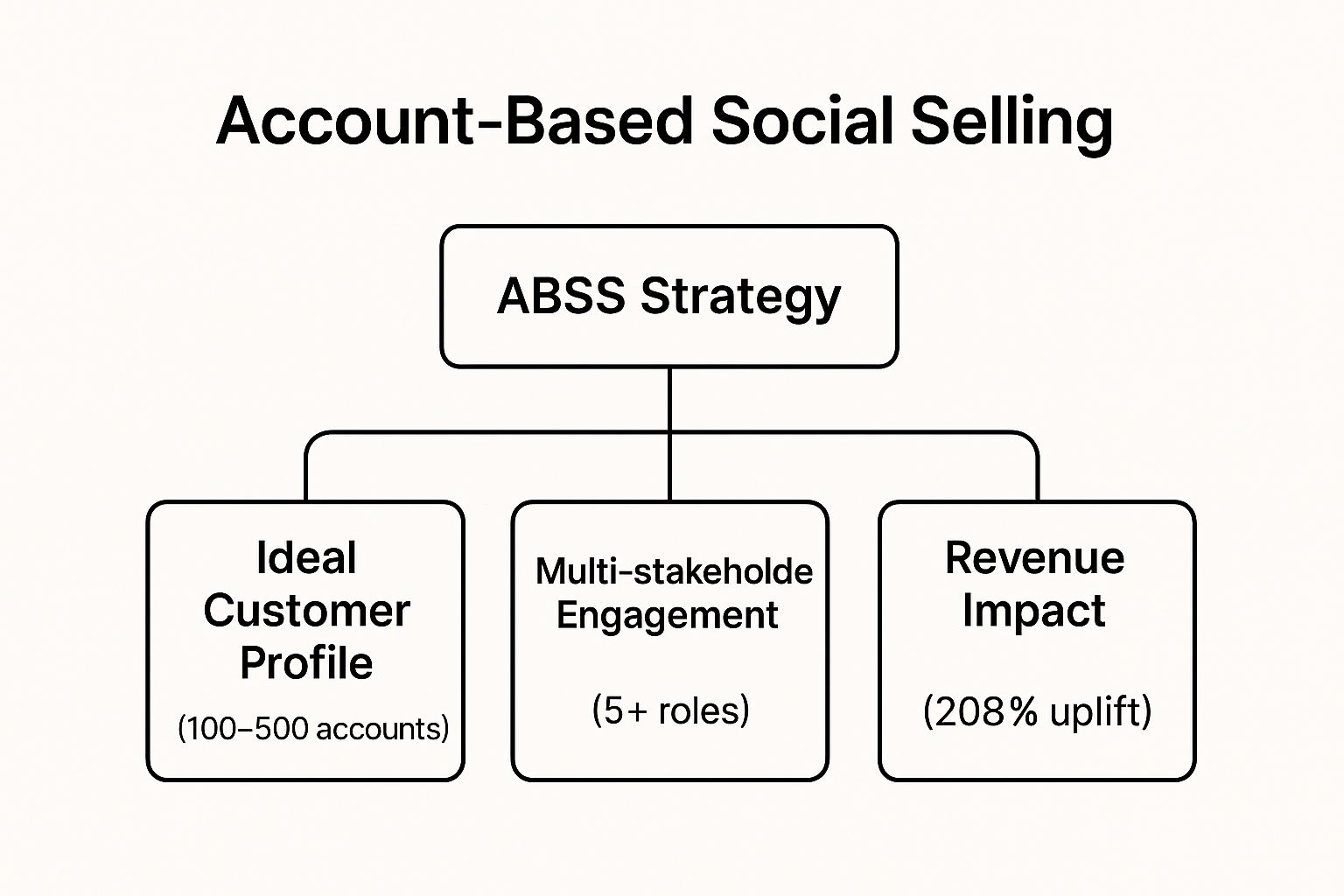
This visualization highlights how a focused list of target accounts, combined with deep multi-stakeholder engagement, can produce significant revenue growth.
Actionable Steps for Implementation:
- Define Your Ideal Customer Profile (ICP): Create a detailed profile of your perfect customer and build a focused target account list (typically 100-500 companies).
- Map the Buying Committee: Use tools like LinkedIn Sales Navigator to identify all key decision-makers and influencers within each target account.
- Monitor Account Triggers: Set up alerts for key events like funding rounds, new executive hires, or company expansion announcements, which signal opportune moments to engage.
- Coordinate Engagement Cadence: Align sales and marketing efforts to ensure a consistent, non-intrusive flow of communication across all social touchpoints, tracked within your CRM.
7. Leverage Social Proof and User-Generated Content
Instead of making claims about your product, let your satisfied customers do the talking. This strategy leverages authentic testimonials, reviews, and user-generated content (UGC) to build credibility and trust. By showcasing real people loving your products, you replace the hard sell with powerful, third-party validation that speaks directly to potential buyers. This approach dramatically reduces skepticism, making your brand more relatable and purchase decisions easier for new customers.
How to Implement a Social Proof Strategy
This method transforms your customer base into your most effective sales team. The goal is to systematically collect and amplify positive customer experiences, creating a continuous loop of trust that fuels growth. For social selling, this is incredibly potent because it provides instant, visual proof of product quality and customer satisfaction right within the social feed, where purchase decisions are often made impulsively.
A brand like Glossier built its empire on this concept, encouraging customers to share their authentic, unedited photos using its products. They repost this UGC, creating a "Wall of Love" that feels more like a community movement than a marketing campaign. This makes prospective buyers feel they are joining a tribe, not just buying a product.
Actionable Steps for Implementation:
- Create a Branded Hashtag: Establish a unique and easy-to-remember hashtag (e.g., #MyBrandStory) and promote it in your bio, packaging, and posts to encourage customers to share their content.
- Prioritize Video Testimonials: Actively request short video reviews from happy customers, as they often outperform text-based reviews. Offer a small incentive, like a discount on their next purchase, for their time.
- Systematize Review Collection: Use automated email or message flows to ask for a review shortly after a customer receives their order. Make the process as simple as possible with direct links.
- Repurpose and Amplify: Turn positive text reviews and customer quotes into visually appealing graphics to share on your feed and in your stories. Always tag the original customer (with permission) to show appreciation and expand reach.
8. Social Selling Through Communities and Groups
This strategy moves beyond your own profile and involves embedding your brand within established online communities like Facebook Groups, Slack channels, and industry forums. Instead of broadcasting messages, you engage in conversations, answer questions, and provide genuine value to members. The goal is to build a reputation as a trusted expert and helpful resource, not as a salesperson. Over time, this credibility naturally converts into sales as community members seek you out when they have a problem your product can solve.
How to Implement a Community-Based Selling Strategy
This approach is about building relationships and social capital within a niche. By consistently showing up and helping others, you position your brand as an integral part of the community fabric. This is one of the most effective social selling strategies for generating high-trust leads, as referrals and inquiries come from a place of established authority. The key is to prioritize giving value far more than you ask for anything in return.
For instance, a brand selling ergonomic office furniture could join a "Work From Home Professionals" Facebook Group. Instead of posting product links, they would answer questions about preventing back pain, share tips for creating a productive workspace, and comment thoughtfully on others' posts. When a member eventually asks for recommendations on a new office chair, the brand is already the most trusted and obvious authority to turn to for advice and a purchase.
Actionable Steps for Implementation:
- Identify Relevant Hubs: Find 3-5 active communities on platforms like Facebook, LinkedIn, or Slack where your ideal customers congregate.
- Follow the 80/20 Rule: Dedicate 80% of your activity to helping, answering questions, and sharing non-promotional resources. Reserve just 20% for any self-promotion, which should feel natural and relevant.
- Search for Opportunities: Use keywords related to your customers' pain points to find conversations where you can provide expert advice.
- Optimize Your Profile: Ensure your personal or brand profile in the community subtly explains what you do, so members who appreciate your contributions can easily learn more about your business.
9. Direct Message (DM) Relationship Selling
This strategy shifts the focus from public broadcasts to intimate, one-on-one conversations within direct messages. Instead of mass outreach, it emphasizes building genuine relationships with high-value prospects, creators, or partners through personalized, human-centric dialogue. The goal is to nurture connections over time, establishing trust before ever introducing a sales pitch. This method transforms your DMs from a simple inbox into a powerful relationship-building engine, ideal for high-ticket sales or strategic partnerships.
How to Implement a DM Relationship Selling Strategy
This approach treats DMs as the start of a conversation, not a transaction. By leading with personalization and value, you stand out from the automated spam that floods most inboxes. This is one of the most effective social selling strategies for building deep, meaningful business connections that lead to long-term loyalty and high-value conversions. It’s about being a human first and a seller second.
For example, a TikTok Shop brand looking to partner with a major creator wouldn't just send a generic "let's collab" message. Instead, they would reference a specific video the creator posted, offer a genuine compliment on their content style, and ask a thoughtful question related to their niche. This opens a natural dialogue, making the eventual partnership proposal feel like a mutually beneficial idea rather than a cold solicitation.
Actionable Steps for Implementation:
- Research Before Reaching Out: Thoroughly review a prospect's profile. Note their recent content, shared connections, or stated interests to use as a personalized conversation starter.
- Lead with Value, Not a Pitch: Your first message should never be a sales pitch. Instead, offer a genuine compliment, share a relevant insight, or ask an open-ended question based on your research. Keep it concise, ideally under 100 words.
- Use Conversational Frameworks: Avoid generic templates. Create personalized frameworks that allow for customization while maintaining a consistent approach. Focus on asking questions to understand their needs rather than making statements about your product.
10. Influencer and Referral Partnership Selling
Instead of relying solely on cold outreach, this strategy leverages the trust and reach of others to generate warm leads. It involves building relationships with industry influencers, complementary brands, and existing customers who can provide endorsements or direct introductions. This transforms your sales process from a monologue into a community-driven conversation, where trusted voices advocate for your brand. By nurturing these partnerships, you tap into pre-qualified audiences who are more likely to convert.
How to Implement Influencer and Referral Partnerships
This approach is about borrowing credibility to build your own. Rather than shouting into the void, you find partners who are already trusted by your ideal customer and collaborate with them. It’s one of the most effective social selling strategies because it bypasses initial skepticism and starts the customer relationship from a place of trust.
For example, a brand selling ergonomic office chairs could partner with a popular productivity influencer on TikTok. The influencer could create content about setting up the perfect WFH space, naturally featuring and recommending the chair. Similarly, the brand could create a referral program that rewards existing customers with a discount for every new customer they bring in, turning happy buyers into a powerful, decentralized sales force.
Actionable Steps for Implementation:
- Identify Micro-Influencers: Focus on creators with 10K-100K followers who have a highly engaged, niche audience. Their recommendations often feel more authentic. Use a dedicated tool to find the right partners with a creator tracker.
- Create a Formal Referral Program: Establish clear incentives, such as cash rewards, store credit, or exclusive products. Make it easy for customers to share with pre-made templates and unique referral links.
- Co-Create Valuable Content: Partner with complementary brands or experts to host a joint TikTok LIVE, create a collaborative guide, or run a giveaway. This exposes both brands to new, relevant audiences.
Top 10 Social Selling Strategies Comparison
| Strategy | Implementation Complexity 🔄 | Resource Requirements ⚡ | Expected Outcomes 📊 | Ideal Use Cases 💡 | Key Advantages ⭐ |
|---|---|---|---|---|---|
| LinkedIn Social Selling | Medium - requires Sales Navigator and relationship building | High - subscription costs and time-intensive | High engagement; increased qualified leads and pipeline growth | B2B sales pros targeting decision-makers in medium to large companies | Professional context boosts natural conversations |
| Employee Advocacy Programs | Medium to High - training, content curation, and ongoing management | Medium - platforms/tools plus employee time | Amplified brand reach; higher engagement and click-through | Medium to large organizations wanting authentic brand amplification | Humanizes brand via trusted employee voices |
| Content-First Social Selling | High - consistent content creation and SEO efforts | High - skills and time for quality content | Long-term pipeline growth; establishes thought leadership | Sales pros focused on building personal brand and long-term trust | Builds credibility and attracts inbound leads |
| Social Listening & Trigger Outreach | Medium - setup of monitoring tools and timely responses | Medium to High - monitoring tools and staff | Highly relevant outreach; intercepts active buyers | Teams with target accounts monitoring specific buying signals | Timely, contextual engagement increases effectiveness |
| Video Social Selling | Medium to High - video production skills and equipment | Medium to High - filming, editing tools, and on-camera comfort | Strong trust; higher engagement rates; enhanced memorability | Sales pros comfortable on camera aiming for standout engagement | Video content favored by algorithms and buyers |
| Account-Based Social Selling (ABSS) | High - extensive coordination and alignment | High - multi-team collaboration and tech stack | Higher conversion on strategic accounts; shorter sales cycles | B2B teams selling complex solutions to enterprise accounts | Multi-stakeholder approach improves deal success |
| Social Proof & User-Generated Content | Medium - content collection and curation | Medium - time to gather and manage UGC | Builds trust; reduces buyer skepticism; enhances brand credibility | Companies with satisfied customer base willing to advocate | Peer recommendations are highly trusted |
| Social Selling Through Communities & Groups | Medium to High - consistent community engagement | Medium - time investment over long term | Builds trust; warm introductions; indirect, long-term sales impact | Sales pros with expertise for niche markets and patience | Access to concentrated, engaged audiences |
| Direct Message (DM) Relationship Selling | Medium - very personalized approach, non-scalable | Medium - time per prospect, minimal tech needed | High open/response rates; deep relationships; natural engagement | Sales pros handling high-value prospects with personalized outreach | Feels personal, less intrusive than cold calls |
| Influencer & Referral Partnership Selling | Medium to High - relationship building and program management | Medium - ongoing relationship nurturing and incentives | Warm leads with high conversion; extended network reach | Teams leveraging trusted industry influencers and referral networks | Warm introductions boost conversion |
From Strategy to System: Your Path to Scalable Growth
The journey through the world of social selling reveals a powerful truth: success isn't about finding a single magic bullet, but about building a cohesive, multi-faceted engine for growth. We've explored a diverse set of high-impact social selling strategies, from leveraging the professional authority of LinkedIn and amplifying reach through employee advocacy to building genuine connections within niche communities and mastering the art of the DM. Each tactic, whether it's content-first selling, harnessing social proof, or executing precise account-based campaigns, offers a unique pathway to connect with your audience and drive conversions.
The common thread weaving these strategies together is the shift from passive presence to proactive engagement. Waiting for customers to find you is no longer a viable plan. Modern e-commerce, especially on a dynamic platform like TikTok, rewards brands that listen, interact, and build genuine relationships at scale. The strategies outlined in this article provide the blueprint for doing just that, transforming your social channels from simple marketing outlets into powerful, direct-sales platforms.
Synthesizing Your Social Selling Playbook
The ultimate goal is to move beyond isolated tactics and create a repeatable, scalable system. Your brand's unique social selling playbook will likely integrate several of the approaches we've discussed. For example, your influencer partnership program can be fueled by insights from social listening, while the user-generated content you collect can be repurposed for your account-based selling efforts.
Remember these core principles as you build your system:
- Authenticity Over Automation: While tools are essential for scale, the core of your outreach must remain human and authentic. Personalize your communication and focus on adding value before asking for a sale.
- Data is Your Compass: Don't just execute; measure, analyze, and optimize. Track which strategies deliver the highest ROI, which creators drive the most profitable sales, and which content resonates most deeply with your target audience.
- Consistency is Key: Social selling is a marathon, not a sprint. Building relationships, establishing trust, and nurturing communities require consistent effort over time. Sporadic campaigns will yield sporadic results.
The Future is a System, Not a Strategy
Ultimately, the brands that win on TikTok and beyond will be those that successfully bridge the gap between brilliant social selling strategies and efficient, data-driven execution. The difference between a brand that struggles to grow and one that achieves exponential scale often comes down to the operational system underpinning its efforts. By implementing a structured approach to creator partnerships, automating tedious outreach, and maintaining a clear view of your performance data, you create a formidable competitive advantage. This systematic approach allows you to not only execute your current strategy flawlessly but also to adapt and evolve as the social commerce landscape changes. You are no longer just selling; you are building a predictable, scalable, and resilient growth engine.
Ready to transform your social selling strategies from manual tasks into a scalable, automated system? HiveHQ is the all-in-one platform designed for TikTok Shop brands to discover creators, manage affiliate partnerships, and track profitability with precision. Book a demo with HiveHQ today and build the operating system for your social commerce growth.