Your Guide to Software Affiliate Programs

software affiliate programsaffiliate marketingsaas growthcreator partnershipsmarketing automation
Think of it this way: what if you had a dedicated sales team that you only paid after they made a sale? That's the powerful idea behind software affiliate programs. It’s a performance-based partnership where brands reward creators for bringing in new customers, making it an incredibly smart way for SaaS and e-commerce companies to grow.
What Are Software Affiliate Programs

At its core, a software affiliate program is a structured partnership. You give creators, bloggers, or influencers special tracking links. When someone in their audience clicks that link and buys your software or signs up for your service, the creator earns a commission. It's a classic win-win built on genuine promotion.
It’s like commissioning an artist. You could pay them a flat fee for a painting and just hope it sells. Or, you could agree to pay them a percentage only when the painting is actually purchased. This performance-based model gets rid of the upfront financial risk and ties your marketing budget directly to real revenue.
It's no surprise that these programs have become so popular. Over 80% of companies now rely on affiliate marketing as a major growth channel. In the tech world, this is even more pronounced—more than 75% of SaaS marketers use dedicated affiliate platforms for better tracking and management. You can dive deeper into the rise of affiliate marketing in SaaS and other industries to see just how big this has become.
The Modern Growth Engine
Let's be honest, traditional advertising can feel like shouting into a void and hoping the right people hear you. Software affiliate programs are the exact opposite. They work through trusted voices who have already built a real connection with a specific audience. When a creator someone follows recommends a tool, that recommendation comes with built-in credibility.
This is a fundamental shift from interruption-based ads to trust-based recommendations, and it’s why these programs work so well. It’s not just about getting clicks; it's about bringing in customers who are already interested and feel good about their decision to buy.
A strong software affiliate program transforms your most passionate users and advocates into a scalable, performance-driven sales force. It’s about building relationships that drive revenue, not just running ads.
Core Benefits For Your Brand
So, what makes this channel a must-have for software and e-commerce brands today? The benefits are about more than just boosting sales; they create a powerful cycle of growth and brand validation. The table below breaks down the key advantages you can expect.
Key Benefits of a Software Affiliate Program
| Benefit | Description | Impact on Your Brand |
|---|---|---|
| Cost-Effective Acquisition | You only pay for successful conversions (sales or sign-ups). | Your customer acquisition cost (CAC) becomes predictable and directly tied to results, making budgeting much easier. |
| Authentic Brand Advocacy | Creators promote your product in their own voice, creating genuine content that connects with their audience. | You get relatable, trustworthy marketing that resonates far better than a traditional corporate ad. |
| Targeted Audience Reach | Partnering with niche creators gives you a direct line to a highly relevant and engaged community. | Your marketing message lands exactly where it needs to, without wasted spend on uninterested audiences. |
| Increased Social Proof | When multiple trusted creators endorse your software, it builds powerful social proof and cements your reputation. | Your brand is seen as a credible, go-to solution in your market, building confidence among potential buyers. |
Ultimately, investing in a well-structured affiliate program means you're not just buying ads; you're building a network of advocates who are genuinely invested in your success because it’s tied to their own.
Understanding The Core Program Components
Think of your affiliate program as an engine built for acceleration. Each component must mesh perfectly to convert every effort into forward momentum.
At the heart of this engine lies your commission model—it’s the fuel that attracts high-quality partners and keeps them motivated. Choosing the right structure often comes down to one question: do you offer a one-off license or a subscription service?
Crafting Your Commission Model
In software affiliate programs, two commission structures dominate: one-time payments and recurring revenue.
- One-Time Commission: A single fixed percentage or flat fee for each new customer. Affiliates love the clarity and immediate reward—ideal for high-ticket software or lifetime licenses.
- Recurring Commission: A percentage of every subscription payment while the customer stays active. This aligns affiliates with your goal of low churn and strong customer lifetime value.
SaaS affiliate programs frequently pay between 20% to 70% of the sale value, which far outpaces retail or travel rates of 5% to 15%. For further insights, check out SaaS affiliate marketing statistics on wecantrack.com.
Your commission structure is more than just a payment plan; it’s a strategic message. A generous recurring model says, “We’re in this for the long haul, and we want partners who will grow with us.”
Measuring What Truly Matters
After locking in your commission approach, you need precise performance metrics. Raw sales figures only tell part of the story—key performance indicators (KPIs) reveal what’s really working.
Think of these metrics as your program’s dashboard, guiding you toward smarter decisions and greater profitability.
- Conversion Rate: The percentage of clicks that lead to a trial sign-up or purchase. A high rate signals that an affiliate’s audience is a perfect match for your software.
- Click-Through Rate (CTR): The ratio of clicks to impressions. A strong CTR shows that the affiliate’s content resonates and drives interest.
- Affiliate Lifetime Value (LTV): The total revenue one affiliate generates over time. Tracking LTV highlights your most valuable, long-term partners.
Building The Operational Framework
A winning commission model and clear KPIs still need a rock-solid operational foundation. This framework keeps your program compliant and builds trust with every partner.
At its core is a detailed Affiliate Agreement. This rulebook lays out commission rates, payment terms, cookie duration, and promotional guidelines so everyone knows the ground rules from day one.
Next, address FTC disclosure guidelines. It’s your duty to supply affiliates with the correct phrasing—terms like #ad or #sponsored—ensuring transparency with their audience.
Finally, establish a reliable payment system. Whether you use a dedicated affiliate platform or handle payments in-house, on-time and accurate payouts are the single best way to nurture long-lasting relationships.
Your Step-by-Step Implementation Checklist
Ready to build your own software affiliate program? It can feel like a huge project, but when you break it down into manageable steps, it's far less intimidating. Think of it like assembling a new piece of furniture—you just need a good set of instructions to follow.
This guide is your blueprint. Follow it step-by-step, and you’ll move from a rough idea to a fully functioning program with confidence, making sure you don't miss any crucial details along the way.
Stage 1: Define Your Program Goals
Before you write a single line of code or recruit a single creator, you have to know what you're aiming for. A vague goal like "get more sales" isn't going to cut it. You need specific, measurable targets that will anchor every decision you make from here on out.
Start by asking the right questions:
- What’s our number one objective here? Are we trying to hit a certain number of new customers? Break into a new market? Or maybe just drive sign-ups for a brand-new feature?
- What’s our target Customer Acquisition Cost (CAC)? Knowing this number is critical. It helps you build a commission plan that’s both generous enough to attract great partners and profitable for your business.
- How does this fit with our other marketing? Think about how your affiliates will work alongside your existing paid ads, SEO, and content strategies. They should complement each other, not compete.
Getting these benchmarks sorted out first means you're building your program on a solid foundation, not just hoping for the best.
Stage 2: Design a Competitive Commission Structure
Your commission structure is the engine of your program. It’s what gets top-tier partners in the door and keeps them motivated to perform. Get it wrong, and you'll struggle to attract anyone worthwhile. Get it right, and it becomes one of your most powerful recruiting tools.
For SaaS and other subscription software, recurring commissions are the way to go. A typical rate is 20-40% of the monthly payment for as long as the customer stays subscribed. This model is a win-win: it ties the affiliate's success directly to yours and incentivizes them to find loyal customers who stick around. If you’re selling software as a one-time purchase, a bigger, one-off payout of 30-70% usually makes more sense.
Your commission isn't just a number. It's a signal to your potential partners about how much you value what they bring to the table.
Stage 3: Choose the Right Affiliate Platform
Your affiliate platform is the central nervous system for your entire program. It’s where everything happens—tracking clicks and sales, handling payouts, and communicating with your partners. Trying to jury-rig this with a bunch of spreadsheets is a nightmare waiting to happen, full of errors and broken trust.
When you’re looking at platforms, make sure they have the essentials:
- Rock-Solid Tracking: The system has to be able to accurately attribute sales, whether they come from a unique link or a coupon code. No exceptions.
- Clear Dashboards: Both you and your affiliates need an easy way to see what’s working in real-time. The data should be simple to understand at a glance.
- Automated Payouts: A smooth, automated payment process is non-negotiable. It’s the key to keeping your partners happy and ensuring they get paid on time, every time.
- Creator Management Tools: As you grow, you'll need features that help you onboard, communicate with, and manage your network of creators.
Picking a powerful platform from day one will save you from a world of administrative pain later on.
Stage 4: Create an Affiliate Resource Center
Finally, set your affiliates up for success by giving them everything they need to win. A well-organized resource center is like handing your sales team a complete playbook. It removes guesswork and makes sure all their promotions are on-brand and effective.
Your resource library should be stocked with:
- Brand Guidelines: Simple, clear rules on how to use your logo, what your brand voice sounds like, and the key messages you want them to share.
- Marketing Assets: A ready-to-go collection of approved banners, social media graphics, email templates, and product screenshots.
- Product Cheat Sheets: Detailed feature lists, common use cases, and descriptions of your ideal customer to help them create content that truly connects.
By providing these materials, you make it incredibly easy for creators to promote your software authentically and well. This not only drives their performance but also protects the integrity of your brand.
Finding and Working With the Right Creators
Your software affiliate program is only as good as the people in it. You can have the best platform and the most generous commissions, but without the right partners, it’s just a passive income stream. The real growth engine kicks in when you find, vet, and build genuine relationships with high-impact creators.
Think of it like being a talent scout for a band. You don't just need a guitarist; you need a guitarist whose style fits your sound. In the affiliate world, this means finding creators whose audience and content are a perfect match for your ideal customer.
How to Pinpoint Your Ideal Affiliate Partners
First thing's first: forget about follower counts. A creator with 10,000 deeply engaged followers in your niche is worth a hundred times more than someone with a million generic fans. Your mission is to find the people who have already earned the trust of the audience you want to reach.
Here’s where to start looking:
- Platform Deep Dives: Search hashtags and keywords on TikTok, Instagram, and YouTube. Think like your customer. What terms would they use? (e.g., #productivityhacks, #smallbusinesstools).
- Friendly Competitor Analysis: Check out who is promoting similar, non-competing software. If a creator is already talking about tools in your space, their audience is primed and ready.
- Ask Your Own Customers: Who do your current users follow for advice in your industry? A simple survey can give you a direct pipeline to influencers who are already trusted by your target market.
Once you have a shortlist, it's time to vet them. Dig into their content. Is it authentic? Are the comments real conversations, or just spam? You’re looking for a creator who genuinely solves problems for their audience—that’s the partner who will drive real results.
Building Relationships That Actually Last
Bringing on a new affiliate shouldn't feel like a one-and-done transaction. If you want loyalty and consistent performance, you have to treat them like real partners, not just another sales channel. This is what turns a one-off promo into a long-term collaboration.
This relationship-first approach is especially vital in the SaaS world. There's a reason SaaS affiliate marketing has become a top acquisition strategy, with 54% of SaaS marketers ranking it among their top three methods. It’s because it works—a massive 70% of SaaS conversions come from affiliate-driven traffic, proving just how powerful a trusted recommendation can be. You can learn more about these affiliate marketing findings and see why strong partnerships are non-negotiable.
Your best affiliates aren't just marketers; they are an extension of your brand. Empower them with support, resources, and transparency, and they will become your most effective advocates.
To build these kinds of powerful relationships, you need to provide consistent value. That means a dedicated person they can talk to, solid product training so they know your software inside and out, and total transparency on performance data. When creators feel seen and supported, their promotions become infinitely more authentic and effective.
Managing and Empowering Your Network
Great management isn’t about micromanaging; it's about empowerment. Your job is to give creators the tools and info they need to succeed while letting their own unique voice do the heavy lifting.
Here’s how to empower your network:
- Give Them a Great Creative Toolkit: Arm your partners with a library of pre-approved logos, banners, product screenshots, and video clips. It keeps your brand looking sharp and saves them a ton of time.
- Share Insider Info: Give your top performers a sneak peek at new features or upcoming updates. This makes them feel valued and gives them exclusive content their audience will love.
- Keep Communication Open: Use a dedicated Slack channel, a simple email newsletter, or platform messaging to keep everyone in the loop on new campaigns, promotions, and what’s working.
- Actually Listen to Their Feedback: Your creators are on the front lines, talking directly to potential customers. Ask them what they’re hearing. Their feedback on your product and messaging is pure gold.
When you invest in your creators' success, you’re really investing in your own. You're building a loyal, motivated network that drives authentic, sustainable growth for your brand.
How to Automate and Scale Your Affiliate Operations
When your software affiliate program starts taking off, the manual tasks that were once a breeze can quickly spiral into a full-time headache. Manually onboarding creators, digging through sales data, and calculating commissions one by one just isn't built for growth. The real key to scaling is moving from administrative quicksand to smart, automated systems that grow right alongside your success.
Think of automation as more than just a time-saver. It's about building a tighter, more accurate, and more professional program that truly empowers your partners. When you cut out the tedious busywork, your team is free to focus on what actually moves the needle—nurturing creator relationships and fine-tuning campaign strategy.
This map shows the entire lifecycle of a creator partnership, from that first "hello" to ongoing support, and highlights all the spots where automation can step in.
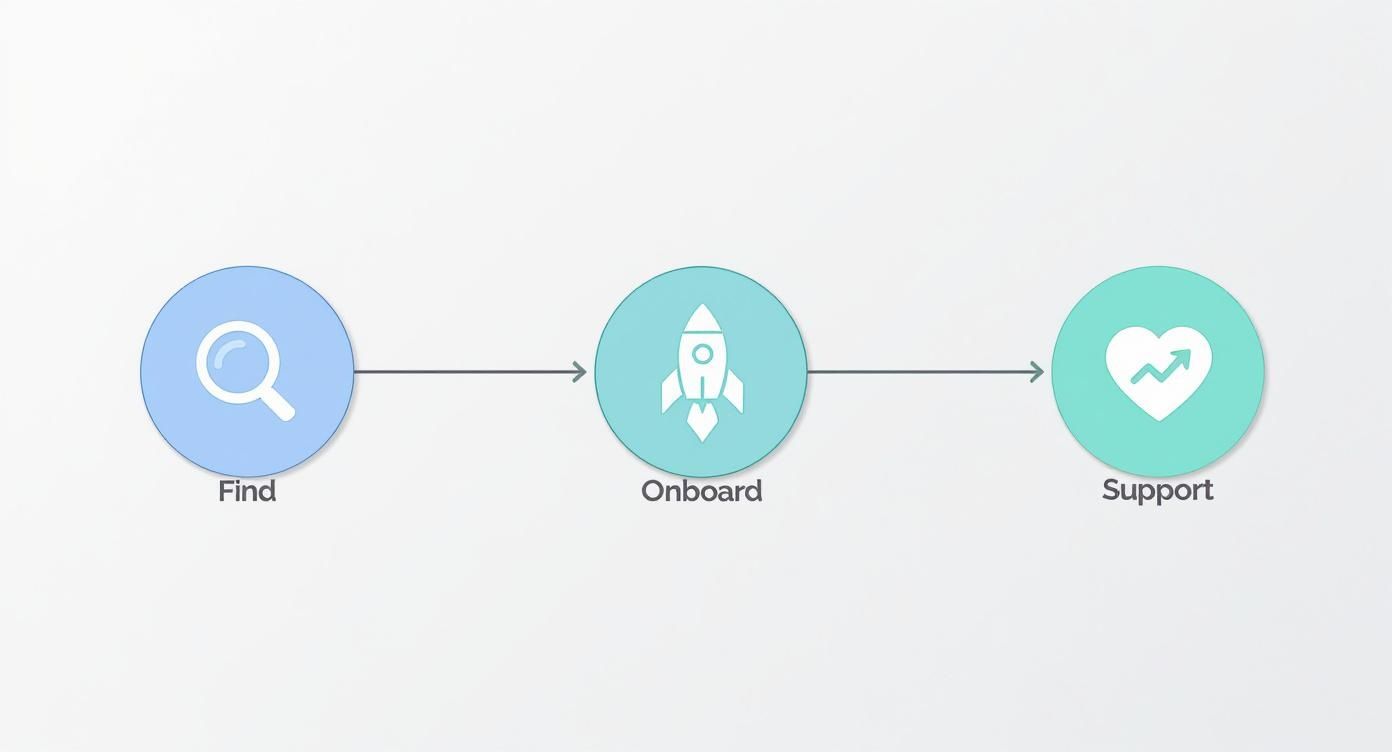
Each of these stages—finding, onboarding, and supporting—is packed with small, repeatable tasks. Automating them ensures no creator ever gets lost in the shuffle.
From Manual Grind to Automated Flow
So, where do you start? The goal is to identify the biggest time-sucks and replace them with systems that run on their own. This usually means tackling onboarding, performance tracking, and relationship management.
The table below breaks down the night-and-day difference between running a program manually versus using dedicated automation tools.
Manual vs Automated Affiliate Management
| Pain Point | Manual Approach | Automated Solution (e.g., HiveHQ) |
|---|---|---|
| Onboarding Overload | Manually sending welcome emails, tracking links, and answering the same questions over and over. | Affiliate Bot automatically sends personalized outreach, tracks sample deliveries, and distributes campaign briefs. |
| Messy Finances | Juggling multiple spreadsheets for revenue, commissions, and expenses. Prone to errors and out-of-date info. | Profit Dashboard provides a single, real-time view of GMV, commissions, and true profit margins. |
| Relationship Chaos | Losing track of conversations, performance history, and individual creator needs as the program grows. | Creator Tracker acts as a central hub, consolidating all partner data, communication logs, and performance metrics. |
As you can see, the shift isn't just about efficiency—it's about gaining clarity and control over your entire program, no matter how large it gets. Let's look at how each of these solutions works in practice.
Streamline Onboarding with an Affiliate Bot
One of the first major bottlenecks you'll hit is the endless cycle of recruiting and onboarding new creators. Sending welcome emails, sharing unique links, and answering repetitive questions eats up hours that could be spent on strategy.
An Affiliate Bot completely automates this workflow. Imagine a system that sends personalized outreach, nudges creators who just received their product sample, and delivers campaign briefs right on schedule. This is precisely what tools like the HiveHQ Affiliate Bot are built for.
By automating these first touchpoints, you give every single creator a consistent, professional experience right from the start. It sets a great tone for the partnership and gets them up and running—and promoting your software—much faster.
An automated onboarding system can handle things like:
- Sending out custom welcome messages pre-loaded with affiliate links and resources.
- Triggering reminders for creators to post after their sample has been delivered.
- Distributing campaign guidelines and creative assets automatically.
This is what it looks like in action. The bot handles the outreach and follow-ups, freeing you from being chained to your inbox.
This kind of automation lets you recruit and manage creators at a scale that’s simply out of reach with manual methods.
Replace Spreadsheets with a Real-Time Profit Dashboard
Once the sales start rolling in, trying to track revenue, commissions, and costs across a web of spreadsheets is a recipe for disaster. Data gets stuck in different places, errors creep in, and getting a straight answer on your program's profitability feels impossible. This is where a dedicated Profit Dashboard becomes a non-negotiable tool.
A real-time dashboard pulls all your critical financial data into one clear, actionable view. No more guesswork. You can see exactly which creators are bringing in the most revenue, what your actual profit margins look like after commissions and ad spend, and which campaigns are giving you the best bang for your buck.
For instance, the HiveHQ Profit Dashboard displays key metrics like Gross Merchandise Value (GMV), Cost of Goods Sold (COGS), and affiliate commissions in real-time. This lets you confidently make data-backed decisions, like doubling down on your top performers or cutting campaigns that aren't working.
Manage Relationships at Scale with a Creator Tracker
Finally, as your network grows from a handful of partners to hundreds, just keeping track of who’s who becomes a monumental task. Remembering individual performance data, conversation histories, and unique needs is a huge challenge. A Creator Tracker becomes your command center for every partner relationship.
This kind of tool, like the HiveHQ Creator Tracker, consolidates every creator's performance data—their sales contribution, posting frequency, engagement metrics, and more—all in one place. It lets you instantly spot your rising stars and identify those who might need a little extra support. By centralizing all this info, you can manage a massive network of affiliates with the same personal touch you had when you were just starting.
Common Questions About Software Affiliate Programs
Jumping into software affiliate programs always brings up a few big questions. Whether you're just getting your feet wet or trying to fine-tune a program you already have, getting straight answers is key to building a strategy that actually works—and lasts.
Let's cut through the noise and tackle the most common questions brands have. The goal here is to give you the confidence to make smart moves as you build out your network of creators.
How Much Should I Pay My Affiliates?
This is one of the first, and most important, decisions you'll make. Your commission rate directly impacts your ability to attract top-tier creators. It’s a balancing act: you need a rate that gets partners excited without gutting your own profit margins. There's no magic number, because the right rate really depends on your business model.
For SaaS products with a subscription model, a recurring commission is the gold standard. A rate of 20-40% for the lifetime of the customer's subscription is not only common but also a huge motivator. This model ties your affiliate's success directly to yours, giving them a real incentive to find loyal customers who stick around.
On the flip side, if you sell software as a one-time purchase or a lifetime deal, a single, higher payout makes more sense. These commissions usually fall in the 30% to 70% range.
To figure out your sweet spot, think about these things:
- Look at the Competition: Do some digging and see what similar software affiliate programs in your space are offering. You have to be competitive to get noticed.
- Know Your LTV: You need to know your Customer Lifetime Value. This number tells you exactly how much you can afford to spend on acquiring a new customer and still make money.
- Create Tiers: A tiered commission structure can be a game-changer. It rewards your top performers with a higher rate once they hit specific sales goals, which is a powerful way to keep them motivated.
What Is the Difference Between an Affiliate and a Referral Program?
This is a common point of confusion. While both use word-of-mouth to drive sales, they’re designed for different people and different goals. Mixing them up leads to a messy strategy, so let's clear it up.
Think of it this way: affiliate programs are for marketing at scale, while referral programs are for activating your existing customer base.
An affiliate program is a formal partnership with professional marketers, influencers, and content creators. They use their platforms and expertise to promote your software to a wide audience in exchange for a cash commission. It’s a business relationship built for broad customer acquisition.
A referral program, on the other hand, is much more informal. It’s about encouraging your happy, loyal customers to tell their friends and colleagues about your software. Instead of cash, the rewards are usually product-related, like:
- Discounts on their next subscription.
- Store credit.
- An upgrade to a better plan.
Both are incredibly valuable, but they play different roles. Affiliate programs cast a wide net to bring in new customers, while referral programs strengthen the loyalty of the ones you already have.
How Do I Track Affiliate Sales Accurately?
Rock-solid tracking is the absolute foundation of a healthy affiliate program. Your partners have to trust that every single sale they drive is credited to them, period. Without that trust, you’ll never hang on to great creators.
Thankfully, modern affiliate platforms use two main bulletproof methods for tracking:
- Unique Tracking Links: Every affiliate gets their own special URL. When someone clicks it, a small file (a cookie) is stored on their browser. If they make a purchase within a certain timeframe (the "cookie window"), that sale is automatically credited to the affiliate who sent them.
- Unique Coupon Codes: Affiliates also get a unique discount code to share. When a customer uses that code at checkout, the system instantly knows which affiliate to credit for the sale.
Using a dedicated, reliable platform for this is non-negotiable. It removes any chance of human error and gives both you and your partners a clear, real-time look at performance. That transparency is what builds the trust you need for a successful, long-term program.
What Legal Requirements Should I Know?
Getting the legal stuff right isn't just a good idea—it’s mandatory. You have to protect your business and maintain credibility. As the program manager, it’s on you to make sure everything is by the book. Two things are absolutely critical.
First, you need a comprehensive Affiliate Agreement. This is your contract. It needs to clearly spell out all the rules: commission rates, payment schedules, cookie duration, what affiliates can and can't do to promote your product, and what could get them removed from the program. It's always best to have a legal professional draft or at least review this document.
Second, you have to enforce FTC disclosure guidelines. The Federal Trade Commission requires affiliates to be transparent about their relationship with you. They must clearly state that they might earn a commission if their audience buys something. Simple hashtags like #ad or #sponsored usually do the trick. Your job is to give your affiliates clear instructions on this and to keep an eye out to make sure they're following the rules.
Ready to eliminate the guesswork and automate your affiliate operations? HiveHQ provides an all-in-one suite with a Profit Dashboard for real-time insights, an Affiliate Bot for scalable creator outreach, and a Creator Tracker to manage your partnerships effectively. Stop drowning in spreadsheets and start scaling with confidence. Discover how HiveHQ can transform your TikTok Shop affiliate program today.