Tiktok Shop Seller Requirements: Easy Guide to Get Started

tiktok shop seller requirementssell on tiktok shoptiktok ecommercetiktok for businesssocial commerce
Before you can start selling on TikTok Shop, you need to meet a few basic criteria. The main things are being over 18, living in a country where TikTok Shop is available, and having the right ID to prove who you are, whether you're selling as an individual or a business. Getting these fundamentals right is your ticket to reaching a massive audience.
Why TikTok Shop Is a Game Changer for Brands
TikTok has grown far beyond just an app for viral dance videos. It's now a serious player in e-commerce, and it's completely changing the game for how brands find customers. The magic is in its "discovery commerce" model. People aren't hunting for your products with a search bar; they're scrolling their "For You" feed and your product just appears in a video they love.
This completely flips the script for sellers. Instead of battling it out for keywords and ad placements, you can weave your products right into the culture of the platform. The numbers speak for themselves. In the United States alone, there are already more than 500,000 TikTok Shop sellers, and that figure is expected to skyrocket. This isn't just a trend; it's a fundamental shift in how people shop online. You can dive deeper into this growth on platforms like AMZScout.
The Big Advantages for New Sellers
Once you get through the door, you’ll find that TikTok Shop has some unique perks that make it a powerful sales channel, especially for new brands.
- You Tap Into a Ready-Made Audience: You don't have to spend a fortune building an audience from the ground up. TikTok's algorithm does the heavy lifting, putting your products in front of the exact people who are most likely to buy them.
- Creators Become Your Sales Team: The whole platform runs on creator energy. Partnering with influencers lets you tap into their audience's trust and get your products in front of thousands, or even millions, of engaged viewers. If you want to master this, we have a guide on finding top-notch TikTok affiliate creators.
- Shopping Without the Hassle: The best part? The entire customer journey—from seeing the product in a video to checking out—happens right inside the app. This smooth flow means fewer abandoned carts and higher conversion rates than you'd typically see on a traditional e-commerce site.
It all boils down to a simple truth: if your products show up in fun, authentic content, they're going to sell. This content-first approach is what makes TikTok Shop so different—and so effective for modern brands.
Before we dive into the nitty-gritty of the application process, here's a quick cheat sheet of what you'll need to have ready.
TikTok Shop Seller Requirements At a Glance
| Requirement Category | Key Details |
|---|---|
| Age Requirement | Must be at least 18 years old. |
| Location | Must be based in a country where TikTok Shop is officially supported. |
| Account Status | Your TikTok account must be in good standing, with no major violations. |
| Identification | Valid government-issued ID (like a driver's license or passport) for individuals, or official business registration documents for companies. |
| Bank Account | A valid bank account is required to receive payments. |
Having these items organized ahead of time will make the setup process much smoother.
Meeting the Foundational Eligibility Criteria
Before you can even think about listing your first product, TikTok needs to know who you are. Think of it like a bouncer at a club checking your ID—it's a crucial step to ensure the marketplace is safe and trustworthy for buyers and sellers alike. The platform funnels everyone down one of two paths: you're either an individual seller or a business.
Knowing which category you fit into is essential because the paperwork is different for each. This isn't just a bureaucratic hoop to jump through; it's about establishing your credibility right from the start. Nail this part, and your application process will be worlds smoother.
Key Documents for Verification
The documents you'll need to have on hand depend on whether you're signing up as a person or a company. The whole point is to prove your identity and your legal right to sell things. My advice? Get all of this gathered before you start the application to save yourself a headache later.
For individual sellers, it's pretty straightforward:
- Government-Issued ID: A passport, driver's license, or national ID card will do the trick. Just make sure the name on your ID is an exact match for the name you put on your TikTok Shop account.
- Proof of Age: You absolutely must be at least 18 years old. Your ID serves as the proof for this non-negotiable rule.
For business sellers, the checklist gets a bit longer:
- Business Registration License: This is your official proof that your company is a legally registered entity.
- Tax Identification Number: For those in the U.S., this is your Employer Identification Number (EIN). It’s critical for handling all the financial and tax stuff correctly.
- Identification of Legal Representative: You'll also need to provide the government-issued ID of the company's owner or main legal contact person.
Think of these documents as the concrete foundation for your shop. If anything is missing or incorrect, your application simply won't stand. One of the most common reasons for rejection is mismatched information, so seriously, double-check that every name and number on your forms matches what you type into the application.
The Importance of Location
Beyond having the right paperwork, your physical location is a deal-breaker. TikTok Shop isn't open for business everywhere. You have to be legally based and operating out of one of their supported countries.
Don't even think about trying to use a VPN to get around this. It's a fast-track to getting your application rejected or, worse, your account suspended later on. TikTok has plenty of ways to verify your true location, so just be upfront. Your business address, bank account, and where you ship from all need to be located within a country on their approved list.
Navigating Different Regional Requirements
Selling on TikTok Shop isn't a one-size-fits-all game. The rules that apply to a seller in the United States can be remarkably different from those in Southeast Asia. Think of it like an international playbook; what scores points in one country might be against the rules in another.
This regional variation is one of the most critical aspects of the TikTok Shop seller requirements to get your head around. A successful global strategy really hinges on adapting to each market’s specific legal and cultural landscape. Simply trying to copy and paste your U.S. approach into a market like Thailand or the Philippines is a surefire way to run into problems.
The sharpest global sellers know this and tailor their entire game plan for each new territory they enter. It means digging into local laws, understanding what customers actually want, and even tweaking marketing messages before ever going live.
United States vs. Southeast Asia: A Tale of Two Markets
The differences between major markets are stark. For instance, setting up shop in the U.S. puts a heavy emphasis on having a registered business entity, a federal Employer Identification Number (EIN), and a U.S.-based address for all your operations.
In contrast, markets across Southeast Asia (SEA) often have different structures for individual sellers versus incorporated businesses. The paperwork you need, your tax obligations, and even the types of products you’re allowed to sell can change dramatically from one country to the next, even within the same region.
Here’s a quick breakdown of what that looks like:
- Business Registration: The U.S. is pretty strict about formal business documents (like from an LLC or corporation). Some SEA countries, however, might offer more flexible paths for individual entrepreneurs or sole proprietors to get started.
- Product Approvals: Certain product categories, like beauty or health supplements, can face much tougher regulatory hurdles in one region compared to another. Something that gets a quick approval in the UK might need extensive lab testing and certification to be sold in Malaysia.
- Marketing and Content: Cultural norms around advertising are vastly different. A direct, hard-sell approach that works well in the West could fall flat in markets where building relationships and using subtler influence are more effective.
The key takeaway is this: Treat each region as a unique launch. A deep dive into local requirements isn't just a good idea; it's essential for avoiding compliance headaches and actually connecting with a new audience.
Why Southeast Asia Is a Key Focus
The explosive growth in Southeast Asia really drives home why this regional knowledge is so important. This area has quickly become the platform's most vibrant market. For instance, Thailand is currently leading global TikTok Shop sales with a staggering $512.79 million, followed closely by the Philippines at $500.51 million. You can find more fascinating insights on this trend over at MarketMaze.me.
These numbers don't lie. Understanding the specific TikTok Shop seller requirements for these high-growth areas gives you a massive competitive edge. The sellers who take the time to master the local rules are the ones who will capture the biggest slice of this booming e-commerce pie.
Understanding Product and Category Rules
When you're starting out in e-commerce, it's easy to think, "If I can get my hands on it, I can sell it." But that's not how things work on TikTok Shop. The platform has its own, much stricter, set of rules.
Just because something is flying off the shelves on Amazon or Shopify doesn't mean it will even be allowed in the TikTok marketplace. This is a crucial part of the TikTok Shop seller requirements that trips up a lot of new sellers. Think of TikTok Shop less like a flea market and more like a carefully curated mall—they're very protective of their community and brand, which means setting firm boundaries on what gets sold.
This isn't like other, more open marketplaces. Ignoring these rules is the fast track to getting your products delisted, your selling privileges frozen, or even your entire account shut down for good.
Prohibited vs. Restricted: What Is the Difference?
You absolutely need to get this part right. There’s a huge difference between products that are completely banned (prohibited) and those that just need a little extra paperwork (restricted). Mixing them up can wreck your inventory plans.
Prohibited Products: These are a hard no. You can't sell them, period. This list includes the obvious stuff like weapons, illegal substances, and counterfeit items, but it also covers things you might not expect, like most adult products or politically charged merchandise. There's no way to get approval for these.
Restricted Products: These aren't banned, but you have to jump through some hoops to sell them. Think of categories like certain types of jewelry, pre-owned luxury goods, or beauty products that make specific claims. You'll need to submit extra documents and get the green light from TikTok before you can list them.
The logic behind this is all about managing risk. TikTok flat-out bans anything that poses a clear legal or safety threat. Restricted categories, on the other hand, are for products that are a bit more complex and need extra verification to prove they're safe and authentic.
To help you see where some common items fall, here’s a quick comparison of products that are often prohibited versus those that are simply restricted.
Common Prohibited vs Restricted Product Categories
| Product Type Example | Prohibited (Not Allowed) | Restricted (Requires Approval) |
|---|---|---|
| Beauty & Personal Care | Products making unverified medical claims | Skincare with specific active ingredients |
| Electronics | Hacking or surveillance equipment | Refurbished electronics from certified vendors |
| Fashion & Accessories | Counterfeit designer bags | Pre-owned, authenticated luxury watches |
| Collectibles | Nazi memorabilia | Historical coins and currency |
| Supplements | Weight loss pills with banned substances | Vitamins and dietary supplements |
This table isn't exhaustive, but it gives you a good feel for the kinds of distinctions TikTok Shop makes. Always double-check the official guidelines for your specific product.
This infographic also shows how your seller tier—which is based on your account's performance—can affect what you're eligible to sell.
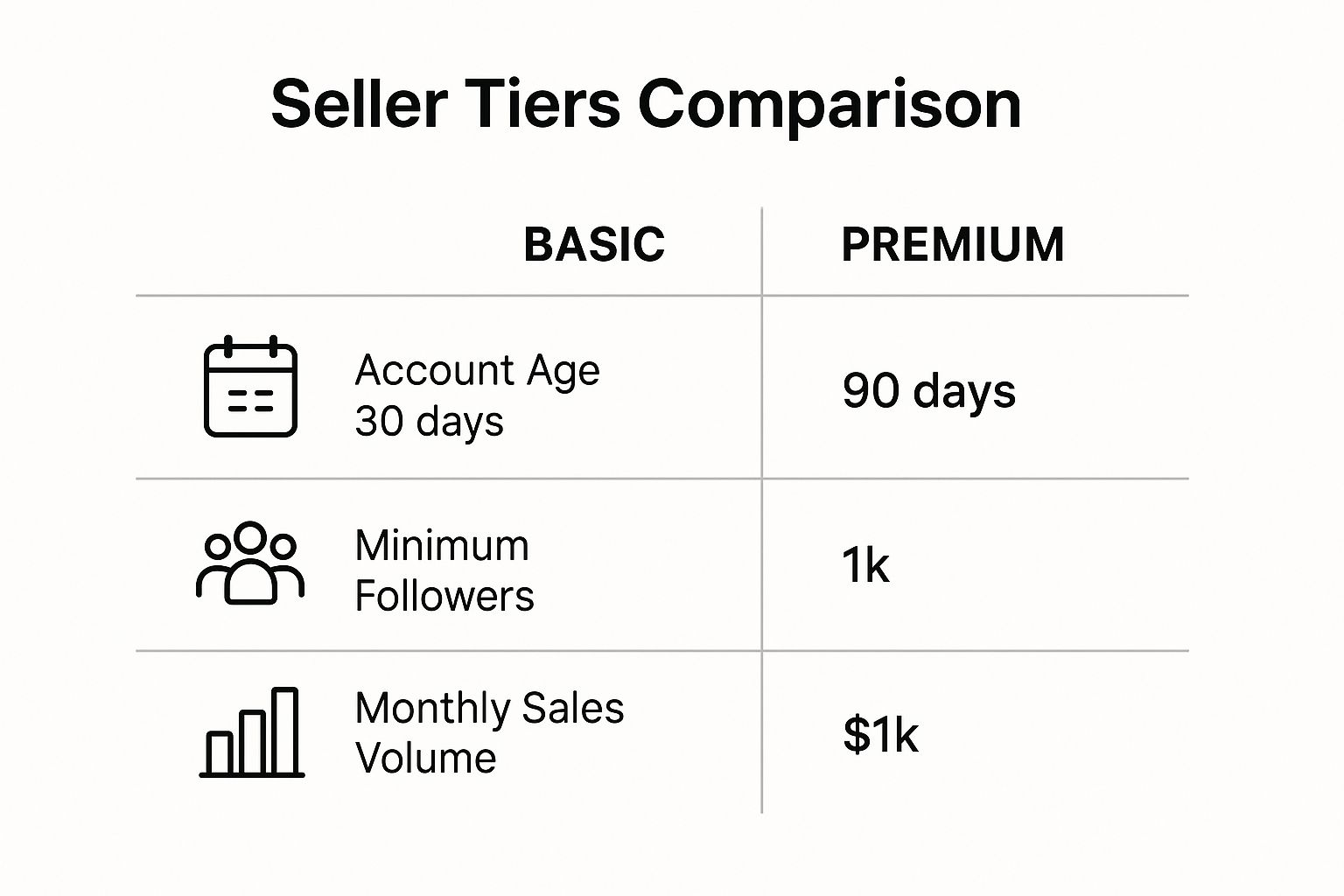
As you can see, leveling up as a seller doesn't just come with perks; it often unlocks the ability to apply for those more complex, restricted categories. A proven track record shows TikTok you can be trusted.
How to Stay Compliant
Staying on the right side of the rules isn't about memorizing every single item on a list. It’s about being proactive.
Before you ever spend a dime on a new product line, your first stop should be the official TikTok Shop Seller Center. The guidelines change, so you need to check the most current version of the prohibited and restricted lists.
If you have a product that seems like it's in a gray area, don't just hope for the best. The smart move is to contact TikTok Shop support and ask for clarification before you list anything. A few minutes of due diligence upfront can save you from a massive headache and protect your account's standing for the long haul.
Mastering the Unwritten Rules of Content
Getting approved to sell on TikTok Shop is just the first step. That's the price of admission. If you really want to succeed, you have to master the unwritten rules of content and community on a platform where being a seller is the same thing as being a creator.
Think of the "For You" page as a fast-moving river of pure entertainment. A boring, static product listing is like a rock sitting on the riverbank—people just flow right past it. Your raft—the thing that lets you ride that current and get seen by millions—is authentic, engaging video content. This is the whole idea behind TikTok's "discovery commerce" model.
On TikTok, you don't just list products. You tell stories that happen to sell things. That means you have to show up consistently.
From Seller to Storyteller
The brands that absolutely crush it on TikTok Shop act more like media companies than traditional retailers. They get that every single video is a chance to connect with a viewer, not just shove a product in their face. This mindset shift is everything if you want to build a lasting business here.
Your content plan needs to be a mix of different formats, all designed to grab attention and, ultimately, drive sales.
- Shoppable Videos: These are your bread and butter. You embed product links directly into your organic, short-form videos. Think unboxings, tutorials, or behind-the-scenes glimpses that make your products feel like a natural part of the feed, not some jarring ad.
- LIVE Shopping: Livestreams are basically your digital QVC channel. They create a powerful sense of real-time urgency and let you demo products, answer questions on the fly, and connect with your audience on a much more personal level. A good LIVE session can literally generate thousands in sales in just an hour or two.
- Jumping on Trends: Using popular sounds and participating in viral trends is your shortcut to getting the algorithm to notice you. It's an incredible way to boost your visibility without spending a dime on ads.
The TikTok algorithm is simple: it rewards content that keeps people on the app. Your job is to make videos so entertaining that people almost forget they're being sold to. The sale just becomes the natural next step after the value and entertainment you've provided.
The Power of an Engaged Audience
Just posting videos into the void won't cut it. You have to actively build a community. This is where the platform's absolutely massive user base becomes your greatest asset. We're talking over a billion people globally, and about 58% of TikTok users actually buy stuff they see on the platform. In the U.S. alone, that's around 70 million shoppers making impulse buys after a compelling video catches their eye. If you want a piece of that action, your content has to resonate. Learn more about these TikTok shopping statistics.
This means you're in the comments, replying to people. It means you're collaborating with other creators and showing the real, human side of your brand. When your followers feel like you actually see and hear them, they're infinitely more likely to become die-hard customers. Your videos also need to grab attention from the very first second. For more on this, check out our guide on the top hooks and CTAs for your content.
At the end of the day, learning these unwritten rules is what separates the shops that fizzle out from the ones that truly scale.
So, you got your shop approved. Congratulations! But don't pop the champagne just yet—that was the easy part. The real work begins now: keeping your account in good standing with TikTok.
Think of your seller account's health like a credit score. Every move you make, from shipping an order on time to handling a customer complaint, either boosts it or brings it down. This "score" directly affects how often TikTok shows your products to potential buyers and can even determine if you get to keep selling at all.
TikTok is constantly watching a few key metrics to see if you’re a reliable seller. Staying on top of these isn't just a suggestion; it’s a core part of the TikTok Shop seller requirements. If your numbers slip, you could find your products buried by the algorithm or, even worse, wake up to a suspended account.
Key Metrics to Monitor
The best way to avoid trouble is to be proactive. Treat these metrics like your shop's daily health check-up. Catching a small issue before it snowballs is the secret to staying in the green.
- Late Dispatch Rate (LDR): This is simple: how often are you shipping orders late? Your goal should be 0%. A smooth, efficient packing and shipping process is non-negotiable here.
- Seller-Fault Cancellation Rate: This tracks how many orders you have to cancel, usually because you ran out of stock. Keep your inventory numbers updated meticulously to avoid this. Nothing frustrates a buyer more than paying for something they can't have.
- Customer Satisfaction and Reviews: Bad reviews are more than just a bummer; they're a massive red flag for TikTok. Happy customers are your best defense. Go the extra mile with customer service to keep those positive reviews rolling in.
Here's a little inside baseball: Keeping your account healthy isn't just about dodging penalties. The TikTok algorithm actively rewards sellers with great stats, giving their products more visibility and a better shot at being featured on the For You Page.
Staying Compliant and Proactive
It’s not all about shipping and reviews, though. You also have to play by TikTok's rules when it comes to your content and product listings. Using a popular song you don't have the rights to or making wild, unproven claims about what your product can do is a surefire way to get a slap on the wrist.
A smart move is to keep a close eye on all your moving parts, especially if you're working with creators. You can use tools like a dedicated TikTok Shop creator tracker to see which collaborations are driving sales and make sure everyone is following the rules. Staying organized and vigilant isn't just good practice—it's how you build a resilient shop that's set up for the long haul.
Got Questions? We've Got Answers
Diving into the world of TikTok Shop can feel like learning a new language, and it's totally normal to have a few questions pop up. Let's tackle some of the most common ones we hear from sellers who are just getting their feet wet.
How Long Does It Take to Get Approved?
This is the big one, right? You're excited and ready to go. Generally, if you’ve got all your documents lined up and everything matches, you could see an approval in just a few business days.
But, a word of caution: even a small typo or a mismatch in your business info can send your application into a review queue. So, take a second look at everything before you hit submit. A little extra care upfront can save you a lot of waiting time later.
Do I Need a Ton of Followers to Start Selling?
Here’s some good news: if you're setting up a shop for your own brand through the Seller Center, there is no minimum follower requirement. Zilch. Nada.
TikTok is more interested in whether you're a legitimate business in a supported location. The follower count really only comes into play for creators in the affiliate program, not for brands building their own storefront.
The number one reason we see applications get rejected isn't a low follower count—it's mismatched information. Make sure the name on your driver's license or business registration is exactly the same as the name you type into the application.
What’s the Commission TikTok Takes?
TikTok Shop does take a small cut from each sale, which is pretty standard for any marketplace. This commission fee isn't set in stone; it can change based on where you're located and sometimes even the type of product you're selling.
It's a crucial number to know for your pricing strategy, so always pop into your region's Seller Center to check the latest fee structure. That way, there are no surprises when you start seeing sales roll in.
Ready to streamline your creator outreach and get real-time profit insights? HiveHQ provides the tools you need to automate your growth and make data-driven decisions. Discover how our all-in-one suite can help you scale your brand.