What Is Cost Per Acquisition A Simple Guide
cost per acquisitioncpa marketingmarketing metricscustomer acquisitionadvertising roi
Ever wondered exactly how much it costs to win a new customer? That's what Cost Per Acquisition (CPA) tells you.
Think of it as the price tag on each new sale, lead, or sign-up you get from your marketing efforts. It’s a no-nonsense metric that measures how efficiently your advertising dollars are working for you.
Decoding Cost Per Acquisition

Imagine you're at a carnival, playing games to win a prize. Each game costs a few bucks, and your mission is to snag that giant stuffed animal for the lowest possible cost. In the world of business, CPA is the same game. It's the total amount you spend on a campaign to win one new customer or get them to take a specific action.
This metric cuts right through the vanity metrics and gets to the heart of what matters. Instead of just tracking total ad spend, CPA answers a much more critical question: “How much did it cost to get someone to actually do something?”
That "something" is what we call an acquisition or a conversion.
What Goes Into the CPA Formula?
To really get a handle on your CPA, you need to know its two key ingredients. Nailing these down is crucial for getting an accurate number and building a smarter strategy.
Here's a quick breakdown of the components that make up the CPA calculation.
CPA Formula At A Glance
| Component | What It Includes | Why It's Important |
|---|---|---|
| Total Campaign Cost | Ad spend, creative production, software fees, agency costs, and even a portion of your team's salary. | Gives you the full picture of your investment, not just the money spent on ads. |
| Total Conversions | The number of desired actions taken. This could be a purchase, lead submission, app install, or email sign-up. | Defines the "win" you're measuring against your costs. |
By focusing squarely on these two inputs, you get a clear view of how effectively your budget is turning into real business results.
At its heart, CPA is a simple health check for your marketing budget. A low CPA means your campaigns are lean and effective, while a high CPA signals that it's time to optimize your strategy.
Calculating Your Cost Per Acquisition Accurately
Ready to move from theory to practice? The good news is that figuring out your CPA isn't rocket science. It all boils down to one simple formula that cuts straight to the point, telling you exactly how effective your campaigns really are.
Here’s the magic formula: Total Campaign Cost / Number of Conversions = Cost Per Acquisition (CPA)
Let's break down what each of those pieces actually means so you can calculate it correctly every time.
Breaking Down the CPA Formula
First up, let's talk about Total Campaign Cost. This is where many people trip up. It’s not just the money you hand over to TikTok for ad placements. To get a true, honest CPA, you have to account for everything that went into making the campaign happen.
Think bigger. Your total cost should include:
- Direct Ad Spend: The obvious one. This is what you pay platforms like TikTok, Google, or Meta.
- Software and Tools: Any subscriptions for design tools, analytics platforms, or campaign management software.
- Creative Costs: Did you hire a videographer, a graphic designer, or a copywriter? Their fees go here.
- Team Costs: A prorated portion of the salaries for the marketing folks who planned, built, and ran the campaign.
Next, you need a crystal-clear definition of a conversion. This is simply the main goal of your campaign. For a TikTok Shop seller, a sale is the most common conversion, but it doesn't have to be. Your goal could be getting someone to sign up for your newsletter, request a free sample, or download your lookbook. Consistency is key—pick one primary goal per campaign and stick with it.
CPA gives you the final verdict on your marketing spend. It tells you, in plain dollars and cents, exactly what it cost to get a potential customer to take that one specific, valuable action you wanted.
This screenshot shows the basic formula used to determine cost per acquisition.
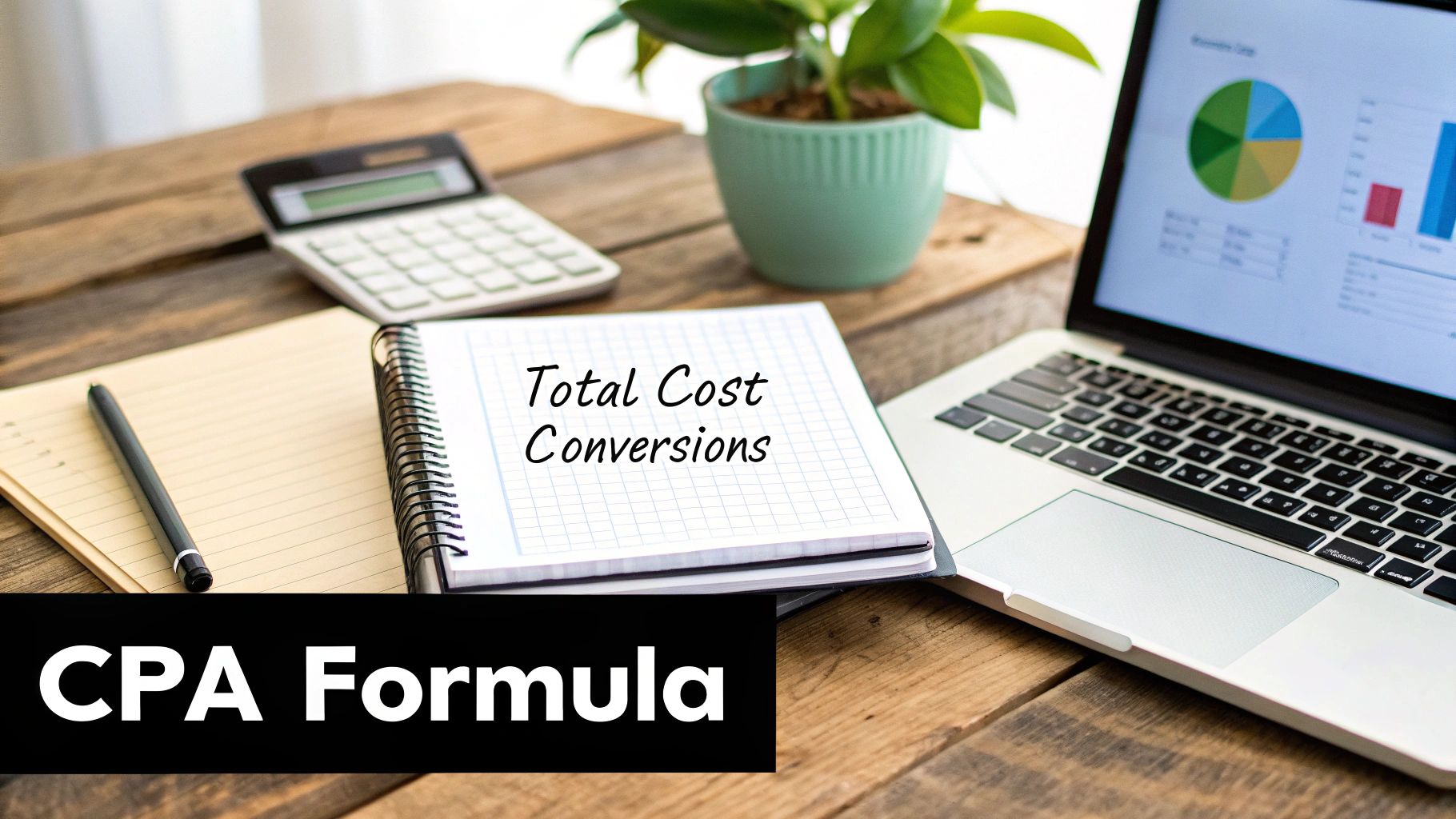
As you can see, the math is straightforward. You take the total cost of your campaign and divide it by the number of conversions it brought in.
Let’s use a real-world example. Say your TikTok Shop brand spends $2,000 on a campaign that drives 100 sales. The calculation is as simple as $2,000 / 100 = $20 CPA. That means you paid $20 for each sale you made.
Why CPA Is The Metric That Truly Matters
Think of your cost per acquisition as the ultimate health check for your marketing budget. It goes way beyond just looking at how much you're spending. CPA tells you how efficiently you're spending that money, turning a simple expense into a powerful gauge of your investment's performance. For any business serious about growing sustainably, this kind of clarity isn't just nice to have—it's essential.
By keeping a close eye on your CPA, you can start making smart, data-driven decisions instead of just guessing what works. It helps you fine-tune your marketing spend, boost your overall return on investment (ROI), and pinpoint exactly which channels are giving you the most bang for your buck.
A Tale of Two TikTok Shops
Let's paint a picture. Imagine two online stores, both competing for the same customers on TikTok Shop.
Store A is running ads, making some sales, and feeling pretty good. They're spending money and seeing revenue come in, so they assume their strategy is working. The one thing they're not doing? Tracking their CPA.
Store B, on the other hand, is obsessed with its cost per acquisition. They track it for every single campaign, every ad group, and every creative they test.
After a few weeks, Store A keeps pumping money into a trendy ad campaign that gets a lot of views, but they don't realize it's actually costing them more to get a customer than they make from the sale. Meanwhile, Store B looks at their dashboard and sees a clear story: one ad campaign has a CPA of just $15, while another is bleeding money at $50 per sale.
So, what happens?
- Store B immediately pauses the campaign with the bloated $50 CPA.
- They take that same budget and funnel it directly into the high-performing $15 CPA campaign.
- This one simple adjustment means Store B can now acquire more than three times the number of customers without spending a single extra dollar.
This is the whole game right here. Knowing your CPA is the difference between blindly burning cash and strategically building a profitable business. It gives you the power to cut what isn't working and double down on what is.
In the end, Store A is left scratching its head, wondering why profits are down even though sales are up. Store B, however, is scaling efficiently, turning a modest ad budget into a thriving enterprise. This single metric really can be the deciding factor between the businesses that win and those that just fade away.
Understanding CPA Benchmarks Across Industries
So, what’s a “good” cost per acquisition? That’s the million-dollar question, and the honest answer is: it depends. There’s no magic number that works for everyone. A fantastic CPA for one business could be a total disaster for another.
This isn't arbitrary, either. The differences come down to fundamental market realities. Think about it like this: a company selling a $2,000 piece of high-end camera gear can naturally afford to spend more to get a customer than a brand selling $20 t-shirts. The profit margin on that single sale sets the stage for what’s considered a reasonable acquisition cost.
Why Do CPA Benchmarks Vary So Much?
Several key factors explain why acquisition costs can be so wildly different from one industry to the next. Getting a handle on these will help you set realistic goals for your own campaigns.
Here's what's usually at play:
- Customer Lifetime Value (LTV): Businesses with high LTV, like subscription services or luxury brands, can stomach a higher initial CPA. They know that a single customer will likely generate a lot more revenue over time.
- Sales Cycle Length: The longer and more complicated the journey to a sale, the higher the cost. This is common in B2B or high-ticket services like legal advice, where multiple touchpoints are needed to convince a customer to buy.
- Market Competition: It’s simple supply and demand. If tons of advertisers are all fighting for the same audience’s attention, ad costs go up, and so does the CPA.
This is why focusing on your CPA is so critical—it directly impacts your budget, profitability, and the overall health of your business.

As you can see, getting your CPA right makes every dollar you spend on marketing work that much harder for you.
To put some real numbers on this, let's look at some industry benchmarks.
Average Cost Per Acquisition By Industry
The following table gives you a snapshot of just how much CPA can differ across various sectors. These figures provide some context, but remember they are just averages.
| Industry | Average CPA |
|---|---|
| Fintech | $1,450 |
| Legal Services | $749 |
| Manufacturing | $723 |
| E-commerce SaaS | $274 |
Source: GoCustomer.ai
The huge gap between E-commerce SaaS at $274 and Fintech at $1,450 highlights the impact of things like heavy regulation and intense competition. It’s a completely different ballgame.
The real lesson here is to stop worrying about what a business in a totally different field is paying. The most important comparison is your CPA versus your industry's standards and, crucially, its relationship to your own customer lifetime value.
Proven Strategies To Lower Your Cost Per Acquisition
Lowering your cost per acquisition is all about making your marketing budget work smarter, not just harder. The goal isn't just to spend less; it's to get a better return on every dollar you do spend. This means fine-tuning your entire funnel, from the very first ad someone sees to that final, satisfying "buy now" click.
The best place to start is with what you have the most direct control over: your targeting. Think about it—you could have the most amazing, eye-catching ad, but if it's being shown to people who couldn't care less about your product, your CPA is going to skyrocket. Dialing in your audience is ground zero for efficiency.
Once you have that sorted, you can focus on other big-impact areas.
Sharpen Your Conversion Points
Your ads might be doing a great job bringing people to your digital doorstep, but it’s your landing page that has to seal the deal. A slow-loading, confusing, or just plain unappealing page is a conversion killer, and it will send your CPA through the roof.
Here are a few things to tackle right away for a quick win:
- Optimize Your Landing Pages: Your page needs to load fast and have a crystal-clear call-to-action. Critically, the message and offer on the page must be a perfect match for what you promised in the ad.
- Refine Ad Targeting: Don't stop at basic demographics. Dig deeper with interest-based and behavioral targeting to connect with people who are already on the hunt for products just like yours.
- A/B Test Everything: Never stop testing. Pit different ad creatives, headlines, and copy against each other. Sometimes the smallest tweak can unlock a huge improvement in performance.
A low cost per acquisition is rarely an accident. It’s the direct result of relentless testing, measuring, and optimizing. Every experiment you run is a lesson learned about what truly motivates your audience.
Explore Cost-Effective Channels
While paid ads are a fantastic tool, they're not the only one in your toolbox. Spreading your efforts across different marketing channels can do wonders for your overall cost per acquisition by bringing in customers from more affordable sources.
For example, recent analytics have shown that some emerging AI tools can slash acquisition costs by as much as 50%. And don't forget the classics—channels like email and referral programs often have incredibly low acquisition costs, which really proves the power of building and nurturing your own audience. You can dig into more customer acquisition cost statistics to see how different channels stack up.
Think about putting some effort into organic search (SEO) to attract high-intent customers for free, or even launch a referral program that turns your happiest customers into your most effective advocates. These strategies might take a bit more time to build momentum, but they pay off with sustainable, long-term growth.
Got Questions About Cost Per Acquisition? We’ve Got Answers.
Even once you get the hang of the basics, some of the finer points of cost per acquisition can still be a bit murky. Let's tackle some of the most common questions that pop up. Getting these details straight is crucial for using CPA to build a smart, data-backed growth plan.
The most common point of confusion? The difference between CPA and CAC (Customer Acquisition Cost). They sound almost identical, but they're telling you two very different stories about your business.
What’s the Difference Between CPA and CAC?
Here’s the simplest way to think about it: CPA is a micro-level, tactical metric. It’s all about the cost of a single, specific action you want someone to take—a lead, a download, a newsletter sign-up, or a single sale from one ad. CPA answers the question, "What did I pay for that one action?"
CAC, on the other hand, is a macro-level, strategic metric. It takes a much bigger picture, calculating the total sales and marketing spend it takes to bring in one brand new paying customer. So, CPA is about the action; CAC is about the person.
How Does Customer Lifetime Value (LTV) Fit In?
CPA and Customer Lifetime Value (LTV) are two sides of the same profitability coin. While CPA tells you what it costs to get a conversion, LTV tells you what that customer is actually worth to you over the long haul.
For your business to be sustainable, your LTV has to be much higher than your CPA. You need to make more from a customer than you spent to get them. It’s that simple.
A healthy rule of thumb is to aim for an LTV:CPA ratio of 3:1 or higher. This means for every dollar you spend to acquire a customer, you should be getting at least three dollars back over their lifetime. This is the sweet spot for real, long-term profitability.
Does My Location Affect My CPA?
It absolutely does. Where you're running your ads can have a huge impact on your cost per acquisition. A handful of factors come into play here, like how many other brands are competing for eyeballs, how saturated the ad market is, and the average spending power of people in that region.
Don't underestimate these geographical differences. In the U.S., for example, fierce competition means ecommerce brands often have a higher-than-average CPA. Things get even more granular when you look at regions—brands on the West Coast might pay 15–25% more than the national average, while those in the Midwest could see costs 10–20% lower. You can dig into more of these regional ecommerce acquisition costs to see how things shake out.
This is exactly why you can't just lift and shift a successful strategy from one market to another and expect the same results. You have to adapt.