what is creator marketplace: Your Guide to Finding Talent
creator marketplaceinfluencer marketingbrand partnershipscreator economytiktok creators
A creator marketplace is basically a bridge connecting brands with content creators for marketing partnerships. Think of it like a specialized, high-tech talent agency, but instead of actors, it’s filled with influencers, and instead of movie roles, it’s for brand campaigns.
What Is a Creator Marketplace, Really?
Imagine you’re a casting director trying to find the perfect actor for a new film. You wouldn't drive to every local theater in the country hoping to stumble upon the right person—that would be a nightmare. This is exactly what it feels like for brands trying to find the right creators to promote their products on social media.
Creator marketplaces solve this problem by bringing all that talent into one central, searchable place.
But these platforms are much more than just a fancy list of names. They’re complete systems built to manage the entire partnership from start to finish. This includes everything from finding the right person and agreeing on terms to approving their content and sending payment.
For brands, it means an end to the endless scrolling and cold DMs that usually go nowhere. And for creators, it’s a direct pipeline to legitimate, paid opportunities from real businesses.
The Engine of a Growing Economy
The explosion of these marketplaces is no accident; it’s directly linked to the massive growth of the creator economy. What used to be a small corner of the internet is now a global powerhouse, valued somewhere between $191.55 billion and $250 billion in 2024. That number is expected to nearly double by 2027, which shows you just how much marketing budgets are shifting. You can dig deeper into the creator economy's massive growth on Market.us.
A creator marketplace fundamentally bridges the gap between brands needing authentic voices and creators seeking to monetize their influence. It streamlines a complex, relationship-based process into a structured, scalable workflow.
At the end of the day, these platforms provide the rails for this new kind of marketing to run on. They bring order to a chaotic and fragmented world, making it possible for any brand—big or small—to tap into the power of creator marketing without all the usual headaches and guesswork.
How Creator Marketplaces Actually Work
To really get what a creator marketplace is, you have to look under the hood and see how the engine runs. It’s not just a one-off transaction. Think of it as a guided journey, with clear, predictable steps that take you from finding the right creators all the way to a finished campaign with solid performance data.
The whole point of these platforms is to cut through the chaos of influencer marketing. They’re designed to turn a messy, time-sucking outreach process into a smooth, repeatable workflow. This journey really breaks down into a few core phases.
This simple flow shows you the big picture: a brand taps into the marketplace, which acts as the hub for connecting with the right creator.
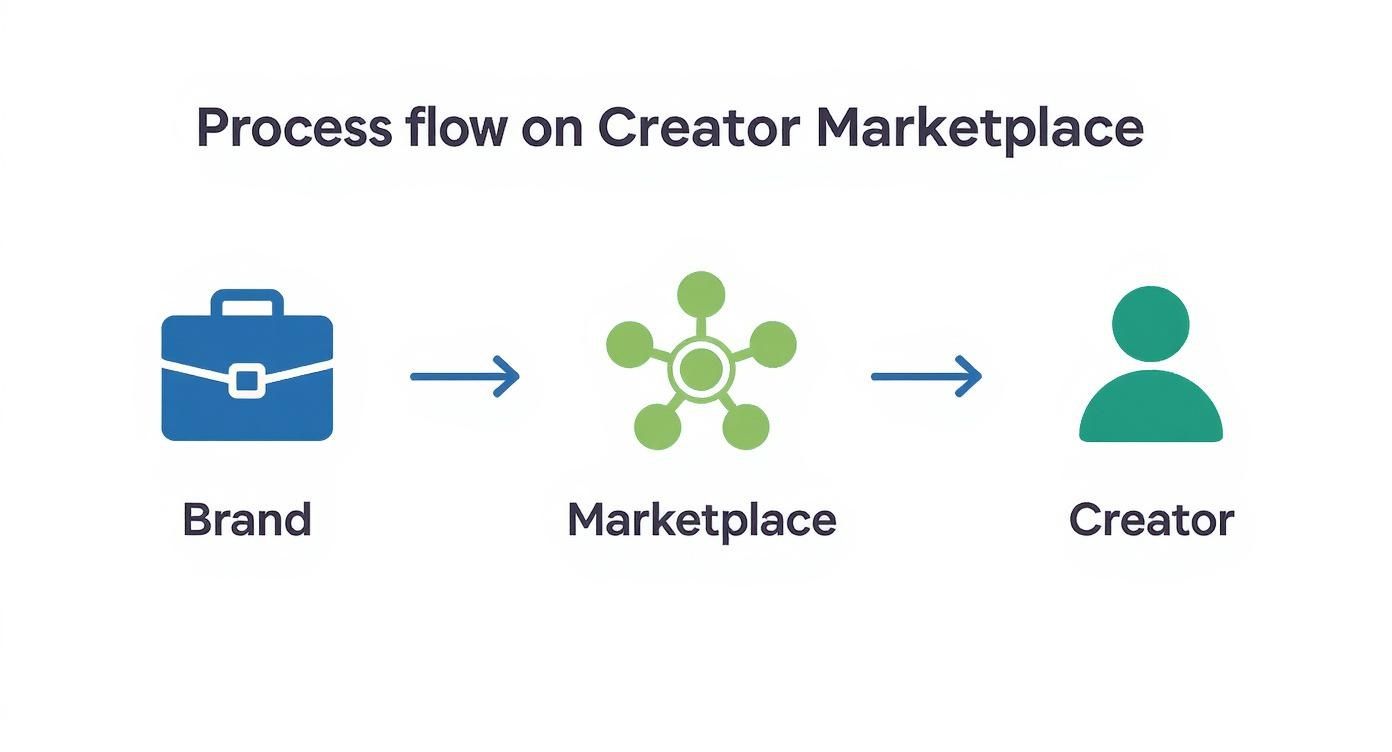
As you can see, the marketplace isn’t just a list of names. It’s the crucial go-between, providing the structure and tech that makes these partnerships possible and scalable for everyone involved.
Creator Vetting and Discovery
It all starts with curation. Marketplaces don’t just let anyone with a social media account sign up. They use a blend of smart algorithms and actual human review to vet creators before they ever appear in your search results. This process weeds out the fakes and ensures the creators on the platform are legit, have real engagement, and meet a certain bar for quality.
For a brand, this is a huge win right out of the gate. Forget spending hours manually vetting follower lists or calculating engagement rates. You’re starting with a pool of pre-qualified talent. From there, you can dig in with powerful search filters to find your perfect match.
- Audience Demographics: Need to reach 25-34 year old women in California who are into skincare? You can filter for that.
- Performance Metrics: Search for creators based on solid numbers, like average video views, engagement rates, or even past campaign results.
- Niche and Content Style: You can easily find creators who live and breathe your industry, whether that’s gaming, high-end fashion, or power tools.
This kind of granular filtering is what lets you zero in on creators who can speak to your audience authentically.
Collaboration and Campaign Management
Once you’ve found a few creators you’re excited about, the marketplace steps in to manage the entire collaboration. It usually kicks off with you sending out a campaign brief—basically an invitation that lays out the project goals, what you need them to create, the timeline, and what you're paying.
Creators get these briefs and can accept, decline, or sometimes negotiate the terms. All this communication happens right on the platform, which means no more chaotic back-and-forth in DMs and email chains.
At its core, a creator marketplace standardizes the entire collaboration. It offers built-in tools for everything from generating contracts and approving content to handling payments securely, which removes a ton of friction for both you and the creator.
Everything is kept in one place. You can review and approve content drafts before they go live, making sure the final videos or posts are perfectly aligned with your brand. This centralized hub is what makes it possible to work with dozens of creators at once without needing a massive in-house team to keep it all straight.
Payments and Analytics
Finally, the marketplace handles all the money and the data. Payments are built right in, which gives everyone peace of mind. As a brand, you deposit the funds, and the platform holds them in escrow, releasing the payment to the creator only after they’ve delivered on their end of the deal.
The payment models can be pretty flexible, too:
- Flat Fee: A set price for a specific job (e.g., $500 for three TikTok videos).
- Commission-Based: The creator earns a percentage of every sale they drive through their unique affiliate link or discount code.
- Hybrid Models: A mix of both, like a smaller upfront fee plus a commission on sales. This can be a great way to motivate performance.
Once the campaign is running, the real fun begins. The platform gives you access to analytics dashboards where you can track all the important metrics—views, clicks, engagement, and most importantly, sales. This allows you to measure the direct return on investment (ROI) from each partnership and use that data to make your next campaign even better.
The Pros and Cons for E-commerce Brands
For any brand diving into TikTok Shop, a creator marketplace can look like a godsend. On the surface, it’s a streamlined way to get your influencer marketing off the ground, but it’s critical to understand what you’re gaining—and what you might be giving up.
The biggest sell is speed. You can go from zero to a list of potential creator partners in minutes, which is a world away from the old-school grind of manual outreach. These platforms also roll campaign management, content approvals, and payments into one neat package.
But that convenience isn't free. There are real trade-offs to consider, from budget hits to the very nature of the relationships you build.
The Advantages of Marketplace Speed
The main reason brands turn to creator marketplaces is for instant access to talent. If you need to launch a campaign fast or test the waters with a new audience, this is a massive shortcut.
Here’s where they really shine:
- Rapid Creator Discovery: Instead of endless searching, you can filter through thousands of vetted creators by their niche, audience demographics, and past performance.
- Streamlined Operations: Built-in tools for things like contracts and payments cut down on the administrative busywork, making it much easier to juggle multiple collaborations.
- Data-Backed Decisions: Good marketplaces give you access to real creator analytics, so you're picking partners based on actual performance data, not just a vibe check.
This whole ecosystem is built on some serious tech. The digital content creation market, which fuels these platforms, was valued at $27.1 billion in 2023 and is expected to soar to $90.4 billion by 2033. You can dig into the growth of digital content creation tools on Market.us for a deeper look.
Potential Risks and Downsides
Despite the perks, you have to go in with your eyes open. The most obvious downside is the cost. Marketplaces usually take a cut of creator payments or charge a hefty monthly subscription, which can quickly shrink your marketing budget and hurt your ROI.
There's also a bigger, more strategic risk: the relationships often feel transactional.
When every interaction is filtered through a platform, it’s tough to build the genuine, long-term loyalty that comes from direct communication. Your brand can feel like just another gig on a creator's list.
Finally, remember you’re competing in a crowded, "pay-to-play" space. Your campaign brief is sitting next to hundreds of others, all vying for the attention of the best creators. To stand out, you often have to pay a premium, turning your partnership strategy into a bidding war. This can strip away the very authenticity that makes creator marketing work in the first place.
Marketplace Model vs. Direct Outreach: A Comparison
So, how does the marketplace route truly stack up against building your own creator relationships from scratch? It really comes down to a trade-off between speed and control. One gives you a ready-made pool of talent at a cost, while the other requires more effort but yields deeper, more authentic partnerships.
This table breaks down the key differences to help you decide which approach, or combination of approaches, is right for your brand.
| Factor | Creator Marketplace | Direct Outreach |
|---|---|---|
| Speed & Scale | High. Instantly access thousands of creators. Great for launching quickly. | Low to Medium. Takes time to find, vet, and build relationships manually. |
| Cost | Medium to High. Subscription fees and/or commission on creator payouts. | Low. Primarily a time investment. No middleman fees. |
| Relationship Depth | Transactional. Often project-based, less personal connection. | Deep & Authentic. Builds long-term loyalty and brand advocacy. |
| Creator Quality | Varies. Includes top-tier and emerging talent, but competition is high. | Curated. You hand-pick creators who are a perfect fit for your brand. |
| Campaign Control | Platform-Dependent. You're limited by the marketplace's tools and rules. | Total Control. Full flexibility on terms, creative, and communication. |
| Administrative Load | Low. Centralized tools for contracts, payments, and communication. | High. Requires manual tracking of outreach, negotiations, and payments. |
Ultimately, there’s no single right answer. A new brand might use a marketplace to get early traction, while a more established one might focus on direct outreach to nurture a core community of brand advocates. The key is to be intentional about your strategy and choose the path that best aligns with your long-term goals.
How to Choose the Right Creator Marketplace
Not all creator marketplaces are built the same. Picking the wrong one can be a massive drain on your time and budget, so it’s crucial to know what you’re looking for. Think of it like hiring a key employee—you need to get past the shiny sales pitch and really dig into whether they're the right fit for your brand's goals.
The first thing to look at is the most important asset any marketplace has: its creators. You have to make sure the talent pool isn't just big, but that it's relevant. Do they have creators who actually resonate with your target audience? A database with a million influencers is worthless if none of them speak your customer's language.
Evaluate the Creator Database and Filters
A great marketplace needs powerful search and filtering tools that let you zero in on the perfect partners without wasting hours. There are over 207 million creators out there, so finding the real gems can feel like searching for a needle in a haystack. This is especially true when you realize only about 4% of creators actually earn over $100,000 a year, which shows just how big the performance gap is. You can find more stats on the creator economy landscape from inbeat.agency.
Here’s what to look for when you're evaluating their search tools:
- Niche Relevance: Can you easily drill down to find creators in specific verticals? Whether you sell sustainable fashion or niche hobby gear, you need that level of precision.
- Audience Data: How deep can you go into a creator's audience analytics? You should be able to see key demographics like age, location, and interests.
- Performance History: Does the platform show you how a creator has performed on past campaigns? You need proof they can drive real engagement and, more importantly, sales.
Without these features, you’re just scrolling through a directory, not using a strategic tool to find your next top-performing partner.
Uncover the True Cost and ROI Tools
Next up, get a crystal-clear picture of the fee structure. A lot of platforms have hidden costs that go way beyond the subscription or commission rate you see on the pricing page. Be sure to ask about transaction fees, charges for boosting content, or extra costs for accessing advanced analytics. What looks like a bargain at first can quickly get expensive.
Just as important are the platform’s analytics and ROI tracking tools. A good marketplace gives you more than just vanity metrics like likes and views.
The best platforms offer clear, actionable data that connects creator activity directly to your bottom line. You should be able to track conversions, sales revenue, and return on ad spend (ROAS) for every single campaign.
If a platform can’t give you robust ROI tracking, that's a huge red flag. You need a partner who helps you prove the value of your marketing spend, not just one who manages the logistics.
Finally, don't forget the little things that make a big difference, like the user interface—is it actually easy to use?—and the quality of their customer support. These elements are key to a smooth partnership that helps you hit your goals.
Building Your Own Direct Creator Program
Creator marketplaces are fantastic for speed and scale, but the smartest brands in the game know a secret: the best, most authentic partnerships are almost always built directly. This brings us to a powerful alternative—building your own in-house creator program. It’s a shift from renting creators to owning the relationships.
Think of it as the next evolution of your creator marketing strategy. Instead of relying on a middleman, you're cultivating your own community of creators who are genuinely bought into your brand's mission. This direct approach builds real loyalty, gives you total creative freedom, and almost always delivers a better long-term return by cutting out those marketplace fees.
This doesn't mean you have to go back to the dark ages of tracking everything in messy spreadsheets and sending endless cold DMs. Modern tools now give you the power to build your own program with the same efficiency as a marketplace, just without the downsides.
The Tools for an In-House Program
Building a direct program might sound like a huge undertaking, but a new wave of automation and management tools makes it totally manageable. These platforms are built to do the heavy lifting, freeing you up to focus on what matters most—strategy and building real connections, not getting buried in admin work. The whole point is to create an owned, sustainable creator ecosystem that becomes a serious competitive advantage.
Here are the key pieces of a modern in-house program:
- Automated Recruitment: Tools like an Affiliate Bot can handle outreach on a massive scale. It finds and recruits the right creators from huge talent pools, automating the top of your funnel and bringing potential partners straight to you.
- Centralized Tracking: A dedicated Creator Tracker is non-negotiable. It pulls all your performance data into one place, keeps an eye on posting schedules, and tracks GMV so you know exactly who your top performers are and can double down on what works.
- Clear Financial Insights: A solid Profit Dashboard gives you the financial clarity to make smart calls. It shows you the key shop- and product-level numbers, tying your creator efforts directly to your bottom line.
By combining these tools, brands can build their own private, high-performance creator network. This approach gives you the scale of a marketplace with the depth and control of a direct partnership—truly the best of both worlds.
Benefits of an Owned Creator Ecosystem
The biggest win here is the shift from one-off, transactional deals to genuine brand ambassadorship. When creators feel like you see them as real partners, not just hired guns, their content becomes far more authentic and powerful. That deeper connection really clicks with their audience, building trust and driving more consistent results over the long haul.
This strategy also opens up an incredible, direct feedback loop from the front lines. Your core group of creators can become your personal focus group, giving you raw insights on how people see your products, what trends are popping off, and what content actually connects. That's a direct line of communication you simply don't get through a marketplace.
Ultimately, building your own program is an investment in a long-term, defensible marketing asset—one that only grows more valuable the more you nurture it.
Why a Hybrid Creator Strategy Is the Future
The debate over using a creator marketplace versus building direct partnerships often misses the point. It’s not an either/or decision. The savviest brands are blending them into a powerful hybrid model.
Think of it like this: creator marketplaces are your go-to for speed and scale. Need to find new faces fast, test a campaign in a new niche, or get a product in front of a ton of people for a flash sale? A marketplace is perfect for that kind of quick-hit, wide-net casting.
At the same time, you should be cultivating your own inner circle of creators. These are the partners you build direct, long-term relationships with—the ones who truly get your brand and become genuine ambassadors. This is where authentic, deep-rooted loyalty is born.
A balanced model gives you the rapid-fire discovery of a marketplace without sacrificing the powerful, long-term connections that create true brand advocates and drive sustainable growth.
By combining the transactional horsepower of a platform with the authentic connection of a direct program, you build a complete creator ecosystem. You get the right partners for every goal, from explosive short-term sales to unshakable brand loyalty. It’s not about picking one tool; it’s about mastering the entire toolkit.
Frequently Asked Questions
When you're first dipping your toes into the world of creator marketplaces, it's natural to have a few questions. Let's walk through some of the most common ones that brands ask before they get started.
What’s This Going to Cost Me?
The pricing for creator marketplaces isn't one-size-fits-all, but most platforms use one of a few common models. Getting a handle on these is the first step to figuring out your budget and what your actual ROI will look like.
Some platforms will charge you a flat monthly or yearly subscription fee. This gives you access to their database of creators and tools for running your campaigns. Another popular route is a commission model, where the platform takes a cut—usually anywhere from 10% to 30%—of every dollar you pay to a creator. You'll also see tiered plans, where paying more gets you better features or a dedicated account manager.
Can I Haggle on the Price with Creators?
That really depends on the marketplace you’re using. Some platforms are set up with fixed, take-it-or-leave-it rates for specific video types or deliverables. It makes things simple, but you lose any room to negotiate.
On the other hand, a lot of marketplaces are designed to be a starting point for a conversation. They'll have built-in messaging tools so you can chat directly with creators, hash out the details of a campaign, and agree on a price that feels right for both of you. That direct connection is often where the best, most authentic partnerships are born.
Are These Marketplaces Actually a Good Idea for a Small Business?
They absolutely can be, as long as you're smart about it. For a smaller brand, a creator marketplace can be a game-changer, giving you a direct line to creators you'd otherwise never find. The trick is to play to your strengths.
Don't blow your budget trying to land a mega-influencer. Instead, zero in on micro-influencers (those with around 10k-100k followers). Their audiences are often far more engaged, and their rates are much more small-business-friendly. Even better, focus on performance-based deals like affiliate marketing. That way, you’re only paying a commission when a creator actually drives a sale, which takes a ton of the risk off your plate.
Ready to stop renting creators and start building your own high-performance team? HiveHQ provides the tools to automate recruitment, track performance, and measure profit, all in one place. Discover how to build your direct creator program and scale with confidence.