What Is Gross Merchandise Value and Why It Matters
gross merchandise valueecommerce metricstiktok shopgmv explainedbusiness growth
Think of Gross Merchandise Value (GMV) as the grand total of every sale that passes through your TikTok Shop over a set time. It’s the raw, top-line figure before you subtract any costs like platform fees, shipping, or returns. Simply put, GMV shows you the total sales volume your shop is handling.
Decoding Gross Merchandise Value

To really get what gross merchandise value is, picture yourself selling handmade crafts at a local market. At the end of the day, you add up the sticker price of every single item you sold. That total—before you pay the market for your booth or account for the cost of your supplies—is your GMV. It’s a pure measure of your sales activity.
This metric gives you a bird's-eye view of your shop's size and how quickly it's growing. It answers one key question: "How much are customers spending here?" For big players in e-commerce, this number gets massive. For example, Shopify handled an incredible $235.91 billion in GMV in 2023 alone. That was a 20% jump from the year before, which really shows the scale of transactions flowing through its platform. If you're interested, you can explore more about key ecommerce metrics and the stories they tell about the market.
GMV vs Revenue At a Glance
It’s easy to mix up GMV with the actual cash that ends up in your bank account, but they are not the same thing. That's where revenue comes in. While GMV is the total value of what you sold, revenue is what's left for you after the marketplace takes its cut and you account for returns and other direct costs.
Think of it like this: GMV is the total value of all the goods you moved, while revenue is the slice of that pie your business actually gets to keep.
Understanding this difference is absolutely essential for getting an accurate read on your shop’s financial health. This quick comparison table should help make it crystal clear.
| Metric | What It Measures | Includes | Excludes |
|---|---|---|---|
| GMV | Total sales volume of all goods sold | The full retail price of every item sold | Fees, taxes, shipping costs, returns, discounts |
| Revenue | The actual income your business earns | The portion of GMV left after deductions | Cost of goods sold, operating expenses, marketing |
Knowing both numbers gives you a much fuller picture. GMV tells you about your market share and growth, while revenue tells you about your actual profitability.
How to Calculate Your GMV
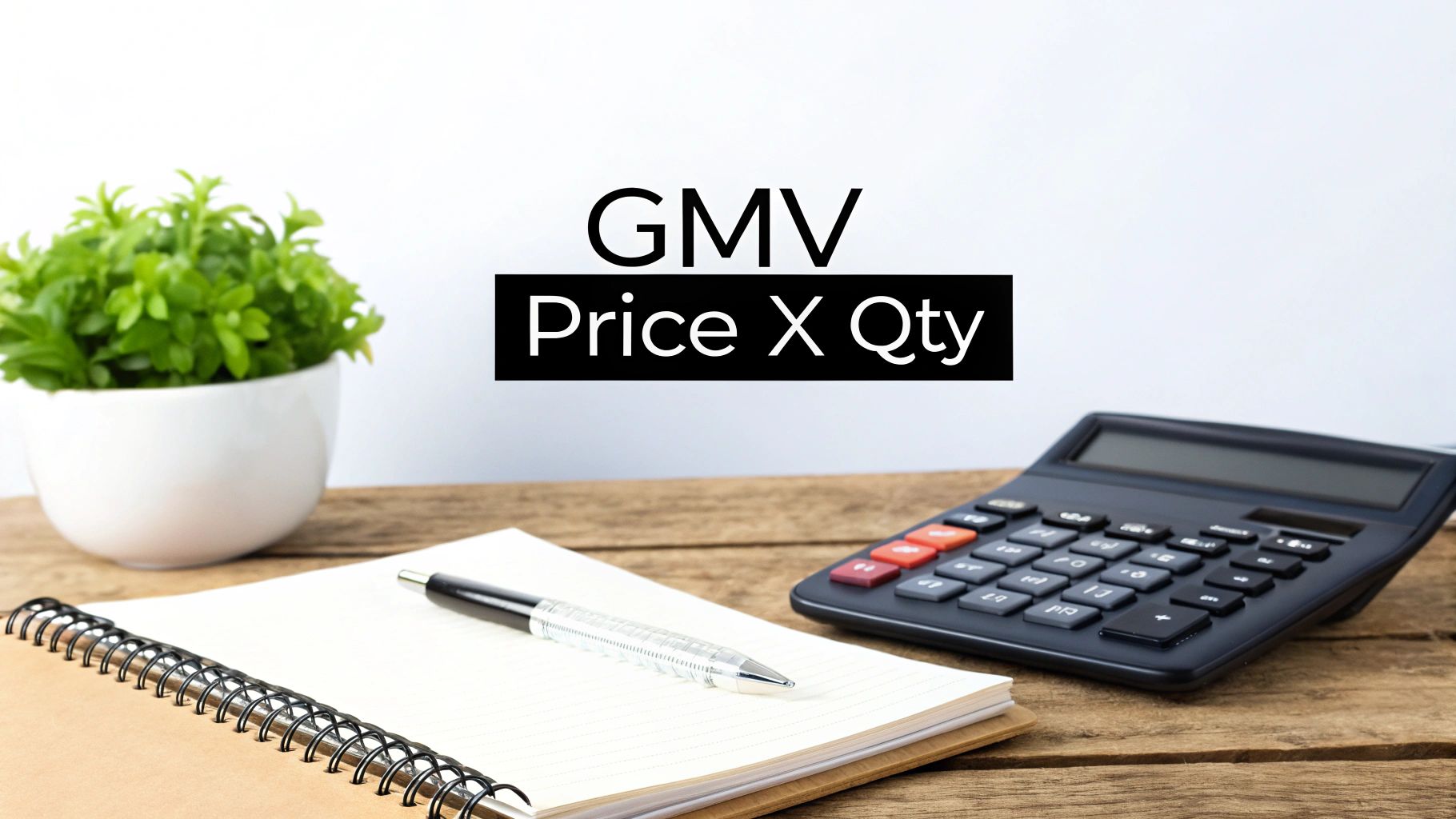
Figuring out your Gross Merchandise Value is surprisingly simple. You don't need to be an accountant or a spreadsheet wizard; it all comes down to basic multiplication.
At its heart, the calculation is about getting a quick, high-level snapshot of your sales activity. Think of it as the total value of everything that passed through your digital cash register before anything else is taken out.
The GMV Formula:
GMV = Sale Price of an Item x Number of Items Sold
That's it. This gives you the raw number representing the total value of goods sold over a specific time frame.
A Simple Calculation Example
Let's break it down with a single product. Say you sell a viral skincare serum on your TikTok Shop for $25 a pop. Last month, you moved 100 of them.
Here’s how you’d calculate the GMV for just that serum:
- Calculation: $25 (Sale Price) x 100 (Items Sold) = $2,500 (GMV)
So, your GMV for the serum last month was $2,500. This tells you the total dollar amount of all those serum transactions.
Calculating GMV for Multiple Products
Of course, most shops aren't one-trick ponies. Let's imagine your store has three hot products with the following sales numbers for the month:
- Skincare Serum: 100 units sold at $25 each
- Lip Gloss: 150 units sold at $15 each
- Face Masks (10-pack): 50 units sold at $20 each
To get your shop's total GMV, you just run the calculation for each product first and then sum them up. It’s a simple three-step process.
- Serum GMV: 100 x $25 = $2,500
- Lip Gloss GMV: 150 x $15 = $2,250
- Face Mask GMV: 50 x $20 = $1,000
Now, just add those numbers together to see the big picture:
Total GMV = $2,500 + $2,250 + $1,000 = $5,750
And there you have it. Your shop's Gross Merchandise Value for the month is $5,750. By following this straightforward method, you can easily track the sales volume for any product or for your entire store.
Why GMV Is a Key Growth Indicator
While Gross Merchandise Value doesn't tell you anything about profit, there’s a good reason it’s one of the most closely watched numbers in e-commerce. Think of it as a powerful barometer for the overall health and momentum of an online marketplace or even your own shop.
It’s a raw measure of the sheer volume of sales activity and customer demand happening on a platform. It shows you the big picture.
For investors and the people running the platform, a rising GMV is a fantastic sign. It shows that more customers are buying and the platform is carving out a bigger piece of the market pie. This kind of upward trend makes a business much more appealing for partnerships and investments because it points to strong potential for future growth.
A Measure of Market Dominance
At the highest level, GMV is the yardstick used to compare the e-commerce giants. It puts their market share and influence into perspective on a global scale. Let's be honest, the e-commerce world is pretty top-heavy, with just a handful of major players driving most of the action.
To give you an idea, the top 10 e-commerce companies pulled in a staggering $3.5 trillion in GMV from online sales in 2022 alone. That accounted for 61% of the entire global market. Amazon is the undisputed leader, with its gross merchandise value projected to hit nearly $800 billion in 2024. That’s how we use GMV to benchmark who's on top. You can dig deeper into these e-commerce statistics and trends to see the full picture.
A consistently growing GMV tells a compelling story of market adoption and customer trust. It proves that a platform’s marketing is effective and its value proposition resonates with both buyers and sellers, creating a thriving digital ecosystem.
Why GMV Matters for TikTok Shop Sellers
This big-picture view is just as important when you zoom in on your own business. For your TikTok Shop, tracking your GMV is crucial for figuring out what’s working and making smarter decisions based on real data, not just a gut feeling.
By keeping a close eye on your GMV trends, you can:
- Spot your star products: Pinpoint which items are actually driving the most sales volume.
- Measure marketing impact: See if that creator collaboration or ad campaign actually led to a real spike in sales.
- Forecast future demand: Use your past GMV data to get ahead of busy seasons and manage your inventory better.
Ultimately, understanding your GMV helps you move beyond guesswork. It gives you a clear, numbers-based look at your shop's growth, helping you set achievable sales goals and decide where to put your money—from ad spend to inventory—for the best possible return.
Why Chasing a High GMV Can Be a Trap
While a big, flashy GMV number looks fantastic on a report, it doesn't tell you the whole story about your business's health. In fact, chasing a high GMV without keeping an eye on your actual profits can be a really dangerous game.
Think of it this way: It’s like celebrating a shopping cart piled high with gourmet groceries, only to get to the checkout and realize you don't have enough cash to cover the bill. A business can have a massive GMV but still be bleeding money if its costs are out of control.
At the end of the day, GMV is a top-line figure. It’s the sticker price, not the amount you take home.
When a Big GMV Is Just an Illusion
Imagine you run a huge flash sale. To get a ton of orders, you offer a 50% discount on your best-selling product. Your GMV for that day goes through the roof, and it feels like a massive win. But what happens after the excitement fades?
Once you subtract the cost of your products, what you spent on ads, and TikTok's platform fees, you might discover you actually lost money on every single sale. Ouch.
This is a classic example of why GMV is a measure of volume, not viability. Focusing only on this one number can trick you into making some pretty bad decisions for your shop.
Here are a few common traps where GMV can paint a misleading picture:
- Aggressive Discounting: Sure, slashing prices inflates your GMV, but it can absolutely demolish your profit margins and lead to growth you can't sustain.
- High-Volume, Low-Profit Items: Selling thousands of cheap, low-margin products can create a huge GMV, but the actual profit you pocket might be tiny.
- Forgetting the Real Costs: It's easy to overlook things like customer acquisition costs (CAC), shipping expenses, or a high return rate. These hidden costs can turn a high-GMV business into a deeply unprofitable one.
To get a true sense of how your shop is really doing, you have to look beyond what gross merchandise value shows you. It's just one piece of a much larger financial puzzle.
Look Beyond GMV for the Full Story
To truly understand your shop's performance, you need to look at GMV alongside other crucial metrics. KPIs like your profit margin, Customer Acquisition Cost (CAC), and Average Order Value (AOV) add the context you need to see if you're actually building a healthy business.
By balancing your focus across these different numbers, you can make sure that your sales growth actually translates into a stronger, more profitable business for the long haul.
Using GMV to Fuel Your TikTok Shop Strategy
Knowing what Gross Merchandise Value is and how to calculate it is a great start. But the real magic happens when you start using that data to make smarter decisions for your TikTok Shop. Think of your GMV trends as a treasure map—they point directly to what's driving your growth and where you can find more profit.
By keeping a close eye on your GMV, you can quickly spot your viral superstars—the products that are flying off the shelves. This insight is gold. It tells you exactly what to double down on, making sure your best-sellers are always in stock and front-and-center in your videos. It also gives you a crystal-clear way to measure the ROI of your creator collaborations. Did partnering with that influencer lead to a big jump in sales? Your GMV data will tell the story.
From Data to Decisions
Suddenly, forecasting demand feels less like guesswork and more like a science. Looking at your past GMV helps you see seasonal trends coming, so you can stock up and avoid the dreaded "sold out" sign during your busiest times. It’s also the foundation for setting ambitious—but achievable—sales goals and seeing how your shop is performing compared to last month or last quarter.
But here’s a crucial catch: a high GMV doesn't always equal high profit. It’s entirely possible to have impressive sales numbers while your costs quietly eat away at your bottom line.
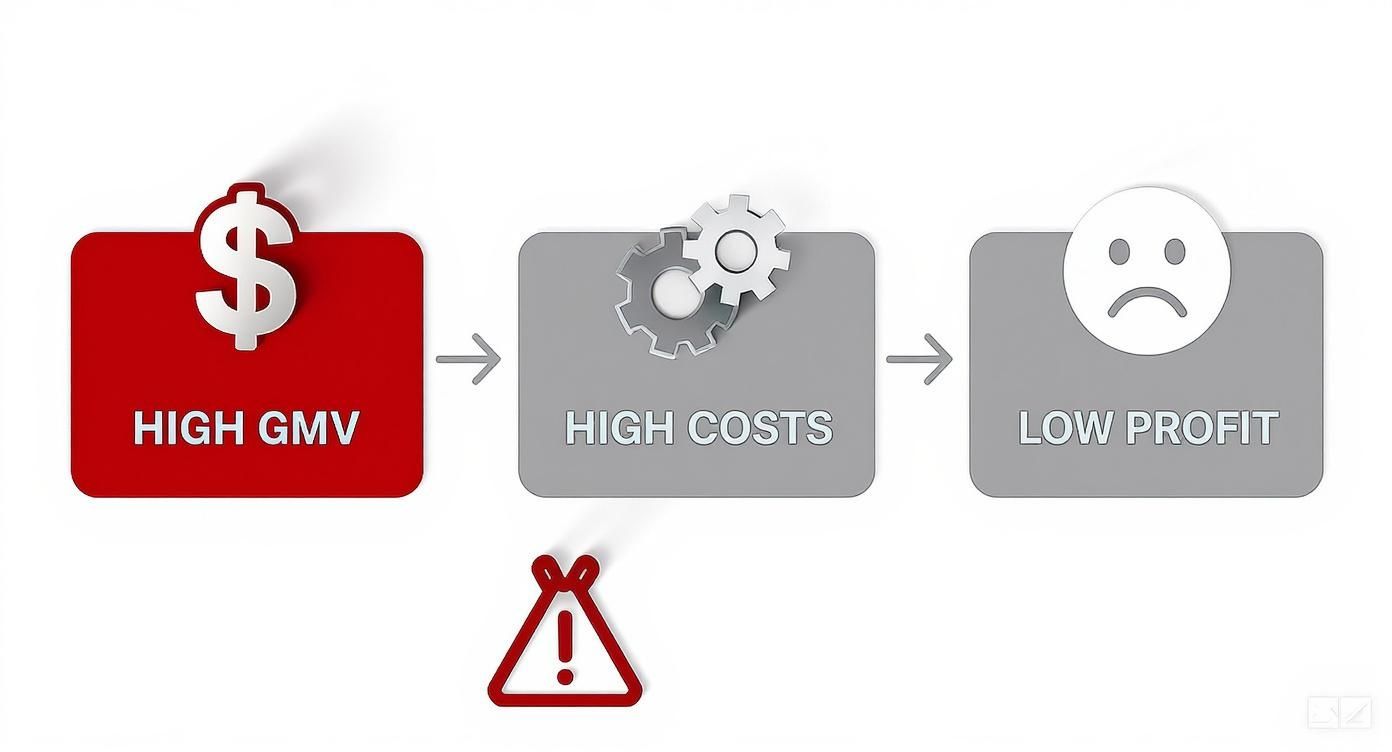
This is why you have to look at GMV in context with your expenses. Only then can you get a true picture of your shop's financial health.
Trying to track all of this manually in a spreadsheet is a recipe for headaches and missed opportunities. This is exactly where tools built specifically for TikTok Shop sellers come in to save the day.
Turning raw numbers into clear, actionable insights is the whole point of tracking metrics. When you automate this process, you spend less time buried in data and more time actually growing your business.
For example, a platform like HiveHQ plugs directly into your shop, giving you a live look at your most important numbers. Instead of juggling reports, you get a single, clear dashboard that shows your Gross Merchandise Value, profits, and creator performance all in one place. This makes it so much easier to make fast, informed decisions to scale your shop.
Common GMV Questions
Even after getting the hang of Gross Merchandise Value, a few specific questions always seem to pop up. We've pulled together the most common ones we hear from TikTok Shop sellers to give you clear, straight-to-the-point answers.
Think of this as your go-to cheat sheet for any lingering GMV confusion.
How Do Returns and Refunds Affect GMV?
This is a big one, and the answer is simple: they don’t. GMV is calculated before any deductions like returns or refunds are factored in. It’s a “gross” measure of sales volume, not your final take-home cash.
So, when a customer sends something back, your net revenue and profit will obviously take a hit. But that initial sale still counts toward the GMV for the period it happened in. To get the full story, you’ll want to track your return rate right alongside your GMV.
Does GMV Include Shipping and Taxes?
Generally, no. The standard calculation for Gross Merchandise Value is all about the price of the products themselves. It purposefully leaves out any extra costs tacked on at checkout.
That means these costs are usually not part of the main GMV number:
- Shipping and handling fees
- Sales tax or VAT
- Platform-specific transaction fees
It's always a good idea to double-check how your specific platform defines it, but the pure-product-price approach is the industry norm.
Is a Higher GMV Always a Good Thing?
Not on its own. A rising GMV is a great sign that you’re selling more and that people want what you’ve got. But it's not the final word on your shop's success. A business can have a huge GMV and still be bleeding money.
A high GMV becomes a vanity metric if it isn't supported by healthy profit margins. It's vital to analyze it in conjunction with other KPIs like Customer Acquisition Cost (CAC) and net profit to get a true picture of your shop's financial stability.
Why Do Investors Focus on GMV?
For investors looking at e-commerce platforms and marketplaces, GMV is a key indicator of scale and growth potential. A quickly climbing GMV tells them that the platform is grabbing market share and getting more people to buy stuff.
It’s a powerful sign of strong consumer demand and points to future revenue from transaction fees or ad services. In short, it’s a quick way for them to gauge a platform's momentum in the market.
We've laid out the most common questions in a quick-reference table below.
| Question | Quick Answer |
|---|---|
| How do returns affect GMV? | They don't. GMV is calculated before returns and refunds are deducted. |
| Is shipping included in GMV? | Typically, no. GMV usually only includes the retail price of the products. |
| Is a high GMV always good? | Not necessarily. It's a positive sign of sales volume, but it must be paired with profitability to be meaningful. |
| Why do investors care about GMV? | It’s a strong indicator of a platform's scale, market share, and growth trajectory. |
Hopefully, these answers clear up any final questions you had about what GMV really means for your shop.
Ready to stop guessing and start growing? HiveHQ provides a real-time Profit Dashboard that transforms your raw data into actionable insights. Track your GMV, creator performance, and true profitability all in one place. Book a demo today and see how HiveHQ can scale your TikTok Shop.