Unlocking Growth with Chatbots for Enterprise
chatbots for enterpriseecommerce automationtiktok shopcustomer support botsaffiliate marketing
When you hear the term "chatbot," you might picture a simple pop-up window on a website. But for large-scale e-commerce, we're talking about something entirely different. Enterprise chatbots are sophisticated AI tools built to handle the heavy lifting of complex business operations, from fielding thousands of customer questions to managing massive creator outreach campaigns.
Unlike their simpler cousins, these bots plug directly into your core business systems. They’re designed to manage a huge volume of interactions, giving e-commerce brands a powerful way to cut costs, boost sales, and truly scale.
The E-Commerce Shift to Enterprise Chatbots
Think of your e-commerce business. Is it running like a small market stall where you handle every task by hand? Or is it more like a fully automated, 24/7 supercenter, running smoothly even when you're not there? This is the change that enterprise chatbots are bringing to the table, and it's especially critical for sellers on fast-paced platforms like TikTok Shop.
These tools aren't just a neat feature anymore; they're becoming a central part of a smart business strategy.

This shift is happening for a simple reason: modern commerce, especially social commerce, throws a unique set of challenges at you. Trying to manually answer every customer message, track every order, and recruit affiliates just doesn't work once you start to grow. Enterprise automation is built to take over these jobs with speed and accuracy.
Why Enterprise-Level Automation Is a Must-Have
For any e-commerce brand with big ambitions, powerful automation isn't just a nice-to-have. It’s essential for staying competitive and growing without burning out. The market numbers tell the same story. The global AI chatbot market hit $7.76 billion in 2024 and is expected to soar to $27.29 billion by 2030.
Retail and e-commerce already make up a huge 30% of that market, which shows just how vital these tools have become.
This explosive growth is driven by real-world results that you can see in your bank account. Here’s what it boils down to:
- Massive Cost Savings: Automating repetitive questions and tasks drastically cuts your cost per interaction. This frees up your human team to solve the tricky, high-value problems that really need their attention.
- Better Sales Conversion: A chatbot can proactively engage shoppers, offer personalized product suggestions, and provide instant help, guiding more people from browsing to buying.
- Smoother Operations: When a chatbot is connected to your e-commerce software, information flows seamlessly. This helps with everything from keeping inventory updated to tracking how well your affiliates are performing.
The true magic of an enterprise chatbot isn't just that it can answer questions. It's that it builds an operational backbone that lets your business grow without breaking. It turns the growing pains into genuine opportunities.
To give you a clearer picture, here’s a quick summary of what these chatbots bring to an e-commerce operation.
Enterprise Chatbots At a Glance
| Core Function | Primary Business Impact | Example Application (TikTok Shop) |
|---|---|---|
| 24/7 Customer Service | Reduces support costs and improves customer satisfaction | Instantly answers "Where is my order?" queries with real-time tracking data |
| Sales & Lead Generation | Increases conversion rates and revenue | Recommends products to users based on their comment history or DMs |
| Outreach Automation | Scales affiliate/creator recruitment efforts efficiently | Automatically contacts potential TikTok creators to join an affiliate program |
This table shows how enterprise chatbots are not just support tools, but core drivers of growth, efficiency, and scale in the demanding world of e-commerce.
Meeting the Demands of Social Commerce
Platforms like TikTok Shop are incredibly fast-moving. Success depends on how quickly you can make sales and how many creator partnerships you can build. An enterprise chatbot is designed specifically for this environment. It can handle thousands of customer messages and affiliate DMs at the same time, ensuring you never miss an opportunity.
This is what sets the top-performing brands apart from everyone else. To really grasp what this technology can do for you, it's worth digging into the full range of advantages. You can explore some great insights by Unlocking the Benefits of AI Chatbots for Your Business.
Key Use Cases Driving E-Commerce Growth
Theory is great, but let's get down to what actually moves the needle. Enterprise chatbots aren't just a cool tech concept; they are workhorses that can handle specific, high-impact jobs for your business. For any ambitious e-commerce brand, especially those navigating a fast-paced platform like TikTok Shop, figuring out where to apply this technology is the key to unlocking real growth.
So, let's break down the three most critical areas where enterprise chatbots deliver an immediate and obvious return. Think of these as a shift from slow, manual work to smart, automated efficiency.
This kind of interface is mission control. It turns what used to be a jumble of complex operations into clear, actionable data, showing you exactly how your automated functions are performing.
Proactive Customer Service and Sales Assistance
The first place you'll see a massive impact is in customer service. A well-implemented enterprise chatbot can transform your support from a reactive cost center into a proactive sales machine. For years, "support" meant damage control—answering an angry email or a frustrated DM after a problem happened.
AI-powered bots flip that script entirely.
A good chatbot can instantly resolve the most common customer questions, 24/7. Things like "Where is my order?" or "What's your return policy?" no longer need to clog up your support team's inbox. This frees up your human agents to focus on the tricky, high-value conversations that actually require a personal touch.
But the real magic is in personalization. A smart bot can look at a user's browsing history or past purchases and serve up tailored product recommendations on the spot.
Imagine a customer who frequently comments on videos featuring a specific product line. The bot can automatically engage them with a personalized offer, turning a casual viewer into a buyer. A manual team could never hope to do that at scale.
This doesn't just make for a better customer experience; it directly drives sales. In fact, one recent study found that AI-driven agents were responsible for an extra $60 billion in online sales during a single holiday season, mostly through these kinds of personalized, timely offers.
Automated Order Management and Logistics
For any e-commerce business, the post-purchase experience is everything. Managing orders, tracking shipments, and processing returns is a huge operational lift. As you grow, this can quickly become a bottleneck, leading to frustrated customers and a flood of negative reviews.
Enterprise chatbots can automate this entire workflow.
By plugging directly into your e-commerce platform and shipping carriers, a chatbot gives customers a self-service hub for everything they need after they click "buy."
- Real-Time Order Tracking: Customers can just type their order number into the chat and get an instant, up-to-the-minute status update without ever leaving the conversation.
- Effortless Returns and Exchanges: The bot can walk a user through the entire return process, confirm their order details, and even generate a shipping label automatically.
- Inventory Inquiries: A shopper can ask if a specific size or color is in stock nearby, and the bot can pull live inventory data, connecting your online and offline worlds.
This level of automation takes a massive load off your operations team. More importantly, it delivers the fast, transparent service that modern customers demand, which is a huge factor in building trust and earning repeat business. You can explore a variety of other applications by checking out these 8 powerful chatbot use cases to scale your business.
Scalable Creator and Affiliate Outreach
On platforms like TikTok Shop, partnerships with creators and affiliates are the lifeblood of your marketing. The problem? Manually finding, contacting, and managing thousands of potential partners is an impossible task for a small team. This is where an enterprise chatbot becomes a game-changer.
An affiliate outreach bot automates the most tedious and time-consuming parts of the recruitment process.
- Discovery at Scale: The system can scan and identify thousands of relevant creators based on your specific criteria, like follower count, niche, and engagement metrics.
- Personalized Automated Contact: Instead of blasting out generic emails, the bot can send customized intro messages to each creator, referencing their content and explaining why a partnership makes sense.
- Intelligent Follow-Up: The bot keeps track of the entire follow-up sequence, making sure no promising partner slips through the cracks. It can even nudge creators with reminders to post their content after receiving a product sample.
By automating this top-of-funnel outreach, your affiliate manager can spend their time negotiating with creators who are already warm and interested. This allows a small team to build a massive, high-performing affiliate network that would normally require a whole department. For a deeper dive, our guide on https://www.hivehq.ai/blog/bots-for-shopping explains how this kind of automation can seriously supercharge your sales strategy.
Measuring the Real ROI of Your Chatbot Strategy
Putting an enterprise chatbot to work is more than just adding another piece of tech to your stack—it's a direct investment in the financial health of your business. To really prove its worth, you have to look past the surface-level metrics and focus on the numbers that hit your bottom line. So, how do you actually measure the return on an automation strategy?
The secret is to track a few critical key performance indicators (KPIs). Instead of just counting conversations, a proper ROI analysis connects the chatbot’s performance to real dollars saved and earned.
Key Financial Metrics to Track
The best way to see if your chatbot is pulling its weight is to zero in on three core financial areas where automation makes a real, tangible difference. These numbers give you a clear before-and-after picture of its impact.
- Reduced Cost Per Interaction: This one is the most straightforward. It's simply the cost of a human agent handling a query versus a bot. The savings here can be massive.
- Increased Customer Lifetime Value (CLV): By offering instant, 24/7 support and smart product recommendations, chatbots make customers happier and more likely to buy again. A higher CLV means every customer is bringing more value to your business over their lifetime.
- Direct Conversion Rate Uplift: Think of a good chatbot as a tireless sales assistant. It can jump in to save abandoned carts, suggest relevant upsells, and nudge hesitant shoppers toward the checkout, directly pushing your sales numbers up.
And these aren't just theoretical benefits. Businesses that really commit to these tools see incredible results. We're talking a 148-200% ROI and annual cost savings that often break $300,000 for a single deployment. In customer service alone, engagement costs can drop from around $6 per human support ticket to just $0.50 with a chatbot. You can dig into more of these eye-opening AI chatbot statistics over on Fullview.io.
A Tale of Two Outreach Strategies
Let's bring this to life with a real-world scenario for a busy TikTok Shop trying to recruit new affiliates. You've got two ways to go about it: the old-school manual approach or an automated one powered by an enterprise chatbot.
Scenario 1: The Manual Method
A human affiliate manager can probably reach out to about 100 potential creators in a good week. That means finding them, sliding into their DMs with a personalized message, keeping track of who replies, and then following up. It’s slow, tedious work that’s completely limited by how many hours are in the day.
Scenario 2: The Automated Method
Now, an enterprise chatbot, like the kind built into HiveHQ, can fire off 10,000 outreach actions in that same week. It finds the right creators, sends tailored messages, and handles all the initial back-and-forth automatically.
The difference in scale is just staggering. While the human manager is still warming up, the bot has already sparked thousands of conversations, pinpointing interested partners and teeing them up for a human to close the deal. This isn't just a small step forward; it completely changes the game.
The true ROI of an enterprise chatbot isn't just about saving money on salaries. It's about enabling a level of scalable growth that would be physically impossible to achieve with a human team alone.
Connecting Automation to Your Profit Dashboard
To get the complete picture, you need to plug your chatbot's performance data directly into your core financial metrics. This is where having a unified profit dashboard is a must. A tool like HiveHQ's Profit Dashboard doesn't just spit out chatbot stats in a vacuum; it connects them directly to your Gross Merchandise Value (GMV), Cost of Goods Sold (COGS), and other financials that actually matter.
This integrated view lets you see exactly how your automation efforts are moving the needle on profitability. For instance, you can see if a spike in chatbot-driven affiliate sign-ups lines up with a direct increase in GMV. That’s how you get a precise, no-fluff understanding of your ROI.
If you want to go deeper on this, our guide on how to measure marketing ROI breaks down how to connect campaign activities to real financial outcomes. By linking automation directly to profit, you can make decisions backed by hard data, ensuring your chatbot strategy becomes a powerful engine for real, sustainable growth.
How to Choose the Right Enterprise Chatbot Platform
Picking the right chatbot platform isn't like grabbing any old software off the shelf. Let’s be real—not all bots are created equal. The wrong choice can leave you with frustrated customers and an investment that’s dead on arrival. For a fast-paced, high-volume world like TikTok Shop, you need a tool that was actually built for enterprise-level chaos, not a flimsy, free plugin.
Think of this section as your no-nonsense buyer's guide. I'll walk you through the non-negotiable features you should be looking for, presented as a straightforward checklist. This will help you spot the difference between a simple chat widget and a true enterprise platform that can actually drive serious growth.
First Things First: Figure Out What You Actually Need
Before you even start looking at vendors, get a crystal-clear picture of what you want to accomplish. Are you completely drowning in customer service tickets? Is your main goal to blow up your affiliate outreach, going from 100 contacts a month to 10,000? Nailing down your primary objective is step one.
Your goals will point you directly to the features that matter. A brand swamped with support questions needs a bot that can dig deep into its knowledge base. On the other hand, a brand focused on creator partnerships needs powerful automation and tracking to manage it all.
The Non-Negotiable Enterprise Checklist
When you're sizing up different platforms, use this checklist to make sure they can handle the unique pressures of a rapidly scaling e-commerce business. These aren't just "nice-to-haves"—they're absolute essentials for success.
- Proven Scalability: What happens when a product goes viral or a Black Friday sale hits? Can the platform handle a massive, sudden surge in traffic? An enterprise-grade chatbot has to manage thousands of conversations at once without breaking a sweat.
- Seamless Integrations: Your chatbot can't be an island. It needs to plug directly into your existing e-commerce stack—your inventory management system, CRM, and shipping carriers—to pull real-time data and give accurate answers.
- Sophisticated AI and Customization: A good platform uses advanced AI that understands what a user means, not just the keywords they type. It also needs to be flexible enough to let you fully customize conversation flows and messaging to match your brand's unique voice.
- Robust Analytics and Reporting: You can't improve what you don't measure. The platform has to deliver detailed analytics that track key metrics like resolution rate, conversion lift, and cost per interaction, connecting the bot's performance directly to your bottom line.
The reality is that most businesses are already thinking this way. In fact, a whopping 58% of B2B chatbot implementations are for enterprise needs, with adoption rates climbing past 60% in companies with over 5,000 employees. SaaS platforms are leading the charge, making up 65.1% of B2B chatbot usage by automating up to 70% of customer requests and slashing response times by 30%. You can dig into more eye-opening chatbot statistics on Fullview.io.
Basic Chatbot vs. Enterprise Suite Comparison
It’s crucial to understand the massive gap between a basic tool and a full-blown enterprise platform. The difference in capability is huge and will directly impact your ability to scale. A free or cheap bot might look tempting at first, but in a high-growth environment, it often creates more problems than it solves.
To really see what separates a simple widget from a strategic business asset, let's break it down side-by-side.
| Feature | Basic/Free Chatbot | Enterprise Suite (e.g., HiveHQ) |
|---|---|---|
| Scalability | Limited; struggles with high traffic and can slow down your site. | Built for high volume; can handle thousands of concurrent interactions flawlessly. |
| Integrations | Minimal to none; operates in a silo. | Deep integration with e-commerce platforms, CRMs, and shipping carriers. |
| AI Capability | Rule-based; follows simple "if-then" logic and often fails with complex queries. | Advanced AI understands context, sentiment, and user intent for natural conversations. |
| Customization | Very limited; often stuck with generic templates and branding. | Fully customizable workflows, scripts, and branding to match your business needs. |
| Analytics | Basic metrics like chat volume; offers little strategic insight. | In-depth performance dashboards that tie chatbot activity directly to revenue and ROI. |
| Security | Minimal security protocols, posing a risk to customer data. | Enterprise-grade security and compliance features to protect sensitive information. |
This comparison really lays it all out. A basic bot might handle a few simple FAQs on a small website, but it just doesn't have the power, intelligence, or security to manage the complex operations of a growing e-commerce brand. Investing in an enterprise suite like HiveHQ isn’t just about buying software—it’s about building an operational backbone that can actually support your long-term growth.
Your Roadmap for a Successful Chatbot Rollout
Even the most advanced enterprise chatbot is destined to fail without a smart game plan. A great idea needs a solid strategy to bring it to life. This section lays out a practical, step-by-step roadmap to guide you from the initial concept to a fully humming, optimized system.
Following a structured approach isn't about bureaucracy; it's about removing the guesswork. It ensures your chatbot starts delivering real value right out of the gate, building a sustainable engine for growth instead of just flipping a switch and hoping for the best.
Phase 1: Define What "Success" Actually Looks Like
Before you even think about code or platforms, you need to get crystal clear on what you're trying to achieve. What specific business headache are you trying to cure? Vague goals like "improve customer service" won't cut it. You have to be specific.
Are you trying to slash customer support tickets by 30%? Or maybe your goal is to supercharge affiliate outreach, jumping from 100 contacts a month to 5,000?
These clear, measurable Key Performance Indicators (KPIs) are your north star. They'll inform every single decision you make down the line. Get specific with targets for metrics like:
- Cost Per Interaction: How much cash are you saving every time the bot handles a conversation?
- Resolution Rate: What percentage of issues does the bot solve completely on its own, without a human ever stepping in?
- Conversion Lift: Can you point to a direct increase in sales that happened because of the chatbot?
Phase 2: Pick the Right Tool for the Job
Once your goals are locked in, you can start shopping for a platform with the horsepower to get you there. This is a make-or-break decision. A free, basic tool might be fine for a simple FAQ page, but it will absolutely crumble under the pressure of enterprise-level traffic, especially on a platform as chaotic and high-volume as TikTok Shop.
You need a solution that was built from the ground up to scale and that plugs directly into the e-commerce tools you already use.
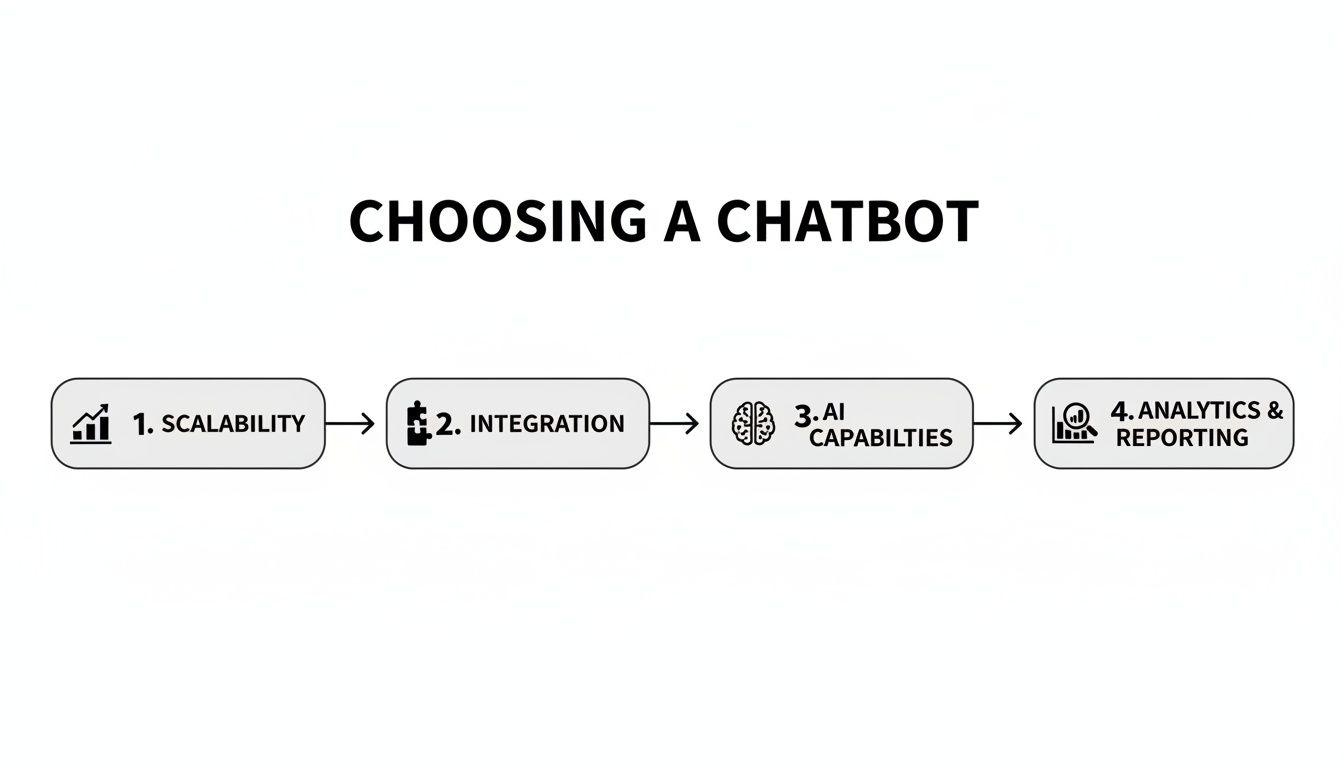
As you can see, a real enterprise-grade solution has to deliver on four fronts: it must be scalable, integrate smoothly, have truly smart AI, and give you actionable data.
Phase 3: Design and Build Your Conversation Flows
This is the creative part—where your chatbot gets its personality. Start by mapping out the most common, mind-numbingly repetitive conversations your team currently handles. For any e-commerce brand, that list almost always includes order tracking, return requests, and basic product questions.
Design conversation flows that feel natural and genuinely helpful, all while staying true to your brand's voice. A well-designed workflow doesn't feel like talking to a robot; it feels like getting a fast, efficient answer. If you're new to this, checking out a guide on how to build a chatbot can give you a great starting point for crafting effective automated scripts.
Pro Tip: Start with the low-hanging fruit. Automate the top five most frequent questions your support team gets. This single move can immediately free up a massive chunk of their time and deliver a quick, satisfying win.
Phase 4: Run a Controlled Pilot Test
Whatever you do, don't unleash a brand-new system on your entire customer base at once. That's a recipe for disaster. A pilot test is your safety net. Deploy the chatbot to a small, controlled group first—maybe on a single product page or to a select list of VIP customers.
This small-scale launch lets you gather real-world data and honest feedback without risking a major public stumble. Use this phase to find clunky conversation paths, squash any technical bugs, and identify gaps in the bot's knowledge. Listen to the feedback, measure the initial results against your KPIs, and fine-tune everything before you even think about a full rollout.
Phase 5: Go Live and Never Stop Improving
Once your pilot test is a success and you’ve ironed out the kinks, it's time to go live. But the job isn't done. A great chatbot implementation is a living, breathing project that requires constant monitoring and tweaking.
Make a habit of digging into your chatbot's analytics dashboard. Keep a close eye on:
- Unresolved Questions: What is the bot consistently failing to answer? This is a goldmine of data for expanding its knowledge base.
- User Drop-Off Points: Where are people getting stuck and giving up? This usually flags a confusing or frustrating workflow that needs a redesign.
- Performance vs. KPIs: Are you actually hitting the goals you set back in Phase 1?
Treat your chatbot like a new team member that needs coaching and training to get better over time. This cycle of continuous optimization is what turns a good tool into a powerful, long-term asset for your business.
Looking Ahead: How to Future-Proof Your E-Commerce Strategy
Bringing enterprise chatbots into your workflow isn't just about plugging a few efficiency gaps. It’s a strategic decision that locks in your competitive advantage for the long haul. In a market that worships speed and personalization, sticking with manual processes is like showing up to a Formula 1 race on a bicycle. Automation is the engine you need for real, sustainable growth.
The whole point of this strategy is to make decisions based on data, not just gut feelings. When your chatbot's performance data flows directly into your main profit dashboard, you get a completely transparent view of what’s actually moving the needle. You can literally draw a straight line from automated affiliate outreach to a bump in your Gross Merchandise Value (GMV) or see exactly how instant support cuts down on customer churn.
Shifting to Data-Driven Decisions
This is where the top brands separate themselves from the pack—they move from being reactive to proactive. The demand for these tools is absolutely skyrocketing, with over 987 million people already using AI chatbots. This wave is driving massive growth, especially in places like the Asia Pacific region, which is on track for a 24.2% CAGR through 2028.
For TikTok Shop sellers who live and die by their GMV, COGS, and commission numbers, integrating chatbots for enterprise means you can finally make sharp, data-backed decisions in the moment. The guesswork is gone. You can find more incredible stats about this trend in this AI chatbot statistics report from Fullview.io.
A data-first mindset changes the game for every team:
- Marketing: Instantly spot your most valuable affiliate partners and pour your resources into what’s proven to work.
- Operations: Get a live feed of customer complaints and issues, helping you fix products and sharpen your processes on the fly.
- Finance: Forecast revenue and manage your budget with total clarity, since you can see exactly how your operations impact the bottom line.
The real power of enterprise automation is the clarity it brings. It cuts through the operational fog, letting you steer the ship with confidence because you know every decision is calculated to drive profit and secure your future.
Your Next Step: Building for Scalable Growth
The way forward is pretty clear. The days of grinding out e-commerce growth with pure manual effort are over. The winners will be the brands that build smart, automated systems capable of handling the volume, complexity, and breakneck speed of modern commerce.
When you adopt a complete automation solution, you're not just buying a piece of software—you're fundamentally changing how your business operates. You’re building a model where growth doesn’t automatically lead to team burnout and where scaling becomes more predictable and a whole lot more profitable. It’s time to ditch the manual guesswork and make automation the core of your strategy.
Frequently Asked Questions
Jumping into the world of enterprise chatbots can bring up a few practical questions. If you're running an e-commerce brand, especially on a fast-moving platform like TikTok Shop, you're probably wondering about the real-world complexity, the investment, and how it all actually works. Let's clear up some of the most common queries.
Do I Need a Developer to Set This Up?
Nope, not anymore. The days of needing a programming team to build a chatbot are long gone. Modern enterprise platforms are built for business users, not coders.
You'll typically find a guided setup process that involves connecting your store, using a simple visual builder to drag and drop automation rules, and tweaking pre-made message templates. The best companies also provide dedicated support to walk you through everything, ensuring you’re up and running without a hitch.
Can a Bot Really Handle Complex Affiliate Negotiations?
Let's be clear about the bot's job. An enterprise affiliate bot is a master of scale. Its superpower is automating the most grueling parts of outreach—finding, contacting, and following up with thousands of potential partners. It's designed to start conversations and filter for serious interest.
Think of it as your super-efficient opening act. Once a creator is genuinely interested and ready for the finer details, the bot hands them off seamlessly to a human manager. This frees up your team to focus only on the high-value conversations that seal the deal.
Is an Enterprise Chatbot Actually Worth It for a Growing Brand?
Absolutely. For a brand on the rise, the biggest roadblock is often that manual tasks just don't scale. An enterprise chatbot isn't just a tool; it's an investment in your brand's future.
By automating customer service and creator outreach now, you're building an operational backbone that can handle a massive surge in sales without needing to hire an army of new staff. It's a strategic move that makes your growth far more efficient and profitable down the road.
Ready to unlock scalable growth on TikTok Shop? HiveHQ provides the automation and analytics you need to operate with precision. Automate your creator outreach, track real-time profitability, and make data-led decisions without the guesswork. Start building a more efficient and profitable business today.