Chatbots Lead Generation Your Guide to High Conversions
chatbots lead generationlead generation aie-commerce automationaffiliate marketingai chatbot
Let’s be honest: your website's contact form is probably where good leads go to die. They’re static, impersonal, and force interested people to wait. In a world of instant gratification, filling out a form and waiting for an email feels like a chore, causing most visitors to just click away.
This is exactly why AI chatbots are a game-changer for lead generation. They flip the script from passive to proactive.
Turn Website Visitors Into Leads With AI Chatbots
Imagine a potential partner for your affiliate program browsing your site late on a Tuesday night. Instead of just hoping they find your contact form and remember to email you tomorrow, a chatbot can pop up and start a conversation right then and there. It can answer their questions about commission rates, program terms, and sign them up on the spot. That immediate, helpful interaction makes all the difference.
The Power of Proactive Engagement
A well-designed chatbot doesn’t just sit there waiting. It initiates the conversation, turning your website from a one-way brochure into a two-way dialogue. This is how you capture those high-intent visitors who are ready to act but might not have the patience for a traditional follow-up process.
This proactive model is more than just a fancy contact form; it’s like having an automated sales assistant working for you 24/7. Before you jump into building one, it's worth understanding the top benefits of chatbot lead generation. If you're curious about the tech that makes this possible, our guide on how do chatbots work breaks it all down.
Why Chatbots Outperform Static Forms
The proof is in the numbers. Across the board, businesses see a real impact from this conversational approach. In fact, 64% of companies using chatbots have seen a significant jump in the number of qualified leads they generate. Why? Because that real-time engagement can boost conversion rates by up to 20%, particularly for B2B or e-commerce where getting quick answers is crucial.
Here's a clearer look at how the two methods stack up.
Lead Generation Methods Traditional vs Chatbot
| Feature | Traditional Lead Forms | Chatbot Lead Generation |
|---|---|---|
| Engagement | Passive, user-initiated | Proactive, bot-initiated |
| Response Time | Delayed (hours or days) | Instant, 24/7 availability |
| Personalization | Generic, one-size-fits-all | Dynamic, tailored to user behavior |
| Qualification | None, all submissions treated equally | Real-time, pre-qualifies leads with targeted questions |
| User Experience | High-friction, feels like a task | Low-friction, conversational and helpful |
| Data Collection | Collects basic contact info | Gathers rich, contextual data through dialogue |
The table makes it pretty clear: chatbots create a fundamentally better user experience that leads to better business outcomes.
A chatbot doesn’t just collect information; it qualifies it. By asking the right questions, it can tell the difference between a casual browser and a high-value prospect, making sure your sales team spends their time on leads that are actually ready to convert. A static form could never do that.
Design a Chatbot Conversation That Actually Converts
A great chatbot doesn't feel like a robot; it feels like a genuinely helpful assistant guiding a visitor toward a solution. The difference between a fresh lead and a lost opportunity often boils down to the quality of that first conversation. Designing a flow that qualifies leads without scaring them away is an art, but it's one you can absolutely master.
The whole point is to create a natural dialogue that collects the information your team needs for a warm follow-up. A well-designed conversation seamlessly moves a user from a casual browser to an engaged prospect.
This simple flowchart breaks down the powerful journey a chatbot creates, turning anonymous website traffic into real, qualified leads for your business.
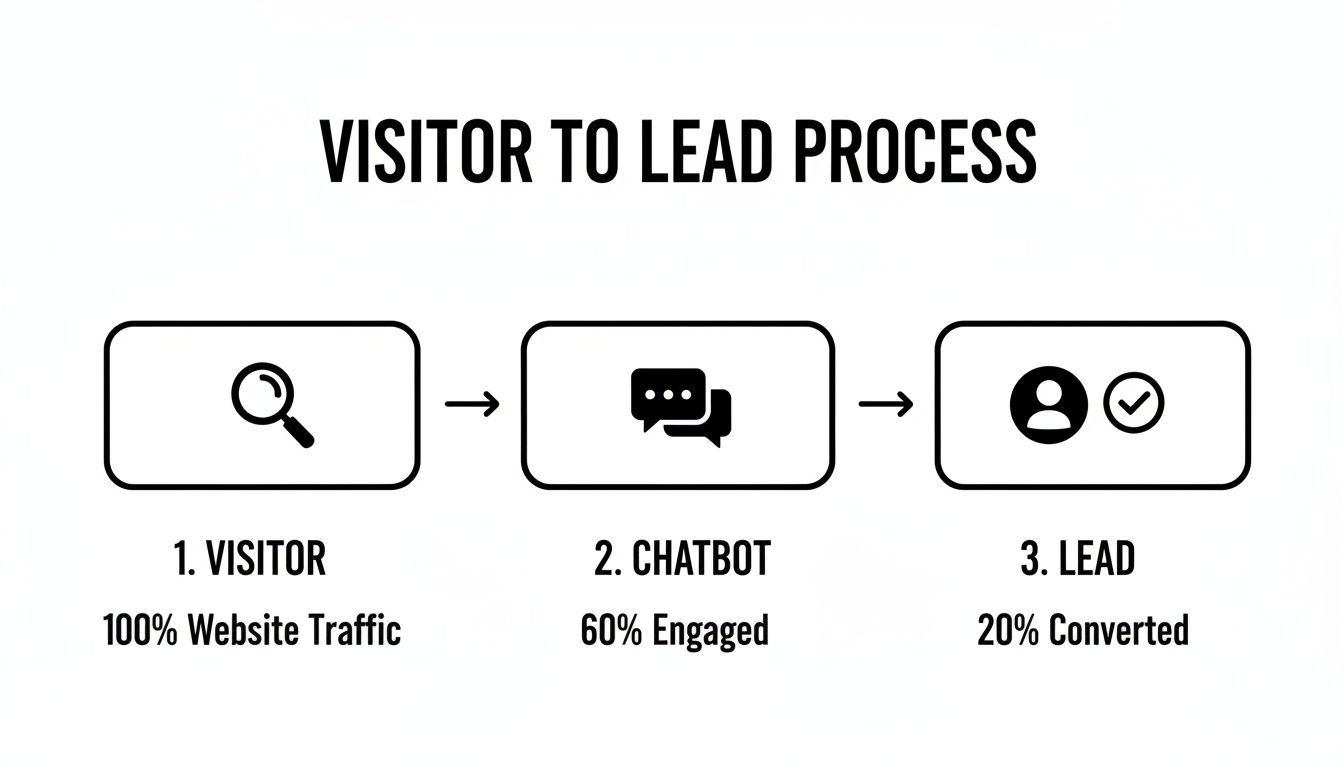
As you can see, the chatbot acts as an incredibly effective filter. It engages a huge portion of your visitors and pinpoints the most interested among them, converting them into actionable leads.
Crafting the Initial Hook
Your chatbot’s very first message is its most important. Seriously. It needs to be compelling enough to stop a visitor in their tracks and get them to engage.
Ditch the generic "How can I help you?" Instead, make it contextual and show its value immediately.
- For an e-commerce site: "Hi there! Looking for the perfect fit? I can help you find your size or check on an order in seconds."
- For affiliate recruitment: "Hey, creator! Saw you're checking out our partner program. I can answer your questions about commission rates and get you started."
This approach instantly shows the user the bot understands why they're there and can provide immediate help, which is a game-changer for engagement.
Asking Smart Qualification Questions
Once you have their attention, it’s time to qualify them. The secret is to ask questions that feel like a natural part of a conversation, not an interrogation. Weave them into the flow logically.
For example, after helping an e-commerce customer find a product, the bot could ask, "Great choice! Can I get your email to send you a 10% off coupon for your first order?" You're framing data collection as a direct benefit to them.
The most effective chatbots gather information by offering something valuable in return. Whether it's a discount, a helpful guide, or a personalized recommendation, the exchange has to feel worth it to the user. This simple strategy turns what could be a chore into a welcome interaction.
If you’re trying to recruit a new TikTok affiliate, the conversation might go like this: "Awesome! To see if we're a good match, what's your primary content niche and typical engagement rate?" This question is direct but highly relevant, filtering candidates on the spot.
These small tweaks have a massive impact. In fact, 77% of marketers who use this kind of automation see higher lead conversions. Why? Because this conversational approach can generate twice as many conversions as a static form or a boring landing page.
Ultimately, building a high-converting chatbot requires a thoughtful approach to dialogue design. For a deeper dive into the technical side, check out our guide on how to build a chatbot from the ground up.
Where to Put Your Chatbot for the Best Results
You can build the world's smartest chatbot, but it won't do you any good if nobody uses it. Where you place your bot is just as important as what it says. It’s all about meeting your audience exactly where they are, right when their interest is highest.
Think beyond just slapping a widget on your homepage. The real magic happens when you get strategic. Where do your most motivated visitors hang out? That’s where your bot needs to be, ready to turn a passive scroll into an active, valuable conversation.
Pinpoint Your High-Intent Website Pages
Your website is your home turf, and it’s the perfect place to start your chatbots lead generation strategy. But not all pages are created equal. Instead of a blanket approach, focus your firepower on the pages where people are closest to making a decision.
- Pricing Page: Someone on this page is already doing the math. A well-placed chatbot can jump in to clarify plan details, explain features, or even schedule a call for a custom quote, capturing a lead who is seriously considering your offer.
- Product or Service Pages: When a visitor is digging into the specifics of what you sell, they’re bound to have questions. A bot can provide instant specs, offer a link to a case study, or book a demo on the spot. Our guide on bots for shopping dives deep into how this works for e-commerce.
- Affiliate Sign-Up Page: This is a goldmine for recruiting new partners. Your chatbot can act as an initial screener, asking potential affiliates about their audience, niche, and promotion strategies before they even fill out the form.
Go Beyond Your Website and Onto Social Media
Your audience isn't confined to your website—they're scrolling through social media every single day. Deploying chatbots on these platforms lets you engage with potential leads and creators in a much more direct and personal way.
Think about using an Instagram or Facebook Messenger bot. Imagine a potential creator comments on your post asking how to partner with you. A bot can immediately slide into their DMs to start the conversation. That instant response catches them while their interest is red-hot, rather than waiting for them to find your website.
Meeting people on the platforms they use every day removes a ton of friction. A quick chat in their DMs feels way more natural and less of a commitment than clicking to a website and filling out a stuffy form. This simple shift can dramatically boost your engagement.
By taking a multi-channel approach, your chatbots lead generation machine never sleeps. You’re not just sitting back and waiting for people to find you; you're actively starting conversations in the digital spaces they already call home. You'll never miss a chance to connect with a perfect-fit prospect again.
Connect Your Chatbot to Your CRM for Seamless Follow-Up
Capturing a lead's information is a great start, but it’s only half the battle. The real magic happens when that fresh data flows straight into your Customer Relationship Management (CRM) system, instantly and without any manual effort. Let's be honest, copying and pasting lead details from your chatbot to your CRM is tedious, slow, and a surefire way to let hot leads slip through the cracks.
This is where integration is absolutely essential. By hooking your chatbot directly into your CRM, you create a smooth, automated pipeline that gets qualified leads from the chat window to your team for follow-up. It transforms your bot from a simple data-entry tool into a powerful lead generation machine that scales with your business.
Why You Can’t Afford to Skip Direct Integration
Think about the speed. When your chatbot identifies a high-intent lead—maybe a creator with 50,000 followers who wants to join your affiliate program—that information can't just sit in a chatbot inbox. It needs to land in your CRM immediately.
A proper integration makes this happen and kicks off a chain of events:
- Instant Record Creation: A new contact profile is built in your CRM the second the chat ends, filled with all the info the bot collected.
- Smart Tagging and Scoring: The new lead can be automatically tagged based on their answers (like "High-Value Affiliate") and scored to prioritize follow-up.
- Automatic Assignment: The lead is instantly routed to the right person, whether that’s someone on your sales team or an affiliate manager.
This kind of seamless handoff means your team can follow up in minutes, not hours, catching leads while they're still fired up about your offer.
A lead's value drops off a cliff with every minute that passes. The odds of actually making contact with a lead decrease by over 100 times if you wait 30 minutes versus just 5. A solid chatbot-to-CRM connection closes that gap and lets your team strike while the iron is hot.
Connecting Your Tools for Better Results
So, how do you actually get this done? Thankfully, most modern chatbot platforms are built for this. They offer native, one-click connections to popular CRMs like HubSpot, Salesforce, and Zoho. Setting these up is usually as simple as logging into your CRM account through the chatbot’s dashboard.
If there isn't a direct connection available for your specific tools, don't worry. A middleware service like Zapier is your best friend. It lets you build simple workflows, or "zaps," that connect thousands of apps. You can create a rule that says, "When my chatbot captures a new lead, create a new contact in my CRM with these specific details."
For example, picture your chatbot qualifying a potential TikTok Shop customer who needs a quote for a bulk order. With an integration, their contact info, budget, and product interests are instantly zapped over to Salesforce. At the same time, a task is created and assigned to a sales rep who gets a notification to follow up right away with a personalized quote. This isn't just about saving time; it's about building a smarter, faster sales process that ensures your best leads always get the attention they deserve.
How to Measure and Optimize Your Chatbot's Performance
Putting a chatbot on your site is a great start, but the real magic happens when you start refining it. Think of your bot's launch as day one. To turn it into a genuine lead-generating machine, you have to constantly measure what’s working, figure out what isn’t, and make smart adjustments.
Guesswork just won’t do. You need to get into the data. This means looking past surface-level numbers like "total conversations" and digging into the metrics that actually affect your revenue. Are these chats turning into qualified leads? Are those leads actually buying anything? Answering these questions is how you get real results.
Key Chatbot Lead Generation Metrics to Track
To get a true sense of your chatbot's impact, you'll want to keep a close eye on a few key performance indicators. The table below breaks down the most important metrics I track to understand how a bot is really doing.
| Metric | What It Measures | Why It Matters |
|---|---|---|
| Lead Qualification Rate | The percentage of conversations that result in a qualified lead. | This shows how well your bot filters for serious prospects, saving your sales team from chasing dead ends. |
| Conversion Rate from Chat | The percentage of qualified chatbot leads who become paying customers. | This is the ultimate test of lead quality and the smoothness of your bot-to-human handoff. |
| Chatbot-Influenced Revenue | The total revenue generated from leads who first interacted with your chatbot. | This directly connects your bot's activity to your bottom line. It's the most important number. |
These metrics tell the story of your chatbot's journey from conversation to cash. A simple conversion rate calculator can be a handy tool for quickly checking how small tweaks affect your overall numbers.
Don’t just track how many people talk to your bot; track how many of those conversations turn into money. A high engagement rate is nice, but a high chatbot-influenced revenue is what actually moves the needle for your business.
Running A/B Tests to Improve Performance
Once you've got your baseline data, it's time to start experimenting. A/B testing is your best friend here. It lets you test small changes to your bot's script, timing, or flow to see what your audience responds to best.
Here are a few practical A/B tests I’ve seen work wonders:
- Test your opening lines. Pit a direct question like, "Looking for help with our affiliate program?" against a benefit-driven opener, such as "Want to see how our top affiliates earn over $5k a month?"
- Tweak your qualification questions. Do you ask for an email right away? Try asking for it after you’ve provided some value and see if your completion rate improves.
- Adjust your timing and triggers. If your bot currently pops up after 5 seconds, test what happens if you wait 15 seconds or trigger it only when someone signals they're about to leave the page.
Find and Fix Conversation Bottlenecks
Your chatbot's conversation logs are an absolute goldmine. I make it a habit to regularly read through transcripts to see where people are getting confused, stuck, or just giving up. This is where you'll find awkward phrasing, unclear questions, or frustrating dead ends in your flow.
When you spot a common drop-off point, you’ve found a bottleneck. Fix it. You might need to rephrase a question, add more response options, or give people a clear path to talk to a human. Every bottleneck you fix plugs a leak in your lead generation funnel, which means more qualified prospects get through.
When done right, the results can be massive. Businesses that dial in their chatbot strategy see 67% higher sales, and a surprising 26% of all sales now begin with a bot interaction.
Got Questions About Using Chatbots for Leads?
Jumping into the world of chatbots can feel a little overwhelming, especially when you're already juggling an e-commerce store or trying to grow an affiliate program. It's totally normal to have a few questions about how they work, what they feel like for users, and if they'll actually help you hit your goals.
Let's clear up some of the most common worries I hear. Getting these sorted will help you build your strategy with confidence.
Do I Need to Be a Coder to Build a Lead Gen Chatbot?
Not anymore. That’s a myth from the early days of chatbots. Today's platforms are built for business owners and marketers, not developers. Most use a simple drag-and-drop interface.
Honestly, if you can sketch out a conversation on a napkin, you’ve got the skills you need. Many tools even come loaded with pre-built lead generation templates. You can just plug in your own questions, add your logo, and have a working bot in minutes.
Will a Chatbot Annoy My Website Visitors?
A bad chatbot? Absolutely. But a good one? It actually makes for a better, smoother experience for your visitors. The trick is to design it to be helpful, not aggressive.
Forget the jarring pop-ups that hijack the entire screen. Instead, make your chatbot a subtle, user-initiated widget. A visitor should have to click on it to start a conversation.
The goal is to provide instant value. When a bot can immediately answer a question about shipping, help someone find the right product, or offer a timely discount, it becomes a helpful assistant, not a pest.
Your bot shouldn't be forcing a conversation on every single person. It should be there, ready and waiting, for the visitors who actually need help or are signaling they're ready to move forward. A well-designed bot is a patient one.
Can I Really Use a Chatbot to Recruit TikTok Affiliates?
You bet. This is one of my favorite uses for a chatbot, and it can be a total game-changer for affiliate recruitment. You can embed it right on your affiliate sign-up page or even set it up to handle initial chats in your social media DMs.
Think of it as your automated front-line recruiter. It can ask all those crucial pre-qualifying questions for you, like:
- What’s your main content niche?
- Can you share your typical follower count and engagement rate?
- Which platforms do you focus on?
This simple conversation automatically vets applicants, filtering for the high-potential partners you actually want to work with. This frees up your affiliate manager from sifting through hundreds of applications so they can spend their time building relationships with your best creators.
What’s the Difference Between a Basic and an AI Chatbot?
A basic chatbot, often called a rule-based bot, works like an old-school phone menu. It follows a very strict, pre-written script based on the buttons a user clicks. It's perfect for simple, linear conversations where you want to guide the user down a very specific path.
An AI chatbot is much more advanced. It uses Natural Language Processing (NLP) to understand what a user is really asking, even if they use slang, make a typo, or phrase their question in a unique way.
For lead generation, AI bots create a much more natural, human-like conversation. In my experience, this almost always leads to higher engagement rates, better-qualified leads, and a far more impressive user experience.
Ready to stop losing leads and start automating your growth on TikTok Shop? HiveHQ provides the Affiliate Bot, Profit Dashboard, and Creator Tracker you need to scale efficiently. Discover and recruit the right creators automatically with HiveHQ.