The Ultimate Influencer Brief Template for TikTok Shop
influencer brief templatetiktok shop creatoraffiliate marketingugc campaignscreator outreach
An influencer brief is the instruction manual you give a creator for your campaign. For TikTok Shop, this document is your single source of truth. It lays out the goals, what you need them to create, and your expectations, preventing any expensive mix-ups before a video ever gets posted.
Why Your Influencer Brief Is the Key to TikTok Shop Growth
Let’s be real for a second: winging it with creator collaborations is a recipe for disaster. If you don't have a clear plan, you're bound to get content that doesn't quite hit the mark—maybe it misrepresents your product, glosses over the best features, or just doesn't convince anyone to buy. This is a massive risk on TikTok Shop, where one great video can drive thousands in sales overnight, and a bad one can be a complete waste of money.
A solid influencer brief template is your insurance policy. It protects you from burning through your budget and, just as importantly, protects your brand's reputation. Think of it as the blueprint for a successful partnership. It's not about dictating every move to a creator; it's about making sure you both agree on what "success" looks like from the get-go.
From Chaos to Clarity: The Role of a Standardized Brief
Imagine you send a new skincare product to an affiliate with a vague note that just says, "Please post a video." The creator does their best and produces a gorgeous, cinematic clip focusing on the slick packaging and creamy texture. It looks great, but they completely missed the main selling point: its scientifically-proven ability to slash redness in under an hour. The video might get views, but you get zero sales. Your investment is gone.
Now, let's replay that scenario. This time, the creator gets a clear, one-page brief that spells everything out:
- The Campaign Goal: Drive direct sales through the TikTok Shop link.
- Key Talking Point: Hammer home the fast-acting, anti-redness formula.
- Visual Mandatories: Must show a clear before-and-after shot.
- Call-to-Action: Tell viewers to tap the orange shopping cart icon to buy it now.
This simple shift changes everything. The creator has all the essential info they need to make content that not only looks amazing but actually works. They can still be themselves and use their unique style, but it’s all aimed at a clear, strategic goal.
More Than Instructions, It’s a Partnership Agreement
A good brief is more than just a to-do list. It makes the entire collaboration feel more professional and sets a clear standard. It’s a document both you and the creator can refer back to, making sure everyone is aligned on deliverables, deadlines, and payment terms.
By standardizing your briefing process, you turn creators from unpredictable freelancers into a reliable and scalable sales channel. This is how you go from hoping for a one-off viral hit to building a predictable revenue stream for your TikTok Shop.
Ultimately, a detailed influencer brief template is the bridge between your brand's business goals and a creator's genuine connection with their audience. It ensures your product is shown in its best light while allowing their voice to shine through. Getting this alignment right is the non-negotiable first step to scaling your brand on the platform.
What Goes into a Great Influencer Brief?
A solid influencer brief is the blueprint for a winning campaign. It’s more than just a list of instructions; it's what bridges the gap between your brand’s goals and a creator’s authentic style. When you get it right, the content feels genuine but still hits all the right strategic notes to drive sales.
I like to think of a good brief in three parts: the vision, the specifics, and the ground rules. Each section answers key questions for the creator, so there’s no guesswork that could throw the whole project off track.
Laying the Groundwork with Context and Vision
Before you get into the deliverables, you have to set the scene. This first part is your chance to get the creator genuinely excited about what you’re doing.
Start with a punchy Company and Campaign Overview. This isn't the place for your formal "About Us" page. Tell a story. What problem does your product solve? What’s the magic behind it? Then, explain the "why" for this specific campaign. Are you dropping a new product? Is there a big seasonal sale? Or are you trying to stock up on authentic user-generated content?
- Brand Story: Give them a short, compelling narrative about your company’s mission. Why do you exist?
- Campaign Goal: Be crystal clear about the main objective. Something like, "Drive direct sales of our 'Glow Up' serum through its TikTok Shop link."
- Target Audience: Paint a picture of your ideal customer. Who are they, what do they care about, and how does your product make their life better?
Giving a creator this context is a game-changer. It empowers them to talk about your product in a way that truly connects with their followers, turning a simple transaction into a real partnership.
A great brief inspires, it doesn't just instruct. When a creator understands your vision, they can translate it into content that feels natural and compelling, which is exactly what you need for TikTok Shop success.
Defining the Nitty-Gritty Details
Okay, this is where we get down to business. The core of your brief is outlining exactly what you need, and you can’t afford to be vague here. Clarity prevents frustrating revisions and misaligned content later on.
Your Creative Guidance and Key Talking Points are absolutely vital. You don't want to script their video word-for-word—that kills authenticity. But you do need to provide some guardrails. Give them two or three non-negotiable features or benefits they have to mention. For a skincare product, that might be "clinically proven to reduce redness in 30 minutes."
Next, spell out the Content Deliverables and Timeline. Get specific.
- Format & Quantity: "One (1) TikTok video, 30-60 seconds in length."
- Posting Schedule: Give them a firm deadline for the draft and a clear window for when the video should go live.
- Platform Specifics: Explicitly state that the video must be posted to their TikTok feed.
This is also where you’ll put your Do's and Don'ts. Think of this list as your brand safety net. "Do's" could include things like showing the product in natural light or demonstrating its texture. "Don'ts" are just as important—no competitor logos in the background, no profanity, and definitely no unverified medical claims.
Many of these principles are universal when it comes to creative work. You'll find similar advice in guides on how to write a creative brief for any marketing project.
Outlining the Rules of Engagement
The final piece of the puzzle covers the operational and legal stuff that protects both you and the creator. Here, you’ll clearly state the FTC Disclosure Requirements. Always, always mandate clear and obvious disclosures like #ad or #sponsored right at the beginning of the caption.
For TikTok Shop, the Call-to-Action (CTA) needs to be direct. Don't just ask them to say "link in bio." Tell the creator to specifically instruct their audience to "tap the orange shopping cart button on the screen to buy now." This direct command makes a huge difference in conversions.
Getting this right isn't just about good content; it's about efficiency. Brands that use standardized, well-structured briefs have seen their CPMs drop by as much as 53% year-over-year. That's a massive cost saving, especially in an industry projected to grow from $23.59 billion to $70.86 billion by 2032. For anyone watching their bottom line, that’s an advantage you can’t ignore.
Before we move on, let's pull all these components together into a simple checklist you can reference every time you build a brief.
Influencer Brief Template Checklist
This table summarizes the essential components every TikTok Shop influencer brief must include to ensure clarity and success.
| Component | What to Include | Why It Matters |
|---|---|---|
| Campaign Overview | Your brand story, campaign goals, target audience, and key messaging. | Aligns the creator with your vision and helps them create relevant, authentic content. |
| Product Details | Product name, key features, benefits, and unique selling propositions (USPs). | Ensures the creator has all the necessary information to accurately represent the product. |
| Content Deliverables | Format (video, story), quantity, length, and specific platforms (e.g., TikTok). | Sets clear expectations and prevents misunderstandings about the scope of work. |
| Creative Guidance | Key talking points, visual style, tone of voice, and any specific angles to explore. | Provides direction without stifling creativity, ensuring brand consistency. |
| Do's and Don'ts | Specific instructions on what to include (e.g., product demo) and what to avoid (e.g., competitor mentions). | Protects your brand's reputation and ensures content is compliant and on-message. |
| Call-to-Action (CTA) | Exact phrasing for TikTok Shop, such as "Tap the orange shopping cart to buy now!" | Directly drives conversions by making it incredibly simple for viewers to purchase. |
| Timeline & Deadlines | Draft submission date, feedback window, and the final go-live date/time. | Keeps the campaign on schedule and allows for necessary reviews and revisions. |
| Legal & Disclosures | FTC disclosure requirements (#ad, #sponsored) and any other necessary legal language. |
Ensures compliance with advertising regulations and maintains transparency with the audience. |
| Payment & Terms | Compensation details (flat fee, commission, or both), payment schedule, and usage rights. | Establishes a professional agreement and clarifies ownership of the content. |
Having a checklist like this on hand is a lifesaver. It guarantees you won't miss any critical details, setting both you and your creator up for a smooth and profitable collaboration.
Tailoring Your Brief for Different Campaign Goals
Let's be real: a one-size-fits-all influencer brief is a recipe for disaster. Your campaign goals can swing wildly from one month to the next, and your brief has to keep up. If you send the exact same document for a brand awareness push as you would for a hard-hitting sales campaign, you're just setting yourself up for misaligned content and a wasted budget.
Success on TikTok Shop is all about adapting your playbook. A creator seeding program designed to get a library of authentic User-Generated Content (UGC) has completely different needs than a high-stakes product launch meant to sell out in 24 hours. Each goal calls for its own unique set of deliverables, performance metrics, and even payment terms.
This visual breaks down the core sections of any solid brief—the overview, deliverables, and rules. Think of these as the fundamental building blocks you'll rearrange and customize for every campaign.
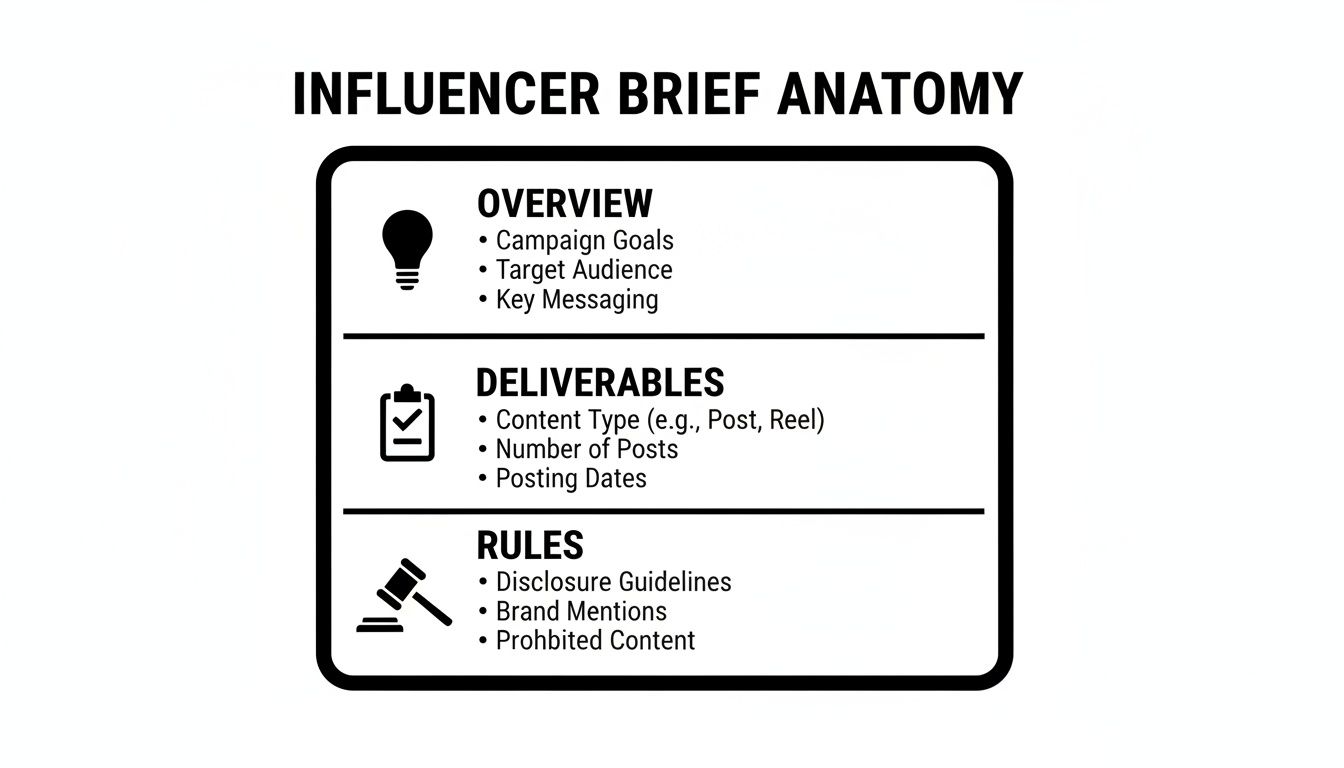
This structure is your foundation. Once you have it down, you can simply plug in the specific goals and instructions you need to get the job done.
Scenario 1: The UGC Seeding Campaign
Picture this: you're launching a new line of sustainable home cleaning products. Right now, your main goal isn't immediate sales. It's about building a stockpile of authentic video testimonials that you can repurpose for future ads. This is your classic UGC seeding play.
For this brief, you'll want to dial back the emphasis on sales metrics. The whole vibe should be more collaborative and less prescriptive, giving creators the freedom to share their genuine experiences with the product.
Mini-Brief Breakdown: UGC Seeding
- Campaign Goal: Generate 20-30 high-quality, authentic UGC videos showing the product being used in a real home.
- Deliverables: One 30-45 second TikTok video featuring a clear before-and-after cleaning shot. The creator must grant the brand full usage rights for paid advertising for 90 days.
- KPIs: The focus is on content quality, how well it aligns with your brand message, and the overall completion rate. Sales (GMV) are a nice bonus, not the main event.
- Compensation: Gifting the product plus a flat fee to fairly compensate the creator for their time and for granting you those crucial usage rights.
The most important part here is being crystal clear on content ownership. Since the entire point is to get assets for your ad campaigns, the brief has to spell out your usage rights in no uncertain terms. This will save you from major legal headaches later on.
Scenario 2: The High-Impact Product Launch
Okay, let's shift gears. Your brand is dropping a limited-edition sneaker next Friday, and the goal is to drive a massive sales spike on day one. For this, your brief needs to scream urgency and provide a super clear path to purchase. Authenticity still matters, of course, but the focus is now squarely on direct-response marketing.
This brief is going to be far more structured. You'll include specific talking points and a call-to-action (CTA) that is absolutely non-negotiable.
Mini-Brief Breakdown: Product Launch
- Campaign Goal: Maximize Gross Merchandise Value (GMV) within the first 48 hours of the drop.
- Deliverables: Two TikTok videos. The first is a teaser video that goes live 24 hours before launch. The second is a "shop now" video posted at the exact moment the product goes live.
- KPIs: We're tracking GMV, conversion rate, click-through rate on the TikTok Shop link, and Cost Per Acquisition (CPA).
- Compensation: A higher flat fee paired with a performance bonus for hitting specific sales targets (e.g., an extra $500 for every $5,000 in GMV they generate).
This kind of structure incentivizes creators to make content that not only looks great but actually converts their audience into paying customers. Finding the right talent for this is everything, which is why having access to a solid TikTok influencer database is a game-changer for targeted recruitment.
Scenario 3: The Long-Term Affiliate Partnership
Finally, let's talk about building a steady, long-term revenue stream. The goal here is to bring creators into an evergreen affiliate program where they earn a commission on every sale they drive over the long haul. This requires a completely different kind of brief—one that reads less like a set of instructions and more like an onboarding guide for a true brand partner.
Your focus is on education and empowerment. You're giving the creator all the tools and info they need to talk about your products consistently and authentically for months to come.
Mini-Brief Breakdown: Affiliate Partnership
- Campaign Goal: Forge a long-term, profitable partnership that brings in consistent monthly affiliate revenue.
- Deliverables: An initial "announcement" video to introduce the partnership and the product. After that, the creator is expected to organically feature the product in at least two videos each month.
- KPIs: Monthly recurring GMV, affiliate link clicks, and the creator retention rate.
- Compensation: A generous, tiered commission structure (e.g., 15% commission on all sales, which jumps to 20% after they clear $1,000 in monthly sales). You might also include a small flat fee for that initial announcement video.
By tailoring your influencer brief template to fit each specific goal, you graduate from just "doing influencer marketing" to executing a precise, results-driven strategy. It's this adaptability that separates the brands that are just getting by from the ones that are consistently scaling on TikTok Shop.
Defining KPIs and Payment Terms That Protect Your Brand
An influencer brief without solid metrics and payment terms is just a wish list. To protect your brand and make sure your budget is actually working, you have to define Key Performance Indicators (KPIs) that connect directly to business growth—not just vanity metrics. This is where we stop chasing views and start tracking what truly matters.
For TikTok Shop, the most important numbers are the ones hitting your bottom line. Sure, likes and views feel good, but they don't pay the bills. Your brief needs to laser-focus on the KPIs that measure real financial results.
To get this right, using a good UTM Builder is a must. It helps you accurately track where every click and sale comes from, so you can see which creators are really moving the needle and calculate your ROI with confidence.
Moving Beyond Vanity Metrics
On TikTok Shop, the name of the game is turning viewers into customers. To do that, your brief has to spell out exactly how you'll be judging success. It’s time to stop obsessing over follower counts and get serious about transactional data.
Here are the only KPIs that should matter in your influencer brief:
- Gross Merchandise Value (GMV): This is the big one—the total dollar amount of products a creator sells. It’s the ultimate measure of their impact and should be your north star for any sales-focused campaign.
- Conversion Rate: This tells you what percentage of people who clicked the TikTok Shop link actually bought something. A high conversion rate is a great sign that the creator’s content is hitting the mark and their audience is a perfect fit.
- Cost Per Acquisition (CPA): How much did it cost you to get a new customer through that creator? Just divide their total payment by the number of sales they drove. A low CPA means a killer partnership.
- Click-Through Rate (CTR): This is the percentage of people who clicked the product link in the video. It’s a great early indicator of how compelling the video and the creator's call-to-action are.
Focusing on these metrics changes the entire conversation. You'll go from asking, "How many people saw it?" to "How much money did it make?"
Structuring Payment Models That Motivate
Your payment model needs to match your goals. A simple flat fee might be fine if you just want some user-generated content (UGC). But for driving sales, you need a structure that lights a fire under your creators. Often, a mix of payment types works best.
For TikTok Shop affiliates, I’ve found a hybrid model is incredibly effective. It usually looks like a modest base fee—to show you respect their time and lock in the collaboration—paired with a healthy commission on every sale they generate. This gives the creator some security while pushing them to go all-in on conversions.
Don't sleep on micro-influencers (10k-100k followers). They can deliver up to 60% higher engagement than bigger creators, making them absolute gold for campaigns where authentic connection drives sales. And if you find the right nano-influencers, their sky-high engagement rates on TikTok can lead to some seriously explosive affiliate results.
A great payment structure isn't just about paying for a video; it's about investing in a sales partner. By offering performance bonuses for hitting certain GMV milestones, you turn a one-off collaboration into an ongoing, mutually beneficial relationship where everyone is focused on growth.
Essential Clauses for Your Agreement
Finally, your brief has to lay out some clear legal terms. These aren't just boring formalities—they’re what will save you from headaches down the road over content rights and payments. Never, ever assume something is "understood." Put it in writing, every single time.
Make sure your brief or a separate agreement always covers these three bases:
- Content Usage Rights: Get specific. Where, how, and for how long can you use the creator's content? Can you turn it into a paid ad? Post it on your website or in emails? Lay it all out to avoid any confusion.
- Payment Schedule: Outline exactly when and how you'll pay. For instance: "50% of the flat fee is due on signing, with the final 50% paid within 14 days of the video going live. Affiliate commissions are paid out on the 1st of each month for the previous month's sales."
- Exclusivity Clause: If you don’t want a creator promoting your main competitor right after your campaign, you need an exclusivity clause. Clearly state the timeframe and list out the specific competitors.
By locking in these KPIs, payment models, and legal protections upfront, your influencer brief becomes more than just a guide—it becomes a powerful tool that drives results and protects your business.
How to Automate Your Briefing Process and Scale Your Outreach
If you’ve ever found yourself drowning in a sea of spreadsheets, manually creating, sending, and chasing down briefs for dozens of creators, you know it’s a direct path to burnout. That kind of administrative grind is the biggest bottleneck preventing you from scaling your TikTok Shop affiliate program.
To really grow, you have to move past one-off emails and embrace automation. It’s all about working smarter, not just harder. Modern affiliate platforms are built to do the heavy lifting, turning what was once a soul-crushing manual task into an efficient growth engine that works for you in the background. This is exactly how you win back your time to focus on strategy instead of busywork.

From Manual Outreach to Automated Recruitment
The first hurdle in scaling is finding the right creators without spending your entire day scrolling through TikTok. This is where automation can completely change the game. Imagine having a system that pinpoints relevant creators based on your specific criteria—niche, follower count, even past performance—and then reaches out to them for you.
With a platform like HiveHQ, for instance, you can set up campaigns that send thousands of personalized outreach messages a month. This isn't just a generic email blast. You can use tokens to pull in details like the creator's name, making each message feel personal. This approach massively expands your recruitment capacity, letting you build a huge pipeline of potential partners.
The real goal of automation isn't to remove the human touch. It’s about saving it for where it matters most. By automating the repetitive parts of outreach, you free up your energy to build genuine, high-value relationships with your top-performing affiliates.
Triggering Briefs at the Perfect Moment
One of the most powerful workflows you can set up is triggering your influencer brief template based on a specific action. The best trigger, hands down, is when you ship a product sample.
Think about it from the creator's perspective. They agree to work with you, and a few days later, your product shows up at their door. At that exact moment, an email with the complete brief lands in their inbox. This perfect timing ensures they have all the critical info—talking points, deliverables, CTAs—right when they're most excited to unbox the product and start creating.
This simple automation trick prevents the all-too-common scenario where a creator gets a product with zero context, which almost always leads to delays or content that misses the mark.
Setting Up Your Automated Workflow
Putting these systems in place is more straightforward than you might think. Most modern affiliate tools are designed to guide you through it. Here’s what the setup usually looks like:
- Integrate Your Systems: First, connect your affiliate platform to your e-commerce store (like Shopify) or shipping software. This is what allows them to "talk" to each other and share data.
- Build Your Brief Template: Create your master influencer brief template right inside the platform. Make sure to use placeholders or tokens for personalized details like the creator’s name or the specific product they’re receiving.
- Create the Trigger Rule: This is the core of the automation. You’ll set up a rule that says something like, "When a product's shipping status for an enrolled creator changes to 'shipped,' automatically send them the 'New Product Launch' brief."
- Activate Automated Follow-ups: Don’t stop at the brief. Set another rule to send a gentle reminder email three days before the content deadline. This simple step cuts down on manual check-ins and keeps everything on schedule.
This kind of system ensures every creator gets the same professional, consistent experience. With the influencer marketing industry now valued at a staggering $33 billion globally and 73.2% of brands working with ten or more creators per campaign, automation is no longer just a nice-to-have; it's essential for staying competitive.
By automating your briefing and follow-up process, you ensure every creator gets the right information at the right time, leading to better content and a much more scalable affiliate program. If you want to dive deeper into effective communication, check out our guide on influencer outreach email templates for more ideas.
Your Top Influencer Brief Questions, Answered
Even with the best template in hand, you're bound to have questions. It’s totally normal. Every campaign has its own quirks, and the creator world is constantly changing. To help you iron out those last few details, I've pulled together the questions I hear most often from brands working on their TikTok Shop briefs.
Think of this as your go-to cheat sheet. These are the practical, no-fluff answers you need to build your briefs with confidence and make sure your collaborations run like a well-oiled machine.
How Long Should an Influencer Brief Be?
I've found the sweet spot for a great influencer brief is somewhere between one and three pages. You want to be thorough, but you absolutely don't want to overwhelm the creator. Let's be real—if you send over a ten-page novel filled with corporate-speak, their eyes are going to glaze over, and key details will get lost.
Keep it clean and scannable. Use bold headings, short paragraphs, and bullet points to make the important stuff pop. A well-organized, concise brief shows you respect the creator's time and makes it easy for them to find exactly what they need to get started.
My rule of thumb: If a creator can't grasp the core of the campaign in under ten minutes, the brief is too complicated. It's a guide, not a legal tome.
Should I Give Creators Total Freedom or Be Very Specific?
Ah, the classic question. It's all about striking the right balance. The campaigns I’ve seen perform best are the ones that set clear "guardrails" but still leave plenty of room for creative magic to happen. You’re hiring these creators for a reason—they know their audience better than anyone. Trust that.
That said, you need to be crystal clear on the non-negotiables. These are the things that have to be there, no exceptions.
- Key Messages: What are the one or two things you absolutely need them to say about your product?
- FTC Disclosures: Make sure they know to put
#ador#sponsoredright at the beginning of the caption. It’s a legal must. - Call-to-Action: For TikTok Shop, this needs to be specific. Tell them to use phrases like, "Tap the orange shopping cart to buy."
Beyond that, try not to script their video word-for-word. Give them a mood board or a general creative direction for inspiration, but let them bring your product to life in their own authentic voice. That’s what will resonate with their followers and drive sales.
What Is the Biggest Mistake Brands Make in Their Briefs?
From what I've seen, the most common (and most expensive) mistake is being either too restrictive or way too vague. It's a surprisingly easy trap to fall into.
A brief that dictates every single shot, line, and camera angle will result in content that feels stiff and robotic. Audiences can spot a forced ad from a mile away. On the flip side, a brief that just says "make a video about our new moisturizer" is a recipe for disaster. It leads to confusion, countless emails back and forth, and content that completely misses the mark.
The key is finding that happy medium. Give them a solid framework with your goals and must-haves, but then empower them to run with it and add their own unique flair.
When Is the Right Time to Send the Influencer Brief?
Timing is everything here. You should send the full, finalized brief after you’ve locked in the collaboration terms and payment but before they actually start creating anything. The perfect time? Have it sent automatically the second you ship their product sample.
This creates a fantastic workflow. The creator gets the product in their hands, and boom, an email with the brief lands in their inbox at the same time. They have everything they need right when the excitement of unboxing is at its peak, which makes the whole process feel professional and seamless.
Tired of the manual grind of running your TikTok Shop affiliate program? HiveHQ automates your entire workflow, from finding and recruiting the best creators to automatically sending briefs and follow-ups. See how our all-in-one platform can help you build a predictable revenue stream at https://hivehq.ai.