A Startup's Guide to influencer marketing for startups on TikTok Shop
influencer marketing for startupstiktok shop strategycreator partnershipsstartup ecommercesocial commerce
Influencer marketing isn't just another line item in your marketing budget; for a startup, it's a lifeline. It lets you sidestep the massive expense of traditional ads and instead, tap into the authentic connection creators have with their audiences. In a world where people trust people, not ads, this is your chance to build credibility, drive real sales, and actually compete with the big guys.
This is especially true on platforms like TikTok Shop, where creator content is the engine of commerce.
Why Influencer Marketing Is a Startup’s Secret Weapon

As a startup founder, you know every dollar and every minute has to count. Pouring cash into traditional ads can feel like a gamble, with no guarantee of a return. Influencer marketing flips that script. It’s about joining conversations already happening in established communities, not trying to shout over the noise.
You get to partner with creators who have spent years earning the trust of their followers. This shift is critical. Consumers today are incredibly sharp—they'll take a recommendation from a creator they follow over a slick corporate ad any day of the week.
The Power of Authenticity and Niche Audiences
This is where startups have a real edge. You can be nimble and build genuine, one-on-one relationships with up-and-coming creators. Forget chasing celebrities with massive price tags. The real gold is with micro-influencers (10,000 to 100,000 followers).
Here’s why they’re so effective:
- Higher Engagement: Their communities are tight-knit and loyal. This means more comments, more shares, and more genuine interest in what they have to say.
- Greater Authenticity: A post from a micro-influencer feels like a recommendation from a trusted friend, not a paid-for ad. That authenticity builds instant trust for your brand.
- Cost-Effectiveness: They’re much more affordable, which means you can spread your budget across multiple creators, test different niches, and expand your reach without going broke.
The numbers back this up. The influencer marketing industry rocketed to $21.1 billion in 2023 for a reason. On average, businesses see a $6.50 return for every $1 spent. And micro-influencers? They drive a 60% higher engagement rate, which is why 56% of marketers now make them a core part of their strategy.
From Brand Awareness to Direct Sales
At the end of the day, influencer marketing is about more than just buzz. It's a direct-response channel that acquires customers.
On platforms like TikTok Shop, the gap between seeing a product and buying it has completely vanished. A creator’s video can drive a sale right inside the app, giving you a crystal-clear view of your ROI. This approach shares a lot of DNA with strategies like affiliate marketing for startups, where every dollar is tied directly to performance. For a startup that needs to prove traction from day one, that's a game-changer.
If you're hungry for more ways to move the needle, dive into our full guide on https://www.hivehq.ai/blog/ecommerce-growth-strategies.
Building Your Foundation for Success
Jumping into influencer outreach without a clear plan is like setting sail without a map. Sure, you might make some noise, but you'll have no idea if you're heading toward profitable growth or just burning cash. The most successful influencer marketing for startups I've seen is always built on a solid foundation: clear goals, real metrics, and a budget that makes sense. This prep work isn't glamorous, but it’s what separates a one-hit wonder from a scalable growth engine.
Before you even dream of which creators to DM, you need to answer a simple question: What are we actually trying to achieve here? Vague goals like "get more exposure" just don't cut it. You need to get specific and tie your objectives directly to where your business is right now.
Define Your Campaign Goals
Your startup's immediate needs should be the North Star for your influencer marketing. Are you brand new, a complete unknown? Or do you have a product that sells and just need to pour fuel on the fire?
Most goals will fall into one of three main buckets:
- Brand Awareness: This is for when your main problem is obscurity. The goal is to get your startup's name and mission in front of as many relevant eyeballs as possible. You’ll be tracking things like reach, impressions, and follower growth on your own accounts.
- Direct Sales (GMV): All about the money. Every single piece of content is engineered to convert viewers into paying customers. Success here is measured in cold, hard numbers—specifically Gross Merchandise Value.
- Content Generation (UGC): You're starved for authentic, high-quality photos and videos to feed your own ads and social channels. The objective is to build a library of creator-made content, saving you a fortune on production costs.
Pro Tip: Don't try to boil the ocean. Pick one primary goal for your first few campaigns. A campaign built for pure brand awareness looks completely different from one designed to max out GMV on TikTok Shop. Focus is your friend.
Connect Goals to Business Metrics
Once you’ve locked in a goal, you have to connect it to metrics that actually matter to your bottom line. Likes and comments feel good, but they don’t tell you if you're building a sustainable business.
Instead, get obsessed with these critical KPIs:
- Customer Acquisition Cost (CAC): How much are you paying to get a new customer through your influencer efforts? Just divide your total campaign spend (fees, commissions, product costs) by the number of new customers you brought in.
- Return on Ad Spend (ROAS): For every dollar you put in, how many dollars in revenue did you get back? A ROAS of 3:1 or higher is a fantastic starting point for a profitable channel.
Tracking these numbers is non-negotiable. It’s the only way you’ll ever know if your influencer marketing for startups is a smart investment or just another expense. This data gives you the confidence to double down on what’s working and kill what isn’t, fast.
Craft a Realistic Startup Budget
Your budget sets the rules for the game. As a startup, you probably don't have a massive war chest, so every dollar has to be put to work strategically. I generally see startups approach this in three stages, often moving from one to the next as they scale.
- Product Seeding: Your budget is basically the cost of goods sold. You send free products to micro-influencers for honest feedback or a piece of content. This is the perfect play for early-stage startups with a killer product but minimal cash.
- Commission-Based: This is pure performance. You pay creators a percentage of the sales they drive, which is a low-risk way to align incentives. It's especially powerful on platforms like TikTok Shop.
- Flat Fees + Commission: For more established creators, you might need to offer a flat fee for the content itself, plus a commission on sales. This hybrid model guarantees you get the content while still rewarding actual performance.
Getting your budget right is critical. In 2023, 39% of brands were already dedicating between 10-20% of their total marketing budgets to influencer work. With 89% of marketers planning to keep or increase that spend, it's clear this channel delivers. You can discover insights on influencer marketing budgets at HubSpot to see how the landscape is shifting.
Finding and Recruiting the Right Creators at Scale
Your campaign is only as good as the creators you partner with. Getting this part right—finding influencers who genuinely click with your brand and can actually move the needle on TikTok Shop—is everything. For a startup, this isn't about chasing big names; it's about finding the right names, and doing it without wasting time.
Forget vanity metrics. A massive follower count means nothing if that audience doesn't trust the creator's recommendations or isn't engaged. True alignment is what turns a creator's content into your startup's sales.
Building Your Ideal Creator Persona
Before you even think about scrolling through TikTok, you need to know exactly who you're looking for. The best way to do this is to build an ideal creator persona, just like you would for a customer. I've seen startups skip this and waste dozens of hours recruiting creators who look good on paper but deliver zero results.
Your persona is a simple document that outlines the key traits of a perfect partner:
- Content Authenticity: Does their content feel real and unscripted? Are they already talking about products or topics in your world? A creator who genuinely loves hiking is a natural fit for an outdoor gear brand, but it would feel totally forced if they started promoting a fintech app.
- Audience Demographics: Who are they really talking to? You need to ask for a breakdown of their audience's age, location, and interests. A creator with a huge following in a country you don't even ship to is a complete waste of resources.
- Engagement Quality: Look past the likes and view counts and dive into the comments. Are people having real conversations, or is it just a wall of fire emojis? High-quality engagement signals a strong, trusting community.
A creator with 15,000 engaged followers who hang on their every word will outsell a creator with 500,000 passive followers every single time. Focus on the depth of the connection, not just the width of the reach.
How to Actually Find These Creators
Once your persona is crystal clear, you can start the hunt. The manual approach—that endless, mind-numbing scroll on TikTok—is a time-sink no startup can afford. You need a smarter, more structured way to find people.
A great place to start is by looking at your competitors. See which creators they’re working with. This not only gives you a pre-vetted list of potential partners but also shows you what kind of content is already working in your niche.
Another trick is to search relevant hashtags. Think about terms your ideal customers would actually use, like #newmomhacks or #dormroomessentials. The creators who consistently show up in these conversations are often micro-influencers with incredibly dedicated audiences.
Creator Tier Breakdown for Startups
Navigating the different tiers of creators can be confusing when you're just starting out. Here’s a quick-reference guide to help you understand the landscape, what to expect in terms of cost, and where each type fits best for a startup's TikTok Shop goals.
| Creator Tier | Follower Range | Typical Cost Structure | Best For Startups Seeking... |
|---|---|---|---|
| Nano | 1K - 10K | Product Gifting, Commission Only | Authentic user-generated content (UGC) and initial product validation. Low-risk, high-volume. |
| Micro | 10K - 100K | Gifting + Flat Fee ($100-$500), Commission | High engagement, niche audience penetration, and cost-effective conversion-focused campaigns. |
| Mid-Tier | 100K - 500K | Flat Fee ($500-$5k+), Commission | A balance of broad reach and strong engagement. Great for scaling brand awareness with a proven product. |
| Macro | 500K - 1M+ | Flat Fee ($5k-$20k+), Performance Bonuses | Major brand awareness pushes and top-of-funnel traffic. Higher cost, but massive potential reach. |
Remember, these are just general guidelines. The "best" tier for you depends entirely on your campaign goals and budget. A smart strategy often involves a mix of different tiers.
Cutting Through the Noise with Outreach That Works
Creators get bombarded with outreach messages every single day. Most are generic, lazy, and get deleted instantly. If you want a reply, your first message has to be personal, professional, and show them what's in it for them.
Here’s a simple, three-part framework for an outreach message that actually gets opened:
- Personalize the Opener: Show you’ve done your homework. Mention a specific video or post you genuinely enjoyed. "I loved your recent video on sustainable kitchen swaps" is a world away from the generic "Hi, I like your content."
- State Your Offer Clearly: Get straight to the point. Are you offering a free product, a commission on sales, a flat fee, or a mix? Don't be vague—clarity shows you respect their time and their business.
- Highlight the Mutual Value: Explain why this partnership makes sense for their audience. Frame it as a win-win, where they get to share an awesome new product with their community, and you get to reach new customers.
If you have the budget and want to move faster, working with Top Influencer Marketing Agencies can be a great move. They already have the relationships and can seriously accelerate your program.
Using Smart Automation to Scale Your Recruiting
Manual outreach is fine for your first few partners, but it's not a growth strategy. To build a real engine for your brand, you have to bring in automation. This is where tools built specifically for influencer marketing for startups become a game-changer.
Platforms like HiveHQ's Affiliate Bot let you filter through a massive database of active creators and send out personalized outreach sequences automatically. This turns what was a multi-day manual slog into a process that runs in the background. It frees you up to focus on building relationships and refining your strategy. For a much deeper dive, you can check out our complete playbook on how to recruit affiliates.
TikTok's dominance is undeniable. In 2022, a staggering 45% of all influencer campaigns ran on the platform. The opportunity for startups is huge—even macro-influencers on TikTok average nearly 40,000 views per post. This just goes to show the immense reach available when you find the right partners and scale your efforts effectively.
Launching and Managing Your Influencer Campaigns
You’ve found your creators and brought them on board. Now for the fun part—actually launching the campaign. This is where your strategy gets put to the test, and it’s the phase that will ultimately decide whether you see real returns or just a few vanity metrics.
For any startup, a successful launch depends on a process that’s crystal clear for the creator but still manageable for you. The goal is to walk that fine line between providing enough structure to hit your business goals and giving creators the freedom to be, well, creators. If you over-manage, you’ll stifle the very authenticity you’re paying for. But if you under-manage, you risk getting off-brand content and pure chaos. Nailing that balance is everything.
The flowchart below breaks down the essential workflow, from defining your ideal creator persona all the way through discovery and outreach. It’s all about laying the right foundation for a smooth launch.
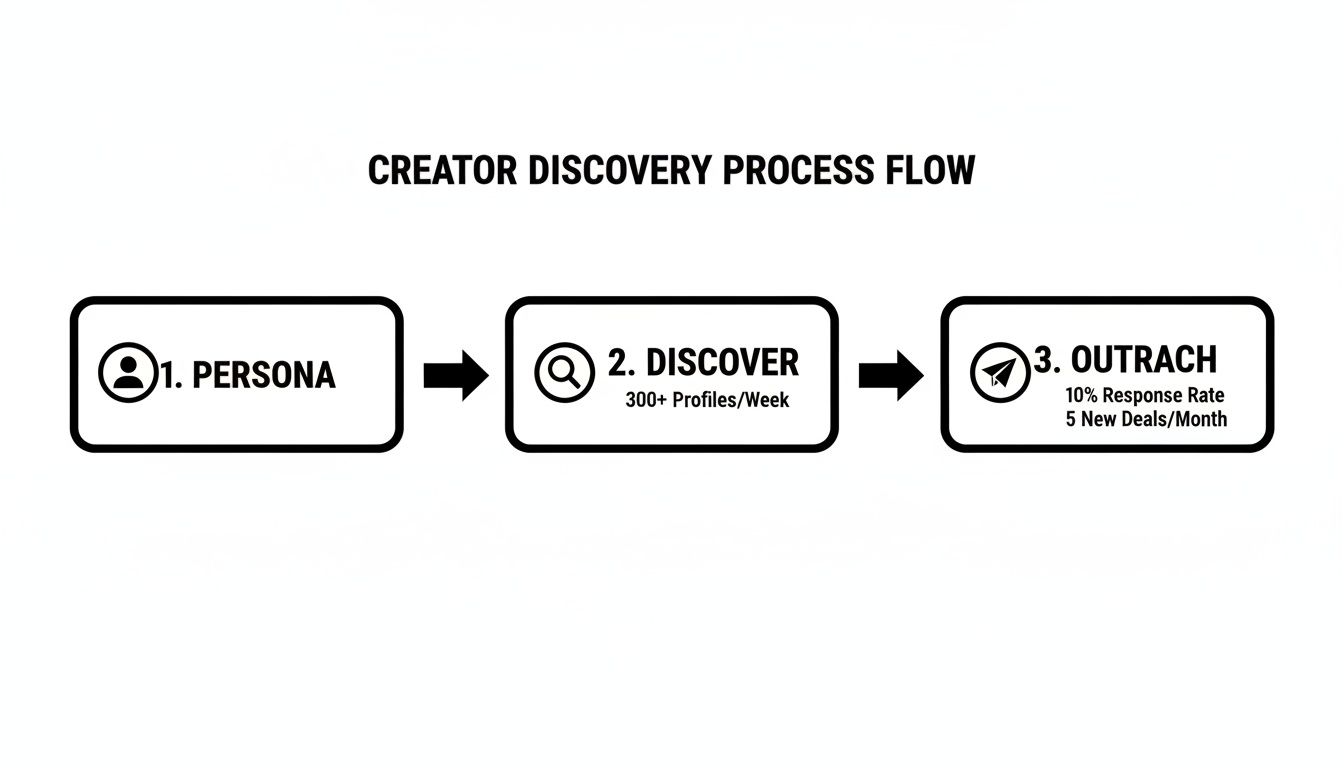
Getting this discovery process right from the start is what sets you up for an effective partnership and a campaign that truly delivers.
Crafting the Perfect Creator Brief
If there's one document you need to get right, it's the creator brief. Think of it less like a script and more like a playbook. A good brief gets everyone on the same page about the goals, key messages, and deliverables, but it doesn't dictate every single word or camera angle. Trust me, skipping this step is a classic rookie mistake that almost always leads to content that completely misses the mark.
Your brief needs to be thorough without being overwhelming. Here are the non-negotiables:
- The Big "Why": Reiterate the campaign's main objective. Are we driving direct sales on TikTok Shop? Generating a library of authentic UGC? Or just getting our name out there?
- Key Talking Points: Give them 2-3 core messages about your product. And please, focus on benefits, not just features. Instead of saying, "Our moisturizer contains hyaluronic acid," try something like, "This moisturizer delivers deep, all-day hydration for a dewy glow." See the difference?
- A Clear Call-to-Action (CTA): Be specific. Tell the creator exactly what you want their audience to do. Should they tap the product link in the video? Visit your shop? Use a special discount code?
- Content Do's and Don'ts: These are your brand guardrails. Simple things like "Please show the product out of its packaging" or "Avoid mentioning competitors by name" can save a lot of headaches later.
- Disclosure Rules: This isn't optional; it's a legal requirement. Make sure your brief mandates clear disclosures like
#Ador#Sponsoredto comply with FTC and ASA regulations.
We've put together a more detailed guide on this. If you want to dive deeper, check out our complete influencer brief template.
Choosing the Right Campaign Type for TikTok Shop
Not all influencer campaigns are built the same, especially on a fast-moving platform like TikTok Shop. The content format you pick should directly ladder up to your main goal.
Sure, a simple, organic video post is a great place to start, but don't be afraid to experiment. Here are a few powerful campaign types we've seen work wonders for startups:
- Organic Product Showcase: The bread and butter. A creator naturally works your product into their usual content. It’s the gold standard for building authenticity.
- "Get Ready With Me" (GRWM) & Routine Videos: Perfect for beauty, wellness, or lifestyle products. Seeing a creator use your product as part of their actual daily routine is an incredibly powerful and relatable endorsement.
- Live Shopping Events: This format is pure conversion fuel. The creator goes live, demos the product, answers questions in real-time, and can drive a massive, immediate spike in sales. It's interactive, urgent, and highly effective.
- Product Seeding for UGC: This is a volume play. Send free products to a dozen micro-influencers with a very loose brief. The goal isn't necessarily immediate sales from their posts; it's to generate a ton of authentic visuals you can then repurpose in your own paid ads.
Streamlining Your Management Workflow
Once you start working with more than a handful of creators, that trusty spreadsheet and email combo will start to unravel. Fast. You need a real system to manage communication, track when content is due, and handle approvals without going crazy.
This is where a centralized tool becomes a non-negotiable. For instance, the HiveHQ Creator Tracker gives you a single dashboard to see every partnership. You can instantly check who has received their product, when their content is due, and review drafts before they go live. It’s all about preventing miscommunication and making sure nothing falls through the cracks.
Key Takeaway: The secret to scaling influencer marketing isn't just about finding more creators. It's about building a repeatable, efficient system for launching and managing them. Centralization is your best friend here.
This structured approach is no longer just a "nice-to-have." The U.S. influencer marketing industry hit a $16.4 billion valuation in 2022. With one in four marketers already running campaigns and another 17% planning to start, the space is only getting more professional. Adopting a streamlined workflow is how your startup can compete and win.
Measuring What Matters to Optimize Profitability
A viral video with a million views feels like a huge win, but if it doesn't lead to actual sales, it’s just expensive noise. For a startup, that's a luxury you can't afford. The line between a successful influencer program and a money pit is drawn by tracking the right numbers.
Likes and comments are nice, but profit is what builds a sustainable business.
This is where you graduate from just running campaigns to building a genuine growth engine. The goal is to create a powerful feedback loop fueled by real data, not guesswork. By laser-focusing on the metrics that directly impact your bottom line, you can confidently decide where to double down and what to cut, turning your influencer marketing for startups from a cost center into a reliable profit driver.
Moving Beyond Vanity Metrics
It's so easy to get mesmerized by big numbers like impressions and follower growth. While these metrics can suggest brand awareness is growing, they don't pay the bills. A startup simply cannot operate on metrics that have no clear path to revenue.
The real trick is connecting a creator’s activity to your financial outcomes. A high engagement rate is a great signal, but it's a leading indicator, not the final destination. You always have to ask the ultimate question: did this partnership actually make us money?
To answer that, you have to look deeper than the surface.
Key Metrics for Startup Influencer Campaigns
To truly understand performance, you have to shift your focus from what's easy to track to what actually matters for your business's health. This table breaks down that crucial mindset shift.
| Metric Category | Vanity Metric (Easy to Track) | Business Metric (What Really Matters) |
|---|---|---|
| Reach | Video Views & Impressions | Click-Through Rate (CTR) to your TikTok Shop page from the creator's content. |
| Engagement | Likes & Comments | Add-to-Cart (ATC) Rate from traffic driven by a specific creator's affiliate link. |
| Audience | Follower Count | Conversion Rate of the audience that comes from the creator’s unique link or code. |
| Activity | Number of Posts | Gross Merchandise Value (GMV) generated by the creator’s specific efforts. |
Focusing on that right-hand column is how you start making intelligent, data-backed decisions that will actually grow your startup.
The KPIs That Drive Profitability
To build a truly profitable influencer channel, you need a dashboard that tells the full financial story of each partnership. It’s not just about the revenue coming in; it’s about the profit left over after all your costs are accounted for.
This is where a specialized tool like the HiveHQ Profit Dashboard becomes so valuable, pulling all these critical numbers into one clear, actionable view.
Here are the core metrics you absolutely must track:
Gross Merchandise Value (GMV): This is your top-line number—the total sales value of products sold through a creator's link or code before any deductions. Think of it as the starting point for all your other profit calculations.
Product Margin: You have to know your gross profit on every single item sold. If a creator sells $1,000 worth of a product with a 60% margin, you’ve generated $600 in gross profit. That's a completely different story than if the margin was only 20% ($200).
Customer Acquisition Cost (CAC): How much did it cost you to get that new customer? For influencers, this includes their commission, the cost of goods for any gifted products, and any flat fees you paid. A low CAC is the sign of a beautifully efficient partnership.
Return on Ad Spend (ROAS): This is the ultimate measure of campaign profitability. You calculate it by dividing the revenue generated (GMV) by the total campaign cost (commissions + fees + product costs). A ROAS of 4:1 means for every $1 you put in, you got $4 back in revenue.
Key Takeaway: A creator who drives $5,000 in GMV might seem like a star. But if their commission rate is high and they’re selling low-margin products, a creator who drives $3,000 in GMV on high-margin items could actually be far more profitable for your startup.
Creating Your Optimization Loop
Data is completely useless if you don't act on it. The final, most important step is building a repeatable process for analyzing performance and fine-tuning your strategy. This is your optimization loop, and it’s a simple but powerful cycle: Measure, Analyze, Act.
- Measure: Continuously track your core KPIs for every single creator. Don't wait for a quarterly review; look at the data weekly to spot trends early.
- Analyze: Find your winners. Who has the best ROAS? The lowest CAC? Which product categories are they crushing? Just as importantly, identify the bottom performers.
- Act: Double down on what's working. Go back to your top performers with new opportunities or even better commission rates. For the underperformers, either give them feedback to adjust the strategy or cut them from the program and reallocate that budget to someone who delivers.
Cost-effectiveness is a huge reason brands love this channel—44% of marketers cite it as a major benefit. This isn't just a feeling; it's backed by real money. U.S. influencer marketing spend grew from $3.69 billion to $4.14 billion in 2022, proving that the channel is efficient even at a massive scale. You can read the full research on influencer marketing investment trends to see where the market is headed.
Following this data-driven approach is how you ensure your startup is part of that efficient growth story.
Got Questions? We've Got Answers
Jumping into the world of creators can feel like a big leap, especially when you're a startup watching every penny. We get it. Let's tackle the most common questions and concerns we hear from founders so you can move forward with total confidence.
How Much Should We Actually Budget for This?
There's no single magic number, but a solid rule of thumb is to set aside 10-20% of your total marketing budget. But for startups just getting off the ground, your "budget" might not be cash at all—it can start with your product.
Your spending strategy will naturally change as your business grows:
- The Early Days (Pre-Revenue): Your budget is your product. Seriously. Focus everything on product seeding. Get your goods into the hands of nano- and micro-influencers who are a perfect fit for your brand, in exchange for their honest opinion and content. Tacking on a sales commission is a killer way to do this with zero upfront risk.
- The Growth Spurt (Scaling Up): Once revenue is flowing, you can start offering small flat fees to your best micro-influencers. This guarantees you get the content you need, but you should still keep a hefty commission tied to performance. It keeps everyone motivated.
- The Big Leagues (Proven Channel): When you’ve found creators who consistently drive sales, you can start investing in bigger flat fees for dedicated campaigns. By this point, you're not guessing—you know the ROI is there.
The trick is to start small, track everything like a hawk, and pour the profits from your winners right back into the program. That’s how you build a marketing engine that pays for itself.
Follower Count or Engagement Rate: What Really Matters?
For any startup focused on the bottom line, it's not even a contest: engagement rate is king. A huge audience means nothing if no one is actually paying attention.
Think about it this way: a creator with 10,000 die-hard followers who hang on their every word is going to sell way more of your product than a celebrity with 500,000 passive followers who scroll right past sponsored posts. That smaller, tight-knit community is where your first true fans are hiding.
Look for engagement rates north of 3-5% on platforms like TikTok and Instagram. But don't stop there. Dig into the comments. Are people asking real questions and having conversations, or is it just a wall of fire emojis? Real interaction signals a real, valuable community.
What Absolutely Must Go in an Influencer Contract?
Even if you're just sending out free products, a simple agreement is non-negotiable. It protects you, it protects the creator, and it sets clear expectations from the get-go. This doesn't need to be some 20-page legal monstrosity, but it does need to cover the essentials.
Make sure your agreement nails down these key points:
- The Deliverables: Get specific. Exactly how many TikToks? How many Instagram Stories? On what schedule?
- Usage Rights: This one is huge. Define exactly how you can use their content. Can you run it as a paid ad? Feature it on your website homepage? Use it in your email campaigns? Spell this out clearly.
- Payment Terms: Lay out the commission rate, any flat fees, and the payment schedule (e.g., Net 30). No ambiguity.
- Content Approval: Will you need to review content before it goes live? A simple approval clause can save you from a major off-brand headache.
- FTC Disclosure: Explicitly require creators to follow FTC/ASA guidelines. This means using clear and conspicuous disclosures like
#Ador#Sponsored.
How Long Until We See Real Results?
Sure, a video could go viral overnight and bring a flood of sales, but that's lightning in a bottle. Building a sustainable influencer program is a long game. You need to think in months, not days.
You’ll likely see your first sales trickle in within a few weeks of your first creators posting. But the real, predictable value—the kind you can build a business on—starts to show up after about 3 to 6 months. That’s the time it takes to test enough creators, fine-tune your offers, and truly figure out what clicks with your audience.
In the meantime, keep an eye on leading indicators like link clicks and add-to-carts. They’ll tell you if you’re heading in the right direction long before the big sales numbers roll in. Patience is your secret weapon here.
Ready to stop guessing and start growing? HiveHQ gives you the tools to automate creator outreach, track every dollar of profit, and manage your partnerships from a single dashboard.
Discover how HiveHQ can scale your influencer program at HiveHQ.ai