Grow with tiktok shop influencers: A Proven Growth Guide
tiktok shop influencerstiktok affiliate marketinginfluencer marketingtiktok shop sellers
TikTok Shop influencers are creators who don't just promote products—they sell them directly through shoppable videos and livestreams. Think of them less as traditional influencers and more as a powerful, commission-based sales team for your brand. They masterfully blend entertainment with e-commerce, turning authentic recommendations into a direct sales channel built right into the app.
Your Advantage in a Crowded Marketplace
If you're still thinking about influencer marketing in terms of brand awareness, it's time for a reset. On TikTok Shop, influencers are your direct-to-consumer sales engine. The platform has completely changed the rules by merging content and commerce into a powerful force called "shoppertainment."
This fusion of entertainment and shopping is incredibly effective because it meets users where they are. People are scrolling for fun, not necessarily to shop. But when a creator they trust genuinely shows off a product they love, the leap from casual viewer to paying customer happens in an instant. That’s your unfair advantage.
The Power of Shoppertainment
Shoppertainment runs on authenticity. A slick, over-produced ad feels jarring on TikTok and gets swiped away immediately. What works? A creator showing how a stain remover actually gets a coffee stain out of a white shirt, or unboxing a new gadget with pure, unscripted excitement. That’s what builds instant trust.
And this trust translates directly into sales. In fact, nearly 50% of TikTok Shop purchases come from influencer posts. This proves that creators are the lifeblood of this new social commerce world. They don't just recommend products; they demonstrate them, validate their quality, and close the deal—all in a single, engaging video.
From Vanity Metrics to Tangible GMV
For brands, the biggest mental shift is moving away from vanity metrics like likes and views and focusing squarely on Gross Merchandise Value (GMV). A single viral video from the right creator can drive tens of thousands of dollars in sales overnight, completely changing a product’s future.
This is a true performance channel where you measure success in real dollars, not just fuzzy engagement stats. A creator with 10,000 loyal followers who consistently moves your product is far more valuable than one with a million followers who generates zero sales.
The real magic of TikTok Shop is its native integration. Unlike other platforms where users must click away to a separate website, the purchase happens directly in the app. This frictionless experience drastically reduces purchase friction and captures customers at their highest point of interest.
The platform's algorithm even rewards this commercial content. Influencer posts linked to TikTok Shop see no 42% engagement drop that often plagues non-commerce content, which means your product gets sustained visibility.
To give you a clearer picture, let's break down how this new model stacks up against the old way of doing things.
Traditional Influencers vs TikTok Shop Influencers
| Attribute | Traditional Influencer | TikTok Shop Influencer |
|---|---|---|
| Primary Goal | Brand awareness, reach, engagement | Direct sales, revenue, GMV |
| Key Metrics | Likes, comments, shares, follower growth | Sales, conversions, revenue, ROAS |
| Compensation | Flat fees, free products | Commission-based, affiliate model |
| Content Style | Aspirational, polished, brand-centric | Authentic, user-generated feel, product-first |
| Call to Action | "Link in bio," "Swipe up" (external) | In-app "Shop Now" button (native) |
| Sales Funnel | Top of funnel (awareness) | Full funnel (from discovery to purchase) |
This table really highlights the fundamental shift: TikTok Shop turns influencer marketing from a brand expense into a scalable, profit-generating sales channel.
Why Your Competitors Are All-In
Think of TikTok Shop as a digital mall with thousands of passionate salespeople working for you around the clock. Brands that build a strong army of creators are essentially creating a performance-driven sales force that scales on demand. While exploring your strategy, it can be interesting to see how technology like an AI influencer generator is changing the way we think about digital personalities and marketing.
This isn't just another trend; it's a fundamental change in how people discover and buy products online. Your competitors are already building their creator networks. If you ignore TikTok Shop influencers, you're leaving a massive and scalable revenue stream on the table for them to grab.
Finding Influencers Who Actually Sell
Let's be honest, sifting through thousands of TikTok creators to find the ones who can actually move your product is the biggest headache for any brand on TikTok Shop. It's so easy to get distracted by vanity metrics like follower counts. But here’s the hard truth: a creator with a million followers might get you a ton of views and zero sales, while a micro-influencer with a super-engaged, niche audience can sell out your entire inventory overnight.
The trick is to look past the surface and hunt for genuine conversion potential. You're not just looking for content creators; you're building a roster of TikTok Shop influencers who act as a true extension of your sales team. Forget the old rules of influencer marketing. On TikTok Shop, the only metric that really counts is Gross Merchandise Value (GMV).
Using the TikTok Creator Marketplace
Your first stop should always be the TikTok Creator Marketplace. It's the native tool, built for this exact purpose, giving you a direct line to creators who have already raised their hand to work with brands. But just scrolling through profiles is a waste of time. You have to get strategic with the filters to cut through the noise.
First thing's first: filter for creators who are already active on TikTok Shop. This is non-negotiable. From there, zero in on your niche and, just as importantly, filter by audience demographics to make sure their followers are your ideal customers. You can get pretty granular:
- Location: Pinpoint creators whose audience is in your primary sales region.
- Age and Gender: Make sure the creator's audience matches your target customer.
- Interests: Find creators whose followers are already into topics related to your product.
Once you’ve got a shortlist, the real work begins. You need to dig into their profiles and look for proof of past performance. A creator’s willingness to share their previous Shop sales data is a massive green flag. If they know they can sell, they won't be shy about showing you the numbers.
Analyzing Competitor Partnerships
One of the sneakiest—and smartest—ways to find proven sellers is to see who's already crushing it for your competitors or for brands in similar categories. This isn't about ripping off their strategy. It’s about identifying creators who have already demonstrated they can sell products just like yours.
Fire up TikTok’s search bar and look for videos featuring your competitors’ products. Keep an eye out for that little orange shopping cart icon, which tells you it's a TikTok Shop link. Don't just look at likes; dive deep into the comments. Are people asking questions about sizing, colors, or shipping? Are they tagging friends and saying "we need this"? That kind of language shows serious purchase intent and is an absolute goldmine.
Key Takeaway: A creator’s comment section is a direct window into their audience's buying behavior. If the comments are full of purchase-related questions and excitement, you've likely found a creator who can drive sales.
Start a list of these creators and watch them for a bit. Using a tool like HiveHQ's Creator Tracker can help you monitor their posts and sales impact automatically, giving you a data-backed list of high-potential partners to reach out to.
Vetting Creators with a Critical Eye
With a pool of over 500,000 creators in the TikTok Shop Affiliate program, you have to be ruthless in your vetting process. Trust me, having a clear set of criteria will save you from some very costly mistakes. If you want to get the full scoop, TikTok's official insights on the affiliate program are worth a read.
Here’s a quick checklist I use to separate the promising partners from the potential problems:
- Green Flag: They proactively link products and have a dedicated showcase on their profile. It shows they're serious about the sales side of things.
- Red Flag: A massive follower count but their engagement (likes, comments, shares) is pitifully low. Something's not right there.
- Green Flag: Their content feels real and unscripted. You can tell they have a genuine passion for the products they’re showing off.
- Red Flag: Their entire feed is just a wall of sponsored posts for dozens of different brands. That kind of oversaturation kills their credibility.
This dashboard gives you a centralized view of your influencer performance, helping you double down on what works.
When you track performance properly, you can clearly see which creators are driving real revenue, which lets you put your budget where it will have the most impact.
Beyond just finding popular people, truly successful campaigns are built on solid influencer marketing best practices, especially when it comes to who you choose to work with. Ultimately, your goal is to build a powerful team of sellers based on data, not just guesswork. If you're ready to get serious about building out your creator roster, check out our deep-dive guide on how to build a TikTok influencer database.
Automating Your Outreach and Onboarding
So, you’ve found a solid list of potential TikTok Shop influencers. Now comes the hard part—the part that grinds most programs to a halt. Manually sliding into DMs, trying to track who replied, and juggling follow-ups is a recipe for burnout, not growth. If you want to build a real sales engine, you have to move past the slow, one-by-one approach and build a scalable system.
This isn't about blasting creators with spammy, robotic messages. It's about systemizing your communication so you can reach out to hundreds—or even thousands—of qualified influencers without losing that personal touch. The aim is to create a predictable pipeline of new partners, freeing you from being buried in your inbox all day.
Scaling Your Initial Contact
The first major shift is ditching the manual DM. With the right tools, you can create personalized message templates that work at scale. Think of it as developing a core script that you can tweak for the different types of creators you’ve already segmented.
For instance, you’ll want different templates for:
- Micro-influencers in your niche, where you might lead with a commission-only offer and free product.
- Established creators who have a track record of driving sales. Here, you can reference their past work and hint at a more structured partnership.
- Competitor influencers you’re hoping to win over by highlighting what makes your product better.
This lets you contact a massive number of creators without sacrificing efficiency. The top sellers on TikTok Shop aren't just getting lucky; they're automating their outreach, sometimes contacting up to 100,000 creators per month. This high-volume strategy is what uncovers those hidden gems who eventually become top-performing affiliates.
This workflow is a great visual for how to think about finding and vetting creators before you even start your outreach.
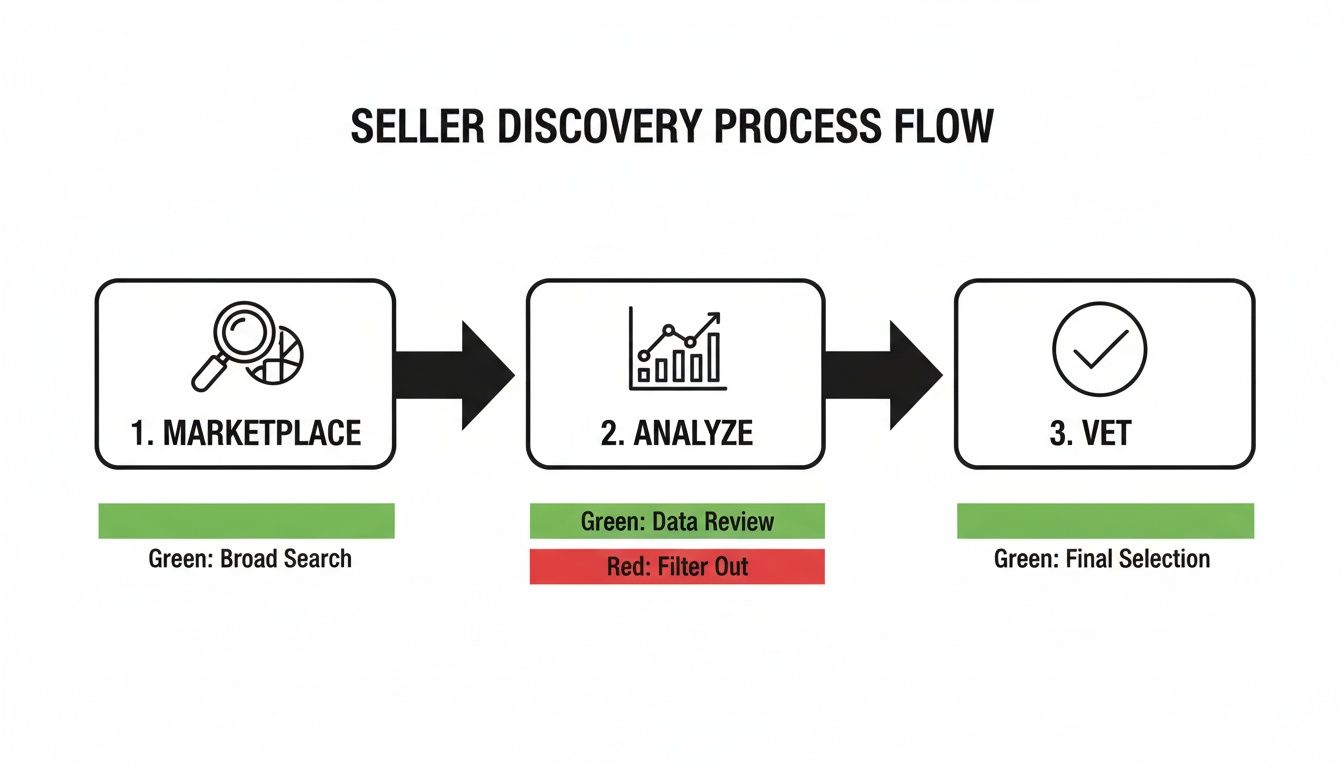
It breaks the discovery process down into three key stages: finding them in the marketplace, analyzing their performance, and then giving them a final vet. Nailing these steps is what makes your automated outreach so much more effective.
Building a Seamless Onboarding Workflow
Once an influencer says "yes," the manual chaos usually just shifts to shipping samples, sending briefs, and chasing them for content. Automating the onboarding is just as critical as the initial outreach. A clean, automated workflow makes sure nobody gets forgotten and every creator gets exactly what they need to start creating great content.
Your onboarding sequence should kick off the second an influencer agrees to work with you. This system handles all the tedious logistics, letting you focus on the bigger picture.
Here’s what a killer automated onboarding flow looks like:
- Sample Request: As soon as a creator drops their shipping info, the system automatically fires off a request to your fulfillment team or 3PL. No more copy-pasting addresses.
- Brief Delivery: The moment the sample ships and a tracking number is generated, the creator automatically receives the creative brief. The timing here is perfect—they’re already excited about the product, making them much more likely to actually read your guidelines.
- Delivery Check-In: When the package is marked as delivered, an automated message goes out to confirm they got it and see if they have any initial questions.
- Content Reminder: A few days before the post is due, a gentle reminder automatically nudges them. This one simple step can dramatically boost on-time posting rates.
By systemizing these touchpoints, you turn a messy, reactive process into a predictable and professional operation. Creators appreciate the clarity and efficiency, which sets a positive tone for the entire partnership from day one.
The Power of Smart Follow-Ups
The real magic of automation is in the follow-ups. These aren’t just generic pings; they’re smart, context-aware messages triggered by actual events. An automated message saying, "Hey, just saw your package was delivered!" feels way more personal and helpful than a random "Just checking in."
This level of automation keeps the conversation going without you having to live in your DMs. It also helps solve one of the most common frustrations for brands: creators who go silent after getting a free product. When an influencer knows there’s a system tracking progress and sending reminders, they’re far more likely to hold up their end of the bargain. If you're building your program from the ground up, our guide on how to recruit affiliates covers all the fundamentals.
By automating your outreach and onboarding, you aren't just saving a few hours. You're building the infrastructure you need to scale your TikTok Shop program from a handful of partners into a powerful, revenue-driving army of creators.
Crafting Compelling Briefs and Commission Structures
Once you've got a promising TikTok Shop influencer on board, the real work begins. The success of your partnership boils down to two things: a clear creative brief and a commission structure that actually motivates them.
If your brief is vague, you'll get off-brand content. If your commission offer is weak, you'll get a half-hearted effort. You have to nail both to turn a single post into a long-term, revenue-driving relationship.
A great brief is all about balance. You need to provide enough direction so your key messages get across, but you also have to leave room for the creator's own style to come through. Micromanaging their creative process is the fastest way to get stiff, salesy content that dies on the For You Page.
Building an Effective Influencer Brief
Your brief should be a simple guide, not a ten-page rulebook. Think of it as putting up guardrails, not writing a script. The goal is to give the creator everything they need to make content that feels authentic to their audience while still hitting your business goals.
Every solid brief should include these essentials:
- Your Core Value Prop: In one or two sentences, what's the single most important thing your product does for the customer? Make it impossible to miss.
- Key Talking Points: Offer 3-5 bullet points about features or benefits. Frame them as ideas, not a script they have to read word-for-word.
- A "Hook" Idea: Suggest 1-2 video concepts that have worked for you before. This gives them a creative launchpad if they need one.
- Hashtags & Mentions: Clearly spell out any required hashtags (like
#TikTokShopor#brandname) and remind them to tag your official account. - The Do's and Don'ts: This is where you set your non-negotiables. Keep it simple: "Do show the product being used," and "Don't mention our competitors by name."
I’ve found that the best briefs feel like a collaboration. I always add a line like, “These are just starting points—we completely trust your creative instincts and can’t wait to see what you come up with!” This gives them ownership and almost always results in better, more creative videos.
The brief really sets the tone for your entire partnership. For a more detailed look at structuring your creative guidelines, you can check out our guide on the perfect influencer brief template.
Designing Commission Structures That Motivate
While the brief guides the creative, the commission structure is what fuels the performance. For most TikTok Shop influencers, starting with a commission-only model makes perfect sense. It's a low-risk way for both of you to test the waters. They get free product and the potential for uncapped earnings, and you only pay for actual sales.
But if you want to attract and keep the real top-tier talent, a single flat rate won't cut it. The average commission rate on TikTok Shop hovers between 10% and 20%, but the smartest brands I've seen use tiered structures to reward their heavy hitters.
For instance, you could offer 15% on the first $5,000 in sales and then bump it to 20% for any sales after that. This simple change gamifies the process and gives your best partners a real reason to keep pushing your products.
Here’s a quick breakdown of the common models:
| Model Type | Best For | Why It Works |
|---|---|---|
| Commission-Only | Micro-influencers and testing new partners | Zero upfront risk. You pay only for direct sales, making it perfect for scaling your program broadly. |
| Tiered Commission | Proven, high-performing influencers | Motivates top sellers by rewarding them with higher rates as they hit sales milestones, encouraging consistent promotion. |
| Hybrid (Retainer + Commission) | Your top 5-10% of elite partners | Secures guaranteed content volume from your most valuable creators while still tying the majority of their earnings to performance. |
At the end of the day, your commission strategy has to line up with your goals. By offering competitive and genuinely motivational structures, you can shift your influencer relationships from one-off transactions into true performance-based partnerships.
Tracking Performance and True Profitability
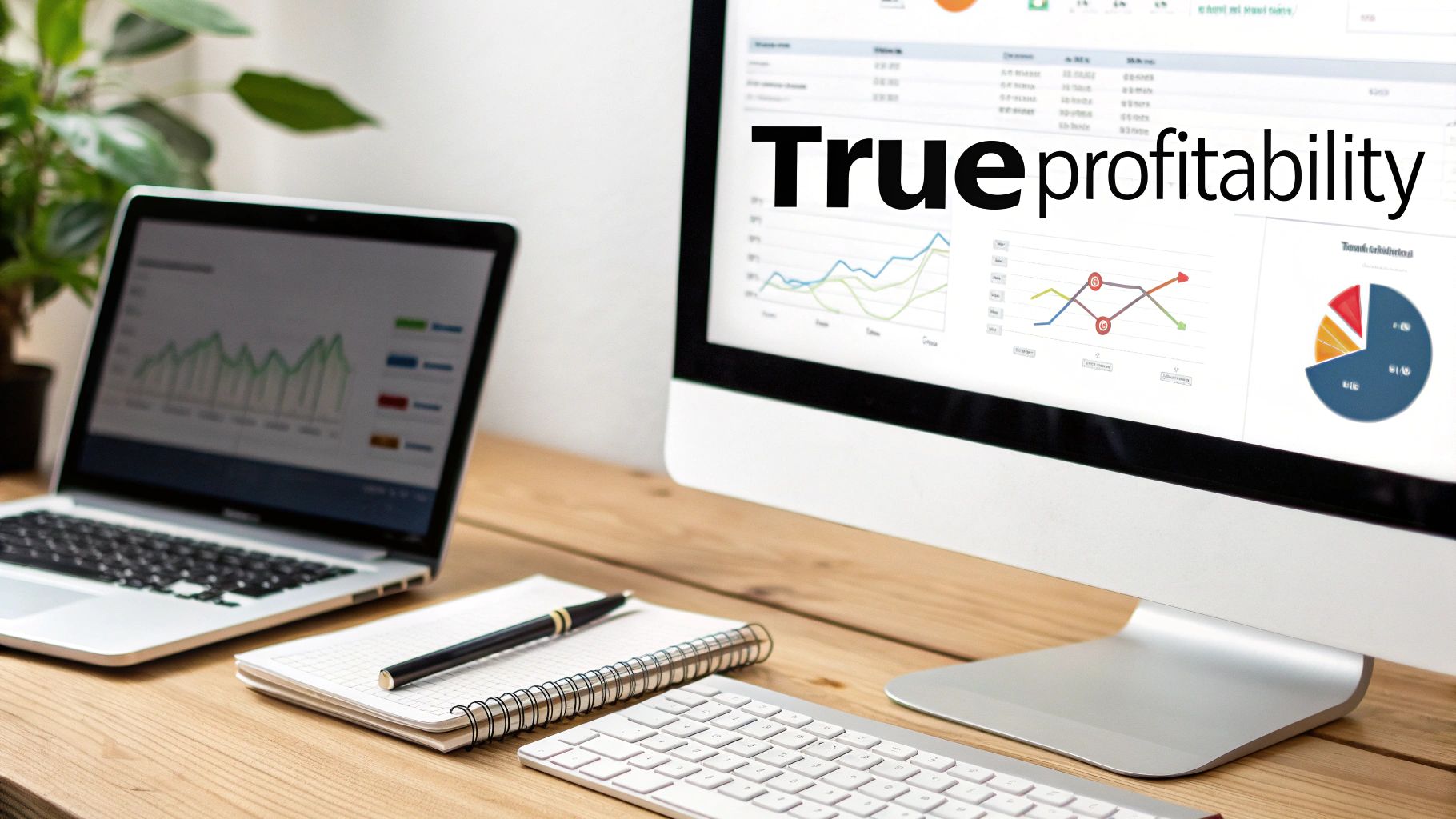
It’s easy to get caught up in the thrill of watching your Gross Merchandise Value (GMV) go up. But GMV is a classic vanity metric, and relying on it alone can hide some serious financial leaks in your influencer program.
The real measure of success on TikTok Shop isn't revenue; it's profit. If you aren't tracking your bottom line with an almost obsessive level of detail, you could be losing money on your "best" partnerships without ever knowing it.
It's a common trap. A creator might pull in $50,000 in GMV, which looks fantastic on the surface. But what if their commission, your product costs, and any ad spend you put behind their content totals $51,000? You just paid $1,000 for the privilege of selling your own product. This is why you need to shift from a revenue-chasing mindset to a profit-first strategy.
The goal is to get the complete financial story for every single influencer you work with. That means digging into all the costs that chip away at your gross sales until you land on the one number that actually matters: net profit.
Moving Beyond GMV
To really understand an influencer’s value, you have to look past the top-line sales number and track a few key performance indicators (KPIs) for each partner. When you see these metrics together, it becomes crystal clear who is actually making you money and who is just making noise.
Your tracking needs to be far more sophisticated than the basic data you get in the TikTok Shop seller center. A solid approach means monitoring:
- Individual GMV Contribution: See exactly what each creator is driving daily, weekly, and monthly.
- Video-Level Performance: Pinpoint the exact videos that are converting. Is it a tutorial, an unboxing, or something else entirely?
- Retainer ROI: If you're paying retainers, you need to know if that fixed cost is paying for itself in profit.
- Commission Costs: Keep a close eye on the total commission paid to each influencer as a percentage of the sales they generate.
When you track at this level, patterns start to jump out. You might find that your highest GMV creator is actually your least profitable because of a high commission rate. Or you might discover a micro-influencer on a tiny retainer is delivering an insane return.
The True Profitability Formula
Figuring out true profitability means you have to account for every expense tied to a sale. Think of this simple formula as your guide to make sure nothing gets missed.
Net Profit = GMV - COGS - Affiliate Commissions - Shipping Costs - Ad Spend
Let's quickly break down why each piece is so critical. COGS (Cost of Goods Sold) is what you paid for the product itself. Affiliate commissions are what you pay the creator. Shipping costs are self-explanatory but often overlooked. And finally, any ad spend, like using Spark Ads to boost a creator's video, cuts directly into that post's profitability.
Taking this granular approach changes the game. Your decisions stop being about gut feelings and start being driven by hard data. The top brands on TikTok Shop live and breathe this stuff, tracking profitability at the individual influencer level. They don't just look at GMV; they analyze COGS, ad spend, and commissions to see the true net profit per partner. You can explore how top sellers track profit with dashboards that pull all this data together for them.
Your Centralized Profit Dashboard
Trying to pull these numbers manually from different spreadsheets and platforms is a total nightmare. It’s slow, full of potential for human error, and makes getting a real-time snapshot of your program's health basically impossible.
This is where a centralized profit dashboard becomes your single source of truth. Something like the one from HiveHQ can be a lifesaver.
Imagine having one screen where you see every influencer you work with, ranked by their actual net profit. These dashboards plug right into your TikTok Shop and automatically pull in the data you need—sales, commissions, COGS, even ad spend—to give you a clear, up-to-the-minute view of your finances.
This kind of centralized view lets you make smarter decisions, faster. You can instantly spot your most profitable partnerships and figure out how to double down on them. At the same time, you can see which creators are underperforming and make a data-backed call to either switch up the strategy or part ways before they drain more of your budget. Without this holistic view, you're flying blind.
Answering Your Top Questions About TikTok Shop Influencers
Even with the best plan in hand, jumping into the world of TikTok Shop influencers is bound to stir up some questions. Let's tackle some of the most common hurdles and strategic puzzles brands face. Here are some quick, straight-to-the-point answers to help you run your program like a pro.
How Many Influencers Do I Really Need?
There’s no magic number. Forget about a specific headcount and focus on building a diverse portfolio of creators instead. The real goal is to create a healthy mix of influencer types to spread out your risk and cast a wider net. A tiered approach works best.
I always recommend starting with a base of 10-20 micro-influencers (think 5,000 to 50,000 followers) on a commission-only deal. This lets you test the waters with different content styles and see what clicks with your audience, all without draining your bank account.
While you're building that foundation, you should also be scouting for 3-5 mid-tier influencers who have a solid track record of selling products in your niche. The sweet spot is a blend: a broad base of smaller creators driving steady, day-to-day sales, with a handful of heavy hitters reserved for big product launches and campaigns.
What’s a Realistic Starting Budget?
You can actually get a powerful influencer program running on a surprisingly lean budget. The secret is to start with product seeding. Your only real expense here is the cost of your products plus shipping. For most brands, $500 to $1,000 is more than enough to get the ball rolling with 20-30 micro-influencers.
Since you're leading with a commission-only model, you're not paying any upfront fees for content. You only pay when they generate a sale, which means every dollar you spend is directly tied to revenue coming in.
Once you spot creators who are consistently crushing it—let's say they're bringing in over $5,000 in GMV each month—that's when you can start talking about performance-based retainers. These can be as low as $250-$500 and are a great way to secure their loyalty and guarantee you get a certain amount of content. The key is to always scale your spending based on proven ROI, not on a gut feeling.
This strategy ensures your budget is always working for you, funding the partnerships that have already proven they can drive profitable growth.
Should I Pay Retainers or Stick to Commission?
For the overwhelming majority of your partnerships—we're talking 90% of your creator roster—a commission-only model is the smartest way to go. It’s scalable, it minimizes your financial risk, and it guarantees you’re only paying for actual results. This performance-based model is the bedrock of any healthy, profitable program.
So, when do retainers make sense? Save them for the absolute top tier, the elite 10% of your partners who have already shown their incredible value by driving serious, consistent sales for your brand.
For these proven winners, a hybrid model is perfect. Something like a $500 retainer plus a 15% commission secures their posting volume while keeping them hungry to sell more. Just remember the golden rule: never pay a retainer to an unvetted creator. Their past success with another brand is no guarantee they’ll be able to deliver for you.
How to Handle Influencers Who Ghost After Getting Product
It happens, unfortunately. But this is a totally manageable problem if you have the right systems. Your first line of defense is a rock-solid vetting process to weed out the flakes from the start.
Next, lean on automated follow-ups. A simple system that pings them when a product is delivered and reminds them when content is due creates a sense of accountability. Your agreement should also be crystal clear that the product is an exchange for content delivered within a set timeframe, like 14 days.
If they still go silent, a final, manual message is a good last resort. If that doesn't work, just blacklist them from future campaigns and move on. At the end of the day, your financial loss is limited to the cost of your product, which is a small and manageable risk when you're running an influencer program at scale.
Ready to stop guessing and start scaling your TikTok Shop influencer program with data-driven precision? HiveHQ provides the ultimate toolkit to automate your outreach, track true profitability, and manage your creators all in one place. Discover, recruit, and optimize your influencer partnerships by visiting the HiveHQ website to see how our platform can transform your growth.