Affiliate Commission Rates for TikTok Shop Profit
affiliate commission ratesTikTok Shop commissionsbreakeven commissioncreator payoutsprofit dashboard
An affiliate commission rate is the share of actual paid, discount-adjusted revenue a creator earns on an attributed order. The useful question is the highest rate that still leaves your target contribution profit after product cost, fees, ads, and refunds.
Popular advice tells you to copy a category benchmark and raise it until creators respond. That's backwards for TikTok Shop. A headline percentage can look generous and still lose money, or look modest and still produce healthy profit. Start with what the percentage is calculated on, then work out what your margin can afford.
Table of Contents
- What Affiliate Commission Rates Really Pay
- Benchmark Affiliate Commission Rates by Model
- Factors That Set a Sustainable Rate
- Calculate ROI and Breakeven Commission
- Set and Test Affiliate Commission Rates
- Negotiation Rules and Costly Pitfalls
- Track Rates with the Profit Dashboard
What Affiliate Commission Rates Really Pay
You're not splitting the shelf tag. You're splitting the receipt after coupons. That distinction matters because affiliate commission rates apply to the amount the customer paid after seller and TikTok discounts, not the marketplace list price you originally set.
Most rate guides skip this point. They quote a percentage without clarifying the base, so sellers compare offers that aren't calculated the same way. A 20% nominal commission on a discounted price is a smaller payout than 20% on list price, yet your other costs don't shrink at the same pace. Product cost, fulfillment, ads, refunds, and returns still come out of your side.
The Separate Fee Sellers Forget
Commission isn't your only platform cost. Coverage of TikTok Shop economics notes that the seller may also pay a separate referral fee, reported as 6% for many US categories after introductory periods. That fee sits beside the creator commission, so adding only the creator percentage to your spreadsheet understates the true cost per order.
Think of it in plain steps:
- List price: the number shoppers see before discounts, not your commission base.
- Actual paid price: the discounted amount that drives the creator payout.
- Contribution profit: what's left after every variable cost, including that payout.
Judge a rate by contribution profit per delivered order, not by how attractive the percentage sounds in a creator offer.
Why the Base Changes Your Decision
Discounts reduce the commission base, which helps a little. They also reduce the revenue you have left to cover fixed product and shipping costs, which hurts more if your margin was thin to begin with. That's why two sellers in the same category can offer the same percentage and get very different results. One has room. The other doesn't.
The profit floor should come first. Decide the minimum contribution profit you'll accept on a delivered order, subtract the costs you can't avoid, and treat whatever remains as the maximum pool for commission. If a proposed rate doesn't fit inside that pool, it isn't competitive. It's subsidized.
This framing changes the conversation with creators too. You aren't negotiating a generous or stingy percentage in the abstract. You're explaining what a specific product can pay after discounts and fees while staying worth selling. That is a clearer, fairer starting point for both sides.
Benchmark Affiliate Commission Rates by Model
A benchmark percentage can mislead: the same rate creates two different costs, depending on whether an affiliate sale comes organically or through Shop Ads. Judge both against contribution profit after refunds, not against the headline rate.
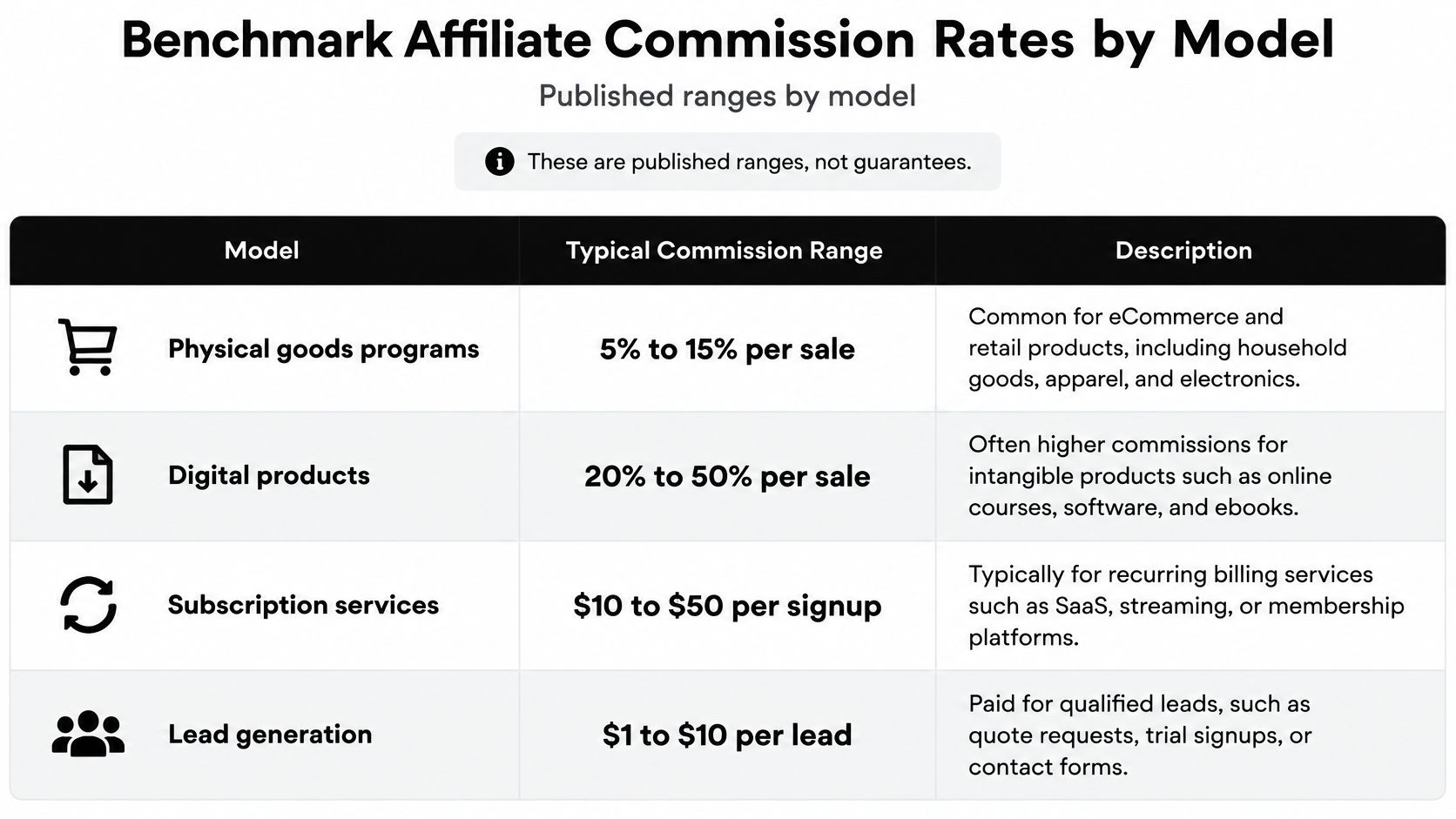
Published benchmarks offer a starting point, not a rate to copy. Shopify's overview of affiliate earnings by business type places physical-goods commissions around 5% to 15% and digital products and online courses around 20% to 50%. These models differ in what the payout must cover: physical orders carry product and fulfillment costs, while digital products usually have fewer per-sale costs.
Recurring programs work differently again. Subscription services frequently use 15% to 30% recurring commissions, and B2B software commonly pays 10% to 30% of initial contract value, according to FirstPromoter's affiliate commission rate guide. The payout base and timing matter as much as the percentage: a recurring share can continue across renewals, while an initial-contract payout is tied to the first sale.
Where TikTok Shop Sits
TikTok Shop's setting range is broad. Sellers can set rates from 1% to 80% at product, product-group, or shop level, according to TikTok Shop seller guidance on commission settings, while UK TikTok Shop guidance identifies 10% to 15% as an average range. The permitted range describes what sellers can configure, not what a product can afford.
A public beauty creator partnership program shows how a beauty brand presents an offer to creators. Use it as an example of presentation, not proof of a sustainable rate. Without its margin, refund rate, and repeat-purchase economics, the percentage alone says little.
Organic affiliate sales and Shop Ads need separate calculations. For an organic sale, the creator commission is the affiliate acquisition cost. For an ad-attributed sale, account for both the commission and ad spend. Then adjust each cost for refunded orders, since a refunded sale may reverse revenue while fees or other costs remain.
Consider a 10% commission on two products. A high-margin digital offer may retain contribution profit after payout; a physical item with thin margins may not, especially after shipping, platform fees, and refunds. The percentage is identical. The costs around it are not.
Use benchmarks to check whether an offer looks plausible for its business model. Then test the organic and Shop Ads costs against contribution profit per delivered order. If a benchmark rate leaves too little profit after refunds, your own unit economics should set the ceiling.
Factors That Set a Sustainable Rate
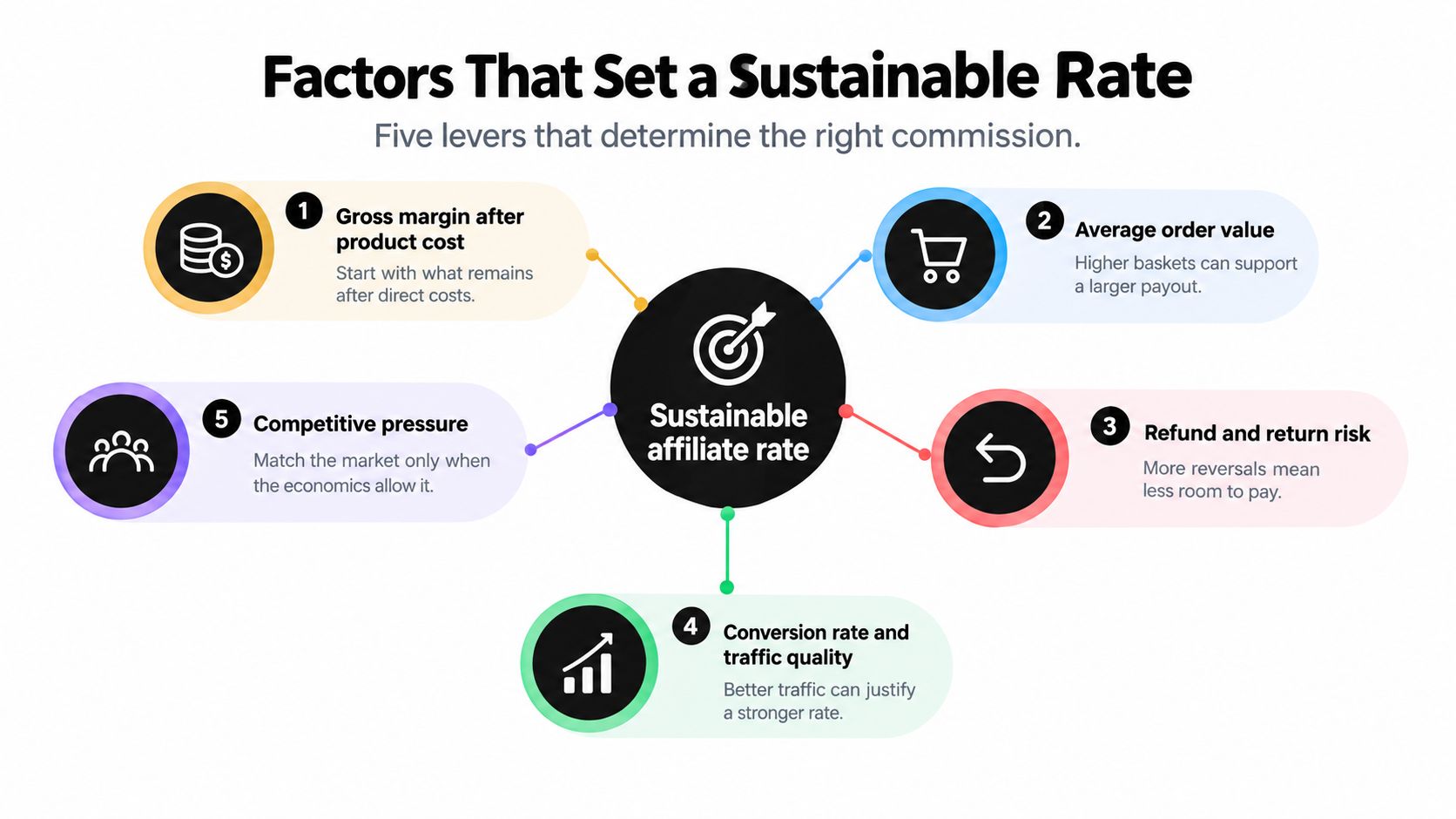
Two products in the same category shouldn't automatically share a rate. Five levers decide what each one can pay, and they interact. A strength in one can offset weakness in another, but none of them can be ignored.
Margin, Basket, and Lifetime Value
Gross margin after product cost comes first. It's the pool every other cost draws from, so a higher margin can fund a richer creator payout. If you're unsure how that pool relates to broader profitability, reviewing what counts as a healthy operating margin helps you set a floor before you promise anyone a percentage.
Average order value matters because a percentage of a larger basket pays creators more in dollars without raising your rate. A low-priced item may need a higher percentage just to produce a payout worth a creator's time, even though its margin argues for less. That tension is real, and bundles or multipacks sometimes solve it better than a rate increase.
Customer lifetime value is the third lever. If buyers reorder reliably, the first order is partly an acquisition expense and you can justify paying more for it. If there's no repeat behavior, the first order has to carry its own profit. Don't assume lifetime value you haven't measured yet.
Category Norms Aren't Permanent
Marketplaces reprice acquisition over time. Industry analysis describes Amazon's average commission peaking at approximately 9.25% in May 2012, falling to about 4.18% by January 2020, and dropping to roughly 3.14% after reductions announced in April 2020, as tracked in Review42's analysis of affiliate marketing data. Category schedules there ranged from 1% to 10%, including 10% for luxury beauty and 0% for some excluded categories such as gift cards.
Treat category norms like a dimmer, not a contract carved in stone. They tell you what creators may expect today. They don't guarantee those expectations survive a fee change, a margin squeeze, or a shift in your own costs.
Mental checklist: margin first, basket second, repeat value third, category expectations fourth, and creator-specific lift last.
Creative Lift as the Tiebreaker
Creative lift is the reason a specific creator might earn more than your base rate. A creator whose content converts cold viewers, answers objections, and reduces returns is worth more than one who just posts a link. That's an argument for a targeted premium. It isn't evidence that raising everyone's rate by the same amount will return the same profit.
Calculate ROI and Breakeven Commission
Here is where affiliate commission rates stop being a benchmark discussion and become arithmetic. The key move is splitting one blended percentage into separate costs by attribution path. TikTok lets sellers configure a standard commission for organic affiliate orders and a distinct Shop Ads commission for orders generated with paid ads, and TikTok's help guidance on separate Shop Ads commission rates confirms rates can be set at product, product-group, or shop level.
That means the same SKU can clear at different margins. With a 10% organic rate and a 5% Shop Ads rate, an organic affiliate purchase costs you more commission but no ad spend. A paid purchase through GMV Max or Shop Ads costs less commission but adds media cost. Multiplying total GMV by one rate hides both facts.
The Contribution Equation
Use this sketch at SKU level:
Net contribution = net sales, minus COGS, minus platform fees, minus advertising cost, minus affiliate commission, minus fulfillment and returns costs.
TikTok's documented formula sits inside that equation. Commission equals (Revenue − Refunds) × Commission rate, and TikTok's seller documentation on how commission is calculated states the amount shown after purchase is only an estimate until actual revenue is final. The same documentation notes Shoppable Carousel commission is currently set at 60% of the commission rate for videos, so format changes the cost too.
| Path | Rate logic | Profit check |
|---|---|---|
| Organic affiliate video | Full standard rate on refund-adjusted revenue | Contribution after COGS, fees, fulfillment, and commission, with no ad cost |
| Shop Ads affiliate order | Separate, often lower Shop Ads rate | Contribution after the same costs plus advertising spend |
| Shoppable Carousel | 60% of the video commission rate | Lower commission cost, but check conversion and refund behavior by format |
Backing Into Your Maximum Rate
To find a ceiling, work backwards:
- Set your target: decide the contribution profit you require per delivered order.
- Subtract non-commission costs: COGS, platform fees, fulfillment, expected returns, and ads where they apply.
- Divide by refund-adjusted revenue: the remainder, expressed as a percentage, is your maximum sustainable rate.
If you want a fuller walkthrough of that backwards math, a TikTok Shop break-even analysis framework applies the same logic at shop level. The principle is identical. Commission gets what's left after your required profit, not whatever a benchmark suggests.
A practical lever follows from the split. Use a higher organic rate when creator distribution is your limiting factor, because you're not also funding media on those orders. Use a lower Shop Ads rate when you're already paying for ads and need to protect incremental return. One blended rate can't do both jobs.
Finally, test any increase against cannibalization. A rate rise is justified only when the incremental creator-driven gross profit beats the extra commission paid on both new sales and sales that would have happened anyway. If the increase mainly reprices existing conversions, you've raised cost without buying growth.
Set and Test Affiliate Commission Rates
A higher percentage doesn't reliably produce better economics. That's the assumption worth challenging before you touch any setting. Published guidance commonly treats 20% to 30% as more attractive for creators making repeated or detailed content, while lower rates suit testing, according to SellerApp's guide to TikTok Shop affiliate marketing. The same coverage describes a program that raised targeted commissions from 15% to 28%, and another that saw much greater weekly-revenue volatility during an open-only phase than after moving into a structured program.
Neither example proves the rate caused the result. Creator quality, content volume, product-market fit, discounting, and seasonality all move at the same time. Your test design has to separate them, or at least narrow what else could explain the change.
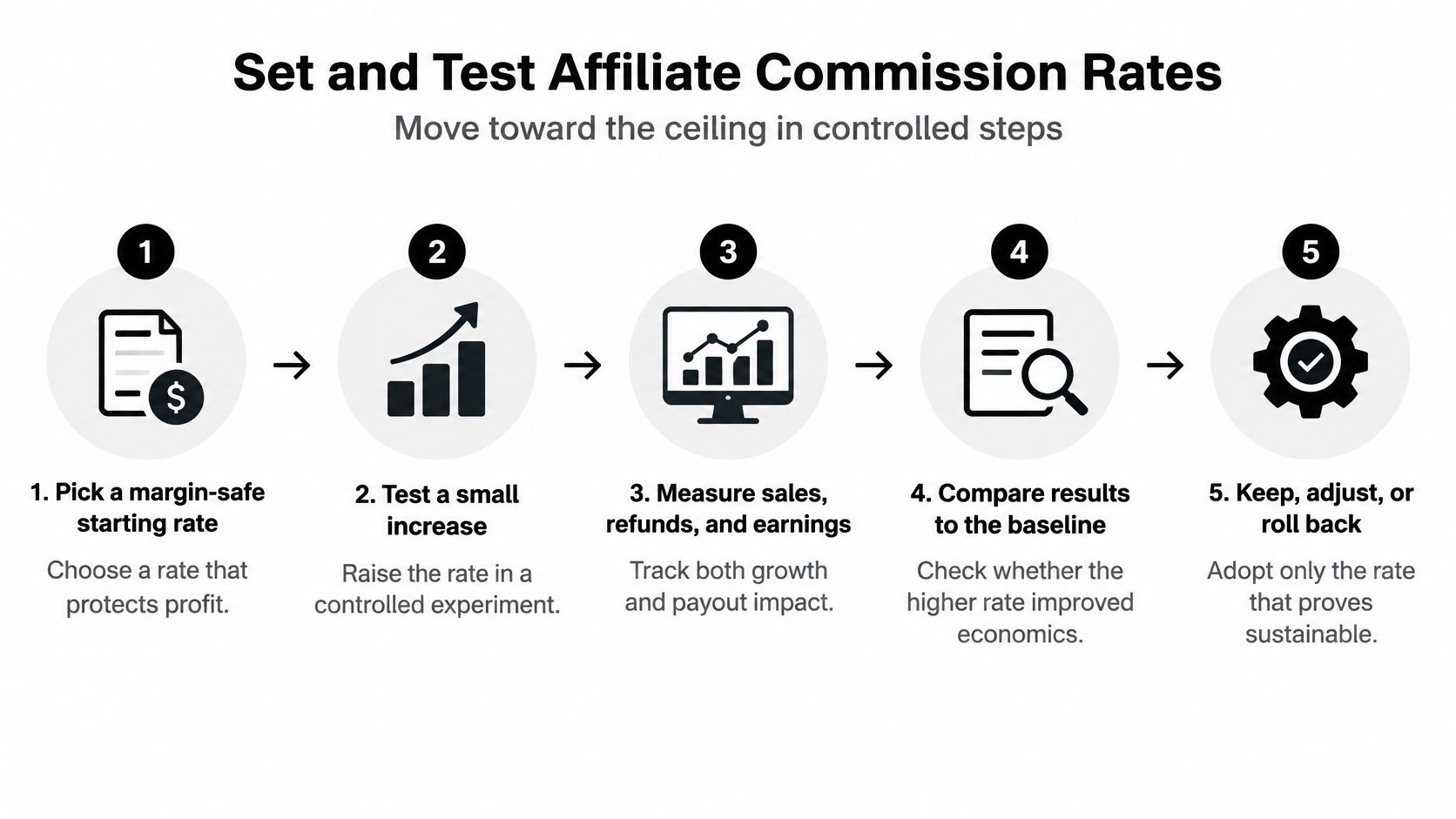
The visual below maps a controlled way to move from a safe starting rate toward your calculated ceiling.
A Progressive Test You Can Rerun
Start with a margin-safe rate by SKU or small product group, not a shop-wide guess. Set organic and Shop Ads rates separately so you know which cost you're changing. Hold discounting as steady as you can during the test window, because a price cut and a rate increase in the same week makes attribution of the result impossible.
Then raise the rate in one controlled step for a defined group. Compare matched creators or similar products on measures that reflect profit, not applause:
- Net contribution profit: after refunds, fees, ads, and the new commission.
- Approved versus returned orders: a rate that drives low-intent buyers can inflate reversals.
- Content output and repeat sales: whether creators did more, and whether buyers came back.
- Assisted versus last-click conversions: whether the creator started the journey or merely closed an existing one.
The short video below is worth watching before you run your first comparison, as a prompt to define your measures before you change the number.
Questions the Test Must Answer
Ask three things at the end of every window. Did the higher rate create incremental GMV, or reallocate conversions you'd have won anyway? Which specific creators earned a premium with profitable, low-return sales? And what's the marginal profit per additional percentage point, so you know whether the next point would pay for itself?
Log the starting rate, the change, the dates, the discount conditions, and the result for each SKU and creator group. That log turns a one-off guess into a rerun-able process. A blanket category increase, by contrast, teaches you nothing except that your costs went up everywhere at once.
Negotiation Rules and Costly Pitfalls
A tested rate can still mislead you if the contract timing works against your forecast. Commission on TikTok Shop is refund-sensitive and dynamically timed, so accruing cost from gross order value overstates expense and distorts creator ROI.
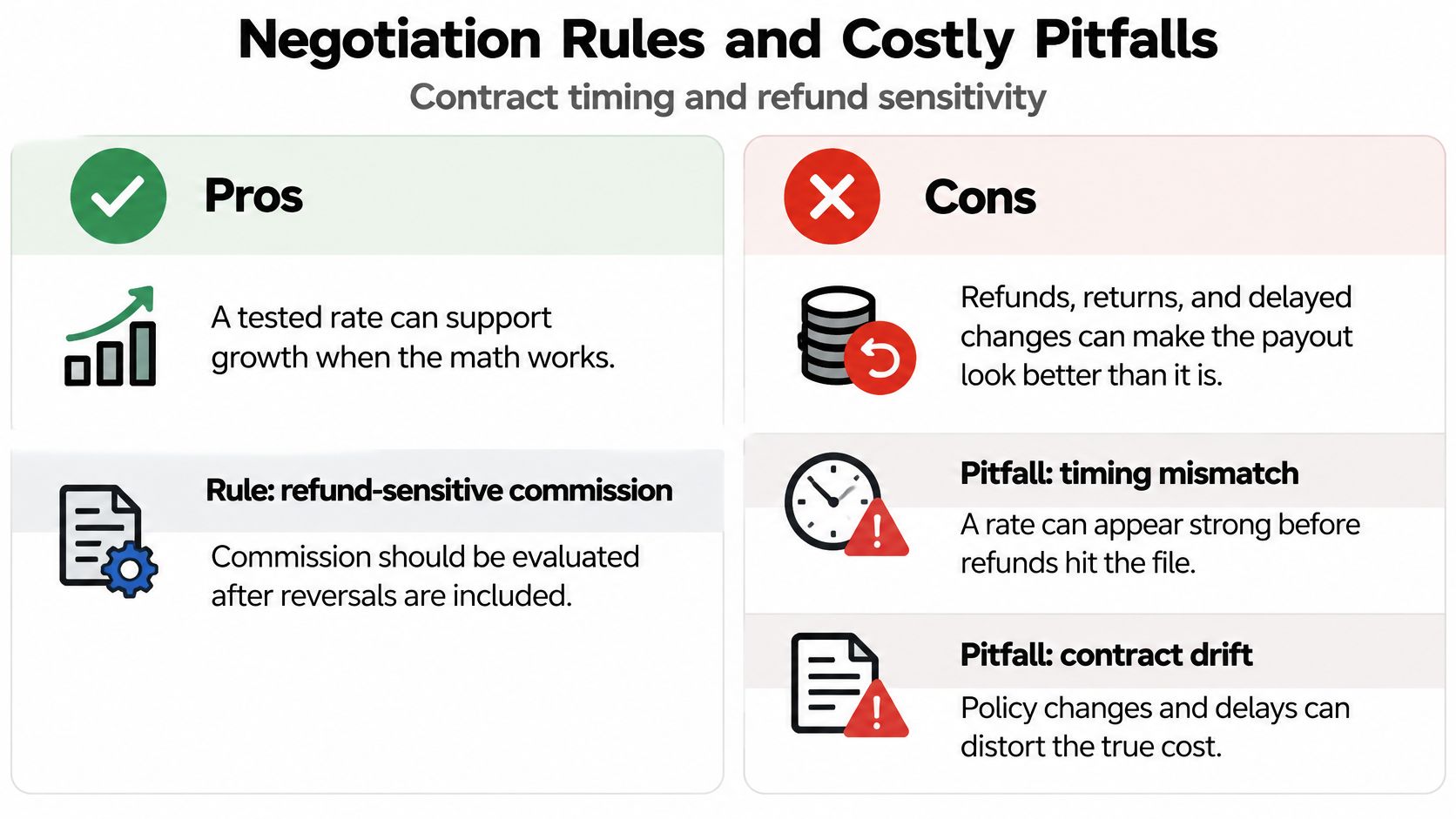
TikTok's UK policy on the adjusted commission base states commission is calculated using net sales, customer-paid shipping, platform discounts, refunds, and platform-discount refunds, and a fully returned order results in a full commission refund. In the US, commission finalizes only after delivery and the applicable 14-day after-sales period. A full refund pays nothing, a partial refund reduces the payout, and a cancellation before receipt doesn't qualify.
Rate Changes Don't Apply Instantly to Everyone
Creators may retain a previously locked rate for at least 30 days. Increases can apply immediately to creators already promoting a product, while decreases may not immediately remove the initial rate. So the rate you set today and the rate you pay this week can differ by creator. If your forecast assumes an instant switch, your payout file will surprise you.
These mechanics are exactly the clauses worth getting right in writing, and reviewing how influencer contract terms should be structured helps you see which terms belong in any creator agreement. For affiliate commission rates specifically, put four things on paper: the calculation base, the organic versus Shop Ads split, the refund treatment, and the effective date of any change.
Never promise a percentage of list price. Promise a percentage of the actual paid, refund-adjusted amount, because that's what the platform pays on.
Forecast With the Effective Rate
For planning, replace the headline rate with the effective commission rate, calculated as finalized commission divided by gross attributed GMV. That number absorbs refunds, partial payouts, locked rates, and format differences into one honest figure. A high-return product stops looking artificially efficient, and creators can be compared on equal terms.
Keep an order-level ledger to support it. Record order ID, SKU, creator, attribution channel, rate version, gross sales, refunds, and payout status for every attributed order. It's unglamorous work, but it's the difference between knowing your commission cost and estimating it from a percentage that was never going to survive contact with returns.
Review high-return SKUs before offering any premium. A generous rate on a product that comes back often doesn't just waste commission accruals. It attracts promotion toward the product least able to fund it.
Track Rates with the Profit Dashboard
Rates drift. Costs change, discounts rotate, return behavior shifts by SKU, and a percentage that was safe last quarter can become a loss. Monitoring isn't a monthly spreadsheet exercise. It's how you catch that drift while you can still act on it.
HiveHQ is self-serve software you run yourself, and its Profit Dashboard is built for exactly this check: real-time net profit, product-level performance, and customer analytics for TikTok Shop sellers. It surfaces shop and product GMV alongside COGS, ad spend, and commissions, so you can separate organic affiliate GMV from Shop Ads affiliate GMV and watch your effective commission rate and contribution margin per SKU. That separation stops you from applying an estimated percentage to list price and calling it profit. When a flat fee sits beside a percentage, the Creator Tracker shows retainer performance, posting cadence, and GMV contribution so the fixed cost isn't hidden inside the rate. If you want the method behind that view, tracking creator-level profitability walks through the per-creator profit calculation.
Frequently Asked Questions
Can one shop-wide rate survive different product margins?
Only as a temporary default. Set it conservatively from your weakest-margin product you'd still promote, then split rates by SKU or product group as soon as you have contribution data. A single rate across different margins overpays on some products and underpays on others.
Does HiveHQ change my commission rate inside TikTok?
No. You still set and change rates in TikTok Shop yourself. HiveHQ shows you the profit consequence of each rate so you can judge whether to keep, raise, or lower it.
How do samples and retainers differ from commission?
They're separate costs, not part of the percentage. A sample is product and shipping expense, and a retainer is a fixed fee, so both should sit as their own lines in your per-creator profit view rather than being buried inside an inflated commission rate.
Can US and UK shops share one commission assumption?
No. HiveHQ supports both US and UK TikTok Shops, but refund windows, the calculation base, and policy timing differ by market, so review each shop's economics locally. Plans range from self-serve to fully managed, which lets you choose how much of this monitoring you run yourself.
Try the HiveHQ Profit Dashboard to see each product's effective commission rate beside its real contribution profit, so you can set affiliate commission rates from evidence instead of benchmarks. Visit HiveHQ to start, and talk to the HiveHQ team about which plan fits how your shop runs today.