Affiliate Marketing for TikTok The Ultimate Operator's Guide
affiliate marketing for tiktoktiktok shop affiliatecreator marketingecommerce growthtiktok automation
For brands serious about growth, affiliate marketing on TikTok isn't just an experiment; it's a system for turning creator partnerships into a predictable revenue stream. It's about getting past manual outreach and messy spreadsheets to build a scalable engine that drives sales right inside the TikTok Shop ecosystem.
Why TikTok Shop Affiliate Marketing Is Your New Growth Engine
Let's skip the obvious "TikTok is huge" talk. If you're running a seven-figure TikTok Shop, you know affiliate marketing is more than just another channel. It’s a core growth engine just waiting to be systematized. The real headaches start when your manual methods inevitably break under the pressure of scale—finding hundreds of creators, automating outreach, and tracking true profit beyond just surface-level Gross Merchandise Value (GMV). This guide gives you a battle-tested framework to turn that chaos into a well-oiled sales machine.
The biggest shift here is moving away from clunky external links and embracing the seamless, in-app world of TikTok Shop. This native integration is the secret sauce for boosting conversions and riding the platform's explosive growth wave.
The Power of Native Integration
TikTok has absolutely blown up as a hub for affiliate marketing. In fact, 42% of affiliate marketers now use the platform to drive sales, putting it neck-and-neck with Instagram. The momentum is real: just last year, 26% of marketers started using TikTok for the first time, making it one of the fastest-growing spots for affiliate promos.
For TikTok Shop sellers, this means affiliates can leverage seamless in-app purchasing. This is a game-changer because it slashes the drop-off rates that plague external links, which can kill your sales by 30-50%.
The old way of sending TikTok users to an external site is broken. The friction of leaving the app to complete a purchase kills conversion rates. TikTok Shop's native checkout solves this, turning creator content directly into sales with zero friction.
From Manual Chaos to Automated Scale
At the end of the day, a successful affiliate program runs on content that stops the scroll. To make sure your affiliate content grabs attention and actually converts, you have to master the art of creating compelling video hooks that stop scrolling in seconds. Once you have that locked down, the next challenge is all about operations.
Scaling an affiliate program from its first few sales to over $1M in monthly GMV demands a complete operational overhaul. The jump from a manual, hands-on approach to a systematic, automated one is massive.
Here’s a quick look at how the day-to-day changes.
Manual VS Automated TikTok Affiliate Management
| Operational Area | Manual Approach (Sub-$100k GMV) | Automated System (Scaling to $1M+ GMV) |
|---|---|---|
| Creator Discovery | Manually scrolling feeds and searching hashtags | Using software to filter and identify creators at scale |
| Outreach | Sending one-off DMs and emails with templates | Automated, personalized outreach sequences and follow-ups |
| Onboarding | Emailing briefs and tracking samples in spreadsheets | Triggered briefs upon sample shipment; centralized tracking |
| Performance Tracking | Relying on basic GMV and creator-provided screenshots | Real-time profit dashboards tracking GMV, COGS, and ROI |
This evolution isn’t just about working faster or being more efficient. It’s about building a durable competitive advantage that your competitors can't easily replicate.
Building a Scalable Creator Acquisition Machine
Finding one great TikTok creator is easy enough. Finding hundreds of them, systematically, is a whole different beast—and it's the real challenge for brands pushing past $1M GMV. When your creator acquisition becomes a bottleneck, your whole affiliate program grinds to a halt.
It's time to stop the endless doom-scrolling through the For You Page. To truly scale, you need to build a repeatable, predictable engine for finding talent.
This is about moving beyond hoping you stumble upon a few winners and into a system that manufactures consistent results. It means using the right tech and processes to pinpoint creators who are a perfect match for your brand—by niche, performance history, and product affinity—at a scale that manual searching just can't handle. The goal is to flip your model from reactive to proactive, actively hunting for partners instead of waiting for them to find you.
From Manual Chaos to Automated Discovery
The first, and most critical, step is to automate the most soul-crushing part of the process: the initial discovery. This is where an "Affiliate Bot" becomes your best friend. Instead of your team burning hours manually digging through hashtags and profiles, an automated system can sift through thousands of potential partners using your exact criteria.
Think about the precision this gives you. You could set up filters to find creators who:
- Have 10,000 to 100,000 followers, letting you tap into that high-engagement sweet spot of micro-influencers.
- Are based specifically in the US or UK to align with your TikTok Shop's supported regions.
- Have posted about a competitor's product or specific keywords in the last 30 days.
This kind of targeting immediately shrinks the ocean of creators down to a manageable, highly-relevant shortlist. Your team stops being prospectors and starts being what they should be: relationship builders. For a deeper dive into sourcing talent, you can also check out our guide on how to find influencers for your brand.
This diagram really nails the shift from a messy, manual workflow to a clean, automated system.
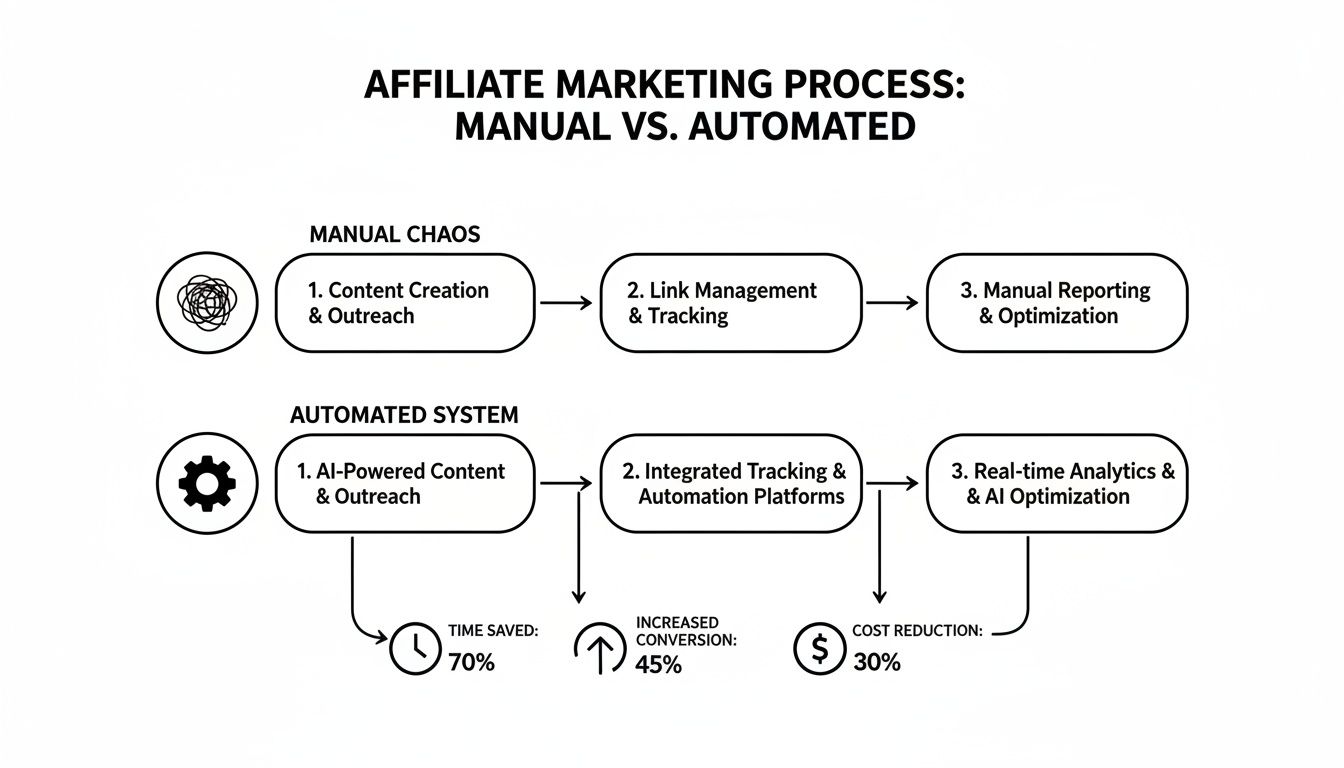
By taking discovery and initial outreach off your team's plate, you free them up to focus on what actually moves the needle—strategy, negotiation, and building genuine partnerships.
Crafting Outreach That Actually Converts
Okay, you've got your list of perfect-fit creators. Now what? The next hurdle is sending an outreach message that actually gets a response. Generic, copy-pasted DMs are a one-way ticket to being ignored. The trick is to achieve personalization at scale, using smart templates that don't sound like they came from a robot.
Your outreach has to feel personal, even if it’s automated. A solid template will use dynamic fields to pull in specific details about the creator you’re messaging.
Pro Tip: Keep your first message short, direct, and all about the value for them. Mention a recent video you liked, compliment their style, and get straight to what's in it for them—free product and a commission. Ditch the long, self-important paragraphs about your brand's mission statement.
Here’s a simple template that just works:
"Hey [Creator Name]! Just saw your video on [Topic of their recent video]—that editing style is incredible. We're from [Your Brand] and think our [Product Name] would be a killer fit for your content. We’d love to send one over for you to try out in a TikTok Shop video. We offer a [X%] commission on all sales. No strings. Let me know if you're interested!"
It's personalized, it's quick, and it gets right to the point. It respects the creator’s time and makes saying "yes" incredibly easy.
Building a Predictable Talent Pipeline
A truly scalable system doesn't just stop after one message. It has to include automated follow-ups so you don't lose promising creators who just got busy. If someone opens your message but doesn't reply within 48 hours, a gentle, automated nudge can be all it takes to get the conversation going again.
This systematic approach turns creator acquisition from a game of luck into a predictable, measurable pipeline. You'll start to know exactly how many creators you need to contact to onboard a certain number of partners. That means you can forecast growth, manage your budget, and build an acquisition machine that consistently fuels your TikTok Shop affiliate program with fresh talent.
Designing Commission Structures That Drive Profit
Once you've found your creators, the real work begins: turning that potential into profitable sales. This is where your financial strategy has to be just as creative as your content. Designing the right commission structure is a delicate balancing act. It needs to be juicy enough to motivate top-tier creators but smart enough to protect your profit margins.
Get this wrong, and you'll end up with a high-GMV, low-profit program—a classic mistake I’ve seen operators make when they scale too fast.
A flat, one-size-fits-all rate might feel easy, but it’s lazy. You're leaving money on the table by failing to reward your heavy hitters and treating every product like it has the same margin. The goal is to build a flexible framework that actually drives your business goals forward.
Beyond the Flat Rate Commission
The most successful affiliate programs I’ve seen on TikTok Shop all use dynamic commission models. These aren't just about paying for sales; they’re about incentivizing specific actions, whether that’s blowing up a new product launch or simply driving more volume. This is how you level up your strategy.
Here are three models that work incredibly well:
Tiered Commissions: This is the easiest way to gamify performance and reward your best partners. As a creator's monthly GMV crosses certain thresholds, their commission rate goes up. For instance, they might start at 12% on their first $5,000 in sales, but that jumps to 15% on every dollar after that. It gives your top affiliates a very clear reason to prioritize your brand.
Product-Specific Rates: Your products don't all have the same profit margin, so why should their commissions be the same? Offer a bigger cut—say, 20%—on a high-margin "hero" product to get creators excited about featuring it. On the flip side, you can set a lower rate on items with tighter margins to keep the program profitable across your entire catalog.
Hybrid Retainer Models: Got a few A-list creators who are absolutely crushing it for you? A hybrid model can lock in that momentum. This usually involves a modest monthly retainer plus a performance-based commission. The creator gets some predictable income, and you still keep them motivated to drive sales. This is a move best reserved for proven partners who consistently deliver.
Setting Benchmarks and Calculating True Profit
To build a commission strategy that actually makes you money, you have to know your numbers cold. A 10-15% baseline is pretty standard in e-commerce, but don't be afraid to push that to 20% or more for a new launch where you need to make a splash. For context, the average rate in a high-margin space like health and wellness is 16.38%.
For operators managing $1M+ in GMV, just tracking commission payouts isn't nearly enough. You have to be monitoring commissions against COGS and ad spend in a single view to make sure the channel is truly profitable. You can dig deeper into these kinds of benchmarks by exploring these social media marketing statistics on NewMedia.com.
Remember, GMV is a vanity metric if you don't know your profit.
The formula is simple but absolutely critical: Profit = GMV - COGS - Commissions - Other Variable Costs. You need to run this calculation for every single creator and product to get a true picture of your program’s financial health. It’s the only way to make decisions based on data, not just feelings.
Here’s a practical example of a tiered structure for a consumer goods brand.
Sample Tiered Commission Structure
This model is designed to incentivize top-performing affiliates and maximize profitability. It clearly rewards growth and encourages creators to push past performance plateaus, making them feel like true partners in the brand's success.
| Performance Tier (Monthly GMV) | Base Commission | Bonus Incentive | Total Potential Commission |
|---|---|---|---|
| Tier 1 ($0 - $4,999) | 12% | None | 12% |
| Tier 2 ($5,000 - $9,999) | 12% | +3% on all sales | 15% |
| Tier 3 ($10,000+) | 12% | +6% on all sales | 18% |
By tying higher rewards directly to performance, this structure ensures your marketing spend is working as hard as possible. It also gives creators a clear roadmap for increasing their earnings with your brand.
Streamlining Creator Onboarding and Activation
A killer commission structure means nothing if your creators don't have what they need to start selling. A clunky, manual onboarding process is a conversion killer. It creates friction and delays the moment you start seeing a return. The second a creator agrees to work with you, the clock is ticking.
Automating your onboarding workflow is a game-changer. The goal is simple: the instant a sample is shipped, the creator should have everything they need to get started. Not days later, but instantly.
Set up a workflow where the shipping confirmation from your logistics software automatically triggers an email containing:
- A Detailed Content Brief: This needs to cover everything—content expectations, key talking points, mandatory hashtags, and FTC disclosure rules.
- Their Unique Affiliate Links: Make it ridiculously easy for them to find and use their TikTok Shop tracking links.
- Payment Information: Be crystal clear about the commission structure, when they get paid, and how they get paid. For a deeper dive on payment options, our guide on a daily payment affiliate program has some great insights.
This kind of automated handoff gives every creator a consistent, professional experience. It removes any guesswork, sets clear expectations from day one, and turns your onboarding from a manual time-suck into a seamless, scalable system.
Measuring What Actually Matters: Moving Beyond Vanity Metrics
Gross Merchandise Value (GMV) is the number everyone loves to show off. It’s big, it’s impressive, and it looks fantastic on a dashboard. But if you’re running a serious TikTok Shop operation, relying on GMV alone is a trap. It tells you how much you’re selling, but it says absolutely nothing about how much you’re keeping.
To really scale your affiliate program profitably, you have to shift your entire mindset from revenue to profit. This means building out a KPI framework that goes deeper, tracking true profitability from the 30,000-foot view of your shop all the way down to a single creator’s video. Chasing GMV without a firm grip on your margins is like driving a race car with a broken fuel gauge—you feel like you’re flying, but you have no clue when you’re about to run out of gas.
Your Single Source of Truth: Centralizing Data
First things first: you need to get all your numbers in one place. Trying to piece together the story from fragmented reports in TikTok Seller Center, your accounting software, and a dozen messy spreadsheets is a recipe for bad decisions. What you need is a centralized profit dashboard that pulls it all together.
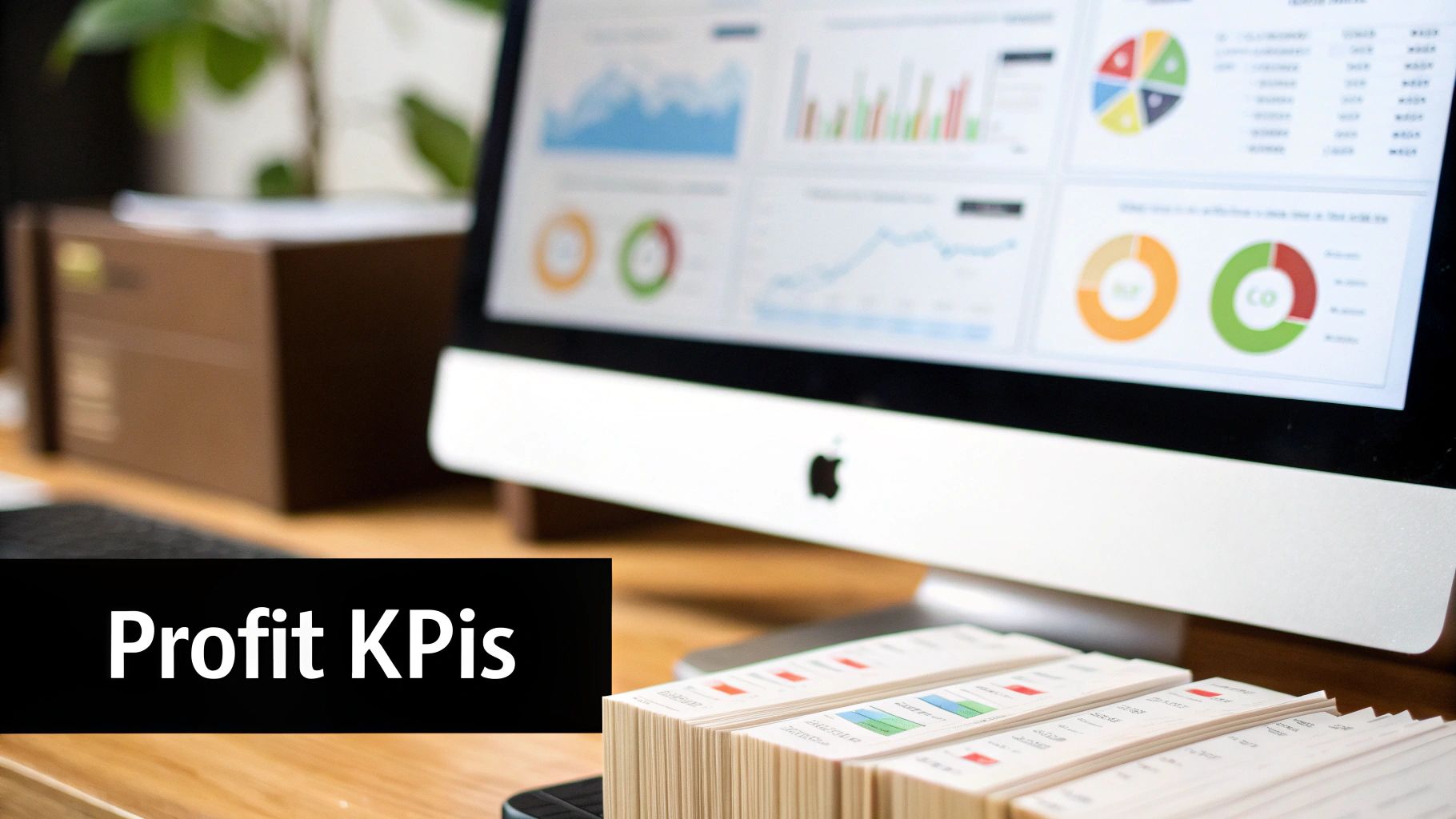
This dashboard becomes your command center. It should track the essentials side-by-side:
- GMV: The top-line sales number.
- COGS (Cost of Goods Sold): What you actually paid for the products you sold.
- Ad Spend: Don't forget any Spark Ad budget you're putting behind creator content.
- Commissions Paid: The cash going out the door to your affiliate partners.
When you can see all these metrics in one view, calculating your real profit margin becomes instant. This level of clarity lets you stop guessing and start making moves based on cold, hard data.
The goal is to evolve from asking, "How much did we sell?" to asking, "How profitable was that sale?" Answering that question at the creator, product, and even campaign level is what separates a good affiliate program from a great one.
Go Granular: Profitability by Creator and Product
Once you have the high-level picture of your program’s health, it’s time to zoom in. A top-tier operator doesn’t just know their overall profit; they know the exact profitability of every single creator they work with and every SKU in their catalog.
This is where you find the game-changing insights that GMV completely hides. By analyzing performance at this micro-level, you can finally see which partnerships are your true profit drivers and which are just generating empty revenue.
Think about this real-world scenario. You have two creators who each generated $10,000 in GMV last month. On the surface, they look like equals. But when you dig into the profit data, the story changes completely.
- Creator A focused on your high-margin flagship product, delivering a healthy 40% profit margin after their commission.
- Creator B pushed a low-margin, high-volume item, leaving you with just a 15% profit margin.
Suddenly, it’s obvious that Creator A is a far more valuable partner, yet a GMV-only report would have told you they were identical. This is the kind of data that’s worth its weight in gold. It tells you exactly where to double down.
From Insights to Action
Armed with this kind of detailed performance data, you can finally make strategic decisions that directly boost your bottom line. Your creator relationships are no longer based on gut feelings or follower counts; they’re built on tangible ROI.
This data-driven approach unlocks a whole new level of control:
- Optimize Your Roster: You can now confidently invest more in your high-ROI partners. Maybe that means offering them a higher commission tier, a monthly retainer, or exclusive access to new product drops.
- Renegotiate with Underperformers: For the creators bringing in high GMV but low profit, you have the data to start a conversation. You can guide them to promote higher-margin products or adjust their commission to better align with your actual business goals.
- Spot Winning Content: By tracking which specific videos drive the most profitable sales, you’ll start to see patterns. Do unboxing videos for Product X always convert better? Does a "get ready with me" format lead to a higher Average Order Value (AOV)? This lets you refine your content briefs and teach all your creators what really works.
Ultimately, looking past vanity metrics is what separates amateur affiliate programs from professional growth engines. It transforms your affiliate channel from a chaotic, unpredictable beast into a systematic, profit-generating machine.
Automating Your Workflows to Scale Without Breaking a Sweat
When your affiliate program starts to pick up steam, all those manual tasks that were once manageable suddenly become massive bottlenecks. You're juggling hundreds of sample shipments, chasing down creators for late content, and trying to spot the viral videos worth boosting. These jobs are critical, but they're also huge time sucks. This is where you bring in smart automation to build a program that can actually scale.
The whole point is to build a system where technology handles the repetitive, high-volume work. This isn't just about being more efficient; it’s about freeing yourself up to focus on the things that actually grow the business—like high-level strategy, creative direction, and building stronger relationships with your top-tier creators.

Trigger-Based Workflows That Do the Work for You
The foundation of good automation is building trigger-based workflows. Think of them as simple "if this happens, then do that" recipes that run on their own, taking manual follow-up off your plate.
Let's say a creator agrees to work with you. The moment you mark their sample as "shipped" in your system, a pre-built sequence can kick into gear:
- Deliver the Brief Instantly: An automated email fires off with the full content brief, their unique affiliate link, and payment instructions. No more forgetting to send the details.
- Send Smart Reminders: If they haven't posted a video seven days after getting the product, the system can send a friendly, automated nudge. This one simple step can make a huge difference in your content output.
- Flag High-Fliers: As soon as a creator's video is live, the system can start watching its performance. If it rockets to 100,000 views in the first 48 hours, your team gets an immediate alert.
This is what a connected system does. Instead of living in a spreadsheet and manually checking every little thing, you've built a machine that guides creators and surfaces opportunities automatically. We dig deeper into setting these up in our guide to social media marketing automation.
Finding and Boosting Winners on Autopilot
One of the most powerful automations you can set up is a system that identifies your best-performing organic content and gets it ready for paid ads. A great organic affiliate video is a proven concept. Putting ad spend behind it with Spark Ads is one of the fastest ways to pour fuel on the fire.
But when you're working with hundreds of creators, finding these gems by hand is next to impossible. An automated workflow, on the other hand, can constantly scan all your affiliate content for videos that meet specific performance triggers.
Your best-performing organic affiliate videos are essentially free, pre-tested ad creatives. Automating the process of finding and boosting them with Spark Ads is the closest thing to a cheat code for profitable scale on TikTok Shop.
For instance, you could create a rule that flags any affiliate video that hits a certain velocity—like generating $1,000 in GMV within its first 72 hours. Once that threshold is crossed, the system can automatically:
- Alert Your Media Buyer: Ping them with a link to the video, the creator’s handle, and its latest performance data.
- Request the Spark Ad Code: Automatically draft and send an email or DM to the creator asking for the ad code needed to run Spark Ads.
- Update a "Top Content" Dashboard: Add the video to a real-time dashboard that tracks your top performers, which makes it easy to spot trends in content that's working right now.
This kind of workflow flips the script from a reactive, manual process to a proactive, systematic one. You stop hunting for needles in the haystack. Instead, the best content gets delivered right to your team, ready for amplification. It ensures your ad budget is always aimed at videos with the highest chance of success, maximizing your ROI. This is how you stop just managing an affiliate program and start building a self-sustaining growth engine.
Your Playbook for Continuous Growth
Alright, let's pull all of this together. The real goal here is to get your TikTok Shop affiliate program out of the weeds of manual, day-to-day tasks and into a system that basically runs itself. It’s a shift in mindset.
This playbook is your roadmap to making that happen. We’re moving beyond just managing creators and starting to optimize a machine built on two simple, powerful ideas: making decisions with data and automating everything you possibly can.
Your focus now should be on refining the system—from how you find creators to how you remind them to post. A huge piece of this puzzle is also getting ahead of the curve by mastering how to identify winning TikTok product trends. You can't scale if your products aren't what people want.
Your Program Audit Checklist
So, where do you start? Run through this quick health check. It'll show you exactly where the leaks are in your current setup and where you'll get the biggest bang for your buck.
Creator Acquisition: Are you still scrolling the For You Page for hours? Or do you have a system that automatically surfaces new talent? If you can't find and reach out to 50+ qualified creators every single week, this is your biggest bottleneck. Full stop.
Performance Tracking: Be honest—are you just looking at GMV, or are you tracking actual profit per creator? If you don't have a single dashboard showing you who's actually making you money, you're flying blind and probably burning cash on creators who look good on paper but have terrible margins.
Onboarding Efficiency: From the moment a creator says "yes," how long does it take for them to get a product brief in their hands? If the answer isn't "instantly," you're killing momentum. Speed is everything.
The whole point is to build a self-sustaining growth loop. Good data helps you pick better creators. Better creators make higher-performing content. Automating how you boost that content drives more sales, which in turn attracts even more (and better) creators.
This is the cycle that separates the seven-figure shops from everyone else stuck in a rut. By tackling these key areas one by one, you'll build an affiliate program that doesn't just grow—it scales profitably.
Common Questions From the Trenches
When you're in the weeds, trying to scale a TikTok Shop affiliate program, the same questions pop up again and again. Here are the straight-up answers I give to operators who are serious about hitting big numbers.
How Many Creators Do I Actually Need?
There isn't a magic number, but let's get real. If you're aiming for seven-figure GMV, your system better be built to handle hundreds of creator relationships at once. To start, I'd aim for a solid, active roster of 20-30 creators.
Don't get star-struck by huge follower counts. Your bread and butter will be micro-influencers (10k-100k followers). They almost always punch above their weight on engagement. The real goal isn't hitting a specific number of creators; it's building a machine to constantly recruit, test, and find your winners. You can't do that manually at scale, which is why automation is non-negotiable.
What's a Fair Commission to Start With?
For most products on TikTok Shop, a 10-15% commission is a solid, competitive starting point. But don't just set it and forget it. If you have a high-margin product or you're launching something new, bumping that up to 20% can be a smart move to grab the attention of top-tier creators and kickstart momentum.
The best approach I've seen is a tiered commission structure. It gamifies the process. You could offer 12% for the first $1,000 in sales, then jump them to 15% for everything after that. Just make sure you've run the numbers against your COGS and know your target profit margin cold.
How Do I Know If a Retainer Is Worth It?
Tracking the ROI on a monthly retainer means looking beyond just the gross sales number. You need to know your actual profit.
Here’s a simple formula to live by: (Attributed GMV - COGS - Commissions - Retainer Fee) / Retainer Fee.
You absolutely need a centralized Creator Tracker for this. It’s where you’ll pull together all their attributed sales, how often they're posting, and how their content is performing. This is the only way to know for sure if the sales they're driving justify that fixed cost. It gives you the hard data you need to decide whether to renew, renegotiate, or cut a contract.
Tired of guessing what works? HiveHQ gives you the Affiliate Bot, Profit Dashboard, and Creator Tracker to build a predictable revenue engine on TikTok Shop. If you're ready to run your affiliate program like a pro, get started with HiveHQ today and see what true automation feels like.