Choosing Brand Ambassador Agencies for E-commerce Growth
brand ambassador agenciescreator marketingTikTok Shopinfluencer managemente-commerce marketing
Think of a brand ambassador agency as your outsourced partnerships team. They specialize in finding, managing, and scaling a team of genuine creators to promote your products. Instead of your team getting bogged down in the nitty-gritty, an agency handles everything from recruitment and contracting to campaign execution and reporting—a huge advantage for platforms like TikTok Shop.
Your Outsourced Creator Partnerships Department

Picture this: an agency is an extension of your marketing team, but one that comes pre-loaded with a very specific, hard-to-find skill set. Rather than spending endless hours hunting for creators, vetting them, and managing the back-and-forth, you offload the entire operational lift. They become the architects and managers of your creator army.
Their real job is to shift your strategy from one-off influencer campaigns to long-term, authentic relationships. A single sponsored post might give you a quick traffic bump, sure. But a well-run ambassador program creates a steady, consistent drumbeat of genuine advocacy that builds real trust and drives sales month after month.
The Strategic Value of an Agency Partner
For any growing e-commerce brand, the biggest win is getting instant access to expertise and infrastructure. If you tried to build a creator program from scratch, you'd need to become an expert in negotiation, contract law, content trends, and performance analytics overnight. Brand ambassador agencies bring all that institutional knowledge to the table from day one.
This frees up your internal team to do what they do best—focus on product, logistics, and customer service. The agency, meanwhile, handles the specialized work of creator management. They’re not just a vendor; they're a strategic partner laser-focused on one goal: turning creator passion into a measurable revenue stream.
A great agency doesn't just find people to post about your product. They find true fans and build a community around your brand, creating a powerful moat that competitors can't easily replicate.
What Problems Do They Solve?
Hiring an agency is about solving very specific, resource-draining problems that kill growth. Their entire model is built to unblock the operational and strategic hurdles that e-commerce teams constantly run into.
Here’s a breakdown of the core problems they solve:
- Lack of Time and Resources: Your team is already wearing multiple hats. An agency provides the dedicated people-power to manage a creator program at scale, saving you from having to hire several new full-time employees.
- Difficulty Finding Quality Creators: It’s a needle-in-a-haystack problem. Poring over thousands of profiles to find authentic, brand-aligned ambassadors is a massive undertaking. Agencies use their established networks and proven tools to pinpoint the right talent quickly.
- Inexperience with Negotiation and Contracts: Agencies are masters of negotiation. They know how to set fair compensation, establish clear expectations, and handle the legal side of creator agreements, which protects your brand from a world of potential headaches.
- Inconsistent Content and Messaging: They act as the brand guardians, giving creators clear briefs, helpful guidance, and constructive feedback. This ensures every piece of content aligns with your brand’s voice and campaign goals, keeping your message cohesive.
- Measuring True ROI: A top-tier agency sees right through vanity metrics. They focus on what matters: tracking KPIs like sales, customer acquisition cost, and creator-level profitability, giving you a crystal-clear picture of the program’s financial impact.
The Core Services That Drive Growth
Working with a brand ambassador agency is like hiring a specialized pit crew for your marketing engine. While every agency has its own unique style, they all generally focus on four core services. Getting to know these pillars helps you see how they turn the vague idea of "creator partnerships" into a real, measurable growth channel for your brand.
These agencies essentially offer an all-in-one solution, taking care of the complicated logistics that can quickly swamp an in-house team. And the market reflects their value—the global brand ambassador solution market was valued at $408.4 million in 2024 and is on track to hit $825.8 million by 2032. It's a clear sign that more and more businesses are betting big on this strategy. You can read the full research about this market growth if you want to go deeper.
Strategic Recruitment and Vetting
The whole program lives or dies by the quality of its people. An agency's first job is to look past vanity metrics like follower counts and really dig into a creator’s analytics and audience makeup. They act as your expert talent scouts, finding people whose personal brand, values, and audience are a perfect match for yours.
This isn't about finding the biggest creators; it's about finding the right ones. A good agency will dissect engagement rates, check for audience authenticity, and review past brand deals to make sure you’re partnering with genuine fans, not just hired guns.
This careful vetting process typically includes:
- Audience Analysis: Making sure the creator’s followers actually line up with your ideal customer profile.
- Brand Alignment Check: Verifying that their content style and personal values won't clash with your brand’s identity.
- Performance History Review: Looking at the results of their past partnerships to get a sense of what they can do for you.
Program Activation and Management
Once the right ambassadors are on board, the agency switches gears and becomes the program's project manager. This is where all the daily operational heavy lifting gets done. They handle all the administrative and logistical work that keeps a partnership running smoothly and professionally.
Think of them as the central command center connecting your brand with dozens, or even hundreds, of creators. They make sure everyone knows what to do, has what they need to succeed, and is legally buttoned up.
An agency’s real magic isn't just finding talent. It's managing the complex web of relationships, logistics, and creative direction that turns a group of individual creators into a cohesive marketing force.
This activation phase covers everything from the initial handshake to ongoing support:
- Contract Negotiation: Hammering out all the legal agreements, payment terms, and content rights.
- Product Seeding: Managing the nuts and bolts of getting your products into ambassadors' hands.
- Brief Development: Writing clear, compelling creative briefs that inspire amazing content while keeping it on-brand.
- Communication: Serving as the go-to contact for any and all ambassador questions.
Campaign Execution and Optimization
With the program up and running, the agency’s focus shifts to execution. They launch campaigns, keep an eye on performance, and tweak things to get the biggest bang for your buck. This involves coordinating content calendars, making sure posts go live on time, and jumping into the comments to engage with the community.
The best brand ambassador agencies don't just "set it and forget it." They are actively in the trenches, making real-time adjustments based on what’s clicking with the audience. If a certain style of video is blowing up, they’ll quickly work with other creators to lean into that momentum and amplify the results.
Performance Analytics and Reporting
Finally, we get to the most important part: measurement. A great agency is obsessed with data. They use it to prove the program's value and to guide what comes next. They look beyond surface-level metrics like likes and comments and focus on the KPIs that actually move the needle for your business.
They’ll deliver regular, easy-to-digest reports that connect creator activity to real business outcomes, like website traffic, conversions, and—most importantly—sales. This data-driven feedback loop is what allows you to make smarter decisions, refine your strategy, and prove the ROI of your investment. It's what turns your ambassador program from a marketing expense into a predictable revenue driver.
Measuring the True Success of Your Program

It’s incredibly easy to get swept up in big, flashy numbers like views, likes, and follower counts. These are often called “vanity metrics” for a reason—they look good on a report, but they don't pay the bills.
For any e-commerce brand trying to grow, the real measure of a brand ambassador program comes down to one thing: profitability. To have a truly productive conversation with your agency, you have to steer the discussion away from surface-level buzz and toward the hard numbers that impact your bottom line.
Moving Beyond Vanity Metrics
The first step is learning to separate the metrics that make you feel good from the ones that actually move your business forward. A viral video is fantastic for exposure, but if it doesn't translate into actual sales, it's just a very expensive ad. Real success is measured in dollars, not likes.
A good agency gets this. They should be just as focused on the financial health of your program as you are, providing clear reports on which creators are generating revenue and which campaigns are falling flat. This allows you to double down on what’s working and cut your losses on what isn't.
Focusing solely on Gross Merchandise Value (GMV) can be a dangerous trap. While high GMV looks impressive, it tells an incomplete story. A creator driving $20,000 in GMV with $18,000 in costs is far less valuable than one driving $10,000 in GMV with only $3,000 in costs.
The Profit-Driven KPIs That Matter
To get the full story of your program's performance, you need to track a few key metrics that are all about profit. These numbers show you how efficient and sustainable your creator partnerships really are, turning your program from a simple marketing expense into a genuine profit center.
Let's break down the difference between what most people track and what you should be tracking.
Comparing Ambassador Program KPIs: Vanity vs. Profit Metrics
This table highlights the shift from traditional social media metrics to the e-commerce performance indicators that reveal true profitability, especially on platforms like TikTok Shop.
| Metric Category | Vanity Metric (Traditional) | Profit Metric (E-commerce Focus) |
|---|---|---|
| Top-Line Performance | Impressions & Reach | Gross Merchandise Value (GMV) Per Creator: The total sales value generated by each ambassador. |
| Direct Program Cost | Engagement Rate (Likes, Comments) | Commission Costs: The direct percentage of sales paid out to the creator. A critical variable cost. |
| Hidden Program Cost | Follower Growth | Sample Costs: The Cost of Goods Sold (COGS) for every product sent to an ambassador. This is a real, hard cost. |
| The Bottom Line | Video Views | Net Profit Per Creator: The ultimate metric. GMV minus all costs (commissions, COGS, shipping, fees). This is true profit. |
By focusing on the "Profit Metric" column, you move from guessing to knowing. You get a crystal-clear picture of financial performance.
Here are the essential KPIs your brand ambassador agency absolutely must be tracking and reporting on:
Gross Merchandise Value (GMV) Per Creator: This is your starting point. It’s the total sales value each ambassador brings in, giving you a baseline for their top-line impact.
Commission Costs: This is the direct cut of each sale you pay to the creator. On a platform like TikTok Shop, this is a major variable cost you have to monitor closely.
Sample Costs: Don't let this slip through the cracks. The Cost of Goods Sold (COGS) for every single product you send out is a real expense that cuts directly into your margins. It must be tracked for each ambassador.
Net Profit Per Creator: This is the number that matters most. It’s the GMV minus all the associated costs—commissions, sample COGS, shipping, and any platform fees. This is the exact amount of money each creator is putting back into your business. For a deeper dive, you can learn more about calculating the real ROI on influencer marketing.
When you analyze these metrics together, you build a powerful framework for performance. It enables you to have intelligent, data-backed conversations with your agency about which ambassadors are true growth partners and which might not be a sustainable fit. This is what separates a decent program from a truly great one.
How to Vet and Choose the Right Agency
Picking the right partner from a sea of brand ambassador agencies can feel like a huge task, but it’s easily the most critical decision you'll make for your creator program. The right agency is more than a vendor; they’re an extension of your team, dedicated to driving profitable growth. The wrong one? They can burn through your budget and, worse, tarnish your brand's reputation. A solid vetting process is your best line of defense.
First, let's get a feel for the market. Brand ambassador programs are blowing up right now. Recent research shows that 61% of marketers have already upped their investment in these programs over the last year. What’s even more telling is that 73% plan to spend even more in the next 12 months. This isn't a small trend; it's a major shift in where marketing dollars are going.
Core Questions to Ask Potential Partners
Before you even think about signing a contract, you need to ask some tough, direct questions. The answers you get will tell you everything you need to know about their strategic thinking, how they operate, and whether they actually care about your bottom line. It's time to get past the slick sales pitch and demand real substance.
Here are the essentials to start with:
- TikTok Shop Experience: "Show me the proof. Can you walk me through specific e-commerce brands you've scaled on TikTok Shop? I want to hear about the challenges you faced and how you measured success in terms of actual net profit, not just gross sales."
- Creator Sourcing Methodology: "How do you find your talent? I'm interested in your process for identifying and vetting ambassadors that goes beyond just looking at their follower count. How do you ensure they genuinely align with our brand and that their audience is real and engaged?"
- Reporting and Analytics: "What metrics do you live and die by? Can I see a sample report? I need to see how you break down GMV, commission costs, sample costs, and net profit for each individual creator."
- Communication and Workflow: "Let's talk logistics. What does our day-to-day communication look like? Who is my main point of contact, and what’s your system for handling approvals and feedback loops?"
Uncovering Critical Red Flags
Asking the right questions is only half the battle. You also need to know how to spot the red flags. Some agencies are brilliant at talking the talk but fall flat when it's time to deliver. To get a better sense of who’s out there, you can browse through different Agencies & Services categories to see what the full spectrum of providers looks like.
A huge red flag is any agency that leads with vanity metrics like "potential reach" or "impressions." A real partner will immediately pivot the conversation to profitable growth. They get that e-commerce is a numbers game.
Keep your eyes peeled for these warning signs during your calls:
- Vague Performance Promises: If they promise you'll go viral or make sweeping claims without hard data and case studies to back them up, it's time to hang up. Real success comes from smart strategy and constant testing, not wishful thinking.
- A One-Size-Fits-All Strategy: Your brand is unique. If an agency throws a generic, cookie-cutter plan at you before they've even asked about your goals, brand identity, or unit economics, they’re not a strategic partner. They’re just trying to make a quick sale.
- Lack of Reporting Transparency: If they get cagey about sharing sample reports or can't clearly articulate how they track net profit, it’s a bad sign. It usually means one of two things: they don't track it, or the results aren't worth showing.
- Over-reliance on Their "Exclusive" Network: An existing network of creators is great, but it shouldn't be their only move. A top-tier agency will have a robust system for discovering fresh, up-and-coming talent that’s a perfect match for your specific niche.
Finding the right fit takes some legwork, but the reward is a scalable, profitable creator program that can become a true engine for your brand's growth. For teams looking to nail down the basics first, our guide on how to launch winning ambassador programs for brands is a great place to start.
Exploring Powerful Alternatives to Agencies
While working with a brand ambassador agency can be a smart move, it’s definitely not the only game in town. For many e-commerce brands, especially those that want to own their data and move quickly, looking at other options can unlock a ton of potential.
Stepping away from the traditional agency model isn't about cutting corners. It's about finding the right fit for your brand's budget, goals, and team size. Let's walk through three distinct paths you can take.
Building an In-House Program
The first route is to bring your entire brand ambassador program in-house. This gives you the ultimate say over everything—from who you partner with to the final look of every campaign. Your own team lives and breathes your brand, so you can be sure every ambassador is a perfect cultural fit.
But this level of control comes at a price. You're essentially building a mini-agency from scratch, which means hiring a creator manager, a contract negotiator, and a data analyst. It's a slow, often expensive process that can pull focus away from your core business.
Using Creator Marketplaces
Think of creator marketplaces as giant digital talent agencies. They're fantastic for finding influencers for one-off projects or when you need to find someone in a very specific niche, fast. They solve the immediate problem of discovery by giving you access to thousands of creator profiles.
The catch? These relationships are often transactional. Marketplaces are built for short-term campaigns, not for building the kind of deep, long-term partnerships that make a brand ambassador program truly effective. If you're just starting, our guide on how to find microinfluencers can point you in a more targeted direction.
Leveraging Automation Platforms
The third, and often most scalable, option is using an automation platform. This modern approach gives you the control of an in-house team with the power of technology. Instead of paying agency retainers or spending hours on manual outreach, you use software to manage and scale your entire program.
This lets a small team do the work that once required a big agency. Platforms can handle the tedious stuff—like finding creators, sending products, and tracking results—so your team can focus on what matters: building real relationships. Many brands are turning to solutions like a dedicated lunabloomai's brand ambassador app to centralize these efforts.
The numbers back this up. The market for brand ambassador software is expected to hit USD 693.4 million in 2025, showing a clear industry shift toward data-driven, automated solutions.
Deciding which path is right requires a clear look at the trade-offs. This table breaks down the key differences between the three main approaches.
Agency vs In-House vs Automation Platform Comparison
| Factor | Brand Ambassador Agency | In-House Program | Automation Platform |
|---|---|---|---|
| Cost | High (Retainers + Commissions) | High (Salaries + Benefits + Tools) | Low to Moderate (SaaS Subscription) |
| Scalability | Moderate (Limited by agency headcount) | Low (Limited by internal headcount) | High (Software-driven) |
| Control | Low (You relinquish direct control) | High (Full control over strategy) | High (You manage the strategy directly) |
| Data Access | Limited (Often get reports, not raw data) | High (You own all data) | High (You own all data) |
| Expertise | High (Access to specialists) | Variable (Dependent on hires) | Moderate (Platform provides tools, you provide strategy) |
Ultimately, the best choice depends on your budget, team size, and how much control you want over your brand's voice and data.
This flowchart maps out the key steps for vetting a potential agency partner, covering everything from initial discovery questions to red flags to watch out for.
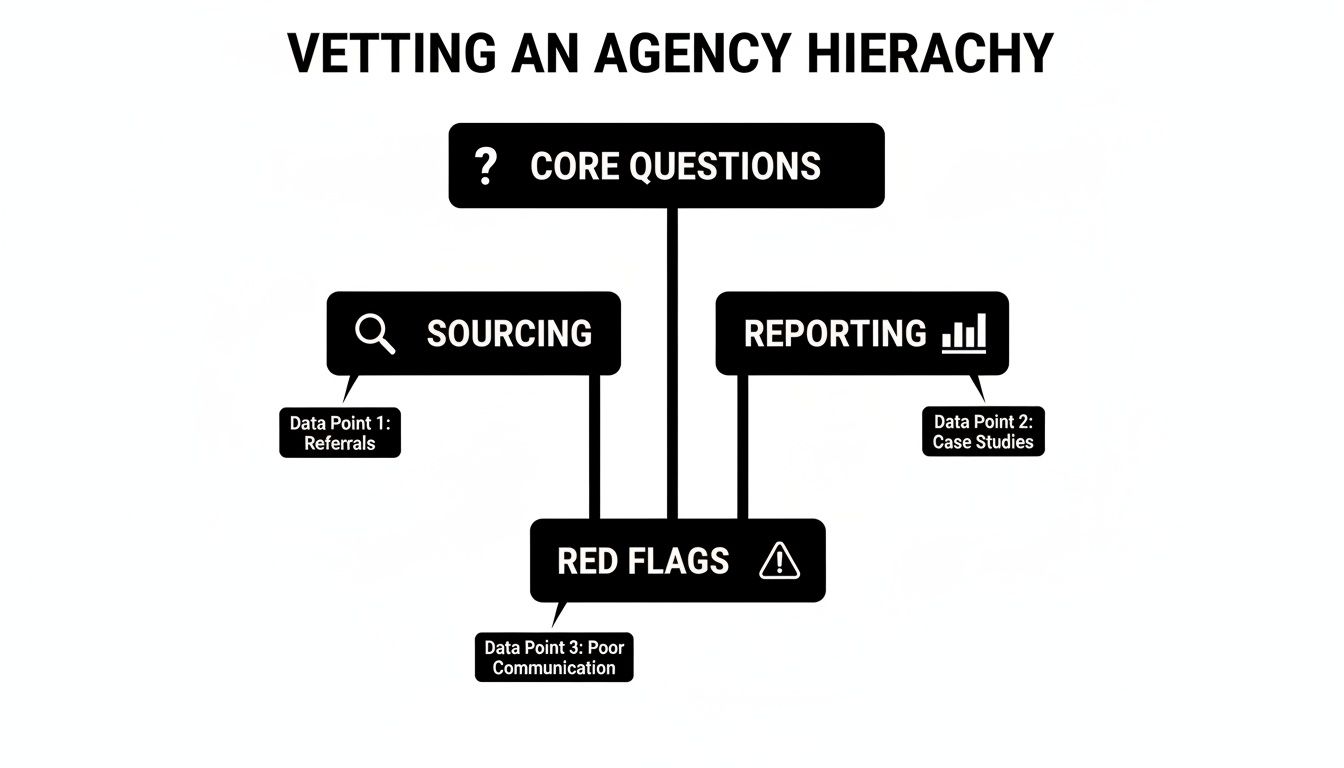
As the visual shows, a good partnership starts with asking the right questions about how they find creators and what kind of reporting you can expect.
Automation isn't about replacing human connection; it's about eliminating the administrative friction that gets in the way of it. It handles the repetitive tasks so you can focus on strategy and relationships.
Platforms like HiveHQ are built on this idea. By combining a creator discovery bot with a profit-focused dashboard, they let you scale your outreach while keeping a close eye on the most important metric: net profit per creator. You get the data ownership of an in-house program and the reach of a marketplace, all powered by efficient software.
Making the Right Choice for Your Brand
Figuring out the best way to run your creator program really comes down to where your brand is right now—your budget, your team, and what you’re trying to achieve. There’s no silver bullet here. But once you get the pros and cons of each path—working with brand ambassador agencies, building your own team, or using software—you can build a strategy that actually fits.
The best approach is rarely a single solution. It’s all about creating a model that works with your financial reality and your ambitions for growth.
Tailoring the Strategy to Your Brand Stage
If you’re an early-stage startup, you know every dollar has a job to do. A pricey agency retainer just isn't in the cards. In this case, your best bet is often an automation platform. It keeps your fixed costs low while letting you reach a huge number of creators and track your ROI with precision from the very beginning. It gives a small team the power of a whole department.
Now, consider a mid-sized brand with a more stable footing. Here, a hybrid model can work wonders. You might hire an in-house creator manager to handle the big-picture strategy and build relationships with your top-tier partners. Then, you give that manager automation tools to scale up outreach, product seeding, and performance tracking for the rest of your ambassador community. It's the perfect blend of personal touch and operational scale.
No matter how you run your creator program—with an agency, an in-house team, or a mix of both—the one constant for success is a foundation of data-driven automation. Anything else is just guesswork.
The Foundational Role of Automation
Whichever path you take, technology has to be at the core if you want to grow sustainably. Automation tools aren’t just for blasting out emails. They’re for making smarter, faster, and more profitable decisions at every step. They give you the hard data you need to see your true net profit per creator, which is the only metric that really counts.
This data-first mindset ensures your program doesn't just get bigger, but also more profitable. Here’s what that foundation gets you:
- Scalable Outreach: You can find and connect with thousands of potential ambassadors without having to hire an army of people.
- Profit-Driven Reporting: Forget vanity metrics. You can see exactly how much revenue each partnership brings in after accounting for all costs.
- Operational Efficiency: All the repetitive stuff—like follow-ups and shipping logistics—gets handled automatically, freeing up your team to focus on strategy.
At the end of the day, you want to build a creator program that acts as a reliable growth engine for your brand. Whether you bring in an agency to run the show or use a platform to empower your own team, smart automation is the key to making it happen.
Frequently Asked Questions
When you're diving into the world of creator partnerships, a few key questions always pop up. Let's clear the air on some of the most common ones we hear from e-commerce teams, especially around costs, roles, and the right strategy for working with a brand ambassador agency.
How Much Do Brand Ambassador Agencies Typically Cost?
This is the big one, right? The truth is, agency pricing isn't a simple, flat rate. It really depends on what you need, but most models fall into one of three buckets. Getting familiar with these will help you find a partner that fits your budget and goals.
- Monthly Retainer: You pay a fixed fee every month for a set scope of services. This can be anywhere from $3,000 to $15,000+, based on the agency’s reputation and how much work they're doing for you.
- Commission-Based: Here, the agency takes a cut of the sales they drive, usually 10-25% of GMV. This is great because their success is directly tied to your sales.
- Hybrid Model: A popular middle ground. This combines a smaller monthly retainer with a lower commission rate, giving you some budget predictability while still motivating the agency to drive performance.
Before you sign anything, get super clear on all the potential costs. Don't be shy—ask about platform fees, ad spend markups, or any other charges that might be hiding in the fine print. You want total transparency.
What Is the Real Difference Between an Influencer and a Brand Ambassador?
People throw these terms around as if they mean the same thing, but they're fundamentally different. The key distinction is the relationship.
Think of it like dating versus a long-term commitment.
An influencer collaboration is often transactional—a one-off campaign or a few paid posts. A brand ambassador, on the other hand, is in it for the long haul. They have a genuine, deep-seated love for your brand and product. Over time, they become true, trusted advocates, which is what a great agency helps you build.
Can I Use an Automation Platform and an Agency Together?
Yes, you absolutely can! In fact, this is often the smartest and most efficient way to scale your creator program. It’s all about playing to the strengths of both and creating a powerful growth engine.
A hybrid approach lets you pair high-touch, strategic management with high-volume, automated execution. Your agency handles the top-tier creators, while software scales the rest of your program profitably.
Here’s a practical look at how it works: Your agency can focus on the big-picture strategy and nurture the high-value relationships with your VIP creators. At the same time, an automation platform can handle the heavy lifting of scalable outreach, affiliate link management, and product seeding for your wider community of ambassadors.
This integrated setup means your internal team and the agency can work from a single, unified dashboard. Everyone sees the same profit-driven reports, ensuring you’re all aligned and making smart, data-backed decisions that actually grow your brand.
Ready to scale your creator program with data-driven automation? HiveHQ provides an all-in-one suite to discover creators, automate outreach, and track net profit with unparalleled accuracy. Stop guessing and start growing by visiting https://hivehq.ai to see how our platform can become your brand's growth engine.