How to Find Microinfluencers for Your TikTok Shop
how to find microinfluencerstiktok shop influencerscreator marketingecommerce growthtiktok affiliate
When you're looking for microinfluencers for your TikTok Shop, you’re not just chasing follower counts. You're hunting for creators with between 10,000 and 100,000 followers who have built a real, dedicated community around a specific niche.
These creators are absolute gold because of the authentic connection they have with their audience. That bond translates directly into higher engagement and, more importantly, genuine sales. The secret isn't in their follower count; it's in the trust they've worked so hard to build.
Why Microinfluencers Are Your TikTok Shop Secret Weapon
Let's cut right to it. While the big-name macro-influencers and celebrities get all the headlines, it's the microinfluencers who are quietly delivering the most powerful results on TikTok Shop. It's never been about the size of the audience; it’s always been about the strength of the connection. A smaller, highly engaged following is infinitely more valuable than a massive, passive one.
Think about it like this: a mega-influencer is basically a billboard on the highway. Millions of people might drive past it, but only a tiny fraction will ever pull over and buy something. A microinfluencer, on the other hand, is like a trusted friend giving you a personal recommendation over coffee. Their followers don't just see another product—they see someone they genuinely respect and relate to using and loving it. That kind of social proof is what actually drives sales.
Microinfluencers vs Macroinfluencers at a Glance
To really see why smaller is often better, it helps to put the two side-by-side. The differences in engagement, cost, and audience connection make it clear why so many successful TikTok Shops build their strategy around microinfluencers.
| Metric | Microinfluencers (10k-100k followers) | Macroinfluencers (100k-1M+ followers) |
|---|---|---|
| Engagement Rate | Typically 7-10% or even higher | Often drops to 1-3% |
| Audience Connection | Feels personal, like a trusted friend | More distant, like a celebrity endorsement |
| Cost Per Post | Highly affordable, often a few hundred dollars or product trade | Can cost thousands, sometimes tens of thousands |
| Niche Authority | Deep expertise in a specific topic | Broader focus, less specialized |
| Authenticity | Seen as genuine and relatable | Can sometimes feel overly commercial or scripted |
The takeaway is simple: if your goal is to build trust and drive actual conversions, microinfluencers offer a much more direct and cost-effective path.
The Power of Niche Authority and Trust
Microinfluencers succeed because they are specialists. They've built entire communities around incredibly specific interests, whether that’s sustainable fashion, vegan skincare, or retro gaming accessories. This laser focus means their audience isn't just random people—they're highly targeted consumers who are already primed to be interested in what you’re selling.
When a creator who only reviews cruelty-free makeup recommends your new vegan foundation, that endorsement carries serious weight. Their followers trust their opinion because they’ve proven their expertise over hundreds of videos. That level of authenticity is something you simply can't buy from a larger creator who's promoting a new energy drink one day and a car brand the next.
The real magic of microinfluencers isn't just their engagement rate; it's the transactional trust they've built. When they recommend a product on TikTok Shop, their followers listen because the recommendation feels like a genuine discovery, not a paid advertisement.
This isn't just a hunch; the data backs it up. The micro-influencer market share jumped from 89% in 2020 to a staggering 91% in 2021, and experts believe that trend is only accelerating.
Driving Better ROI with a Creator Army
Instead of pouring your entire budget into one high-stakes post from a celebrity that might completely miss the mark, you can partner with an army of 20, 50, or even 100 microinfluencers. This "creator army" strategy is smarter for a few key reasons:
- You Diversify Your Risk: If one creator’s content doesn’t perform as expected, it won’t tank your entire campaign.
- You Get Broader Reach: You’re tapping into dozens of unique, niche communities instead of just one large, generic audience.
- You Gain Authentic Content Variety: You'll end up with a treasure trove of user-generated content (UGC) in different styles, which you can then repurpose for your own ads, social channels, and website.
To truly make this work, it's vital to understand the proven TikTok growth strategies that these creators use to build their communities. At the end of the day, working with microinfluencers isn't just a tactic—it's a fundamental strategy for building a loyal community, earning trust, and creating a sustainable sales engine for your TikTok Shop.
How to Discover High-Potential Creators
Finding the right micro-influencers can feel like searching for a needle in a digital haystack. With millions of creators on TikTok, the goal isn't just to find any creator—it's to find the right one for your brand. This takes a smart, multi-channel approach that mixes good old-fashioned manual discovery with some strategic automation.
The great news is that your next top-performing partner is out there, you just have to know where to look. Let's dig into the most effective ways to build a solid shortlist of creators who can drive real results for your TikTok Shop.
This flowchart really breaks down why micro-influencers are such a powerful asset, highlighting how their niche audiences create sky-high engagement and a much better return on investment.
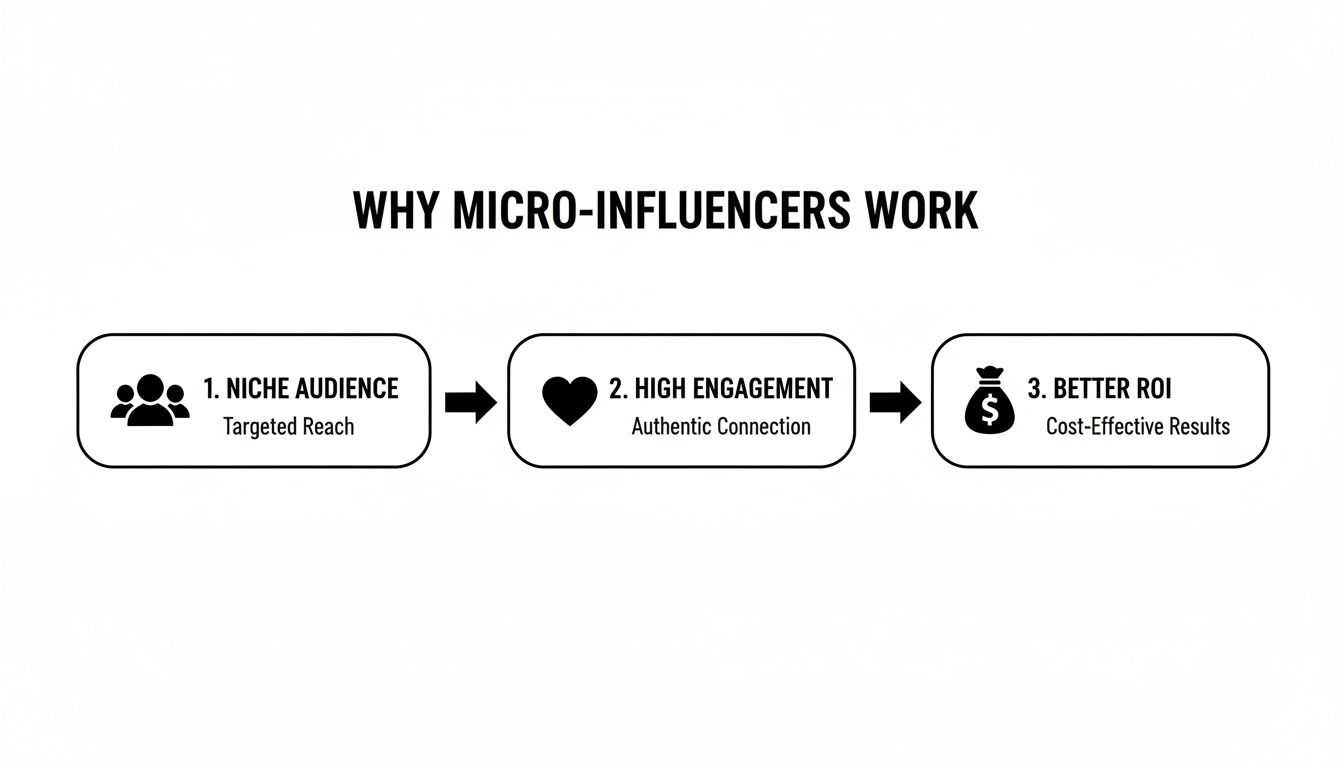
It’s a simple but potent cycle: a specialized audience leads to a stronger connection, which in turn drives more cost-effective results for your brand.
Mastering Manual Discovery on TikTok
Your first stop for talent should be the TikTok app itself. This hands-on method helps you get an authentic feel for the content styles and creators that are genuinely clicking with your target audience right now.
Think of the search bar as your best friend here. Skip the generic terms and start using the long-tail keywords your ideal customer would actually type in. For example, instead of just "skincare," try searching for "acne-safe makeup routines" or "Korean glass skin secrets." This immediately filters your results down to the niche experts.
Also, don't sleep on the comments section of popular videos in your niche. You'll often find up-and-coming micro-influencers sharing their own takes and engaging with the community. These are the passionate people who are already deeply invested in the conversation.
Pro Tip: Look beyond the official partnerships your competitors are running. Dig deeper to see which micro-influencers are organically shouting out their products. These creators are gold because they're already genuine fans, making them your most authentic and valuable potential partners.
Leveraging the TikTok Creator Marketplace
When you need a more structured approach, the official TikTok Creator Marketplace is an invaluable resource. It’s essentially a database where brands can connect with creators who have already raised their hand for partnerships.
The biggest advantage here is the verified data. You can filter creators with a level of precision that manual searching just can't offer, giving you a pre-vetted list to work from.
- Audience Demographics: Filter by location, age, and gender to make sure a creator's audience lines up with your customer profile.
- Niche or Vertical: Zero in on creators in specific categories like "Beauty & Personal Care" or "Fashion & Accessories."
- Follower Count: Set your range to specifically target micro-influencers, typically between 10k-100k followers.
While the Marketplace is a fantastic starting point, just remember that a ton of high-potential creators aren't on it. You'll get the most comprehensive list by combining Marketplace searches with your manual discovery efforts. For more advanced strategies, this guide on finding and activating micro-influencers has some excellent tips that are useful for any industry.
Automating Discovery with HiveHQ
Let's be real: manual searching is insightful, but it's a massive time sink. If you want to scale your program from a handful of creators to dozens or even hundreds, you need automation. This is where a tool like HiveHQ's Affiliate Bot comes into play.
Instead of you spending hours doom-scrolling through feeds, an automation tool can sift through a massive TikTok influencer database of active creators on your behalf. You can set hyper-specific filters to find creators who aren't just in your niche but are also actively and successfully promoting products on TikTok Shop.
This approach can save you hundreds of hours and, more importantly, surface creators you would have never found on your own. For instance, you can pinpoint micro-influencers who recently drove sales for a competitor's product. That’s a huge signal that they have an audience ready to buy, making them a perfect candidate for your brand to reach out to.
By blending these three methods—manual searching for authenticity, the Creator Marketplace for verified data, and automation for scale—you create a powerful and efficient system for finding the absolute best micro-influencers for your brand.
How to Vet Influencers Beyond the Follower Count
So, you’ve got a promising list of creators. That’s a great start, but the real work is just beginning. Finding potential partners is one thing; properly vetting them to make sure your investment pays off is another entirely. A high follower count can be a vanity metric, and jumping into a partnership based on that alone is a classic recipe for a failed campaign.
This is where you shift from discovery to deep-dive analysis. You need to get your hands dirty and dig into a creator's profile, looking for the tell-tale signs that they have a real, engaged community that actually trusts them. Honestly, a creator with 20,000 followers who can genuinely influence purchasing decisions is infinitely more valuable than one with 100,000 passive viewers.
This meticulous vetting process is your safety net. It’s how you ensure you’re partnering with creators who can deliver tangible results, not just a fleeting moment of visibility.
Analyzing Content Quality and Consistency
First things first, become a student of their content. Don't just glance at their last few videos—scroll back for weeks, even months. What you're looking for are patterns, both in their performance and their creative style.
Is their video quality consistent? Do they have a clear point of view or a niche they stick to? A creator who bounces erratically from gaming to skincare to cooking tutorials probably has a confused, disjointed audience with no single unifying interest. That makes it incredibly difficult to predict how your product will land.
Pay close attention to their video views, too. A profile with a couple of massive viral hits but where most videos struggle to break a few thousand views is a major red flag. This tells you their audience isn't consistently tuning in for their day-to-day content, which is exactly where your product will likely live.
Assessing Audience Health and Engagement
True influence lives and breathes in the comments section. This is your window into the health of a creator’s community and the authenticity of their engagement.
Don't just look at the number of comments; start actually reading them. Are they substantive? Are people asking genuine questions, tagging their friends, and sharing their own experiences? Or is the feed clogged with generic replies like "Great video!" and single emojis?
Here are the key signals of a healthy, thriving audience:
- Thoughtful Questions: Followers ask for more details, product links, or the creator's opinion on related topics.
- Community Interaction: You see followers replying to each other, sparking real conversations.
- Personal Anecdotes: Viewers share their own stories related to the video's content, showing a genuine connection.
Watch out for comment pods or repetitive, bot-like comments. Authentic engagement is conversational and varied. A high comment count means absolutely nothing if it isn't from real, interested people who could become your customers.
This deep dive is critical. The global influencer marketing industry hit a staggering $21.1 billion in 2023, and with 38% of marketers citing sales as their number one goal, vetting creators for true audience alignment is essential for getting that measurable ROI. You can dig deeper into these trends in recent industry analysis from micro-influencer marketing platforms.
Creator Vetting Checklist Green Lights and Red Flags
To keep this process from becoming overwhelming, it helps to use a simple checklist. This framework keeps you objective and helps you spot common pitfalls when you're trying to find the right micro-influencers.
| Vetting Criteria | Green Light (Look for this) | Red Flag (Avoid this) |
|---|---|---|
| Video View Consistency | Most videos perform within a predictable range, showing a stable, engaged audience. | A few viral hits surrounded by dozens of low-performing videos. |
| Comment Quality | Genuine questions, conversations between followers, and personal stories. | Spammy, one-word comments or an endless stream of emojis. |
| Niche Alignment | The creator consistently posts high-quality content directly related to your product category. | Posts are scattered across many unrelated topics, indicating a fragmented audience. |
| Past Partnerships | Previous sponsored content is creative, authentic, and integrates naturally into their feed. | Their feed is oversaturated with ads, or sponsored posts feel forced and disingenuous. |
| Audience Demographics | Their followers clearly match your ideal customer profile in terms of age, location, and interests. | A clear mismatch between their audience and your target market. |
Running through these points for each potential creator will give you a much clearer picture of who is worth pursuing and who you should pass on.
Automating Vetting with a Creator Tracker
Let's be real: manually vetting dozens of creators is incredibly time-consuming. While you should always do a manual spot-check, you need tools to help you manage this process at scale.
This is where platforms like HiveHQ come in. They offer a Creator Tracker that centralizes this entire process, pulling you out of spreadsheet hell. Instead of juggling tabs and notes, you can monitor everything in one place, tracking key performance indicators like GMV contribution, post frequency, and the overall ROI for each partner.
This transforms vetting from a one-off task into an ongoing optimization engine. You can quickly see who your top performers are and double down on those relationships, while gracefully phasing out creators who aren't delivering results. This data-driven approach is how you build a truly scalable and profitable influencer program on TikTok Shop.
Crafting an Outreach Message That Actually Gets a Response
You’ve put in the time to find and vet the perfect creators. Now for the moment of truth: the first message. This is where so many brands get it wrong.
A generic, copy-pasted DM is the fastest way to get ignored. The best creators are absolutely swamped with low-effort pitches every single day. If you want to stand out, your outreach has to feel personal, look professional, and show value right from the start.
Think of it this way: you’re not just sending them a product, you're inviting them into a real partnership. The goal is to make them feel like you’ve specifically chosen them for a reason, not like they’re just another name on a spreadsheet.
This isn’t just about being polite—it’s smart strategy. A thoughtful approach will massively increase your response rate and set a positive, collaborative tone for the rest of your work together.
Go Deeper Than Just Their First Name
Real personalization is so much more than Hi [Creator Name]. It’s about proving you’ve done your homework and actually appreciate what they do. Before you even think about hitting send, find a specific video or post of theirs that you genuinely enjoyed.
Instead of a generic compliment like, "I love your feed," try something that shows you've been paying attention. For example: "Your recent video on sustainable morning routines was fantastic. The way you explained the benefits of bamboo toothbrushes really clicked with our brand’s mission."
That one sentence does two critical things:
- It immediately builds rapport and makes the creator feel seen.
- It frames your product as a natural fit for the conversation they’re already having with their audience, not just a random ad.
Make Your Value Prop Crystal Clear
Once you’ve got their attention, you have to answer the question that’s on every creator’s mind: “What’s in it for me?” For micro-influencers, this is often about more than just a paycheck or a freebie.
Be upfront about the mutual benefits. Frame the partnership as a true win-win, where they get to create content their audience will genuinely love while you get to connect with a super-engaged community.
Your offer should feel like a genuine opportunity, not a transaction. Highlight how your product solves a problem for their audience or aligns with their personal brand values. This elevates the conversation from a simple ad read to a meaningful collaboration.
Clearly lay out the next steps. Vague requests just create confusion and are a recipe for being ghosted. Give them a simple, clear call to action, like asking if they’d be open to receiving a product sample with no strings attached. Make it incredibly easy for them to say yes.
Nail Down the Logistics Upfront
A great outreach message also anticipates the practical questions a creator is bound to have. You don't need to send a full contract in your first DM, but you should be ready to talk about how the partnership will work.
Be prepared to discuss things like your product seeding process, what you’re hoping to see in the content, and how you’ll measure success. Having a solid influencer brief template is a game-changer here, as it ensures everyone is on the same page from day one.
Automate Outreach Without Sounding Like a Robot
Okay, let's be realistic. Manually personalizing every single message is effective, but it’s not scalable. If you're serious about building a real creator army, you need a way to streamline this.
This is where automation tools come in. A platform like HiveHQ has an Affiliate Bot that lets you send customized messages at scale. You can build templates that automatically pull in specific details about a creator's content, so you get that personal touch without spending all day in your DMs.
The system can also handle Smart Follow-Ups, sending automatic reminders when a product has been delivered or when a content deadline is getting close. It’s the perfect way to stay on top of everything without the administrative headache, blending efficiency with that all-important personal connection.
Scaling Your Program From a Handful of Creators to Hundreds
Juggling a few creator partnerships on a spreadsheet is manageable. But turning that small group into a full-blown affiliate army that drives predictable revenue? That's a completely different ballgame.
Once you start moving from a handful of creators to dozens or even hundreds, those manual processes don't just get slower—they flat-out break. This is where you have to shift from one-off campaigns to building a robust, systematic program. You're not just coordinating posts anymore; you're building a growth engine.
From Messy Spreadsheets to a Centralized Creator Database
The first thing to go haywire at scale is organization. That trusty spreadsheet quickly devolves into a chaotic mess of outdated contact info, inconsistent performance data, and missed follow-ups. To build a real program, you need a single source of truth: a centralized creator database.
This isn't just a fancy address book. A proper creator database tracks the entire partnership lifecycle:
- Recruitment: Who have you contacted? Who’s replied? Who's in the pipeline?
- Status: Are they an active partner, on pause, or someone you worked with in the past?
- Performance: What's their average GMV per video? What's their overall ROI?
- Payments: How and when do you pay commissions?
Having all this in one spot gives you the clarity to make smart, fast decisions. You can instantly see who your top performers are, spot creators who might need a little more support, and manage your budget with actual precision.
Precision Tracking for TikTok Shop Performance
Once you’ve got your creators organized, it's time to get serious about tracking. Vague metrics like "exposure" or "brand awareness" just don't cut it when you're managing a program at scale. You have to tie every single creator's activity directly to sales on TikTok Shop.
This means you have to move beyond vanity metrics and focus on what truly matters. The best way to do this is by setting up unique affiliate codes for every creator. TikTok Shop can then attribute sales with near-perfect accuracy, so you know exactly who’s driving revenue and who isn’t.
Your north star metric should be Gross Merchandise Value (GMV). By tracking the GMV generated by each microinfluencer, you can calculate their direct ROI and understand the real financial impact they're having on your business.
This level of detail also lets you get strategic with your commission structures. Maybe you offer a higher rate to your top-tier affiliates or run a bonus campaign to fire everyone up during a key sales event. Without precise data, you're just throwing money at the wall and hoping something sticks.
Building a System with an All-in-One Platform
Let's be real: trying to build and manage this entire system by hand is a recipe for burnout. This is where an all-in-one platform becomes non-negotiable for any brand that's serious about scaling. A tool like HiveHQ is built to do the heavy lifting, turning your affiliate program into a primary growth channel.

An integrated platform connects all the dots—from finding creators to paying them—and gives you clear financial insights. For anyone looking to grow their roster, we share more tips in our guide on how to recruit affiliates.
Here’s how a dedicated platform completely changes your workflow:
- Automated Recruitment: Instead of spending hundreds of hours on manual outreach, an Affiliate Bot can send personalized messages to thousands of potential partners. This speeds up your discovery and recruitment process immensely.
- Centralized Performance Data: All your key metrics—GMV, sales, commissions, ROI—are tracked in a single Profit Dashboard. This ends the guesswork and helps you make decisions backed by real numbers.
- Streamlined Operations: The system can automate administrative tasks, like sending a follow-up when a product is delivered or nudging a creator when content is due. This frees you up to focus on strategy and building genuine relationships.
By systemizing your approach, you create a scalable, predictable, and profitable machine. You can onboard new creators with confidence, fine-tune your commission structures, and transform your microinfluencer program from just another marketing tactic into a core pillar of your business growth.
Quick Answers to Your Top Questions
Stepping into the world of TikTok Shop partnerships can feel like navigating a maze. You're bound to have questions, especially when you're just getting your influencer program off the ground. Getting clear answers is the fastest way to build momentum and start making smart, confident decisions.
We've gathered some of the most common questions we hear from brands who are just starting to figure out how to find and work with microinfluencers. This isn't just theory—it's practical advice you can use right away to fine-tune your strategy and avoid those early, costly mistakes.
Let's dive into some of the questions that are probably on your mind.
| Question | Answer |
|---|---|
| How much do I pay a microinfluencer? | It varies. For creators with 10k-50k followers, free products (product seeding) can work, especially for high-value items. A more common approach is a flat fee ($100-$500 per video) plus a sales commission. The best model is often a hybrid: a small base fee to respect their time, plus a strong commission to motivate sales. |
| What's a good commission rate? | Standard rates on TikTok Shop range from 10% to 20%. Start on the higher end if you can. A more generous commission signals a true partnership and motivates creators to put more effort into their content because they have more skin in the game. |
| Should I pay for a single video or a package? | While a single video is a good way to test a new partnership, a package of 3-5 videos often provides better value and more data. It gives the creator multiple chances to find an angle that resonates with their audience and drives real sales. |
| What if a creator doesn't drive sales? | Don't panic—it happens. Treat it as a learning experience. Analyze the content: was the call-to-action weak? Did it feel authentic to their style? The content can still be repurposed as valuable UGC for your ads, and the data helps you refine your vetting process for the next creator. |
| How long does it take to see results? | Building a successful program takes time. You might see a sales spike from a viral video overnight, but sustainable, predictable revenue comes from building a diverse portfolio of 20-30 creators over a few months. Consistency is the name of the game. |
Getting your influencer program right is all about testing, learning, and refining as you go. Each partnership, successful or not, gives you valuable data. By starting with these fundamentals, you're already positioning your brand to build a powerful and profitable creator team on TikTok Shop.
Ready to stop guessing and start scaling? HiveHQ provides the all-in-one suite to automate your creator discovery, track your true profitability with a powerful dashboard, and manage your entire affiliate army in one place. Find your next top-performing microinfluencer and build a predictable sales engine for your TikTok Shop. Learn more about HiveHQ and book a demo today.