Discover roi on influencer marketing: Proven Tactics to Boost Returns

roi on influencer marketingtiktok shop roiinfluencer marketingcampaign measurementaffiliate marketing
Calculating the return on investment (ROI) for influencer marketing is pretty straightforward in theory: you measure the profit a campaign generates against what it cost you to run. For brands on TikTok Shop, though, this goes way beyond just counting likes and views. It's about getting a crystal-clear picture of the financial return from every single dollar you spend on creators, product samples, and commissions.
Why Tracking Influencer Marketing ROI Is Non-Negotiable

Think of your influencer marketing budget like an investment portfolio. You wouldn't just throw money at stocks without ever checking their performance, right? The exact same logic applies here. Tracking your ROI on influencer marketing is the single most important thing you can do to turn your campaigns from a hopeful expense into a reliable, scalable revenue machine.
Without it, you’re basically flying blind. A campaign might feel successful because it got a ton of engagement, but you'll have no idea if it actually made you money or ended up costing you. For any serious TikTok Shop brand aiming for real growth, that kind of clarity isn't just nice to have—it's non-negotiable.
Getting a Handle on Your Investment and Return
At its heart, the ROI calculation is simple: what did you get back for what you put in? But to get an accurate number, you have to be honest about all the moving parts.
Your total investment isn't just what you pay an influencer in commission. It’s the sum of all your expenses, including:
- Creator Fees: Any commissions, flat fees, or retainers you pay for content and promotion.
- Cost of Goods Sold (COGS): The actual production cost of every single product sample you send out.
- Shipping & Handling: The costs to get those samples into your creators' hands.
- Software & Tools: Your subscription fees for any platforms you use to find, manage, or track creators.
On the flip side, your return is primarily the Gross Merchandise Value (GMV) that comes directly from an influencer's unique affiliate link or promo code. This creates a clean, traceable line from their content straight to your sales.
ROI Formula: (Revenue from Campaign - Total Investment) / Total Investment * 100
This simple formula gives you a percentage that shows your net profit for every dollar spent. A positive ROI means you're in the green. A negative one is a clear sign that it's time to rethink your strategy.
To make this even clearer, here’s a quick breakdown of what goes into your ROI calculation for a TikTok Shop campaign.
Core Components of Your Influencer Marketing ROI
| Component Type | Key Metrics & Examples | Why It Matters for TikTok Shop |
|---|---|---|
| Investment (The "I") | Creator Commissions, COGS for samples, Shipping Costs, Platform Fees (e.g., from your management software). | This is your total "all-in" cost. Underestimating it leads to an inflated and inaccurate ROI. |
| Return (The "R") | Gross Merchandise Value (GMV) from affiliate links, Revenue from unique discount codes. | This is the direct, trackable revenue. It’s the most reliable measure of an influencer's sales impact. |
| The Calculation | (GMV - Total Costs) / Total Costs * 100 |
This simple math turns your raw data into a clear performance indicator, telling you if a campaign was profitable. |
Getting these inputs right is the foundation of effective measurement. Once you have a handle on them, you can start making much smarter decisions about where to put your budget.
The Financial Power of Getting This Right
Focusing on ROI isn't just about plugging leaks in your budget; it’s about pouring fuel on one of the most powerful marketing channels out there. On average, brands earn $5.78 for every $1 spent on influencer marketing, and some of the best campaigns see returns as high as $18 to $20. That performance often translates to an 11x higher return compared to traditional digital ads. You can learn more about these powerful influencer marketing findings right here.
When you truly master ROI, you unlock the secret to profitable scaling. You ensure every single marketing dollar is working as hard for your brand as it possibly can.
Formulas and Models for Measuring Your True ROI
Alright, so you get the theory behind ROI. But how do you actually calculate it with confidence? This is where the rubber meets the road—where you take all that campaign data and turn it into a clear financial verdict on whether your efforts paid off.
The most direct route is a simple, foundational formula. It’s clean, it’s quick, and it gives you an immediate pulse on your campaign's performance by comparing what you earned directly against what you spent.
Basic ROI Formula:
[(Gross Merchandise Value - Total Campaign Costs) / Total Campaign Costs] * 100
This little equation spits out a simple percentage. Let's say you generated $10,000 in GMV from a campaign that cost you $2,500 all-in (commissions, samples, shipping, the works). Your ROI would be 300%.
That means for every single dollar you put in, you got that dollar back plus three more. Not too shabby.
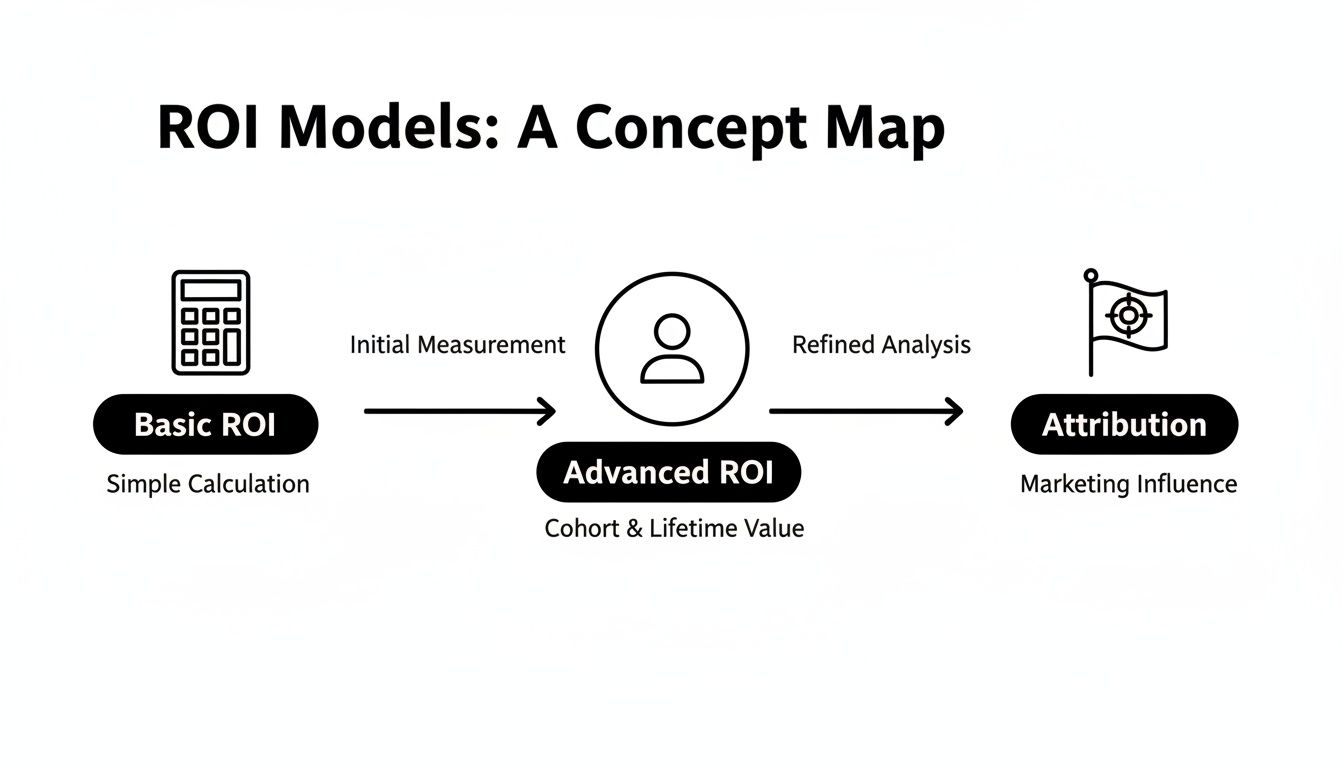
A More Advanced View with Customer Lifetime Value
While that basic formula is your go-to for a quick checkup, it only tells part of the story. It’s a snapshot of a single moment, the initial sale. What it misses is the long-term ripple effect of bringing in a new customer who might come back to buy from you again and again.
For a much deeper analysis, you need to bring Customer Lifetime Value (CLV) into the picture.
CLV is basically the total amount of money you can expect to make from a single customer over the entire time they shop with you. When you factor this in, you stop measuring one-time transactions and start measuring the long-term value an influencer delivered to your brand.
- When to Use CLV: This is a game-changer for brands with high repeat purchase rates. Think consumables like coffee, beauty products, or anything with a subscription model.
- Why It Matters: It proves that an influencer's real impact often goes far beyond that first sale, giving you a much more complete view of their value.
Bringing CLV into your ROI math turns a short-term calculation into a long-term strategic forecast. It helps you pinpoint the influencers who aren't just driving sales, but are attracting loyal, high-value customers who stick around.
Understanding Attribution: The Last Touch vs. Multi-Touch Model
Next up is attribution—the art of figuring out who gets credit for a sale.
Think of it like a soccer game. The striker who kicks the ball into the net gets all the glory, but what about the midfielders who passed the ball up the field to set up the shot? That's the core difference between Last-Touch and Multi-Touch attribution.
The HiveHQ Profit Dashboard gives you a clear, real-time look at these financial inputs and outputs, so you're not just guessing.
Seeing it all laid out like this makes it much easier to connect the dots and calculate your true ROI on the fly.
1. Last-Touch Attribution
This is the standard model on TikTok Shop and the most common one you'll encounter. It gives 100% of the credit for a sale to the very last touchpoint a customer interacted with before buying.
In our soccer analogy, this is the player who scored the goal. On TikTok, it's the influencer whose affiliate link was clicked or whose discount code was punched in at checkout. It's simple and easy to track.
2. Multi-Touch Attribution
This model, on the other hand, recognizes all the "assists." It acknowledges that a customer's journey is rarely a straight line. They might see a video from Influencer A, click a link from Influencer B a day later, and finally use a coupon code they got from Influencer C.
Multi-Touch attribution tries to spread the credit across all of those touchpoints, giving you a fuller picture of how different creators contributed.
While TikTok Shop's native tools are built around Last-Touch, just understanding the concept of Multi-Touch is crucial. It’s a powerful reminder that even the influencers whose links aren't the final click are still building brand awareness and warming up your audience.
To truly get ahead, you have to get good at measuring social media ROI and making sure every dollar you spend is working for you. By getting a handle on both the basic formulas and the more advanced ideas around attribution, you'll be set to make smarter, more profitable decisions for your brand.
The Metrics That Matter Most for Your Campaigns
Your final ROI on influencer marketing is the scoreboard—it tells you if you won or lost. But to understand how the game was played, you need to look at the stats. That's where Key Performance Indicators (KPIs) come in. They're the vital signs that show you what’s working, what isn’t, and why.
Think of it like a car's dashboard. ROI is the destination you plugged into your GPS. But the KPIs? They're your speedometer, your fuel gauge, and your engine temperature light. They give you the real-time data you need to make sure you actually get where you’re going.
Let's break down the essential metrics you need to build a complete performance scorecard for your TikTok Shop campaigns.
Your Core Financial Metrics
This is where the rubber meets the road. These metrics tie your influencer efforts directly to your bank account and are absolutely non-negotiable for understanding profitability.
- Gross Merchandise Value (GMV): This is the big one. It's the total revenue generated from a creator's affiliate link or unique discount code before deducting any costs. GMV is the clearest, most direct measure of an influencer's ability to drive sales.
- Return on Ad Spend (ROAS): While it's a term borrowed from paid ads, ROAS is perfect for influencers. It measures the gross revenue generated for every single dollar you spend on a creator—their commission, flat fees, you name it. It's a fantastic at-a-glance metric for campaign efficiency.
- Cost Per Acquisition (CPA): This KPI tells you exactly what you paid to get a new customer through a specific influencer. A low CPA is a tell-tale sign of a highly effective and profitable partnership. If you want to get into the weeds on this, our guide on what is cost per acquisition is a great place to start.
Vital Engagement Metrics
Sales are the ultimate goal, sure, but engagement is often the smoke that signals a fire. These metrics show how an audience is interacting with your brand through a creator's content, signaling real interest and purchase intent.
High engagement means the content is resonating. People aren't just scrolling past it. On a platform like TikTok, a strong engagement rate is a powerful sign that a creator knows how to spur their audience to action.
- Clicks: The number of people who actually clicked the affiliate link in a creator's bio or video. This is a direct measure of their power to drive traffic off the platform and to your shop.
- Shares & Saves: On TikTok, these are gold. When someone shares a video or saves it for later, they're essentially giving it their stamp of approval. It’s a huge indicator of strong interest and content they find genuinely valuable.
- Comments: Don't just count them—read them. The quality and sentiment of comments provide incredible, unfiltered feedback on how potential customers feel about your product.
Critical Audience Metrics
Finally, these metrics help you understand the scale and reach of your campaign. They don't measure sales directly, but they're essential for gauging brand awareness and the top-of-funnel impact your collaborations are having.
- Reach: The total number of unique users who saw the influencer’s content. This tells you the sheer size of the audience you successfully put your product in front of.
- Impressions: The total number of times the content was displayed on a screen. High impressions mean the algorithm is loving the content and actively pushing it out to more people.
To pull all of this together, here’s a simple scorecard you can use to track your campaign's health at a glance.
Your TikTok Shop Influencer Campaign KPI Scorecard
This table breaks down the most important KPIs into categories, explaining what they measure and why they're so vital for understanding the true performance of your influencer partnerships.
| Metric Category | KPI | What It Measures |
|---|---|---|
| Financial | Gross Merchandise Value (GMV) | Total revenue generated before costs, a direct indicator of sales impact. |
| Financial | Return on Ad Spend (ROAS) | Revenue earned for every dollar spent on an influencer, showing efficiency. |
| Financial | Cost Per Acquisition (CPA) | The average cost to acquire a new customer, measuring profitability. |
| Engagement | Clicks | The number of users who clicked the affiliate link, signaling direct interest. |
| Engagement | Shares & Saves | How many users found the content valuable enough to share or save for later. |
| Engagement | Comments | Audience sentiment and direct feedback on the product and content. |
| Audience | Reach | The number of unique people who saw the content, measuring brand awareness. |
| Audience | Impressions | The total number of times the content was displayed, showing algorithmic favor. |
Keeping an eye on this mix of metrics gives you a holistic view. It stops you from focusing on just one number and helps you see the complete picture of an influencer's value—from sparking initial interest to driving the final sale.
Common Mistakes That Quietly Kill Your ROI

Knowing what to track is one thing. Knowing what not to do is a whole different ballgame.
It’s surprisingly easy to make small, seemingly harmless errors that silently drain your budget and torpedo your ROI on influencer marketing. These aren't the big, dramatic failures that shut down a campaign overnight; they're the quiet profit killers that build up over time.
Think of it like running a bath with a leaky drain. You can keep pouring in more water (your budget and effort), but you’ll never fill the tub. Let's plug those leaks.
Prioritizing Follower Counts Over True Engagement
This is the oldest trap in the book, and brands still fall for it. Chasing vanity metrics like a massive follower count is a recipe for disappointment. A creator with one million followers might look impressive on paper, but if that audience is a mix of bots, inactive accounts, or just plain disengaged people, you're essentially paying to talk to an empty room.
The real gold is in genuine connection. A micro-influencer with 10,000 die-hard fans who hang on their every word will almost always drive more real-world results than a mega-influencer whose comment section is a wasteland. Look for creators whose followers are actually talking, sharing, and saving their content. That’s where true influence lives.
Launching Campaigns Without Clear Objectives
"We want to build brand awareness." That's not a goal; it's a wish. Campaigns launched with vague intentions like this are almost impossible to measure, which means you’ll never really know if your investment paid off.
A successful campaign starts with a clear finish line. Whether your goal is to generate $5,000 in GMV, acquire 100 new customers, or achieve a 3:1 ROAS, having a concrete target is essential.
When you define exactly what success looks like, every other decision—from which creators to partner with to the call-to-action you use—becomes clearer. It turns a hopeful shot in the dark into a strategic business move.
Ignoring the True Cost of Product Gifting
Product gifting is the ultimate hidden cost. It feels "free," but it's anything but. Many brands send out tons of samples without tracking the real costs involved, creating a huge blind spot in their ROI calculations.
Let’s break down a simple gifting campaign:
- Product: A popular skincare serum.
- Cost of Goods Sold (COGS): $8 per unit.
- Shipping & Handling: $7 per package.
- Total Cost Per Sample: $15.
You send this out to 100 creators. Right off the bat, you've spent $1,500 before a single video goes live.
Now, let's say that campaign generates $1,200 in GMV. On the surface, that might seem okay. But when you factor in your costs, you’ve actually lost $300. If you weren't tracking COGS and shipping, you'd be fooled into thinking it was a success.
This is why meticulous cost tracking is non-negotiable. Every single dollar you spend has to be on the books if you want a true picture of your financial performance.
How to Automate and Clarify Your Influencer ROI
Knowing your metrics is one thing, but trying to stitch them together from scattered spreadsheets and TikTok Shop reports is a surefire way to get a headache and miss huge opportunities. The real secret to maximizing your ROI on influencer marketing isn't just about tracking numbers—it's about moving from slow, manual analysis to getting fast, automated clarity.
This is where specialized platforms completely change the game. Instead of losing hours trying to connect the dots between your campaign costs and actual sales, you can use integrated tools to do the heavy lifting. This gives you back precious time to focus on strategy, not spreadsheets.
Ditch the Spreadsheets with a Profit Dashboard
Imagine trying to drive a car while looking at the speedometer, fuel gauge, and GPS on three separate screens scattered around the dashboard. It’s not just inefficient; it's dangerous. That’s exactly what it feels like to manage your TikTok Shop finances with a jumble of disconnected spreadsheets.
A good Profit Dashboard acts as your central command center. It pulls all your critical financial data into one clear, unified view, automatically.
- Gross Merchandise Value (GMV): See exactly how much revenue each creator is driving, as it happens.
- Cost of Goods Sold (COGS): Instantly factor in the true cost of every sample you send out.
- Commissions & Fees: Keep a running tally of creator payments without lifting a finger.
- Ad Spend: If you're boosting creator content, you'll see those costs right alongside the returns they generate.
This single source of truth removes all the guesswork. You’re no longer estimating profitability; you’re seeing it in black and white. For any brand serious about scaling, learning more about real-time profit tracking is the first step toward making much smarter financial moves.
Find High-Performing Creators on Autopilot
Let’s be honest: your ROI is only as good as the creators you partner with. But finding affiliates who can actually drive sales—not just rack up views—is a massive time sink. Manual outreach is painfully slow, and you never really know if you're talking to the right people.
An Affiliate Bot completely flips the script on recruitment. It shifts the process from a one-to-one manual grind to a one-to-many automated system.
Instead of sending a handful of DMs a day, you can automate thousands of targeted outreach messages every month. This lets you connect with a much wider pool of creators who have a proven history of generating sales, not just vanity metrics.
This automated approach doesn't just save time; it dramatically improves the quality of your partnerships. By using data-driven filters, you can zero in on creators who are a perfect fit for your brand and, more importantly, have an audience that's actually ready to buy.
Use Data to Double Down on Your Winners
Once your campaigns are live, how do you figure out who your true top performers are? Some creators might cause a huge sales spike one week, while others deliver steady, consistent revenue over time. A centralized Creator Tracker is the key to spotting these critical patterns.
To really get a handle on your influencer ROI, using a dedicated influencer marketing dashboard is a game-changer. It gives you a single, reliable source for all creator performance data, letting you see at a glance:
- Who drives the most GMV over a week, a month, or an entire quarter.
- Which creators have the best sales conversion rates from their content.
- Who is consistently meeting their posting obligations and delivering on their promises.
With this kind of hard data, you can finally make truly informed decisions. You can confidently renew contracts with your superstars, give targeted feedback to those who are lagging, and strategically put your budget behind the partnerships that deliver the highest possible return. It's the final piece of the puzzle for a truly optimized and profitable influencer program.
Actionable Strategies to Actively Boost Your ROI

Just measuring your ROI on influencer marketing isn't enough. The real win comes from actively making it better. Getting great results means moving from a passive "wait and see" approach to a proactive one, using smart tactics to squeeze more value out of every dollar you spend.
One of the most effective changes you can make is switching from flat-fee payments to performance-based commissions. This move directly ties your spending to actual sales. Instead of paying a creator a set fee and crossing your fingers, you're rewarding them for the revenue they bring in. It's a game-changer that lowers your risk and gives creators a powerful reason to make content that truly converts.
Optimize Your Creator Partnerships
Once you have the right payment model, the next step is to fine-tune how you collaborate with creators. Solid relationships and data-driven experiments are what separate the good campaigns from the truly great ones.
Start by A/B testing different messages with your creators. You can give two similar creators different talking points or calls-to-action. For instance, have one creator focus on your product’s unique features while another highlights a limited-time discount. Tracking which message drives more sales gives you incredible insights to apply to all future campaigns.
And remember, great content deserves a second life. A top-performing TikTok video can be a goldmine if you repurpose it for paid ad campaigns on platforms like Meta or TikTok itself.
This strategy takes authentic content that has already proven its appeal and puts it in front of a new, wider audience. It often leads to a much lower Cost Per Acquisition (CPA) than a polished, brand-created ad because it feels more genuine.
Build for the Long Term
The most profitable influencer programs I’ve seen are always built on long-term relationships, not one-off posts. When you find a creator who consistently drives a great ROI, your focus should be on nurturing that partnership. This is where strong influencer campaign management comes into play.
Investing in long-term partners unlocks a few key benefits that directly pad your bottom line:
- Better Rates: Creators who deliver consistent results are often open to negotiating better commission structures or retainers for the promise of steady work.
- Increased Authenticity: When an audience sees a creator using and loving your brand over months or years, the endorsement feels genuine—not just like another sponsorship. This builds incredible trust.
- Predictable Revenue: Your star creators become a reliable, scalable sales channel you can count on every single month.
By putting these strategies into practice, you stop being a passenger and start driving your ROI. Each tactic—from performance pay and content repurposing to building lasting partnerships—is a powerful tool to make your influencer marketing more efficient, scalable, and profitable.
Got Questions About Influencer Marketing ROI? We’ve Got Answers.
Even the most seasoned marketers have questions when they get into the weeds of influencer marketing. It's a dynamic space, and the details matter. Here are some quick, straightforward answers to the questions we hear most often.
What Is a Good ROI for Influencer Marketing?
Everyone wants to know the magic number, but the truth is, "good" is relative. The industry average hovers around $5.78 for every dollar spent. So, if you're hitting that, you're doing well. Truly exceptional campaigns? They can pull in an 18:1 return or even higher.
But here's a better way to think about it: your most important benchmark is your last campaign. If you hit a 3:1 ROI last month, your goal for this month is 3.5:1. The real aim is continuous improvement. As long as you're in the green, you're winning.
How Long Does It Take to See a Return?
This really depends on what you're selling. For a trendy, impulse-buy product—think a viral lip gloss or a cool phone accessory—you could see sales flooding in just hours after a creator's video goes live. The buying cycle is short and sweet.
On the other hand, if you're selling a high-ticket item like a mattress or a specialized piece of software, people will need more time to think it over. The ROI might take weeks or even a month to fully materialize as potential customers do their research. Patience is key here; don't judge a campaign's success in the first 24 hours.
Key Takeaway: While some results are instant, you'll get the truest picture of your ROI by tracking performance over a 30 to 90-day window. This captures the long tail of an influencer's impact on buying decisions.
Can I Measure ROI Without Tracking Direct Sales?
Absolutely. Not every campaign is about driving immediate sales, and that's perfectly fine. If your goal is brand awareness or audience engagement, you can still put a number on your return.
One of the best ways to do this is with Earned Media Value (EMV). Think of it this way: EMV calculates what you would have paid for traditional advertising to get the same amount of eyeballs and interaction that your influencer delivered organically. It’s a powerful way to assign a dollar value to buzz.
Beyond EMV, you can also look at other concrete indicators:
- Cost Per Engagement (CPE): What did each like, comment, and share actually cost you? A low CPE is a great sign of an efficient campaign.
- Website Traffic: Did you see a big spike in clicks to your site right after a creator posted? That’s a direct result of their influence.
- Follower Growth: Did your brand’s social media accounts gain a new wave of followers? That’s your audience expanding.
These metrics prove you're getting value for your money, even if it doesn't show up as a sale right away.
Ready to stop guessing and start knowing your exact ROI? The HiveHQ Profit Dashboard, Affiliate Bot, and Creator Tracker work together to give you real-time financial clarity and automate your growth. Discover how HiveHQ can maximize your TikTok Shop profitability today.