Can You See Who Viewed Video on Instagram? the Real Answer
instagram video viewsinstagram reels analyticsinstagram story viewersinstagram privacyinstagram insights
Instagram does not show a named viewer list for Reels or feed videos, while Stories expose usernames for roughly 24 to 48 hours, so the answer depends on the format. Instagram Live also lets broadcasters see accounts watching during the broadcast, but not a permanent, complete viewer list afterward.
Why would the same video reveal viewers in one place and hide them in another? Because where you publish matters more than what the video contains. A product demonstration shared as a Reel, a Story, or a Live broadcast follows different viewer-data rules.
Think of the difference as a counter versus a guestbook. A counter records activity without collecting names. A guestbook identifies participants, but only within the limits of that particular format.
Table of Contents
- The Short Answer for Every Instagram Video Format
- How Each Instagram Video Format Handles Viewer Data
- Comparing What Each Format Reveals at a Glance
- Why Third-Party Viewer Apps and Stalker Tools Cannot Deliver
- Practical Workarounds for Capturing Viewer Identity
- Best Practices for Reading Audience Insights Honestly
- Frequently Asked Questions About Instagram Video Viewers
The Short Answer for Every Instagram Video Format
Stories can show viewer usernames; Reels and ordinary feed videos can't show silent viewers. Instagram distinguishes these formats rather than applying one viewer-list rule to every video. For feed videos and Reels, creators receive aggregate information such as views, likes, comments, saves, shares, and reach, not a complete list of accounts that watched, as explained in this guide to Instagram video viewer visibility.
The first step is to identify the publishing surface. Don't decide based on whether the content is vertical, short, edited, or filmed on a phone. Those characteristics don't answer the privacy question.
Identify the format before interpreting the data
Use these labels to keep your question precise:
- Reel: Ask about distribution and engagement, not a hidden audience roster.
- Feed video: Treat performance totals separately from the accounts that visibly interact.
- Story: Look for temporary account-level viewer information.
- Live: Distinguish people visible during the broadcast from later replay audiences.
For another format-focused explanation, Gainsty's resource on does Instagram show video viewers is a useful companion to this distinction.
Decide what you actually need to know
A creator asking whether a particular customer watched needs identity information. A creator asking whether a product demonstration reached an audience needs performance information. Those are different measurement jobs.
For example, a seller might want to know whether an existing customer saw a care tutorial. A video's view total can't establish that customer's participation. A visible comment from the customer establishes an interaction, which is narrower and more defensible.
When you ask, “Can you see who viewed video on Instagram?” specify the format and the evidence you need. That keeps an audience-size question from turning into an unsupported claim about an individual.
How Each Instagram Video Format Handles Viewer Data
A viewer can watch the same product demonstration through different Instagram surfaces. The creator's access to identity information changes with the surface, even if the footage stays the same.

Reels and feed videos provide a scoreboard
For Reels, available performance signals can include plays, reach, watch time, likes, comments, saves, and shares. Standard feed videos follow the same basic identity boundary: aggregate performance is available, but a passive play isn't attached to a publicly visible username, according to this explanation of Instagram views and identifiable interactions.
The scoreboard analogy helps. You can read how the content performed without seeing a roll call of everyone who contributed to its total.
Visible likes and comments can identify the accounts that performed those actions. However, don't assume every engagement metric includes names. A saves or shares total isn't automatically a list of savers or sharers. Use a username only when Instagram makes that particular interaction visible.
Consider a hypothetical product tutorial. If someone watches without interacting, you can't identify them from the view alone. If they leave a question, you can identify the commenter, but you still shouldn't assume how much of the tutorial they watched.
Content choices belong to a separate workflow. A guide to trending songs on Instagram Reels can inform creative planning, but choosing different audio doesn't solve the viewer-identity question.
Stories provide a temporary guestbook
Stories expose the usernames of accounts recorded as viewers during the normal 24-hour publication period, with the list commonly accessible through the archive for up to 48 hours after posting, as described in this explanation of Story viewer-list availability.
That archive window is measured from publication, not from the moment you open the archive. Saving the content doesn't make the original viewer list permanent.
A username on that list identifies an account Instagram recorded as a viewer. It doesn't establish a demographic profile, meaningful attention, or purchase intent.
Interpretation rule: An account appearing in a viewer list is evidence of recorded viewing, not evidence that its owner understood your message or wants your product.
Live requires a distinction between attendance and replay
During a broadcast, the host can see accounts joining or watching in real time. Afterward, the replay doesn't preserve the same attendance roster.
Treat Live as a temporary attendance surface, not a permanent customer database. Comments and other visible participation can provide context, but attendance alone doesn't explain why someone joined.
Comparing What Each Format Reveals at a Glance
Choose a format according to the question you're trying to answer. If you need account-level evidence, a distribution metric won't substitute for it. If you need to assess content performance, a short-lived list of names won't explain the full audience response.
Viewer Data Available by Instagram Video Format
| Format | Named Viewer List | Aggregate Metrics | How Long It Lasts |
|---|---|---|---|
| Reels | No complete list of passive viewers | Views or plays, reach, watch time, and engagement totals | No named viewer window exists |
| Feed videos | No complete list of passive viewers | Views, reach, and engagement totals | No named viewer window exists |
| Stories | Yes, temporarily | Viewing totals alongside the temporary account list | Active Story period and limited archive window |
| Live | Accounts visible during the broadcast | Later performance reporting is primarily aggregate | Identity visibility during the active broadcast, not a permanent replay roster |
Read totals without turning them into people
Views and unique reach aren't interchangeable. View totals can include repeat plays, while unique reach is a different metric, as explained in this guide to tracking Instagram Reel engagement.
A useful analogy is a shop entrance counter. The same visitor can walk through the entrance repeatedly. Counting entries doesn't tell you how many distinct shoppers entered, and neither number tells you their names.
That distinction should shape your reporting language:
- Use “plays” for playback activity. Don't relabel that total as identified people.
- Use “reach” for audience distribution. Keep it separate from repeat playback.
- Use “named interaction” for visible actions. Record what happened rather than assuming a complete viewing history.
If you're working on distribution, Data Hunters Agency's guide to how to boost Instagram views addresses a different objective from identifying viewers. Keep those objectives separate when planning content or reviewing results.
A video can be useful for reach without producing an audience roster. A Story can identify accounts without proving that they paid close attention. Neither format needs to do both jobs.
Why Third-Party Viewer Apps and Stalker Tools Cannot Deliver
An outside app doesn't become a valid source merely because Instagram leaves a question unanswered. A polished list of usernames is not proof of a viewer list.
Services claiming to reveal all silent viewers of a Reel or feed video can't obtain those identities through Instagram's ordinary creator-facing metrics. This discussion of Instagram stalker-tool claims explains why such promises deserve caution.
Ask what the tool is actually measuring
A follower list, commenter list, or collection of visible likes may contain real accounts. That doesn't make it evidence that those accounts watched a particular video.
The same problem applies to follower-export tools. Exporting an existing relationship doesn't establish a viewing event. A service could show familiar usernames and still fail to answer your question.
Don't infer how every questionable service produces its results. Without evidence, you can't know whether a particular service is guessing, relabeling public activity, or fabricating a list. You can assess whether its claimed output matches data Instagram makes available.
Watch for these warning signs:
- Credentials before explanation: Never enter your Instagram password into an unfamiliar login form just to see an advertised list.
- Unclear methodology: Ask whether the output represents viewers, followers, or people who interacted.
- Payment before evidence: A paywall doesn't validate an otherwise unsupported capability.
- Overconfident guarantees: A promise to reveal every hidden viewer contradicts the established format boundary.
Replace curiosity with a defensible measurement process
Use official performance information for aggregate analysis. For account-level records, rely on usernames and actions Instagram displays.
A tool can organize available evidence. It can't turn an anonymous play count into verified identities.
Treat requests for sensitive account access as a security decision, not a shortcut to better analytics. Consider the risk of credential exposure, account misuse, and misleading reports before granting access.
If you're choosing an export or reporting workflow, confirm what fields it contains. Preserve the original labels so a follower export doesn't become a viewer report after someone renames a spreadsheet column.
Practical Workarounds for Capturing Viewer Identity
The useful workaround isn't to uncover hidden Reel viewers. It's to create a separate opportunity for viewers to identify themselves voluntarily, then record only what you can verify.
Use the surface that supports the question
Review Story viewer information while it remains available. If you need a record for legitimate follow-up, capture the relevant information promptly and limit it to what you need.
Don't assume Instagram offers a universal viewer-list export. Verify the available options in your account, and don't give an unfamiliar service access just because it promises an export button.
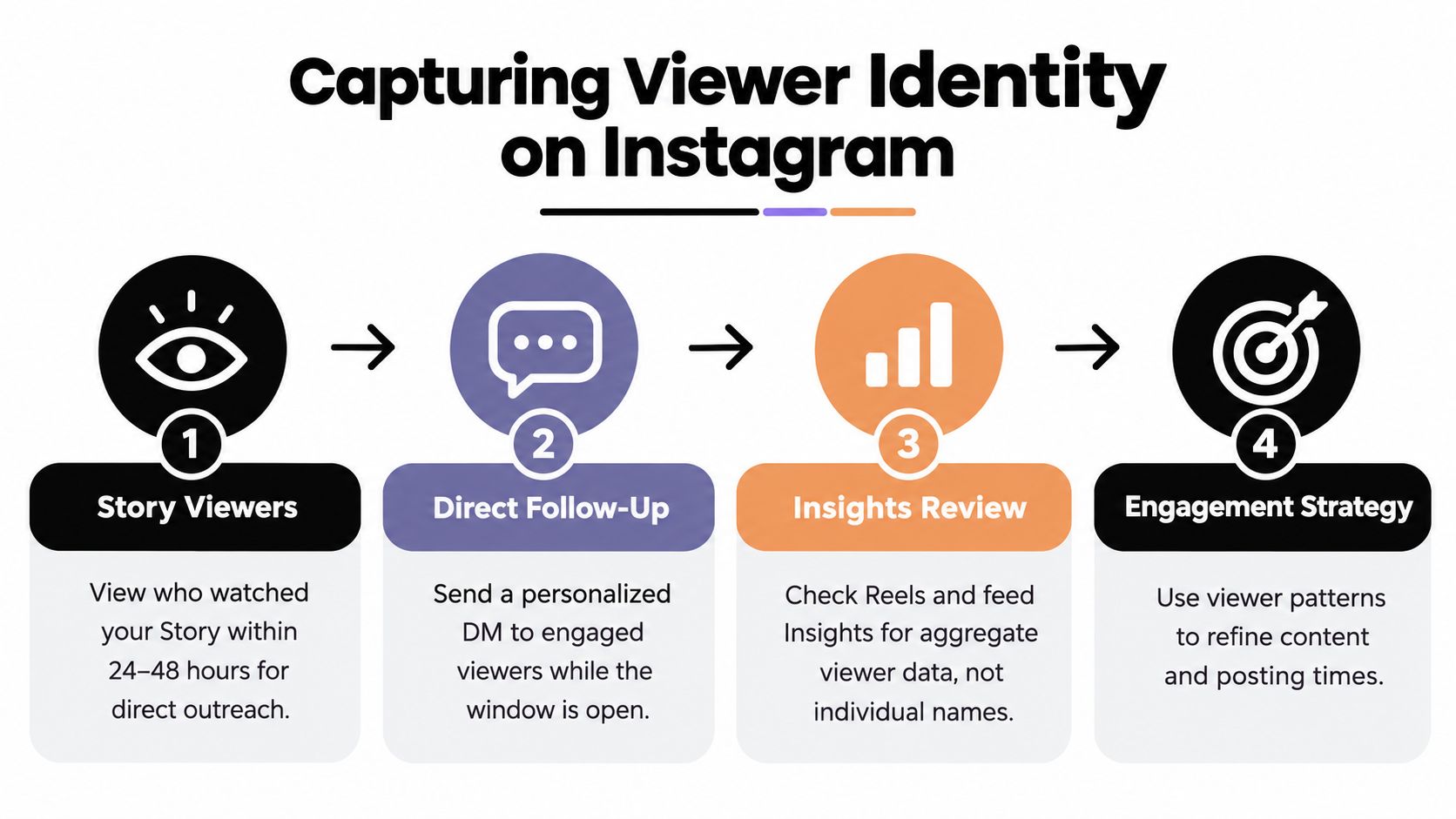
Resharing a Reel to a Story creates an identifiable viewing opportunity on the Story surface, under the temporary rules described earlier. It doesn't reveal the original Reel's silent audience. Someone appearing on the Story list isn't proof that they watched the full Reel.
Invite participation rather than assuming interest
A product demonstration can end with a practical question about sizing, setup, or maintenance. Ask viewers to comment if they want clarification, rather than treating a passive play as a request for contact.
- Prompt a specific comment: Ask which part of the demonstration needs more explanation.
- Offer a relevant conversation: Invite viewers to ask a product question if they want help.
- Use Story prompts thoughtfully: Ask for preferences or questions, then inspect the responses Instagram displays.
- Keep saves in the aggregate workflow: A save can be a useful content signal without revealing the saver's identity.
Follow up when the person's action provides a reasonable reason to do so. A reply asking for help is a clearer invitation than an account merely appearing in a viewer list.
Follow-up principle: Refer to what someone actually asked or did, not to attention or intent you've inferred from their presence.
Plan these prompts during video production for social media, rather than attaching a generic request after filming. A clear demonstration and a relevant invitation make the resulting feedback easier to interpret.
Use audience patterns to form content hypotheses, then test them. Don't treat a handful of identifiable accounts as a complete picture of everyone who watched.
Best Practices for Reading Audience Insights Honestly
A useful audience report distinguishes exposure, observable participation, and business outcomes. These categories can inform the same decision, but they aren't interchangeable.
Views describe exposure, while trackable interactions describe actions taken by part of the audience. This explanation of Instagram video views and engagement signals supports keeping those inputs separate rather than treating a view count as a customer list.
Record the evidence before interpreting it
For each content entry, keep the format, metric label, relevant time window, and any visible interaction together. That prevents someone reviewing the report later from mistaking a Story viewer for a Reel commenter or a customer.
Use precise notes:
- Observed activity: Record that an account commented with a setup question.
- Aggregate performance: Record plays, reach, or engagement totals using their displayed labels.
- Interpretation: Mark a possible need for clearer instructions as a hypothesis.
- Business outcome: Don't mark a purchase unless you have separate evidence of that purchase.
For a TikTok Shop seller also publishing on Instagram, this discipline prevents a familiar mistake: treating social attention as proof of profitable demand. A product can attract questions without establishing whether it generates net profit.
Match the signal to the decision
For a decision about whom to help, a named question is more actionable than raw plays. For a decision about distribution, aggregate reach is more relevant. Don't rank every metric on a universal ladder of value.
An Instagram engagement-rate calculation guide can help structure engagement analysis, but calculating a rate doesn't add identity information to anonymous activity.
The broader topic of platform-driven marketing analytics from The AI CMO is useful context for organizing measurement around available platform data. Apply that approach without assuming different platforms share the same audience definitions.
The operating principle is straightforward: answer each question with evidence suited to that question. Use Instagram for the audience signals it provides, and use shop-level financial and customer records to evaluate commerce outcomes.
Frequently Asked Questions About Instagram Video Viewers
Can you see who watched an Instagram Live replay?
Not as a permanent viewer roster. Instagram Live can reveal accounts during the active broadcast, but later reporting is primarily aggregate, as explained in this guide to Instagram Live viewer visibility. A visible replay interaction can identify that participant, not everyone who watched.
How long can you access Story viewer usernames?
The list is available during the active Story period and commonly remains accessible briefly through the archive. The clock runs from the original posting time, not from when you check it. Review relevant information promptly rather than expecting the archive to preserve names indefinitely.
Do Highlights keep the original Story viewer list?
No, saving the Story as a Highlight doesn't preserve its original viewer list permanently. Content retention and identity-data retention are separate. Being able to replay an old Story doesn't mean you can recover its original audience roster.
Can polls or stickers identify anonymous Reel viewers?
They can't uncover the identities behind earlier anonymous Reel plays. They can invite a new, voluntary interaction on a Story. Treat any displayed response as evidence of that interaction, not proof that the respondent watched a particular Reel.
Should you message everyone who viewed a Story?
A viewer list alone isn't an invitation to receive a sales message. Prioritize people who ask questions, reply, or otherwise create a relevant reason for contact. Keep your message tied to their observable action and avoid claiming you know how closely they watched.
HiveHQ offers self-serve TikTok Shop profit analytics through the HiveHQ Profit Dashboard, including real-time net profit, product-level performance, and customer analytics. Keep Instagram audience signals separate from verified shop outcomes, then visit HiveHQ to try the Profit Dashboard yourself. Talk to the HiveHQ team about using it to review your TikTok Shop's performance and profitability.