Chatbots for Enterprises: Transform Operations with AI-Driven Solutions
chatbots for enterprisesbusiness automationai chatbotscustomer service automationecommerce automation
When you hear the term "chatbot," you might picture the simple pop-up on a website asking, "How can I help you today?" But for large-scale businesses, especially those in the fast-paced world of e-commerce, that's just the tip of the iceberg. Enterprise chatbots are a different breed entirely—they're sophisticated AI engines built to handle complex, mission-critical tasks across the entire organization.
They're less like a receptionist and more like an operational hub. Instead of just answering basic questions, they integrate with your core systems, process huge amounts of information, and execute tasks automatically. For a rapidly growing brand, this is the key to scaling without having to hire an army of people to keep up.
The New Engine of Enterprise Growth

Let go of the old idea of clunky, rule-based bots that get stuck in a loop if you ask the "wrong" question. Today’s chatbots for enterprises act more like the central nervous system for your business, connecting different departments and turning raw data into decisive action. Think of it as an automated team member that never sleeps, tirelessly managing workflows that would otherwise bog down your best people.
If you're an operator managing millions in gross merchandise value (GMV), this isn't just a minor upgrade; it's a complete change in how you run things. Imagine no more manually pulling sales reports or chasing down creators for their latest TikTok posts. You can simply deploy a bot to handle these high-volume, repetitive jobs, freeing up your team to think bigger and focus on what truly matters—growth.
A Strategic Asset for Modern Commerce
We’ve officially passed the tipping point. An incredible 91% of companies with more than 50 employees are already using chatbots somewhere in their customer journey. It’s not just about customers, either. A solid 78% of global enterprises use AI chatbots for at least one internal workflow, proving their value behind the scenes.
The market reflects this massive shift. Currently valued at $7.76 billion, it's expected to explode to $27.29 billion by 2030. This isn't just hype; it's a strategic move driven by real results.
Here's what an enterprise chatbot can actually do:
- Automate Affiliate Marketing: Imagine a bot that handles creator outreach, vets potential partners, and even walks them through the onboarding process for your TikTok Shop affiliate program.
- Streamline Financial Reporting: Need the latest profit margins? The bot can pull real-time data from your financial dashboards and send a summary directly to key stakeholders via Slack or email.
- Boost Operational Efficiency: These bots can perform thousands of automated actions every month, from sending follow-up messages to tracking content submissions from influencers.
By plugging directly into your core business systems, an enterprise chatbot becomes an essential tool for making smarter, faster decisions and managing a complex operation without getting overwhelmed.
To help you see the bigger picture, here’s a quick breakdown of where these bots make the most impact.
Enterprise Chatbot Impact At a Glance
| Business Area | Primary Function | Key Benefit for TikTok Shop Brands |
|---|---|---|
| Customer Support | 24/7 instant issue resolution, order tracking, and FAQ handling. | Frees up human agents to handle high-value, complex customer issues. |
| Sales & Marketing | Lead qualification, product recommendations, and affiliate onboarding. | Automates the entire top-of-funnel for creator and affiliate partnerships. |
| Internal Operations | Data retrieval, report generation, and task management for teams. | Provides instant access to sales data and performance metrics on demand. |
| HR & Onboarding | Answering employee queries and guiding new hires through processes. | Ensures new team members and creators get consistent, accurate information. |
This table just scratches the surface of what’s possible when you put intelligent automation to work.
If you're looking to really dig in and understand how to weave AI into your business, this Ultimate Guide to Enterprise Chatbots is a fantastic starting point. For any brand serious about staying ahead, these systems are quickly becoming non-negotiable.
Unlocking Value Across Your Business

When people think of chatbots, customer support is usually the first thing that comes to mind. But sticking to just FAQs is like using a supercomputer to run a calculator—you're leaving its real power on the table. For high-volume e-commerce brands, the game really changes when you use chatbots to drive revenue and fix complex internal bottlenecks.
Think of it this way: a basic chatbot is a digital receptionist. It can point people in the right direction. An enterprise-grade chatbot, on the other hand, is an entire automated department, running sophisticated workflows from start to finish.
This shift is already happening. While customer service still makes up 31.31% of the global chatbot market, the fastest growth is actually happening in areas like HR and recruiting. More importantly for e-commerce operators, the retail and e-commerce segment pulls in a massive 30% revenue share of the market. With some companies seeing an ROI as high as 200%, it’s not hard to see why.
Automating the Entire Affiliate Lifecycle
One of the smartest ways to use chatbots for enterprises, especially if you’re big on TikTok Shop, is to automate your entire affiliate management pipeline. This is so much more than just sending a few DMs.
Picture a dedicated Affiliate Bot, like the one we've built at HiveHQ, working as your 24/7 partnerships manager. This kind of system can handle thousands of interactions a month, building a scalable engine to find and manage creators.
Here's how that actually looks day-to-day:
- Discovery and Outreach: The bot scours platforms to find thousands of potential creators who fit your ideal profile—think follower count, engagement rate, and niche. Then, it contacts them automatically.
- Intelligent Qualification: Instead of a generic message, the bot starts a real conversation. It asks smart questions to qualify them, like asking about their audience demographics or past brand deals.
- Automated Follow-ups: It sends perfectly timed follow-ups so promising conversations don't go cold. No more creators slipping through the cracks because someone forgot to reply.
- Seamless Onboarding: Once a creator is in, the bot can walk them through onboarding, grab their info, and even trigger a sample product shipment from your warehouse.
This level of automation turns affiliate marketing from a manual, time-sucking grind into a predictable, scalable growth channel. It means a small team can run a creator program that would otherwise need a whole department.
Streamlining Internal Operations and Data Access
Chatbots aren't just for talking to people outside your company. They're incredibly powerful for making things run smoother on the inside. They can act as a direct line to your business data, so managers don't have to spend their time digging through dashboards or waiting for someone to pull a report.
For a founder or a finance lead, this is a huge deal. They can get answers to critical questions right inside the apps they already use, like Slack.
Real-World Internal Use Cases:
- Real-Time Profitability Checks: A manager can just type, "What was our net profit on Product X yesterday?" The bot, plugged into something like HiveHQ's Profit Dashboard, pulls the answer instantly. No spreadsheets needed.
- Ad Spend Summaries: An executive could ask, "Summarize our TikTok ad spend and performance for the week." The bot grabs the latest data from the ad platform and delivers a clean summary.
- Proactive Affiliate Performance Alerts: This is where it gets really strategic. You can set up alerts so the system tells you when something is wrong. For example, it can proactively ping a manager if a top affiliate's GMV drops by a certain percentage, letting them jump on it right away.
This kind of immediate data access helps leaders make faster, smarter decisions. It also supports sales efforts by arming the team with the latest numbers. For a deeper look, check out our guide on how chatbots can supercharge your lead generation strategies.
By automating both customer-facing growth and internal data workflows, chatbots for enterprises become a core part of what drives efficiency and profit.
Choosing Your Enterprise Chatbot Solution
Picking the right enterprise chatbot solution is a huge decision. It's not just about the initial setup; it’s about choosing a partner that can grow with you, adapt to new challenges, and actually deliver on the promise of automation. Think of it like picking the engine for a race car—the wrong one will limit your top speed, no matter how good the driver.
For e-commerce brands and multi-brand operators, the stakes are even higher. You're dealing with rapid growth, a specialized tech stack, and the need to maintain a distinct brand voice across all your communications. You need a platform that can keep up. Let’s break down exactly what to look for so you can build a solid evaluation framework.
Defining Your Core Requirements
Before you even start looking at vendors, you need to know precisely what you want this chatbot to do. Vague goals like “improve efficiency” won’t cut it. You need to get specific.
- Scalability: Can the system handle your traffic on Black Friday without breaking a sweat? If you’re planning to automate 100,000 affiliate outreach messages a month, you need infrastructure built for that kind of load. Ask potential vendors for real-world case studies or performance benchmarks at that scale.
- Integration Depth: A chatbot is only as good as the systems it connects with. Does it have seamless, native integrations with your most important tools—like TikTok Shop, your ad platforms, and your financial software? Constantly needing to build custom connectors is a huge red flag and a massive time sink.
- Customization and Flexibility: Can you bend the tool to fit your existing workflows? Your brand has a unique voice and a specific way of managing creators. A rigid, cookie-cutter chatbot will force you to change your proven processes just to accommodate its limitations.
A great enterprise chatbot should adapt to your business, not the other way around. The ability to customize messaging, decision logic, and integration points is what separates a basic tool from a strategic asset.
Once you have these core requirements mapped out, you can start digging into the different types of solutions on the market. Each one offers a different balance of speed, cost, and control. For a deeper look at the technical nuts and bolts, our guide on building AI bots breaks down what's really going on under the hood.
Comparing Platform Types
Not all chatbots for enterprises are built the same. You'll generally run into three main categories, and each comes with its own set of pros and cons.
- Off-the-Shelf Platforms: These are plug-and-play solutions with pre-built templates for common tasks. They're usually the fastest and cheapest way to get started, but they often lack deep customization. They’re a solid choice for simple, standard use cases but can struggle with specialized or complex workflows.
- Low-Code/No-Code Builders: This is the middle ground. These platforms give you a visual interface to build custom bots without needing a team of developers. They offer much more flexibility than off-the-shelf tools and are great for teams that want to design their own logic. Just be aware that they can sometimes have limitations when it comes to massive scale or very deep system integrations.
- Fully Custom-Built Bots: This means building a chatbot from the ground up with your own development team. It gives you total control and can be tailored perfectly to your needs, but it's also the most expensive and time-consuming route. Don't forget to factor in the ongoing maintenance costs, too.
Chatbot Vendor Evaluation Checklist
Choosing a vendor can feel overwhelming. This checklist is designed to help you cut through the marketing noise and focus on what truly matters for a growing e-commerce business. Use it to structure your demos and compare solutions side-by-side.
| Evaluation Criterion | What to Look For | Why It Matters for E-commerce |
|---|---|---|
| E-commerce Platform Integration | Native connectors for TikTok Shop, Shopify, Amazon Seller Central, etc. | You need real-time access to order data, inventory, and customer profiles without messy workarounds. |
| Creator Workflow Automation | Features for affiliate onboarding, commission tracking, and performance reporting. | This is a high-volume, repetitive task. A bot built for this can save hundreds of hours a month. |
| Customizable Logic & Scripting | A visual workflow builder or low-code interface to define conversation paths. | You need to control the brand voice and handle unique customer scenarios without vendor intervention. |
| Scalability & Performance | Evidence of handling high-volume interactions (e.g., 100,000+ per month). | Your bot can't crash during a major sales event. Proven performance under pressure is non-negotiable. |
| Analytics & Reporting | Dashboards tracking conversation volume, resolution rates, and goal completion. | If you can't measure it, you can't improve it. Data shows you where the bot is succeeding and where it needs work. |
| Security & Compliance | Certifications like SOC 2, GDPR compliance, and clear data handling policies. | You're handling sensitive customer and affiliate data. A security breach could be catastrophic. |
| Support & Onboarding | Dedicated account managers, technical support SLAs, and comprehensive training. | A great tool is useless without great support. You need a partner who will help you succeed long-term. |
Ultimately, the right choice comes down to your unique combination of resources, timeline, and the complexity of the problems you're aiming to solve. While starting with customer service is common, it pays to think bigger. Exploring the best AI chatbot for customer service tools can give you a great foundation, but always keep an eye on how the platform can support other parts of your business, from internal reporting to managing your entire creator network.
Your Implementation Roadmap: From a Smart Idea to Serious ROI
Rolling out an enterprise chatbot isn't like installing a new piece of software. It’s a full-blown strategic project, as critical as opening a new warehouse or launching a major marketing campaign. If you don't have a solid roadmap, you risk a long, expensive process with fuzzy results.
The goal here isn't a "big bang" launch. It's about starting smart. A phased approach lets you score some quick wins, prove the value of the investment, and get the rest of the company excited. By starting with a focused project in one high-impact area, you build a powerful internal case study that makes everyone from finance to marketing lean in and say, "Okay, what's next?"
Phase 1: Start With a High-Impact Pilot Project
Your journey begins with a single, focused pilot project—not a company-wide overhaul. The trick is to pick one specific, nagging problem that, if you solve it, delivers a clear and undeniable win. For most e-commerce brands, especially those crushing it on TikTok Shop, the best place to start is automating affiliate and creator outreach. Why? Because it's often a soul-crushing, manual bottleneck that's directly tied to revenue.
Picking this workflow gives you a clean slate to measure against. How many hours is your team really spending on outreach right now? What’s your current creator sign-up rate? You need these numbers to prove the chatbot is working.
Your pilot objectives have to be razor-sharp. For example:
- Objective: Automate the top of our creator recruitment funnel to boost outreach volume by 500% without hiring another person.
- Key Result 1: Reach out to 10,000 qualified creators in the first month.
- Key Result 2: Get a 15% positive response rate from the automated messages.
- Key Result 3: Cut the time from first contact to onboarding by 40%.
By treating your first implementation like a controlled experiment, you minimize risk and create a clear definition of success. The tangible results you generate become the fuel for future investment.
Phase 2: Design and Integrate the Workflow
With your goals locked in, it's time to map out the conversation flows and plug the chatbot into your core systems. You're essentially building the bot's brain. A good conversational flow isn't just a script; it’s a smart decision tree that guides a potential creator through a natural sequence of steps.
For an affiliate outreach bot, that flow might look something like this:
- Initial Contact: Kick things off with a personalized message that references the creator's actual content.
- Qualification: Ask a few questions to confirm their audience demographics and check engagement rates.
- The Pitch: Clearly lay out the benefits of your affiliate program.
- Info Capture: Grab the necessary details, like their email and a shipping address for product samples.
- The Handoff: Once they’re qualified, the bot can automatically send them to an onboarding portal or ping your affiliate manager to take over.
This is the critical part: the workflow has to talk to your other tools. For instance, the bot needs to check your Creator Tracker so it isn’t bugging people you already work with. It should also log every new conversation. An automation platform like HiveHQ can be a game-changer here, acting as the central hub that connects the chatbot's activities to your other business data, like your Profit Dashboard. This is what turns a simple messaging bot into a deeply integrated part of your operations.
Phase 3: Go Live and Measure Everything
With the design and integrations buttoned up, it's launch time. But a smooth go-live is more than flipping a switch. You need to prep your team. Your affiliate managers need to understand how this new tool works and how their jobs are about to change for the better. They'll spend less time on tedious outreach and more time building real relationships with your top-tier creators.
Once you’re live, measurement becomes everything. You have to religiously track performance against the goals you set in Phase 1.
- Are you actually hitting those outreach numbers?
- How is the bot's response rate stacking up against the old manual way?
- Most importantly, what’s the final conversion rate from a bot conversation to an active, money-making affiliate?
Connecting these chatbot metrics to real business results is the final piece of the puzzle. When you can walk into a meeting and draw a straight line from the bot's activity to a jump in affiliate revenue or a serious drop in operational costs, you've officially proven its ROI. That success story is what gives you the green light to confidently scale automation to other parts of the business.
Integrating Chatbots with Your Automation Stack
A chatbot on its own is useful, but it really comes alive when you plug it into your company’s other systems. Think of it like a new team member. They can do their own job well, but their real value emerges when they start collaborating, sharing information, and working in sync with everyone else. The same goes for your technology—when your tools talk to each other, the entire system becomes more powerful than any single part.
This is how a simple messaging bot evolves into a central command hub for your operations. For instance, an enterprise chatbot could handle the heavy lifting of contacting thousands of potential creators. But the moment a creator expresses interest? A more specialized Affiliate Bot can step in to manage everything from that point on—vetting them, getting them onboarded, shipping out product samples, and even keeping track of their content. It's a one-two punch that makes the entire process incredibly efficient.
Creating a Data-Driven Feedback Loop
The real game-changer is when data flows both ways. Your chatbot shouldn't just be sending out messages; it should be pulling in real-time information from your other platforms. This creates a smart feedback loop that helps your team make better decisions, faster.
Imagine your finance lead needs a quick number. Instead of digging through spreadsheets or logging into a separate dashboard, they can just pop a question into Slack: "What was our GMV from Creator X last week?" The chatbot, which is connected to your company’s profit dashboard, can pull that exact figure in seconds. This isn't just about convenience; it’s about giving your leadership team the power to act on what's happening right now, not what happened last month.
This roadmap shows how a great chatbot implementation isn't a one-and-done project. It's a cycle.
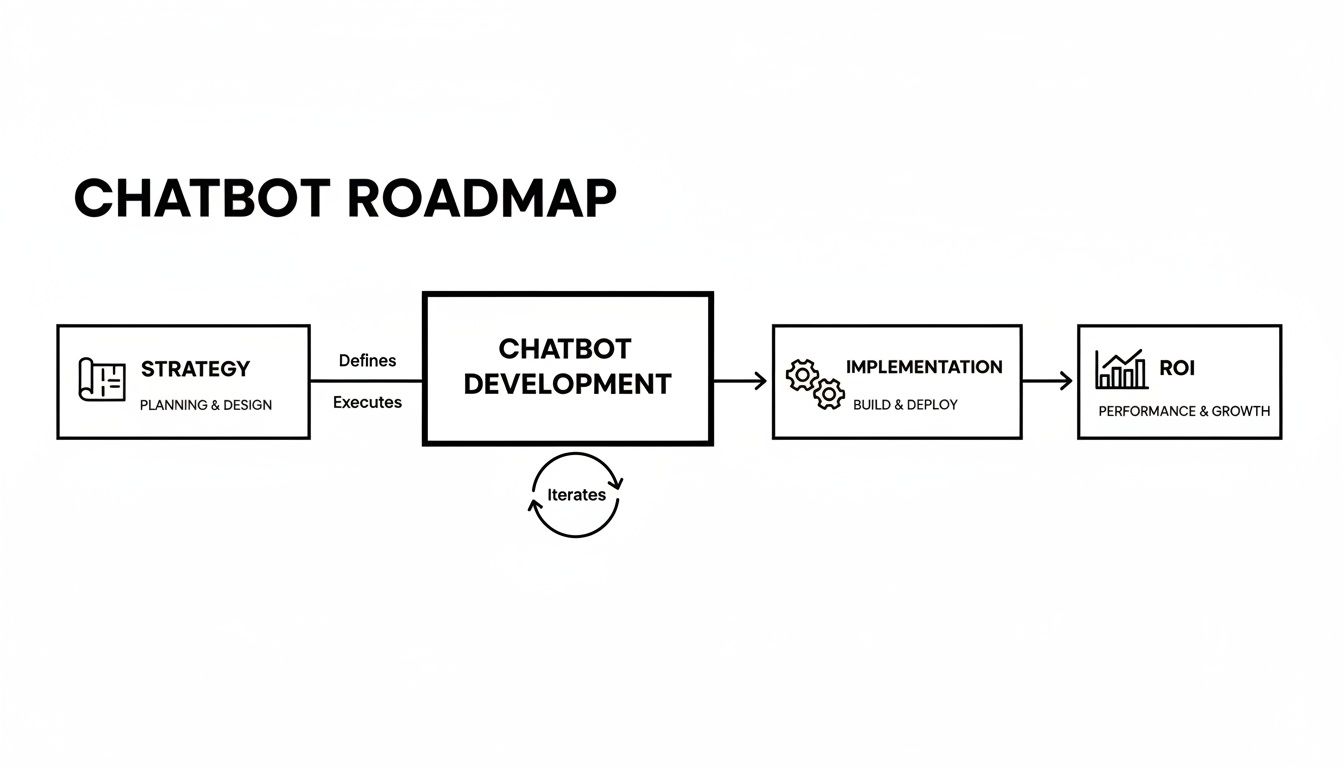
As you can see, it’s all about continuous planning, building, measuring, and refining.
Your integrated system can also be proactive. For example:
- Performance Alerts: Your Creator Tracker might flag that a top-performing affiliate’s sales have suddenly dropped. This can automatically trigger the chatbot to send them a friendly message, checking in to see if they need fresh content ideas or more samples.
- Milestone Rewards: When an affiliate crosses a major sales threshold in your dashboard, the bot can instantly send a congratulatory message and automatically process a bonus payment.
Key Takeaway: When you connect your chatbot to your core data sources, you're not just automating conversations. You're automating intelligence. The bot starts learning from your business and acting on that information all on its own.
Building a Holistic Automation Strategy
This kind of interconnected system is quickly becoming the new standard for fast-growing companies. There's a reason the conversational AI market is expected to reach $41.39 billion by 2030—it’s because businesses are seeing massive returns from building these kinds of integrated workflows. While many large companies still prefer on-premise setups for security reasons, the broader trend is moving toward cloud-based tools that can easily communicate with one another.
Platforms like HiveHQ are built to be the nerve center for this exact strategy. By bundling tools like an Affiliate Bot, a Profit Dashboard, and a Creator Tracker together, it creates the foundation for a truly connected system. You can set up smart alerts and automation rules that tie your chatbot’s actions directly to live performance data. The end goal is a smooth, intelligent operation where every automated task is guided by accurate, up-to-the-minute information, driving huge gains in both efficiency and revenue.
Common Questions About Enterprise Chatbots
Even with the best plan in place, you're bound to have questions when bringing a new technology like an enterprise chatbot into your operations. It’s a big move. Let's tackle some of the most common questions I hear from business leaders, focusing on the practical stuff: ROI, what happens when the bot gets stuck, and who you need on your team.
How Long Does It Take to See a Return?
This is the big one, and the honest answer is: it depends on what you're asking the chatbot to do.
If you're using it for internal tasks—say, automating IT helpdesk tickets—you'll see the payoff pretty quickly. The ROI shows up in saved labor hours and a more efficient team, often within just a few months.
But for a revenue-driving role, like recruiting affiliates for your TikTok Shop, the return is tied directly to the sales those new creators bring in. A good rule of thumb is to expect a clear financial return in about three to six months. That gives the system enough time to get up and running, onboard creators, and start seeing the results of their campaigns.
What Happens When a Chatbot Doesn't Know the Answer?
A well-built enterprise chatbot should never just give up and leave a user hanging. Instead, it has a built-in plan for when to call in a human. Think of it as knowing its own limits.
The bot is programmed to recognize when a question is too complex or if a user is getting frustrated.
When that happens, it seamlessly hands off the entire conversation—context, history, and all—to the right person, like a senior affiliate manager. This hybrid approach gives you the best of both worlds: automated efficiency for the easy stuff and a skilled human touch for a problem that really needs it.
What Kind of Team Do I Need to Run This?
Good news: you don't need a squad of developers to manage a modern chatbot. Most of the top platforms today are built with low-code or even no-code interfaces, so your non-technical team members can jump right in.
That said, you do need someone to own it. A dedicated "chatbot owner" or a small team with a few key skills is crucial for success. Here’s the ideal mix:
- Process Know-How: You need someone who knows your business workflows inside and out, like an operations manager. They’re the ones who will map out conversations that actually make sense and solve real problems.
- An Analytical Eye: This person lives in the data. They’ll watch the performance metrics, figure out what’s working (and what isn’t), and constantly tweak the bot to make it better.
- Basic Tech Savvy: While you don't need a hardcore coder, having someone who understands how to connect different systems via APIs is a huge advantage. This is key to integrating the bot with all the other tools you already use.
With this blend of operational, analytical, and technical oversight, your chatbot will grow from a simple tool into a genuine strategic asset.
Ready to see how a dedicated Affiliate Bot and Profit Dashboard can transform your TikTok Shop operations? With HiveHQ, you can automate creator outreach at scale and get the real-time data you need to make smarter decisions. Explore our all-in-one solution at HiveHQ.