How to Become UGC Creator in 2026: A Step-by-Step Roadmap
how to become UGC creatorUGC creatorTikTok Shop affiliateUGC pricingUGC portfolio
To become a UGC creator, pick one niche, produce six to ten varied sample videos, pitch brands with a clear price and usage terms, and track what your content does after it goes live. You don't need a large following, and chasing followers first is the popular advice I'd ignore, because brands pay for reusable content that sells a product, not for your audience size.
Table of Contents
- Your Roadmap From Zero to First Paid Brand
- Choosing a Niche and Work Model
- Gear, Editing and Sample Production Workflow
- Building a Portfolio and Pitch Without a Following
- TikTok Shop Requirements and Disclosure Rules
- Pricing, Contracts and Rate Benchmarks
- Frequently Asked Questions About Becoming a UGC Creator
- Track Results and Decide Where to Scale Next
Your Roadmap From Zero to First Paid Brand
Most beginners start in the wrong place. They post for weeks hoping a brand notices, then try to invent a rate when someone finally replies. Work the other way around. Build proof first, put a price and usage term on it, then pitch.
The timing helps. According to Whop's summary of UGC statistics, the number of UGC creators grew by 93% from 2024 to 2025, and TikTok was the primary platform for 54% of UGC creators. That's why vertical video, a fast hook, burned-in captions, and TikTok-native storytelling are the working skills to build first. Instagram matters, but it isn't where I'd spend my first month.
The Six Phases in Order
| Phase | Core action | Output | Typical time |
|---|---|---|---|
| 1. Choose niche and work model | Pick one niche and three to five content pillars | Niche brief and pillar list | One to two weeks |
| 2. Set up gear and editing | Assemble a phone rig, light, audio and one editing app | Repeatable edit template | About one week |
| 3. Produce sample videos | Make six to ten videos across varied direct-response formats | Portfolio reel | Three to four weeks |
| 4. Qualify for TikTok Shop | Verify identity, reach 1,000 followers and bind to a seller if pursuing affiliate work | Eligible affiliate account | Until you reach 1,000 followers |
| 5. Pitch and sign terms | Send concept, deliverables, usage rights and price to brands | First paid or affiliate deal | Two to six weeks |
| 6. Track and scale | Review watch time, saves, clicks and sales per video | Repeatable offers and hook library | Ongoing |
The phases overlap in practice. You can start pitching while your last two samples are still in edit, and you can work toward TikTok Shop eligibility while you're filming. What you shouldn't do is pitch with no samples at all. A brand manager can't approve a fee for work she can't picture.
If you're learning how to become a UGC creator from zero, connect the pitch phase to a broader outreach plan, such as the approach in this guide to getting brand deals on TikTok. The outreach gets easier once each message points to a sample that matches the product.
Practical rule: Don't wait for a perfect portfolio. Eight finished, varied samples beat twenty drafts.
Do three things this week.
- Pick one niche: Choose products you can film at home without buying stock.
- Film one demo: Make a 30-second video with the product visible in the first three seconds.
- Check eligibility: Compare your TikTok account against the requirements in the TikTok Shop section below.
Choosing a Niche and Work Model
A good niche passes three tests. You can demonstrate the product on camera in under a minute. The category produces repeat purchases, so brands need fresh content often. And you already understand the buyer's problem well enough to describe it in one sentence. Kitchen tools, pet supplies, skincare accessories, and home organisation all pass those tests for many beginners.
Say you narrow to kitchen gadgets. Your pillars could be problem and solution, a timed demo, a comparison, a testimonial style video, and quick tips. That spread gives a brand five different ways to use you, and it stops every sample looking like the same unboxing with a different product.
How the Three Work Models Pay
| Model | How you earn | Usage rights | Income pattern | Best starting point |
|---|---|---|---|---|
| Paid UGC | Flat fee per deliverable | Negotiated, may include paid ad usage for a set period | Predictable per project | Creators with strong editing and no following |
| Affiliate UGC on TikTok Shop | Commission on tracked sales, rate set by the seller | Usually organic, confirm whether the seller may run the video in GMV Max | Variable and tied to conversion | Creators who can demonstrate products that already sell |
| Hybrid | Base fee plus commission per sale | Negotiated per contract | Mixed, with a floor and upside | Creators after three to five completed brand deals |
Separate these models in your first pitch. A brand buying the content itself is a different deal from a seller paying you only when a tracked sale happens, and mixing them up is how beginners end up filming free ad assets in exchange for commission on a product that doesn't convert.
Commission needs the same care. According to TikTok's seller documentation on affiliate commission, the amount is determined at the product and seller level rather than by a universal platform-wide rate, sellers can set a standard rate for organic affiliate sales and a separate Shop Ads rate, and the permitted commission range is 1% to 80%. If a seller doesn't activate a separate Shop Ads rate, ad-supported affiliate sales use the standard rate. So check the rate, the selling price, and which type of sale it covers before you accept a sample.
Before you commit, compare where each model is sourced, including the options covered in this overview of UGC platforms for creators. Then apply a plain decision rule. Start with paid UGC if your editing is strong and you want predictable fees. Move toward affiliate work when you can show that a product in your niche converts.
Gear, Editing and Sample Production Workflow
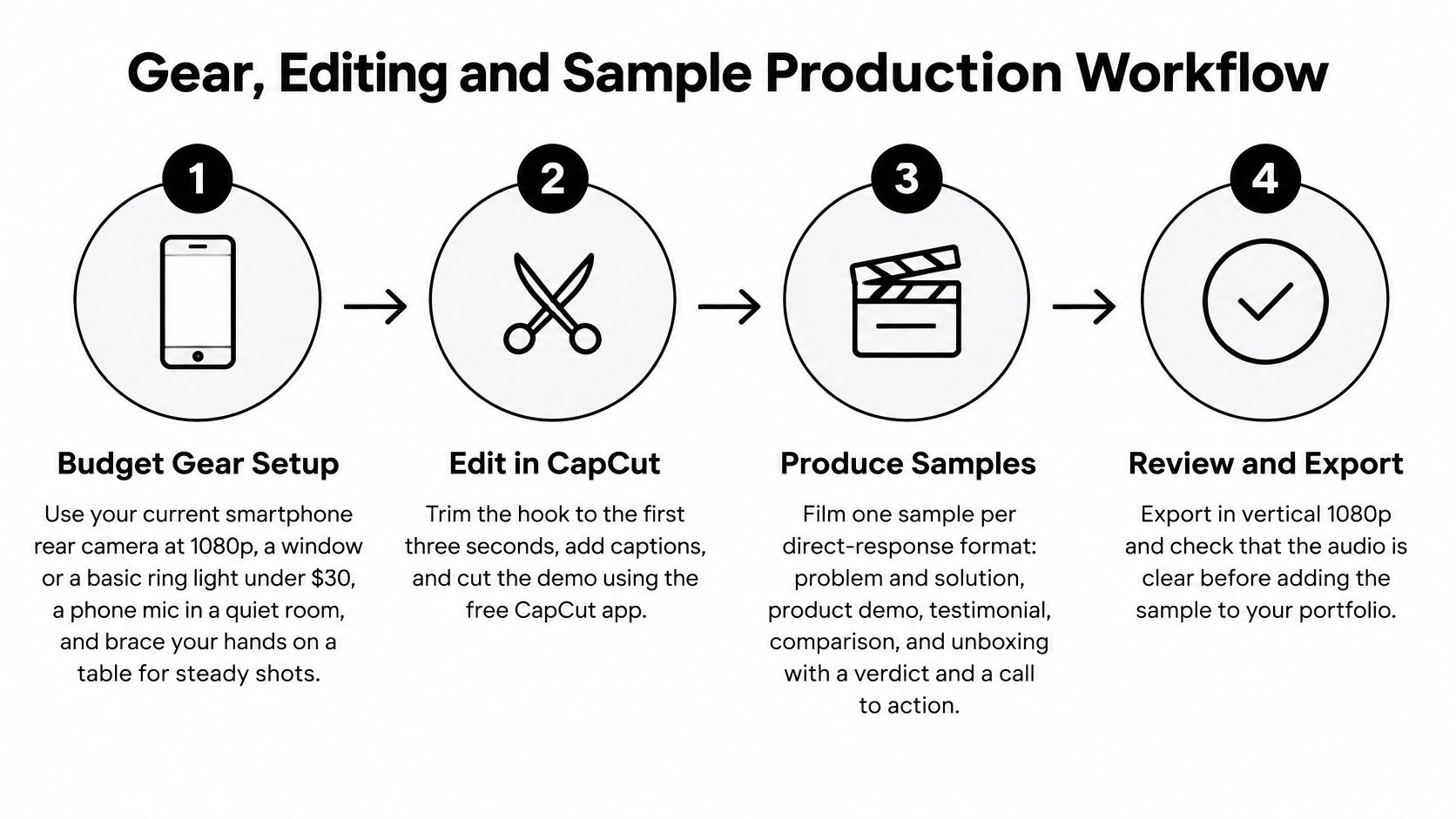
Your first setup doesn't need a camera upgrade. Use your current smartphone on its rear camera at 1080p, because the rear lens is sharper than the selfie lens on most phones. Film facing a window or use a basic ring light, record with the phone mic in a quiet room with soft furnishings, and brace your hands on a table instead of holding the phone at arm's length. Edit in CapCut or your phone's built-in app. That budget tier is enough for paid work if the light is even and the audio is close.
Upgrade only when a specific weakness costs you retakes. A phone that shoots 4K at 60fps gives you room to crop. A softbox or an 18-inch ring light with a diffuser flattens harsh shadows. A clip-on lavalier microphone fixes the thin, distant sound that makes a demo feel amateur, and a compact gimbal helps with walking shots. Desktop editors such as Premiere Pro or DaVinci Resolve earn their place on complex cuts with many clips, not on a simple 30-second demo.
Room noise is the fault viewers notice first, so clean the recording before you add music, and use the cleaner dialogue tips from Isolate Audio when a take is good but the room echo isn't. Treat audio cleanup as part of the edit, not a rescue job.
A Repeatable Six-Step Workflow
- Convert the brief into a shot list: Write down the product, the problem, the proof shot, and the call to action.
- Write hook variations: Draft three to five opening lines before you film anything.
- Film the product in use early: Show it working within the first three seconds.
- Record a second version: Shoot a talking-head take and a voiceover take so you can compare pacing.
- Add burned-in captions: Many viewers scroll with the sound off, so the argument has to work without audio.
- Export two files: Deliver a clean master and a platform-ready cut with the same timing.
Three slips waste the most time. Audio clips or turns hollow when the phone sits too far from you. Captions placed over the product hide the very thing you're selling. And a half-second pause before your first word gives viewers time to swipe. Trim to the first consonant.
For the wider production habits behind this workflow, see these notes on video production for social media. The habit that matters most is simpler. Keep one template per niche, with your caption style, framing, and export settings saved. Each new sample should take hours, not days.
Building a Portfolio and Pitch Without a Following
Conversion skill beats follower count, so organise your portfolio by what each video proves. Build six to ten samples across direct-response formats: problem and solution, product demo, testimonial style, comparison, and unboxing with a verdict and a call to action. Label each one by the skill it shows and the outcome it targets, such as a hook that holds attention or a demo that makes the product's use obvious in one shot.

You still need social proof, and you can get it without an audience. Redo a sample from a real brand brief so a manager sees you following instructions. Ask a seller who ran your video for a short result note. Save a screenshot of watch time or click-through from an organic or boosted test. Each one answers the same question: can this person make content a stranger acts on?
Presentation matters too. When you cut the samples into a reel, the demo reel music and distribution tips from LesFM are useful on pacing and on picking music that supports the voice instead of competing with it. Keep the reel short and put your strongest hook first. For layout and ordering, this breakdown of a UGC creator portfolio shows how to present samples so a busy manager can scan them quickly.
The Pitch, in Order
Write the pitch in this sequence: subject line with the product name, a two-sentence introduction, one concept sentence, the target viewer, deliverables and count, turnaround, then usage rights and price. Keep the whole thing under 150 words. Keep the first offer inside paid UGC scope: creative fee, posting deliverables, usage period and where the content may run.
A garlic press brand has just posted a product page. Your concept is a 25-second video built on a messy-kitchen problem: sticky fingers, wasted cloves, then one press and a clean board. You'd offer one vertical video plus a second cut, delivered in four days, usable organically for 30 days, at your stated fee. That tells the manager exactly what they are buying.
A pitch that names the product, the viewer, and the usage period reads like a supplier quote.
Find brands where the selling already happens. Check TikTok Shop listings for items moving well in your niche, look for brand accounts that post product demos, and note which brands have run creator campaigns in your category. Send each pitch to a named product manager or brand contact, and reference one specific product detail so it can't be mistaken for a mass message. If the reply shifts to commission or Shop setup, settle the paid scope first.
TikTok Shop Requirements and Disclosure Rules
Paid UGC doesn't require TikTok Shop access, but affiliate income does, and the account paths aren't interchangeable.
| Account path | Follower minimum | Key requirements | Typical use |
|---|---|---|---|
| Affiliate creator | 1,000 | Age 18 or over, US-based, identity verified, policy compliant, no revoked e-commerce permissions | Earning commission on products from sellers |
| Account bound to a seller | No minimum | Bound to an eligible seller and passes risk checks | Content posted for a single seller's shop |
| Marketing account | 5,000 | Promotes other sellers' products through the Product Marketplace | Promoting many sellers' products |
Eligibility is only the first step. After that, you bind your creator account to an eligible seller and pass the platform's risk checks before you can work that relationship. A prior record of revoked e-commerce permissions can block the application, including an association with an account that had permissions revoked. I'd check your account standing before you build a content plan around affiliate income, because a blocked application wastes weeks.
Disclosure Is Part of the Job
When you post organic content that promotes a brand, product, or service, turn on TikTok's commercial content disclosure setting. TikTok's Product GMV Max guidance says creators should apply a commercial content label by turning on the content disclosure setting, and it identifies affiliate posts as a video source that advertisers can use in GMV Max campaigns. The requirement applies even when you're posting ordinary organic content and not running advertising yourself, so don't treat the label as optional because the video looks informal.
Run this checklist before every post goes live.
- Material connection disclosed: Payment, a free product, or commission is stated clearly with the endorsement.
- Label switched on: The commercial content setting is active on the post.
- Affiliate link checked: The product link points to the right listing and variant.
- Claims matched: Every product claim matches an approved claim the brand gave you.
- Record saved: You keep the brief, sample status, commission terms, and posting deadline in one place.
That last claims point carries real risk. Don't promise sales results or health outcomes you can't substantiate, and don't repeat a claim just because it appears in another creator's video. Ask the brand for its approved claims and product specifications, and get permission before you reuse customer photos or brand assets. Disclosure doesn't weaken a deal. It protects it, because a seller who wants to run your video in a paid campaign needs content that passes review cleanly.
Pricing, Contracts and Rate Benchmarks
Your rate has two parts: the fee for making the video and the fee for what the brand does with it. Price them separately, because a brand that only wants organic posting pays differently from one planning a paid campaign.
Start with the gap between what creators ask and what they receive. In 2025, the average asking price for a UGC collaboration was $198.06 while the average payment received was $177.68, according to Collabstr data reported by Net Influencer. Creators regularly settle below their ask, so quote with a small negotiating margin and decide your floor before the call.
| Benchmark | Value | Year | Source |
|---|---|---|---|
| Average UGC rate per deliverable | A few hundred dollars per video | 2024 | Whop UGC statistics |
| Average payment received per collaboration | $177.68 | 2025 | Collabstr data via Net Influencer |
| Average asking price per collaboration | $198.06 | 2025 | Collabstr data via Net Influencer |
| Median total earnings for UGC creators | Far below the average | 2023 | NeoReach and Influencer Marketing Hub |
| Average estimated total earnings for UGC creators | Pulled upward by a small share of top earners | 2023 | NeoReach and Influencer Marketing Hub |
Read the earnings rows carefully. A median far below the average means a minority of high earners lifts the mean, so published averages flatter what a typical beginner should expect. Plan for lumpy income in your first months: two paid videos one month, none the next, then a repeat client. Keep TikTok Shop affiliate commissions out of this math, because commission income depends on conversions and belongs on top of quoted fees as upside, never folded into a flat rate. If you want a sanity check on the follower-based estimates quoted online, this explainer on how TikTok money calculators work shows what those tools assume, which matters because UGC fees are priced on deliverables and usage rights rather than audience size.
How to Build a Quote
Start from a per-deliverable base fee that covers filming, editing, and one round of revisions. Then price the rights on top. Thirty days of organic usage on the brand's own account costs less than 60 days of paid usage in one market, because paid usage puts your face and voice in front of a far larger audience for longer. Add for exclusivity that blocks competitor work, extra revision rounds, a rush turnaround, and posting on your personal account if the brand wants distribution along with content. Disclosure-ready delivery belongs in the price too: a video that passes ad review cleanly is worth more to a seller who plans to run it as paid media.
Before you sign, check these clauses against the points in this guide to social media influencer contracts.
- Usage type and length: Organic, paid media, or both, and for how many days.
- Territories: Which countries the licence covers.
- Derivative edits: Whether the brand may recut your footage into new versions.
- Revision limit: How many rounds are included before extra fees apply.
- Exclusivity window: How long you can't work with named competitors.
- Payment and cancellation: When you're paid, and what you receive if the brand cancels after filming.
Rule before filming: No written terms, no shoot. A friendly chat thread grants no usage licence.
Verbal agreement is where scope creep starts. One extra cut becomes three, and a 30-day organic post slowly becomes a paid campaign. Written terms protect the brand too, because the licence stays clear if its media team changes. I'd rather lose a deal than let paid usage hide inside a flat fee.
Frequently Asked Questions About Becoming a UGC Creator
Do I Need a Large Following to Become a UGC Creator
No. Brands buy rights to persuasive content, not access to your audience, so a few strong samples organized by the outcome they drive will carry a pitch further than a follower count. Followers only become a hard requirement in one place: TikTok Shop affiliate access.
What Do I Need to Join TikTok Shop as an Affiliate Creator
The follower threshold of at least 1,000 is the true gate for beginners, since the other conditions are basics like age, location, and identity verification. Affiliate work also pays commission on orders your content generates, which is a different deal from paid UGC. Many creators pitch paid brand deals first and add affiliate work once they qualify.
Do Free Products Require Disclosure
Yes. The obligation follows the connection with the brand, not the payment method, so a gifted product, an affiliate commission, and a flat fee all trigger the same requirement. Beginners get this wrong by assuming unpaid work is exempt.
What Do I Say When a Brand Asks for a Rate Before Seeing a Sample
Quote a range, not a single number, and ask what rights they plan to buy before you commit. A brand purchasing 30 days of organic usage is priced differently from one purchasing paid media rights, so the honest answer is a range for one deliverable plus usage, finalized once they name the terms. If they want a firm number with no sample on file, offer a paid test deliverable: it proves your work at low risk to them without discounting your full rate.
Track Results and Decide Where to Scale Next
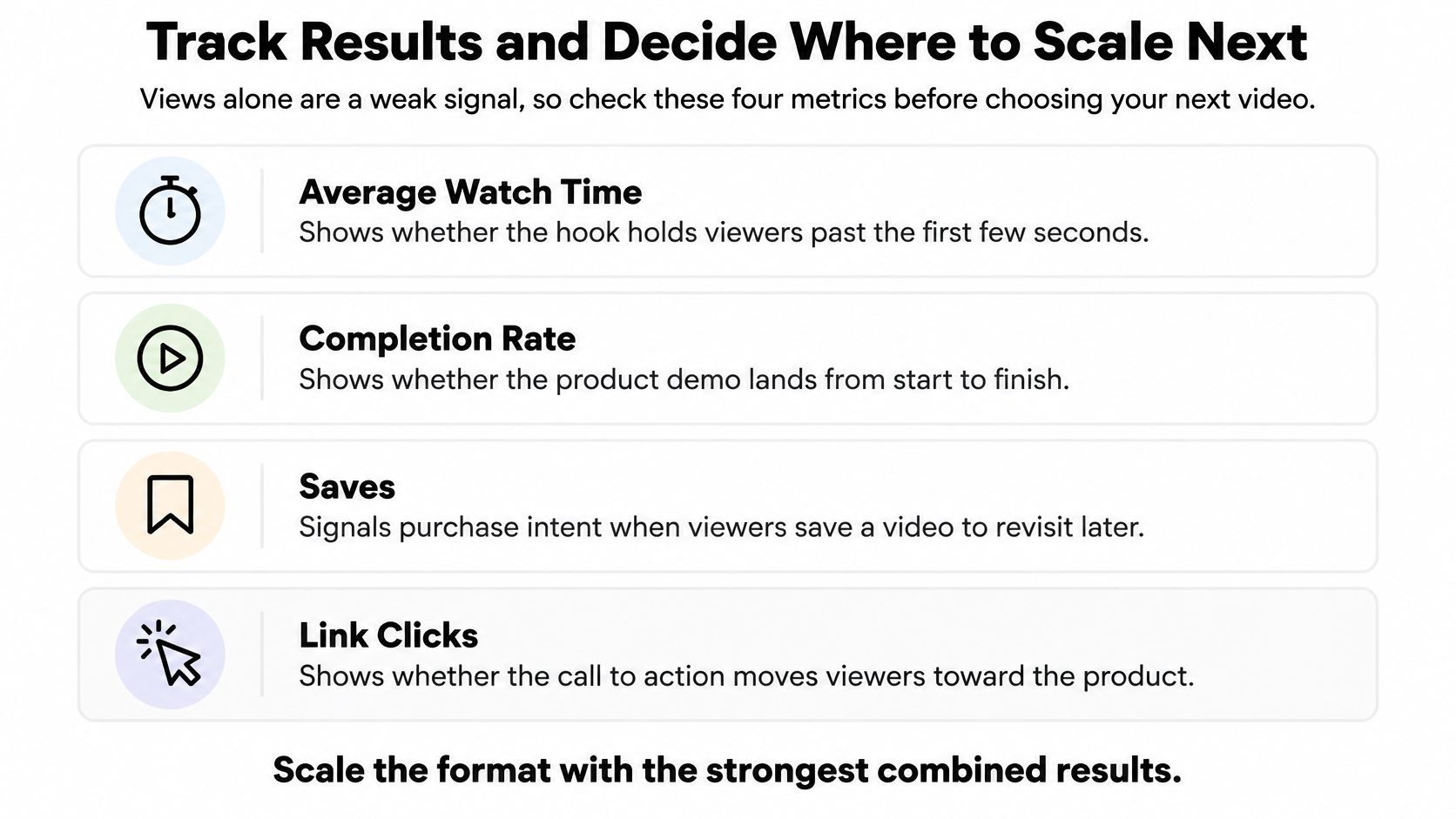
Views are the weakest signal you own. A video can collect views because the opening frame is odd, then produce no clicks and no orders. If you judge your work by views alone, you will keep the format that looks busy and drop the one that sells. Judge each video on what viewers did next.
Average watch time tells you whether the hook holds. If viewers leave in the first two seconds, your opening line or first frame is the problem, so fix the entry before you touch the product demo. Completion rate tells you whether the demo lands from start to finish. A strong opening with a weak completion rate usually means the middle drags, often because you explained a feature instead of showing it.
Saves signal purchase intent. People save a video they plan to act on later, so a modest-view video with high saves is often worth more to a seller than a viral one with none. Click-through rate on the product card shows whether your call to action and the moment you placed it moved viewers to the listing.
Conversion, meaning orders per click, separates curiosity from buying. Plenty of clicks with few orders can point to price, reviews, or a listing problem outside your control, and that is worth raising with the seller plainly. GMV per video is the number that lets you compare offers. It shows which products and formats produce revenue, so you can choose your next samples and pitches on evidence. Tag each portfolio clip by the outcome it produced, such as saves, clicks, or orders, so the next pitch leads with conversion proof rather than audience size.
Test Hooks Against One Demonstration
Keep the demonstration fixed and test three to five hooks against it. That way you learn whether the opening changed the result, instead of guessing across completely different videos. Keep the version with the strongest click and order signals, save its opening line in a hook library, and retire formats that gain views but no saves or clicks. Retiring a format is how your portfolio gets sharper.
Attribution causes most arguments in affiliate work. Your commission depends on tracked sales through your product link, so before you post, record the link, the commission terms, the sample status, and whether the seller may run the video as paid media. Keep affiliate earnings and paid usage as separate terms in the same agreement: one ties pay to tracked orders, the other prices reuse of the video. Then ask the seller how the video performed on their side. Sellers who use the HiveHQ Profit Dashboard can see GMV, COGS, ad spend, commissions, and net profit per product in real time, which makes your contribution easier to prove in the next pitch because you are talking about profit per product, not impressions.
Send the brand a short results note without being asked. It's the cheapest repeat business you'll ever win.
Scaling means choosing, not filming more of everything. Pick one offer to scale this month, based on the metrics above, and set a review date two to four weeks out. On that date, compare GMV per video and conversion across your last batch, keep the winning format, and send the results to the brand with a proposal for the next round. That single habit turns a one-off deliverable into a retainer conversation.
It also sharpens your niche choice. If your kitchen demos convert and your home organisation videos only collect views, you have your answer about where to pitch next. The loop stays simple: make a clear offer, film it well, disclose it properly, price usage separately, then let the numbers decide what you make next.
Try the HiveHQ Profit Dashboard to see real-time GMV, COGS, ad spend, commissions, and net profit by product for your TikTok Shop, so you can show which creator videos make money. Talk to the HiveHQ team about setting it up for your shop, and start at HiveHQ.