How to Calculate Cost Per Acquisition for TikTok
cost per acquisitionTikTok Shop CPAecommerce metricscustomer acquisition costHiveHQ profit dashboard
Cost per acquisition is total acquisition cost divided by the number of completed acquisitions, and on TikTok Shop that total should include ad spend, commissions, and sample costs for the same period. If you spend $2,000 and get 50 customers, your CPA is $40.
That simple math gets messy fast on TikTok Shop, because the platform can hide costs inside creator fees, coupons, referral fees, and fee structures that don't show up in ad spend alone. If you want the number to mean anything, you have to calculate it against the same time period, the same audience, and the same conversion definition, then check whether the result still works after fees and refunds.
Table of Contents
- The Core Cost Per Acquisition Formula
- Identifying Hidden TikTok Shop Costs
- Calculating True Profit with Worked Examples
- Solving Attribution and Incrementality Challenges
- Automating Metrics with the HiveHQ Profit Dashboard
- Frequently Asked Questions About Acquisition Costs
The Core Cost Per Acquisition Formula
Start with the base formula
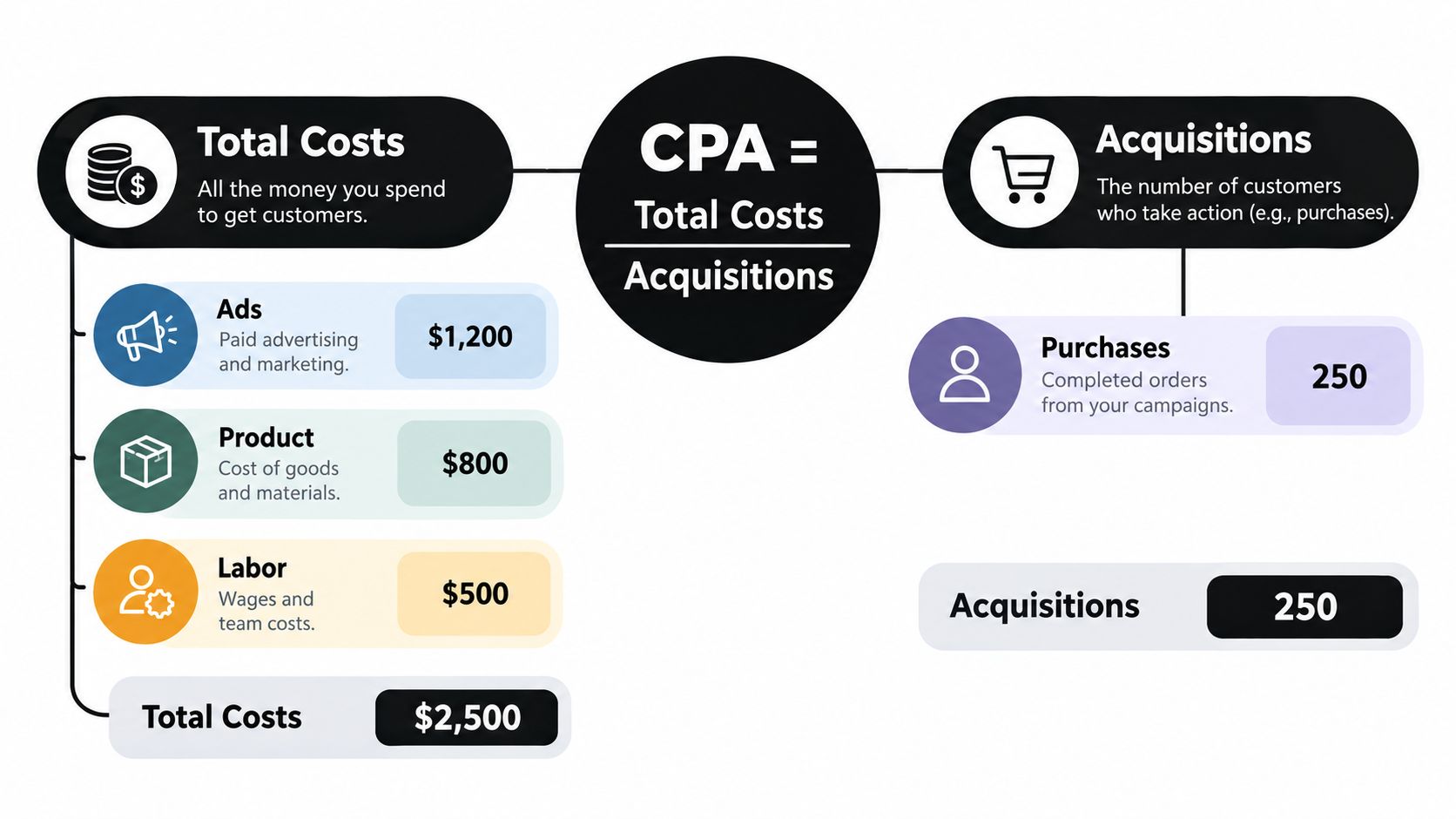
The core formula is straightforward, CPA = total acquisition cost / number of acquisitions. That definition matters because it keeps the metric tied to a specific campaign or acquisition program, not to a vague blend of every marketing activity in the business. Intuit's explanation of CPA uses the same basic structure, and the operational point is the same, the numerator and denominator have to belong to the same measurement window. what changed in your acquisition spend is a useful framing when you're comparing one period against the next.
A clean CPA calculation answers one question, what did it cost to generate one completed acquisition in that period? If you spent money during March, count March costs and March acquisitions. If you mix a quarter of spend with one month of orders, the ratio becomes misleading before you even start optimizing it. For a practical acquisition workflow, that's why it helps to track the metric alongside shop-level profit data, like the approach outlined in TikTok Shop ad spend and profit tracking.
Separate media CPA from fully loaded CAC
The mistake I see most often is treating ad spend as the whole story. That creates a narrow media CPA, which is useful for ad operations, but it's not the same as fully loaded customer acquisition cost, where you include creative, labor, software, commissions, and overhead tied to the acquisition program. If you only count ads, you'll usually make a campaign look cleaner than it really is.
Practical rule: If the expense exists because you acquired the customer, it belongs in the numerator.
That distinction matters because a channel can look efficient on a media-only basis and still destroy margin once the rest of the acquisition stack is added. The right question isn't just “what did the ad cost?” It's “what did it cost to create a paying customer in the period I'm measuring?” When that answer is incomplete, CPA stops being a decision metric and turns into a vanity number.
Identifying Hidden TikTok Shop Costs
What belongs in the numerator
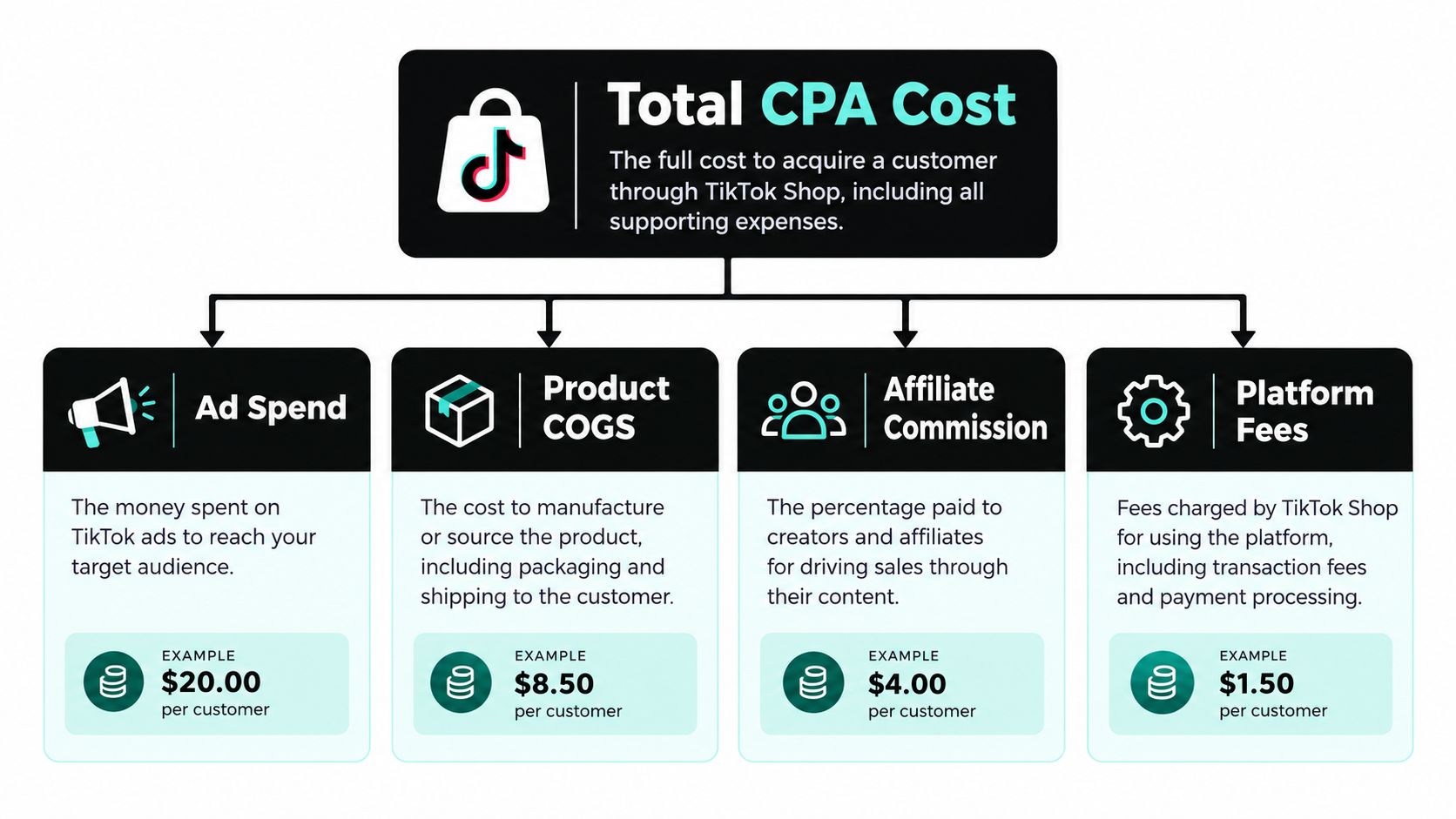
TikTok Shop adds cost layers that standard ad math doesn't capture. TikTok states that GMV Max can account for business costs beyond advertising spend, including affiliate commissions, coupons, and referral fees, when optimizing campaigns. That matters because the platform can make a campaign look viable on an ad-only basis while the full acquisition stack is already heavier than the dashboard suggests. TikTok GMV Max optimization details
Creator commissions are the obvious example, but they're not the only one. Samples, creator payouts, affiliate management labor, creative production, discounts, and measurement tools all belong in the acquisition numerator when they exist to win the customer. If you bury those expenses in general overhead, you'll understate CPA and make bad scaling calls.
For TikTok Shop operators, it's also worth separating seller-funded promotions from true product cost. A discount isn't free just because it doesn't show up as a cash expense line item in the ad account. It reduces what the order can contribute after acquisition, which is why profit tracking needs to sit next to CPA rather than downstream in a separate spreadsheet. TikTok Shop fee breakdown explained
Why platform fees change the math
Platform fees matter because they eat into contribution before you've recovered acquisition cost. TikTok seller-fee information gives a 6% commission example for each sale, which means a $50 order carries a $3 platform commission before product cost, shipping, creator commission, refunds, discounts, or advertising. That single line item can completely change whether a campaign is worth repeating. TikTok seller-fee example
A low ad CPA can still be a bad acquisition if the fee stack and promotion stack are heavy enough.
That's why I'd rather see CPA tracked as part of a profit view than as a standalone performance badge. Once commissions, coupons, and referral fees are folded in, the question stops being whether the campaign got cheap clicks and becomes whether it brought in customers at a cost the business can absorb.
Calculating True Profit with Worked Examples
A simple TikTok Shop scenario
Use the platform-reported number first, then test it against your actual stack. Suppose a GMV Max campaign spends on ads, creator incentives, and samples to drive new orders. The dashboard may show an acquisition cost that looks acceptable because it's only reflecting part of the expense picture.
Now layer in the business costs. If the order value is $50, the seller fee example at 6% equals $3 before any product cost, shipping, creator payout, refunds, or promotional discount is considered. That's the point where many teams realize they've been reading revenue as if it were profit. For a deeper profit workflow, the TikTok Shop net profit calculator is the right companion view to CPA.
Why the surface number can mislead you
A campaign can look healthy when the platform counts only attributed orders and direct ad costs, but still lose money after the rest of the acquisition stack is included. That's not a tracking quirk, it's a unit economics problem. If the margin after cost of goods, fulfillment, platform fees, commissions, discounts, and returns can't cover acquisition, the campaign is not really buying customers profitably.
Here's the practical way to think about it.
| Layer | What it tells you | What it can hide |
|---|---|---|
| Platform-reported CPA | Ad efficiency inside the dashboard | Creator fees, samples, fees, refunds |
| Fully loaded CPA | Total acquisition burden per new customer | Nothing if you captured all acquisition costs |
| Contribution after acquisition | Whether the order actually pays back | Only if product cost or fulfillment are mis-entered |
The useful habit is to evaluate CPA at the product level, not just the store level. A store-wide average can hide one product that's subsidizing another. Once you start reading acquisition through contribution profit, the numbers become decision tools instead of reporting decorations.
Solving Attribution and Incrementality Challenges
Attribution is not the same as incrementality
TikTok Shop attribution can overcredit the platform when the buyer was already in motion. One available summary of TikTok Shop affiliate ROI notes that attributed orders may include purchases where the user did not directly engage with an ad, which means a platform-reported acquisition result should not automatically be treated as an incremental customer. TikTok Shop attribution caveat
That distinction matters because overlapping organic content, paid ads, and affiliate links often influence the same order. If you count that same buyer too many times, you'll inflate acquisitions and make CPA look better than it really is. If you ignore the overlap completely, you may undercredit a channel that moved new customers.
Use three views, not one
The cleanest operating model is to keep three numbers in view. Platform-attributed CPA tells you what the dashboard thinks happened. Blended business CPA tells you what the business spent versus unique new customers. Incrementality-adjusted CPA tells you what the channel created beyond existing demand.
A holdout test or geo test gives you the incrementality read. Pause creator activity for a comparable product set or region, then compare new-customer orders, contribution profit, and repeat purchase behavior against the active group. That doesn't need to be fancy to be useful. It just needs to separate credited orders from real lift.
Operator's rule: If a low CPA only exists because the platform claimed demand that was already there, it's not a scaling signal.
This is especially important when multiple creators, retargeting, and organic content all touch the same buyer journey. The point isn't to distrust every dashboard. The point is to reconcile dashboard credit with business truth before you commit more spend. For a deeper framework, see what attribution modeling actually means.
Automating Metrics with the HiveHQ Profit Dashboard
Manual tracking breaks down fast
Spreadsheets can handle one product and one creator. They struggle once you have several products, multiple creators, refunds, commissions, and ad accounts feeding the same shop. The problem isn't just speed, it's reconciliation. By the time someone updates a sheet, the shop data has usually changed again.
That's where a self-serve profit dashboard becomes operationally useful. HiveHQ's Profit Dashboard is built to surface shop and product economics in real time, so sellers can see GMV, COGS, ad spend, commissions, and net profit without stitching reports together by hand. It's the difference between guessing at acquisition cost and reading it from a reconciled view. HiveHQ Profit Dashboard
Tracking method comparison
| Tracking Method | Data Accuracy | Time Required | Profit Visibility |
|---|---|---|---|
| Manual spreadsheet | Inconsistent, depends on human updates | High | Low unless every cost is entered correctly |
| Native platform exports | Partial, limited to platform-reported data | Medium | Limited, especially on fees and refunds |
| HiveHQ Profit Dashboard | Reconciled across key shop inputs | Low after setup | High, with product-level and customer-level views |
Beginning in July 2025, GMV Max became TikTok Shop's default and only supported campaign type for TikTok Shop Ads, so campaign-reported CPA now needs to be separated from broader blended acquisition cost. TikTok Shop Ads budget guidance That shift makes automation more valuable, not less, because the reporting standard itself is narrower than the business question most operators need to answer.
The right software doesn't decide strategy for you. It just reduces the chance that a missing fee or delayed refund changes your decision without you noticing. For teams that want the acquisition number tied to profit, that's the genuine value.
Frequently Asked Questions About Acquisition Costs
What is a good cost per acquisition target
A good target depends on contribution margin, not on a universal benchmark. If a customer's gross profit can't cover the acquisition cost and still leave room for overhead, the CPA is too high for that product. Use the product's own unit economics, not a channel average, to set the ceiling.
Should I include creator commissions in CPA
Yes, if the commission is part of acquiring the customer. On TikTok Shop, creator payouts often function as acquisition expense, not pure overhead. If you leave them out, the number will look better than the business reality.
How do I handle delayed payouts and refunds
Match the cost period to the acquisition period, then reconcile later adjustments into the same cohort. That keeps the first read useful while still letting finance correct the final result when refunds or payout delays land. A dashboard that can absorb those adjustments is a lot easier to trust than a static sheet.
When should I scale a creator partnership
Scale when the partnership still works after commissions, platform fees, and refunds are included, and the contribution profit after acquisition stays positive. A creator that looks efficient on attributed CPA alone may still be weak at the business level. The decision should come from reconciled profit, not reach or vanity sales.
If you also want to tighten the back office side of the business, it can help to reduce invoice processing costs so acquisition reporting isn't buried under manual admin. The less time your team spends reconciling paperwork, the faster you can act on true profit signals.
HiveHQ gives TikTok Shop sellers a way to see acquisition cost, commissions, ad spend, and net profit in one place instead of across scattered exports. If you want to calculate CPA against actual contribution economics, visit HiveHQ and talk to the HiveHQ team about the Profit Dashboard.