How to Find Content Creators for Your TikTok Shop
how to find content creatorstiktok shop affiliatescreator marketingtiktok creatorsinfluencer outreach
Before you even think about sliding into a creator's DMs, you need to lay the groundwork. A solid strategy is the difference between a thriving TikTok Shop program and one that just drains your budget.
Jumping into outreach without a plan is a classic mistake. It's like sailing without a map—you'll be busy, sure, but you won't get anywhere meaningful. The real secret to finding creators who actually move the needle isn't in the search; it's in defining what success looks like for your brand first. A rushed process almost always leads to partnerships that fizzle out, waste money, and deliver mediocre sales.
This initial planning phase is your chance to get methodical. It’s about looking past vanity metrics like follower counts and digging into what truly drives performance on TikTok Shop.
Define Your Ideal Creator Profile
First things first, you need to build a detailed Ideal Creator Profile (ICP). Think of this as the north star for your entire search. It’s not just about how many followers someone has; it’s about finding a perfect alignment between their audience and your product.
A solid ICP should get super specific on a few key things:
- Audience Demographics: Who are their followers? Do their age, location, and interests line up with your target customer? A creator with a million followers is totally useless if none of them are potential buyers for you.
- Content Style and Niche: Does their video style—the editing, the tone, the overall vibe—actually match your brand's identity? If you sell sleek, minimalist tech, a creator known for chaotic, high-energy comedy might not be the right fit.
- Brand Values and Authenticity: Do they seem to genuinely believe in the kinds of products they promote? Authenticity is everything on TikTok. Users can spot a forced, pay-for-play partnership from a mile away.
Set Measurable Campaign Goals
Once you know who you're looking for, you need to decide what you want them to do. Vague goals like "increase brand awareness" are not going to cut it here. You need specific, quantifiable targets that you can actually track.
For a TikTok Shop program, your goals usually fall into one of these buckets:
- Driving Direct Sales (GMV): This is the big one. The main objective is to generate immediate revenue through affiliate commissions and product showcases.
- Building a Content Library: Your goal might be to get a steady stream of authentic user-generated content (UGC) that you can repurpose for your own ads and social channels.
- Increasing Product Discoverability: Sometimes, it's just about getting your products in front of new, relevant audiences who've never heard of your brand before.
This simple workflow really nails down the foundational steps.
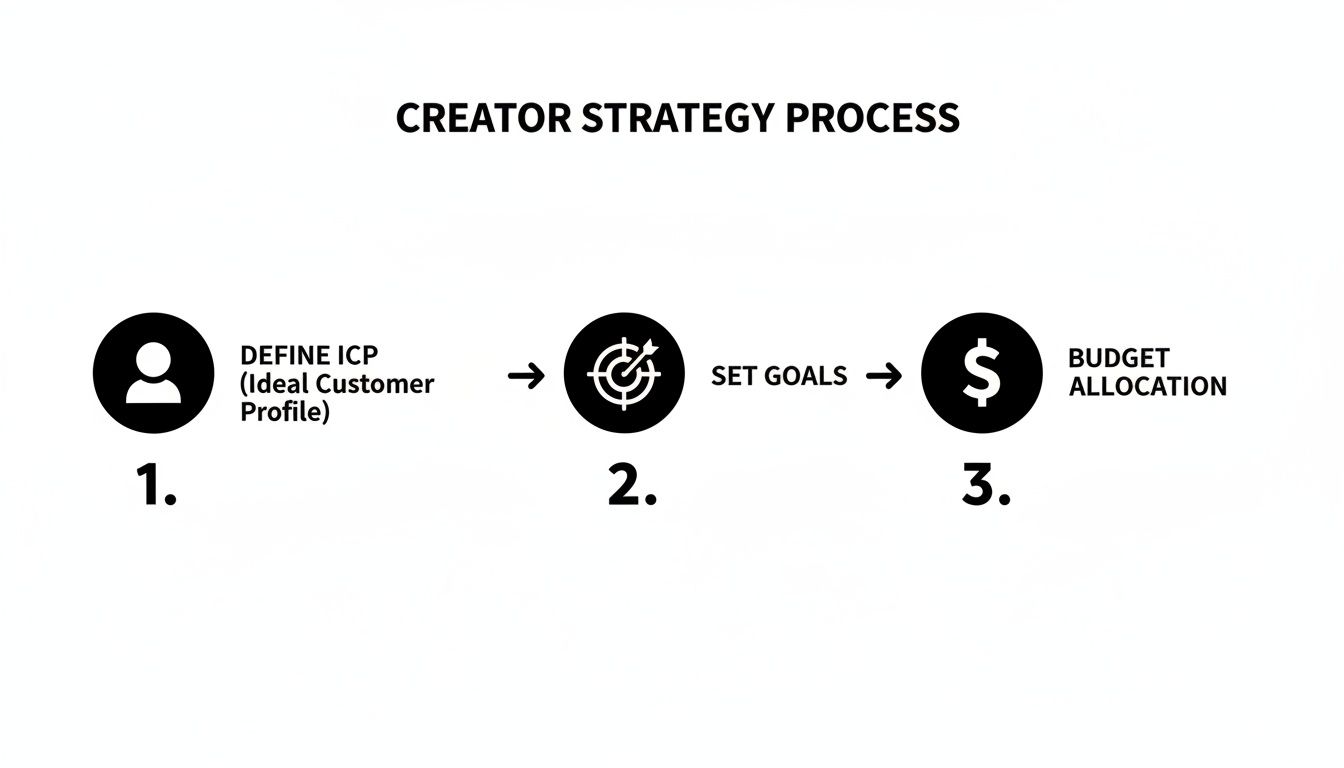
Following this process ensures every decision you make—from who you reach out to, to how much you spend—is directly tied to your main objectives.
Establish a Realistic Budget and KPIs
Finally, you need to talk money. A realistic budget has to account for more than just commissions. A smart, comprehensive budget will cover:
- Product Seeding: The actual cost of the free products you'll be sending to creators.
- Creator Compensation: This could be commission-only, a flat fee, a monthly retainer, or some kind of hybrid model. As you'll find in our guide to TikTok Shop influencers, the real top performers often expect a retainer.
- Shipping and Logistics: Don't forget the operational costs of just getting the products into creators' hands.
Alongside your budget, you have to define the Key Performance Indicators (KPIs) you'll use to see if any of this is actually working.
Your most important metrics aren't likes or views. For TikTok Shop, you need to be laser-focused on Gross Merchandise Value (GMV), conversion rate, and Return on Ad Spend (ROAS) to measure the true financial impact of your creator program.
Getting this framework locked in from day one makes your search targeted, your goals crystal clear, and your investment completely measurable.
Uncovering High-Impact Creators on TikTok
Alright, you’ve got a solid game plan. Now for the hard part: finding the right talent to bring it to life. Just scrolling through your 'For You' page and hoping for a lucky break isn't a strategy—it's a recipe for wasted time.
The real challenge with TikTok Shop isn't a lack of creators; it's the overwhelming noise. You need a systematic way to find the ones who can actually move the needle on sales.
Endless manual searching is a trap I see brands fall into all the time. It feels productive, but it’s a massive operational bottleneck. To build a creator program that actually scales, you need to blend some smart, targeted manual searching with powerful discovery tools.
Manual Discovery Methods That Still Work
Look, manual searching still has its place, especially when you're just starting out or hunting for a very specific type of creator. The key is to be methodical, not just endlessly scrolling.
- TikTok Creator Marketplace: This is TikTok’s own platform for brand-creator intros. It’s a decent place to start and see who’s actively looking for deals, but I’ve found its filtering options can feel a bit basic compared to dedicated tools.
- Smart Search Bar Tactics: Use TikTok's search bar like a pro. Try combining your product niche with keywords like #tiktokshop, #ad, or #sponsored. For instance, a quick search for "skincare #tiktokshopfinds" will instantly show you creators who are already in the game and comfortable selling.
- Competitor Spying: This is my favorite trick. Check out which creators your competitors are working with, especially the successful campaigns. This isn't just about poaching talent; it tells you what kind of content and offers are already working in your niche.
These methods can definitely land you your first handful of partners. But they hit a wall fast when you're trying to onboard dozens, let alone hundreds, of creators. And for direct outreach, using specialized TikTok email finder tools can be a game-changer for getting straight into their inbox.
Scaling Your Search with Automation
To really grow your program, you have to move beyond doing everything by hand. The sheer volume of creators makes automation a necessity, not a nice-to-have.
The creator economy on TikTok is massive. We're talking about roughly 1.5 million active creators projected for 2025. You simply can't vet that kind of talent pool manually if you're serious about e-commerce.
This is where dedicated platforms built for TikTok Shop come in. They turn what was once a soul-crushing manual task into a slick, automated workflow.
With the right tool, you can tap into a huge database and apply incredibly specific filters. Forget just looking at follower counts. You can start searching for creators based on the metrics that actually matter—their niche, average engagement rates, and even past sales performance.
Instead of broadcasting a generic offer, you can pinpoint partners who are a perfect fit. We explain exactly why this is so critical for ROI in our guide to building a TikTok influencer database.
Finding Hidden Gems for Better ROI
One of the biggest wins from using an automated discovery tool is finding the "hidden gems." These are often micro-influencers (10k-100k followers) with smaller but fiercely loyal audiences.
Don't sleep on creators with smaller followings. Their communities trust them implicitly, which often leads to conversion rates that blow larger, more generic influencers out of the water. Their authenticity is your secret weapon.
These creators fly under the radar of brands obsessed with vanity metrics. And because their inboxes aren't overflowing with offers, they're often much more open to performance-based deals, like a commission-only affiliate partnership.
This approach lets you build a diverse portfolio of creators. You can spread your risk, test out different audience segments, and see who really drives GMV—all without a huge upfront investment. Once you identify your top performers, you can nurture those relationships with retainers and bigger, more exciting opportunities.
How to Vet and Qualify Potential Creator Partners
Finding a long list of potential creators is the easy part. The real work—the part that separates a thriving TikTok Shop from a costly mistake—is in the vetting. A massive follower count might look impressive at first glance, but it’s essentially worthless if that audience doesn't trust the creator or has zero interest in what you sell.
This is where you need to get forensic. You're moving past simple discovery and into deep qualification, digging into both the hard data and the subtle signals that tell you if a creator can actually move the needle on sales. Skipping this is like hiring someone without even a quick chat; you're just crossing your fingers, and hope is never a solid business strategy.

A disciplined vetting process is what protects your budget, your brand's reputation, and your time. It’s how you find authentic partners who become true extensions of your brand, not just rented billboards.
Analyzing the Quantitative Signals
Let's start with the numbers. The data gives you an objective baseline to weed out the obvious non-starters. The trick is to ignore the vanity metrics and zoom in on the data points that actually correlate with TikTok Shop performance.
Here's what I always look at first:
- Engagement Rate: This is the ultimate health check for a creator's account. A simple (likes + comments + shares / followers) calculation tells you if the audience is actually listening. Honestly, a creator with 50,000 followers and a 10% engagement rate is exponentially more valuable than one with 500,000 followers and a 1% rate.
- Audience Demographics: Does their audience profile line up with your ideal customer? Most serious creator platforms offer this data. If you're selling high-end kitchen gadgets, a creator whose audience is 85% under the age of 21 is a clear mismatch, no matter how many views they pull.
- Past Sponsored Performance: Go through their feed and find every #ad or #TikTokShop video they’ve ever posted. Pay close attention to how those videos performed against their regular, organic content. If you see a massive drop-off in views or engagement on sponsored posts, that’s a huge red flag. It tells you their audience doesn’t trust their paid recommendations.
A pro tip: Keep an eye out for creators with suspiciously high follower counts but shockingly low comment numbers. This often points to fake followers or engagement pods, neither of which will do anything for your bottom line. You're looking for real, authentic interaction.
These quantitative checks are your first line of defense. They help you quickly filter out the low-quality or misaligned profiles, letting you focus your energy on the creators with genuine potential.
Assessing the Qualitative Factors
Once a creator makes it past the numbers round, it’s time to move on to the more nuanced, qualitative review. This is the "art" of vetting, where you assess brand fit and authenticity—things a spreadsheet can't always tell you.
This side of the evaluation is all about gut feel and brand alignment. As you scroll through their content, ask yourself:
- Content Quality and Style: Is their video and audio quality consistently good? Does their editing style, humor, and general on-screen personality feel like a good fit for your brand's vibe?
- Brand Alignment: Think bigger than just your product category. Do their personal values and the overall tone of their channel feel compatible with what your brand stands for?
- Authenticity and Communication: How do they talk about products they promote? Does it sound like they're just reading a script, or does it feel like a genuine, enthusiastic recommendation? Don't forget to read the comments—see how they engage with their community.
A balanced approach that combines hard data with your intuition on brand fit is the most reliable way to find partners who will not only sell your product but also build your brand’s credibility.
To bring it all together, here’s a quick checklist you can use to structure your vetting process, balancing the numbers with the nuances.
Creator Vetting Checklist: Quantitative vs. Qualitative Metrics
This table breaks down the key metrics to analyze when vetting potential creator partners for your TikTok Shop, helping you build a balanced evaluation process.
| Metric Category | What to Look For | Why It Matters |
|---|---|---|
| Engagement Rate | Consistently high engagement (3-5% or higher) across organic and sponsored posts. Healthy comment-to-like ratio. | Shows an active, loyal audience that trusts the creator's content. Low engagement on ads signals a lack of trust. |
| Audience Fit | Demographics (age, gender, location) that align with your target customer. | Ensures your product is being shown to people who are actually likely to buy it. |
| Sales History | Previous success with #TikTokShop or other affiliate links. Evidence of driving real sales for other brands. | Past performance is the best predictor of future success. They already know how to convert viewers into customers. |
| Content Quality | Good lighting, clear audio, and a consistent, polished editing style. | High-quality content reflects well on your brand and is more likely to capture and hold a viewer's attention. |
| Authenticity | Creator’s tone feels genuine, not like a scripted ad read. Positive and engaged interactions with their community in comments. | Authenticity is the cornerstone of creator marketing. Audiences can spot a phony a mile away, and it kills conversion. |
| Brand Safety | No controversial content, offensive language, or associations that conflict with your brand's values. | Protects your brand reputation from being tarnished by a partnership with a creator who isn't a good cultural fit. |
This dual-focused vetting ensures you're making smart, data-backed decisions without ignoring the critical human element that makes creator marketing so powerful in the first place.
Crafting Outreach That Actually Gets a Response
Once you’ve found a creator who looks like a great fit, you’ve reached the make-or-break moment: the first message. This is your one shot to make a good impression. In a creator’s impossibly crowded inbox, a generic, copy-paste pitch is the fastest way to get ignored or, worse, marked as spam.
Remember, creators are running a business. They get bombarded with lazy, low-effort proposals all day long. If you want to stand out, your message has to prove you’ve done your homework and see them as a real partner, not just another name on a spreadsheet. Personalization isn’t optional.
And I don't just mean using their first name. Your outreach needs to show you’ve actually watched their content. Mention a specific video you loved, a joke that made you laugh, or a review that felt especially genuine. This one simple act immediately separates you from the 90% of brands spamming them with generic templates.
The Anatomy of a High-Converting Message
A great first message is a careful balancing act of respect, value, and clarity. It needs to be short enough to scan quickly but detailed enough to be taken seriously. Every solid outreach pitch has a few key ingredients.
First, that personalized compliment we just talked about. Right after that, get straight to the point with a clear introduction to your brand and product. Never assume they know who you are. Briefly explain what you sell and—this is crucial—why their specific audience would actually care.
Next, you have to tell them what’s in it for them. Is this a commission-only deal? Are you offering a flat fee? Is a monthly retainer on the table? Being vague about money is a huge red flag for creators. Be upfront about the compensation from the very beginning.
Finally, wrap it up with a simple, clear call-to-action. Don't ask them to fill out a ten-minute form or jump through a bunch of hoops. A simple "Are you open to discussing a potential partnership?" is often all you need. For some great starting points, you can find a bunch of proven influencer outreach email templates here that you can easily adapt.
Automating Outreach Without Losing the Personal Touch
Okay, crafting a unique, personalized message for every single creator sounds great in theory, but it's an operational nightmare when you're trying to scale. The trick isn’t to ditch personalization—it’s to automate the workflow around it. This is where a tool like HiveHQ's Affiliate Bot becomes a game-changer.
An automation tool can do the heavy lifting: sending the initial DMs, tracking who has replied, and sending follow-ups. But it’s only as good as the message templates you create. You can build out a few different versions for various creator niches or tiers, using custom fields that automatically pull in their name and links to their content.
The point of automation isn't to kill the human element. It's to free up your time so you can focus on building real relationships with the awesome creators who respond. Let the bot handle the volume so you can handle the valuable conversations.
This system lets you manage outreach to hundreds of creators at once, all while making sure each message feels personal and relevant.
Setting Clear Expectations with Briefs and Contracts
Once a creator says yes, the next move is to make things official by setting crystal-clear expectations. This is where a detailed creator brief and a simple contract come in. Trust me, skipping this step is a recipe for disaster—think missed deadlines, off-brand content, and a lot of wasted time.
A good creator brief should cover:
- Campaign Goals: What are we trying to achieve? Drive sales (GMV)? Get some great user-generated content?
- Key Talking Points: Give them the must-have features or benefits of the product. Don’t write a script for them, just the core info they need.
- Deliverables: What exactly are they creating? Be specific (e.g., "Two 60-second TikTok videos").
- Content Do's and Don'ts: Any brand guidelines they need to follow, like words to avoid or specific visuals to include.
- FTC Disclosure: A friendly but firm reminder that they have to use #ad or #sponsored to stay compliant.
The contract just solidifies these details and locks in the payment terms, schedule, and content usage rights. How long can you use their videos, and where? Getting this in writing protects both you and the creator.
Given that over 23 million videos get uploaded to TikTok every single day, this structured approach is non-negotiable. To learn more about the platform's mind-boggling scale, check out these current TikTok stats. A well-defined brief is what ensures your creator’s content is perfectly aligned with your goals, helping it cut through the noise and actually convert.
Tracking Performance to Maximize Creator ROI
Getting your creator campaigns live is a huge milestone, but it’s really just the starting line. The real growth happens when you start obsessively tracking performance and optimizing your strategy. Now that you’ve found your creators and their content is out in the wild, it's time to shift your focus from vanity metrics like views and likes to the numbers that actually hit your bank account.
For a TikTok Shop, a data-driven approach isn't just a nice-to-have; it's the only way to scale. Without it, you’re flying blind, throwing money at partnerships and just hoping something sticks. Meticulous tracking is what lets you confidently double down on your star performers and cut ties with those who aren't moving the needle. It turns your creator program from a guessing game into a predictable sales machine.
Metrics That Actually Matter for TikTok Shop
To really understand what's working, you need to track the right KPIs. For TikTok Shop, that means focusing squarely on revenue and profitability.
- Gross Merchandise Value (GMV): This is your north star. It's the total value of all products sold through a creator's specific affiliate link or coupon code. GMV is the cleanest signal of a creator's ability to drive sales.
- Conversion Rate: This metric tells you what percentage of people who clicked a creator’s link actually bought something. A high conversion rate is a fantastic indicator that the creator’s audience is a perfect match for your product.
- Return on Ad Spend (ROAS): Simply put, this is your direct ROI. You calculate it by dividing the GMV by the total cost of the partnership (commissions, fees, product costs). It answers the question: "For every dollar I put in, how many did I get back?"
These three metrics give you a clear, financial snapshot of each creator’s impact, empowering you to make smart, objective decisions about where to invest your budget for the best results.
Calculating True Profitability Beyond GMV
While GMV is a great top-line number, it doesn't paint the full picture. A creator can drive a ton of revenue, but if their commission rate is eating up all your margin, the partnership isn't truly successful. You have to dig deeper to find your actual profit.
A simple formula to get to the real ROI looks something like this:
(GMV - Cost of Goods Sold - Creator Commissions - Product Seeding Costs - Shipping Costs) / Total Costs
This calculation shifts your focus from a basic ROAS to a genuine profit analysis. Suddenly, you can see which creators aren't just driving sales, but driving profitable sales. To get an even more advanced view of how creators fit into the entire customer journey, implementing multi-touch attribution is the key to unlocking the true, full-funnel ROI.
Think about it: a creator generating $10,000 in GMV on a 20% commission looks amazing on the surface. But if your product margins are tight, another creator who generates $7,000 on a 10% commission could be putting way more actual profit in your pocket.
This is the kind of detailed financial tracking that separates the amateurs from the pros. It’s how you move from just finding creators to building a portfolio of genuinely profitable long-term partners.
Using a Centralized Creator Tracker
Trying to manually track all these numbers in a spreadsheet for dozens—or hundreds—of creators is a recipe for disaster. It's slow, full of potential for human error, and completely unsustainable as you scale. This is precisely why a centralized Creator Tracker is an absolute necessity.

A dedicated tracker brings all your performance data into one clean dashboard. At a glance, you can see GMV, commission payouts, ROAS, and content output for every single creator, all updated in real-time. This kind of visual reporting makes it dead simple to spot your top performers and immediately identify anyone who’s lagging.
The sheer scale of TikTok makes this kind of efficiency non-negotiable. With a user base projected to hit 1.9 billion by late 2025 and over 66% of users in the prime 18-34 demographic, the opportunity is massive. Without a solid system to manage performance data, you'll be completely overwhelmed and unable to capitalize on that growth.
Ultimately, tracking performance is the final, crucial piece of the puzzle. It closes the loop, turning all your hard work in discovery and outreach into a measurable, optimizable, and highly profitable growth engine for your TikTok Shop.
Answering Your Top Questions About Finding TikTok Creators
When you're scaling your TikTok Shop, you'll inevitably hit some roadblocks with your creator strategy. Moving from a manual, one-off approach to building a real, repeatable system brings up a lot of questions. I've been there, and I see the same challenges pop up time and time again.
Getting straight answers to these questions is the key to building momentum. Let's clear up the confusion so you can build a creator program that's not just big, but genuinely profitable from the get-go.
How Much Should I Pay Content Creators for TikTok Shop?
Ah, the million-dollar question. The truth is, there's no magic number. How you pay a creator really depends on their track record and what you're trying to achieve with a specific campaign.
Here are the most common models I see working right now:
- Commission-Only: This is your bread and butter, especially for new affiliate partnerships on TikTok Shop. A 10-25% commission is pretty standard. It’s a win-win: the creator only earns when you do, so your goals are perfectly aligned from day one.
- Flat Fee Per Video: For creators with a proven sales history or for a big product launch, a flat fee might be on the table. For micro-creators, this could be anywhere from $150-$500+ per video, and it scales up fast from there.
- Monthly Retainer: Once you find a creator who consistently crushes it for you, lock them in. A monthly retainer is for your top-performers. It secures their loyalty and ensures you get a steady flow of killer content.
My advice? Start every new creator on a performance-based commission. Once they prove they can drive real GMV, then you can offer them a retainer or a hybrid deal. It's the best way to reward your top partners and protect your bottom line.
This tiered approach lets you test the waters without much upfront risk, while giving your best creators a reason to stick around.
What's the Difference Between TikTok's Creator Marketplace and a Tool Like HiveHQ?
This one really boils down to doing things by hand versus building a scalable, automated machine. They're both tools for finding creators, but they solve very different problems.
Think of TikTok's Creator Marketplace as your starting point. It’s great for manually finding your first few partners. But the filters are basic, and there's zero automation, so trying to manage more than a handful of creators quickly becomes a nightmare.
A platform like HiveHQ is built for scale. You get access to a massive, pre-vetted database of active affiliates, with advanced filters that let you zero in on niche, past performance, and engagement. More importantly, it automates the entire outreach and onboarding process. The Marketplace is for dipping your toes in the water; a dedicated platform is for building a high-performance affiliate program that runs itself.
How Many Creators Should I Work With at Once?
There's no single right answer here, but I can tell you what doesn't work: putting all your eggs in one basket. Relying on one or two superstar creators is a huge risk. If their account gets flagged or their performance tanks, your entire program goes down with them.
A diversified portfolio of 20-50+ micro and mid-tier creators almost always outperforms a strategy focused on a few huge names. You spread your risk, you get to test your product with dozens of different audiences, and you’ll inevitably find some hidden gems who deliver insane ROI.
Of course, you can't manage that many people in a spreadsheet. This is where automation and a centralized Creator Tracker become non-negotiable. You need one place to see who’s performing, who isn't, and where your top 10% are coming from so you can double down on what works.
What Are the Most Important Creator Performance Metrics to Track?
Stop looking at views and likes. Seriously. Those are vanity metrics that don't pay the bills. For TikTok Shop, you need to be obsessed with the numbers that actually hit your bottom line.
These are the only KPIs that truly matter:
- Gross Merchandise Value (GMV) generated by each creator.
- Conversion Rate on their specific videos and livestreams.
- Return on Ad Spend (ROAS) after you factor in commissions, fees, and product costs.
- Cost Per Acquisition (CPA).
When you track these metrics religiously, you can make smart, data-backed decisions about who to keep, who to cut, and where to invest your time and money.
Ready to stop guessing and start scaling your TikTok Shop creator program with data and automation? HiveHQ provides the Affiliate Bot, Creator Tracker, and Profit Dashboard you need to build a predictable, high-growth sales channel. Discover how HiveHQ can transform your creator strategy today.