How to Sell on TikTok Shop for Free in 2026
tiktok shoptiktok shop freesell on tiktoktiktok shop guidetiktok shop profit
You can sell on TikTok Shop for free in 2026 by opening a seller account without an upfront setup fee, publishing organic shoppable content, and paying TikTok only when a sale is completed. The path isn't costless, though, because commissions, payment processing, shipping, samples, refunds, and creator payouts can turn a zero-budget launch into an unprofitable one.
You may be in that familiar position right now: the shop is approved, the first products are listed, and the content calendar is full of ideas. Yet views don't tell you whether the business is working. A video can generate attention while shipping and creator costs consume the order's contribution margin.
The practical approach is to use organic content and selective affiliate activity to create demand, then track net profit at product level before you scale. That discipline is what separates a free launch from a costly experiment.
Table of Contents
- What Free Really Means on TikTok Shop
- Setting Up Your Shop and Picking the Right Products
- Building a Free Organic Content Engine
- Activating Creators and Affiliates Without Paid Spend
- Fulfillment, Shipping, and the Hidden Costs Behind Free
- Tracking Profit, GMV, and What Is Actually Working
- Your 30/60/90 Free TikTok Shop Plan and Next Steps
- Frequently Asked Questions
What Free Really Means on TikTok Shop
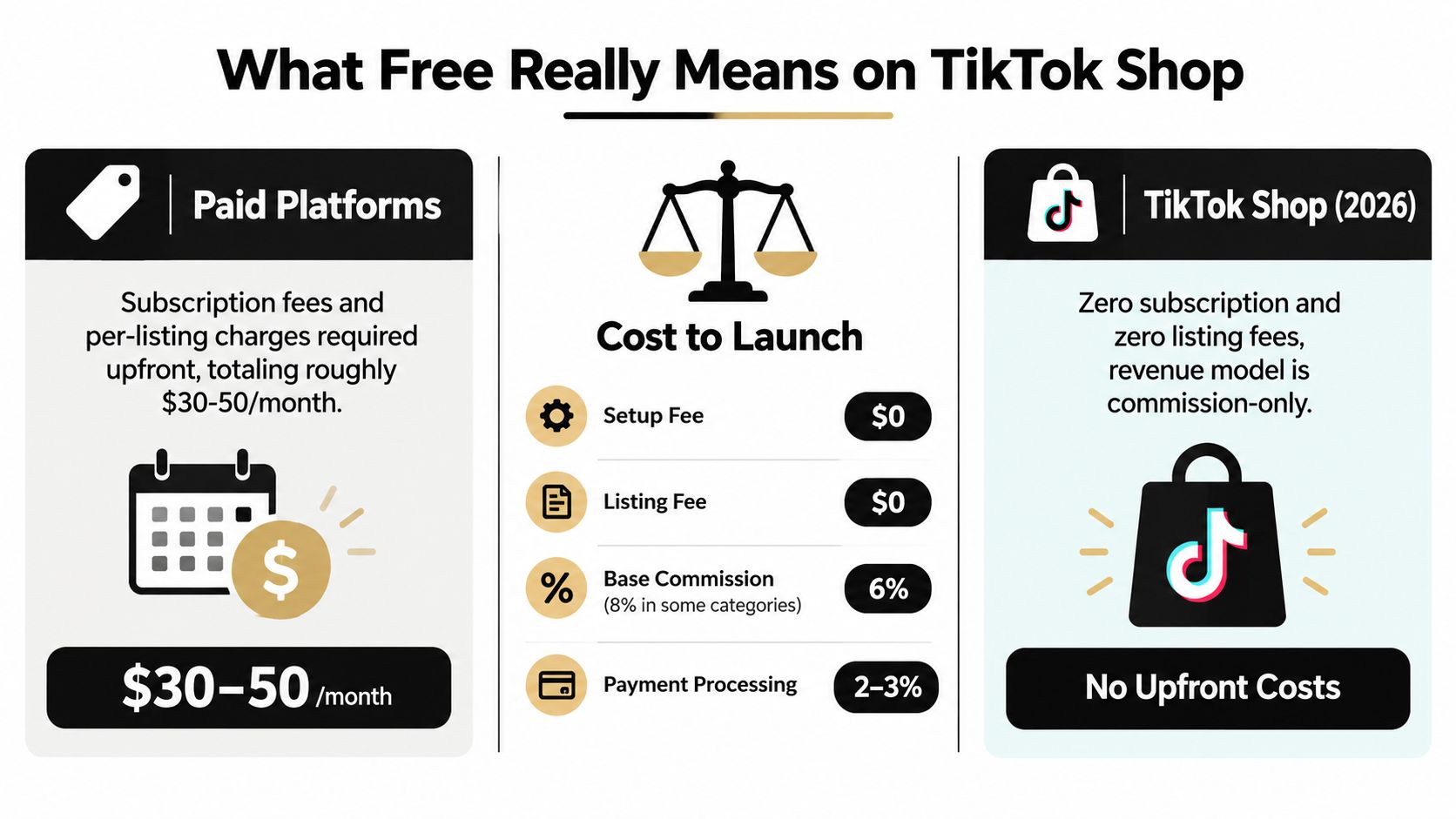
A shop can be open, listed, and attracting orders before you spend on ads. That makes TikTok Shop suitable for a low-capital test, but “free” describes the entry point, not the full operating model. The TikTok Shop Seller Center states there is no setup fee to join. TikTok Shop charges a 6% commission on each sale, so the platform cost arrives when a transaction is completed. The same source says 83% of customers have discovered a new product on TikTok Shop and reports that annual sales growth reached 80% in 2025 compared with 2024.
The cash requirements start as soon as you prepare an order. Inventory, packaging, postage, returns, and working capital all sit outside the setup fee. Creator activity adds another layer. Samples and affiliate commissions are customer-acquisition costs, even when your ad spend is zero.
Separate launch cost from operating cost
Use four cost buckets when assessing a free launch:
- Launch cost: Seller Center registration and initial setup do not require an upfront platform subscription fee.
- Transaction cost: TikTok's commission comes from completed sales, so include it in product pricing and contribution-margin calculations.
- Fulfillment cost: Packaging, labels, postage, returns, and shipping promotions reduce the amount left from each order.
- Demand cost: Organic content consumes time. Affiliate orders consume commission, and creator outreach may require samples.
The TikTok Shop fee breakdown explained helps map platform deductions against your own order costs. I record those deductions in a product-level profit dashboard, alongside product cost, fulfillment, samples, commissions, and refunds. An order with positive revenue can still produce a negative contribution margin.
Use organic reach before paid distribution
TikTok Shop does not require a minimum ad budget for publishing shoppable videos or hosting LIVE sessions. Start with a product that is easy to demonstrate, test several creative angles, and judge content by purchase intent and contribution margin rather than views alone.
Independent reporting estimates that TikTok Shop generated about $64.3 billion in global GMV across 16 active markets in 2025, up 94% year over year. It estimates $15.1 billion from the U.S., up 68% from 2024, with U.S. registered stores reaching 803,500 and more than 2,000 stores exceeding $1 million in annual GMV. Axis Intelligence's TikTok Shop statistics
Those figures show that the model can support scale, not that every product will be profitable. Treat “free” as zero upfront platform setup cost. Organic content can create demand without ad spend, but only margin tracking shows whether the resulting orders are worth fulfilling.
Setting Up Your Shop and Picking the Right Products
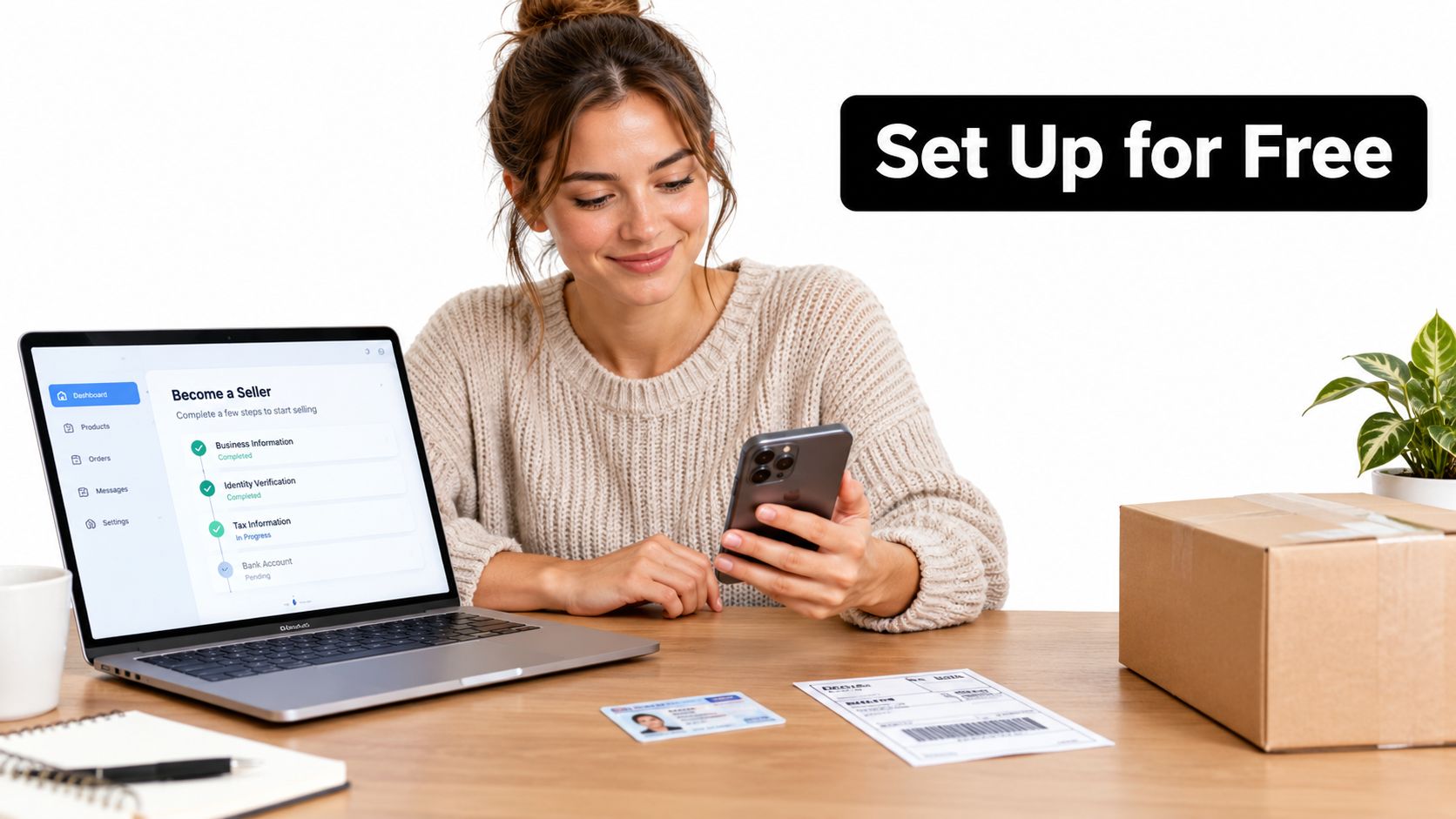
A clean setup prevents avoidable delays later. Begin in Seller Center by selecting the appropriate seller account type, then submit the identity, business, and tax information TikTok requests. Connect the payout bank account only after checking that the legal name and account details match your registration.
Next, add the ship-from address, return address, and shipping template. Don't list a product until you know how it will be packed, weighed, labeled, and handed to the carrier. A product that sells well but can't be dispatched reliably will create customer-service and account-health problems.
Clear approval issues before publishing
TikTok Shop may require extra review for restricted categories, branded goods, health-related products, cosmetics, or items with safety implications. Keep authorization documents, invoices, certifications, and brand permissions available before you upload the catalog.
For a zero-budget launch, choose products with operational simplicity:
- Keep the catalog focused: Start with a hero product or a small group of closely related SKUs, rather than spreading content across an unfocused catalog.
- Favor lighter parcels: Lower shipping weight and compact packaging make it easier to protect margin when you don't have volume discounts.
- Choose demonstrable products: A product that solves a visible problem or changes in use is easier to sell in a short video.
- Reduce variation risk: Too many colors, sizes, or bundles create picking errors and make inventory performance harder to read.
Build listings for both shoppers and operators
Use a descriptive title that identifies the product, its audience, and its main benefit. The first three images should answer basic buying questions quickly, such as what the product looks like in use, what arrives in the package, and how large it is.
Complete every relevant attribute. Enter packed dimensions and weight accurately, and make sure the description reflects the actual item rather than a generic promise. Price from the payout backward. Start with selling price, subtract TikTok's commission, payment costs, expected shipping, packaging, refunds, and any creator expense, then check whether the remainder justifies the work.
A scheduling workflow can help you organize product demonstrations and launches across channels. If you're comparing publishing workflows, Buffer vs PostSyncer offers a useful reference point for thinking about scheduling needs without confusing content planning with profit measurement. For the Seller Center setup sequence itself, use this guide to set up a TikTok Shop for your business.
Building a Free Organic Content Engine
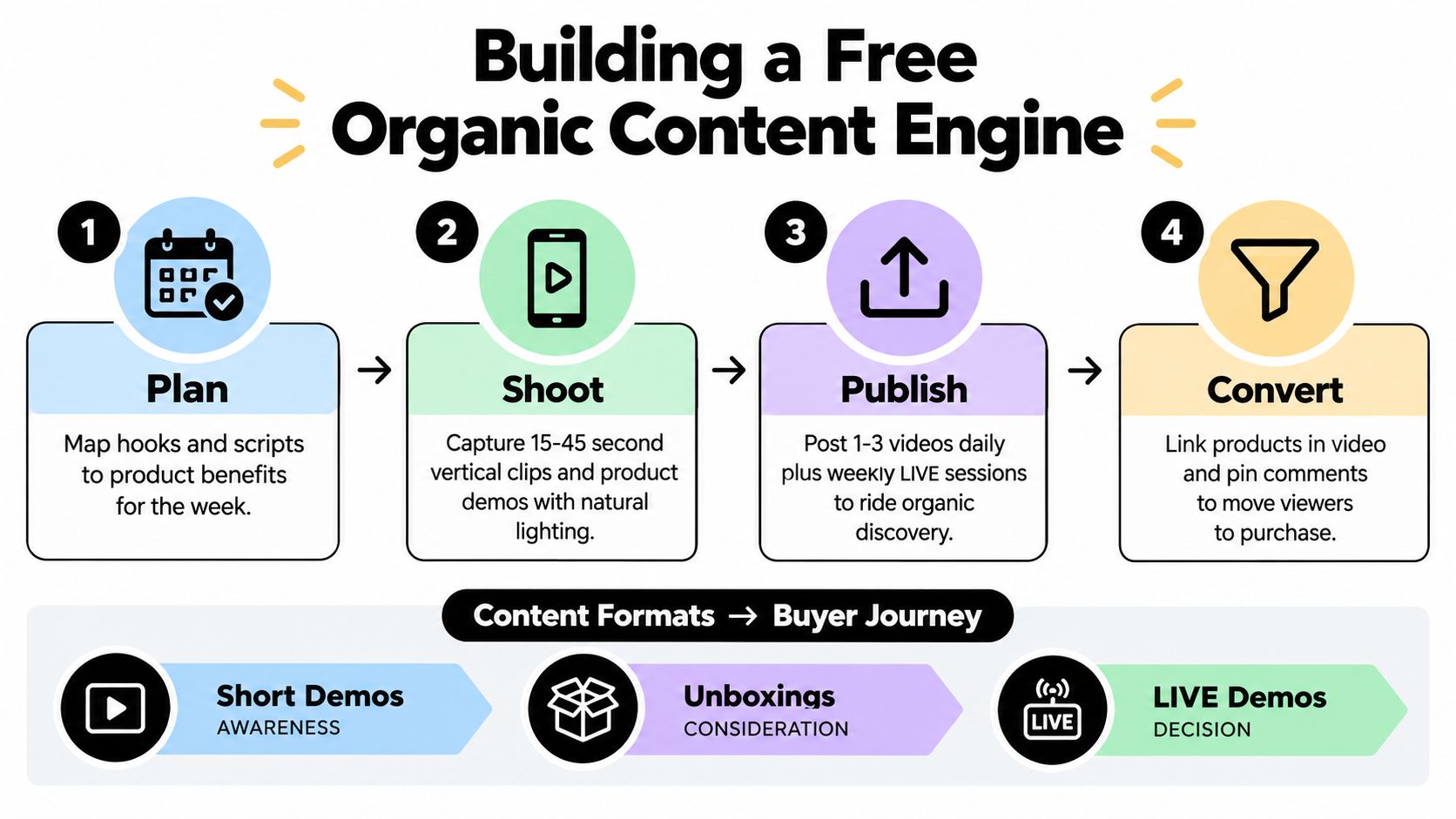
Organic content works when each post has a job. Short demonstrations create awareness, unboxings and comparisons answer consideration questions, and LIVE sessions handle objections while the shopper is deciding. Product tags should appear wherever the viewer can reasonably move from interest to purchase.
The strongest format isn't necessarily the prettiest one. Show the product in use, state the problem in the opening seconds, and make the next step obvious. Put the key benefit in on-screen text because many viewers watch without sound, then use the caption and product tag to reinforce the search intent.
Match the format to the metric
Independent benchmark reporting puts standard affiliate video conversion at 3% to 6%, LIVE shopping conversion at 5% to 12%, and in-app link traffic at 5% to 10%. The same benchmark set places overall TikTok Shop conversion around 3.4%, or between 3.2% and 4.7%, so don't compare a LIVE-only figure with blended shop traffic. TikTok Shop affiliate benchmarks
Category and price change the result. Beauty benchmarks are reported around 5.2% to 6.8%, while products priced above $80 can fall below 1% without substantial retargeting. These figures are directional benchmarks, not promises. Use them to choose what to investigate, then rely on your own product-level conversion and return data.
A practical weekly rhythm looks like this:
- Awareness posts: Show the product solving one specific problem, with a direct hook and a visible result.
- Consideration posts: Answer sizing, materials, setup, compatibility, care, or delivery questions.
- Decision content: Demonstrate the product in LIVE, pin the relevant item, and respond to objections in real time.
- Review content: Recut questions, customer feedback, and common mistakes into fresh posts.
You can use a phone, natural light, a stable surface, and a clear voiceover. If you don't want to appear on camera, these faceless video creation tools from ClipNova can help you explore production formats, but the tool won't replace a strong demonstration or an accurate product claim.
Treat LIVE as a conversion workshop
A LIVE session should have a simple talk track: identify the problem, demonstrate the product, explain who it's for, answer objections, and repeat the product call to action. Pin the item you're discussing instead of asking viewers to search through the whole shop.
Use the questions from one LIVE to create the next batch of short videos. This turns a single session into a source of product education rather than a one-off broadcast.
The organic TikTok Shop growth guide can help you build a repeatable publishing system. The operator's test is simple: keep the formats that generate product clicks and orders, not the ones that merely make the content calendar look busy.
Activating Creators and Affiliates Without Paid Spend
The affiliate marketplace can extend your reach without an upfront media budget, but it isn't free acquisition in the accounting sense. A creator commission is paid when the creator drives a sale, and a sample is an inventory and fulfillment expense whether or not the creator publishes useful content.
Start with a product that already has a clear demonstration. Write a brief that gives the creator one audience problem, a few accurate talking points, the product link, relevant search language, and one required hashtag. Leave room for the creator's own style. Scripts that sound like ads often produce content that viewers skip.
Prioritize fit over volume
Creators can be evaluated in tiers, but follower count should not be the only filter. Review recent content quality, audience relevance, comments, product demonstrations, and evidence that the creator can move viewers from interest to purchase.
| Creator Tier | Follower Range | Typical Commission | Sample-to-Sale Target | Best Use |
|---|---|---|---|---|
| Emerging creator | Smaller, focused audience | Seller-defined and margin-safe | Positive contribution after sample cost | Testing multiple creative angles |
| Established niche creator | Relevant, engaged audience | Seller-defined and tied to product economics | Repeatable sales after sample cost | Conversion-focused demonstrations |
| Larger creator | Broad audience and stronger reach | Seller-defined after profitability review | Contribution margin remains positive | Credibility and selected launches |
Don't send samples indiscriminately. Record the product cost, shipping cost, commission, and resulting sales for every creator. A creator who produces attention but no profitable orders isn't a winner, even if the video looks polished.
Seller Center reporting can help you inspect GMV by creator and identify who contributes revenue. TikTok Shop's seller documentation also notes that earnings analytics covers transactions created after January 1, 2025, which limits long-range comparisons across older activity. TikTok Shop earnings analytics documentation
Margin rule: A free sample is a marketing expense. Approve it from the same P&L logic you use for any other acquisition cost.
Once a creator proves product fit, reuse the winning brief and creative angle. Don't assume every creator deserves the same commission, sample access, or follow-up effort. The TikTok Shop affiliate recruitment guide can support the process, but the final decision should come from profit per shipped sample, not the size of an outreach list.
Fulfillment, Shipping, and the Hidden Costs Behind Free
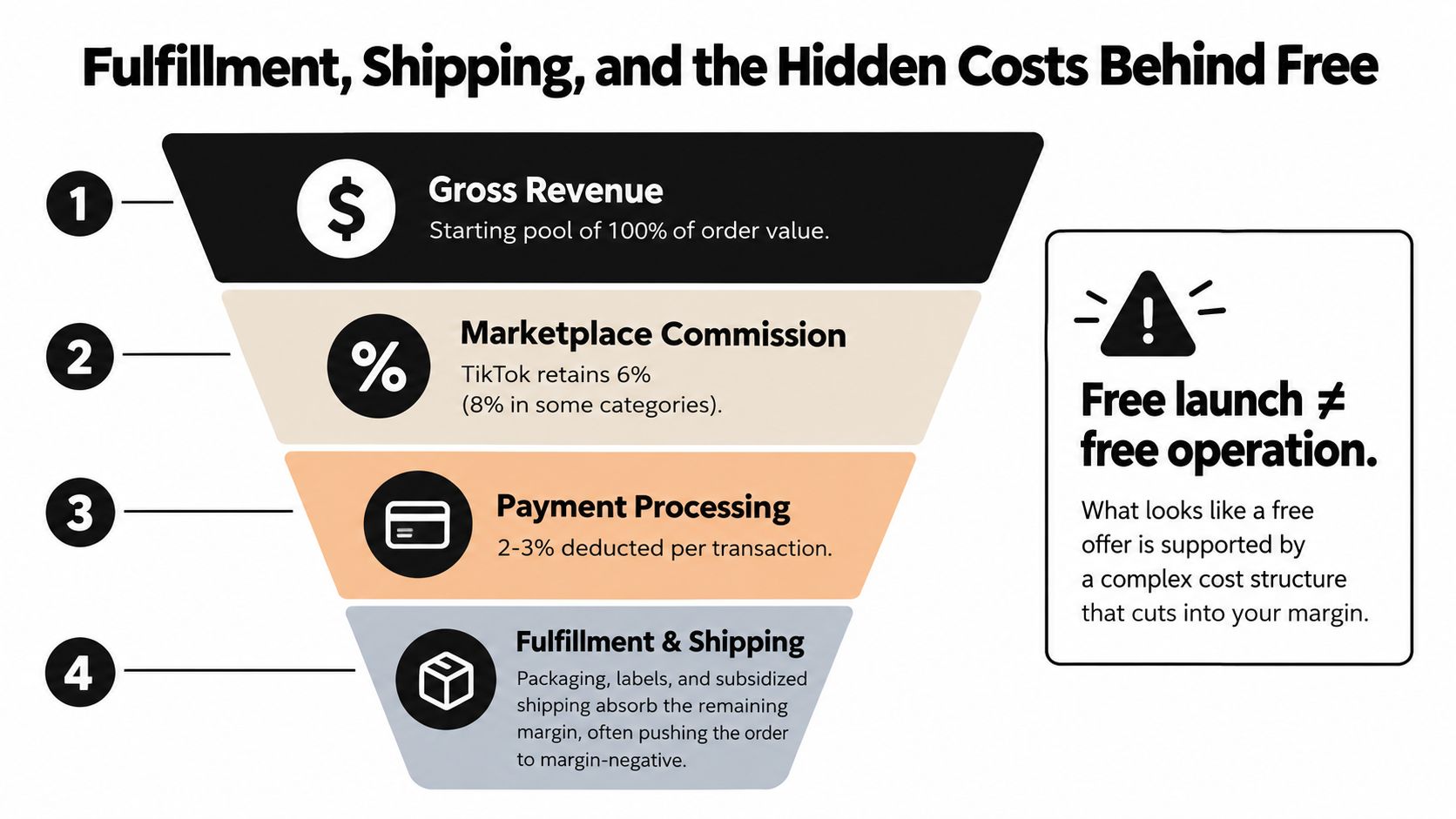
The most common free-launch mistake is pricing from product cost alone. TikTok's commission comes off the order, payment processing affects the payout, and shipping promotions can absorb the remaining margin. Packaging, returns, damaged units, and creator samples make the true cost higher still.
TikTok Shop's U.S. shipping policy says free shipping applies only when the total shipping fee stays within the platform's subsidy cap. The buyer pays any amount above that cap. The seller-facing FAQ also says shops offering free shipping with a threshold of $30 or less receive the same benefits. TikTok Shop U.S. shipping policy
Choose fulfillment by control and complexity
Self-shipping gives you control over packing and inventory, but you must maintain a reliable daily dispatch routine. A fulfillment service can reduce manual work, but storage, inbound handling, and inventory timing need their own margin model. A hybrid approach can make sense when a few proven SKUs deserve faster handling while experimental products remain in-house.
TikTok's fulfillment rules differ by market and method. In the U.S., units fulfilled through TikTok Shop's FBT service can receive free shipping with no minimum order value. In Italy, orders at or above €25 qualify automatically for co-funded free shipping, while sellers can offer free shipping below that amount at their own cost. TikTok Shop fulfillment free-shipping rules
Don't transfer inventory to a managed fulfillment program just because the badge looks attractive. First calculate storage, inbound movement, pick and pack, shipping, returns, and the cost of aged stock. A fast conversion improvement isn't useful if the order-level contribution becomes negative.
Make shipping part of the product decision
Before publishing, calculate the expected payout under at least three scenarios:
- Standard order: Customer pays the normal price and shipping follows your default method.
- Promotional order: A shipping subsidy or discount reduces your realized revenue.
- Return or refund: The item may require reverse logistics, inspection, repacking, or disposal.
If you connect multiple fulfillment systems, handle tracking webhooks carefully so order status and shipment events don't fall out of sync. Missing operational data can make a profitable product look weak, or allow a margin leak to remain hidden.
The free-shipping badge may improve purchase confidence, but it shouldn't be treated as automatically beneficial. Model the full order before you use it, then monitor whether higher conversion compensates for the additional fulfillment expense.
Tracking Profit, GMV, and What Is Actually Working
Every Monday, pull three Seller Center metrics first: GMV, units sold, and average order value. Those numbers describe sales activity, but they don't tell you whether the shop kept money after costs. Add COGS, packaging, shipping, refunds, samples, commissions, and any optional promotion expense in a separate operating view.
The basic SKU formula is:
Net profit = revenue − TikTok commission − payment fee − COGS − shipping − packaging − samples − creator commission
Use the same definitions every week. If one product includes sample costs in the monthly view while another assigns them to the launch week, the comparison becomes unreliable.
Read traffic and conversion together
A SKU with strong product-page visits but weak orders usually has a conversion problem. Review the first image, price, product promise, reviews, shipping offer, and the video's match with the listing. Don't send more traffic to a page that fails to answer basic purchase objections.
A SKU with healthy conversion but little reach has a distribution problem. Create more hooks, publish more demonstrations, invite carefully selected affiliates, or test LIVE. The remedy is different, so don't rewrite a converting product page just because sales volume is low.
A self-serve profit dashboard should show shop-level and product-level performance in one place. HiveHQ's TikTok Shop profit dashboard is designed to surface real-time net profit, product performance, and customer analytics so sellers can compare GMV with the costs that Seller Center doesn't present as one contribution-margin view.
Use a weekly decision tree
- Positive margin and rising conversion: Keep the SKU, document the winning creative, and increase distribution carefully.
- Positive traffic but weak conversion: Fix the listing and content promise before adding samples or creator commissions.
- Strong conversion but weak reach: Produce more content and test additional organic surfaces.
- Negative contribution margin: Reprice, reduce fulfillment cost, change the offer, or stop promoting the SKU.
- Unclear result: Keep collecting clean data, but set a decision date so uncertainty doesn't become indefinite spend.
GMV Max is now TikTok Shop's default and only supported campaign type for TikTok Shop Ads from July 2025. TikTok says Product GMV Max can attribute relevant conversions in Seller Center, including organic content and affiliate orders, so paid and unpaid activity should be reviewed against the same profit logic. TikTok's GMV Max migration guidance
Your 30/60/90 Free TikTok Shop Plan and Next Steps
The free path works best as a controlled sequence, not as a race to fill the catalog. Start with a narrow product range, publish enough variations to learn which message earns clicks, and connect every decision to contribution margin.
First phase
Complete Seller Center verification, connect payouts, configure shipping, and publish a small group of hero SKUs. Build a bank of demonstrations before you need them, then start organic videos that show the product in use.
Host initial LIVE sessions once you have enough questions and objections to answer naturally. Invite a limited group of relevant creators rather than sending samples to everyone who requests one. Log each sample and its outcome from the start.
Second phase
Increase the consistency of your content only after you know which formats attract product intent. Keep the best hooks, remove weak SKUs from active promotion, and revisit pricing when shipping or commission costs leave too little room.
Review creator performance by GMV, shipped samples, commission, returns, and net contribution. A creator who generates orders at a loss shouldn't stay active because the order count looks encouraging.
Third phase
Set a recurring LIVE schedule, retain affiliates who produce profitable sales, and cut products with negative contribution margin. Consider a fulfillment change only when the operational data shows that the additional service will reduce cost or improve delivery enough to justify its fees.
The operating anchor remains the same throughout: net profit by product, channel, and customer outcome. The free entry model is real, but the margin can be thin. Sellers who measure only views or GMV can mistake activity for progress, while sellers who track the complete order economics can decide what to keep, fix, or stop.
Frequently Asked Questions
Can you really sell on TikTok Shop without an upfront fee?
Yes. TikTok Shop's Seller Center says there's no setup fee to join, and the platform charges a commission on completed sales rather than an upfront subscription cost. You still need to cover inventory, fulfillment, shipping, payment processing, samples, and returns.
Do you need ads to get TikTok Shop sales?
No. Organic videos and LIVE sessions can generate discovery without an ad budget. Paid distribution is optional, and it should be considered only after you know that the product and creative can produce acceptable contribution margin.
Is affiliate selling free?
No. Affiliate selling avoids an upfront media purchase, but commissions are paid on attributed sales and samples create additional costs. Measure each creator by profit after commission, sample, fulfillment, and refund costs.
What should you track first?
Start with GMV, units sold, and average order value from Seller Center. Then add COGS, TikTok commission, payment costs, shipping, packaging, samples, creator commissions, and refunds to calculate net profit by SKU.
What should you do with a product that gets views but no orders?
Treat it as a conversion investigation. Check the product promise, first three seconds, listing images, price, shipping terms, reviews, and product-page clarity before you spend more on reach.
Try the HiveHQ Profit Dashboard to monitor real-time net profit, product-level performance, and customer analytics instead of relying on GMV alone. Visit HiveHQ and talk to the HiveHQ team about building a practical profit-tracking workflow for your TikTok Shop.