Influencer briefing template: Skyrocket TikTok collaborations
influencer briefing templatetiktok shop guidecreator collaborationinfluencer marketingaffiliate marketing
An influencer briefing template is really just a roadmap for your campaign. It's a single, clear document that lays out all the critical details for a creator, making sure everyone is on the same page about goals, what needs to be made, and the core message. Think of it as your single source of truth—it kills miscommunication before it starts and ensures your brand’s vision comes to life perfectly on TikTok Shop. Honestly, this simple tool is the backbone of any influencer marketing program that’s built to scale.
Why a Strong Brief Is Your TikTok Shop Growth Engine
Let’s be real for a second. A vague, slapped-together influencer brief is a one-way ticket to a failed campaign. It’s how you end up with wasted product samples, disappointing sales, and content that just doesn't hit the mark. Before we even get into the template, it’s vital to understand why a thoughtfully crafted brief isn't just nice to have—it's your most powerful tool for driving real results on TikTok Shop.
Think of it like an architect's blueprint. You wouldn't build a house without one, right? Sending a product out without a brief is basically asking a creator to read your mind, and that almost always leads to frustrating and costly mistakes.
Preventing Costly Miscommunication
Picture this: you ship your amazing new skincare product to a creator with a quick note saying, "Would love a TikTok on this!" What you might get back is a beautifully shot video… focusing entirely on your slick packaging. They might completely miss the key ingredients that solve a huge problem for your customers. Even worse? They could forget to add the product anchor link, which makes the whole video a complete zero for driving sales.
A solid brief stops these blunders in their tracks by being crystal clear.
Here's a quick look at the core elements that turn a simple request into a powerful, sales-driving campaign directive.
Anatomy of a High-Converting Influencer Brief
| Component | Why It Matters for TikTok Shop |
|---|---|
| Clear Goals & KPIs | Creators need to know if the goal is brand awareness, direct sales, or something else. It shapes their entire creative approach. |
| Product Talking Points | You know your product best. Give them the 2-3 key features or benefits that resonate most with customers. |
| Mandatory Do's & Don'ts | This is where you specify things like "must show the product in the first 3 seconds" or "do not mention competitor brands." |
| Call to Action (CTA) | Explicitly tell them what to say: "Tap the orange shopping cart to buy now!" This is non-negotiable for sales. |
| Content & Deliverables | Spell out exactly what you need: one 15-second TikTok video, two Stories, etc. No room for interpretation. |
These details aren't about micromanaging; they're about aiming a creator's talent directly at your business goals. It turns a partnership from a shot in the dark into a reliable revenue stream.
The Foundation of a Scalable System
Once you start working with more creators, trying to manage dozens of conversations without a standard process is pure chaos. An influencer briefing template is the bedrock of that system. In the wild world of the creator economy, consistency is everything. The global influencer market is expected to hit $32.55 billion by 2025, and a recent report shows 73.2% of brands are already working with ten or more influencers at a time. A template is the only way to manage that kind of volume without losing your mind.
By treating your brief as a core operational asset, you create a repeatable engine for growth. Each campaign builds on the last, refining what works and eliminating what doesn't.
This systematic approach is what separates the brands just dabbling in influencer marketing from the ones seeing massive growth. It ensures every creator, whether they have 5,000 followers or 500,000, knows exactly how they fit into your marketing machine. You can see how this plays into the bigger picture in our guide to finding the right TikTok Shop influencers for your brand.
At the end of the day, a strong brief is so much more than a document—it's your command center for driving measurable results on TikTok Shop.
Breaking Down the Influencer Briefing Template
A great influencer brief is so much more than a list of instructions—it's your campaign's strategic backbone. It's what elevates a simple collaboration into a predictable, performance-driven partnership. Let's get past the generic advice and really tear down the critical parts of a brief that works for TikTok Shop, turning it from a static document into your campaign's command center.
Every section in the template has a job to do. Each one is designed to kill ambiguity and give creators the clarity they need to produce their best, most authentic work while still smashing your commercial goals. Think of it as giving them the best ingredients and a proven recipe but letting them work their magic as the chef.
Campaign Goals and Core Messaging
This is your campaign’s “why.” A creator can't produce killer content if they don't know what you're actually trying to do. Is the main goal to drive immediate sales, measured by Gross Merchandise Value (GMV)? Or is it to stock up on authentic User-Generated Content (UGC) that you can slice and dice for your own ads later?
You have to be explicit. Instead of a vague goal like "increase brand awareness," get specific: "generate 50 pieces of high-quality UGC showing how easy our product is to use." That kind of clarity instantly shapes the creator’s entire creative process.
Next, you need to boil down your core message into a few powerful talking points. These aren't scripts to be read word-for-word; they're conversation starters.
- Feature 1: Our serum has Hyaluronic Acid for instant hydration.
- Benefit 1: It leaves your skin feeling plump and dewy, never sticky.
- Problem it Solves: It gets rid of those annoying dry patches under makeup.
Giving them these clear, benefit-focused points makes sure they hit on what actually matters to your customers. It's the difference between them saying "this has a cool ingredient" and "this is why your makeup will look incredible all day."
A well-defined goal is the North Star of your campaign. It guides every decision the creator makes, from their video's hook to their final call to action, ensuring their creative energy is pointed directly at your desired outcome.
This is also the spot to inject your brand's personality. Drop in a link to a few past campaigns you loved or a mood board that captures your vibe. This gives the creator crucial context to align their style with yours without feeling like you're micromanaging. And if you're just starting your search, our guide on how to find content creators is a great place to find partners who are a natural fit right from the get-go.
Content Deliverables and Technical Specs
Okay, this is the "what" and "how" of your brief. From my experience, vagueness here is the number one reason campaigns go off the rails. You need to be almost surgically precise with your expectations to avoid those back-and-forth emails that waste everyone's time and money.
Don't just ask for "a TikTok video." Spell it all out.
- Quantity and Format: Be crystal clear. For example: one in-feed TikTok video and two Instagram Stories.
- Video Length: Give them a target range. 30-45 seconds is often the sweet spot for engagement on the platform.
- Product Integration: Lay out the ground rules, like "the product must be clearly visible within the first 3 seconds" or "show yourself actually using the product as intended."
- Call to Action (CTA): This is non-negotiable. Tell them exactly what to say and do. A great example is, "Tap the orange shopping cart button in this video to shop now!"
A solid brief also has to cover the technical stuff. You need to make sure the content is compliant and looks great on the platform. Bookmark this complete guide to TikTok video ad specs for all the details on resolution, aspect ratio, and file size. Tossing those specs into your brief saves you from getting a video you can't even use.
This section is also the place to outline the full timeline, including a deadline for draft reviews (if you require them) and the final go-live date. A clear schedule helps creators plan their work and makes sure your campaign launches right on schedule.
Mandatories and Creative Freedom
This is where the real art of the brief comes in: balancing brand safety with creative authenticity. It’s a delicate dance, but a crucial one. Your goal is to set clear guardrails, not build a creative prison. I've found the best way to do this is to split your guidelines into two simple categories: Mandatories and Creative Suggestions.
Mandatories (The "Must-Do's"): These are your absolute, non-negotiable rules of the road.
- Hashtags: Provide a mix of campaign-specific tags (
#YourBrandChallenge), broader tags (#TikTokMadeMeBuyIt), and legally required disclosures (#Ad,#Sponsored). - Mentions and Tags: Specify the exact handle (
@YourBrand) that must be tagged in both the caption and the video itself. - Product Links: This is critical. Emphasize that the correct TikTok Shop product anchor link must be attached to the video so you can track sales.
- Restrictions: List your "don'ts" clearly. No profanity, no showing competitor products, no making unverified medical claims.
Creative Suggestions (The "Nice-to-Have's"): This is where you get to inspire them, not instruct them.
- Point them toward popular TikTok trends they could jump on.
- Share a mood board with visual styles you're loving right now.
- Encourage them to weave in a personal story related to the product.
By clearly separating these two, you give creators the confidence to get creative within a framework that you know works. You're protecting your brand while empowering them to make the kind of native, high-performing content their audience came to see. This approach builds a much more collaborative and respectful partnership, and trust me, that almost always leads to better results.
Adapting Your Brief for Different Campaign Goals
One of the biggest mistakes brands make is sending out the same generic brief for every single campaign. Your master template is a great starting point, but its real value is in how you adapt it. A campaign built to generate authentic, user-generated content (UGC) needs a totally different touch than a high-stakes livestream shopping event.
That one-size-fits-all approach is a recipe for misaligned expectations and disappointing results. To really kill it on TikTok Shop, you have to tailor your brief to the specific goal. This means tweaking everything from the main objective and deliverables to the payment structure and creative guardrails.
Let's walk through how to pivot your master template for three of the most common TikTok Shop campaigns. I'll give you concrete examples for a product unboxing, a livestream, and an affiliate promotion, showing you the exact changes that make each brief work.
Sample Brief for a Product Unboxing and UGC Campaign
The whole point here is to get a library of authentic, relatable content you can chop up and use for your own ads, website, and social feeds. You're basically trading your product for genuine reactions and high-quality visual assets.
The brief needs to give the creator enough freedom to be themselves while still guiding them toward producing content you can actually use. This isn't about driving immediate sales; it's about capturing real excitement on camera.
Strategic Adjustments to the Brief:
- Campaign Goal: Forget about sales targets for now. The goal is much clearer: "Generate 5 high-quality, repurposable video assets showcasing an authentic unboxing experience and first impressions of the product."
- Deliverables: Get specific about what you need. Ask for one 30-60 second polished TikTok video that clearly shows the packaging, the unboxing, and the product in use. Crucially, add a requirement for 3-5 raw, unedited video clips to be sent separately for your own use.
- Compensation: This is usually a product-seeding or "gifting" campaign. Be upfront about it: "Compensation is the gifted product (Retail Value: $X). In exchange, we request full usage rights to repurpose your content on our paid and organic marketing channels for 12 months."
- Creative Guidance: Ditch the strict scripts. Instead, offer "story prompts" to get their creative juices flowing. Something like, "We want to see your genuine first reaction! What's the first thing you notice? How does it feel? Capture the real moment of discovery."
This kind of brief encourages the creator to produce that raw, unscripted gold that works so well in paid ads, all while making sure you get the assets you paid for (with product).
Sample Brief for a Livestream Shopping Event
A livestream brief is a different beast entirely. Here, the objective is singular and intense: drive as many sales as possible in a short window. You need absolute clarity, high energy, and a rock-solid call to action. There’s no room for ambiguity—this is all about structure and preparation.
Think of this brief as a run-of-show document. It guides the creator through every key moment of the live event to keep viewers hooked and clicking "buy."
Key Changes for a Livestream Brief:
- Campaign Goal: Be direct and make it measurable. "Drive a minimum of $2,500 in GMV during the 60-minute livestream event and achieve an average watch time of 3 minutes."
- Deliverables: This is more than just telling them to go live.
- Promo Content: Require 2 pre-live TikTok videos to build hype, announcing the date, time, and any exclusive deals.
- Run-of-Show: Give them a timed outline. Include when to introduce certain products, when to drop flash sales, and when to pause to answer viewer questions.
- Post-Live: Specify that the recording must be saved and available for 24 hours after the event wraps.
- Compensation: The payment structure has to motivate sales. A hybrid model works best: "You'll receive a flat fee of $500 for hosting the 60-minute livestream, plus a 20% commission on all sales from your link during the live event and for 24 hours after."
- Mandatories: This is where you can be firm. "The exclusive discount code 'LIVE25' must be mentioned at least 5 times. The top 3 bestselling products must be showcased within the first 15 minutes."
This structured approach makes sure the creator is fully prepared to handle the pressure of live selling and gives them a powerful incentive to turn viewers into customers.
Sample Brief for an Affiliate Promotion
This brief is all about starting a long-term, performance-based partnership. The goal is to generate consistent, evergreen sales from a creator who genuinely loves your product. You're shifting from a one-off campaign mindset to building a lasting relationship.
Your brief essentially becomes the foundational agreement for this partnership. As more operators move to TikTok Shop, clear briefs like these are what unlock viral potential. With 47% of brands raising their influencer budgets, having a structured workflow is non-negotiable. We're also seeing that AI-enhanced briefs are used in 66.4% of campaigns to sharpen outcomes—a critical tactic for founders managing serious revenue. You can dig into more of these influencer marketing statistics to see how they’re shaping successful campaigns.
Crafting the Affiliate Brief:
- Campaign Goal: Frame it as a true partnership. "Establish a long-term affiliate partnership to generate consistent monthly sales. Our initial goal is to hit $1,000 in attributed GMV within the first 30 days."
- Deliverables: This is about sustained effort, not just one post. "Create at least 2 organic TikTok videos per month that naturally feature the product. Your unique affiliate link should be permanently included in your profile bio."
- Compensation: To truly align your incentives, this should be purely performance-based. "This is a commission-only partnership. You'll earn a 25% commission on all sales tracked through your unique affiliate link, with a 30-day cookie window. Payouts are processed monthly."
By adapting your brief for each specific goal, you move from simply "doing influencer marketing" to strategically engineering predictable outcomes. The document becomes a tool for precision, not just communication.
This approach gives the creator the flexibility they need for authentic content while creating a clear, motivating structure for an ongoing sales relationship. It shows you respect their role as a long-term brand advocate.
Defining Compensation and Measuring Success
A great influencer brief does more than just outline creative ideas. It's your negotiation blueprint and your performance tracker, all rolled into one. This is where you shift from the creative vision to the commercial reality, clearly defining what’s in it for both you and the creator.
Getting this part right from the start is crucial. It saves you from awkward conversations down the line and makes sure everyone is working towards the same goal: making the campaign a massive success.
Structuring Fair and Motivating Compensation
There’s nothing that sours a creator relationship faster than confusion about payment. Your brief needs to lay out the compensation structure with total transparency. When a creator knows exactly how and when they'll be paid, it builds trust and shows them you're a professional, organized partner they want to work with.
The right payment model really depends on what you're trying to achieve. A one-off product review is going to look very different from a long-term affiliate partnership.
Here are the most common models we see for TikTok Shop:
- Flat Fee: This is a simple, fixed payment for a specific set of deliverables. It’s a great option for brand awareness campaigns where your main goal is getting eyeballs on your product, not necessarily driving direct sales.
- Commission-Based: The creator earns a percentage of every sale made through their unique affiliate link or code. This is the heart and soul of most affiliate programs because it perfectly aligns their motivation with your goal of driving GMV.
- Product Seeding (Gifting): You send the creator free products in exchange for content. This usually works best with nano-influencers or when your primary goal is generating user-generated content (UGC). Just make sure the value of the product is fair for the work you're asking for.
- Hybrid Model: A fantastic approach that combines a smaller flat fee with a commission. We see this work wonders for livestreams because it guarantees the creator is compensated for their time while giving them a powerful incentive to drive sales during the event.
Pro Tip: Don't just present the payment as a number. Frame it as a true partnership. Language like, "We want to reward you directly for the sales you drive," makes the relationship feel collaborative, not just transactional.
Setting Clear KPIs to Measure Performance
Once you've settled on compensation, you need to connect it to real, measurable results. Without clear Key Performance Indicators (KPIs), you're just throwing money into the wind and hoping for the best. Your brief must state exactly how you'll be measuring the campaign's success.
On TikTok Shop, it's all about metrics that directly impact your sales.
Essential TikTok Shop KPIs to Include:
- Gross Merchandise Value (GMV): This is the big one. It's the total sales value generated from the creator's content. For any sales-focused campaign, GMV is your north star.
- Click-Through Rate (CTR): The percentage of people who watched the video and actually clicked the product link. A high CTR tells you the creator's call-to-action was compelling.
- Conversion Rate: The percentage of those clicks that turned into a purchase. This is a powerful indicator of the quality of the traffic the creator is sending your way.
- Cost Per Acquisition (CPA): How much did it cost you (in fees, product, etc.) to get each new customer? This helps you understand the true efficiency of your spend.
Defining these KPIs upfront allows you to set realistic targets and judge performance objectively. If you want to get even more granular, a Tiktok Profile Metrics Scraper can provide incredibly valuable data for benchmarking and analysis.
TikTok Shop KPI Benchmarks for Creator Campaigns
Not sure what "good" looks like? Use this guide to set realistic performance goals for your influencer collaborations based on current industry averages.
| Metric | Good Starting Point | Excellent Performance |
|---|---|---|
| Gross Merchandise Value (GMV) | $500 - $1,500 per video | $3,000+ per video |
| Click-Through Rate (CTR) | 1% - 2% | 3%+ |
| Conversion Rate | 2% - 4% | 5%+ |
| Cost Per Acquisition (CPA) | < $25 | < $15 |
These numbers can vary based on your product price and niche, but they provide a solid baseline for what you should be aiming for.
As the creator economy races towards $500 billion by 2027, the influencer brief has become the operational core for any brand serious about profitability. It’s what allows you to track results, automate outreach, and filter through thousands of potential affiliates.
We're already seeing that using AI and automation can slash campaign management costs, while simple automated reminders can boost content completion rates by up to 30%. It's this kind of efficiency that fuels consistent growth.
Ultimately, the data you gather from one campaign should directly inform the brief for the next one. This creates a powerful feedback loop, making every collaboration more effective and profitable than the last.
Bringing Automation to Your Briefing and Follow-Up Game
Nailing the perfect influencer brief is a huge step, but let's be honest—it's only half the battle. The real headache starts when you're juggling dozens of creators. You're stuck manually sending out briefs, tracking product shipments, and endlessly chasing down content that's running late. That manual grind is exactly where campaigns slow down and profits start to slip.
If you're serious about scaling your TikTok Shop efforts, you have to get that briefing process out of a static document and into an automated system. It needs to become part of a well-oiled machine that works for you.
From Manual To-Do Lists to an Automated Workflow
The dream is to get rid of the repetitive tasks that eat up your day. Think about it: a creator gets approved, a product sample goes out, and your perfectly crafted brief lands in their inbox, all without you having to click a single button. This isn't some far-off fantasy; it's completely possible with the right setup.
A smooth, automated process makes sure every step, from the initial brief to the final campaign report, is connected and driving toward profitability.
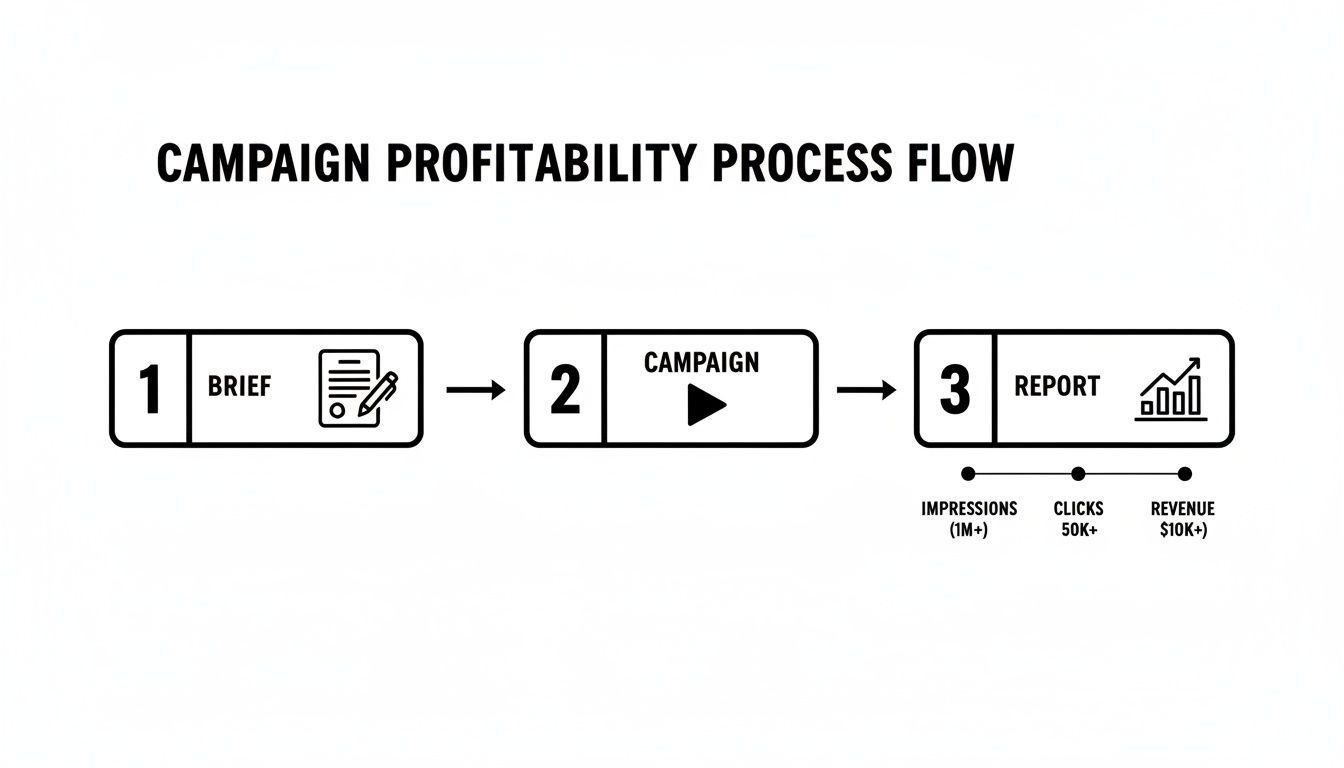
As you can see, the brief is the critical first move that sets the stage for a profitable campaign, leading directly into execution and, finally, measurable results.
Tools built specifically for TikTok Shop, like HiveHQ, have this logic baked right in. For example, their Affiliate Bot can be set up with Smart Follow-Up sequences that handle the busywork for you.
- Trigger 1 (Sample Shipped): The moment the system sees a shipping update, it can automatically fire off your pre-loaded brief to the creator.
- Trigger 2 (Deadline Nearing): If the content is due in 48 hours and nothing has been posted, a friendly, automated reminder gets sent.
- Trigger 3 (Campaign Wrap-Up): Once it's all over, you can automatically send a thank-you note that even includes some of their performance highlights.
By automating these key touchpoints, you’re not just saving time—you’re ensuring consistent communication and on-time content across your entire network. It’s how you run a tight, professional operation and get hours back in your week.
Keeping an Eye on Deliverables and Compliance
Automation also acts as your safety net. An automated system doesn't just send messages; it can actively monitor for deliverables based on the timeline you set in your brief. Instead of you having to stalk creator profiles every single day, a Creator Tracker brings all that information into one place, flagging who has posted and who's falling behind.
Having a central dashboard gives you a complete, at-a-glance view of your entire program. It turns what was once a mess of scattered data into clear, actionable insights you can use to make your partnerships even better.
This is the kind of operational efficiency that separates brands struggling with 10 creators from those who can scale to 100 or more without breaking a sweat. It ensures every dollar is tracked and every piece of content is accounted for, tying your briefing efforts directly to your bottom line. And if you want to polish your initial outreach, check out our guide on influencer outreach email templates.
Common Questions About Influencer Briefs
Even with the best template in hand, you're going to have questions. It’s totally normal. Nailing these details is often the difference between a campaign that sings and one that causes a massive headache. Let's walk through a few of the most common questions we see from brands getting started with TikTok Shop creators.
Getting these things straight from the get-go builds a foundation of trust and makes for a much smoother partnership.
How Much Creative Freedom Should I Give Influencers?
This is the big one, isn't it? The magic lies in finding the sweet spot between firm "Mandatories" and flexible "Guidelines." Think of it this way: your brief sets the destination (the campaign goal), but you need to let the creator drive the car.
For example, a solid mandatory would be, "You must mention these three key product features." A flexible guideline would be, "We'll let you decide how to weave those points into your personal story."
I’ve seen it happen time and time again: overly restrictive briefs lead to stiff, robotic content that TikTok audiences can spot a mile away. You're hiring them for their voice and connection to their audience—trust them to use it.
This approach ensures you get what you need for brand safety while letting them create the kind of authentic content that actually works.
What Is the Most Common Mistake in a Brief?
Hands down, the biggest (and most expensive) mistake I see is being vague. Ambiguity, especially around deliverables and content usage rights, is a recipe for disaster. Just writing "post one video" is asking for trouble.
A truly effective brief leaves no room for doubt. It clearly states:
- The platform: TikTok
- The format: In-feed video
- The duration: 30-45 seconds
- The call-to-action: "Tap the orange shopping cart to buy!"
And don't forget usage rights! If you fail to clearly state something like, "Brand may use the content in paid ads on Meta platforms for 90 days," you could be facing some serious legal and financial pain down the road. Be explicit. It protects you and the creator.
Should I Use the Same Brief for All Influencers?
Yes and no. You should absolutely start with the same core template—that keeps your program consistent. But you must tailor the specifics to who you're working with. A brief for a nano-influencer might need to be a bit more educational, with extra guidance on how to use TikTok Shop links, and the compensation will likely be product-based.
When you're dealing with a macro-influencer, that brief becomes more of a collaborative jumping-off point. Their agent will be involved, and everything from deliverables to compensation and usage rights will be part of a bigger negotiation. The foundation is the same, but the details change with the scale of the partnership.
Ready to stop the manual grind and scale your creator program? The HiveHQ Affiliate Bot automates your entire briefing and follow-up process, from sending briefs when samples ship to reminding creators when content is due. See how HiveHQ can streamline your TikTok Shop growth.