Mastering TikTok Shop: managing affiliate programs for Modern Sellers
managing affiliate programstiktok shop affiliatecreator marketingecommerce growthinfluencer management
Running a successful affiliate program is more than just throwing money at creators and hoping for the best. It's about designing a profitable system from the ground up, finding the right partners, and obsessively tracking your data. This is how you build a scalable growth engine instead of just another marketing expense.
Designing Your Profitable Affiliate Program Blueprint
Before you even think about reaching out to your first creator, you need a solid game plan. A well-thought-out affiliate program is what separates a profitable channel from a costly experiment. This isn't just about picking a commission rate; it's about reverse-engineering your entire program for success from day one.
First things first, you have to know your numbers cold. Get granular with your Cost of Goods Sold (COGS), shipping, packaging, and any other variable costs. If you don't have these figures locked down, setting a commission rate is just a shot in the dark. A rate that feels competitive could easily be wiping out your entire profit margin on every sale.
Defining Your Ideal Creator Persona
It's time to stop chasing vanity metrics. Forget follower count for a minute and focus on what actually moves the needle: audience alignment and genuine engagement. A creator with 10,000 hyper-engaged followers who perfectly match your ideal customer is far more valuable than someone with 100,000 followers who couldn't care less about your product.
Your ideal creator persona should be a detailed profile covering:
- Audience Demographics: Are their followers the right age, in the right location, and interested in the problems your product solves?
- Content Style: Does their vibe—whether it's authentic product reviews, funny skits, or polished tutorials—mesh with your brand's voice?
- Engagement Quality: Dive into their comments section. Is it full of real conversations and questions, or just spammy emojis? Quality engagement is a sign of a loyal, trusting community.
- Niche Relevance: An influencer specializing in sustainable fashion is a natural fit for an eco-friendly skincare brand. A general lifestyle creator? Not so much.
I see so many brands make the mistake of chasing the biggest names right away. A much smarter move is to build a strong foundation with micro-influencers (those with 10k-100k followers). Their audiences often have incredible trust, leading to partnerships that deliver a much higher return on your investment.
Structuring Commissions for Mutual Success
The commission you offer is the core incentive that gets creators excited. A simple flat percentage is the most common approach, but it’s rarely the most effective. Getting a bit more creative here can really motivate performance while protecting your bottom line.
A tiered commission structure, for example, can work wonders. You could start everyone at a standard 10% commission, but bump it up to 15% for creators who drive over $5,000 in monthly sales. For your top-tier partners who break $10,000? Reward them with 20%. This simple structure gamifies the process and gives everyone a clear reason to push harder for your brand.
Another powerful strategy is a hybrid model. This could look like a slightly lower base commission paired with a flat fee per video, or maybe a bonus for hitting specific goals, like a target conversion rate. This gives creators more predictable income upfront, which they love, while still tying the bulk of their earnings directly to the sales they generate for you. This kind of strategic framework is crucial for building affiliate programs that are both attractive to creators and financially sustainable for your business.
Scaling Creator Discovery and Automated Outreach
Let's be real: endlessly scrolling through TikTok for the right creators is a one-way ticket to burnout. While doing things by hand might work when you're just getting started, it's a model that simply can't scale.
To truly grow your affiliate program, you need to build a predictable engine for finding and recruiting partners. This is how you turn a time-sucking chore into a repeatable system. The goal isn’t to blast generic DMs to hundreds of creators; it’s about automating personalized outreach that feels one-on-one but operates at a much larger scale. When you nail this, you’ll have a steady pipeline of high-quality affiliates lining up to join.
Building Your Creator Sourcing Engine
First things first, you need to define your filtering criteria. Before you even think about looking at a single tool, you have to know exactly who you're looking for. Go back to that ideal creator persona you developed and translate those traits into searchable metrics.
Start with these filters:
- Niche and Keywords: Look for creators who are already using specific hashtags or keywords related to your product, like #skincarehacks or #ketorecipes.
- Follower Count Range: Don't just chase the big names. Setting ranges helps you find micro-influencers (10k-100k followers) who often have way better engagement.
- Audience Demographics: Filter by location (e.g., US-based creators), age, and gender to make sure their audience is actually your target customer.
- Engagement Rate: A huge follower count means nothing if the community is dead. I always recommend aiming for creators with engagement rates above 2-3%.
I see so many brands get hung up on follower counts, but the real gold is in audience alignment and authenticity. A creator with 15,000 deeply engaged followers in your niche will almost always outperform one with 200,000 generic followers. Think of it as fishing with a spear instead of a giant, indiscriminate net.
Platforms built for affiliate program management can automate this entire discovery process. If you want to explore different ways to find talent, we've got a whole guide on how to find influencers for your brand.
Automating Outreach Without Losing the Human Touch
Once you have a solid list of potential partners, the outreach begins. Sending DMs one by one is slow, painful, and nearly impossible to track. Instead, you can use automation tools to send out personalized sequences that actually get responses.
A good outreach message is never just a copy-paste template. It has to show you've actually looked at their content.
Here’s a simple structure I’ve seen work time and time again:
- Personalized Opener: Mention a specific recent video of theirs that you genuinely enjoyed.
- Quick Intro: Briefly introduce your brand and what you sell.
- Clear Value Prop: Tell them what’s in it for them. For example, "We offer a 15% commission and free products."
- Simple Call to Action: End with an easy, low-commitment question like, "Would you be open to hearing more?"
This approach respects the creator's time and instantly proves you're not just another spammy brand filling their inbox. For a more comprehensive look at engaging partners, this modern influencer marketing guide is a great resource.
The real magic, though, is in automating the follow-ups. If a creator doesn’t reply to your first message, a system can send a polite nudge a few days later. This one simple step can dramatically increase your response rate without you lifting a finger.
Don't overlook micro and nano-influencers. They're the fastest-growing segment at 25% annually, and their authentic engagement is exactly what the TikTok algorithm loves. HiveHQ's Affiliate Bot taps into a network of over 500,000 active affiliates, using advanced filters to recruit these high-ROI creators at scale and automating up to 100,000 outreach actions every month. It’s all about working smarter, not harder.
Getting Creators Set Up: Onboarding and Creative Briefs That Work
Getting that "yes" from a creator you've been chasing is a great feeling, but don't pop the champagne just yet. The real work is just beginning. A clunky, confusing onboarding process is one of the fastest ways to kill a new partnership's momentum, turning a creator's initial excitement into frustration.
Your goal here is simple: create a seamless, professional experience that gives creators everything they need to start making great content. Think about it from their perspective. A smooth process shows them you're an organized, serious brand they'll want to work with again. It gets them promoting faster and sets the right tone for a long-term relationship.
Building a Frictionless Onboarding Flow
First impressions matter immensely. From the moment they agree to join, a creator should feel supported and confident. It’s time to ditch the messy email chains and links to ten different Google Docs. Instead, build a single, centralized welcome kit. This can be as simple as a well-organized Notion page or a password-protected area on your website.
This welcome kit becomes their go-to resource, containing everything in one place:
- A Personal Welcome: A short, genuine message thanking them for partnering with you.
- Brand Assets: Easy-to-download logos, color codes, and any font guidelines.
- Product Cheat Sheet: Key features, benefits, and who the product is for.
- The Agreement: A clear, easy-to-understand contract covering commission rates, payment schedules, and other terms.
Speaking of agreements, implementing top contract management best practices can drastically cut down on administrative headaches. A clean, straightforward process for drafting and signing contracts is a hallmark of a professional program.
Crafting the Perfect Creative Brief
If there's one document you need to get right, it's the creative brief. This is where many brands go wrong. It’s a delicate balance—you need to provide enough direction to ensure your brand's core message comes across, but not so much that you suffocate the creator's unique voice. After all, their style is why you wanted to work with them.
A great brief doesn't give a script; it provides a playground. It sets clear boundaries and goals but leaves ample room for the creator to play, experiment, and create content that feels authentic to their audience.
Think of your brief as a guide, not a list of commands. You're giving them the key ingredients and letting them cook up their own recipe. This approach empowers creators, leads to fewer revision requests, and ultimately results in content that performs better because it actually connects with their followers.
Here’s a practical structure for a brief that gives direction without being restrictive:
| Section | What to Include | Example |
|---|---|---|
| Campaign Goal | What's the one thing we want this content to do? | Drive sales for our new "Glow Up" Vitamin C serum. |
| Key Talking Points | The 2-3 must-have messages. | Made with 99% natural ingredients, visibly brightens skin in 7 days. |
| Mandatory Elements | Any absolute non-negotiables. | Must use the hashtag #GlowUpChallenge and tag our brand account. |
| FTC Disclosure | Crystal-clear compliance instructions. | Include #ad or #sponsored in the first line of the caption. |
| Creative "Do's" | Ideas and inspiration to get them started. | Show a real "before and after," use natural lighting. |
| Creative "Don'ts" | Guardrails to prevent common mistakes. | Don't use filters that alter skin texture, avoid making medical claims. |
By providing this level of clarity right from the start, you eliminate guesswork and set your new affiliate up for a win. This thoughtful approach isn't just about being organized; it's a fundamental part of building profitable, lasting relationships with the creators who will grow your brand on TikTok Shop.
Implementing Actionable Performance Dashboards
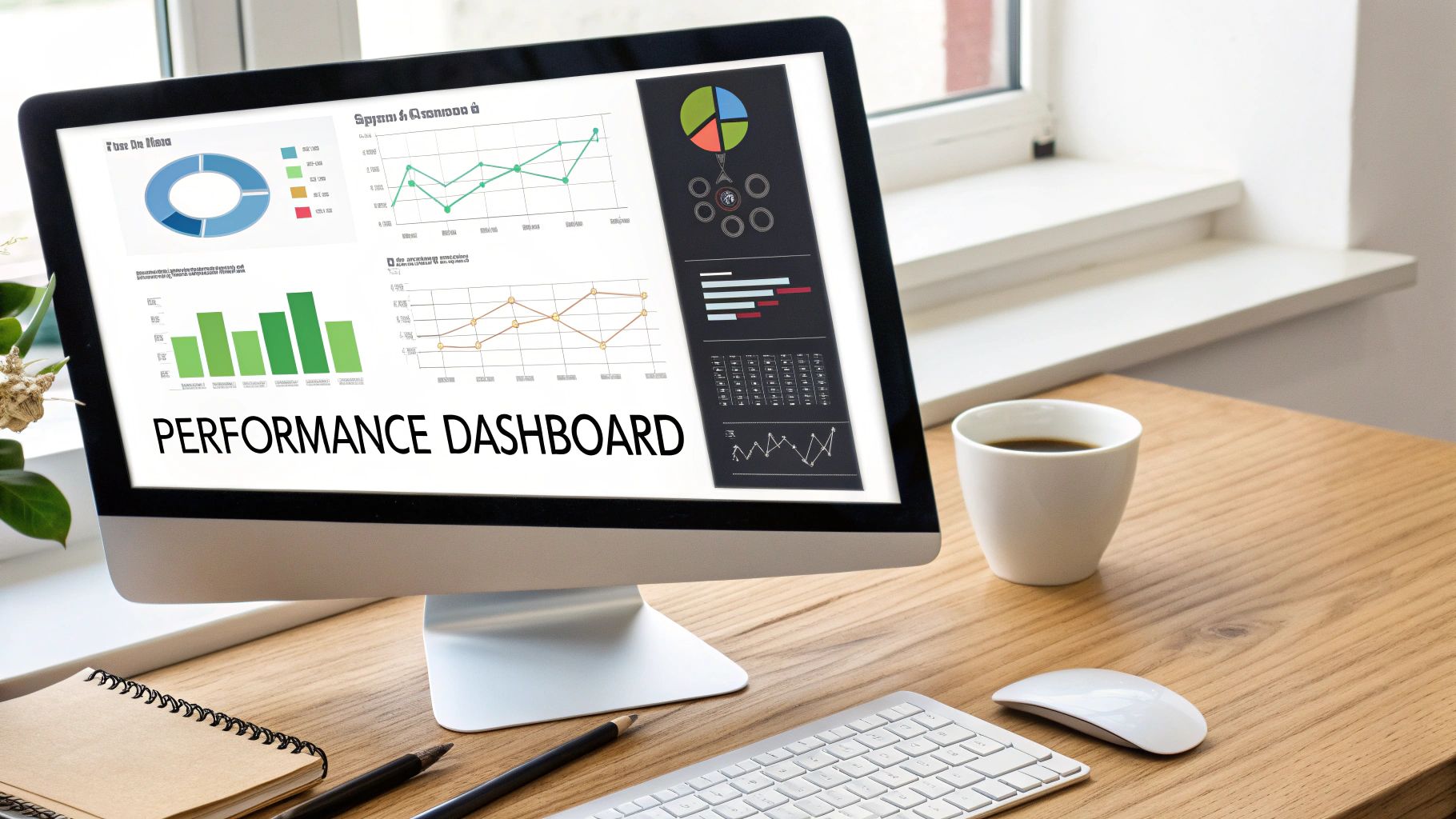
If you're still trying to run your affiliate program from a tangled mess of spreadsheets, you’re flying blind. Let's be honest, the days of manual data entry and pure guesswork are long gone. To actually scale your TikTok Shop affiliate channel, you need a data-driven command center—a single source of truth that shows you what’s working, what’s a waste of money, and where to invest your next dollar.
An integrated dashboard isn’t a nice-to-have anymore; it's absolutely essential. It brings all your scattered data into one clear, real-time view. This means you can make sharp, informed decisions on the fly instead of reacting to last month's numbers. It's the difference between just running a program and strategically managing it for maximum profit.
The global affiliate marketing space is exploding, with some forecasts predicting an 18.6% CAGR through 2032. With 80% of brands already using affiliates and 62% of their traffic coming from mobile, a platform like TikTok is a goldmine. The opportunity is massive, and you need the right tools to capture it.
Identifying the KPIs That Actually Matter
It’s easy to get distracted by vanity metrics. Sure, high view counts and huge follower numbers look great on a report, but they don't pay the bills. A truly actionable dashboard cuts through the noise and focuses on the key performance indicators (KPIs) that connect directly to your shop’s financial health.
These are the metrics you should be obsessing over:
- Gross Merchandise Value (GMV): The total revenue your affiliates bring in before any costs. Think of it as the top-line pulse of your program's health.
- Commission Payouts: Exactly what you're paying creators. This is a core expense you need to watch like a hawk.
- Conversion Rate (CR): What percentage of clicks on an affiliate link actually turn into a sale? A high CR is a sign of a perfect creator-audience-product fit.
- Average Order Value (AOV): Are your affiliates driving high-value shopping carts or a bunch of small, one-off sales? A higher AOV often means a more valuable customer.
An effective dashboard doesn't just throw numbers at you; it tells a story. It should instantly answer the question, "Is my affiliate program making me money, and how can I make it make more money?"
To help you get started, here's a breakdown of the KPIs that every affiliate manager should be tracking to measure success and profitability.
Essential KPIs for TikTok Shop Affiliate Programs
| KPI | What It Measures | Why It Matters |
|---|---|---|
| Gross Merchandise Value (GMV) | The total sales revenue generated by affiliates before deductions. | Your primary indicator of overall program scale and revenue impact. |
| Commission Payouts | The total amount of commission paid to all affiliates. | A critical expense that directly influences your program's profitability. |
| Conversion Rate (CR) | The percentage of clicks on affiliate links that result in a sale. | Shows how effectively a creator's content persuades their audience to buy. |
| Average Order Value (AOV) | The average dollar amount spent per order from an affiliate link. | Helps identify which affiliates are driving higher-value customers. |
| Creator ROI | The net profit generated by a creator divided by the total investment in them. | The ultimate metric for determining which partners are truly profitable. |
| Click-Through Rate (CTR) | The percentage of viewers who click on an affiliate's link. | Measures how engaging and compelling a creator's call-to-action is. |
Tracking these metrics consistently is the first step toward building a data-driven program that scales effectively.
From Raw Data to True Profitability
Tracking GMV is a great start, but it's just the beginning. The real magic happens when you connect these affiliate metrics to your shop’s actual bottom line by factoring in all your costs. A sophisticated dashboard moves beyond surface-level data to calculate your true return on investment (ROI) on a per-creator basis.
This means pulling in some crucial financial data:
- Cost of Goods Sold (COGS): What does it actually cost you to produce the products an affiliate sells?
- Ad Spend: If you're putting money behind creator content (spark ads, etc.), that cost needs to be accounted for.
- Shipping & Fulfillment Costs: These expenses chip away at your margins on every single order.
- Transaction Fees: Don't let these small, sneaky fees fly under the radar. They add up.
Once you subtract all these costs from the GMV a specific affiliate generated, you finally arrive at their true profit contribution. Understanding your program at this granular level is a huge step up in your analytics game. If you're curious about where your company stands, you can learn more about the different stages of data proficiency with the analytics maturity model.
Picture this: You’re looking at your profit dashboard. Creator A brought in a massive $20,000 GMV, but after you factor in their high commission rate and the cost of the free products you sent, their net profit is only $2,000. Meanwhile, Creator B "only" drove $8,000 GMV, but thanks to a lower commission and a higher AOV, their actual profit contribution was $3,000.
This is the kind of insight that completely changes how you manage your program. You can now confidently invest more in high-performers like Creator B, figure out what's wrong with underperformers like Creator A, and run your entire channel with a relentless focus on profitability.
Handling Payouts and Staying Compliant
Let's be blunt: if you don't pay your creators correctly and on time, nothing else matters. It's the bedrock of trust in any affiliate program. A single late or incorrect payment can torpedo a great relationship, wasting all the effort you spent finding and onboarding that creator.
This is where the less glamorous, back-end work becomes make-or-break. Trying to manage payouts with spreadsheets and manual bank transfers is a ticking time bomb. It’s not just a time suck; it’s a minefield of potential human errors that can cost you both money and relationships as you grow. Automation isn't a luxury here—it's essential.
Nailing Your Payment Workflow
First things first, you need a payment schedule that makes sense for everyone. While some brands still cling to old-school net-30 or even net-60 terms, that doesn't fly in the fast-paced world of TikTok. Creators are used to instant feedback and quick wins, so weekly or bi-weekly payments are far more effective at keeping them motivated.
Once you’ve locked in a schedule, you need a rock-solid payment method. You've got a few options, each with its own quirks:
- Direct Bank Transfers (ACH): Feels professional and is very secure, but it can be slow and a huge administrative headache if you're doing it all by hand.
- PayPal or Wise: Super fast and recognized worldwide, which is great for creators. The downside? You'll be eating transaction fees on every single payment.
- Integrated Platform Payouts: This is the gold standard. Using a dedicated platform like HiveHQ means the system handles all the commission math and payments for you, completely automatically.
The real goal here is to make getting paid completely frictionless for your creators. When they know their money will arrive on schedule without them having to chase you down, they can put all their energy into what they do best: making great content.
A good automated system plugs directly into your TikTok Shop sales data, calculates exactly what each affiliate is owed, and sends the money out on the schedule you set. This completely eliminates the risk of manual errors and guarantees everyone gets paid the right amount, every time. If you really want to stand out, you can even explore setting up a daily payment affiliate program to attract the best creators.
Staying on the Right Side of the Rules
Paying commissions is just one part of the equation. You also have to navigate the legal and financial side of things. Mess this up, and you could be looking at serious fines and a major blow to your brand’s reputation. Compliance is not just about checking a box; it’s about running a professional, sustainable operation.
Two things absolutely need your attention: tax forms and FTC disclosures.
If you have any US-based creator who earns more than $600 from you in a year, the IRS requires you to send them a 1099-NEC tax form. Imagine manually chasing W-9s and tracking earnings for hundreds of creators. It's a full-blown nightmare. This is another area where an affiliate platform is a lifesaver—it collects the necessary tax info during onboarding and automatically generates the 1099s for you.
Just as critical are the Federal Trade Commission (FTC) rules. The FTC is very clear that creators must disclose their financial relationship with you. They need to let their audience know they could earn a commission from sales.
Here's how you ensure everyone stays compliant:
- Be Explicit in Your Briefs: Don't leave it to chance. Your creative briefs must clearly state that a disclosure like #ad, #sponsored, or #affiliate is mandatory.
- Tell Them Where to Put It: Instruct creators to place the disclosure right at the beginning of their video caption. It needs to be seen immediately, not buried.
- Do Regular Spot Checks: Every so often, scroll through your affiliates' content to make sure they're consistently following the rules.
By getting your payment automation and compliance systems in order, you build a program that feels professional and trustworthy. Top-tier creators will notice, and it frees you up to focus on the fun stuff—strategy and growth—knowing the operational side is running like a well-oiled machine.
Steering Clear of Common Affiliate Program Pitfalls
A successful affiliate program is never a "set it and forget it" channel. It’s more like a garden; it needs constant attention, care, and smart adjustments to really flourish. Just getting it up and running is the easy part. The real growth comes from creating a continuous cycle of improvement, where you turn performance data into real-world strategies that make your program more profitable and your creators happier.
This optimization loop really kicks off when you dive into your performance dashboard. Start looking for the patterns. Are unboxing videos crushing tutorials? Which creators are pulling in customers with the highest lifetime value (LTV)? Answering these kinds of questions is how you uncover your biggest growth opportunities.
Building a Cycle of Constant Improvement
Once you see what's clicking, it's time to pour fuel on that fire. If a specific creator is absolutely killing it, don't just sit back and let their standard commission roll in. Be proactive. Reach out and offer them a better commission tier, suggest a co-branded campaign, or give them an exclusive discount code for their audience.
The same goes for creative. If you notice a certain style of video is really resonating with viewers, use that knowledge to shape your future creator briefs. You can even update your brand assets for everyone, showcasing top-performing video examples to inspire the whole group. This hands-on approach transforms your program from a passive sales channel into an active growth engine.
The biggest mistake I see brands make is treating their affiliates like transactions instead of partners. A program's health is directly tied to the strength of its relationships. When you invest in your top performers and treat them like true collaborators, they invest more of their energy and creativity back into your brand.
This flowchart maps out the crucial backend operations—from payouts to compliance—that keep an affiliate program running smoothly.
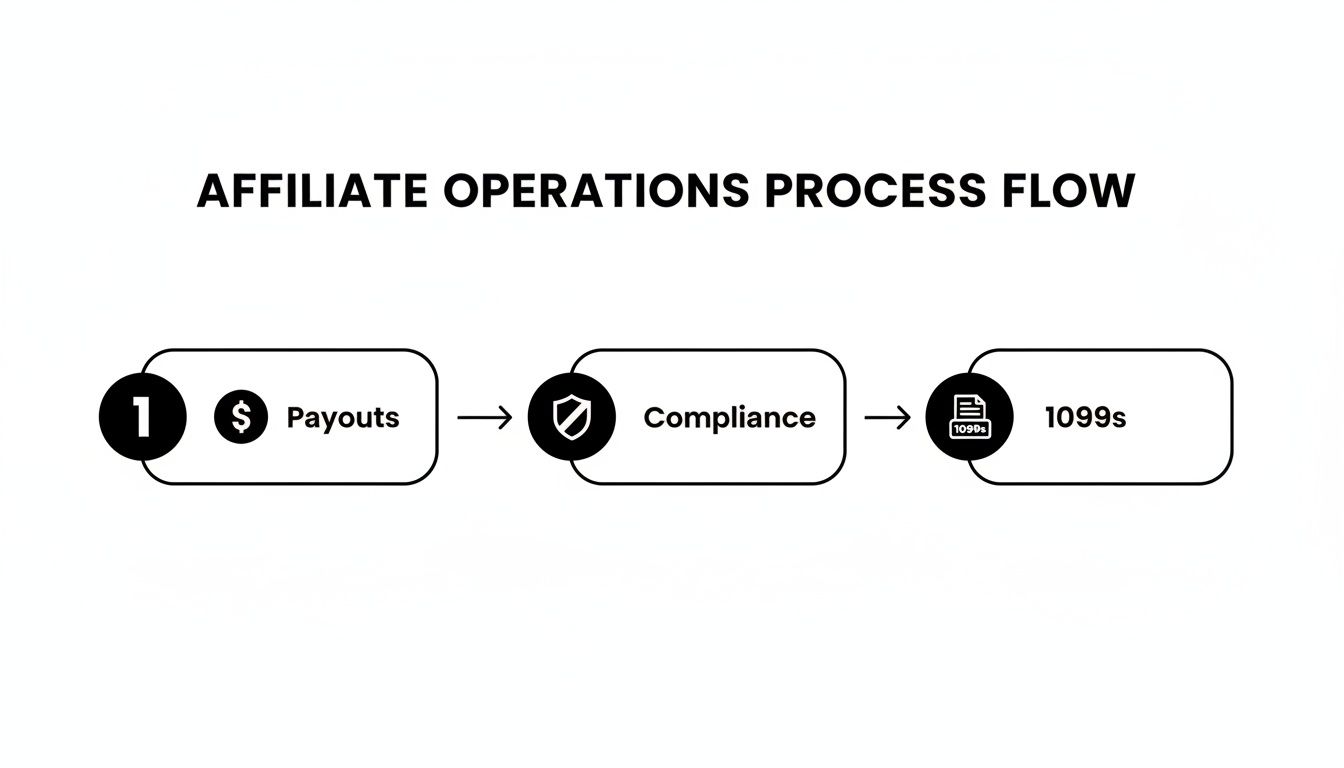
Think of this as the essential workflow for paying affiliates accurately, staying on the right side of the law, and managing tax documents like 1099s.
Mistakes That Can Sink a New Program
Even the most well-intentioned programs can get tripped up by a few common mistakes. Getting ahead of them is the key to building something that lasts.
- Going Silent: Ghosting your creators after they've onboarded is a recipe for failure. Keep the lines of communication open with a dedicated Slack channel or a regular email newsletter. Share updates, celebrate wins, and be there when they have questions.
- Forgetting the "Relationship" Part: Don't just be an anonymous name in their inbox. Take a genuine interest in your top affiliates' goals and content. That personal connection builds a kind of loyalty a commission check simply can't buy.
- Ignoring the Underperformers: It’s tempting to focus all your energy on your star players, but don’t write off creators who aren't hitting their numbers. A little one-on-one guidance, a different product to try, or a clearer brief might be all they need to turn things around.
When managed well, the impact is undeniable. An incredible 16% of all e-commerce sales are now driven by affiliates. With a typical ROI of $6.50 for every $1 spent, it’s a channel that truly delivers. And the opportunity is only getting bigger—social commerce in the US is on track to hit $149 billion by 2028, with TikTok Shop leading the charge. You can discover more insights about these e-commerce trends to see the full picture.
By sidestepping these common blunders, you’ll build a resilient program that not only attracts top-tier talent but also keeps them motivated, paving the way for scalable and profitable growth.
Common Questions Answered
What’s a Good Commission Rate for a TikTok Shop Affiliate Program?
You'll typically see commission rates for physical products on TikTok Shop fall somewhere between 10% and 20%. But this isn't a hard and fast rule. The right number really depends on your product margins, what's standard in your niche, and the kind of value a specific creator can deliver.
If you have high-margin products, you can comfortably offer higher rates. A smart strategy we've seen work well is a tiered structure. You might offer a standard rate to start, but your top-performing affiliates could earn rates above 20% as an incentive. It's a great way to keep your best partners motivated.
How Do I Actually Track Sales from Different TikTok Creators?
The only way to do this reliably is with dedicated affiliate management software that plugs directly into TikTok Shop. Don't try to manage this with spreadsheets—it'll become a nightmare. These platforms, like HiveHQ, handle all the heavy lifting for you.
Here's how it works:
- Each creator gets a unique tracking link or a special coupon code.
- When a customer clicks their link or uses their code to buy something, the software instantly credits that sale to the right person.
This automated attribution means you can pay commissions accurately and get a crystal-clear picture of who your top performers are.
Should I Just Send Free Products to Every Creator Who Asks?
Definitely not. Sending out free products is an investment, and you need to be strategic about it. It’s smart to qualify creators before you ship anything out.
For up-and-coming creators or those you haven't worked with before, you could ask them to buy the product first—maybe offer a big discount to soften the ask. This simple step weeds out people who are just looking for freebies and ensures they're genuinely invested in your brand.
But for major creators with a proven history of driving sales? Sending them free samples is standard practice. It's a professional courtesy that gets the partnership started on the right foot.
Ready to stop guessing and start managing your affiliate program with real data? HiveHQ gives you the Profit Dashboard, Affiliate Bot, and Creator Tracker you need to automate your outreach, see your true ROI, and scale your TikTok Shop the right way. Get started with HiveHQ today and turn your creator partnerships into a predictable growth engine.