TikTok Shop Seller Center: The Complete Operator's Guide
tiktok shop seller centertiktok shop profitseller center analyticshivehq profit dashboardtiktok shop guide
You can open TikTok Shop Seller Center and see healthy GMV, rising orders, and a green performance panel, then discover that the period produced little or no profit after COGS, commissions, refunds, and advertising. TikTok Shop Seller Center is the operating back office for TikTok Shop, but GMV is not the north star for an operator. Product-level net profit is.
That distinction matters most when an Amazon seller expands into TikTok Shop, when a creator-driven product suddenly accelerates, or when finance asks why marketplace sales aren't matching bank deposits. The practical answer isn't to ignore Seller Center. It's to use it for compliance, catalog, orders, fulfillment, settlements, and campaign control, then reconcile its events against the costs that determine whether each SKU earns money.
Table of Contents
- What TikTok Shop Seller Center Actually Is for Operators
- Core Modules and What Each Controls in Daily Operations
- GMV, Refunds, and Timing Rules That Trip Up Finance Teams
- Seller Center Reporting Versus Product-Level Profit Dashboards
- Typical Workflows from Onboarding Through Monthly Reconciliation
- Common Pitfalls That Make GMV Look Better Than Actual Profit
- Security, Access Controls, and Ad Account Dependencies
- Frequently Asked Questions About TikTok Shop Seller Center Profitability
What TikTok Shop Seller Center Actually Is for Operators
A seller checks Seller Center before the morning stand-up. GMV looks strong. Orders are moving. Visitors and conversion rate appear healthy. By afternoon, the finance lead asks why cash is tighter than expected, and the operator starts hunting through refunds, creator commissions, discounts, fulfillment charges, and settlement timing.
That situation is common because Seller Center reports marketplace activity, while profitability depends on a wider cost model. TikTok defines and presents platform metrics for operating the shop, but the dashboard alone doesn't tell you whether a product covered its landed cost, advertising, commissions, refunds, and fulfillment expense.
TikTok Shop Seller Center became the operational foundation for TikTok's U.S. commerce business after TikTok Shop launched in the United States in September 2023. By June 2025, U.S. TikTok Shop sales had increased 120% year over year, with more than 8 million hours of LIVE shopping sessions in the preceding year, and small business sales growing 70% year over year. A separate report noted that 83% of shoppers discovered a new product and 70% discovered a new brand on the platform, illustrating why Seller Center supports discovery-led marketplace operations rather than simple listing management. These figures are reported in TikTok's U.S. commerce update.
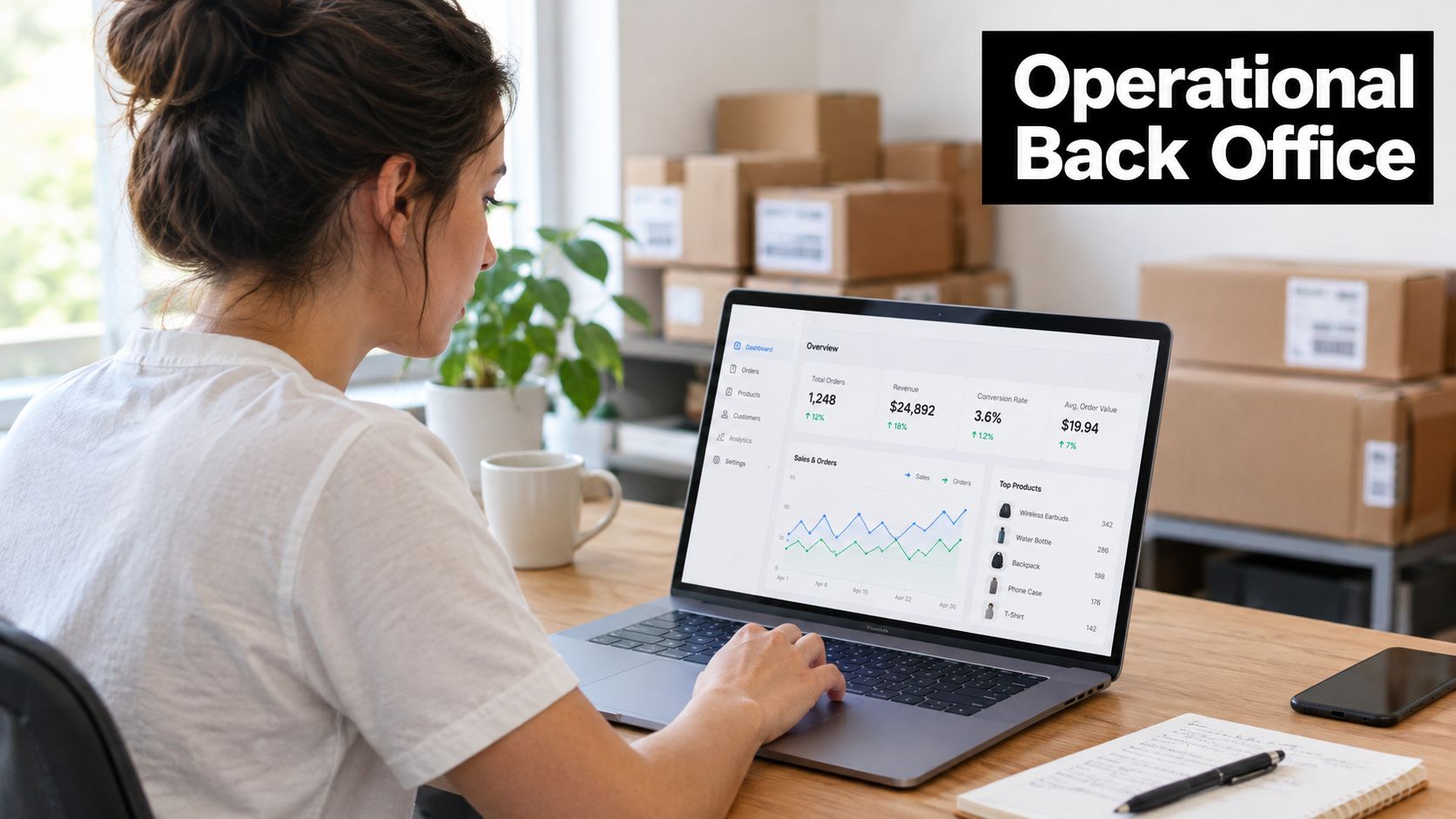
The operating hub, not the profit ledger
Seller Center brings together store operations, customer service, seller education, performance analysis, and policy updates. It's where teams verify the business, manage listings, monitor orders, review fulfillment, handle customer issues, and inspect platform-reported results. If your shop is active, this is the control plane your team can't avoid.
The mistake is treating the control plane as a complete accounting system. An operator needs a second view that joins order-level revenue to SKU COGS, ad spend, commissions, refunds, fulfillment, and settlement adjustments. That view should preserve the dates and statuses behind every amount, rather than flattening an order into one static row.
For a broader explanation of the channel itself, see what TikTok Shop is. The important operating principle is simple: Seller Center tells you what happened inside the marketplace; reconciliation tells you what the business kept.
Core Modules and What Each Controls in Daily Operations
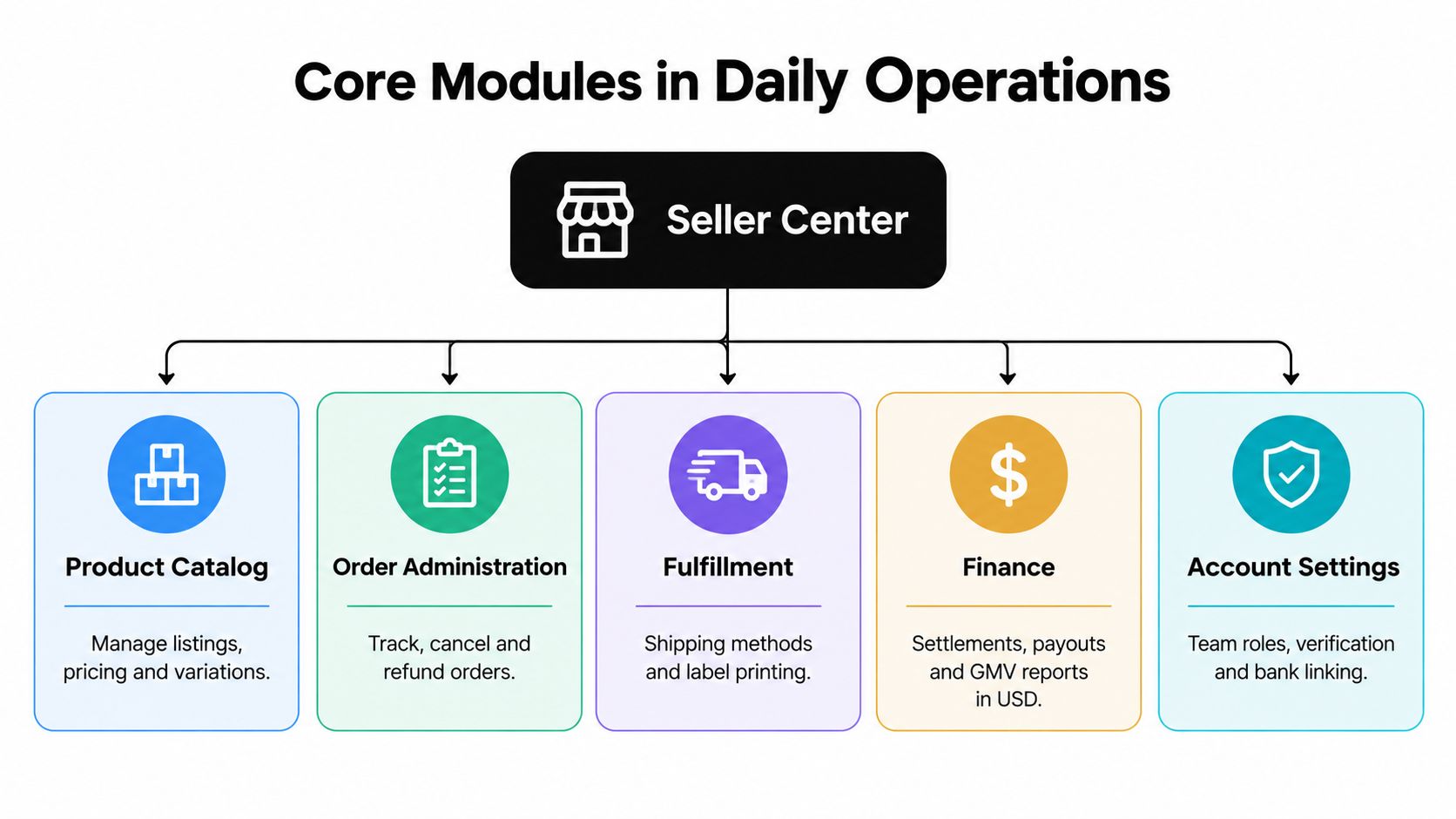
Open Seller Center during a normal trading day and every team reads a different truth from the same account. Merchandising watches listings and stock. Operations watches orders and exceptions. Finance watches settlements. That split is why GMV becomes a bad north star so quickly. The platform is organized for execution, while operators still need a separate model that reconciles what sold, what shipped, what got refunded, and what the business kept.
Seller Center's analytics view is still useful. TikTok says sellers can monitor today's GMV, orders, visitors, and conversion rate in real time, compare periods, export reports, and review GMV rankings by category and time frame in Seller Center's official data overview. The catch is that a metric definition can change by report. If one export treats discounts or shipping differently from another, the operator who saves only the final number loses the context needed to reconcile margin later.
Follow the record from listing to settlement
Product catalog. This module controls titles, variations, media, certifications, pricing, and available inventory. A small catalog edit can change which SKU gets ordered, which price version was live at checkout, and which item a warehouse has to pick. If product data is sloppy, every report downstream gets harder to trust.
Order administration. This is the event log for order creation, payment status, cancellation, return, and refund activity. Treat it as a sequence, not a single row that keeps changing. Operators need the event history because payment, cancellation, and refund rarely land in the same reporting window.
Fulfillment. Shipping method, warehouse actions, tracking, delivery status, and exceptions sit here. This module often explains margin leakage that headline sales numbers hide, including failed delivery attempts, late dispatch, and return-triggering service issues.
Finance. Use this area for platform-reported GMV, payments, adjustments, fees, and settlements. Useful, yes. Final, no. Settlement tells you cash movement inside the marketplace, not product-level net profit after COGS, commissions, refunds, and ad spend.
Account settings. Verification, payout banking, return settings, and user permissions live here. Access should follow role boundaries because the people editing listings should not always be the same people approving financial workflows.
The API structure mirrors these operating lanes in TikTok's Seller Center API documentation. For day-to-day reconciliation, keep the immutable field tied to the module that creates it: catalog exports should retain SKU ID and price version, order records should retain order ID and payment timestamp, fulfillment records should retain tracking and delivery events, and finance records should retain adjustment type and settlement reference. Teams building a profit view can use custom dashboard design for ecommerce reporting to separate raw marketplace facts from calculated margin so daily ops and month-end close do not fight each other.
GMV, Refunds, and Timing Rules That Trip Up Finance Teams
GMV is easy to read and difficult to reconcile. The problem isn't only what the metric includes. It's the date assigned to each event.
TikTok's shop analytics model can include product price, quantity, shipping fees, seller-funded discounts, platform-funded discounts, and tax treatment. TikTok also states that GMV is keyed to payment time, cancellations and returns to initiation time, and refunds to full-settlement time. A payment cohort can therefore contain orders whose cancellation or refund appears in a different reporting period.
That's why finance teams should never subtract the refund export for a calendar period from the GMV export for the same calendar period without checking event dates. The two reports may be correct individually while producing a misleading combined result.
Build cohorts around events
Use separate reporting cohorts for:
- Payment date: the period in which the order entered the GMV view.
- Cancellation or return initiation date: the period in which the customer or platform initiated the event.
- Settlement date: the period in which the financial adjustment reached full settlement.
Practical rule: Reconcile events by their own dates first, then summarize them into a management period.
The controls below make the timing model auditable.
| Metric | Timing Rule | Reconciliation Control |
|---|---|---|
| GMV | Keyed to payment time | Match order and SKU records using payment-date cohorts |
| Cancellations and returns | Keyed to initiation time | Keep initiation timestamps and connect them to the original order |
| Refunds | Keyed to full-settlement time | Reconcile the settlement event separately from the original payment |
| Contribution margin | Calculated after operational costs | Deduct COGS, commissions, advertising, fulfillment, refunds, and platform adjustments |
The accounting logic behind these controls is explained in TikTok's shop analytics documentation. For a useful finance-oriented discussion of why gross merchandise value can be misused as a performance proxy, Jumpstart Partners on GMV misuse adds context without replacing the platform's own definitions.
Version the definitions
TikTok can present related metrics through different reports, and the calculation basis matters. Copy each metric definition into your internal data model and version it when the platform documentation changes. Otherwise, a dashboard may appear to change unexpectedly even though the order records are intact.
Your contribution margin formula should be explicit:
Contribution margin = recognized revenue minus refunds, COGS, platform commissions, creator commissions, ad spend, fulfillment, and platform adjustments.
That is not the same as GMV, net sales, settlement cash, or accounting profit. Operators who separate those measures can explain variance quickly instead of arguing over which dashboard is right. For a plain-language reference, what GMV means for ecommerce operators is useful, but your own model should remain tied to the exact Seller Center definitions and event dates.
Seller Center Reporting Versus Product-Level Profit Dashboards
A common failure point shows up right after a strong sales day. Seller Center shows healthy GMV, ads look efficient, and the team assumes the product is scaling well. Then refunds hit, creator commissions post later, shipping runs higher than planned, and the SKU that looked like a winner turns out to be thin or negative on contribution. That is why GMV is a poor north star for operators. The job is to reconcile revenue to product-level profit, not to admire top-line volume.
Once a shop grows past basic monitoring, operators usually end up with one of three setups. They use native Seller Center reports, build a spreadsheet model, or run self-serve software that combines platform data with external cost layers.
| Approach | Settlement Alignment | Attribution Clarity | Automation Effort | Best For |
|---|---|---|---|---|
| Seller Center reports | Strong for platform-defined views, limited for full-cost profit | Useful for shop and campaign activity, not complete contribution margin | Low | Daily store operations and policy monitoring |
| Custom spreadsheet | Depends on the model and date controls | Can be precise if event and channel fields are preserved | High and ongoing | Finance teams with unusual cost structures |
| Self-serve profit dashboard | Combines platform events with configured cost layers | Surfaces product, customer, and campaign relationships | Moderate setup, lower recurring assembly | Operators who need fast SKU-level decisions |
Seller Center is fast, familiar, and good for operational control. It answers marketplace questions well. It does not close the profit loop on its own because COGS, external ad spend, some fulfillment costs, and finance-side adjustments usually live outside the platform view.
Spreadsheets give teams flexibility and visibility into every formula. They also fail in predictable ways. A commission rate gets pasted over, a new SKU inherits the wrong cost, a refund is matched to the report month instead of the event date, or one manual export lands in the wrong tab. The file still calculates, which is what makes the error expensive.
The differentiator is cost-layer governance. Spreadsheets drift when commission rates are maintained manually. Profit dashboards drift when COGS mappings are not versioned. Both still depend on immutable order and SKU keys, plus a cost-version field that lets finance trace which margin logic applied at the time.
A self-serve dashboard helps when the operator can inspect source records, map costs deliberately, and keep platform metrics separate from calculated profit. Teams that need a clearer finance workflow can use a reference on TikTok Shop financial reporting, while a practical TikTok analytics guide helps explain what the native reporting layer does well.
HiveHQ is one self-serve option for TikTok Shop sellers that need a Profit Dashboard with real-time net profit, product-level performance, and customer analytics. The value is not that software replaces operator judgment. The value is that it shortens the path from raw order events to a repeatable reconciliation model that accounts for COGS, commissions, refunds, ad spend, fulfillment, and platform adjustments at SKU level. That gives merchandising, finance, and growth teams the same answer when they ask a simple question: did this product make money?
Typical Workflows from Onboarding Through Monthly Reconciliation
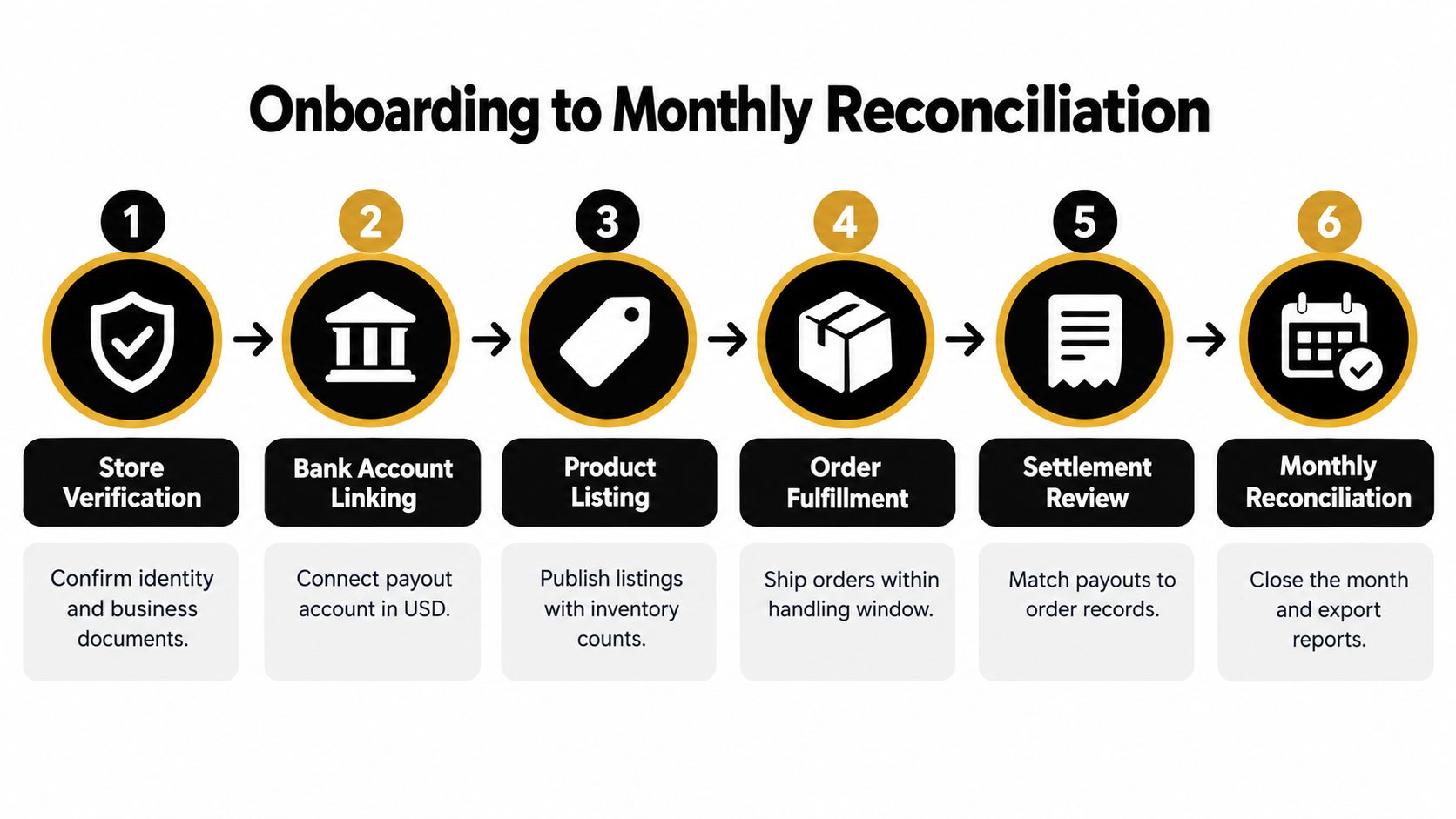
A reliable operation treats onboarding and reconciliation as one connected workflow. Verification affects payouts, catalog accuracy affects fulfillment, and the quality of event records determines whether finance can close the period without guesswork.
Establish the account foundation
Start with identity or business verification. TikTok requires seller access to go through verification, followed by bank-account linking for payouts and returns. Keep the submitted business identity, payout account, and internal owner documented so a team member doesn't make an untracked change.
Next, publish products with complete attributes, approved media, variations, pricing, and inventory. Assign an internal SKU that maps cleanly to the TikTok SKU and the inventory or accounting record. If a product has multiple variations, don't rely on the customer-facing title alone for matching.
Run orders as event streams
When orders arrive, capture the order ID, SKU ID, payment timestamp, fulfillment status, cancellation status, return status, refund status, and any adjustment type. Treat each change as an event. This prevents a later refund from erasing the original sale in your audit trail.
Fulfillment teams should reconcile shipped and delivered states against warehouse records. Customer service should link returns and refunds to the original order rather than creating an unrelated credit row. Campaign teams can review creator or paid-channel activity, but finance should retain the final attribution and settlement fields used for commission calculation.
Keep a commission ledger
A commission ledger should record:
- Product and SKU: The item connected to the commission.
- Collaboration type: The applicable collaboration or promotional arrangement.
- Rate history: The rate active when the relevant promotion and order occurred.
- Attribution channel: The source assigned to the order.
- Refunds: Revenue reductions that affect payable commission.
- Settlement status: Whether the amount is pending, adjusted, refunded, or settled.
TikTok's UK analytics update includes Total Order Income, expenses, overall profit performance, SKU and account views, exports, and affiliate-related costs such as commissions, partner commissions, Shop Ads commissions, creator bonuses, and commission refunds. The documentation does not explain how to reconcile those figures with COGS, external advertising, fulfillment, taxes, agency fees, reserves, returns timing, or cash received. It also limits analytics coverage to transactions created after January 1, 2025, which constrains long-term comparisons for established shops. These limitations are described in TikTok's UK analytics update.
Close the month by exception
At month-end, match settlement records to order cohorts, then investigate exceptions rather than manually rewriting totals. Review missing COGS, unmatched refunds, unexpected commission changes, duplicate IDs, delayed settlements, and products whose GMV rose while contribution margin fell.
Operators can document the recurring process in TikTok Shop workflow automation for brands, but automation should preserve the raw event history. A clean close is reproducible by another person.
Common Pitfalls That Make GMV Look Better Than Actual Profit
A product can generate more GMV and become less attractive to sell. That happens when creator commissions, Shop Ads commissions, refunds, discounts, COGS, or fulfillment costs rise faster than the revenue retained by the business.
Product GMV Max makes this especially easy to miss. TikTok assigns all orders generated by advertised products to the campaign's GMV Max dashboard, including orders that originated from organic content and affiliate activity. It calculates same-day GMV using a one-day attribution window, so the campaign view can show attributed revenue before later refunds, returns, commissions, and product costs are fully known. TikTok's mechanics are documented in Product GMV Max guidance.
Read campaign GMV as attributed activity
GMV Max campaign GMV is not automatically paid-ad revenue, and it isn't contribution profit. It can contain multiple traffic relationships connected to the advertised product. If a manager evaluates the campaign using only that number, organic or affiliate-assisted orders may appear to be paid-media outcomes.
The safer model keeps three views separate:
- Attributed activity: What the campaign assigned within its attribution window.
- Operational outcome: What happened later through shipping, cancellation, return, and refund events.
- Economic result: What remained after COGS, ad spend, commissions, fulfillment, and adjustments.
Margin check: If attributed GMV rises but product-level contribution margin falls, investigate cost and timing before increasing spend.
Watch for silent margin erosion
The warning signs are operational, not cosmetic:
- Missing COGS: The product report shows revenue but no current landed-cost mapping.
- Commission blindness: The dashboard uses an advertised rate rather than the final payable amount after attribution and refunds.
- Window mismatch: Same-day campaign GMV is compared with later-period refunds or settlement cash.
- Cross-channel confusion: Organic and affiliate orders inside a campaign view are treated as incremental paid conversions.
- Cost omission: Fulfillment, discounts, platform adjustments, or external advertising aren't attached to the SKU.
A historical ROI target can help an automated campaign optimize, but it isn't a substitute for current product economics. The operator's decision should be based on realized contribution margin, with unsettled outcomes clearly labeled rather than hidden inside a single blended result.
Security, Access Controls, and Ad Account Dependencies
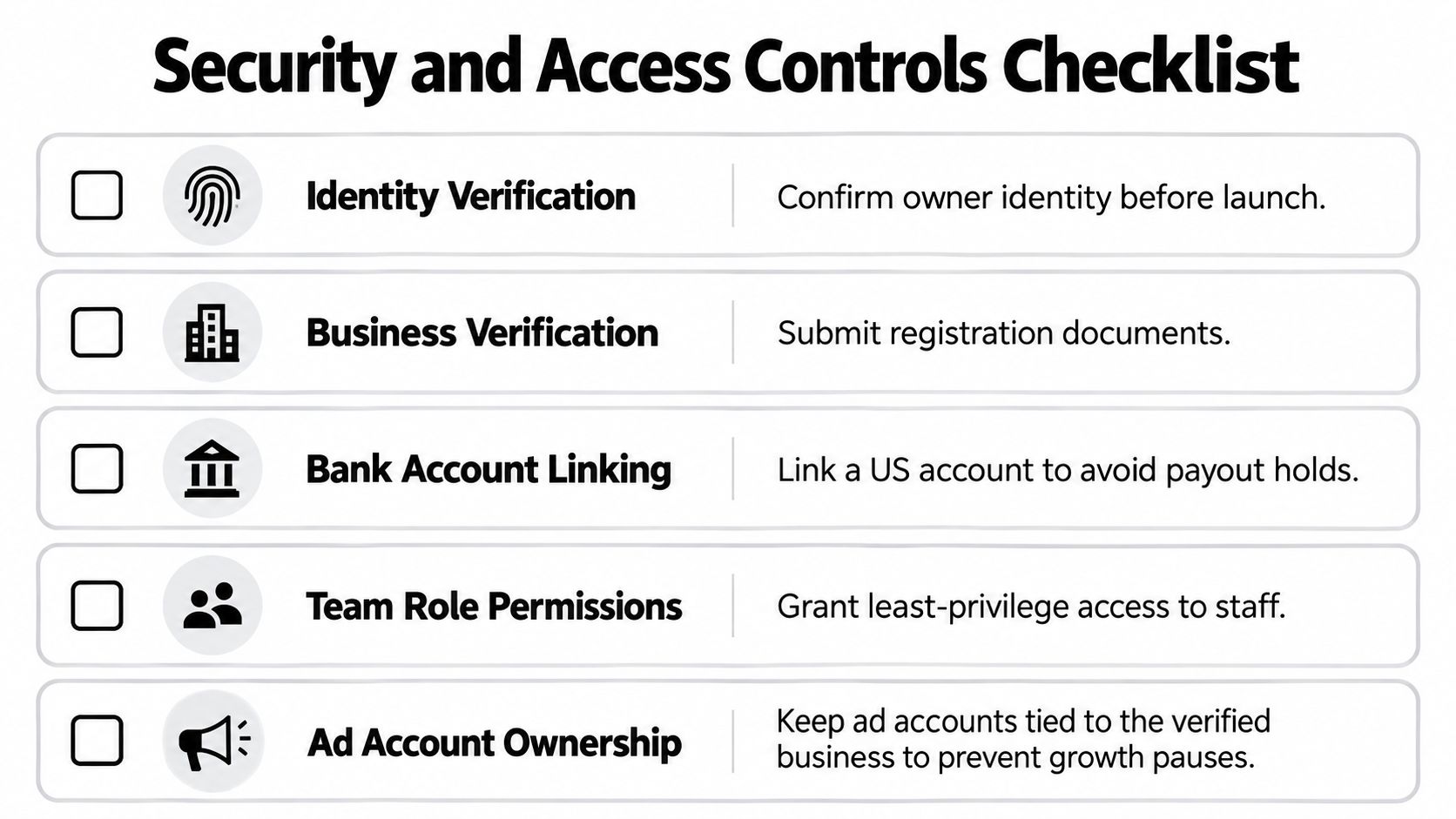
Operational access begins with identity or business verification and bank-account linking. Those controls support seller access, payouts, and returns, but they also establish who owns the shop and which team members can change sensitive settings.
Treat the primary ad account as production infrastructure
GMV Max access is restricted to one ad account per TikTok Shop at a time, and that account must be the shop's primary ad account in Seller Center. If another account becomes primary, access is revoked from the previous account and its existing GMV Max campaigns are paused.
Product and LIVE campaign dependencies create another failure point. An active Product GMV Max campaign can pause or affect existing Video Shopping Ads or Product Shopping Ads using the same products. An active LIVE GMV Max campaign can likewise pause existing LIVE Shopping Ads for the shop's official TikTok account. TikTok documents these dependencies in its GMV Max account guidelines.
Build a change-control routine
Assign one accountable owner for the verified business and primary ad account. Give staff the least access needed for their work, and require a recorded review before changing account ownership, product eligibility, campaign type, or primary-account settings.
For multi-brand operators, document which shop belongs to which business identity, bank account, ad account, and reporting workspace. Teams planning to scale ad account operations should treat account mapping as a control register, not an informal spreadsheet.
A simple pre-change checklist should confirm:
- The affected shop and business identity.
- The current primary ad account.
- Products used in active campaigns.
- Campaigns that may pause or be affected.
- The person authorized to approve the change.
- The reconciliation snapshot captured before the change.
That process reduces accidental pauses and gives finance a before-and-after record when campaign performance changes.
Frequently Asked Questions About TikTok Shop Seller Center Profitability
Can GMV replace net profit?
No. GMV is a platform activity metric. Net profit requires COGS, commissions, refunds, advertising, fulfillment, discounts, and relevant adjustments. Use GMV to monitor demand, then use product-level contribution margin to decide what to scale.
Why doesn't an export match the bank deposit?
Seller Center metrics and bank deposits can use different event dates and include different adjustments. Compare payment cohorts, refund and return initiation, full settlement, fees, and payout timing before treating the difference as an error.
How should attribution windows affect product decisions?
Keep attributed campaign activity separate from realized product economics. A same-day attributed result can precede refunds, returns, commissions, and COGS recognition, so wait for the relevant operational outcomes or label the result as provisional.
Do scaled sellers need an external dashboard?
They need a reliable reconciliation model. That can be a controlled spreadsheet, an internal data system, or self-serve software. The requirement is not the tool category. It's the ability to connect platform events with product costs and preserve an audit trail.
What changes when GMV Max is the supported campaign type?
Paid-growth analysis becomes more dependent on product-level reporting because GMV Max can combine organic and affiliate-originated orders with paid activity. Track campaign attribution separately from net profit, and monitor the primary ad-account dependency before making structural changes.
The operator who sees green GMV while cash flow looks red needs a reconciliation view, not another top-line screenshot. Seller Center remains essential for running the shop, but a profit dashboard makes the product, customer, and cost relationships visible enough to act on.
Try the HiveHQ Profit Dashboard to connect TikTok Shop activity with real-time net profit, product-level performance, and customer analytics. Run the numbers yourself, identify where COGS, commissions, refunds, and ad spend are changing the outcome, and talk to the HiveHQ team about building a clearer operating view for your shop.