TikTok Affiliate Affiliates Profit Guide
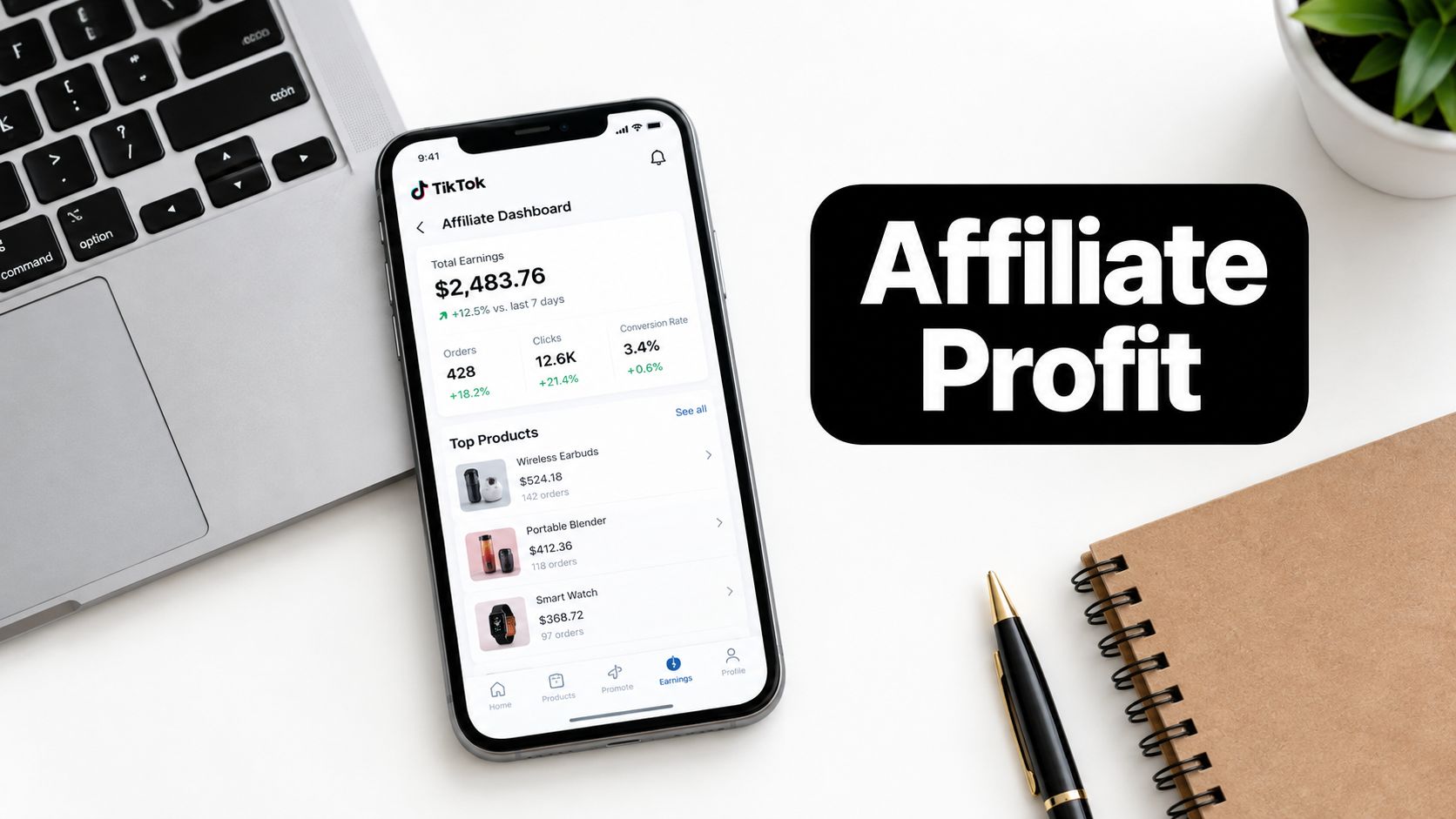
affiliate affiliatesTikTok Shopcreator trackingprofit dashboardecommerce analytics
TikTok Shop affiliate affiliates are independent creators who earn commission on completed, non-refunded sales, and in 2025 the affiliate market was estimated at about $18.4 billion globally. That means real profit depends on settled contribution margin, not gross merchandise value.
Affiliate marketing has been around long enough to prove one thing, the model works when the economics are tracked properly and fails when sellers chase headline sales. The same is true on TikTok Shop, where affiliate payouts, refunds, platform fees, and creator concentration can make a busy program look healthy while it's underperforming on cash.
Table of Contents
- Defining the TikTok Shop Affiliate Model
- Comparing Open and Target Collaboration Structures
- Calculating True Contribution Profit per Creator
- Managing Creator Concentration and Content Durability
- Tracking Performance with the HiveHQ Profit Dashboard
- Navigating Compliance and Platform Policy Constraints
- Frequently Asked Questions About Affiliate Operations
Defining the TikTok Shop Affiliate Model
TikTok Shop's affiliate model is simple in principle and unforgiving in practice, creators promote products, orders are tracked, and payouts follow completed sales after refunds are accounted for. TikTok Shop's official formula calculates affiliate payouts as revenue minus refunds, multiplied by the commission rate (TikTok Shop seller guidance), so a refunded order directly reduces what gets paid out.
That matters because a seller isn't buying exposure, they're buying performance. A headline GMV number can look impressive and still leave the business with weak contribution profit once product cost, fulfillment, platform fees, ads, and commissions are deducted. A profit-first operator treats affiliate activity like any other channel with variable costs, because that's what it is.
What the affiliate actually does
A creator finds a product, attaches it to content, and earns commission if the sale clears the after-sales period. TikTok's commission structure also means the payout is tied to the actual paid price, not a marketing fantasy number, which keeps the seller responsible for real collected revenue rather than list-price optimism.
For a practical primer on how affiliate programs are structured outside TikTok, compare affiliate marketing examples can help you see the mechanics in a broader context without losing sight of the unit economics. The useful takeaway is that TikTok Shop is not a special case, it's a performance channel with a faster content layer and stricter margin discipline.
Practical rule: if you can't reconcile creator-attributed revenue to settled deposits, you don't yet know whether the program is profitable.
For a clean framework on the basic model, the affiliate program definition is a useful internal reference point, but the operational question is always the same, what did the seller keep after refunds and variable costs?
Comparing Open and Target Collaboration Structures
TikTok gives sellers two practical ways to structure affiliate economics, open collaboration and target collaboration. The first is broader and easier to activate, the second is more controlled and better suited to specific partners, products, or margin situations. The wrong choice isn't about reach, it's about mispricing risk.
TikTok allows commission rates from 1% to 80% at the individual-product, selected-product-group, or shop-wide level, and when both apply to the same product, target collaboration supersedes open collaboration (TikTok Open Collaboration guidance). That makes the rate architecture part of the margin model, not a side setting.
Open vs Target Collaboration Economics
| Feature | Open Collaboration | Target Collaboration |
|---|---|---|
| Access | Broader creator participation | Restricted to selected partners or products |
| Rate control | Shop-wide, group, or product settings | More tailored by product or creator relationship |
| Margin risk | Easier to overextend if set too high | Easier to protect SKU-level economics |
| Best use | Discovery and broad participation | High-performing partners and tighter margin control |
| Operational style | More permissive | More selective |
The biggest mistake is applying a universal rate increase because one creator performed well. That usually helps the top line before it hurts the margin. A healthier approach is to keep broad discovery rates disciplined, then assign higher or lower rates only where product economics support them.
How to think about rate design
Use open collaboration for coverage, not vanity. Use target collaboration where you already know the creator, the SKU, and the return profile. If a product has thin margin, the rate needs to reflect that reality, not follower count or the excitement of a recent post.
A rate that wins attention can still lose money if the underlying product can't carry it.
The profit question is never “Can we pay more?” It's “Does this specific creator and SKU still clear contribution margin after platform fees, refunds, and fulfillment?”
Calculating True Contribution Profit per Creator
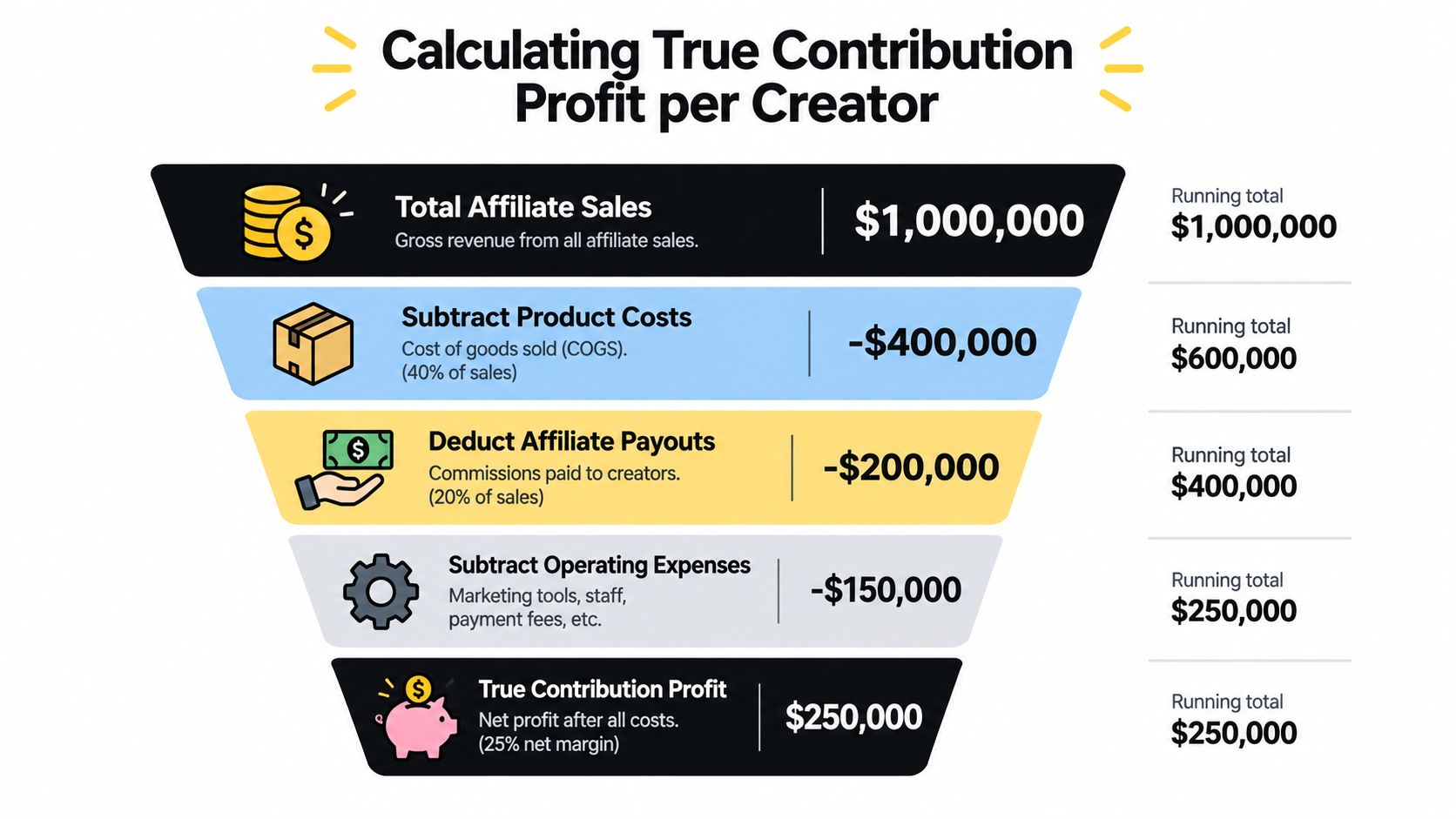
Start with creator-attributed revenue, then subtract every variable cost that touches the order. On US TikTok Shop sales, the platform charges a 6% commission on each sale (TikTok affiliate terms), and that sits alongside product cost, creator commission, refunds, fulfillment, advertising, and any other order-level expense. If you stop at GMV, you're only measuring activity.
The cost stack that actually matters
The calculation should follow the order flow, not the dashboard vanity flow. Revenue arrives first, then refunds can reduce it, then creator commission is applied, then the platform fee is deducted, and then the rest of the variable operating stack has to be paid out of whatever remains.
A simple operator's check looks like this:
- Creator-attributed revenue
- Less refunds and cancellations
- Less product cost
- Less platform fee
- Less creator commission
- Less fulfillment, ad spend, and operational overhead
- Equals settled contribution profit
If that last number isn't clearly positive, the partnership is not healthy at scale. A high-volume creator can still damage margin if the audience returns more than expected or if the product's post-refund economics are too tight.
How to compare creators properly
Don't compare creators only by GMV. Compare them by contribution profit per order, refund-adjusted revenue, and the stability of their settled results over time. The same creator can look strong in launch week and weak once refunds and platform fees settle.
For a practical framework on the bookkeeping side, the creator-level profitability guide is the right internal companion piece. In daily operations, the useful habit is to reconcile affiliate-attributed revenue against what cleared, not what first appeared in a live report.
Managing Creator Concentration and Content Durability
The most dangerous affiliate program isn't the one that grows slowly, it's the one that grows on too few creators. Industry benchmarks suggest that the top 10% of creators may produce 60% to 70% of total affiliate revenue (creator revenue concentration benchmark), which means a healthy-looking program can still be exposed to churn and volatility.
That concentration risk changes how operators should think about portfolio design. A creator who posts once and sells hard for a week is useful, but a program built only on that pattern becomes fragile fast. Audience fatigue, policy changes, and platform shifts all hit harder when the business depends on a handful of names.
What to measure instead of raw reach
Follower count is a weak proxy for resilience. A better operating view is to look at revenue share by the top five creators, new-versus-repeat creator contribution, and how long a post continues to generate settled profit after publication.
Durable content pays more like an asset, viral content behaves more like a spike.
That distinction matters because settled profit has a time component. A post that produces quick GMV but weak after-sales economics can look exciting and still underperform once the refunds clear. A slower post that keeps converting can be more valuable even if it never becomes the loudest item in the feed.
How to use concentration risk in practice
Keep enough creator diversity that one account leaving doesn't break the week. Then watch which pieces of content still sell after launch, because those are the assets worth repeating, remixing, and supporting with samples. For a deeper approach to relationship retention, turn top creators into long-term partners gives the right mindset, but the financial test is still durability.
The actual question isn't how many creators you can activate. It's how many of them can keep generating settled profit without creating dependency.
Tracking Performance with the HiveHQ Profit Dashboard
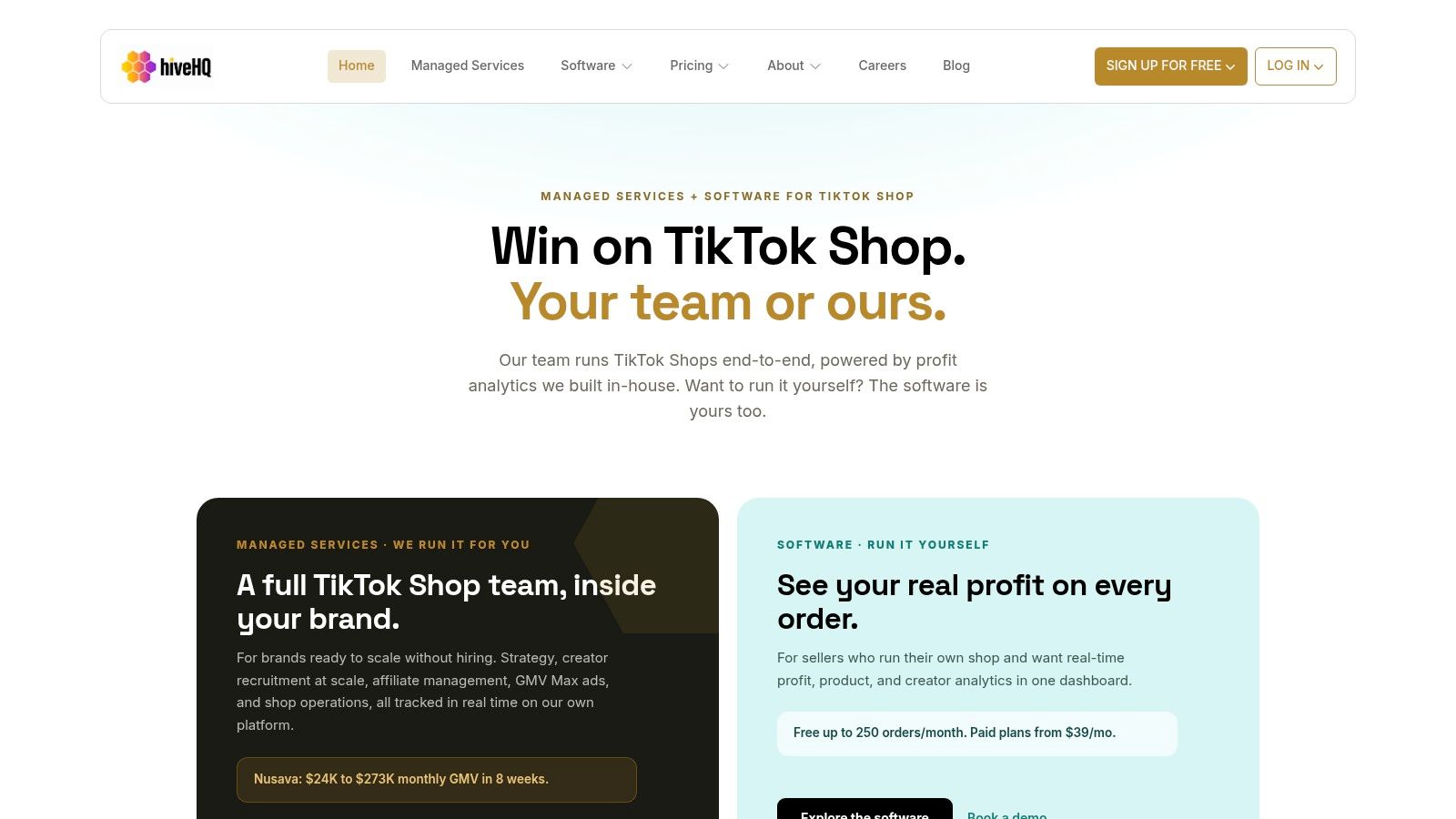
If you're managing affiliate profit manually, the problem isn't effort, it's lag. Refunds, creator commissions, ad spend, and product costs don't arrive in neat batches, so the report you trust most is often the one that's least current. That's why the HiveHQ Profit Dashboard matters, it gives sellers a self-serve view of real-time net profit, product-level performance, and customer analytics without forcing the finance team to rebuild the numbers in spreadsheets.
For operators who want a cleaner framework around e-commerce measurement, NanoPIM on e-commerce performance is a good outside reference for thinking about what to track, but the practical issue here is narrower, did the creator and SKU produce settled profit or not?
What to watch in the dashboard
The most useful fields are the ones that tie orders back to margin. That means creator-attributed revenue, refunds, COGS, commissions, and the product view, not just total shop activity. A dashboard is only useful when it helps you answer one question fast, which SKUs and creators are actually worth scaling?
The HiveHQ setup is built for that kind of operator workflow. It's not about outsourcing decision-making, it's about making the decision visible quickly enough to act on it.
After that, the day-to-day review becomes much simpler.
How to use the data without overreacting
Check product-level results first, then creator-level contribution, then customer behavior. If one creator drives sales but returns are high, the revenue line isn't enough. If one product wins under open collaboration but loses under a higher rate, the margin signal is telling you to slow down.
For sellers who want a tighter operating view, the TikTok Shop profit dashboard guide is the natural next read. HiveHQ's value is that it lets teams run the numbers themselves, instead of waiting for a monthly reconciliation to find out a campaign was unprofitable.
Navigating Compliance and Platform Policy Constraints
TikTok Shop's US Affiliate Marketing Policy requires sellers to keep meeting qualification requirements, and the platform may restrict access or remove affiliate products when those standards aren't maintained (policy overview). That makes compliance part of the profit model, not just an admin issue. If access disappears, the best unit economics in the world won't save the program.
The same discipline applies to refunds, rate changes, and creator expectations. Commission reductions don't always hit creators immediately, while open collaboration and target collaboration can interact in ways that change payout assumptions. Sellers should treat any rate change as a financial event, then confirm how it affects creators already promoting the product before assuming the new number has fully taken effect.
Rules that keep the program stable
Keep product eligibility visible, especially when a seller is close to qualification thresholds. Make sure creators understand that commission is tied to completed, non-refunded sales, not clicks or temporary order counts. If a product is being pushed through different rate structures, reconcile those settings before launch so attribution doesn't drift.
For broader context on handling recorded content and data governance in operational workflows, policy covering recorded content data is a useful reminder that measurement and compliance often overlap. In affiliate operations, the same mindset applies, if the records are messy, the profit view becomes unreliable.
For internal controls, the affiliate fraud detection guide fits naturally alongside these checks. The main point is straightforward, compliance keeps the channel open, and open channels are what keep the economics predictable.
Frequently Asked Questions About Affiliate Operations
How do I know if a creator is actually profitable?
Compare settled revenue against product cost, platform fees, creator commission, refunds, and fulfillment. If the number is still positive after those deductions, the creator is useful. If not, the GMV was just noise.
Should I raise commission rates to grow faster?
Only if the SKU can support it. A higher rate can improve participation, but it can also erase margin quickly on low-cost or high-return products. Test by cohort, not by instinct.
What should I do when creators complain about refunded commissions?
Point them back to the payout logic, commissions are tied to completed, non-refunded sales. The cleanest fix is better pre-sale product clarity and tighter monitoring of refund-heavy SKUs.
How often should I review creator performance?
Weekly is the minimum if the program is active. That cadence is enough to catch concentration risk, refund issues, and margin drift before they become a cash problem.
Is more creator volume always better?
No. A smaller portfolio of durable, profitable creators usually beats a large pool of weak contributors. Volume helps only when the settled economics hold up.
If you want a clearer view of real-time net profit, product-level performance, and creator-level economics, try the HiveHQ Profit Dashboard and talk to the HiveHQ team. If you're ready to stop guessing and start managing TikTok Shop affiliate profit like an operator, visit HiveHQ and see how your numbers look when every sale, refund, and commission is accounted for.