TikTok Shop Affiliates: The Profit-Focused Playbook
tiktok shopaffiliatesaffiliate marketingprofit analyticshivehq
Affiliate marketing is profitable only when you track net profit beyond commission. The HiveHQ Profit Dashboard proves whether affiliate-driven sales create real contribution margin after product costs, advertising, commissions, refunds, and other deductions.
That conclusion runs against the way many TikTok Shop operators read performance. A creator can generate impressive attributed GMV while the associated orders produce little profit, or even lose money after discounts, fulfillment costs, returns, and overlapping paid activity. Affiliate success is a capital-allocation question, not a popularity contest.
Affiliate marketing has become a substantial performance channel. U.S. retailers spent approximately $4.7 billion on affiliate marketing in 2016, representing about 7.5% of digital advertising expenditure at that time. By 2023, estimated U.S. affiliate spending had reached $9.56 billion, and a separate estimate placed 2024 spending at $13.63 billion. These figures show an established channel, but they don't prove that any individual product or creator is profitable. Industry estimates on affiliate spending provide scale, while your own contribution-margin reporting determines whether the channel deserves more capital.
Table of Contents
- Why Affiliate Profit Matters More Than GMV on TikTok Shop
- How TikTok Shop Affiliate Programs Work
- Commission Models and How They Impact Real Margin
- Tracking Affiliate Profit with the HiveHQ Profit Dashboard
- Compliance, Eligibility, and Platform Rules That Affect Affiliates
- How Brands Scale Affiliate Programs to $1M Plus GMV
- Frequently Asked Questions About Affiliate Profitability
Why Affiliate Profit Matters More Than GMV on TikTok Shop
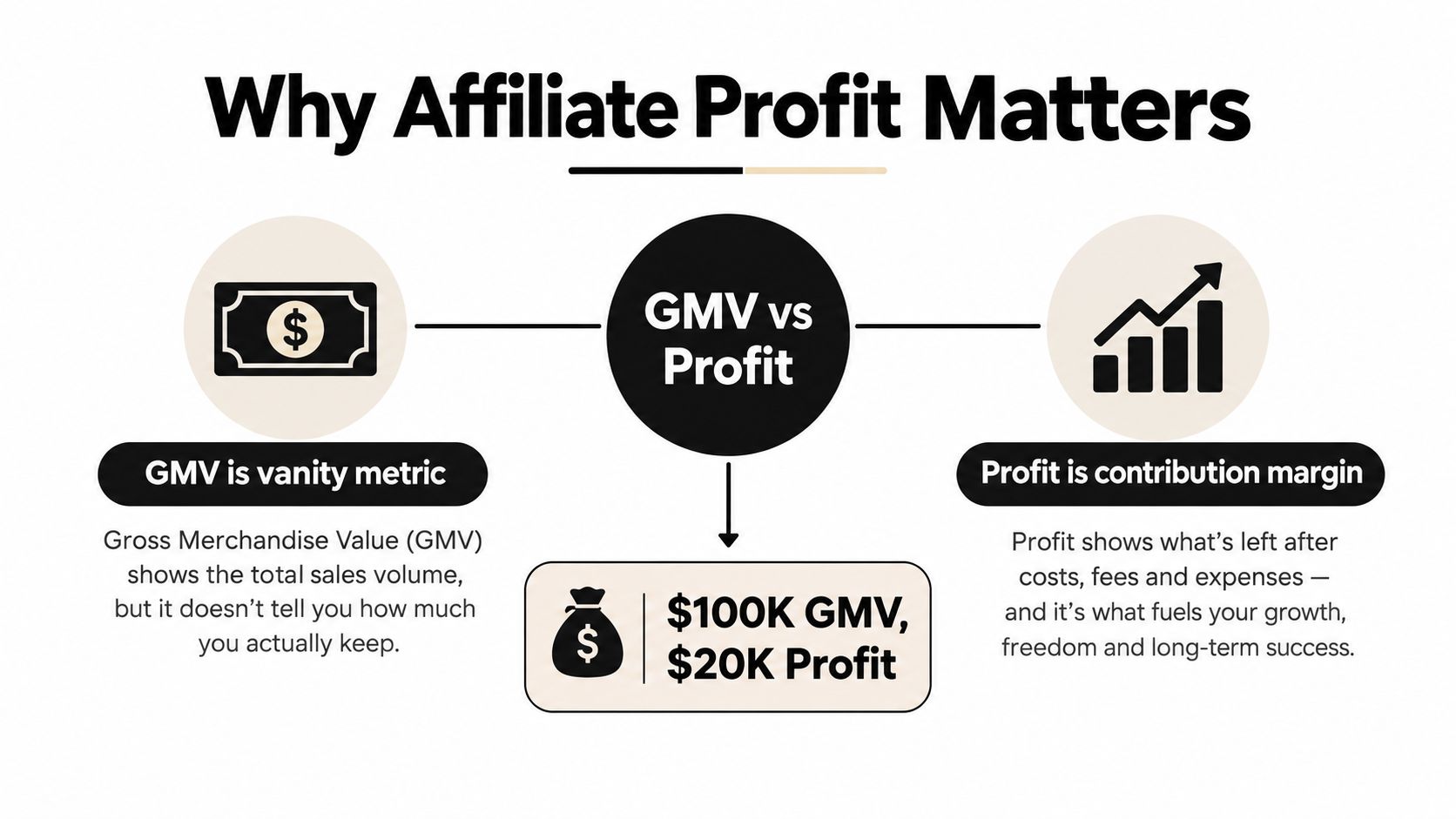
GMV measures transaction value. Profit measures what remains after the transaction has consumed resources. That distinction matters because affiliate-attributed sales can carry a commission expense, cost of goods, fulfillment costs, discounts, refunds, and advertising overlap that Seller Center revenue totals don't fully express as an operating decision.
A $100,000 GMV result can represent $20,000 in profit, or it can represent a much weaker outcome once the complete cost waterfall is applied. The number alone doesn't tell you whether to raise a commission, fund more samples, or keep a product in a campaign. For a broader explanation of why sales volume can mislead TikTok Shop operators, see why GMV is a vanity metric on TikTok Shop.
The profit question operators should ask
The useful question isn't, “Which affiliate generated the most sales?” It is:
Which affiliate generated incremental contribution margin after every variable cost was counted?
That framing changes how you evaluate partners. A creator with lower attributed GMV may produce more profitable new-customer orders, while a high-volume creator may attract heavy discounts, small baskets, or customers who would've purchased through another channel. The dashboard must therefore connect creator activity to product-level economics and customer quality, not just top-line attribution.
HiveHQ's Profit Dashboard is designed as a self-serve reporting environment for TikTok Shop sellers. It brings shop-level and product-level performance into a view that includes real-time net profit, customer analytics, and the cost inputs needed to make an informed affiliate decision. The practical benefit isn't another sales ranking. It's a clearer answer to whether the next dollar of commission is likely to create profit.
How TikTok Shop Affiliate Programs Work
TikTok Shop affiliates connect creators with products through shoppable videos, LIVE streams, and shareable affiliate links. A commission is generated when a viewer places an order through qualifying creator content, rather than only because a seller contacted the creator or sent a sample. TikTok Shop's affiliate overview describes this connection between creator content, attributed orders, and commission payments.
The operating flow is straightforward:
- A seller makes a product available. The seller determines which products can be promoted and under what commercial terms.
- A creator publishes qualifying content. The product can appear in a video, LIVE stream, or shareable affiliate link.
- A viewer purchases through that content. The platform attributes the qualifying order to the creator.
- The seller records the resulting economics. Commission is only one line. Product cost, refunds, fulfillment, discounts, and other deductions determine the actual result.
This differs from a traditional web referral model because the shopping experience and promotional content are tightly connected inside the platform. A creator's video can demonstrate the product, create demand, and provide the purchase path in the same environment. That can make attribution convenient, but convenience doesn't eliminate overlap or cost analysis.
Attribution isn't the same as profit
An attributed order tells you where the platform assigned credit. It doesn't tell you whether the order was incremental, whether the customer was new, or whether the sale displaced another channel. Affiliate revenue should therefore be joined to product margin and customer data before a seller changes commission terms.
Operators who want a wider primer on the structure and terminology can use this affiliate marketing resource, then apply the concepts through TikTok Shop's product-level reporting. The finance decision remains the same: treat affiliate payouts as variable acquisition costs, not as free revenue.
Commission Models and How They Impact Real Margin
Commission structures can look simple in a contract and become complicated in the profit waterfall. A flat rate is easy to administer, a tiered rate can reward volume, and a product-specific rate can protect high-cost SKUs. None of those models is automatically profitable.
| Commission approach | Commercial logic | Main margin risk | Better control |
|---|---|---|---|
| Flat rate | Apply one rate across eligible affiliate sales | High-cost products may carry an excessive payout | Set a ceiling from contribution margin |
| Tiered rate | Increase payout as performance rises | Volume thresholds can reward unprofitable growth | Tie tiers to profitable, verified outcomes |
| Product-specific rate | Vary payout by SKU economics | Complex rules can create reporting errors | Review each SKU after refunds and deductions |
A flat rate works when products have similar economics. It becomes dangerous when the same percentage applies to a high-margin accessory and a low-margin core product. The seller may believe the program is consistent while the portfolio transfers more value to affiliates on the SKU least able to support it.
Tiered commissions can be useful, but the tier should reflect profitable contribution, not just gross order volume. A creator crossing a sales threshold shouldn't automatically receive a higher payout if the additional orders rely on deeper discounts or produce more returns. The trigger can instead be based on verified net contribution, new-customer quality, or repeat-purchase behavior, provided the seller can measure those outcomes consistently.
Product-specific rates offer the strongest unit-economic control. They require more discipline because the seller must maintain accurate product costs, account for promotions, and revisit rates when fulfillment or return patterns change. A commission that was reasonable at launch may become excessive after a price reduction or a change in product mix.
Build a profit waterfall
Start with attributed revenue, then subtract the costs that make the sale possible:
- Product economics: Cost of goods and fulfillment reduce the amount available for acquisition.
- Affiliate payout: Commission is a direct cost of the attributed order.
- Customer concessions: Discounts and refunds can reduce realized revenue after the initial sale.
- Advertising overlap: Paid campaigns may receive credit for the same product demand.
- Customer quality: New and returning customers have different strategic value.
The result is a commission ceiling grounded in contribution margin rather than a rate copied from another seller. This is the core principle behind how affiliate commissions impact your real margins. If the dashboard can't show the full waterfall by product and creator, the commission decision remains an assumption.
Tracking Affiliate Profit with the HiveHQ Profit Dashboard
The Profit Dashboard turns affiliate analysis into an operating routine. Instead of stopping at attributed GMV, a seller can review GMV, COGS, ad spend, commissions, and net profit at shop and product level. That structure matters because a creator can look efficient at shop level while driving an unprofitable mix of products.
Use the dashboard as a decision system
A practical review starts with the product, not the creator leaderboard. For each promoted SKU, ask:
- What revenue did the affiliate-attributed orders produce?
- What was the product cost attached to those orders?
- How much commission was paid?
- Did ad spend contribute to the same sales?
- What did refunds and other deductions leave as net profit?
- Did the orders come from new or returning customers?
That last distinction prevents a common mistake. A returning customer may be valuable, but the economics of acquiring an existing buyer differ from the economics of creating a new customer relationship. Customer analytics help sellers separate those outcomes rather than treating every attributed order as equally valuable.
The dashboard also helps operators avoid a misleading reading of GMV Max. TikTok states that Product GMV Max attributes all orders resulting from products included in a campaign to Product GMV Max, including organic-content and affiliate orders. It uses a one-day attribution window for same-day orders and counts GMV only for selected products. TikTok's Product GMV Max guidance explains why sellers should distinguish campaign-attributed GMV from underlying net profit.
Move from reporting to capital allocation
A finance-led workflow can use HiveHQ to rank products and creators by contribution rather than by sales alone:
- Identify profitable SKUs. Protect products that retain margin after commissions and deductions.
- Segment customer outcomes. Separate new customers from returning customers.
- Inspect overlap. Compare affiliate results with paid and organic activity before increasing payouts.
- Set action rules. Pause, renegotiate, or expand based on net profit and customer quality.
- Review exceptions. Investigate high-GMV, low-profit combinations before they scale.
The TikTok Shop Profit Dashboard is most useful when sellers review it continuously, not only at month-end. Real-time visibility lets operators intervene while a product, promotion, or creator is still consuming budget.
Compliance, Eligibility, and Platform Rules That Affect Affiliates
Compliance affects profit before it affects GMV. A creator who cannot stay eligible, or a product that slips on quality controls, can still produce headline sales for a short period while weakening contribution margin through refunds, complaints, and interrupted distribution.
In the United States, TikTok Shop affiliate creators must be at least 18 years old, based in the United States, pass TikTok's creator identity verification, comply with TikTok Shop and Community Guidelines, have no prior record of revoked e-commerce permissions, and have at least 1,000 followers. TikTok's creator eligibility guidance sets out those conditions. For the broader baseline on shop access and onboarding, see TikTok Shop seller requirements before you add creators to the program.
New affiliate creators with fewer than 5,000 followers enter a 30-day Affiliate Creator Pilot Program. Sellers should account for that status when reading early results. A pilot creator may have limited operating room compared with an established creator, so raw GMV comparisons can distort both performance reviews and payout decisions.
Quality is a financial control
Product eligibility is also a margin issue. TikTok Shop uses product-quality signals, including a Voice of Customer index, and products above specified thresholds may be disqualified. The platform's seller and product quality guidance gives the policy context. For operators, the practical implication is simple. A creator can drive demand while a product becomes less scalable because reviews worsen, complaints rise, claims overreach, or fulfillment slips.
That is why affiliate governance should connect creator output to downstream outcomes, not just attributed orders:
- Content compliance: Claims, disclosures, and product representations.
- Customer feedback: Reviews, complaints, and quality signals.
- Post-purchase outcomes: Refunds, returns, and fulfillment performance.
- Creator status: Eligibility, verification, and pilot-program participation.
This control set protects access to the channel, but it also protects the unit-economic model. If a creator's sales later convert into refunds, support cost, or suppressed product visibility, the gross sales number was never the right decision variable. Profit reporting in HiveHQ is more useful when teams read affiliate performance alongside quality and fulfillment indicators, because that is where apparently strong GMV often breaks down.
Reconcile GMV Max correctly
Beginning in July 2025, GMV Max became the default and only supported campaign type for TikTok Shop Ads. With the Sales objective and TikTok Shop as the destination, TikTok no longer permits creation, editing, or duplication of LIVE Shopping Ads, Product Shopping Ads, or Video Shopping Ads, although existing campaigns may remain active or transition to GMV Max. TikTok also limits GMV Max access to one ad account per TikTok Shop, specifically the shop's primary ad account. TikTok's GMV Max guidelines explain those campaign and account controls.
Finance teams should document ad-account ownership, campaign migration, and attribution boundaries when reconciling spend. Without that discipline, advertising cost and affiliate cost can be posted inconsistently across products or creators, which makes a profitable SKU look weaker than it is and lets an unprofitable one look ready to scale.
How Brands Scale Affiliate Programs to $1M Plus GMV
A seller pursuing $1 million plus GMV doesn't scale by accepting every creator or raising every commission. The operator first establishes whether the product can support the channel, then expands distribution while monitoring contribution margin. That order matters because volume can amplify a weak unit-economic decision.

Consider a seller with several products and a growing group of creators. The first creator produces strong GMV but depends on aggressive discounts. A second creator generates less volume but attracts new customers at healthier margin. A third produces compelling content, yet the resulting orders show high refunds. A sales-only leaderboard promotes the first creator. A profit dashboard changes the decision.
The disciplined scaling loop
The operator reviews each product and partnership through a repeatable loop:
- Select: Prioritize products with enough contribution margin to fund commissions and fulfillment.
- Test: Give creators clear product information and observe attributed sales alongside customer outcomes.
- Diagnose: Separate weak content from weak economics. A product can convert well and still lose money.
- Adjust: Change the commission, product offer, discount, or creator allocation.
- Scale: Increase exposure only after the product and creator combination proves profitable.
Incrementality is particularly important at scale. In a controlled test involving 20.2 million shoppers, affiliate-exposed shoppers converted at a 46% higher rate, had 23% higher average order value, placed 4% more orders, and generated 29% more revenue per customer than the control group. The affiliate incrementality whitepaper shows why exposure can create value, but sellers still need to test their own products and subtract commissions, discounts, samples, fulfillment costs, and returns.
Scaling rule: Don't promote a creator because the creator owns demand. Promote the creator when the creator creates measurable value that survives the profit waterfall.
The same logic applies to a $1 million target. GMV is the visible milestone, but the operating objective is a larger pool of profitable contribution. Scaling from 10 to 100 creators on TikTok Shop is useful only when creator expansion is paired with product-level financial controls.
The sustainable operator also knows when not to scale. A creator with high attributed sales but poor customer quality can consume samples, commission, support capacity, and inventory while weakening the product's long-term economics. Profit reporting makes that tradeoff visible before expansion turns a channel problem into a portfolio problem.
Frequently Asked Questions About Affiliate Profitability
Does high affiliate GMV guarantee healthy profit?
No. GMV excludes the complete cost of the order. Review commissions, COGS, fulfillment, discounts, refunds, advertising overlap, and customer type before deciding whether the partnership is profitable.
How should sellers handle attribution overlap?
Compare exposed and unexposed customer groups where possible, then control for product, geography, customer type, promotion, and traffic source. Last-click credit can overstate an affiliate's incremental contribution when another channel created the demand.
What commission rate is sustainable?
There isn't a universal rate. Set the ceiling from the product's contribution margin after variable costs, then adjust for customer quality, refund behavior, and incremental value.
When should a seller pause an affiliate?
Pause or review a partnership when attributed sales produce weak net profit, rising refunds, poor customer feedback, noncompliant content, or evidence that the creator mainly captures demand that would've converted elsewhere.
What should finance teams monitor?
Track creator-level and product-level GMV, commission expense, COGS, ad spend, refunds, net profit, and new versus returning customers. A self-serve dashboard keeps those decisions closer to real-time operations.
HiveHQ's Profit Dashboard gives TikTok Shop sellers a self-serve view of real-time net profit, product-level performance, and customer analytics, so affiliate decisions can be based on contribution margin rather than attributed GMV alone. Visit HiveHQ to try the dashboard, then talk with the HiveHQ team about building profit reporting around your products, affiliates, and GMV Max activity.