Chatbot for Lead Generation: Boost Outreach with Proven Tactics
chatbot for lead generationlead generationai chatbotecommerce automationtiktok shop
A lead generation chatbot is essentially an automated assistant that chats with your website visitors and social media followers. Its main job? To grab their contact info and figure out if they're a good fit for what you're selling.
Instead of relying on a static "Contact Us" form, a chatbot starts a real-time, interactive conversation. It works 24/7, turning casual visitors into a steady stream of potential customers for your sales team. This kind of automation is a lifesaver when you're dealing with tons of messages and comments every day.
Why Your Business Needs a Lead Generation Chatbot
If your DMs and comment sections are a chaotic mess, you're not just busy—you're sitting on a goldmine of missed opportunities. A chatbot takes that disorganized flood of interest and channels it into a structured, predictable way to grow your business. For fast-moving platforms like TikTok Shop, this isn't just a nice-to-have; it's a core part of your sales infrastructure.
Think of it this way: instead of a person manually digging through hundreds of inquiries, a chatbot acts as your frontline qualifier. It’s always on, ready to greet, engage, and vet every single person who shows interest. That means no potential customer or promising affiliate partner ever gets ignored just because you were asleep or away from your desk.
From Engagement to Predictable Growth
Where this technology really shines is in its ability to automate the lead qualification process. A smartly designed bot can ask specific questions to instantly tell the difference between a casual browser, a serious buyer, or a creator who could be a great affiliate.
The impact is immediate and clear:
- More Time for What Matters: Your team is no longer bogged down by repetitive screening. They can jump straight into high-value conversations with people who are ready to talk business.
- Higher Quality Leads: The bot filters everyone based on your specific criteria, so your sales pipeline is filled with prospects who are actually a good match.
- A Better First Impression: Customers get instant answers to their questions, which boosts satisfaction and makes them less likely to wander off to a competitor.
The numbers back this up. A recent industry report found that 64% of businesses using chatbots saw a major jump in qualified leads. That’s a world away from old-school lead forms, which people often abandon halfway through. If you want to get into the weeds, exploring different chatbots lead generation strategies can offer some great insights.
A chatbot doesn't just collect contacts; it builds a bridge between initial interest and a meaningful sales conversation. It’s about creating a seamless journey that respects the user's time while efficiently gathering the data your business needs to grow.
By putting one of these AI-powered tools to work, you transform random interactions into a reliable, scalable funnel for new leads. For more ideas on using automation to your advantage, take a look at our guide on other powerful AI business solutions.
Here’s a quick look at how a chatbot can directly improve the metrics that matter most on a platform like TikTok Shop.
Chatbot Impact on Key TikTok Shop Metrics
| Metric | Without Chatbot (Typical Challenges) | With Chatbot (Direct Improvements) |
|---|---|---|
| Response Time | Slow, manual replies lead to lost interest and lower platform ratings. | Instantaneous responses keep users engaged and boost seller scores. |
| Conversion Rate | High drop-off as users wait for answers to product questions. | 24/7 guided selling and instant info increases add-to-carts and purchases. |
| Affiliate Onboarding | Manual outreach to creators is slow and hard to scale. | Automated screening and sign-up for potential affiliates via DMs. |
| Customer Support Load | Team gets bogged down with repetitive, basic questions. | Handles up to 80% of common FAQs, freeing up human agents for complex issues. |
Ultimately, a chatbot acts as a force multiplier, improving efficiency and effectiveness across the board. It lets you scale your operations without having to scale your team at the same rate.
Designing Conversations That Actually Convert
A truly effective chatbot doesn't just answer questions; it’s a master conversationalist, skillfully steering visitors toward a goal. The line between a bot that annoys people and one that actually converts them is drawn squarely in the conversation design. Your script is the entire game plan.
For anyone running a TikTok Shop, you're likely juggling two big lead-gen goals: turning curious shoppers into paying customers and recruiting talented creators into your affiliate program. Each of these requires a totally different conversational playbook to get the right information without killing the vibe.
The Art of the Engaging Opener
That first message is everything. A lazy "How can I help you?" is a dead end—it’s forgettable and forces the user to do all the work. Your bot’s opener has to be proactive, relevant to what the user is doing, and show its value instantly. It should feel like an extension of your brand’s personality.
Let’s look at the difference.
- Weak Opener: "Hi, welcome to our store. Let me know if you have questions."
- Strong Opener: "Hey there! 👋 Saw you checking out our new skincare line. Looking for something to tackle dryness or brighten up your skin tone?"
The second one wins, hands down. It’s specific, assumes they're interested, and gives them easy, clickable options. This simple move immediately segments the user and gets the conversation rolling, making it far less likely they'll just close the chat and bounce.
Scripting for Shopper Lead Generation
When a potential customer opens that chat window, your mission is to figure out what they need and point them to the perfect product—fast. The secret is asking qualifying questions that feel less like an interrogation and more like a personal shopping assistant lending a hand.
Here's what a solid shopper conversation flow can look like:
- Acknowledge Intent: Kick things off by mentioning the product or category they're looking at.
- Diagnose the Need: Ask simple, multiple-choice questions to get to the heart of their problem. Think, "What's your main skin concern?" with options like Dryness, Acne, or Dullness.
- Recommend a Solution: Once you have their answer, serve up one or two perfect products with a direct link to your TikTok Shop page.
- Offer an Incentive: If they seem to be on the fence, the bot can jump in with a small, first-time buyer discount in exchange for their email. A classic, but it works.
Your chatbot's script should be a "choose your own adventure" story that always leads to a conversion. Every question should bring the user one step closer to a solution, whether that's the perfect product or a discount code in their inbox.
This approach turns a basic Q&A into a guided selling experience. You capture their contact info, but it feels like a natural part of the process because you're genuinely helping them. The whole interaction feels useful, not salesy.
Crafting a Winning Affiliate Recruitment Script
Trying to recruit creators? That’s a whole different conversation. You're not selling a product anymore; you’re selling an opportunity. The tone needs to be professional but still exciting, and you have to quickly qualify whether they're a good match for your brand's affiliate program.
Your bot needs to pull key details without being pushy. The goal is just to gather enough info to decide if it's worth a human follow-up.
Here are a few must-ask qualifying questions:
- Platform & Niche: "Awesome! What's your primary platform and content niche? (e.g., TikTok, Beauty/Skincare)"
- Audience Size: "Great! What’s your current follower count?" (Using ranges like 10k-50k or 50k-100k makes this super easy to answer).
- Portfolio/Handle: "Perfect. Could you share your handle or a link to your portfolio so our team can check out your amazing content?"
This structured Q&A respects the creator's time while giving your affiliate manager exactly what they need to see. By automating this first pass, you build a steady pipeline of pre-vetted partners, which frees up your team to do what they do best: build real relationships with the creators who are the best fit.
Choosing Your Channels and Integration Strategy
A brilliant chatbot is useless if no one can find it. Figuring out where to put your bot is one of the most important decisions you'll make, as it directly impacts how many leads you can actually pull in. For a TikTok Shop seller, your digital footprint isn't just a website; it’s a whole ecosystem stretching across social media and messaging apps.
Your main website is the obvious starting point. Think of a chatbot here as a digital greeter, ready to engage visitors the second they land on your page. But if you stop there, you're leaving money on the table, especially when so much of your audience lives on social media. Putting a chatbot right inside apps like Facebook Messenger or Instagram DMs lets you meet people where they already are.
Where Should Your Chatbot Live?
The right channel comes down to your specific goal. Are you trying to convert website traffic from your latest TikTok ad campaign? Or are you trying to manage the flood of DMs from potential creator partners? Each goal needs a different strategy.
Let's break down the primary channels:
- Your Main Website: This is your go-to for capturing leads from organic search or paid ads. A bot can pop up to offer a discount, answer a quick question, or point someone to the right product before they bounce.
- Social Media DMs (Messenger/Instagram): Absolutely essential for engaging people who find you directly on social. Your bot can field questions from your stories, handle inquiries about a specific post, and do the initial screening for affiliates who slide into your DMs.
- TikTok Profile & DMs: While direct chatbot integration on TikTok is still limited, you can get creative. Use your bio link to send people to a dedicated chatbot landing page. This is a game-changer for handling a huge volume of affiliate applications after a video goes viral.
The best strategies don't just pick one channel; they build an interconnected system. A potential partner might see your TikTok, chat with your bot on Instagram, and then finalize the details through your website. Your setup needs to make that journey feel seamless.
The Real Magic Is in the Integration
Getting a lead is only the first step. If that contact information just sits in a spreadsheet or a cluttered inbox, you've already lost. The real goal is to build an automated workflow that processes every new lead instantly and without errors.
This is where connecting your chatbot to your Customer Relationship Management (CRM) platform is non-negotiable. Tools like HubSpot or Salesforce make this possible. A solid integration means every piece of info your bot collects—name, email, follower count, niche—gets zapped directly into your CRM. It can create a new contact, tag them ("Potential Affiliate," "Skincare Niche"), and even assign them to someone on your team for follow-up. For bigger operations, more advanced chatbots for enterprise systems take this data flow to a whole other level.
If you’re a TikTok Shop seller focused on recruiting creators, integrating your bot with an affiliate management tool is just as important. Picture this: a creator gives your bot their info, and that integration automatically adds them to your outreach list in a tool like Upfluence or GRIN, logs their social handles, and kicks off an automated email with your program details.
This completely gets rid of manual data entry, cuts down on human error, and shrinks your recruitment cycle from days to minutes.
How to Build Your First Chatbot Without Writing Code
The thought of building a chatbot can feel pretty intimidating, but you can forget about needing a developer. Modern no-code platforms have completely changed the game, letting you design and launch a powerful lead generation bot in just a few hours. These tools are all about visual, drag-and-drop interfaces that feel more like putting together a flowchart than writing a single line of code.
You can get started with a pre-built template—most platforms have them specifically for lead gen—or you can build from scratch. Either way, you're just mapping out the conversation, adding questions, creating quick-reply buttons, and setting up logic to guide users where you want them to go.
Choosing a Template and Customizing Dialogue
Jumping in with a lead capture template is easily the fastest way to get moving. It gives you a great starting point with a welcome message and common questions for name and email already built-in. Your job is to then inject your brand’s personality and tailor the script to your specific goal.
Let's imagine we're building a bot to recruit affiliate creators for a TikTok Shop. A generic "How can I help you?" won't cut it. We need something direct and engaging.
- Initial Greeting: "Hey there! 👋 Interested in joining our creator affiliate program? We're looking for partners to share our latest collection."
- Response Buttons: Give them easy, clickable options like "Tell me more!" or "I'm interested."
This simple opening immediately clarifies the user's intent. If they click, they’ve already identified themselves as a potential affiliate, which lets the bot move on with a much more targeted conversation.
Building a bot without code follows many of the same principles as setting up a good contact form. If you understand how to track leads effectively using any form builder, you’ll find those skills transfer directly to designing your chatbot's data collection and tracking.
Setting Up Qualification Rules and Logic
This is where your chatbot really starts to work for you. You can build rules that automatically filter and segment leads based on how they answer. For our affiliate recruitment bot, we need to find out if a creator is a good match before passing them to the team.
We can program the bot to ask a few key qualifying questions:
- Niche Alignment: "Awesome! What's your primary content niche? (e.g., Beauty, Fashion, Tech)"
- Audience Size: "Great! What's your current follower count on TikTok?" (Offering ranges like 10k-50k, 50k-100k, 100k+ makes it easy).
- Portfolio Request: "Perfect. Could you share your TikTok handle so our team can check out your amazing content?"
This structured approach is incredibly effective. It's no surprise that 55% of companies using chatbots for marketing have seen a real improvement in the quality of their leads. Bots can improve qualification efficiency by up to 40% because they gather all the necessary data right there in the conversation.
At the end of a quick, automated chat, you have more than just a name. You have a profiled, pre-qualified affiliate lead with their niche, audience size, and a link to their work—all captured without anyone on your team lifting a finger.
This diagram shows how smoothly the data can flow, from a user's first click on TikTok, through the chatbot conversation, and straight into your CRM.
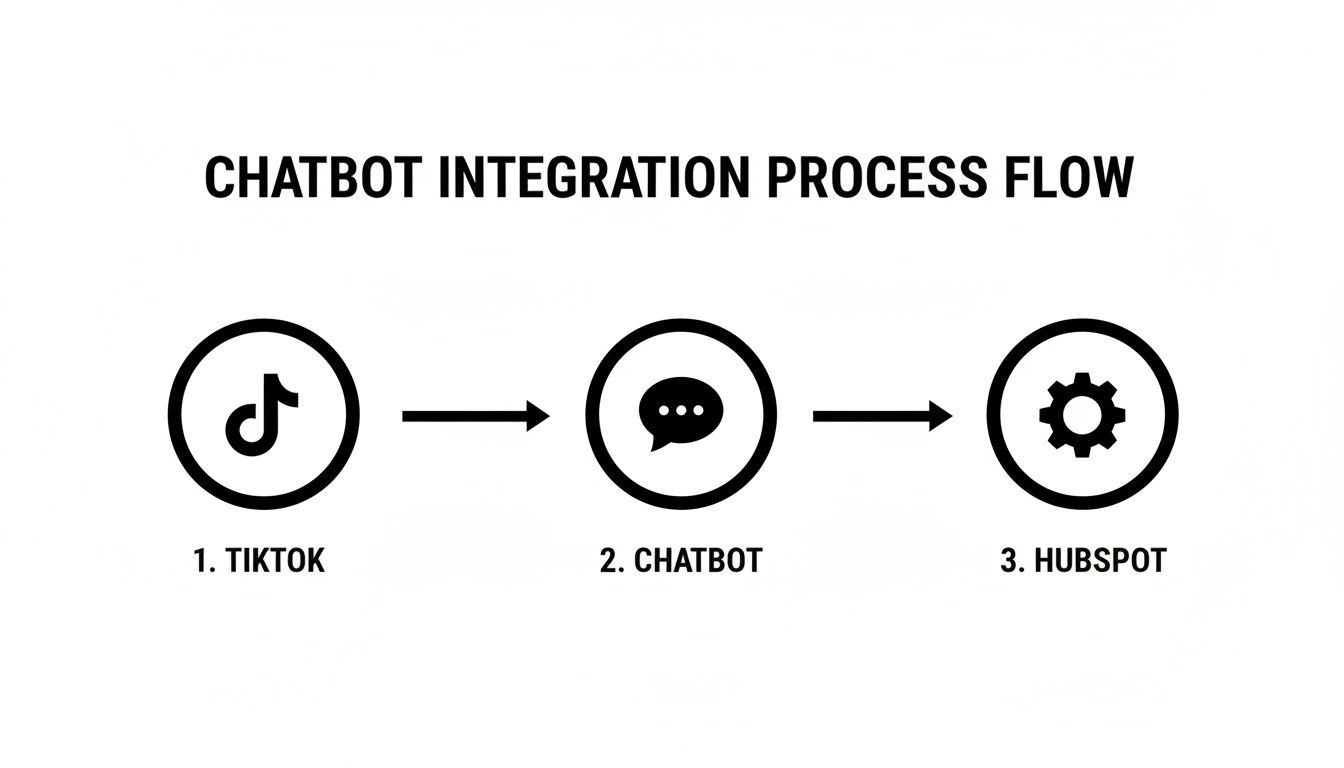
This kind of automated workflow means every qualified lead gets captured and organized instantly. No more manual data entry, just a much faster recruitment cycle.
Measuring Success and Optimizing Performance
Getting your chatbot live is a huge step, but don't pop the champagne just yet. The real work—and the real results—come from what you do after launch. A "set it and forget it" approach just won't cut it. You need to constantly measure, learn, and tweak your bot's performance. Without that, you're just guessing.
The key is to focus on metrics that actually tie back to your bottom line. It's tempting to get caught up in vanity metrics like how many conversations the bot had, but that doesn't tell you much. We need to zero in on the data that shows whether you're generating quality leads that actually become customers.
Key Metrics That Actually Matter
To get a clear picture of how your bot is really doing, you only need to track a handful of core metrics. Forget overwhelming dashboards—focus on the numbers that give you actionable insights.
Here’s what I always keep an eye on:
- Lead Conversion Rate: This is your north star. It's the percentage of people who start a chat and end up giving you their contact info. If this number is low, it’s a big red flag that something in your opening or your script isn't resonating.
- Lead Quality Score: All leads aren’t created equal. A good bot doesn't just get leads; it gets the right leads. By scoring them based on key data—like a creator’s follower count or a customer's company size—you can see if you're attracting your ideal prospects.
- Conversation Drop-off Points: Where are people ghosting you? If you see a mass exodus after you ask for a phone number, you know that question is probably too aggressive or coming too early in the conversation. Pinpointing these friction points is the first step to fixing them.
The goal is to shift your mindset from "How many people used our bot?" to "How many qualified leads did our bot generate?" That simple change is what separates a fun gadget from a serious revenue-driving tool.
Looking at these numbers together tells a story. For instance, a high drop-off rate paired with a low conversion rate often means the conversation feels clunky or the questions are too demanding. These metrics also directly impact your cost per lead. If you want to get into the nitty-gritty of the financials, our guide on cost per acquisition is a great resource.
To help you get started, here's a table breaking down the most important KPIs.
Key Performance Indicators for Your Lead Generation Chatbot
This table breaks down the essential metrics you should be tracking, what they actually mean, and a general benchmark to aim for.
| KPI | What It Measures | Industry Benchmark | Optimization Tip |
|---|---|---|---|
| Lead Conversion Rate | Percentage of chat interactions that result in a captured lead. | 5-10% | Test different opening hooks and the first few questions to grab user attention immediately. |
| Lead Quality Score | A rating (e.g., 1-10) based on lead qualification criteria. | 7+ | Refine your qualifying questions to better filter for high-intent prospects. |
| Conversation Completion Rate | Percentage of users who finish the entire conversation flow. | 60-80% | Shorten the conversation, remove unnecessary questions, and make sure the flow feels natural. |
| Drop-off Rate | Percentage of users who abandon the chat at a specific step. | <20% per step | Analyze the exact point of drop-off. Is the question too personal? Too confusing? Rewrite it. |
| Cost Per Lead (CPL) | The total cost of your chatbot efforts divided by the number of leads. | Varies by industry | Improve your conversion rate. The more efficient your bot, the lower your CPL will be. |
Tracking these numbers will give you a clear, data-backed roadmap for what to improve next.
A Practical Approach to A/B Testing
Once your data points you to a weak spot, A/B testing is your best friend for figuring out how to fix it. The concept is simple: create two versions of a single part of your chat—like an opening line or a button—and see which one performs better with real users.
The trick is to keep it simple. Test one thing at a time. If you change the headline and the CTA button, you’ll never know which change made the difference.
Here are a few high-impact tests you can run right away:
- The Opener: Pit a direct hook like, "Want to join our creator program?" against something more benefit-focused, such as, "Ready to earn by sharing products you love?"
- Question Phrasing: The way you ask for information matters. Does a straightforward "What's your email?" work better than a softer "Where should we send your welcome kit?"
- Call-to-Action Buttons: Test different button copy. Does "Book a Demo" outperform "See a Quick Preview"? Small changes in wording can have a surprisingly big impact.
By methodically testing and iterating, you can turn a decent chatbot into a lead-generating powerhouse. It’s this cycle of continuous optimization that makes all the difference.
Got Questions About Lead Generation Chatbots? Let's Clear Them Up.
Diving into automation always brings up a few questions. I get it. Many brands I've worked with are curious about the real-world side of using a chatbot for lead gen, from what it costs to whether it'll sound like, well, a robot.
Here are the straight-up answers to the most common things people ask.
What's This Going to Cost Me?
You can find everything from free, super-basic tools to enterprise platforms that run several hundred dollars a month. But for a growing e-commerce brand, you're realistically looking at a powerful no-code builder in the $50 to $200 per month range.
Honestly, the price tag isn't the most important number. The real metric is your return on investment. Think about it: if the bot helps you land just one solid affiliate partner or convert a few extra customers each month, it's already paid for itself. That’s before you even factor in the hours your team gets back by not having to manually sift through every single inquiry.
But Won't a Chatbot Feel Robotic and Impersonal?
A chatbot is only as impersonal as you build it. I've seen some truly awful, robotic bots, but I've also seen bots that feel like a genuinely helpful part of the brand's team. The secret is to stop trying to make it sound human.
Be upfront and let users know they’re talking to a bot. Then, give it a personality that matches your brand—make it friendly, helpful, maybe a little quirky.
The goal isn’t to fool anyone into thinking they’re chatting with a person. It’s about delivering fast, accurate answers to the easy questions and knowing exactly when to pass the conversation to a human for the tricky stuff.
This hybrid model is the sweet spot. You get the efficiency of 24/7 automated support plus the human touch right when it's needed most.
How Is This Different from My Outreach Tools?
This is a great question, and the difference is crucial. A lead generation chatbot is an inbound player. It’s your on-site greeter, engaging people who have already found their way to your website or social media profile and decided to start a conversation.
Outreach automation, on the other hand, is pure outbound. It's proactively sending messages to thousands of potential affiliates or creators who might have never even heard of your brand.
They aren't competitors; they're teammates. You can use an outreach tool to get your brand in front of new creators. When those creators click through to your site to check you out, your chatbot is waiting to greet them, answer their first questions, and get them signed up for your program. It's a perfect one-two punch.
Ready to turn your TikTok Shop into an affiliate-recruiting machine and finally get a clear picture of your profits? HiveHQ brings together a smart Affiliate Bot and a real-time Profit Dashboard so you can scale smarter. Find and sign up top creators on autopilot, and get the data you actually need to grow.