8 Cost Reduction Techniques for TikTok Shop Sellers
cost reduction techniquesTikTok Shop profitreduce COGSad spend optimizationTikTok Shop fees
The most effective cost reduction techniques for TikTok Shop sellers tie every fee, unit cost, return, and ad dollar to net profit per SKU and per order. SKU profitability pruning is the best place to start, because cutting spend without that link often removes the wrong costs, such as the ad budget behind a profitable bestseller, while the margin leaks stay in place.
This roundup covers eight techniques across sourcing, fulfillment, creator and ad spend, pricing, and fee auditing. Each one names the cost it targets, a worked example, the trade-off you accept, and how to read the change yourself. Because TikTok Shop deducts referral fees and commissions before a payout arrives, true profit has to include those operational expenses. Real-time profit tracking on the HiveHQ Profit Dashboard calculates sales revenue, cost of goods sold, fees, and net profit as orders come in, so you measure a change instead of guessing.
High GMV can hide an unprofitable creator, product, or campaign. I recommend you set a minimum net margin before you touch a single rate or budget. Then hold every technique below to that rule.
Table of Contents
- 1. SKU Profitability Pruning
- 2. Return Rate Reduction
- 3. Fulfillment and Shipping Cost Optimization
- 4. Sample Cost Control
- 5. Margin-Based Ad Spend Management with GMV Max
- 6. Commission Rate Calibration
- 7. Inventory and COGS Optimization
- 8. Settlement Reconciliation and Fee Auditing
- How each cost reduction technique targets profit, and what it costs to run
- Frequently Asked Questions
- Turn These Techniques Into a Monthly Profit Routine
1. SKU Profitability Pruning
Cost targeted: the net loss left after fees, COGS, shipping, returns, and ad spend on one SKU.
Pause, reprice, bundle, or discontinue any product whose net profit stays under a threshold you chose before you opened the report. This is the fastest move on the list because it keeps cash and ad budget off items that cannot cover their own costs. A self-serve profit view that shows SKU-level net profit in real time makes that review practical at any order volume. The step-by-step sits in how to find unprofitable products on TikTok Shop.
Say a cosmetics seller finds three low-priced variants losing money after fees and returns. Pausing them and shifting budget to the top-margin bestseller raises profit per order without a new supplier quote. A home goods brand can keep a near-break-even item by bundling it with a high-margin product, so the weak SKU stays listed while the order clears a better margin.
How to run the cut
- Set the rule first: Choose a minimum net margin before you sort products, so a favorite SKU cannot talk you out of the pause.
- Load every variable cost: Include returns and shipping, not only the sticker price.
- Hold the window: Review on a fixed cycle and track each change for at least 30 days.
Practical rule: If a SKU cannot clear its own fees, samples, and ads, it does not deserve more spend.
Trade-off: You may lose some GMV and a few videos built around the cheap variant. You gain ad room for products that contribute.
2. Return Rate Reduction
Cost targeted: lost revenue, return freight, restocking labor, and write-offs on orders that come back.
Returns hit net profit twice. You refund the sale, and you still pay to move the unit. Buyers on TikTok Shop often purchase after a short video, so a gap between what the video shows and what arrives is a common reason the order comes back. Accurate listings, clear sizing, and tighter quality checks shrink that gap without touching your ad budget.
An illustrative apparel seller adds a measurement table to every listing and states what is in the box in the caption. Within a quarter, size-related returns fall, and the same ad spend produces more kept orders. That is profit you do not have to renegotiate with a factory.
- Code every return: Assign a reason so you can see size, quality, and "not as shown" as separate problems.
- Split the rate: Compare return rate by SKU and by the video or campaign that drove the sale.
- Match the creative: Put exact dimensions and included pieces in captions and video descriptions, not only on the product page.
What does not work is a blanket restocking fee that buyers never see until checkout. It can cut casual returns and also cut conversion on the products that were already profitable. Fix the listing first, then decide whether a fee is still needed.
Trade-off: Better content and QC take time, and you may ship fewer impulse orders. Kept orders are worth more than a higher gross order count.
3. Fulfillment and Shipping Cost Optimization
Cost targeted: carrier rate, dimensional weight, packaging, and the cost of putting stock in the wrong place.
Shipping is often one of the largest variable costs on a TikTok Shop order. A loose mailer on a bulky item can cost more than the product margin. Compare the true cost of each delivered order, not the rate card alone, against volume and where buyers live.
A recent fulfillment industry report found that 60% of retail leaders were prioritizing inventory accuracy, while 82% considered warehouse automation essential, yet only 71% had a finalized automation plan, according to Cart.com's 2025 fulfillment industry report. Automation without accurate stock data does not lower cost per order. It speeds up the wrong pick.
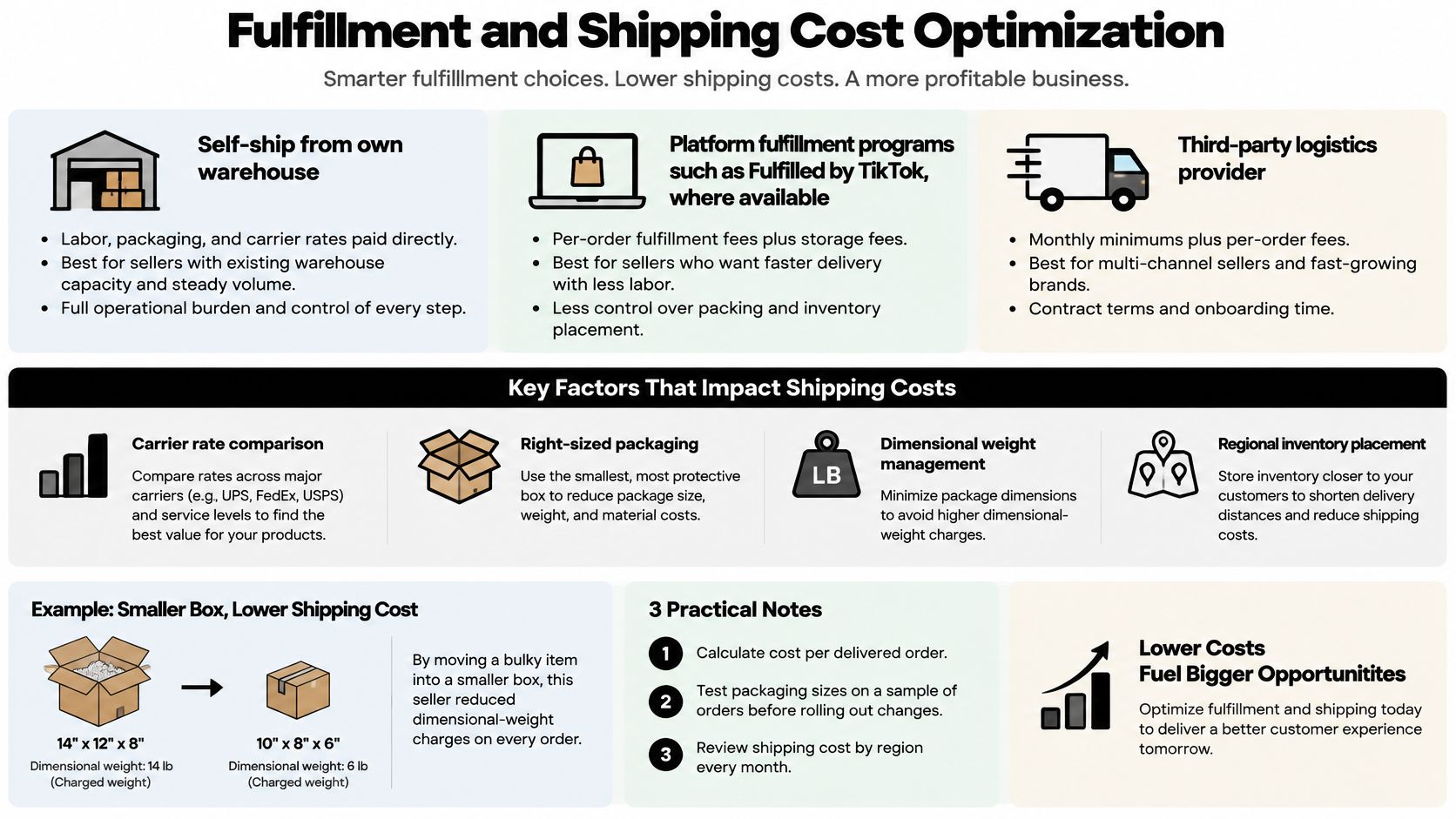
A packaging test before a network change
Say you move one bulky SKU into a smaller box and dimensional weight drops on every shipment. Test that carton on a sample of orders before you reprint every insert. Then review shipping cost by region each month. A deeper walk-through is in understanding TikTok shipping and fulfillment costs. When parcel rates are the lever, it also helps to find cheaper delivery for business parcels and compare them on delivered cost, not the headline.
Trade-off: Cheaper transit can mean slower delivery and more "where is my order" messages. If late orders raise refunds, the carrier saving is not a profit saving.
4. Sample Cost Control
Cost targeted: COGS, outbound shipping, and handling on units you give away.
Samples are real inventory. Without a budget and a sales link, they become one of the largest untracked costs in the shop. Every unit you ship should carry a fully loaded cost and a product line it belongs to. If a line shows no attributable sales after two cycles, stop sampling it.
Cap sample units by product line, not by how many creators ask this week.
An illustrative brand sets a monthly unit cap per line and drops SKUs that produce no attributable GMV after two review cycles. The samples that remain go to products that already convert, so the next shipment has a chance to pay itself back. Managing samples at scale without losing money covers how to keep that log when volume grows.
- Price the gift: Assign COGS plus shipping and handling to every sample, then subtract it from the line's profit.
- Set a target: Give each product line a sample-to-sales ratio you will accept.
- Reset the budget: Review sample return on a fixed interval and move units toward lines that clear the ratio.
Trade-off: Fewer samples can mean fewer new videos in the short run. Unlimited samples feel like growth and often show up later as a hole in contribution margin.
5. Margin-Based Ad Spend Management with GMV Max
Cost targeted: ad dollars that buy orders the product cannot afford.
GMV Max is TikTok's current paid format for Shop campaigns. Ad spend is a direct cost against margin, so a campaign that lifts gross merchandise value can still destroy net profit. Set the return target for each product from its margin after fees, COGS, and a normal return rate. Then judge the campaign on net profit, not on GMV alone.
Say you split high-margin and low-margin products into separate campaigns. The high-margin group can accept a lower return multiple because each order keeps more cash. The thin-margin group needs a stricter target, or it should sit out of paid until the price or the cost changes. A useful outside frame for how brands structure that spend is the 2026 TikTok marketing playbook for brands.
What to set before you scale
Calculate break-even return on ad spend for each product after all fees. Group products into campaigns by margin tier. Do not use one target for the whole catalog. A single target overspends on cheap variants and underspends on the bestseller that could have taken the budget.
Trade-off: You will turn down some scale. A looser target buys more orders and a worse profit per order. I would rather cap the thin-margin campaign than "fix" it by raising the commission later.
6. Commission Rate Calibration
Cost targeted: creator and partner payouts that exceed what the SKU can afford.
A flat commission across the catalog overpays on products that could have funded a lower rate and strips profit from thin-margin items. Affiliate commissions are commonly 10–20% of order value, and platform referral fees in major markets can add another 5–9%, while TikTok calculates affiliate commission after seller discounts, so a deeper discount shrinks the commission base and the revenue at the same time, as laid out by Influencer Marketing Hub. The question is which discount-and-commission pair still leaves a profitable order after every variable cost.
An illustrative brand sets a lower commission on a thin-margin product and a higher one on a bestseller whose profit can absorb it. Partners stay motivated where the order is worth promoting. You are not asking them to push a SKU that loses money at the old rate. Rate structure details are in affiliate commission rates.
- Ceiling from net, not gross: Build the max rate from margin after fees, shipping, and returns.
- Write the tiers down: Put them in partner terms so a custom deal does not break the rule.
- Check the month: Compare total commission cost with profit by product, not only the headline rate.
Trade-off: Cutting the headline rate can lower cost and also lower creator participation and sales velocity. Reallocating payout toward creators and SKUs with high incremental profit usually beats a blanket cut.
7. Inventory and COGS Optimization
Cost targeted: cash trapped in overstock, wasted ads on stockouts, and a unit cost that ignores freight and duties.
Overstock ties up cash and invites markdowns. A stockout wastes the ads you already paid for and can hurt ranking on a product that was working. Landed COGS, not the factory invoice, is the number that belongs in your margin rule.
Historical lean implementations show why flow beats a one-off price cut. A 1999 account of lean manufacturing records that NCR's Dundee operation cut inventory from 47 days to 5 days and flow time from 15 days to 2 days after just-in-time methods. You will not copy a factory result in a TikTok warehouse. You can copy the habit of buying to real velocity and refusing stock that only looks cheap on the quote.

Say you pause ads on a SKU with less than two weeks of cover so spend is not buying orders you cannot ship. At the next reorder, renegotiate unit cost and include freight and duties in the landed figure before you reset price. For categories where the invoice hides the rest of the cost, smarter sourcing for better jewelry margins is a clean reminder that total cost of ownership is the margin input.
Trade-off: Leaner stock raises the chance of a miss on a viral spike. A small buffer on proven bestsellers is cheaper than a deep buy on unproven variants.
8. Settlement Reconciliation and Fee Auditing
Cost targeted: overcharges, unexplained deductions, and fee categories that drift as a share of GMV.
Match each payout to order-level sales, fees, adjustments, and refunds. Small leaks are hard to see in a weekly deposit and expensive across thousands of orders. A finance rhythm that catches them also feeds true cost back into pricing.
Companies that invested at least 20% of their IT budget in automation achieved an average 22% cost savings in 2023, compared with just under 8% for companies investing less than 5%, in Bain & Company's 2024 survey of 893 automation executives. You do not need that share of spend to reconcile a shop. You do need the payout check to be automatic enough that it happens every week. TikTok Shop financial reporting is the place to see how order-level fees should tie back to the deposit.
An illustrative finance owner finds recurring deductions on canceled orders and files a review with the order records attached. The recovery is useful. The larger win is stopping the same deduction from sitting in the next ten payouts.
- Reconcile weekly: Do not wait for month-end, when the trail is colder.
- Track mix, not only dollars: Watch each fee category as a percentage of GMV.
- Keep the file: Store order records so a dispute has something to stand on.
Trade-off: Weekly reconciliation takes a block of time. Skipping it feels faster until a fee change has already repriced your catalog the wrong way.
How each cost reduction technique targets profit, and what it costs to run
| Item | Primary Cost Targeted | Main Lever | Main Trade-off | Best Starting Point |
|---|---|---|---|---|
| SKU Profitability Pruning | Unprofitable product costs and ad spend | Reprice, bundle, pause, or discontinue low-profit SKUs | May remove products that drive traffic or bundle sales | Set minimum net margin thresholds using complete SKU cost data |
| Return Rate Reduction | Return shipping, restocking, and write-offs | Improve listing accuracy, product details, and quality control | Requires coordination and time to diagnose causes | Track return reasons by SKU and review listing details |
| Fulfillment and Shipping Cost Optimization | Shipping and fulfillment costs per delivered order | Compare carriers, right-size packaging, and optimize inventory placement | Changes may require setup, minimum volumes, or more inventory | Calculate total cost per delivered order |
| Sample Cost Control | Sample product, shipping, and handling costs | Set budgets and track sample-to-sales performance | Tracking takes effort and strict limits may slow content momentum | Assign a fully loaded cost to each sample |
| Margin-Based Ad Spend Management with GMV Max | Unprofitable customer acquisition spend | Set product-level break-even ROAS and margin-based budgets | Learning periods may raise costs, while cuts can reduce reach | Calculate break-even ROAS for each product |
| Commission Rate Calibration | Creator and partner commission payouts | Set commission tiers and ceilings based on net margin | Lower or complex rates may reduce partner interest | Set commission ceilings using product-level net margin |
| Inventory and COGS Optimization | Inventory carrying costs and product purchase costs | Align reorders with sales velocity and negotiate supplier costs | Forecasting errors or bulk buys can cause stock issues or tie up cash | Track landed COGS and days of inventory by SKU |
| Settlement Reconciliation and Fee Auditing | Unexplained fees, deductions, and payout errors | Match payouts to orders, fees, refunds, and adjustments | Manual reviews take time and disputes may be slow | Reconcile payouts weekly and log discrepancies |
Frequently Asked Questions
Which cost reduction technique should I do first?
Start with SKU profitability pruning, then settlement reconciliation. Both expose leaks without a new ad test or a supplier change. Set the minimum net margin before you sort the catalog.
Will a lower commission rate always save money?
No. A lower rate reduces payout and can also reduce the videos and orders that rate was buying. Calibrate by product margin and by whether that creator's orders stay profitable after fees, returns, and ads.
How long should I wait before judging a cut?
Track the change for at least 30 days. A one-week GMV dip after you pause a losing variant is not proof the cut failed. Compare net profit per order and per SKU, not revenue alone.
Do I need a managed service just to see profit?
No. If you only need profit tracking and analytics, start with software you run yourself. Our Free plan costs $0 per month and covers up to 250 orders per month. You can move to a higher plan as order volume grows, and if you pass a plan's monthly limit the subscription moves to the next tier.
What should I ignore in a payout?
Do not ignore adjustments on cancels, refunds, and referral fees. Profit tracking has to include operational expenses such as TikTok referral fees and commissions, or the margin you think you have is the margin before the platform takes its share.
Turn These Techniques Into a Monthly Profit Routine
Start this month with SKU profitability pruning and fee reconciliation. They expose the largest leaks without a new media test or a factory visit. Set a minimum net margin, review it on a fixed cycle, and track every change for at least 30 days before you judge it. If the paused SKUs were feeding most of your GMV, you will feel the volume drop. Look at profit per remaining order before you turn them back on.
Then stack one cost at a time. Returns, packaging, samples, GMV Max targets, commission tiers, and landed COGS each move a different line. Changing all of them in the same week makes it impossible to see which decision helped. Product-level reports that show top SKUs and profitability by product keep that sequence honest. Shop-level profit analytics, pulled from your TikTok Shop, show whether the catalog as a whole improved.
Our Profit Dashboard is self-serve software for sellers who want to run the numbers themselves. The Free plan is $0 per month for up to 250 orders. The Starter plan is $39 per month for up to 1,500 orders. The Pro plan is $199 per month with unlimited orders. You can scale to a different plan as the shop grows. Managed Services is a separate, GMV-based engagement with pricing based on scope and goals, and it is not the right fit if you only need profit tracking. Our free TikTok Shop Fee Calculator is there if you want a quick fee check before you reprice.
Try the HiveHQ Profit Dashboard to see real-time net profit, product-level performance, and customer analytics, and talk to the HiveHQ team about which plan fits your order volume and growth stage. Bring one unprofitable SKU and one payout you do not fully understand. That is enough to see whether the next cut should be a product, a fee, or an ad target.
The HiveHQ Profit Dashboard shows real-time net profit, product-level performance, and the fees, ads, commissions, and refunds that sit under each order, so the cost reduction techniques above are measurable instead of theoretical. If you run your own TikTok Shop, start with the plan that matches your order volume and read profit per SKU before you cut another rate. Visit HiveHQ and talk with our team about the dashboard that fits the shop you already operate.